
The red palm weevil, Rhynchophorus ferrugineus day one is a guest, second a burden, and third a pest, regarded as the most devastating, and notorious species of Phoenix dactylifera. This research study was conducted under (25±5oC) and (30±5oC) controlled temperatures in the laboratory during 2023, to examine the biological parameters of RPW. At fixed temperature conditions, the maximum eggs laid by female (185.45±17.74), fertility (138.60±13.87), egg incubation period (5.70±1.39), 1st to 5th larvae stages (11.78±1.60), (16.58±2.81), (18.20±2.73), (21.48±2.81), (22.54±3.32), pupae (21.56±4.70), male and female sex ratio (1:4♂, 1:8♀), adult male (34.25±5.50), female (41.27±5.40) longevity was recorded on (25±5oC). Whereas, the RPW laid maximum mean eggs at (157.33±12.72), fertility (103.56±9.68), egg incubation (9.40±1.97), 1st stage larvae (15.84±2.71), 2nd (18.80±2.91), 3rd (21.00±3.20), 4th (25.00±4.90), 5th (26.00±4.64), pupae (27.28±5.42), sex ratio, (1:2♂, 1:4♀), longevity (43.70±5.92) in male and (49.38±6.38) female adults, were recorded at (30±5oC), respectively. All developmental stages of the insect pest were replicated three times for authenticity. The significant difference was recorded at (P< 0.05). Therefore, to understand the biological fitness parameters, two distinctive temperatures were assessed to manage the biology of this noxious pest. The future advanced holistic IPM approaches and sustainable practices will be vital to mitigating the risk of this vigorous pest.
Research Article · Volume 38, Issue 1, 27 April 2025 · Open Access
Biological Stages of Red Palm Weevil, Rhynchophorus ferrugineus (Oliver) Under Two Distinctive Controlled Temperatures
·
Affiliations & Notes ⌄
- 1Department of Zoology, Shah Abdul Latif University Khairpur, Sindh, Pakistan. *Correspondence | Wali Muhammad Mangrio, Department of Zoology, Shah Abdul Latif University Khairpur, Sindh, Pakistan
- 2Email: wali.mangrio@salu.edu.pk
Article Info ⌄
- Journal:
- Pakistan Journal of Agricultural Research
- Published:
- 27 April 2025
From the article
- The purpose of this research study was to explore the different biological stages of the pest species under two distinctive temperatures at (25±5oC) and (30±5oC) in laboratory conditions.
- Concludingly, from egg to adult, all life associated stages were found with significant development in both consecutive temperature conditions at (30±5oC) as compared (25±5oC).
- In conclusion, it was revealed that the maximum eggs laid by females at (25±5oC) followed by (30±5oC).
- The pupae period and maximum adult longevity lasted at (30±5oC) as compared (25±5oC), respectively.
Selected from the article's own text.
Abstract
Introduction
Date palms, Phoenix dactylifera is an ancient as long as human civilization, originated from Mesopotamia . The fruit of these ever green trees are most significant eatable, economic and extremely supporting for several people who are living in hot and desert areas . Nutritionally, the date palm fruit is the main source of food, and commerce in desert life. The dry, semi-dry and seeds of the date fruit are used as pulping, juices, sweets, food mousses, flavoring ingredients in ice cream, dairy products, and organic fertilizers (Al-Karmadi and Okoh, 2024).
In addition to consumption, date products are utilized as desserts, chocolates, mixed greens, breakfast grains, sauces, an assortment of dishes, sponsorship, and candy store items . The fruit of date palm contains several health benefits, such as anti-inflammatory, anti-oxidant, anti-microbial, anti-mutagenic anti-cancer, hepato-protective, immune-stimulatory properties, hypo-cholesterolemia, anti-oxidant, anti-cancer, regulate glucose, and bone stimulating activities . Date fruit is the rich source of carotenoids, triterpenoids, flavonoids, vitamins, sterols, minerals, phenolic compounds, proteins, and dietary fibers (Alfaris et al., 2022). Muslims have adopted the Islamic date fruit consumption during Holy month of Ramzan fasting to fulfill their spiritual need with positive health effects . From a commercial point of view, the demand and popularity of date fruits are gradually increasing, but the fruit quality depends on processing methods, handling and storage . Aseel, Kupro, Fasli, Karbalian, and Dedhi varieties are grown in discussed study areas are nutrient rich, support body metabolism, human health and disease control . The study area is the richest zone contributing 42% of date fruit country production due to its favorable climatic conditions, highly commercial varieties of this region delivers the financial source to countless families . Unfortunately, due to lack of awareness, most of the novel date palm varieties tremendously infested by the larvae of pest species from the beginning up to the harvest . The R. ferrugineus is a tissue driller polyphagous bug, globally a significant pest in diverse agro-ecosystem, increases their progeny inside the host plant body, rises where diets are rich with nutrients, and finally cause death of palm plantation . This insect pest species damages all growing stages of date palms ideally by creating silt like appearance in the trunk, and their damage is irreparable leading to extreme economic losses to the date palm industry and environmental degradation .
This species is the utmost destructive insect assault invasion directly associated with date palm thickness, infestation can be gentle to extreme and hard, if not treated, then invaded palms might be drop and dead . RPW prefers wet spots of the plant for survival, oviposition but fertility of the RPW mainly relies upon the conditions of the plant, also the egg laying process may proceed till the fatality and the host plant nature is considered to have a great influence on the life span of RPW . The larval stages of RPW and other insect pest species are voracious to feed the internal tissues by boring the lenient internal date material, later it moves upward of the plant, causing tissue spoiling, and prompts to the casualty of tree . Addressing the key importance of date fruits and keeping the view of damaging the most notorious species such as, RPW. Therefore, such type of research work was designed and performed to study the biological traits of RPW.
Materials and Methods
Egg collection of RPW
In this research study the population of the creamy-white, shiny-oblong eggs were collected from the infested trunk of date palm orchards at Prof. Abdul Khalique Jatoi farm, Taluka Kingri during, 2023. The eggs were together by camel hair brush and kept in petri dishes. The red aero in (Figure 1) shows the pest collection point is situated at 27.6507° N, and 68.5724° E. While as, 1 representing talukas, Khairpur, 2 Kingri, 3 Gambat, 4 Sobho Dero, 5 Thari Mirwah, 6 Faiz Ganj, 7 Naro 8 Kot Diji, in district Khairpur Mirs map, respectively.
Egg population culture of RPW
The collected egg populations were brought carefully to the Department of Zoology in Entomology Laboratory for culture maintenance. A total of (n=20) petri plates were arranged of which (n=10) petri plates were kept in 1st temperature settled room and (n=10) in another room. In each petri dish (n=15) eggs were kept for hatching. The temperature of both laboratory rooms were settled at (25±5oC) and (30±5oC) (65 to 75) relative humidity individually.
Rearing of different larvae stages of RPW
To facilitate the newly emerged larvae were shifted and (n=10) 1st stage larvae were placed into 1kg capacity containing plastic jars individually. For larvae survival and development, soft bark trunk tissues of date palms, sugarcane, and 10% honey solution adhered on stick, and glucose absorbed on cotton swabs were given as a diet source. The larvae observation was made every day in early morning 9:15 to 11:30 AM, by providing fresh soft trunk pieces of date palms. During the molting of larvae stages, attention was also given to their developmental time consumption.
Emergence of pupae from larvae of RPW
The 5th stage larva converts into pupae, which develop in a cocoon. At this stage again pupae were shifted into 1.5kg capacity plastic jars by providing pieces of palm trunk to facilitate cocoon formation. Attention was given to time consumption.
Emergence of adult male and female RPW
Again cocoons containing inside pupae were shifted into half kg plastic jars, after completion of pupae time, adults emerged from the cocoon. Thereafter, new adults of both paired sexes were kept in 2.5kg jars individually for mating. The focus was kept on sex ratio and adult longevity. Each stage data was replicated three times at both controlled laboratory temperatures. Attention was given to egg population, incubation, fecundity, fertility, larvae molting, pupae period, sex ratio and adult longevity.
Statistical analysis
The results and mean ± standard deviations of all stages of the pest species was analyzed at both temperature conditions. The comparison was conducted using one-way ANOVA at 95% confidence level and help was taken from 8.1. Student Package USA Statistics Software. The figures were made through Origin 2017, 64-Bit software source.
Results and Discussions
The purpose of this research study was to explore the different biological stages of the pest species under two distinctive temperatures at (25±5oC) and (30±5oC) in laboratory conditions. The insect pest population was reared under laboratory conditions for the determination of all developmental stages of the pest species.
The egg population of the RPW
The findings of the present study revealed, that the adult female laid maximum eggs (185.45±17.74) at (25±5oC) and minimum (157.33±12.72) at (30±5oC). The maximum egg fertility (138.60±13.87) was recorded (25±5oC) and minimum (103.56±9.68) at (30±5oC). While as, the egg incubation period lasts (9.40±1.97) at (30±5oC) and (5.70±1.39) mean days at (25±5oC). The difference in egg fecundity, fertility, egg incubation was statistically analysed, and ANOVA found (DF= 2; F= 26.16; P= 0.02) significant difference among all pairwise comparisons at (P < 0.05) as justified in (Figure 2).
Larvae developmental stages and time consumption of RPW
The RPW larvae development revealed that 1st instar larvae consumed (15.84±2.71), 2nd stage (18.80±2.91), 3rd stage (21.00±3.20), 4th stage (25.00±4.90), and 5th stage (26.00±4.64) mean development days on (30±5oC). Whereas, 1st instar larvae lasts (11.78± 1.60), 2nd stage (16.58±2.81), 3rd stage (18.20±2.73), 4th stage (21.48±2.81), and 5th stage (22.54±3.32), on (25±5oC) mean days, respectively. The red palm weevil larvae stages statistically found (DF= 4; F= 35.87; P= 0.03) significant difference among consumption of days under both temperatures, recorded at (P< 0.05), which is further justified in (Figure 3).
The pupae, sex ratio and adult longevity of RPW
The biological parameter pupae stages of red palm weevil on two distinct temperatures under laboratory conditions lasts (27.28±5.42) on (30±5oC) and (21.56±4.70), (25±5oC), mean days. The red palm weevils sex ratio was recorded (1:2♂, 1:4♀) on (30±5oC) and (1:4♂, 1:8♀) on (25±5oC). The adult longevity was recorded in females at (49.38±6.38) followed by males (43.70±5.92) on (30±5oC), and adult female lasts (41.27±5.40) maximum mean days compared to male (34.25±5.50), on the (25±5oC). The ANOVA found at (P < 0.05) with significant difference, among pupae days consumption, sex ratio, and male-female adult longevity at two distinct temperatures, further justification is given in (Figure 4).
The P. dactylifera is the main cash crop of upper Sindh but massively attacked by a potential species of the tissue boring insect called red palm weevil, locally Asian weevil, causing serious damage to the trunk of the date palm trees . Khairpur of Sindh is regarded as the central hub, and richest fruitful zone for a variety of most commercial, and prominent date palm cultivars, playing a fundamental role in the economics of the country . This study shows that adult females laid maximum number of eggs with fertility at (25±5oC) but maximum egg incubation at (30±5 oC). This is similar to the results of , who assessed the biology of STB on semi-dry and dry fruit of Aseel and Dedhi date palm cultivars, calculated 60.63 egg mean population, 4.09 incubation, with 82.08% of hatching. 1st to 4th larvae duration 2 to 7 days, a pupa 12-12.05 days, 11 to 16 days consumed by adult male, and female. documented that, the female starts to lay eggs in openings or wounds at the crown, and cause huge economic losses.
All larvae stages taken maximum mean days consumption at (30±5oC). This is correlates with the work of , the larvae stages consume 24 to 210 days but gradually influenced by temperature and diet. After egg hatching, emerged larvae start to feed soft trunk tissues, develop into pupae, and form an oval-shaped cocoon of palm fibers, as a result, fronds skirting downwards and palms fall . The pupa of the RPW lasts maximum meantime days at (30±5oC). Jatoi et al. (2020) recorded life parameters of the lesser date moth, another invasive pest, 45.4 eggs with 78.83% fertility, larvae took 24.4, pupae 10.56, with 9-11 adult longevity mean days. The maximum adult male and female longevity were recorded at (30±5oC) but surprisingly, the sex was ratio calculated higher at (25±5oC) compared to (30±5oC). This is the work similarity of , who observed saw toothed grain beetle life stages on Kupro, Karbalian, Fasli, Aseel, and Dedhi palm varieties from the same study area.
All life cycle associated destinations depending on host plant health climatic conditions as reported , who recorded that temperature fluctuations gradually affect the life cycle of the pest species. Faleiro (2006) recorded the life cycles of this invasive pest species range from 45 to 180 days. Yones et al. (2014) documented that, several red palm weevil generations can also develop within a single tree by collapsing to palm trunk, crowns, offshoots, and commonly hidden by visible inspection till the death and fall of the infested palms. Hussain et al. (2019) discussed that R. ferrugineus species of beetle depend on date palm tree for life cycle completion and their larvae feed trunk of palm tree, hit the vascular system, dig deeply and, after six to eight months of infestation palms if cannot treated properly, the palm could die. RPW is a major issue to date, and has caused huge losses in the yielding of dates, it is a major nuisance of dates around the world and is serious issue to date cultivated regions. Therefore, the main objective of this research work was to study the bio-characteristics of RPW under two distinctive temperatures. The population of this potential can be reduced through advanced IMP strategies (Figure 5).
Conclusions and Recommendations
The life cycle of any organism plays a key role in an environment by its nature either its useful or noxious eco-system. Under laboratory conditions, the biological parameters of RPW were studied at two controlled temperatures. Concludingly, from egg to adult, all life associated stages were found with significant development in both consecutive temperature conditions at (30±5oC) as compared (25±5oC). It was proved that date palm orchards are resilient and versatile, predominantly suited for hot climatic conditions. In conclusion, it was revealed that the maximum eggs laid by females at (25±5oC) followed by (30±5oC). Larval development revealed that maximum days taken on (30±5oC) as compared to (25±5oC). The pupae period and maximum adult longevity lasted at (30±5oC) as compared (25±5oC), respectively. It is recommended that this notorious pest species should be controlled at the initial stages, especially at the time of oviposition and larvae stages.
Acknowledgments
The authors highly offer profound thanks to Prof. Abdul Khalique Jatoi farm, from where the pest population of RPW was collected. The authors are warmly extended to thank Department of Zoology, Laboratory of Entomology for providing access and research environment to perform work on the biology of RPW.
Novelty Statement
It is suggested to the date farmers of this area, that they should aware particularly at the time of pruning, and watch for early attack against this potential pest species.
Author’s Contribution
Wali Muhammad Mangrio is the main author of this research paper, performed pest collection, laboratory examination, statistical analysis, and write-up, played role in validation, methodology, data curation, conceptualization, software, visualization, and supervised the work under laboratory conditions.
Hakim Ali Sahito participated in conceived, designated, and tools management and helped in proofreading.
Data availability statement
The data of this research paper is available at the request of corresponding author.
Publication consent
The corresponding author accepted all the responsibilities for publishing this article.
Conflict of interest
The authors have declared no conflict of interest.
Figures
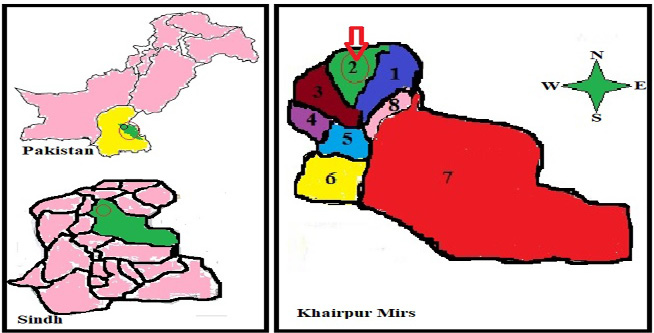
Aero in the map shows the pest population collection site.
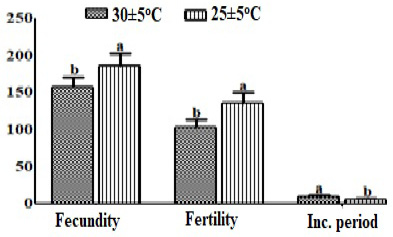
Overall mean fecundity, fertility, and incubation of RPW at two distinct temperatures.
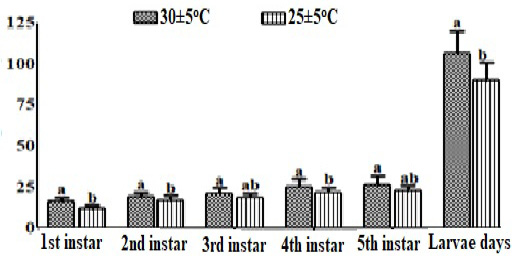
RPW larvae developmental days consumption at two distinct temperatures.
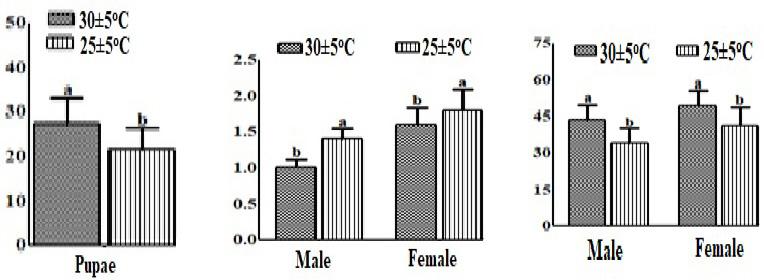
Pupae, sex ratio, and adult’s longevity of RPW at two distinct temperatures.
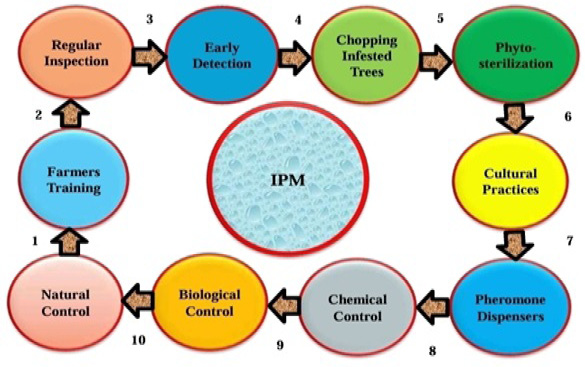
Key tools to manage the population of RPW.
References
- Al-Faris, N.A., J.Z. AlTamim, L.A. AlMousa, N.A. Albarid and F.A. Al-Ghamidi. 2022. Nutritional values, nutraceutical properties, and health benefits of Arabian date palm fruit. Emirates J. Food Agric., 35(6): 488-510. https://doi.org/10.9755/ejfa.2023.v35.i6.3098[CrossRef]
- Al-Karmadi, A. and A.I. Okoh. 2024. An overview of date (Phoenix dactylifera) fruits as an important global food resource. Foods, 13(1024): 1-19. https://doi.org/10.3390/foods13071024[CrossRef]
- Aziz, A.T., 2024. Red palm weevil, Rhynchophorus ferrugineus, a significant threat to date palm tree, global invasions, consequences, and management techniques. J. Plant Diss. Prot., 131(1): 9-26. https://doi.org/10.1007/s41348-023-00805-w[CrossRef]
- Dembilio, O. and J.A. Jacas. 2012. Bio-ecology and integrated management of the red palm weevil, Rhynchophorus ferrugineus (Coleoptera: Curculionidae), in the region of Valencia (Spain). Hellnic Plant Prote. J., 5: 1-12.
- Echegaray, N., B. Gullon, M. Pateiro, R. Amarowicz, J. Misihairabgwi and J.M. Lorenzo. 2021. Date fruit and its by-products as promising source of bioactive components: A review. Food Rev. Int., 39: 1411-1432. https://doi.org/10.1080/87559129.2021.1934003[CrossRef]
- Faiad, A., M. Alsmari, M.M.Z. Ahmed, M.L. Bouazizi, B. Alzahrani and H. Alrobei. 2022. Date palm tree waste recycling: Treatment and processing for potential engineering applications. Sustainability, 14(3): 1134. https://doi.org/10.3390/su14031134[CrossRef]
- Faleiro, J.R., 2006. A review of the issues and management of the red palm weevil Rhynchophorus ferrugineus (Coleoptera: Rhynchophoridae) in coconut and date palm during the last one hundred years. Int. J. Trop. Inse. Sci., 26: 135-154.
- Hussain, A., M. Rizwan-Ul-Haq, A.M. Al-Jabr and H.Y. Al-Ayedh. 2019. Lethality of sesquiterpenes reprogramming red palm weevil detoxification, mechanism for natural novel biopesticide development. Molecules, 24: 1648-1660. https://doi.org/10.3390/molecules24091648[CrossRef]
- Jatoi, F.A., H.A. Sahito, T. Kousar, W.M. Mangrio and Z.H. Shah. 2020. Biology, morphology and taxonomy of Lesser Date Moth, Batrachedra amydraula (Lepidoptera: Batrachedridae) under two different temperatures. Pure App. Biol., 9(1): 1137-1147. https://doi.org/10.19045/bspab.2020.90119[CrossRef]
- Jatoi, F.A., H.A. Sahito, W.M. Mangrio and T. Kousar. 2021. Survey and population fluctuation of lesser date moth, Batrachedra amydraula (Lepidoptera: Batrachedridae) on prominent Aseel variety of date palm. Int. J. Biosci., 18(4): 207-215.
- Khalid, S., N. Khalid, R.S. Khan, H. Ahmed and A. Ahmad. 2017. A review on chemistry and pharmacology of Ajwa date fruit and pit. Trends Food Sci. Tech., 63: 60-69. https://doi.org/10.1016/j.tifs.2017.02.009[CrossRef]
- Kousar, T., Z.N. Memon, H.A. Sahito, W.M. Mangrio, F.A. Jatoi and Z.H. Shah. 2021. Biology, morphology, and varietal distribution of Saw-toothed grain beetle, Oryzaephilus surinamensis (L) on date palm dry and semi-dry dates at district: Khairpur, Sindh, Pakistan. Pure Appl. Bio., 10(3): 539-548. https://doi.org/10.19045/bspab.2021.100057[CrossRef]
- Kousar. T., H.A. Sahito, T. Jatt, W.M. Mangrio, B. Mal, A.H. Mastoi, Y.A. Jamaliand FA. Jatoi. 2022. Control strategy of Saw-toothed grain beetle, Oryzaephilus surinamensis (L. 1758) through a methyl bromide gas fumigation system on date fruits. Ann. Roman. Soc. Cell Bio., 26(1): 1169-1183.
- Kubar, W.A., H.A. Sahito, T. Kousar, N.A. Mallah, F.A. Jatoi, Z.H. Shah and W.M. Mangrio. 2017. Biology of red palm weevil on different date palm varieties under laboratory conditions. Innov. Tech. Agric., 1(3): 130-140.
- Mallah, N.A., H.A. Sahito, T. Kousar, W.A. Kubar, F.A. Jatoi, Z.H. Shah and W.M. Mangrio. 2017. Varietal analyze of chemical composition moisture ash and sugar of date palm fruits. J. Adv. Bot. Zool., 5(1): 1-5.
- Mangrio, W.M., H.A. Sahito, B. Mal, T. Kousar, Z.H. Shah and F.A. Jatoi. 2020. Incidence and distribution of lemon butterfly (Papilio demoleus L.) on five alternate citrus hosts at Sahati region, Sindh, Pakistan. Pure Appl. Biol., 9(4): 2637-2647. https://doi.org/10.19045/bspab.2020.90280[CrossRef]
- Mangrio, W.M., F.A. Jatoi, H.A. Sahito, F.I. Sahito, B. Mal and N. Qureshi. 2024. Efficacy of botanical insecticides against, Batrachedra amydraula on Phoenix dactylifera at field conditions. Pak. J. Agric. Res., 37(1): 79-87. https://doi.org/10.17582/journal.pjar/2024/37.1.79.87[Full text][CrossRef]
- Mastoi, A.H., W.M. Mangrio, H.A. Sahito, F.I. Sahito, F.A. Jatoi and S.P. Solangi. 2023. Effects of different temperatures on the biology of Acyrthosiphon pisum on different pea cultivars. J. Appl. Res. Plant Sci., 4(2): 672-677. https://doi.org/10.38211/joarps.2023.04.02.170[CrossRef]
- Mendel, Z., H. Voet, I. Nazarian, S. Dobrinin and D. Ment. 2024. Comprehensive analysis of management strategies for red palm weevil in date palm settings, emphasizing sensor-based infestation detection. Agriculture, 14: 260.1-16. https://doi.org/10.3390/agriculture14020260[CrossRef]
- Nurashikin, K.W., S.N.A. Abdul-Hamid, M.S. Mansor, I. Bharudin, Z. Othman and J. Jalinas. 2022. A review of entomopathogenic nematodes as a biological control agent for red palm weevil, Rhynchophorus ferrugineus (Coleoptera: Curculionidae). Insects, 13: 245. https://doi.org/10.3390/insects13030245[CrossRef]
- Rasool, K.G., M. Husain, W.S. Alwaneen, K.D. Sutanto, A.O. Omer, M. Tufail and A.S. Aldawood. 2024. Assessing the toxicity of six insecticides on larvae of red palm weevil under laboratory condition. J. King Saud Univ., 36(103268): 1-4. https://doi.org/10.1016/j.jksus.2024.103268[CrossRef]
- Rybacki, P., J. Niemann, S. Derouiche, S. Chetehouna, I. Boulaares, N.M. Seghir, J. Diatta and A. Osuch. 2024. Convolutional neural network model for the classification of varieties of date palm fruits (Phoenix dactylifera L.). Sensors, 24: 558. https://doi.org/10.3390/s24020558[CrossRef]
- Sahito, H.A., N.A. Mallah, T. Kousar, W.A. Kubar, Z.H. Shah, F.A. Jatoi and W.M. Mangrio. 2017. Life table parameters of saw toothed grain beetle, Oryzaephilus surinamensis (L., 1758) on different varieties of stored date palm fruits infested under laboratory conditions. J. Ent. Zoo. Stud., 5(1): 95-99.
- Sahito, H.A., W.A. Kubar, T. Kousar, N.A. Mallah, F.A. Jatoi, W.M. Mangrio and B.D. Ghumro. 2017. Feeding potentional of red palm weevil, Rhynchophorus ferrugineus on different date palm, Phoenix dactylifera verities under field conditions. Curr. Res. Agric. Sci., 4(4): 84-90. https://doi.org/10.18488/journal.68.2017.44.84.90[CrossRef]
- Subhash, A.J., G.B. Bamigbade and M. Ayyash. 2024. Current insights into date by product valorization for sustainable food industries and technology. Sustain. Food Tech., 2: 331-361. https://doi.org/10.1039/D3FB00224A[CrossRef]
- Yones, M.S., M.A. Aboelghar, M.A. ElShirbeny, G.A. Khdry, A.M. Ali and N.S. Saleh. 2014. Hyperspectral indices for assessing damage by the red palm weevil Rhynchophorus ferrugineus (coleoptera: curculionidae) in date palms. Int. J. Geosci. Geom., 2(2): 16-23.
- Yong, W.K., A.B. Aisyah and A.A. Wahizatul. 2015. Fecundity, fertility and survival of red palm weevil (Rhynchophorus ferrugineus) larvae reared on sago palm. Sains Malays., 44: 1371-1375. https://doi.org/10.17576/jsm-2015-4410-01[CrossRef]
Services
Article usage statistics
Loading…