
The red palm weevil (Rhynchophorus ferrugineus L) is an important pest for date palm plantation in all over the world. The present study deals with the optimization of different parameters for trapping of red palm weevil by utilizing pheromone traps. Different field trials have been performed at district Khairpur Mir’s, Sindh-Pakistan. Therefore, different field trials have been performed at date palm orchards of district Khairpur Mir’s, Sindh-Pakistan. During the field trials, various parameters such as aggregation pheromone (ferrugineol; 4-methyl-5-nonanol+ 4-methyl-5-nonanone), kairomone (Ethyl acetate, EA) dosages, effect of date fodder, trap density, the effect of trap color and seasonal changes have been optimized. From the results, it has been revealed that the traps baited with 300 g of date fodder, captured more adult red palm weevil as compared to the traps without date fodder. In addition, 3 mg/trap/day pheromone dose and 5 mg/trap/ day EA captured the maximum number of adult red palm weevils and effective trap density was found to be 11 traps/ha, while further higher trap density has no significant difference. Moreover, the darker color traps catch a significant higher number of weevils as compared to white or light-colored bucket traps.
Short Communication · Volume 54, Issue 3, 5 March 2022 · Open Access
Effect of Various Parameters for Trapping Red Palm Weevil (Rhynchophorus ferrugineus L) in Date Palm Orchards at Khairpur Mir’s Sindh, Pakistan
· · · ·
Affiliations & Notes ⌄
- 1National Centre of Excellence in Analytical Chemistry, University of Sindh, Jamshoro-76080 2Plant Protection Research Institute, Tandojam 3Department of Chemistry, University of Karachi, Karachi 75270 * Corresponding author: ranjhanjunejo@yahoo.com
Article Info ⌄
- Journal:
- Pakistan Journal of Zoology
- Published:
- 5 March 2022

From the article
- Moreover, the combination of pheromone, kairomone and date fodder was the most effective trap to catch the red palm weevils (Fig. 2).
- Though red palm weevil was initially trapped at 10 traps/ha in Israel during 1999-2001.
- It has also been revealed that the effect of kairomone (EA) significantly makes difference in trapping the adult red palm weevil along with date fodder.
- Herein, it is certainly obvious that 11 traps/ha density of trapping systems is the best density and traps a maximum number of adult red palm weevils during March-April season.
Selected from the article's own text.
Abstract
Material and methods
The study was conducted in date palm plantation at village Tando Masti district Khairpur Mir’s Sindh, Pakistan (Latitude: 29°34′52.00′′ N and Longitude: 72°14′11.00′′ E). The palm orchard occupied an area of 5 ha with approximately 600 date palm trees with an average of 15-18 years old.
The pheromone trap consisted of a 15 L High-Density Poly Ethylene (HDPE) bucket with 4 side lateral windows 4 cm2 and 4 windows at the lid as. The 700 mg sachet of aggregation pheromone was chemically composed of 4-methyl-5-nonanol and 4-methyl-5-nonanone (90:10) obtained from (Chem Tica International. S.A. Costa Rica). The kairomone Ethyl acetate (EA) was filled in a 50 ml plastic bottle tight with metallic wire and attached to the lid of the HDPE bucket. The traps were loaded with 3 mg of aggregation pheromone, 300g of date fodder, 5 mg EA and added 7 liters of water per trap. The pheromone sachet was replaced after 45 days while the kairomone (EA) and date fodder were changed after two weeks. The combined effect of date fodder and kairomone along with pheromone have been tested during field trials. The date fodder and kairomone synergies the efficacy of aggregation pheromone. The trials were performed by using blank (control), aggregation pheromone, kairomone (EA), date fodder, pheromone+kairomone, and pheromone+ kairomone+ date fodder. The traps were dumped up to level of side windows and 35-37 m away from each other. The traps were buried at shadow places near to date palm trunk to maintain the release rate. The field trials were carried out by using 8 pheromone trap densities: 21, 18, 15, 11, 8, 5, 3 and 1 trap/ha from January to December 2019. These densities were previously recommended by ; . During the field trial for trapping the red palm weevil, the different trap colors such as white transparent, red, grey, black and dark blue were tested. The minimum/maximum temperature (°C) and relative humidity (%) in the environment were recorded daily throughout the study period and data were obtained from the Meteorological Department of Sindh-Pakistan.
The five treatments (pheromone, kairomone, date fodder, pheromone-kairomone, and pheromone-kairomone-date fodder) were replicated four times during January 2019 to December 2019. During field trials, the pheromone, kairomone doses, trap color, and trap density were tested. All statistical analyses were performed using SPSS (SPSS Release 16.00). The trapped weevils were pooled (not according to the sex). The data were first tested for normality of their distribution using Shapiro–Wilk test and for homogeneity of variance using Bartlett test. No data transformation was required for the analyses. The numbers of captured weevil have been presented as mean ± standard error and subjected to one–way ANOVA. The means were separated using Bonferonni post-hoc test and the differences were considered significant at values P < 0.05 level.
Results and discussion
Figure 1 shows effect of different doses of aggregation pheromone, Kairomone, trap density and color of trap on number of insect trapped. The traps with 3 mg/day of aggregation pheromone and 5 mg of kairomone used as a co-attractant trapped 80 insects trapped per trap and per week which was the maximum number of weevils trapped per trap and per week in this study. Thereafter the other higher doses did not influence the level of insects trapped. In addition, the trap density at 11 traps/ha and black and dark blue bucket trapped 80 insects per trap and per week which again was the maximum number of weevil trapped per trap and per week in this study. Thereafter, an increase in the trap density and bucket of different color did not influence the level of insects trapped.
Moreover, the combination of pheromone, kairomone and date fodder was the most effective trap to catch the red palm weevils (Fig. 2). The highest number of insects were trapped in March and April, while the lowest numbers of red palm weevils were trapped in the winter months summer months (Fig. 3). Different studies showed that EA synergizes with the aggregation pheromone traps ; ; . For example Al-Saoud (2013) have performed experiments for trapping red palm weevil by using pheromone traps combined with EA and noted that these traps are 1.6 times more effective to catch weevils. Basically, EA is not a substituent of food material as reported by Faleiro (2006) but it only synergizes the efficacy of the traps. Vacas et al. (2017) showed in his experiment that alone EA does not synergize the pheromone traps attraction without food bait. It has also been noted that without food bait, EA alone does not synergizes the pheromone traps. However, the loading of EA significantly synergizes the traps and it is revealed that EA is an essential co-attractant along with food bait in pheromone lure traps . Consequently, the role of host plant material as food bait along with aggregation pheromones to synergize the attraction has been reported for many Rhynchophorus species ; and it has also been noticed that the pheromone traps without food material are less effective ; . Shukla (2017) has performed field studies by comparing the dried dates and sugarcane and found no statistical difference in their trapping efficacies. The date palm tissues and dates have been used at Al-Ahsa region of Saudi Arabia between the years 1994 and 1998 for mass trapping the red palm weevil ; . The presence of EA significantly differentiated between total numbers of adult red palm weevil catches with date fruits. Like in this study, the use of EA acts as co-attractant along with aggregation pheromone and food bait ; ; , 1999). The trap color is also an important factor which influences the efficacy of the red palm weevil pheromone traps ; . For example, Ajlan and Abdulsalam (2000) trapped more adult red palm weevil by using green bucket traps as compared to white and yellow traps. A red color pheromone trap catches more palm weevil than the green, blue, orange and yellow colored traps . Another study reported by Al-Saoud et al. (2010) showed that the dark colored traps, in general, and red-colored ones, in particular, recorded the best weevil captures. In Spain, the reddish-brown colored traps work well for the capture of red palm weevil due to resemblance with date palm trunk color . Mohamed and Al-Deeb (2012) found that the black-colored pheromone traps registered significantly high red palm weevils as compared to white color traps. Similarly, the black color bucket traps reported significantly more weevils . In our study the darker colored traps catch more adults of red palm weevil.
Moreover, the trapping density is also an important parameter for trapping the red palm weevil. recommended the trap density of 1 trap/ha to mass trap red palm weevil. In Egypt, the red palm weevil was trapped efficiently by using 0.5 traps/ha . Though red palm weevil was initially trapped at 10 traps/ha in Israel during 1999-2001. Since 2002, no further new infestations were reported. Such mass trapping of red palm weevil in pheromone-based area-wide IPM programs have been applied at different densities ranging from 1-10 trap/ha in date plantations of the Al-Hassa region in Saudi Arabia . The mass trapping program at Al-Hassa have been applied in 1994 with trapping density 1-1.5trap/ha which reduced the population successfully. The increasing rate of infestation reported after 1998 shows that the grid trapping density was inadequate to mass trap the pest in all the operational areas. In our study, a density of 11 traps /ha was the first best density to catch the highest number of weevils.
However, the efficacy of the trap varied significantly according to the season. The trapping rate were highest in March and April while the lowest trapping rates were obtained in December and January. The activity of red palm weevil was lower in high winter and summer season where the temperature range was below 15°C and summer hot season above the 40°C. The weevil activity have been observed by Weissling et al. (1994) in Goa during the monsoon (June-July) but high after monsoon (October-November) while the red palm weevil is active in May at the western India. In the current study, the higher trapping rate have been observed during the March and April in Khairpur Mir’s Sindh, Pakistan. The temperature range was 30-40 °C in that location and period.
Conclusions
It has also been revealed that the effect of kairomone (EA) significantly makes difference in trapping the adult red palm weevil along with date fodder. In addition, during field trials, it has been observed that the bucket color is an important factor that affects the entire trapping system. The darker color remains most effective as compared to light color of the trap. Herein, it is certainly obvious that 11 traps/ha density of trapping systems is the best density and traps a maximum number of adult red palm weevils during March-April season. The trapping of red palm weevil is affected by season due to the variation in temperature and it is observed that high cold and warm seasons reduce the efficiency of the system. Thus, the present study will prove its efficacy in the management of hazardous pest and helps the growers to enhance the production of date palm orchards in all over the world.
Acknowledgement
This research was supported by Sindh Agricultural Growth Project under the project DGAR/Tech-IV 145 2017, Sindh Agricultural University, Tandojam. We are also thankful to National Center of Excellence in Analytical Chemistry University of Sindh, Jamshoro for providing research laboratories.
Statement of conflict of interest
The authors have declared no conflict of interest.
Figures
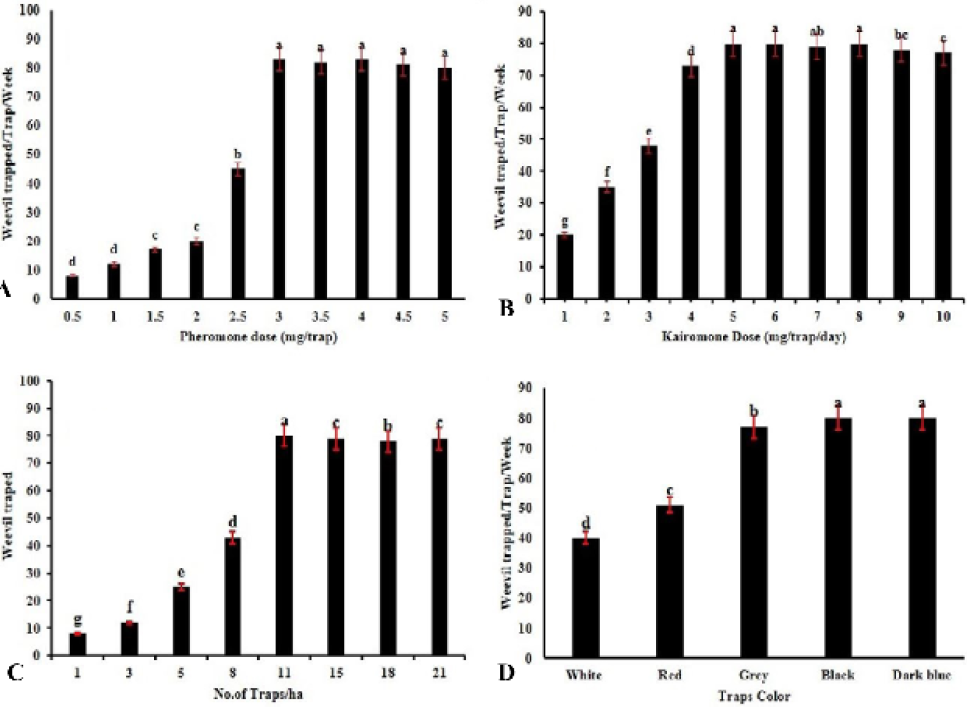
Effect of pheromone (A), Kairomone (B), numbers of traps (C) and Trap color (D) on trapping of red palm.Weevil in date palm orchids at Khairpur Mir, Sindh.
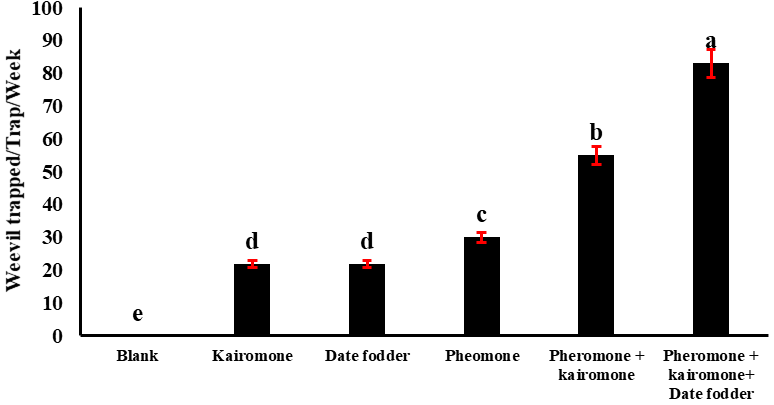
The adult red palm weevils trapped per trap and per week according to different combination. F-statistics = 5411 at df=5, p=0.0000. Each bar followed by different letters are significant different at 5% level according to the Bonferroni test following ANOVA.
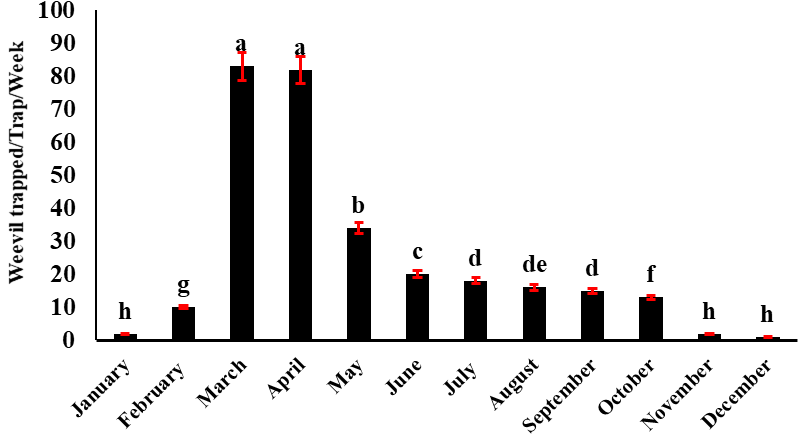
The adult red palm weevils trapped per trap and per week according to the season from January to December 2019. F-statistics= 4630 at df= 11. Each bar followed by different letters are significant different at 5% level according to the Bonferroni test following ANOVA.
References
- Abraham, V., Faliero, J., Prem Kumar, T. and Shuaibi, M., 1999. Indian J. Ent. (India), 61: 201-204.
- Abraham, V., Shuaibi, M.A., Faleiro, J., Abozuhairah, R. and Vidyasagar, P.S., 1998. J. Agric. Mar. Sci., 3: 77-83. https://doi.org/10.24200/jams.vol3iss1pp77-83[CrossRef]
- Ajlan, A.M. and Abdulsalam, K., 2000. Bull. entomol. Soc. Egypt (Econ. Ser.), 27: 109-120.
- Al-Saoud, A., Al-Deeb, M. and Murchie, A., 2010. J. Ent., 7: 54-59. https://doi.org/10.3923/je.2010.54.59[CrossRef]
- Al-Saoud, A.H., 2013. Int. J. Trop. Insect Sci., 33: 202-206. https://doi.org/10.1017/S1742758413000167[CrossRef]
- Faleiro, J., Rangnekar, P. and Satarkar, V., 2003. Crop Prot., 22: 999-1002. https://doi.org/10.1016/S0261-2194(03)00114-5[CrossRef]
- Faleiro, J., 2006. Int. J. Trop. Insect Sci., 26: 135-154.
- Faleiro, J., El-Saad, M.A. and Al-Abbad, A.H., 2011. Int. J. Trop. Insect Sci., 31: 75-77. https://doi.org/10.1017/S1742758411000099[CrossRef]
- Ferry, M. and Gomez, S., 2002. Palms, 46: 172-178.
- Fiaboe, K., Mankin, R., Roda, A., Kairo, M. and Johanns, C., 2011. Fl. Entomol., 94: 766-773. https://doi.org/10.1653/024.094.0406[CrossRef]
- Hallett, R., Gries, G., Gries, R., Borden, J., Czyzewska, E., Oehlschlager, A. and Rauf, A., 1993. Naturwissenschaften, 80: 328-331. https://doi.org/10.1007/BF01141908[CrossRef]
- Hallett, R.H., Oehlschlager, A.C. and Borden, J.H., 1999. Int. J. Pest Manage., 45: 231-237. https://doi.org/10.1080/096708799227842[CrossRef]
- Javaloyes, M.S., Vives, S.G., Ferry, M. and Espejo, G.D., 2008. Plagas, 34: 135-146.
- Mohamed A.A. and Al-Deeb, M.A., 2012. J. Insect Sci., 12: 120. https://doi.org/10.1673/031.012.12002[CrossRef]
- Oehlschlager, A., 1994. Consultancy Report-submitted to Min. Agric., Saudi Arabia.
- Shukla, M.M.A-A.P., 2017. Emir. J. Fd. Agric., pp. 936-948.
- Soroker, V., Harari, A. and Faleiro, J.R., 2015. The role of semiochemicals in date pest management and sustainable pest management in date palm: Current status and emerging challenges. Springer. pp. 315-346. https://doi.org/10.1007/978-3-319-24397-9_11[CrossRef]
- Vacas, S., Abad-Paya, M., Primo, J. and Navarro-Llopis, V., 2014. J. Agric. Fd. Chem., 62: 6053-6064. https://doi.org/10.1021/jf502663y[CrossRef]
- Vacas, S., Melita, O., Michaelakis, A., Milonas, P., Minuz, R., Riolo, P. and Peri, E., 2017. Pest Manage. Sci., 73: 223-231. https://doi.org/10.1002/ps.4289[CrossRef]
- Vidyasagar, P., Al-Saihati, A.A., Al-Mohanna, O.E. and Subbei, 2000. J. Plant. Crops, 28: 35-43.
- Weissling, T.J., Giblin-Davis, R.M., Gries, G., Gries, R., Pérez, A.L., Pierce, H. and Oehlschlager, A.C., 1994. J. chem. Ecol., 20: 505-515. https://doi.org/10.1007/BF02059593[CrossRef]
Services
Article usage statistics
Loading…