
The Oreochromis niloticus (Linnaeus, 1758) has been introduced to various countries as a cultured species. Recently, it has been distributed on all continents except Antarctica and Australia, and has a high invasion risk. The invasion of O. niloticus has threatened the survival of native species, therefore, it is necessary to evaluate the condition and fitness of O. niloticus populations. Length-weight relationship (LWR) was one of the most effective and practical methods to assess fitness and condition and has been widely utilized in fisheries. Thus, the LWRs of this fish have been described in a number of publications. However, there are no systematic reports on LWRs of O. niloticus worldwide, especially comparing native and non-native populations. Therefore, the aim of this present research was to provide a systematic report of LWRs of O. niloticus on a global scale and to compare the LWRs of O. niloticus in native and non-native areas. The results indicated that O. niloticus showed negative allometric growth in native regions and the O. niloticus populations showed isometric growth in non-native regions. These results showed that O. niloticus was better adapted to the environment of the invasion regions and grew better. Given its potential for invasion, the hazards of this species should not be neglected. In addition, some preventive and management methods to eliminate or reduce the adverse effects of further expansion of this species have been provided in the present study.
Short Communication · Volume 57, Issue 2, 8 April 2025 · Open Access
Length-Weight Relationships of Oreochromis niloticus (Linnaeus, 1758) Around the World
· · · · · · · · · · · ·
Affiliations & Notes ⌄
- 1Faculty of Resources and Environmental Science, Hubei University, Wuhan 430062, P.R. China 2Regional Development and Environmental Response, Key Laboratory of Hubei Province, Hubei University, Wuhan 430062, P.R. China 3Hubei Engineering Research Center for Rural Drinking Water Security Hubei, University, Wuhan 430062, P.R. China 4School of Civil Engineering, Wuhan University, Wuhan 430072, P.R. China 5Department of Radiology, Tongji Hospital, Tongji Medical College, Huazhong University of Scienc
Article Info ⌄
- Journal:
- Pakistan Journal of Zoology
- Published:
- 8 April 2025

From the article
- In addition, there was a significant difference (p < 0.05) in median b between the native region (b = 2.91, SE = 0.03) and the invasive region (b = 3.01, SE = 0.03) (Supplementary Table II).
- This suggested that the body shape of this species differed between the two regions.
- According to current research, O. niloticus was growing at negative allometric growth in native regions and at isometric growth in invasive regions.
- This showed that O. niloticus grew better in the invasion area than its origin.
Selected from the article's own text.
Abstract
Materials and methods
This study was based on Chinese and English databases such as China National Knowledge Infrastructure (https://www.cnki.net), Web of Science (https://www.webofscience.com/wos), Google Scholar (https://scholar.google.com), etc. A literature search was conducted on the topic “Oreochromis niloticus” “length-weight relationship”. All LWRs data on O. niloticus collected from published literature sources, such as peer-reviewed journals, conference minutes, and dissertations. All data on LWRs of O. niloticus were obtained from wild populations. Overall, data on LWRs of O. niloticus (233 total:174 combined sexes, 30 males and 29 females) were acquired from literature published in 36 countries from 1987 to 2022 (Supplementary Table I). Of all the data, those with correlation coefficients greater than 0.8 were selected for this study, and these records were not flagged as abnormal due to potential errors or other factors . The following exclusion study for 214 populations will not include 19 of 233 data collected (Supplementary Table I) as the correlation coefficient is less than 0.8 . Among the 214 populations, 132 were native populations and 82 were invading populations (Supplementary Table I).
Length-weight relationship: The equation for the length-weight relationship was W = aLb, where, W = wet body weight of fish in grams, L = total length of fish in centimeter, a is the intercept; and b is the slope . When the LWR was solely represented in logarithmic form (e.g., logW = loga + blogL), and dependent on the exponent value and the units selected, parameter a was acquired through the anti-logarithmic transformation (log is logarithm to base 10). As the majority of LWRs rated length in cm and described as TL, conversion factors acm = amm10b and aTL = aLS (TL/ LS)b (where LS is length type in the original study by standard length (SL) or fork length (FL); TL/ SL = 1.25, TL / FL = 1.02, as calculated from FishBase (Froese and Pauly, 2023) were applied for all studies reporting length in mm and/or LS (Supplementary Table I) . The meaning of the exponent, b, is straightforwardly physical and independent of the chosen system of units. According to the one-sample t-test, an ideal fish has a “b” value of 3 (Supplementary Fig. S1), which indicates isometric development. When the value of “b” is not 3, the weight increase is allometric (positive if “b” is greater than 3, negative if “b” is less than 3), which is a regularly used scale in the study of LWRs .
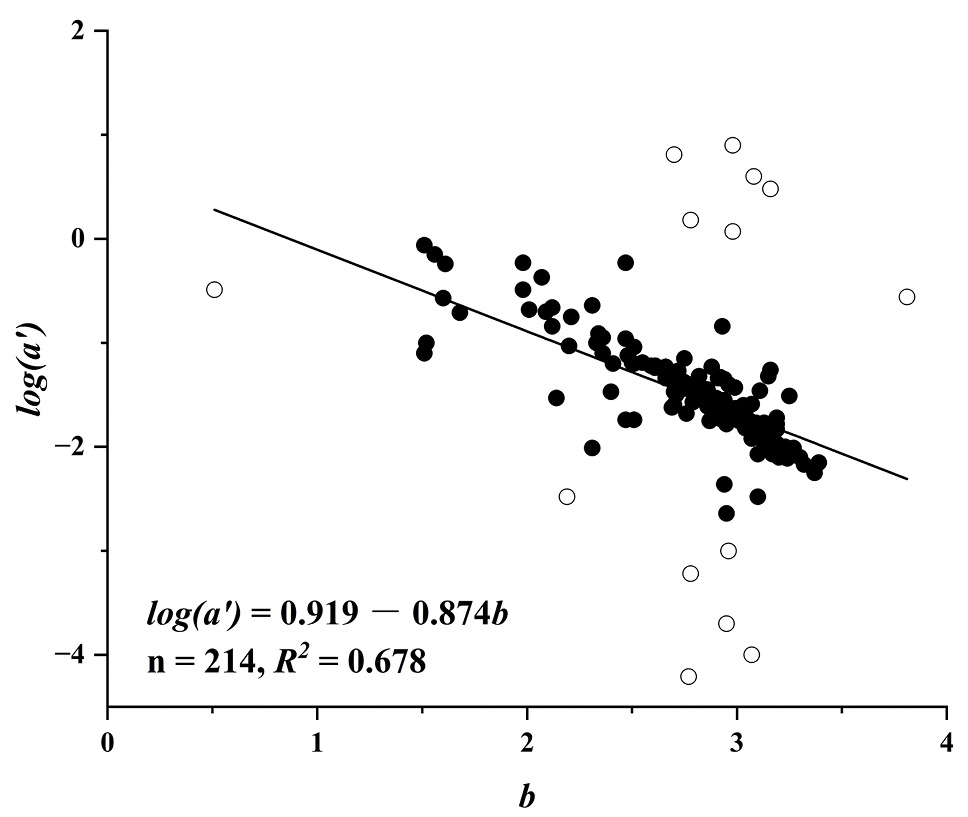
The figure of log (a’) vs b was used in the LWRs data of O. niloticus. Using this technique, outliers that diverged from the regression line by more than two standard deviations were identified. And then the figure of log (a’) vs b contained 14 outliers that were identified as problematic in Supplementary Table I and eliminated in subsequent research. After excluding outliers, a total of 200 data were available, of which 126 data were from the native region and 74 from the invaded region (Supplementary Table I).
In this study, IBM SPSS Statistics 23 was used to test if the data satisfied the normal distribution by Kolmogorov-Smirnov test. And it also be used to test whether there were differences between invasive and native populations by Mann-Whitney test, and one-sample Wilcoxon test was used to compare the differences between invasive and native populations with 3, and all statistics were considered to be different at p < 0.05.
Results and discussion
The range of values for b in the present study was from 1.51 in Wase Dam and Naivasha Lake (Kenya, Nigeria) to 3.39 in the Malewa Lake (Kenya). Generally, the b-values range from 2.5 to 3.5 (Tubb and Carlander, 1969). However, of 233 data collected, 44 were below 2.5. After correlation coefficient were less than 0.8 and log (a’) vs b filtering, 28 were still below 2.5. We then reviewed the original literature and found that studies have shown that poor environmental conditions, lack of food, harsh climate and high population density can lead to low b-values ; ; ; .
The Kolmogorov-Smirnov test rejected this distribution as normal (Fig. 3). In Figure 3, when compared with the normal distribution curve, all b-value distributions were lower than the normal curve except for 1.4-2.0 and 3.0-3.2. Among all LWRs data for O. niloticus, the median value of b was 2.94 (SE = 0.02). 90% of the values ranged from 2.07 to 3.21. As shown in Figure 3, the majority of b (n = 121, 60.5% of the total) was located to the left of the isometric line (b > 3). In addition, there was a significant difference (p < 0.05) in median b between the native region (b = 2.91, SE = 0.03) and the invasive region (b = 3.01, SE = 0.03) (Supplementary Table II). Median value of b (b = 2.91, SE = 0.03) for native populations was less than 3 (p < 0.05) and median value of b (b = 3.01, SE = 0.03) and 3 for invasive populations was not different (p > 0.05) (Supplementary Table II). This suggested that the body shape of this species differed between the two regions.
According to current research, O. niloticus was growing at negative allometric growth in native regions and at isometric growth in invasive regions. This showed that O. niloticus grew better in the invasion area than its origin. Further expansion of O. niloticus populations in invasive sites would compete with native species and destroy biodiversity (Stauffer et al., 2022). Therefore, considering this potential threat, the harmfulness of this invasive species should not be ignored.
Some measures should be taken to suppress or mitigate further invasion of O. niloticus while maintaining economic benefits: (1) Improve the evaluation, early warning, identification and monitoring, management and eradication of invasive alien species, and establish appropriate rules and regulations; (2) For exotic farmed fish, the farming unit should strengthen the monitoring and management of the farming environment, take adequate anti-avoidance and isolation measures, and strictly control farmed species in a specific range of farmed waters; (3) If prevention methods fail, management of invasive organisms should use a combination of biological, physical and chemical means to address this problem ; .
Acknowledgments
The authors gratefully acknowledge the helpful advice of Dr. Xianghong Dong (Guizhou University).
Funding
This work was supported by grants from Natural Science Foundation of Hubei (2022CFB329), China Agriculture Research System (CARS-46), the Key Project (D20191006) of Hubei provincial education department, the Project (2020FB04) of State Key Laboratory of Freshwater Ecology and Biotechnology, the Project (2020C003) of Hubei Key Laboratory of Regional Development and Environmental Response (Hubei University), the Project (202004) of Key Laboratory of Fishery Drug Development, Ministry of Agriculture and Rural Affairs, Pearl River Fisheries Research Institute, Chinese Academy of Fishery Sciences and the Key Project (D20191006) of Hubei provincial education department.
Ethical statement andIRB approval
This study did not sacrifice fish, so institutional review board (IRB) approval was not required.
Supplementary material
There is supplementary material associated with this article. Access the material online at: https://dx.doi.org/10.17582/journal.pjz/20230530080554
Statement of conflict of interest
The authors have declared no conflict of interest.
Figures
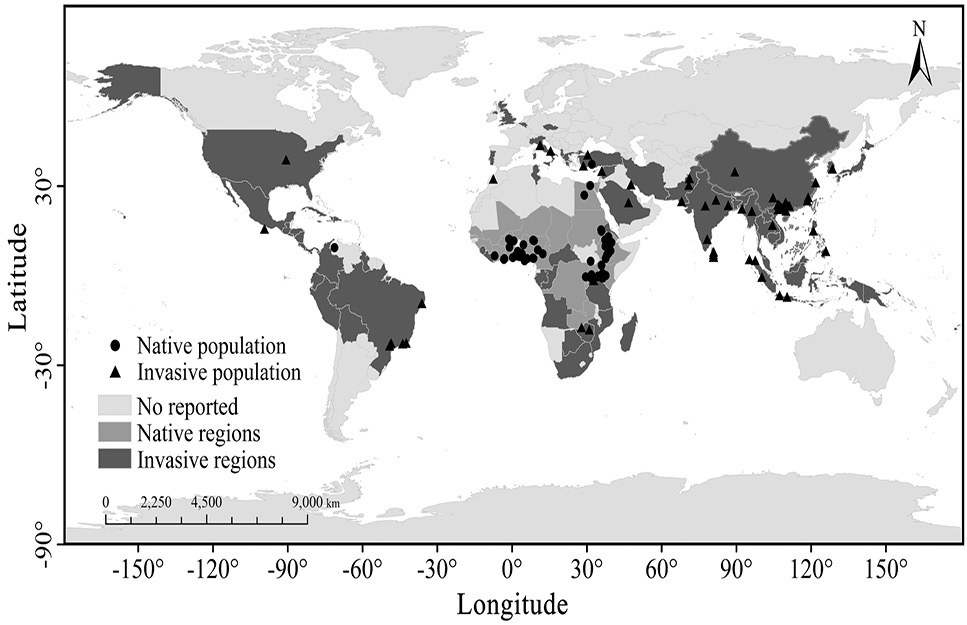
The distribution was available on the FishBase website (Froese and Pauly, 2023), and Oreochromis niloticus (Linnaeus, 1758) was found in 92 countries. In the figure, the light gray sections were the native areas and the black sections were the invasive areas. In the 36 countries with the Length-weight relationships (LWRs) of O. niloticus data, the solid circles represented the native populations and the triangles indicated the invasive populations.
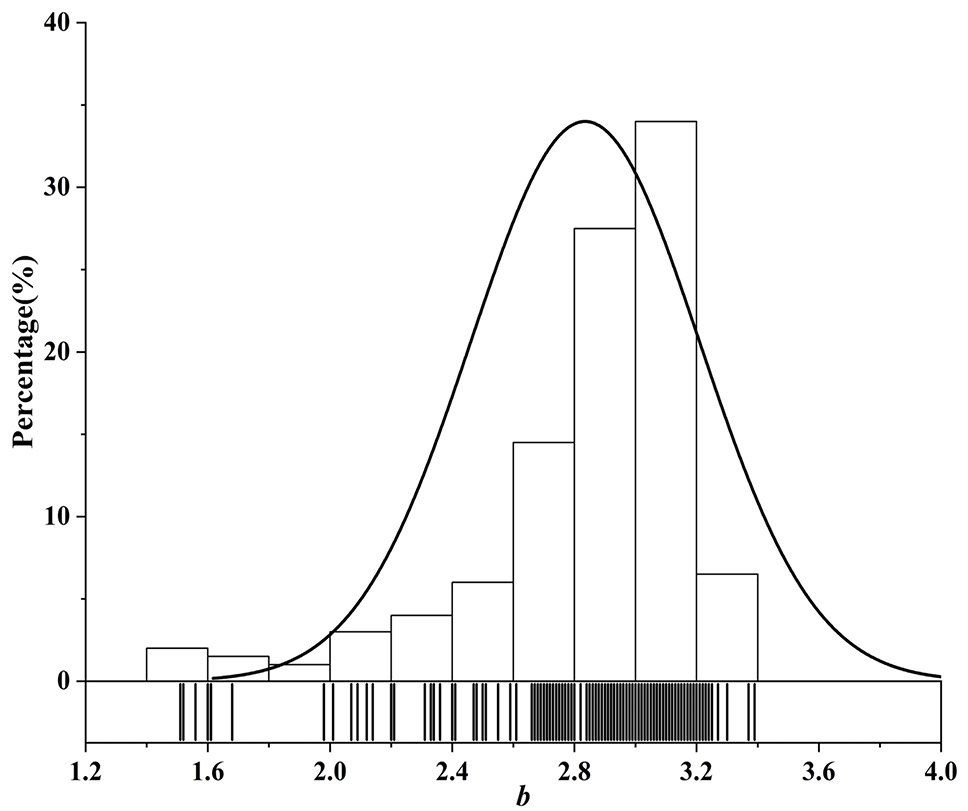
Frequency distribution of index b based on 200 records for O. niloticus, 5th percentile= 2.07 and 95th percentile = 3.21. Gaussian distribution line was superimposed.
References
- Arthur, R.I., Lorenzen, K., Homekingkeo, P., Sidavong, K., Sengvilaikham, B. and Garaway, C.J., 2010. Aquaculture, 299: 81-88. https://doi.org/10.1016/j.aquaculture.2009.11.022[CrossRef]
- Batool, A., Farooq, S., Muhammad, A. and Malik, A., 2017. Sindh Univ. Res. J., 49: 793-796. https://doi.org/10.26692/Surj/2017.12.59[CrossRef]
- Dong, X., Ju, T., Grenouillet, G., Laffaille, P., Lek, S. and Liu, J., 2020. Sci. Total Environ., 711: 134661. https://doi.org/10.1016/j.scitotenv.2019.134661[CrossRef]
- El-Sayed, A.F.M. and Fitzsimmons, K., 2023. Rev. Fish. Sci., 15: 6-21. https://doi.org/10.1111/raq.12738[CrossRef]
- Fletcher, D., Gillingham, P., Britton, J., Blanchet, S. and Gozlan, R.E., 2016. Sci. Rep., 6: 1-8. https://doi.org/10.1038/srep26316[CrossRef]
- Froese, R., 2006. J. appl. Ichthyol., 22: 241-253. https://doi.org/10.1111/j.1439-0426.2006.00805.x[CrossRef]
- Geletu, T.T., and Zhao, J., 2022. Hydrobiologia, https://doi.org/10.1007/s10750-022-04989-4[CrossRef]
- Obayemi, O.E., Komolafe, O.O., Okunola, O.V., Asafa, S.T. and Ayoade, M.A., 2019. Not. Sci. Biol., 11: 205-209. https://doi.org/10.15835/nsb11210433[CrossRef]
- Schiemer, F., 2000. Hydrobiologia, 422: 271-278. https://doi.org/10.1007/978-94-011-4164-2_22[CrossRef]
- Stauffer, J.R., Chirwa, E.R., Jere, W., Konings, A.F., Biol. Invasions, 24: 1585-1597. https://doi.org/10.1007/s10530-022-02756-z[CrossRef]
- Tsegay, T., Haftom, Z. and Tesfay, M., 2018. Int. J. Fish. Aquat. Stud., 10: 86-94. https://doi.org/10.5897/IJFA2017.0637[CrossRef]
- Verreycken, H., Van Thuyne, G. and Belpaire, C., 2011. J. appl. Ichthyol., 27: 1416-1421. https://doi.org/10.1111/j.1439-0426.2011.01815.x[CrossRef]
- Vianny, N., Richard, O.O., Jackson, E., Fredrick, M., Dismas, M., Mark, O., Laban, M., Shamim, N. and Shaon, N., 2015. Lakes Reservoirs Res. Manage., 20: 101-119. https://doi.org/10.1111/lre.12091[CrossRef]
- Xiong, W., Guo, C., Gozlan, R.E., and Liu, J., 2023. Rev. Fish. Sci., 15: 179-197. https://doi.org/10.1111/raq.12710[CrossRef]
- Xiong, W., Sui, X., Liang, S.H. and Chen, Y., 2015. Rev. Fish. Biol. Fisheries, 25: 651-687. https://doi.org/10.1007/s11160-015-9396-8[CrossRef]
- Xiong, W., Zeng, Q., Gu, D. and Hu, Y., 2020. Pakistan J. Zool., 52: 1197-1200. https://doi.org/10.17582/journal.pjz/20190422150443[Full text][CrossRef]
- Yem, I., Bankole, N., Umar, R., Ibrahim, A. and Ewutanure, S., 2020. Int. J. Fish. aquat. Stud., pp. 257-260.
Supplementary material
Cited by 1 article
In journals published by ResearchersLinks.
Services
Article usage statistics
Loading…