
Pseudorasbora parva (Temminck and Schlegel, 1842) has a significant potential to spread outside of its current locations and regions, all-continents-spanning invasive range. The invasion of P. parva has threatened the existence of native species. Therefore, evaluation of the condition and fitness of the invasive P. parva population in different regions is necessary. However, no systematic reports of the P. parva length-weight relationships (LWRs) around the world has been documented, especially comparing indigenous and non-indigenous populations. Thus, the goal of the current study was to offer a systematic report of P. parva LWRs worldwide and a comparison of P. parva LWRs in native and non-native regions. In the present results, P. parva showed positive-allometric growth, it became more rounded as the length increases, and both native and invasive populations showed similar growth patterns and form factor. Considering its invasive potential, the harmful effects of this alien species cannot be ignored. The present research will also focus on eliminating or mitigating the adverse effects caused by the further expansion of the species through a series of prevention and management strategies proposed.
Research Article · Volume 56, Issue 4, 14 June 2024 · Open Access
Length-Weight Relationships of Pseudorasbora parva (Temminck and Schlegel, 1842) Around the World
· · · · · · · ·
Affiliations & Notes ⌄
- 1Faculty of Resources and Environmental Science, Hubei University, Wuhan 430062, People’s Republic of China 2Regional Development and Environmental Response, Key Laboratory of Hubei Province, Hubei University, Wuhan 430062, People’s Republic of China 3Hubei Engineering Research Center for Rural Drinking Water Security Hubei University, Wuhan 430062, People’s Republic of China 4School of Civil Engineering, Wuhan University, Wuhan 430072, People’s Republic of China 5Wuhan Centers for Disease Contro
Article Info ⌄
- Journal:
- Pakistan Journal of Zoology
- Published:
- 14 June 2024

From the article
- The median’s 95% confidence intervals did not include 3.00, indicating that P. parva exhibited overall positive allometric growth (Supplementary Table II).
- There were no significant differences in the form factor for this species sampled from native regions and invasive regions (P > 0.05) (Supplementary Table III).
- This indicated that the body shape of this species in the two regions were similar.
- Considering its invasive potential, the harmful effects of this alien species cannot be ignored.
Selected from the article's own text.
Abstract
Introduction
Over the past two centuries, the number of invasive species has quickly expanded, posing a serious threat to biodiversity ; ; . Among these invasive species, Pseudorasbora parva (Temminck and Schlegel, 1842), one notorious small freshwater Cyprinid species with a pan-continental invasion, is of special concern and an iconic example that could be used for explaining this detrimental impact . This species is native to Japan, China, the Korean peninsula, and Russia . Due to the importation of Chinese silver and grass carps for aquaculture in the 1960s, P. parva was unintentionally introduced to Romania, Hungary, and other nations bordering the Black Sea ; . Later, the species spread throughout the Danube basin in a westward direction . The species currently has a pan-European invasion with distributions in more than half of the European countries . It is therefore regarded as the most invasive fish on the continent . Additionally, it has established successful wild invasive populations in more than 40 nations in Asia, Europe, and Africa (Fig. 1) ; ; . Even worse, this fish has a significant potential to spread to locations and regions outside of its current, all-continents-spanning invasive range .
The invasion of P. parva has threatened the existence of native species through predation, competition for resources (such as food and habitat), hybridization, and disease transmission , 2010), putting the local biodiversity and ecosystems at risk . The greater the fitness of the invasive fish population in a region, the greater threat to the existence of native species. Therefore, evaluation of the condition and fitness of the invasive P. parva population in different regions is necessary.
There were several parameters used to evaluate the condition and fitness of fish population in a region, such as the length-weight relationship (LWR), lipid accumulation and population structure ; ; . Among these indices, LWR, as one of the most effective and convenient tools for evaluating the condition and fitness of the fish population, has been widely used in fisheries management . And the LWR for this species of fish has been documented in some publications ; . However, the majority of these P. parva LWRs results came from research in a single area (Supplementary Table I) ; ; . No systematic reports of the P. parva LWRs around the world has been documented, especially comparing indigenous and non-indigenous populations.
As a result, the goal of the current study was to offer a systematic report of P. parva LWRs worldwide and a comparison of P. parva LWRs in native and non-native regions. The present research sought to answer the following question: Whether a significant difference in P. parva LWRs between indigenous and non-indigenous populations or not?
Materials and methods
Data collection and sampling
Data on LWRs of P. parva were gathered from all available published literature sources, including peer-reviewed papers, dissertations, conference minutes, reports, and our field investigation (Supplementary Table I). Since the majority of LWRs reported in the literature were from invasive regions, we also estimated a LWR of P. parva that was sampled from one native region in Jiangjin Town (29°17′ N, 106°15′ E) in Chongqing Municipality, the upper reaches of the Yangtze River (Fig. 1). Fish were caught using hooks, drift gill nets (mesh: 1.0 cm × 2.0 cm × 3.0 cm), and electrofishing (depth: 30–60 cm; near the beach) between December 2011 and September 2012. Individual fish was measured for total length (nearest to 1 mm) and body weight (nearest to 0.1 g).
In total, data about LWRs of P. parva (98 sexed: 78 combined sexes, 10 males and 10 females) were obtained from literature and our investigation which were published or conducted between 1990 and 2021 in twelve countries (Supplementary Table I). Those records that were considered in this study have a correlation coefficient greater than 0.8, and the records were not marked as questionable because of potential misidentifications or other factors . Due to 5 records (invasive populations in Supplementary Table I) with coefficient of determination below 0.8, these populations were excluded from subsequent analyses that were used in the remaining 93 populations studied, of which sixty-seven LWRs were from invasive regions and other twenty-six from native regions (Supplementary Table I).
Length-weight relationship and form factor
The estimated parameters for the equation W = aLb, where W is the wet body weight (g); L is the total length (TL, cm); a is the intercept; and b is the slope . Parameter a was obtained by the anti-logarithmic transformation (log is the logarithm to the base 10) when the LWR was only expressed in the logarithmic form (e.g. logW = loga + blogL) and depended on the units chosen and the value of the exponent . Since most LWRs measured length in cm and expressed it as TL conversion factors acm = amm10b and aTL = aLS (TL / LS)−b (where LS is length type in the original study by fork length (FL) or standard length (SL); TL/ FL= 1.10, TL/SL= 1.22, as estimated from FishBase) were used for all those studies reporting length in mm and/or LS (Supplementary Table I) . The exponent, b, is independent of the system of units chosen and has a straightforward physical meaning that an ideal fish has a “b” value of 3 (Fig. 2), indicating isometric growth by the one-sample t-test, which is widely used as a scale in the study of LWRs .
We used the plot of log (a’) vs b in the data of P. parva. This method led to the detection of outliers, where the respective point deviated by more than two standard deviations from the regression line . Then, the plot of log (a’) vs b identified five outliers (Fig. 3), including the populations from Nanwan Lake (combined genders, females and males, 2014), the populations from Sava River Medsave (combined sexes; 2004), and the female populations from Süreyyabey Reservoir (females, 2016). These LWRs were marked as questionable in Supplementary Table I and eliminated in subsequent analysis. Due to their outliers, these populations were excluded from subsequent analyses that were used in the remaining 88 populations studied, of which sixty-five LWRs were from invasive regions and other twenty-three from native regions (Supplementary Table I).
By comparing the form factor with other populations and species, one can determine whether the body shape of one is significantly different from another. If b = 3, the slopes of log (a’) vs b can be used to estimate the value of coefficient a’ for a given LWR. This value (a’3.0) can be regarded as the form factor of the population . The equation a’3.0= 10^(log(a’)-S(b-3)), where a and b are regression parameters of LWR and S= - 0.83 is the slope of the regression of log(a’) vs b . Then calculate the summary statistics for parameters a’, a’3.0, and b. Finally, differences in b and the form factor a’3.0 between native populations and invasive populations were tested by the Kruskal-Wallis Test with IBM SPSS Statistics 23. All statistical analyses were considered significant at P < 0.05.
Results and discussion
The values of b in the present study ranged from 2.04 in Lugoj (Turkey) to 3.55 in the Strymon River (Greece). The Kolmogorov-Smirnov test refused to regard this distribution as normal, although it seemed to be close to normal (Fig. 4). As shown in Figure 4, by comparing frequencies with the normal distribution line, the frequencies of b values were higher than predicted by a normal distribution, except at 2.20-2.40 and 2.80-3.00. The median value of b was 3.07 (SE = 0.02) for all LWRs. 90% of the values ranged from 2.55 to 3.43, thus confirming the suggestion of Carlander (1969) that b normally falls between 2.50 and 3.50. This was shown in Figure 4, in which the vast majority of b (n = 61; accounting for 69.32% of the total) was located on the right side of the isometric line (b > 3.00), while only one population located in the b > 3.50 on the graph. A variety of factors, such as gonadal maturity and nutritional status, could have significant differences in the length-weight relationship, however, these factors were not considered in our report. Furthermore, there was no significant differences in the median value of b between native (b = 3.08, SE = 0.02) and invasive (b = 3.09, SE = 0.03) regions (P > 0.05) (Supplementary Table II). The median’s 95% confidence intervals did not include 3.00, indicating that P. parva exhibited overall positive allometric growth (Supplementary Table II). This indicated a tendency for this species to increase in thickness as they grew. There were no significant differences in the form factor for this species sampled from native regions and invasive regions (P > 0.05) (Supplementary Table III). This indicated that the body shape of this species in the two regions were similar.
In the present results, P. parva grew at positive-allometric growth, it became more rounded as the length increases, and both native and invasive populations showed similar growth patterns and form factor . This showed that this species was in a dominant position in the trophic niches and competition with the native species in invasive ecosystems, which would threaten the existence of native species and subsequently the biodiversity . Considering its invasive potential, the harmful effects of this alien species cannot be ignored.
And, several measures should be taken to inhibit or mitigate its further invasion: (1) international standards should be followed for inspections, quarantine, and treatment of imported cargo and ship ballast water; (2) surveillance and monitoring through government and public participation is necessary to inform early-warning and rapid-response efforts; (3) if prevention methods fail, invasive species should be controlled mechanically or physically, chemically, or biologically ; ; .
Declarations
Funding
This work was supported by grants from Natural Science Foundation of Hubei (2022CFB329), China Agriculture Research System (CARS-46), the Key Project (D20191006) of Hubei provincial education department, the Project (2020FB04) of State Key Laboratory of Freshwater Ecology and Biotechnology, the Project (2020C003) of Hubei Key Laboratory of Regional Development and Environmental Response (Hubei University), the Project (202004) of Key Laboratory of Fishery Drug Development, Ministry of Agriculture and Rural Affairs, Pearl River Fisheries Research Institute, Chinese Academy of Fishery Sciences and the Key Project (D20191006) of Hubei provincial education department.
Ethical statement
The authors declare that the fish sampling in the present study was performed under the guidelines of Ethics Committee of Hubei University.
Supplementary material
There are supplementary materials associated with this article which can be accessed at https://dx.doi.org/10.17582/journal.pjz/20221012141044
Statement of conflict of interest
The authors have declared no conflict of interest.
Figures
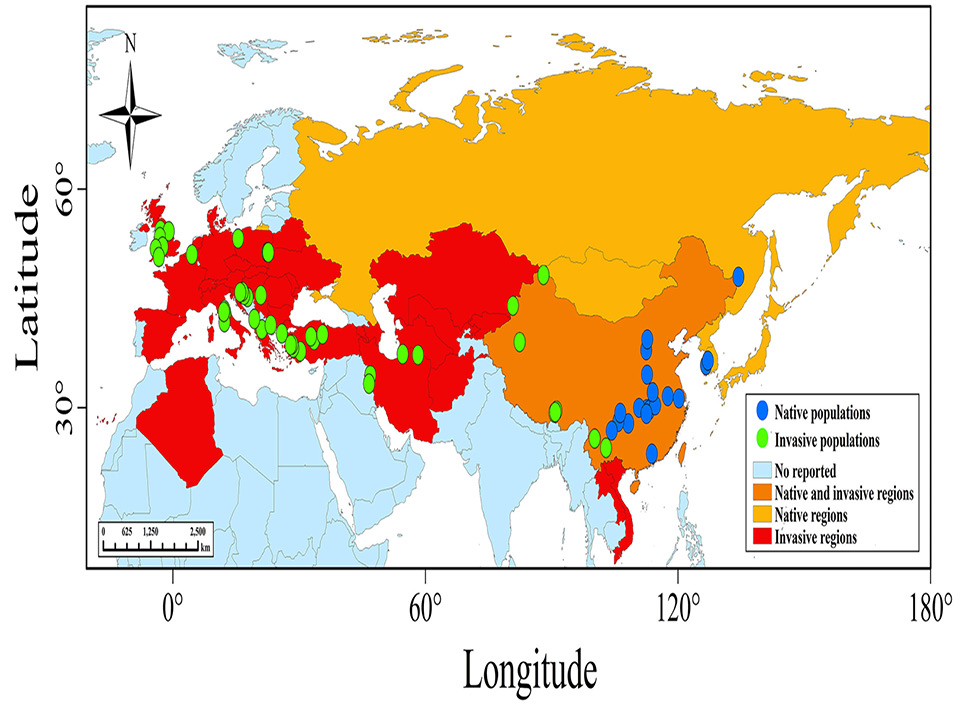
As a result of the distribution study in the Fishbase, Pseudorasbora parva (Temminck and Schlegel, 1842) was found in 43 countries (Froese and Pauly, 2022). In spite of the fact that China is classified as the source of this fish in Fishbase, vast swaths of western China have been invaded by this species and have caused great harm (Jia et al., 2019). In accordance with this, China was categorized as both a native and an invasive region (dark yellow range), whilst the Korean peninsula, Japan, Russia, and Mongolia were categorized as native regions (light yellow ranges) and others as invasive regions (red ranges). There have been reports of both native (blue solid circles) and invasive (green solid circles) length-weight relationships (LWRs) for this species in 12 different countries.
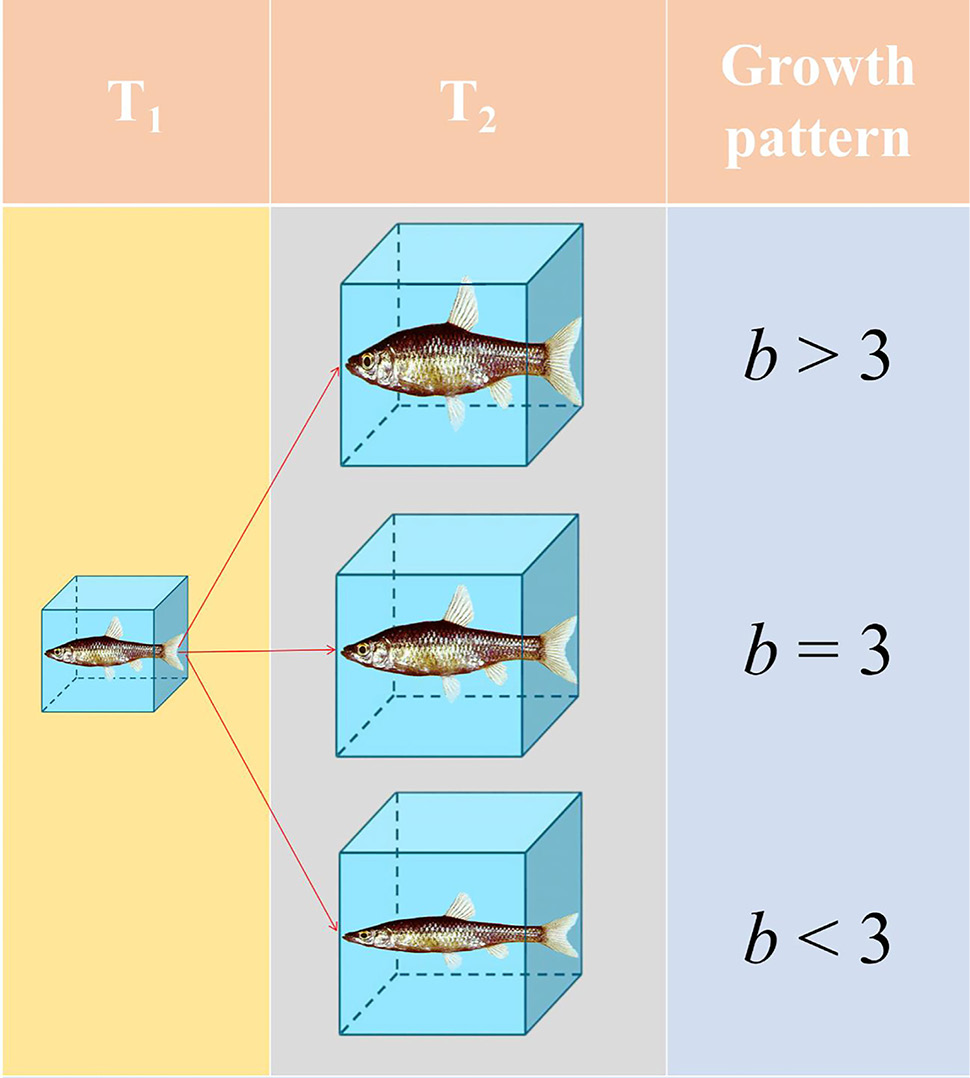
A simple diagram of three growth patterns. When a small fish (T1) grows to the assumed length of the large fish (T2). If b = 3, then this species is isometric growth, that is, T1 has the same form and condition as T2. If b > 3, then this species is positive-allometric growth, that is, T2 increases in relative body thickness or plumpness more than T1. If b < 3, then this species is negative-allometric growth, that is, body shapes of T2 are changed to become more elongated.
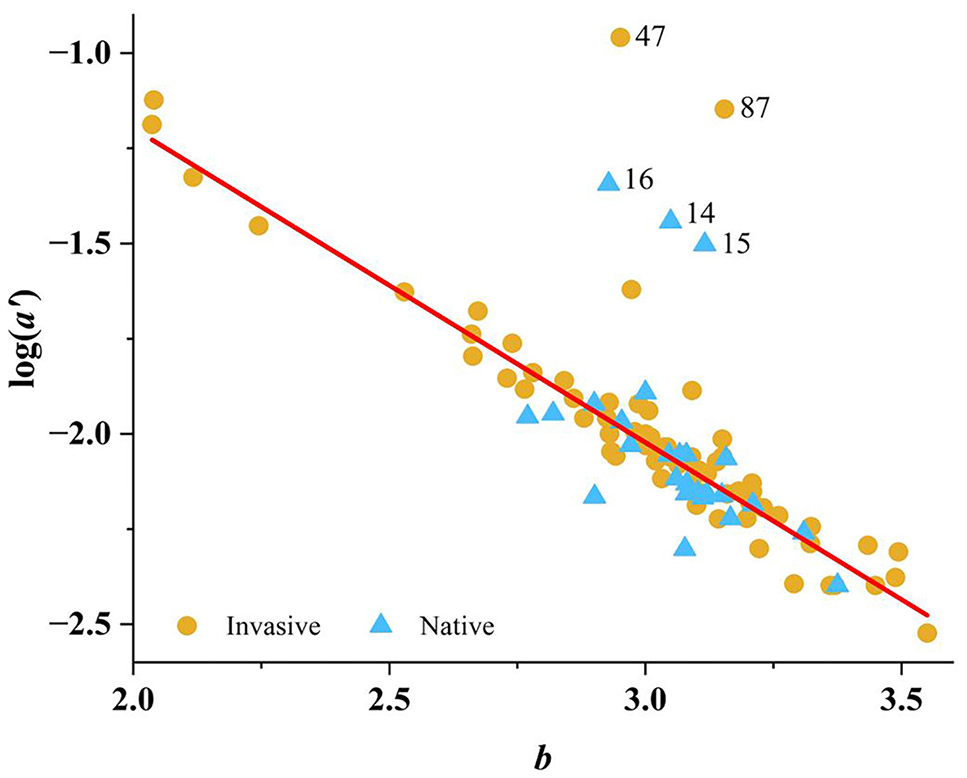
Plots of log (a’) vs b for 93 LWRs of P. parva. Five outliers were marked by row number of Supplementary Table I in the graphs, and eliminated in subsequent analysis. Regression line: log(a’) = 0.45 - 0.83b, n = 88, R2 = 0.84, P < 0.05.
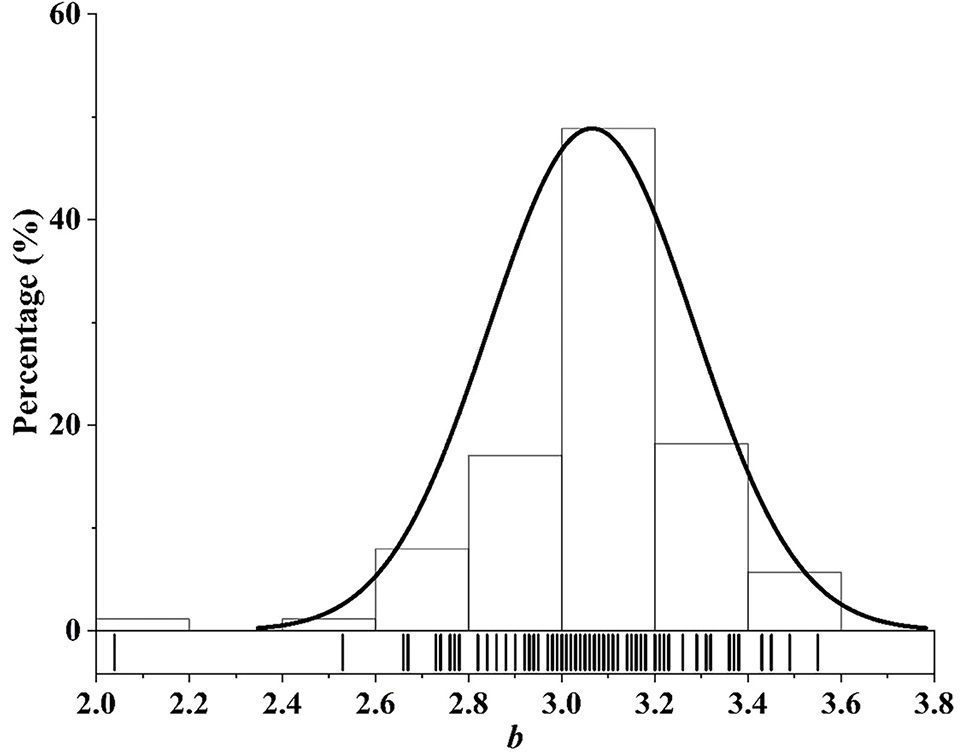
Frequency distribution of mean exponent b based on 88 records for P. parva, with 5th percentile = 2.70 and 95th percentile= 3.44. Gaussian distribution line was overlaid.
References
- AĞDamar, S., and Gaygusuz, Ö., 2021. Condition, length-length and length-weight relationships for four introduced freshwater fish species from an Insular Ecosystem (Gökçeada, Turkey). J. Anatol. Environ. Anim. Sci.., 6: 403–408.
- Arslan, P., and Özeren, S.C., 2019. Growth biology of the topmouth Gudgeon (Pseudorasbora parva)from Lake Mogan (Turkey). Ankara Üniv. Çevrebilimleri Dergisi., 7: 47–55.
- Arts, M. and Wainman, B., 1999. Lipids in freshwater ecosystems. Springer, New York. https://doi.org/10.1007/978-1-4612-0547-0[CrossRef]
- Asadi, H., Sattari, M., Motalebi, Y., Zamani-Faradonbeh, M., and Gheytasi, A., 2017. Length-weight relationship and condition factor of seven fish species from Shahrbijar River, Southern Caspian Sea basin, Iran. Iran J. Fish. Sci., 16: 733–741.
- Baek, S.H., Park, S.H., Kim, J.H., Yoon, J.H., Moon, J.S., Kim, D.H. and Yoon J.D., 2022. Length-weight relations of 12 freshwater fish species (Actinopterygii: Cypriniformes) including two endangered species, Cobitis choii (Cobitidae) and Gobiobotia naktongensis (Cyprinidae), in the Geum River, South Korea. Acta Ichthyol. Piscat., 52: 9–12.
- Baek, S.H., Park, S.H., Moon, J.S., and Kim, J.H., 2020. Length-weight relations for 16 freshwater fish species in the Han River, South Korea. Acta Ichthyol. Piscat., 50: 215–217. https://doi.org/10.3750/AIEP/02850[CrossRef]
- Bǎnǎrescu, P., 1964. Fauna republicii populare Romine: 13th edn. Acad. RPR, Bucuresti.
- Benzer, S., 2020. Ligula intestinalis infection of Pseudorasbora parva in Hirfanlı Dam Lake, Kırşehir, Turkey. J. Fish., 8: 762–767. https://doi.org/10.17017/j.fish.192[CrossRef]
- Benzer, S., and Benzer, R., 2020a. Growth and length-weight relationships of Pseudorasbora parva (Temminck and Schlegel, 1846) in Hirfanlı Dam Lake: Comparison with traditional and artificial neural networks approaches. Iran J. Fish. Sci., 19: 1089–1110.
- Benzer, S., and Benzer, R., 2020b. Growth properties of Pseudorasbora parva in Süreyyabey Reservoir: Traditional and artificial intelligent methods. Thalassas, 1: 149–156. https://doi.org/10.1007/s41208-020-00192-1[CrossRef]
- Bobori, D., Moutopoulos, D., Bekri, M., Salvarina, I., and Munoz, A., 2010. Length-weight relationships of freshwater fish species caught in three Greek lakes. J. biol. Res., 14: 219–224.
- Britton, J.R., and Davies, G.D., 2007. Length-weight relationships of the invasive topmouth gudgeon (Pseudorasbora parva) in ten lakes in the UK. J. appl. Ichthyol., 23: 624–626. https://doi.org/10.1111/j.1439-0426.2007.00870.x[CrossRef]
- Carlander, K.D., 1969: Handbook of freshwater fishery biology, Vol.1. The Iowa State University Press, Ames, IA. 752 pp.
- Carosi, A., Ghetti, L., and Lorenzoni, M., 2016. Status of Pseudorasbora parva in the Tiber River Basin (Umbria, central Italy) 20 years after its introduction. Knowl. Manage. Aquat. Ecosyst., 417: 1–11.
- Cuthbert, R.N., Pattison, Z., Taylor, N.G., Verbrugge, L., Diagne, C., Ahmed, D.A., Leroy, B., Angulo, E., Briski, E., Capinha, C., Catford, J.A., Dalu, T., Essl, F., Gozlan, R.E., Haubrock, P.J., Kourantidou, M., Kramer, A.M., Renault, D., Wasserman, R.J., Courchamp, F., 2021. Global economic costs of aquatic invasive alien species. Sci. Total. Environ., 775: 145238. https://doi.org/10.1016/j.scitotenv.2021.145238[CrossRef]
- Czerniejewski, P., Rybczyk, A., Linowska, A., and Sobecka, E., 2019. New location, food composition, and parasitic fauna of the invasive fish Pseudorasbora parva (Temminck & Schlegel, 1846) (Cyprinidae) in Poland. Turk. J. Zool., 43: 94–105. https://doi.org/10.3906/zoo-1806-26[CrossRef]
- Ding, H.P., 2014. Studies on the biology of exotic fishes in Chabalang wetland and their stresses on native fishes. MSc thesis, Huazhong Agricultural University, Wuhan, China. (in Chinese).
- Ding, H., Gu, X., Zhang, Z., Huo, B., Li, D., and Xie, C., 2018. Growth and feeding habits of invasive Pseudorasbora parva in the Chabalang Wetland (Lhasa, China) and its trophic impacts on native fish. J. Oceanol. Limnol., 37: 628–639. https://doi.org/10.1007/s00343-019-8004-5[CrossRef]
- Dong, X., Ju, T., Grenouillet, G., Laffaille, P., Lek, S., and Liu, J., 2020. Spatial pattern and determinants of global invasion risk of an invasive species, sharpbelly Hemiculter leucisculus (Basilesky, 1855). Sci. Total. Environ., 711: 134661. https://doi.org/10.1016/j.scitotenv.2019.134661[CrossRef]
- Esmaeili, H., and Ebrahimi, M., 2006. Length-weight relationships of some freshwater fishes of Iran. J. appl. Ichthyol., 22: 328–329. https://doi.org/10.1111/j.1439-0426.2006.00653.x[CrossRef]
- Fan, L. Q., Zhang, X. J., and Pan, G., 2015. Length-weight and length-length relationships for nine fish species from Lhasa River Basin, Tibet, China. J. appl. Ichthyol., 31: 807–808. https://doi.org/10.1111/jai.12760[CrossRef]
- Fei, J.H., 2012. Studies on the present condition of fish stocks and its spatial structure, growth characteristics in Erhai Lake. MSc thesis, Hangzhou Normal University, Hangzhou, China. (in Chinese).
- Fei, S.Z., Zhou, X.J., An, M., and Lin, Y.H., 2017. Study on the resource status of Pseudorasbora parva in Caohai Lake. J. Kaili Univ., 35: 75–77. (in Chinese).
- Fletcher, D.H., Gillingham, P.K., Britton, J.R., Blanchet, S., and Gozlan, R.E., 2016. Predicting global invasion risks: a management tool to prevent future introductions. Sci. Rep., 6: 26316. https://doi.org/10.1038/srep26316[CrossRef]
- Froese, R., 2006. Cube law, condition factor and weight-length relationships: History, meta-analysis and recommendations. J. appl. Ichthyol., 22: 241–253. https://doi.org/10.1111/j.1439-0426.2006.00805.x[CrossRef]
- Froese, R., and Pauly, D., 2000. Evaluating length-weight relationships. In: FishBase 2000: Concepts, design and data sources. ICLARM, Los Ban˜os, Laguna, Philippines.
- Froese, R., and Pauly, D., 2022. Fishbase (online). World wide web electronic publication. Available at http://www.fishbase.org/ (accessed 7 Feb 2022).
- Gozlan, R., 2002. Occurrence of the Asiatic cyprinid Pseudorasbora parva in England. J. Fish Biol., 61: 298–300. https://doi.org/10.1111/j.1095-8649.2002.tb01755.x[CrossRef]
- Gozlan, R., Andreou, D., Asaeda, T., Beyer, K., Bouhadad, R., Burnard, D., Caiola, N., Cakic, P., Djikanovic, V., Esmaeili, H.R., Falka, I., Golicher, D., Harka, A., Jeney, G., Kováč, V., Musil, J., Nocita, A., Povz, M., Poulet, N., Virbickas, T., Wolter, C., Tarkan, A.S., Tricarico, E., Trichkova, T., Verreycken, H., Witkowski, A., Zhang, C.G., Zweimueller, I. and Britton J.R., 2010. Pan-continental invasion of Pseudorasbora parva: towards a better understanding of freshwater fish invasions. Fish. Fish., 11: 12–33. https://doi.org/10.1111/j.1467-2979.2010.00361.x[CrossRef]
- Gozlan, R., St-Hilaire, S., Feist, S., Martin, P., and Kent, M., 2005. Biodiversity: Disease threat to European fish. Nature, 435: 1046. https://doi.org/10.1038/4351046a[CrossRef]
- Güçlü, S., and Küçük, F., 2021. Length-weight relationship of 15 different freshwater fish species in the Gediz River Basin (Turkey) Lentic System. Limno Fish., 7: 166–170.
- Han, W.H., 2020. Investigation of fish resources and analysis of nutrients and heavy metals in the Sanggan River. MSc thesis, Shanxi University, Shanxi, China (in Chinese).
- Hasankhani, M., Keivany, Y., Daliri, M., Pouladi, M., and Soofiani, N., 2014. Length-weight and length-length relationships of four species (Barbus lacerta Heckel, 1843), Oxynoemacheilus angorae (Steindachner, 1897), Squalius lepidus (Heckel, 1843) and Pseudorasbora parva (Temminck & Schlegel, 1846) from the Sirwan River (western Iran). J. appl. Ichthyol., 30: 206–207. https://doi.org/10.1111/jai.12319[CrossRef]
- Huang, P., Jia, M., Chai, L., Yu, H., Yu, X., and Wu, Z., 2014. Length-weight relationships for 11 fish species from the tributary of Amur River (Fuyuan, NE China). J. appl. Ichthyol., 30: 216–217. https://doi.org/10.1111/jai.12338[CrossRef]
- Huo, T. B., Jiang, Z. F., Karjan, A., Wang, Z. C., Tang, F. J., and Yu, H. X., 2012. Length-weight relationships of 23 fish species from the Ergis River in Xingjiang, China. J. appl. Ichthyol., 28: 152–153. https://doi.org/10.1111/j.1439-0426.2011.01899.x[CrossRef]
- Huo, T., Yuan, M., and Jiang, Z., 2011. Length-weight relationships of 16 fish species from the Tarim River, China. J. appl. Ichthyol., 27: 937–938. https://doi.org/10.1111/j.1439-0426.2010.01528.x[CrossRef]
- Ilhan, A., and Sari, H. M., 2015. Length-weight relationships of fish species in Marmara Lake, West Anatolia, Turkey. Ribarstvo, 73: 30–32. https://doi.org/10.14798/73.1.784[CrossRef]
- Innal, D., Ceren, D., and Özdemir, F., 2019. Fish species composition and length-weight relationships in Onaç Creek (Burdur-Turkey). Turk. Biol. Derg., 32: 135–142.
- Jia, Y., Kennard, M.J., Liu, Y., Sui, X., Chen, Y., Li, K., Wang, G. and Chen, Y., 2019. Understanding invasion success of Pseudorasbora parva in the Qinghai-Tibetan Plateau: Insights from life-history and environmental filters. Sci. Total Environ., 694: 133739. https://doi.org/10.1016/j.scitotenv.2019.133739[CrossRef]
- Kim, D.K., Jo, H., Lee, W., Park, K., and Kwak, I., 2020. Evaluation of length-weight relations for 15 fish species (Actinopterygii) from the Seomjin River basin in South Korea. Acta Ichthyol. Piscat., 50: 209–213. https://doi.org/10.3750/AIEP/02787[CrossRef]
- Kim, J.H., Yoon, J.D., Won, D.H., Byeon, M.S., and Jang, M.H., 2015. Length-weight relationships of 19 fish species from the Saemangeum Reservoir in South Korea. J. appl. Ichthyol., 31: 951–953. https://doi.org/10.1111/jai.12825[CrossRef]
- Kırankaya, Ş., Ekmekçi, F., Yalcin Ozdilek, S., Yoğurtçuoğlu, B., and Gencoglu, L., 2014. Condition, length-weight and length-length relationships for five fish species from hirfanli reservoir, Turkey. J. Fish. Sci., 8: 208–213.
- Kottelat, M., and Freyhof, J., 2007. Handbook of European freshwater fish: Kottelat, cornol and Freyhof, Berlin.
- Li, H.J., Wang, Y.P., Leng, Q.L., Li, X.J., Li, X.F., Yu, T.L. and Huang, B., 2017. Study on the age and growth of Pseudorasbora parva from Nanwan lake upstream the Huaihe river. Acta Hydrobiol. Sin., 41: 835–842. (in Chinese).
- Li, Q., Xu, X.L., and Huang, J.R., 2014. Length-weight relationships of 16 fish species from the Liuxihe national aquatic germplasm resources conservation area, Guangdong, China. J. appl. Ichthyol., 30: 434–435. https://doi.org/10.1111/jai.12378[CrossRef]
- Lin, F., Zhang, J., Fan, L.Q., Li, S.Q., and Zhou, Q.H., 2017. Length-weight relationship of 12 fish species from the Lhasa River and surrounding area in Tibet, China. J. appl. Ichthyol., 33: 1047–1050. https://doi.org/10.1111/jai.13419[CrossRef]
- Liu, F., Cao, W., and Wang, J., 2014. Length-weight relationships of 77 fish species from the Chishui River, China. J. appl. Ichthyol., 30: 254–256. https://doi.org/10.1111/jai.12288[CrossRef]
- Liu, K., Jing, L., Chen, Y.J., and Xu, D.P., 2016. Growth and mortality of topmouth gudgeon Pseudorasbora parvaand evaluation on resource utilization in Taihu Lake. J. Dalian Ocean Univ., 31: 368–373. (in Chinese).
- Milošević, D., and Mrdak, D., 2016. Length-weight relationship of nine fish species from Skadar Lake (Adriatic catchment area of Montenegro). J. appl. Ichthyol., 32: 1331–1333. https://doi.org/10.1111/jai.13163[CrossRef]
- Patimar, R., and Baensaf, S., 2012. Morphology, growth and reproduction of the non-indigenous topmouth gudgeon Pseudorasbora parva (Temminck et Schlegel, 1846) in the wetland of Alma-Gol, Northern Iran. Russ. J. Biol. Invasions, 3: 71–75. https://doi.org/10.1134/S2075111712010079[CrossRef]
- Petriki, O., Gousia, E., and Bobori, D., 2011. Weight-length relationships of 36 fish species from the River Strymon system (northern Greece). J. appl. Ichthyol., 27: 939–941. https://doi.org/10.1111/j.1439-0426.2010.01578.x[CrossRef]
- Piria, M., Fuka, M., Gavrilovic, A., Wan, S., Li, L., Tanuwidjaja, I., Tang, R., Zhao, H., Yang, Q. and Li, D., 2020. Length-weight relationships and condition between invasive and native populations of top mouth gudgeon Pseudorasbora parva. Paper presented at the 55th Croatian and 15th International Symposium on Agriculture, February 16-21, 2020, Vodice, Croatia.
- Pysek, P., Hulme, P.E., Simberloff, D., Bacher, S., Blackburn, T.M., Carlton, J.T., Dawson, W., Essl, F., Foxcroft, L.C., Genovesi, P., Jeschke, J.M., Kühn, I., Liebhold, A.M., Mandrak, N.E., Meyerson, L.A., Pauchard, A., Pergl, J., Roy, H.E., Seebens, H., Kleunen, M.V., Vilà, M., Wingfield, M.J. and Richardson, D.M., 2020. Scientists’ warning on invasive alien species. Biol. Rev. Camb. Philos. Soc., 95: 1511–1534. https://doi.org/10.1111/brv.12627[CrossRef]
- Qin, X., Lin, P., Li, S., Wang, X., Guo, Z., and Liu, H., 2017. Length-weight and length-length relationships of 26 fish species from the Yiluo River, a tributary of the Yellow River, China. J. appl. Ichthyol., 33: e13472. https://doi.org/10.1111/jai.13472[CrossRef]
- Radkhah, A., and Eagderi, S., 2015. Length-weight and length-length relationships and condition factor of six cyprinid fish species of Zarrineh River (Urmia Lake basin, Iran). Iran. J. Ichthyol., 2: 61–64.
- Rechulicz, J., 2011. Monitoring of the topmouth gudgeon, Pseudorasbora parva (Actinopterygii: Cypriniformes: Cyprinidae) in a Small Upland Ciemięga River, Poland. Acta Ichthyol. Piscat., 41: 193–199. https://doi.org/10.3750/AIP2011.41.3.07[CrossRef]
- Schiemer, F., 2000. Fish as indicators for the assessment of the ecological integrity of large rivers. Hydrobiologia, 422: 271-278. https://doi.org/10.1023/A:1017086703551[CrossRef]
- Seebens, H., Blackburn, T.M., Dyer, E.E., Genovesi, P., Hulme, P.E., Jeschke, J.M., Pagad, S., Pyšek, P. Winter, M., Arianoutsou, M., Bacher, S., Blasius, B., Brundu, G., Capinha, C., Celesti-Grapow, L., Dawson, W., Dullinger, S., Fuentes, N., Jäger, H., Kartesz, J., Kenis, M., Kreft, H., Kühn, I., Lenzner, B. and Essl, F., 2017. No saturation in the accumulation of alien species worldwide. Nat. Commun., 8: 14435. https://doi.org/10.1038/ncomms14435[CrossRef]
- Stavrescu Bedivan, M., Aioanei, F., and Scaeteanu, G., 2017. Length-weight relationships and condition factor of 11 fish species from the Timiş river, western Romania. Agric. For., 63: 281–285. https://doi.org/10.17707/AgricultForest.63.4.27[CrossRef]
- Sui, X.Y., Li, X.Q., Sun, H.Y., and Chen, Y.F., 2015. Length-weight relationship of 13 fish species from the Ili River, China. J. appl. Ichthyol., 31: 1155–1157. https://doi.org/10.1111/jai.12818[CrossRef]
- Tang, J., Ye, S., Liu, J., Zhang, T., Zhu, F., Guo, Z.Q. and Li, Z.J., 2013. Composition and length-weight relationships of fish species in Lake Erhai, southwestern China. J. appl. Ichthyol., 29: 1179–1182. https://doi.org/10.1111/jai.12188[CrossRef]
- Verreycken, H., Thuyne, G., and Belpaire, C., 2011. Length-weight relationships of 40 freshwater fish species from two decades of monitoring in Flanders (Belgium). J. appl. Ichthyol., 27: 1416–1421. https://doi.org/10.1111/j.1439-0426.2011.01815.x[CrossRef]
- Wang, T., Wang, H.S., Sun, G.W., Huang, D. and Shen, J.H., 2012. Length-weight and length-length relationships for some Yangtze River fishes in Tian-e-zhou Oxbow, China. J. appl. Ichthyol., 28: 660–662. https://doi.org/10.1111/j.1439-0426.2012.01971.x[CrossRef]
- Xie, J., Kang, Z., Yang, J. and Yang, D., 2015. Length-weight relationships for 15 fish species from the Hunan Hupingshan National Nature Reserve in central China. J. appl. Ichthyol., 31: 221–222. https://doi.org/10.1111/jai.12465[CrossRef]
- Xiong, W., Sui, X., Liang, S.H., and Chen, Y., 2015. Non-native freshwater fish species in China. Rev. Fish Biol. Fish., 25: 651–687. https://doi.org/10.1007/s11160-015-9396-8[CrossRef]
- Xue, G., 2020. Distribution and health risk assessment of heavy metals in fish of Taiyuan segment of Fenhe River. MSc thesis, Shanxi University. (in Chinese).
- Yan, Y.Z., 2005. Adaptive evolution in life-history strategies of invasive fishes in Lake Fuxian. MSc thesis, Institute of Hydrobiology, Chinese Academy of Sciences, Wuhan, China (in Chinese).
- Yang, Z., Tang, H., Que, Y., Xiong, M., Zhu, D., Wang, X. and Qiao Y., 2016. Length-weight relationships and basic biological information on 64 fish species from lower sections of the Wujiang River, China. J. appl. Ichthyol., 32: 386–390. https://doi.org/10.1111/jai.13016[CrossRef]
- Ye, S., Li, Z., Feng, G., and Cao, W., 2007. Length-weight relationships for thirty fish species in Lake Niushan, a Shallow Macrophytic Yangtze Lake in China. Asian Fish. Sci., 20: 217–226. https://doi.org/10.33997/j.afs.2007.20.2.007[CrossRef]
Supplementary material
Cited by 1 article
In journals published by ResearchersLinks.
Services
Article usage statistics
Loading…