
As one of the main driving factors of biodiversity loss, biological invasion has attracted wide attention. Among the many scientific issues in this field, the most noteworthy one is to figure out the ecological mechanisms behind successful invasions since relevant knowledge is extremely important for conservation and management, but we still know very little about that to some species. In view of this, the notorious sharpbelly Hemiculter leucisculus (Basilewsky, 1855) was selected as the research object, by analyzing the difference between its fitness in the native habitats and the invaded habitats at global scale through data integration technology and body length-weight relationships, this study attempted to reveal the ecological mechanisms underlying the global rapid successful invasion of this invasive species. The results showed that the fitness of the invasive populations was higher than the native populations (t = 3.85; P < 0.05). Based on the above, this study put forward a series of measures and suggestions for prevention and control so as to mitigate the potential harm of its further dispersal in the near future.
Research Article · Volume 58, Issue 1, 20 December 2025 · Open Access
Better Fitness of Sharpbelly, Hemiculter leucisculus (Basilewsky, 1855) in Invaded Habitats: Evidence from Body Length-Weight Relationships Across the World
· · · · · · · · · · · ·
Affiliations & Notes ⌄
- 1College of Animal Science, Guizhou University, Guiyang, 550025, China 2Guangxi Academy of Marine Sciences, Guangxi Academy of Sciences, Nanning, 530007, China 3College of Forestry, Guizhou University, Guiyang, 550025, China 4Nanjing Institute of Geography and Limnology, Chinese Academy of Sciences, Nanjing, 210008, China 5Institute for Ecological Research and Pollution Control of Plateau Lakes, School of Ecology and Environmental Science, Yunnan University, Kunming, 650500, China * Corresponding
Article Info ⌄
- Journal:
- Pakistan Journal of Zoology
- Published:
- 20 December 2025

Abstract
Introduction
With the continuation of global climate change, international trade and transportation industry development, biological invasion has become the second factor leading to global biodiversity loss ; ; . Generally, biological invasion means the process that a species was transferred from its original habitat to a new habitat which is outside the biogeographical barrier by natural or anthropogenic assistances, and formed breeding populations in the new habitat, and afterward caused adverse impacts on the local biodiversity, agricultural, and forestry production as well as human health, or ecological disasters . Compared with terrestrial ecosystems, aquatic ecosystems are more vulnerable to alien species invasion .
The sharpbelly Hemiculter leucisculus (Basilewsky, 1855) is a small freshwater fish belonging to Cypriniformes, Cyprinidae, Culterinae ; , and usually dwells in the middle and upper layers of lakes, rivers, and reservoirs. It mainly feeds on invertebrates and phytoplankton. It can be sexually mature at the age of 1 year, spawns from April to October, with peak period of May and June, and its body length is usually 10–14 cm (https://fishbase.mnhn.fr/search.php; . This cyprinid is native to China, Mongolia, Russia, Vietnam, and the Korean Peninsula . However, due to improper management during introduction, it has spread beyond its native range to many regions including Georgia, Afghanistan, Iran, Iraq, Kazakhstan, Uzbekistan, Turkmenistan, and Azerbaijan ; ; . In addition, this fish also possesses typical characteristics of invasive species , 2016). For example, on the one hand, its life history pattern is r type, i.e. it shows short life span, fast growth rate, early sexual maturity, long breeding period, high fertility, and batch spawning. On the other hand, it also shows a certain degree of plasticity, e.g. with the change of climate or geographical environment, it can not only produce eggs with different ecological types, but also make its own brain grow with different patterns ; ; ; ; . Therefore, some studies even made a bold prediction that, with the continuation of global climate change and increase of human activities, the areas with high invasion risk by this fish will spread all over the world except Antarctica . In light of this species’ strong invasive potential, it is reasonable to speculate that it may have higher fitness in the invaded habitats than the native habitats.
However, after a systematic review and anatomizing of the existing works on this fish all over the world, it is not hard to find that they still just focused on its basic biology , ecology ; , physiology , behavior , molecular biology , phylogeny and adaptive evolution ; , phylogeography or zoogeography ; , environmental toxicology ; as well as morphology and population genetics ; ; . By far, comparative research on the difference between its fitness in the native habitats and the invaded habitats has not been reported.
In view of this, by integrating the body length-weight data of H. leucisculus around the world and comparatively analyzing that data in both the native habitats and the invaded habitats, we attempted to uncover the ecological mechanisms behind the global rapid successful invasion of this species, and provide basic data or science and technology support for the scientific management of H. leucisculus and other similar invasive species.
Materials and Methods
Data collection
The body length-weight relationships data of H. leucisculus were collected by retrieving with the key words Hemiculter leucisculus, body length-weight relations, total length, and body length, etc. in both English and Chinese databases including the Web of Science (https://www.webofscience.com/wos), Google Scholar (https://scholar.google.com), and China National Knowledge Infrastructure (https://www.cnki.net), and data types include journal articles, dissertations, government reports and materials. By statistics, 71 valid records were initially gleaned, of which 45 and 26 were in the native areas and the invaded areas, respectively (Supplementary materials). The spatial distribution of relevant research sites is shown in Figure 1.
Data cleansing
Before taking next steps, this study cleansed the data obtained previously in order to get more reliable information or results. To be specific, firstly, we removed the records that were duplicative, obviously incorrect, and incomplete with key information (e.g. sampling location and time, sample sizes, body length-weight relationship, as well as length types and units); Secondly, using the equations a`cm= amm 10b and aTL= aLS (TL/LS)-b (if the relationship between total length and standard length or fork length is a proportional function) or aTL = aLS (2f/Lmax + g)-b (if that relationship follows the linear function TL = f + gLS), we standardized the a in the filtered body length-weight relationship into a’, so as to make the results of different studies with different body length types or units comparable to each other (i.e. unifying the body length in the body length-weight relationship into total length, and standardizing the units of body length and body weight into centimeter and gram, respectively). In the above formulas, LS is the standard length (SL) or fork length (FL) in the body length-weight relationship in the original records; TL is total length; aLS is the parameter corresponding to the length type before conversion; aTL is the parameter corresponding to the total length. Lmax is the maximum of standard length or fork length in the original studies. f and g are the regression intercept and slope, respectively, of the linear function describing the relationship between the total length and the standard length or the fork length . According to FishBase (https://fishbase.mnhn.fr/search.php) and relevant information , the conversion formulas of TL and FL, and, TL and SL for H. leucisculus in this study are TL/FL = 1.15 and TL = 0.02 + 1.19SL, respectively. Thirdly, based on the theoretical relationship between lg(a’) and b (Fig. 2), outliers (i.e. points outside the 95% confidence interval of the fitting line) are removed. Finally, a total of 48 data (36 and 12 from the native areas and the invaded areas, respectively) were obtained for following analysis.
Statistical analysis
Shapiro-Wilk and Levene tests were applied to evaluate normality and variance homogeneity of the b values of the body length-weight relationship of H. leucisculus populations, respectively. If the normal distribution and the variance homogeneity were both verified, an independent (single) sample t test was adopted; otherwise, non-parametric Mann-Whitney (Wilcoxon) tests were used to analyze whether there were significant differences between the b values of the native populations and the invasive populations (that two sets of b values and the theoretical value 3, respectively). All statistical analyses and graphics in this study were performed in ArcGIS 10.2 (Esri Co., USA) and OriginPro 2022 (OriginLab Corporation, USA). Unless otherwise specified, all statistics are expressed as mean ± standard error. The significance level (α) was set to 0.05 according to the past practice.
Results
Value ranges of b
The results showed that b values of H. leucisculus populations in the native habitats and the invaded habitats were 2.52–3.75 (3.07±0.05) and 3.00–3.54 (3.25±0.05), respectively (Table I). Both manifest normal distribution (W = 0.98; P > 0.05) and variance homogeneity (W = 2.53; P > 0.05).
Table I. b values of both the invasive populations and the native populations of H. leucisculus (CI represents confidence interval for the median of b; SE represents standard error).
| n | Min | Max | Mean | Median | SE | 95%CI | |
| Native | 36 | 2.52 | 3.75 | 3.07 | 3.03 | 0.05 | 2.98–3.16 |
| Invasive | 12 | 3.00 | 3.54 | 3.25 | 3.23 | 0.05 | 3.15–3.35 |
Difference analysis on the invasive populations and the native populations
The results showed that there was significant difference in b values between the invasive populations and the native populations (t = 3.85; P < 0.05; Fig. 3); the b values of the invasive populations were greater than 3 with significance (t = 5.35; P < 0.05), while the b values of the native populations were greater than 3 with no significance (t = 1.53; P > 0.05).
Discussion
Value range of b
The b value of fish’s body length-weight relationship should theoretically be within the range from 2.50 to 3.50 , with which our results are roughly consistent. However, we noticed that the b values in the Erlongshan reservoir of Jilin Province (3.62) and the Beijiang river of Guangdong Province (3.75) deviated far from the upper limit of the theoretical range. Looking up the primary data, it is not difficult to find that: due to the lack of food-competing fishes (e.g. silver carp Hypophthalmichthys molitrix (Valenciennes, 1844) and bighead carp Aristichthys nobilis (Richardson, 1845), H. leucisculus population in the Erlongshan reservoir is rich in food resources, which means better growth conditions, i.e. a larger b value. By contrast, because of sampling bias (the samples were all females with gonadal development stages of from IV to V), the b value in the Beijiang river had a large deviation from the theoretical value as well. This demonstrates that it is correct to cleanse the data after data collection or before further analysis, and hence our conclusions are reliable.
Fitness comparison between the native habitats and the invaded habitats
As mentioned above, the invasive populations’ b values (3.25 ± 0.05) were significantly greater than 3, and thus manifest positive allometry; the native populations’ b values (3.07 ± 0.05) were insignificantly greater than 3, and thus manifest isometry (Fig. 4). For this reason, it can be inferred that our previous conjecture is highly probably correct, i.e. H. leucisculus population may have better fitness in the invaded habitats than the native habitats. However, unlike previous studies, Lin et al. (2023) found that Pseudorasbora parva (Temminck and Schlegel, 1846) showed good fitness at both habitats. In contrast, Sun et al. (2023) discovered that Oreochromis niloticus (Linnaeus, 1758) owned poor fitness at both the native regions and the invaded regions, although the fitness in the latter is still higher than the former.
Management recommendations
Based on the results of this paper, we find that H. leucisculus has a strong invasion potential, which further supports the speculation that this fish may spread to new habitats in the near future. Hence, this study attempts to propose a series of adaptive management recommendations: (1) adopting new technologies (e.g. eDNA and eRNA) to conduct continuous monitoring on its global population dynamics; (2) attempting to analyze the mechanisms behind this fish’s rapid successful global invasion from other perspectives, e.g. the molecular level; (3) increasing input in the basic research on this fish so as to comprehensively understand its ecological habits; (4) enhancing transnational cooperation to achieve more coordinated and effective prevention and control.
Declarations
Acknowledgments
We would like to express our sincere appreciations to those anonymous reviewers who made contributions to this work for their valuable observations, comments, and recommendations, leading the huge improvement of the earlier draft of this paper. This study was founded by the Program Foundation for Talents of Guizhou University (No. [2021]65 and [2021]15), the Guizhou Provincial Science and Technology Projects (No. Yiban 104 2023 Qiankehe Jichu-ZK), the National Natural Science Foundation of China (No. 32102808), and the Basic Program of Guizhou University (No. [2023]14).
Supplementary material
There is supplementary material associated with this article. Access the material online at: https://dx.doi.org/10.17582/journal.pjz/20240420084908
Statement of conflict of interest
The authors declare that there is no conflict of interests regarding the publication of this article.
Figures
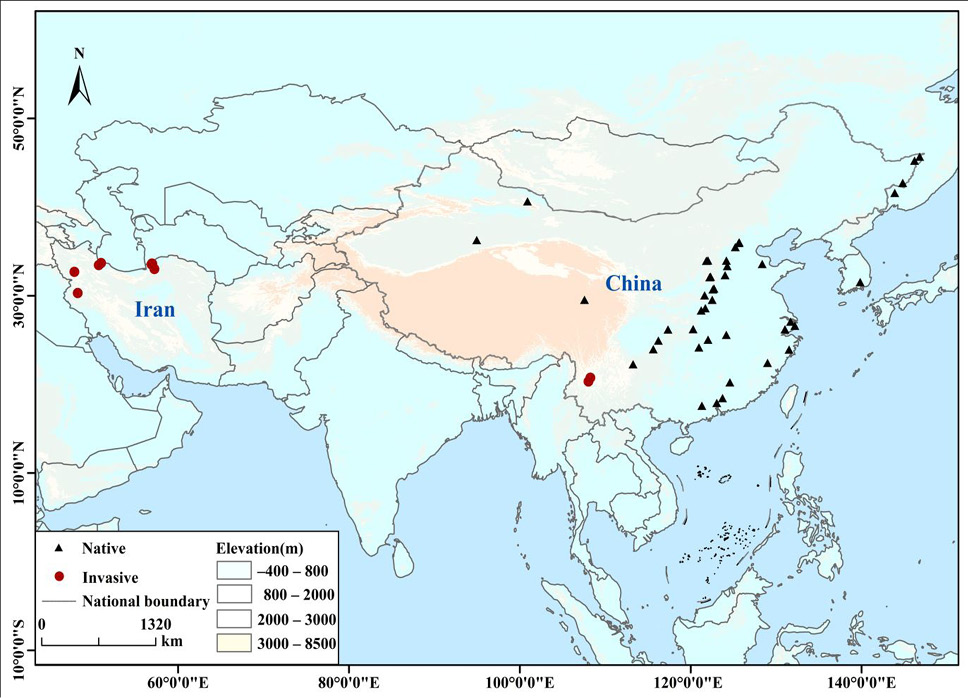
Map showing spatial distribution locations of Hemiculter leucisculus populations in the present study.
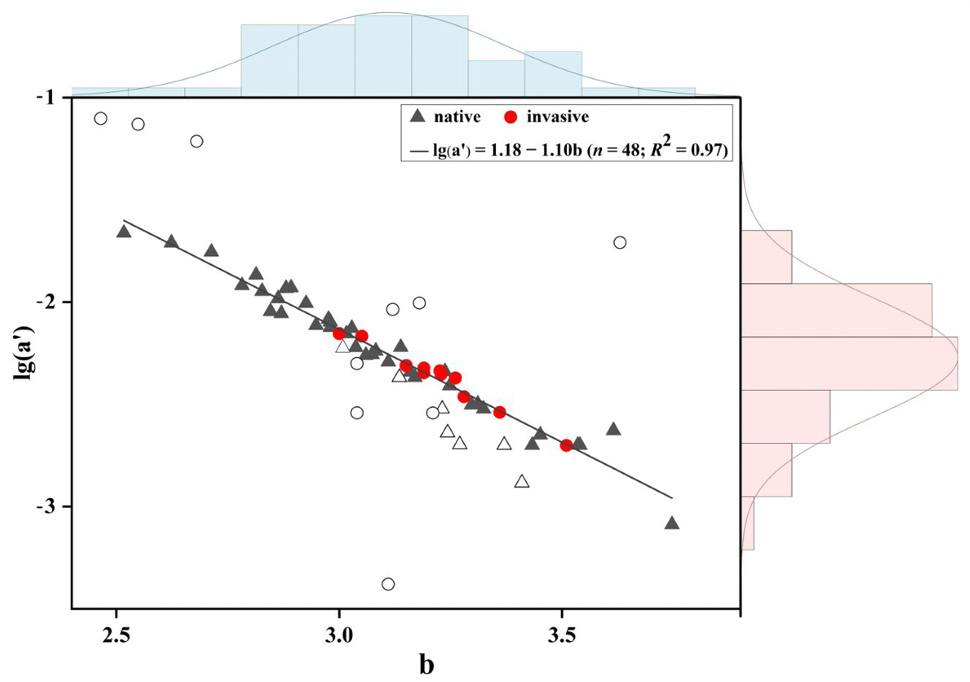
Regression relationship between lg(a’) and b in the body length-weight relationships for H. leucisculus (blank triangles represent the outliers in the data from the native areas; the blank circles represent the outlier in the data from the invaded areas; the blue parts represent the b-value frequency distribution histogram and the superimposed normal distribution curve; the pink parts represent the lg(a’) frequency distribution histogram and the superimposed normal distribution curve).
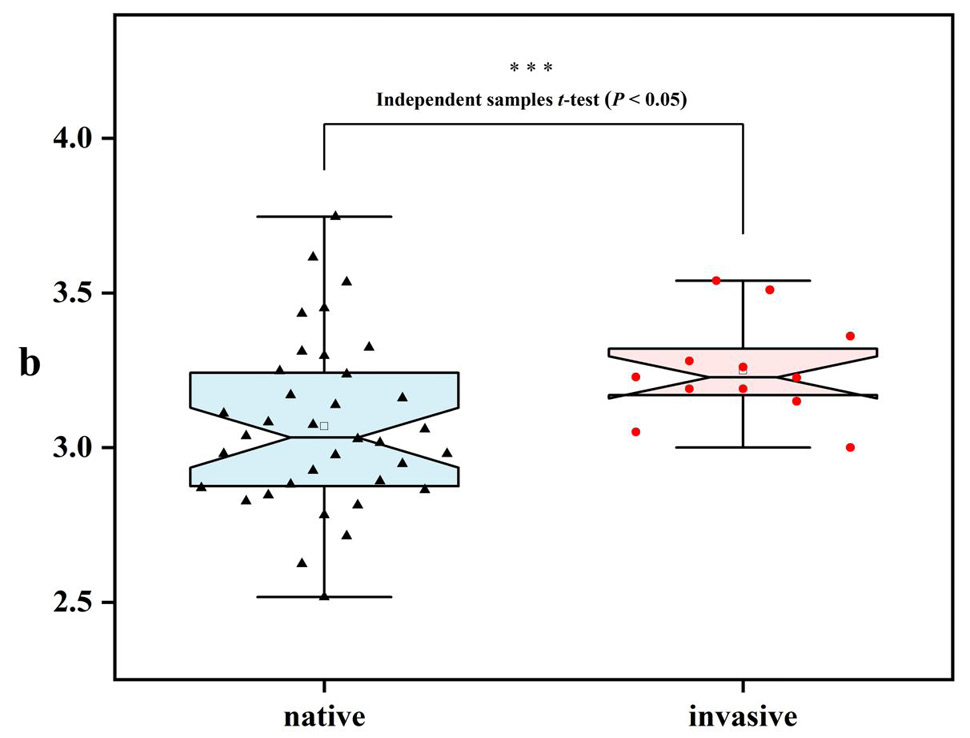
Difference analysis on the b values of both the invasive populations and the native populations of H. leucisculus (the blank boxes refer to the means).
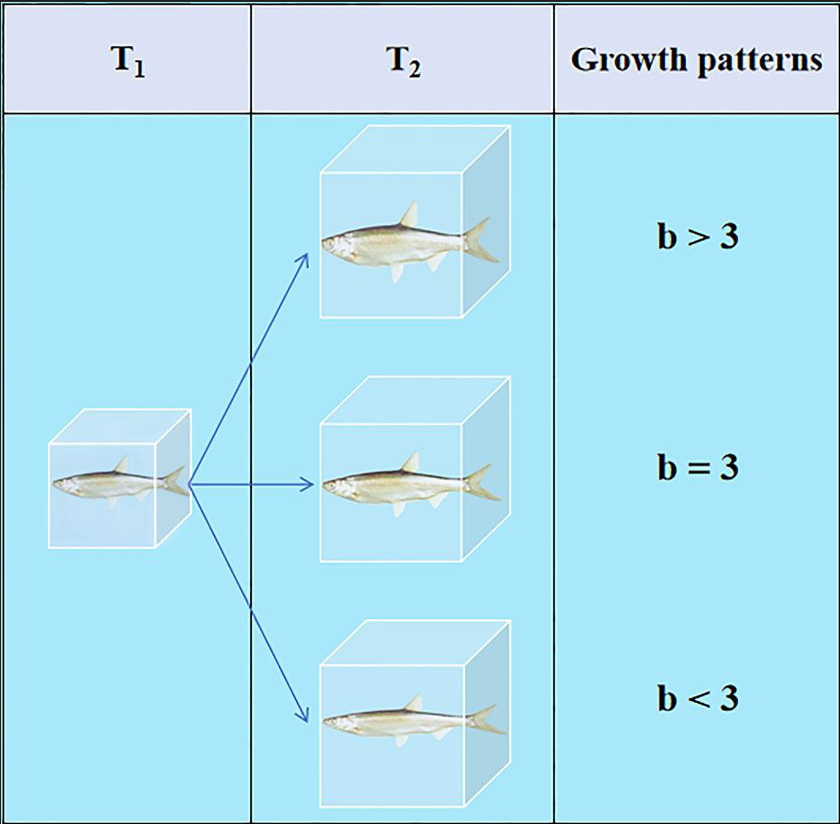
Growth patterns of H. leucisculus (The difference forms between the parameter b and 3 represent different growth patterns of the fish. When the fish grows from T1 to T2, that b = 3 means isometry, i.e. the fish is in the same shape and nutrient conditions during T2 and T1; b < 3 means negative allometry, i.e. the fish is thinner and in worse nutritional conditions during T2; b > 3 means positive allometry, i.e. the fish is thicker and in better nutritional conditions during T2. The differences between b values in different populations reflect the suitability of different habitats to the species).
References
- Carlander, K.D., 1977. Handbook of freshwater fishery biology, Vol. 2. The Iowa State University Press, Ames, IA. p. 431.
- Chen, Y.Y., Luo, Y.L. and Chen, Y.R., 1998. Fauna sinica osteichthyes: Cypriniformes (II). pp. 163–171. (in Chinese).
- Cho, H.G., Kim, B.J. and Choi, Y., 2012. Hemiculter eigenmanni (Jordan and Metz, 1913), a junior synonym of H. leucisculus (Basilewsky, 1855) (Cypriniformes: Cyprinidae). Korean J. Ichthyol., 24: 287–291.
- Dong, X.H., Ju, T., Grenouillet, G., Laffaille, P., Lek, S. and Liu, J.S., 2020. Spatial pattern and determinants of global invasion risk of an invasive species, sharpbelly Hemiculter leucisculus (Basilesky, 1855). Sci. Total Environ., 711: 134661. https://doi.org/10.1016/j.scitotenv.2019.134661[CrossRef]
- Duenas, M.A., Hemming, D.J., Roberts, A. and Diaz-Soltero, H., 2021. The threat of invasive species to IUCN-listed critically endangered species: A systematic review. Glob. Ecol. Conserv., 26: e01476. https://doi.org/10.1016/j.gecco.2021.e01476[CrossRef]
- Early, R., Bradley, B.A., Dukes, J.S., Lawler, J.J., Olden, J.D., Blumenthal, D.M., Gonzalez, P., Grosholz, E.D., Ibañez, I. and Miller, L.P., 2016. Global threats from invasive alien species in the twenty-first century and national response capacities. Nat. Commun., 7: 12485. https://doi.org/10.1038/ncomms12485[CrossRef]
- Epitashvili, G., Japoshvili, B. and Mumladze, L., 2023. New records and range expansions of invasive fish species in Georgia. Bioinvasions Rec., 12: 1111–1120. https://doi.org/10.3391/bir.2023.12.4.23[CrossRef]
- FishBase, 2010. Available at http://www.fishbase.org. (accessed 7 April 2024).
- Froese, R., 2006. Cube law, condition factor and weight-length relationships: History, meta-analysis and recommendations. J. appl. Ichthyol., 22: 241–253. https://doi.org/10.1111/j.1439-0426.2006.00805.x[CrossRef]
- Guo, J.H., Mo, J.Z., Qi, Q.J., Peng, J.L., Qi, G.Z., Kanerva, M., Iwata, H. and Li, Q., 2021. Prediction of adverse effects of effluents containing phenolic compounds in the Ba River on the ovary of fish (Hemiculter leucisculus) using transcriptomic and metabolomic analyses. Sci. Total Environ., 801: 149554. https://doi.org/10.1016/j.scitotenv.2021.149554[CrossRef]
- Huang, Y.F., Liu, L.G., Yang, C.Y., Yang, W.J., Zhou, Y. and Wu, M.Q., 2022. Life history traits of the sharpbelly Hemiculter leucisculus in a dammed tributary of the middle Yangtze River, China. Fish. Sci., 88: 751–765. https://doi.org/10.1007/s12562-022-01641-x[CrossRef]
- Huang, Y.Y. and Zeng, Y., 2016. Sexual dimorphism in the Chinese white fish Hemiculter leucisculus. Pakistan J. Zool., 48: 1595–1597.
- Hung, N.M., Dung, D.T., Anh, N.T.L., Van, P.T., Thanh, B.N., Ha, N.V., Hien, H.V. and Canh, L.X., 2015. Current status of fish-borne zoonotic trematode infections in Gia Vien district, Ninh Binh province, Vietnam. Parasit. Vector., 8: 1–10. https://doi.org/10.1186/s13071-015-0643-6[CrossRef]
- Khurshut, E., 2016. Hemiculter leucisculus (common sawbelly). CABI Compendium.
- Leuven, R.S.E.W., Boggero, A., Bakker, E.S., Elgin, A.K. and Verreycken, H., 2017. Invasive species in inland waters from early detection to innovative management approaches. Aquat. Invasions., 12: 269–273. https://doi.org/10.3391/ai.2017.12.3.01[CrossRef]
- Lin, G.C., Chen, X.Y., Shi, X.H., Li, X.L., Kamran, A.T., Wang, Z.X., Zhu, Q., Liang, G.D. and Pan, L., 2024. Length-weight relationships of Pseudorasbora parva (Temminck and Schlegel, 1842) around the world. Pakistan J. Zool., 56: 1895–1902. https://doi.org/10.17582/journal.pjz/20221012141044[Full text][CrossRef]
- Liu, M.Y., Jia, J., Wang, H. and Wang, L.H., 2022. Allometric model of brain morphology of Hemiculter leucisculus and its variation along climatic gradients. J. Anat., 241: 259–271. https://doi.org/10.1111/joa.13664[CrossRef]
- Lu, J.D., 2015. Influences of water flows on behavioral characteristics, the rate of oxygen consumption and blood physiological parameters aspect under different temperature conditions of Hemiculter leucisculus. MSc thesis, Nanjing Agricultural University, Nanjing, China. (in Chinese).
- Luo, C.Q., Chen, P., Zhu, J.B. and Ma, Z.M., 2022. The complete mitogenome of Hemiculter leucisculus (Basilewsky, 1855) in Hainan Island and its phylogenetic status. Mitochond. DNA B Resour., 7: 396–398. https://doi.org/10.1080/23802359.2022.2040390[CrossRef]
- Mustafayev, N.J., Ibrahimov, S.R. and Levin, B.A., 2015. Korean sharpbelly Hemiculter leucisculus (Basilewsky, 1855) (Cypriniformes, Cyprinidae) is a new species of Azerbaijan Fauna. Russ. J. Biol. Invasion., 6: 252–259. https://doi.org/10.1134/S2075111715040049[CrossRef]
- Pyšek, P., Hulme, P.E., Simberloff, D., Bacher, S., Blackburn, T.M., Carlton, J.T., Dawson, W., EssI, F., Foxcroft, L.C., Genovesi, P. and Jeschke, J.M., 2020. Scientists warning on invasive alien species. Biol. Rev., 95: 1511–1534. https://doi.org/10.1111/brv.12627[CrossRef]
- Qin, X.C., Lin, P.C., Li, S.Z., Wang, X.G., Guo, Z. and Liu, H.Z., 2017. Length-weight and length-length relationships of 26 fish species from the Yiluo River, a tributary of the Yellow River, China. J. appl. Ichthyol., 33: 1270–1273. https://doi.org/10.1111/jai.13472[CrossRef]
- Richardson, D.M., Pyšek, P. and Carlton, J.T., 2011. Fifty years of invasion ecology: The legacy of Charles Elton, Chapter 30. A compendium of essential concepts and terminology in invasion ecology. pp. 409–418. https://doi.org/10.1002/9781444329988.ch30[CrossRef]
- Sun, S.Y., Hu, Z.Y., Lu, Z.Y., Liu, L., Liu, X., Zhou, Q., Huo, B., Li, D.P. and Tang, R., 2022. Genetic diversity and population structure of Hemiculter leucisculus (Basilesky, 1855) in Xinjiang Tarim River. Gene, 13: 1790. https://doi.org/10.3390/genes13101790[CrossRef]
- Sun, W.Q., Shi, X.H., Lin, G.C., Chen, X.Y., Tanwari, K.A., Zhao, C.Y., Song, Y.T., Zhan, Q., Sun, L.H., Liu, X.H., Wang, Z.X., Pan, L. and Peng, C.D., 2023. Length-weight relationships of Oreochromis niloticus (Linnaeus, 1758) around the world. Pakistan J. Zool., Pages 1-17. https://doi.org/10.17582/journal.pjz/20230530080554[Full text][CrossRef]
- Sun, Z.H., 1987. The study of the biology of the Hemiculter leucisculus. J. Jlau., 9: 66–69. (in Chinese).
- Vasileva, E.D., Vasilev, V.P., Miroshnichenko, I.L. and Shedko, S.V., 2022. Taxonomy and phylogenetic relationships of Cyprinid Fish of genus Hemiculter (Cyprinidae, Xenocypridinae): Sharpbellies of the species group Hemiculter lucidus. J. Ichthyol., 62: 327–347. https://doi.org/10.1134/S0032945222030171[CrossRef]
- Wang, L.H., 2021. Study on population morphological differences and population genetics of Hemiculter (Cyprinidae: Culterinae). PhD thesis, Northwest A&F University, Shaanxi, China. (in Chinese).
- Wang, T., Huang, D., Zhao, Y., Wang, H., Hu, S. and Shen, J., 2013. Age, growth and mortality of invasive sharpbelly, Hemiculter leucisculus (Basilewski, 1855) in Erhai Lake, China. J. appl. Ichthyol., 29: 1279–1285. https://doi.org/10.1111/jai.12287[CrossRef]
- Wang, T., Jakovlić, I., Huang, D., Wang, J.G. and Shen, J.Z., 2016. Reproductive strategy of the invasive sharpbelly, Hemiculter leucisculus (Basilewsky 1855), in Erhai Lake, China. J. appl. Ichthyol., 32: 324–331. https://doi.org/10.1111/jai.13001[CrossRef]
- Wu, Q.J. and Yi, B.L., 1959. Preliminary ecological investigation of Hemiculter leucisculus in the Heilongjiang River Basin. J. Hydrobiol., 2: 157–169. (in Chinese).
- Zhang, C.G., Zhao, Y.H. and Xing, Y.C., 2016. Species diversity and distribution of inland fishes in China. pp. 47–60.
- Zhang, G.S., 2007. The effect of Lanthanum chloride and Fenoxaprop-p-ethyl on micronucleus and nuclear anomalies in erythrocytes of Hemiculter leucisculus. Aquat. Sci., 7: 408–410. (in Chinese).
Services
Article usage statistics
Loading…