
The West African lungfish, Protopterus annectens (Owen, 1839), is native to western, central, eastern and southern Africa. This species has been recently introduced to many countries and regions through the ornamental fish trade. Two individuals of West African lungfish were captured in August 2019 and we observed about twenty individuals occurred in the Poyang Lake, the largest freshwater lake in China. This is the first report of West African lungfish recorded in a natural ecosystem in China. Poyang Lake is an important region for agriculture and aquaculture in China but also has a high representation of natural biodiversity. Due to the influence of some large water conservancy projects and extreme climatic conditions, Poyang Lake has experienced severe drought in recent years. West African lungfish might be well tolerant to a seasonal drought environment and might pose threat to the native biodiversity of Poyang Lake due to its abilities of predation and tolerate to drought. More monitoring and management of West African lungfish should be conducted in Poyang Lake to protect it’s native biodiversity from this non-native fish.
Short Communication · Volume 57, Issue 2, 8 April 2025 · Open Access
The First Record of the Non-Native West African Lungfish, Protopterus annectens (Owen, 1839), in Poyang Lake, China
· · · ·
Affiliations & Notes ⌄
- 1Key Lab of Freshwater Biodiversity Conservation, Ministry of Agriculture and Rural Affairs of China, Yangtze River Fisheries Research Institute, Chinese Academy of Fishery Sciences, Wuhan, 430223, China 2College of Life Sciences, Hubei Normal University, Huangshi 435002, China 3Co-Innovation Center for Sustainable Forestry in Southern China, Nanjing Forestry University, Nanjing 210037, China 4Fishery Science Research Institute of Jiujiang, Jiujiang 332900,China * Corresponding author: haileyang1
Article Info ⌄
- Journal:
- Pakistan Journal of Zoology
- Published:
- 8 April 2025

From the article
- Two West African lungfish were collected in Poyang county (N28.925457, E116.382135).
- This non-native fish was likely introduced between 2015 and 2019, and could potentially establish a feral population in Poyang Lake.
- Recently, we observed this species being sold in some aquarium stores of big cities around Poyang Lake such as Nanchang and Jiujiang.
- Thus, this study is the first record that West African lungfish occurred in the wild environment of China.
Selected from the article's own text.
Abstract
Materials and methods
Fish sampling in Poyang Lake was conducted quarterly between January 2010 to October 2019. We implemented 40 surveys in Poyang Lake using dip nets (0.5 m in diameter, mesh size 1 mm), gill nets (20 × 10 m, mesh-size 5 mm) and electroshocking (CWB-2000 P, 12V, 250 Hz). In wetlands, fish sampled by two individuals using a dip net about 15 min. In lake periphery and bays, fish sampled by gillnet with about 12 h (from 18:00 to 6:00). In wetlands and lake periphery, fish sampled by electroshock fishing techniques about 15 min. For a detailed description of our sampling methods see Xiong et al. (2015b, 2017b). The fish sampled were identified according to morphology, and West African lungfish were identified with Kottelat et al. (1993) and Lerssutthichawal (2005). We caught a small patch of pectoral fin and stored in 95% alcohol, mitochondrial COI genes were sequenced in two individuals of fish sample specimens collected from Poyang Lake and base pairs were collected, molecular sequencing (COI) were conducted in laboratory .
Results
Two West African lungfish were collected in Poyang county (N28.925457, E116.382135). It has an elongate body, filamentous paired fins, and external gills located behind the gill slits and above the pectoral fins (Fig. 1). The morphometric and meristic characteristics of our specimens are shown in Table I. The molecular sequences were checked and matched 100% on NCBI database (Fig. 2).
Table I. Features of Protopterus annectens in August 2019 in the Poyang Lake.
| No | TL(mm) | SL(mm) | BW(g) |
| 1 | 210 | 195 | 19.52 |
| 2 | 175 | 160 | 15.03 |
TL, total length; SL, standard length; BW, body weight.
This collection is the first record of the species in a natural environment in China. During our survey in 2018 and 2019, about twenty individuals (about 500mm total length) of this species were observed in the weedy littoral areas of the lake preying on small endemic and endangered fishes, such as Pseudorasbora elongata, Luciobrama macrocephalus and Oryzias latipes, whish were listed in the China Species Red List . Frequent catches (one to four individuals catght in a month) of West African lungfish (about 20-700 mm total length) in Poyang Lake were mentioned by some local fishermen in the past three years (personal communication with local fisherman).
Discussion
Some researchers have investigated fish biodiversity in Poyang Lake, the West African lungfish was not reported from Poyang Lake until 2015 ; . This non-native fish was likely introduced between 2015 and 2019, and could potentially establish a feral population in Poyang Lake.
China is threatened by aquatic non-native species, with a great number of non-native fishes introduced for use in the ornamental fish trade (Xiong et al., 2015a, 2017a; . No-native species are one of the greatest threats to Chinese freshwater biodiversity , 2019), particularly in the Yangtze River watershed.
Although West African lungfish have been introduced into China for many years in the ornamental fish trade (Xiong et al., 2015a), there have been no previous reports of its having escaped and established populations elsewhere in China (Xiong et al., 2015a). Recently, we observed this species being sold in some aquarium stores of big cities around Poyang Lake such as Nanchang and Jiujiang. Non-native ornamental fish often dive in sewage pipes and eventually escape into natural waterbodies by uninternationally escaped . Thus, this study is the first record that West African lungfish occurred in the wild environment of China.
The Poyang Lake is an important region of Chinese freshwater fish biodiversity , including over 200 fish species, of which 131 are endemic . Many native fishes are threatened by the loss of wetland habitat caused by some large water conservancy projects (such as the Three Gorges Dam, the Gezhou Dam), drought, and global warming ; . West African lungfish can survive for long periods in dry environments by encasing their bodies in a thin layer of slime , which possibly enables the species to survive and successfully invade in the drought-prone environment of the Poyang Lake . West African lungfish prey on small fish, crustaceans, insects, mollusks and plants . In field investigations, we observed that West African lungfish are active predators on native locally endangered fish, such as Oryzias latipes . Therefore, we appeal to local government, fishermen and environmental protection organizations to work together to mitigate the potential risk of West African lungfish.
Acknowledgement
Special thanks to three anonymous reviewers whose comments greatly improved the manuscript. Thanks are also due to Professor Peter A Bowler who improved our manuscript.
Funding
This research was supported by the project (LFBC1004) of Key Lab of Freshwater Biodiversity Conservation Ministry of Agriculture and Rural Affairs of China,Yangtze River Fisheries Research Institute and the project ‘The investigation and protection research on the resources and spawning grounds of Coilia nasus in the Poyang Lake of Jiujiang City.
IRB approval
The Tab of Animal Experimental Ethical Inspection of Laboratory Animal Centre, Yangtze River Fisheries Research Institute, Chinese Academy of Fishery Sciences approved the study.
Ethical approval
This research was conducted in accordance with ethics committee procedures of animal experiments.
Sampling and field studies
All necessary permits for sampling and observational field studies have been obtained by the authors from the competent authorities and are mentioned in the acknowledgements, if applicable.
Data availability
All data generated or analyzed during this study are included in this article.
Statement of conflict of interest
The authors have declared no conflict of interest.
Figures
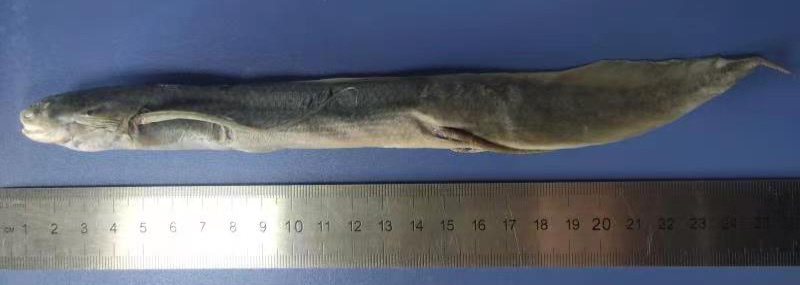
The West African lungfish (Protopterus annectens). Photo by Jinming Wu.
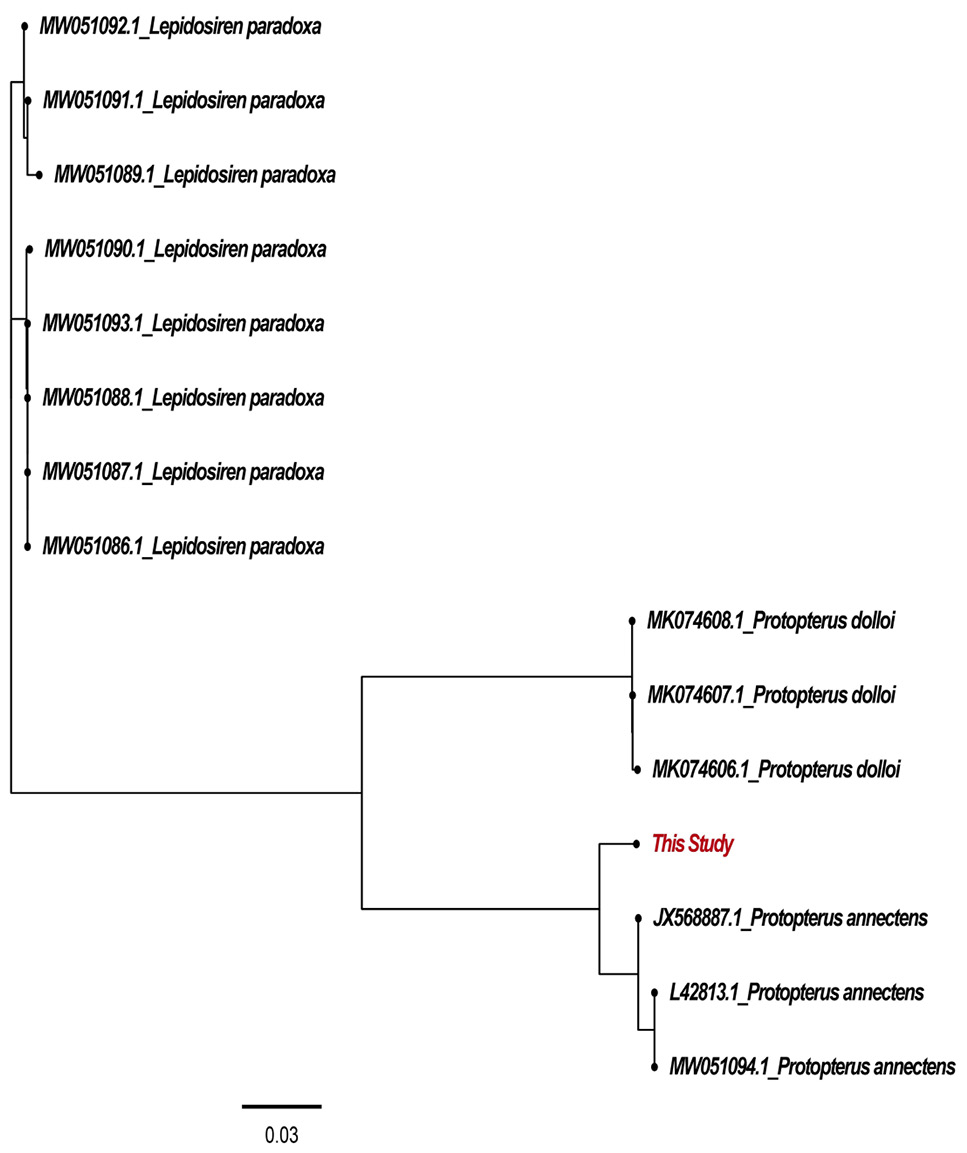
Neighbor-jointing tree for mitochondrial COI fragments for West African lungfish Protopterus annectens.
References
- Bueno, M.L., Magalhães, A.L.B., Neto, F.R.A., Alves, C.B.M., Rosa, D.M., Junqueira, N.T., Pessali, T.C., Pompeu, P.S. and Zenni, R.D., 2021. Biol. Invasions, 23: 3021-3034. https://doi.org/10.1007/s10530-021-02564-x[CrossRef]
- Chan, F.T., Beatty, S.J., Gilles, Jr A.S., Hill, J.E., Kozic, S., Luo, D., Morgan, D.L., Pavia, Jr. R.T.B., Therriault, T.W., Verreycken, H., Vilizzi, L., Wei, H., Yeo, D.C.J., Zeng, Y.W., Zieba, G. and Copp, G.H., 2019. Aquat. Ecosyst. Hlth., 22: 417-439. https://doi.org/10.1080/14634988.2019.1685849[CrossRef]
- Dankwa, H.R., Abban, E.K. and Teugels, G.G., 1999. Annls Musee R. L Afr. Cent. Sci. Zool., 283: 53.
- Gozlan, R.E., Britton, J.R., Cowx, I. and Copp, G.H., 2010. J. Fish Biol., 76: 751–796. https://doi.org/10.1111/j.1095-8649.2010.02566.x[CrossRef]
- Holden, M. and Reed, W., 1972. West African freshwater fish. West African Nature Handbooks, Longman Group Ltd., London. pp. 68.
- Huang, L.L., Wu, Z.Q. and Li, J.H., 2013. Environ. Biol. Fish, 96: 1229-1243. https://doi.org/10.1007/s10641-011-9806-2[CrossRef]
- Kottelat, M., Whitten, A.J., Kartikasari, S.N. and Wirjoatmodjo, S., 1993. Fresh-water fishes of Western Indonesia and Sulawesi. Periplus Editions (HK) Ltd., Indonesia. pp. 221.
- Lerssutthichawal, T., 2005. Dis. Asian Aquacult., VI: 235-244.
- Lévêque, C. and Paugy, D., 2003. Protopteridae. P97-100. In: The fresh and brackish water fishes of west Africa Volume 1 (eds. D. Paugy, C. Lévêque and G.G. Teugels). Paris, France and Musée royal de l’Afrique Central, Tervuren, Belgium, pp. 457.
- Liu, W., Zhu, S., Huang, Y., Wan, Y., Wu, B. and Liu, L., 2020. Sustainability, 12: 3526. https://doi.org/10.3390/su12093526[CrossRef]
- Mei, X., Dai, Z., Du, J. and Chen, J., 2015. Sci. Rep., 5: 18197. https://doi.org/10.1038/srep18197[CrossRef]
- Naylor, R.L., Williams, S.L. and Strong, D.R., 2001. Science, 294: 1655–1666. https://doi.org/10.1126/science.1064875[CrossRef]
- Okeyo, D.O., 1998. Naga, ICLARM., 21: 44-53.
- Olson, D. and Dinerstein, E., 1998. Conserv. Biol., 12: 502–515. https://doi.org/10.1046/j.1523-1739.1998.012003502.x[CrossRef]
- Pyšek, P. and Richardson, D.M., 2010. Annu. Rev. Env. Resour., 35: 25–55. https://doi.org/10.1146/annurev-environ-033009-095548[CrossRef]
- Strayer, D.L., 2010. Freshw. Biol., 55: 152–174. https://doi.org/10.1111/j.1365-2427.2009.02380.x[CrossRef]
- Walakira, J.K., Molnar, J.J., Phelps, R. and Terhune, J., 2014. Uganda J. agric. Sci., 15: 137-155.
- Wang, H., Wang, Q., Bowler, P.A. and Xiong, W., 2016. Aquat. Invasions, 11: 1-9. https://doi.org/10.3391/ai.2016.11.1.01[CrossRef]
- Wang, H., Xiao, K., Wu, Z., Chen, J., Xiong, W., Wang, Z,. Wang, Q., Zhu, H. and Bowler, P.A., 2020. BioInvasions Rec., 9: 618-626. https://doi.org/10.3391/bir.2020.9.3.17[CrossRef]
- Wang, S. and Xie, Y., 2004. China species red list. Higher Education Press, Beijing.
- Valdez-Moreno, M., Ivanova, N.V., Elias-Gutierrez, M., Contreras-Balderas, S. and Hebert, P.D.N., 2009. Probing diversity in freshwater fishes from Mexico and Guatemala with DNA barcodes. J. Fish Biol., 74: 377-402.
- Xiong, W., Shen, C., Wu, Z., Lu, H. and Yan, Y., 2017a. Aquat. Invasions, 12: 109-115. https://doi.org/10.3391/ai.2017.12.1.11[CrossRef]
- Xiong, W., Sui, X.Y., Liang, S.H. and Chen, Y.F., 2015a. Rev. Fish Biol. Fisher., 25: 651–687. https://doi.org/10.1007/s11160-015-9396-8[CrossRef]
- Xiong, W., Tao, J., Zhang, D.C., Liu, C.L., He, D.K. and Chen, Y.F., 2015b. J. appl. Ichthyol., 31: 219-220. https://doi.org/10.1111/jai.12484[CrossRef]
- Xiong, W., Wang, H., Wang, Q., Tang, J., Bowler, P.A., Xie, D., Pan, L. and Wang, Z.X., 2018a. BioInvasions Rec., 7: 153-158. https://doi.org/10.3391/bir.2018.7.2.06[CrossRef]
- Xiong, W., Wang, Q., Xie, D., Fletcher, D.H., He, D.K., 2018b. Knowl. Manage. Aquat. Ecosyst., 419: 6. . https://doi.org/10.1051/kmae/2017054[CrossRef]
- Xiong, W., Xie, D., Chen, G. and He, D., 2019. Aquat. Ecosyst. Hlth., 22: 160-170. https://doi.org/10.1080/14634988.2019.1632666[CrossRef]
- Xiong, W., Xie, D., Wang, Q., Wang, H., Wu, Z.G., Sun, H.Y. and Bowler, P.A., 2023. Non-native species in Poyang Lake Basin: Status, threats and management. Aquatic Invasions AQUAINV-S-23-00001.
- Xiong, W., Zhu, J., Jin, L. and Zhang, J.Q., 2017b. J. appl. Ichthyol., 33: 1240-1241. https://doi.org/10.1111/jai.13439[CrossRef]
- Zeng, Z., 2014. Studies on diversity, age and growth of fishes in sublakes of Poyang Lake National Nature Reserve, Jiangxi China. Master’s Thesis, Nanchang University, China.
Services
Article usage statistics
Loading…