
This study presents 49 length-weight relationships gathered from literature and our investigation pertaining to Gambusia affinis and G. holbrooki. The value of the slope b ranged from 2.44 for male G. holbrooki in Tajan River (Iran) to 3.81 for combined G. holbrooki in reservoirs of Segura River basin (Spain). The mean value of b was 3.11 (SD =0.30), which significantly higher than 3 (t-test, p<0.05). The median value of b was 3.15 and 50% of the b values ranged between 2.95 and 3.31.
Short Communication · Volume 52, Issue 3, 21 March 2020 · Open Access
Length-Weight Relationship of the Invasive Mosquitofish
· · ·
Affiliations & Notes ⌄
- 1Pearl River Fisheries Research Institute, Chinese Academy of Fishery Sciences/ Key Laboratory of Recreational Fisheries, Ministry of Agriculture and Rural Areas, Guangzhou 510380, China 2College of Fisheries, Guangdong Ocean University, Zhanjiang 524088, China , * Corresponding author: chinaxiongwen@gmail.com
- 2huyc22@163.com
Article Info ⌄
- Journal:
- Pakistan Journal of Zoology
- Published:
- 21 March 2020

From the article
- Overall, 49 length-weight relationships (Supplementary Table 1) were gathered from literature and our investigation, referring to two mosquitofish, including female, male and combined.
- Thereinto, 25 length-weight relationships refer to G. holbrooki (6 females, 6male, and 13 combined), other 24 to G. affinis (6 females, 5 males and 13 combined).
- The value of the slope b in the plot of Log W against Log L ranged from 2.44 for male G. holbrooki in Tajan River (Iran) to 3.81 for combined G. holbrooki in reservoirs of Segura River basin (Spain).
Selected from the article's own text.
Abstract
Materials and methods
The study was carried out in some wetlands along side Donghu Lake (30°31′-30°36′N, 114°21′-114°28′E) in Wuhan, Hubei Province, central of the Yangtze River. West mosquitofish specimens were caught periodically every season from May 2012 to January 2013 (20-27 May, 15-22 August, 11-19 November 2012, and 22-30 January 2013). Captured by dip nets, they were measured to the nearest 0.1 cm (total length, L) and weighed to the nearest 0.01g (Weight, W). For detailed sampling methods see Xiong et al. (2015b). West mosquitofish were classified as males if they possessed any evidence of a gonopodium, and as females in the case of the absence of gonopodium. When this was not possible (usually TL<13mm), sex was determined by the direct observation of gonads. Length-weight relationship was calculated using the expression: W= aLb, where the W is the weight (g) and L the length (cm), the parameters a and b is the intercept (coefficient related to body
form) and the slope, respectively . The 95% confidence of limits of a and b were determined.
All length-weight relationships of two mosquitofish are the product of field studies conducted during 2004-2013 in freshwater and estuary of the world. For the majority of the original length-weight relationships (w=aLb), length was in cm and weight in g (43 relationships out 49; 88%), whereas for 6 (12%), length and weight were expressed in mm and g. For all length-weight relationships presented here, length has been expressed in cm and weight in g. Based on our field investigations and literature review, this study is the first report on preliminary length-weight relationship of mosquitofish in the world (Supplementary Table I).
Results and discussion
Overall, 49 length-weight relationships (Supplementary Table 1) were gathered from literature and our investigation, referring to two mosquitofish, including female, male and combined. Thereinto, 25 length-weight relationships refer to G. holbrooki (6 females, 6male, and 13 combined), other 24 to G. affinis (6 females, 5 males and 13 combined).
The value of the slope b in the plot of Log W against Log L ranged from 2.44 for male G. holbrooki in Tajan River (Iran) to 3.81 for combined G. holbrooki in reservoirs of Segura River basin (Spain). The mean value of b was 3.11 (SD =0.30), which significantly higher than 3 (t-test, p<0.05). The median value of b was 3.15 and 50% of the b values ranged between 2.95 and 3.31.
The plot of log a vs b for all known length-weight relationships of s species results in a species results in a linear relationship, and that this relationship can be used to identify outliers . We have applied this method to two mosquitofish (Fig. 1). This method led to the detection of outliers, where the respective point deviated more than two standard deviations from the regression line. These length-weight relationships were marked as “questionable” in Supplementary Table I.
Acknowledgments
This research was supported by the National Natural Science Foundation of China (No 31472016) and open fund of Key Laboratory of Recreational Fisheries, ministry of Agriculture and Rural Areas (2019N03). We acknowledge reviewers’ suggestive comments.
Supplementary material
There is supplementary material associated with this article. Access the material online at: https://dx.doi.org/10.17582/journal.pjz/20190422150443
Statement of conflict of interest
The authors report no conflicts of interest. The authors alone are responsible for the content and writing of the paper.
Figures
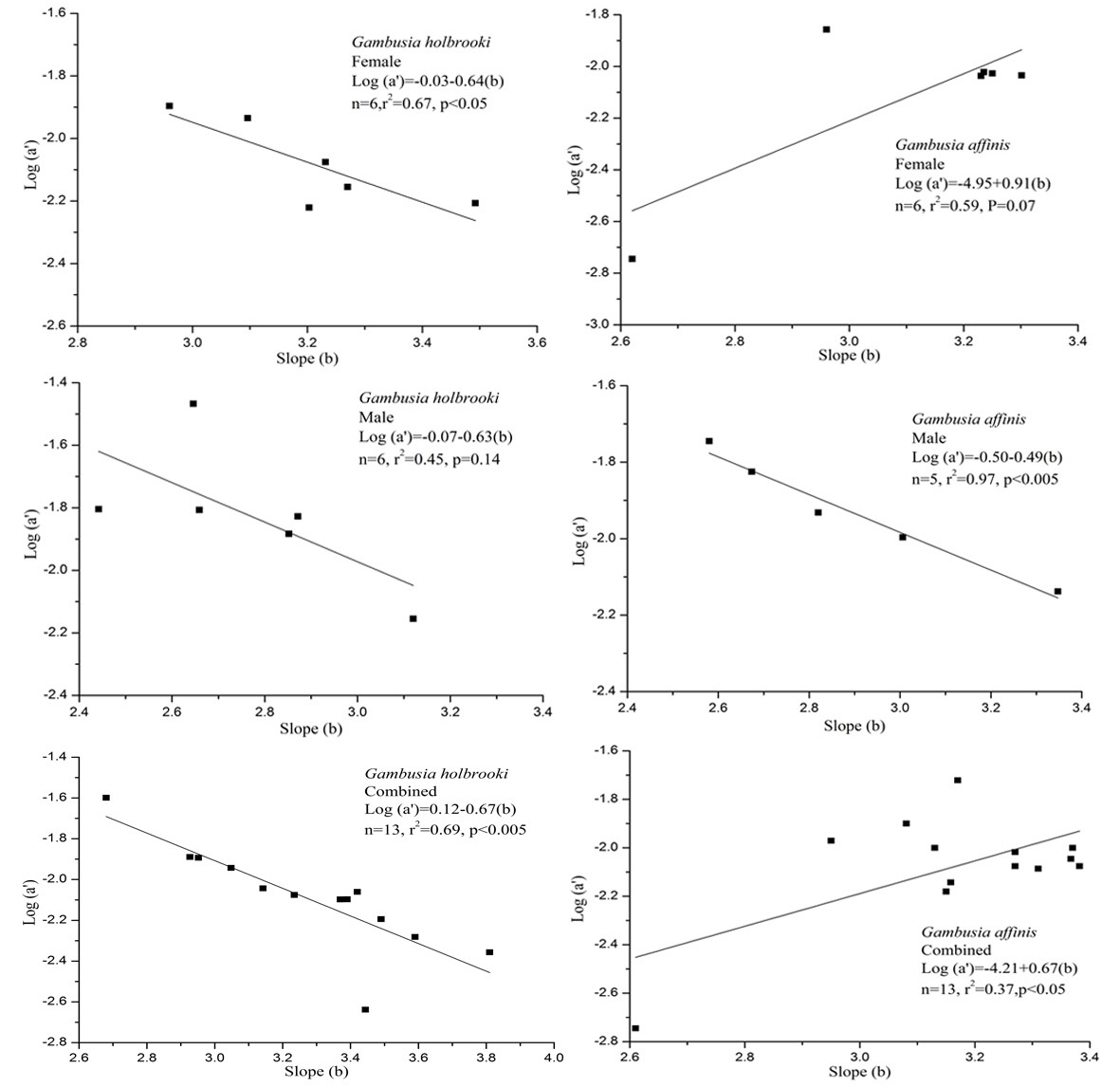
Plots of Log (a’) vs b for all available length-weight relationships of mosquitofish (G. holbrooki and G. affinis) in the world. Outliers are marked by number ‘3’ in Supplementary Table 1.
References
- Andreu-Soler, A., Oliva-Paterna, F.J. and Torralva, M., 2006. J. appl. Ichthyol., 22: 295-296. https://doi.org/10.1111/j.1439-0426.2006.00719.x[CrossRef]
- Cheng, Y., Xiong, W., Tao, J., He, D.K., Chen, K. and Chen, Y.F., 2018. BioInvasions Rec., 7: 309-318. https://doi.org/10.3391/bir.2018.7.3.13[CrossRef]
- Dudgeon, D. and Corlett, R.T., 1994. Hills and streams: An ecology of Hong Kong. Hong Kong University Press, Hong Kong.
- Dulcic, J. and Glamuzina, B., 2006. J. appl. Ichthyol., 22: 254-256. https://doi.org/10.1111/j.1439-0426.2006.00633.x[CrossRef]
- Erguden, S.A., 2013. Iran. J. Fish. Sci., 12: 204-218.
- Erguden, S.A. and Goksu, M.Z.L., 2009. J. appl. Ichthyol., 25: 501-502. https://doi.org/10.1111/j.1439-0426.2009.01231.x[CrossRef]
- Esmaeili, H.R. and Ebrahimi M., 2006. J. appl. Ichthyol., 22: 328-329. https://doi.org/10.1111/j.1439-0426.2006.00653.x[CrossRef]
- Froese, R., 2000. In: Fish Base 2000: concepts, design and data sources (eds. R. Froese and D. Pauly). ICLARM, Los Bauos, laguna, Philippines. pp. 133.
- Froese, R., 2006. J. appl. Ichthyol., 22: 241-253. https://doi.org/10.1111/j.1439-0426.2006.00805.x[CrossRef]
- Froese, R., Tsikliras, A.C. and Stergiou, K.I., 2011. Acta Ichthyol. Piscat., 41: 261-263. https://doi.org/10.3750/AIP2011.41.4.01[CrossRef]
- Gamradt, S.C. and Kats, L.B., 1996. Conserv. Biol., 10: 1155-1162. https://doi.org/10.1046/j.1523-1739.1996.10041155.x[CrossRef]
- Gilligan, D., 2010. The condition of freshwater fish assemblages in the bellinger catchment, NSW. A report to the Northern Rivers catchment management Authority. http://www.dpi.nsw.gov.au/__data/assets/pdf_file/0004/400495/AE_2011_Output-1805_Gilligan_Bellingen-Ecohealth-Report_REPORT.pdf
- Gkenas, C., Oikonomou, A., Economou, A., Kiosse, F. and Leonardos, I., 2012. J. Biol. Res., 17: 121-136.
- Goodsell, J.A. and Kats, L.B., 1999. Conserv. Biol., 13: 921-924. https://doi.org/10.1046/j.1523-1739.1999.98237.x[CrossRef]
- Gossman, B.P., 2005. Use of terraced marsh habitats by estuarine nekton in southwestern Louisiana. MS Thesis. University of Florida.
- Kimmerer, W., Avent, S.R. and Bollens, S.M., 2005. Trans. Am. Fish. Soc., 134: 481-495. https://doi.org/10.1577/T04-042.1[CrossRef]
- Koutrakis, E.T. and Tsikliras, A.C., 2003. J. appl. Ichthyol., 19: 258-260. https://doi.org/10.1046/j.1439-0426.2003.00456.x[CrossRef]
- Li Q., Xu R.L. and Huang J.R., 2013. Acta Ichthyol. Piscat., 43: 65-69. https://doi.org/10.3750/AIP2013.43.1.09[CrossRef]
- Li, Z.Y., Xie, Y., 2002. Invasive alien species in China. Forestry Press, Beijing.
- Moreno-Valcarcel, R., Oliva-Paterna, F.J., Arribas, C. and Fernandez-Delgado, C., 2012. J. appl. Ichthyol., 28: 663-664. https://doi.org/10.1111/j.1439-0426.2012.01933.x[CrossRef]
- Ozturk, S. and Ikiz, R., 2004. Turk. J. Vet. Anim. Sci., 28: 355-361.
- Petriki, O., Gousia, E. and Bobori, D.C., 2011. J. appl. Ichthyol., 27: 939-941. https://doi.org/10.1111/j.1439-0426.2010.01578.x[CrossRef]
- Pyke, G.H., 2005. Rev. Fish Biol. Fisher., 15: 339-365. https://doi.org/10.1007/s11160-006-6394-x[CrossRef]
- Pyke, G.H., 2008. Annu. Rev. Ecol. Evol. Syst., 39: 171-191. https://doi.org/10.1146/annurev.ecolsys.39.110707.173451[CrossRef]
- Rahman, P., Mohsen, G. Ali G. and Hoda, A., 2011. Chin. J. Oceanol. Limn., 29: 167-173.
- Ruiz-Campos, G., Acosta, A.F.G. and Aguero, D.L.C., 2006. J. appl. Ichthyol., 22: 314-315. https://doi.org/10.1111/j.1439-0426.2006.00780.x[CrossRef]
- Sasi, H. and Ozay, G.G., 2017. Pakistan J. Zool., 49: 1571-1580. http://dx.doi.org/10.17582/journal.pjz/2017.49.5.1571.1580[CrossRef]
- Sedaghat, S. and Hoseini, S.A., 2012. World J. Fish Mar. Sci., 4: 530-532.
- Segev, O., Mangel, M. and Blaustein, L., 2009. Anim. Conserv., 12: 29-37. https://doi.org/10.1111/j.1469-1795.2008.00217.x[CrossRef]
- Shulse, C.D. and Semlitsch, R.D., 2014. Hydrobiologia, 723: 131-144. https://doi.org/10.1007/s10750-013-1502-0[CrossRef]
- Singh, N. and Gupta, P.K., 2008. J. Inland Fish. Soc. India, 40: 82-85.
- Tang, J.F., Ye, S.W., Liu, J.S., Zhang, T.L., Zhu, F.Y., Guo, Z.Q. and Li, Z.J., 2013. J. appl. Ichthyl., 29: 1179-1182. https://doi.org/10.1111/jai.12188[CrossRef]
- Tarkan, A.S., Gaygusuz, O., Acipinar, H., Gursoy, C. and Ozulug, M., 2006. J. appl. Ichthyol., 22: 271-273. https://doi.org/10.1111/j.1439-0426.2006.00711.x[CrossRef]
- Tarkan, A.S., Ozulug, M., Gaygusuz, O., Gaygusuz, C.G. and Sac, G., 2009. J. appl. Ichthyol., 25: 230-231. https://doi.org/10.1111/j.1439-0426.2008.01201.x[CrossRef]
- Xiong, W., Sui, X.Y., Liang, S.H. and Chen, Y.F., 2015a. Rev. Fish Biol. Fisher., 25: 651-687. https://doi.org/10.1007/s11160-015-9396-8[CrossRef]
- Xiong, W., Tao, J., Zhang, D.C., Liu, C.L., He, D.K. and Chen, Y.F., 2015b. J. appl. Ichthyol., 31: 219-220. https://doi.org/10.1111/jai.12484[CrossRef]
- Xiong, W., Tao, J., Liu, C.L., Liang, Y.Y., Sun, H.Y., Chen, K., Cheng, Y. and Chen, Y.F., 2019. Aquat. Ecosyst. Hlth Manage., UAEM-2019-0035
- Xiong, W., Zhu, G.P., Wang, Z.L. and Ye, N., 2018a. J. appl. Ichthyol., 34: 167-168. https://doi.org/10.1111/jai.13516[CrossRef]
- Xiong, W., Zhu, X.W., Xie, D. and Pan, C.H., 2018b. J. appl. Ichthyol., 34: 729-730. https://doi.org/10.1111/jai.13588[CrossRef]
- Xiong, W., Wang, Q., Xie, D., Fletcher, D.H. and He, D.K., 2018c. Knowl. Manage. aquat. Ecosyst., 419: 6. https://doi.org/10.1051/kmae/2017054[CrossRef]
- Zelber, R.A. and Sutton, T.M., 2008. J. Freshw. Ecol., 23: 663-671. https://doi.org/10.1080/02705060.2008.9664254[CrossRef]
Supplementary material
Cited by 1 article
In journals published by ResearchersLinks.
Services
Article usage statistics
Loading…