Research Article · Volume 14, Issue 4, 13 October 2026 · Open Access
Integrated Metagenomic, Molecular, Antimicrobial, and Metabolomic Characterization of Broiler Chicken Intestinal Lactic Acid Bacteria as Postbiotic Candidates
· · · · ·
Affiliations & Notes ⌄
1Faculty of Animal Science and Technology, Universitas Brawijaya, Jl. Veteran, Malang, East Java, Indonesia 65145 *Correspondence | Yuli Frita Nuningtyas, Faculty of Animal Science and Technology, Universitas Brawijaya, Jl. Veteran, Malang, East Java, Indonesia 65145
This study aimed to profile the ileal microbial community of commercial broilers using long-read 16S rRNA metabarcoding, isolate and molecularly characterize native lactic acid bacteria (LAB) with potent antimicrobial activity against Escherichia coli and Salmonella sp., and chemically resolve their cell-free supernatant metabolome via LC-HRMS to evaluate their potential as postbiotic alternatives to antibiotic growth promoters (AGPs). Using Oxford Nanopore 16S rRNA metabarcoding, the donor ileal microbiota was dominated by Bacillota (94.49%) and Lactobacillus johnsonii (31.28%). Four native LAB were isolated, and their cell-free supernatants (CFS) were evaluated across 24, 48, and 72 h fermentations. Well diffusion assays and Nested ANOVA demonstrated maximal antimicrobial activity at 72 h. Isolate A exhibited the highest antimicrobial activity, producing inhibition zones of 6.23 mm against Escherichia coli and 6.13 mm against Salmonella sp. Sanger sequencing and Neighbor-Joining phylogenetics positioned Isolate A within the Enterococcus genus, clustering with Enterococcus faecium (76% bootstrap). Untargeted LC-HRMS profiling of the 72-h CFS identified 19 compounds, including indole derivatives, diketopiperazines, phenolic compounds, and organic acids. These host-derived constituents may contribute to the multi-target antimicrobial activity of Enterococcus sp. Isolate A, supporting its potential as a postbiotic candidate for sustainable poultry production.
The long-term use of antibiotic growth promoters (AGPs) in broiler production has raised serious concerns due to their contribution to antimicrobial resistance (AMR) and disruption of intestinal microbial balance . Although AGPs have been widely used to improve growth performance, feed efficiency, and disease control, continuous exposure to subtherapeutic antibiotics may promote the enrichment of resistant bacteria in the poultry gut and increase the risk of AMR transmission through poultry products consumed by humans . Continuous AGP exposure has been mechanistically linked to enrichment of resistance determinants within the poultry gut resistome and to their bidirectional dissemination toward human-relevant Enterobacteriaceae through farm-to-fork transmission pathways ; . In response to these convergent biosafety and public health concerns, the Indonesian government formally proscribed AGP inclusion in livestock feed through Ministry of Agriculture Regulation No. 14/2017, paralleling restrictions implemented earlier within the European Union (Regulation EC No. 1831/2003). This regulatory landscape has generated an urgent technical imperative for biologically safe, mechanistically defined, and operationally robust feed additives capable of fulfilling the productivity-enhancing role historically occupied by AGPs.
Among the AGP-replacement strategies under active investigation, probiotics live microorganisms conferring measurable health benefits at adequate doses have demonstrated capacity to enhance feed efficiency, reinforce gut barrier function, and competitively exclude enteropathogens in broilers . Nevertheless, their commercial deployment remains constrained by viability losses during feed pelleting, gastric transit, and prolonged storage, which collectively undermine dose-effect reproducibility .
To circumvent these limitations, the concept of postbiotics - formally codified by the International Scientific Association for Probiotics and Prebiotics (ISAPP) as “preparations of inanimate microorganisms and/or their components that confer a health benefit on the host” ; ; has emerged as a mechanistically and operationally superior alternative. Postbiotic preparations encompass structural cellular components, exopolysaccharides, organic acids, bacteriocins, and a chemically diverse repertoire of low-molecular-weight bioactive metabolites that exert antimicrobial, immunomodulatory, antioxidant, and epithelial barrier-fortifying activities independently of cell viability .
The dissociation of bioactivity from microbial viability translates directly into enhanced thermal and shelf stability under feed-manufacturing conditions, predictable dosing kinetics, and elimination of risks associated with horizontal gene transfer or opportunistic translocation properties that position postbiotics as particularly suited to industrial-scale poultry nutrition.
The bioactivity spectrum of any given postbiotic preparation is fundamentally dictated by the genomic, metabolic, and ecological characteristics of its parent strain. Lactic acid bacteria (LAB) isolated from the host’s own gastrointestinal tract are increasingly favored over allochthonous commercial strains because their evolutionary adaptation to host-specific intestinal milieus typically translates into superior colonization competence, niche-relevant bioactive metabolite repertoires, and tightly coevolved molecular dialogue with the host epithelium and mucosal immune system . Characterizing LAB specifically from the intestinal tract of healthy commercial broilers is scientifically paramount; these indigenous strains have undergone intensive selective pressure within high-density farming environments, rendering them ecologically adapted to survive and thrive amidst modern poultry physiological stresses . Recent studies indicate that such host-derived broiler LAB exhibit robust cell-surface hydrophobicity and produce tailored antimicrobial peptides (bacteriocins) and organic acids that are highly effective at suppressing targeted avian pathogens like Salmonella and Escherichia coli . Utilizing these broiler-sourced strains as postbiotics ensures that the derived bioactive compounds possess specific, niche-optimized efficacy capable of directly stabilizing the fragile gut ecosystems of intensively raised commercial flocks. Nevertheless, classical cultivation strategies are estimated to capture only a fraction of the autochthonous gut microbial community, leaving substantial functional diversity unexplored. The maturation of long-read third-generation amplicon sequencing notably the Oxford Nanopore Technologies PromethION platform, capable of full-length 16S rRNA gene reads now enables species-level taxonomic resolution that exceeds the discriminatory ceiling of conventional short-read platforms, thereby providing an evidence-based framework for targeted isolation of functionally promising native LAB candidates.
Despite an expanding literature on individual aspects of LAB-derived postbiotics, integrated investigations that simultaneously characterize the ecological background of source isolates (metagenomics), confirm their molecular identity (16S rRNA sequencing and phylogenetics), validate antimicrobial efficacy against clinically relevant enteropathogens, and chemically resolve the bioactive constituents responsible for that efficacy (untargeted metabolomics) remain conspicuously scarce particularly for indigenous LAB derived from tropical commercial broiler systems. Resolving this empirical gap is critical to move away from generic, trial-and-error additive screening toward a precise, data-driven framework for sustainable poultry business development. Such multi-layered characterization is critical to rationalize candidate selection and to mechanistically link strain identity with downstream bioactivity. Accordingly, the present study aimed to (i) profile the ileal microbial community of healthy commercial broilers through long-read 16S rRNA metabarcoding, (ii) isolate native LAB candidates and quantify their antimicrobial activity against Escherichia coli and Salmonella sp. across an optimized fermentation timeline, (iii) molecularly characterize the most active isolate through 16S rRNA sequencing and Neighbor-Joining phylogenetic reconstruction, and (iv) chemically resolve its cell-free supernatant metabolome via LC-HRMS to identify the bioactive constituents underpinning its antimicrobial action collectively positioning the candidate within the broader landscape of postbiotic-based AGP replacement strategies for sustainable poultry production.
MATERIALS AND METHODS
Research materials
The research sample consisted of ileal digesta collected in August 2026 from 35-day-old COBB 707 broiler chickens raised at a farm in Nogosari Village, Trawas, Mojokerto, Indonesia, without antibiotic administration during the rearing period. Pathogenic indicator bacteria used included Escherichia coli and Salmonella sp. Growth media used were de Man Rogosa and Sharpe Agar/Broth (MRSA/MRSB) (Merck, Germany) for lactic acid bacteria; Nutrient Agar (NA), Eosin Methylene Blue Agar (EMBA), and Salmonella Shigella Agar (SSA) for pathogenic bacteria . Materials for molecular analysis included the ZymoBIOMICS™ DNA Miniprep Kit, universal 16S rRNA primers (27F and 1492R), GoTaq Green Master Mix, nuclease-free water, TBE buffer, agarose, DNA staining dye, loading dye, and a DNA ladder. Equipment included a micropipette, vortex mixer, microcentrifuge, thermal cycler, electrophoresis apparatus, UV/blue light transilluminator, gel documentation system, and BioDrop spectrophotometer. For metagenomic analysis, materials included the ZymoBIOMICS™ DNA Miniprep Kit, Equalbit 1× dsDNA HS Assay Kit, Native Barcoding Kit 24 (SQK-NBD114-96), and R10.4.1 flow cell from Oxford Nanopore Technologies (ONT). Equipment included a bead beater, Qubit™ Fluorometer, Oxford Nanopore PromethION 24, MinKNOW software, and the Dorado basecall server.
Metagenomic analysis of the gut microbiome community
Genomic DNA from ileal samples was extracted using the ZymoBIOMICS DNA Miniprep Kit via the bead-beating method, followed by purification and DNA concentration measurement using the Qubit™ Fluorometer. The 16S rRNA gene was amplified using universal primers 27F and 1492R under PCR conditions consisting of 35 cycles. PCR products were prepared using the Native Barcoding Kit 24 (SQK-NBD114-96), including end-labeling, barcode ligation, sample pooling, adapter ligation, and selection of target fragments around 1,500 bp. The DNA library was sequenced using the ONT PromethION 24 platform with the R10.4.1 flow cell, with real-time data acquisition via MinKNOW software. Sequence data were bioinformatically analyzed using the Dorado v7.9.8 basecall server with a super-high-accuracy model, filtered at a minimum Q-score of 10, and subjected to taxonomic identification using the EPI2ME wf-16s pipeline with the NCBI 16S/18S/ITS/28S database .
Isolation and identification of lactic acid bacteria
The LAB isolates used in this study were originally obtained from a previous isolation procedure reported by Alfariza et al. (2026) and were directly applied for downstream analyses in the present work.
In the original study, 1 mL of chicken intestinal content was homogenized in 9 mL of bacteriological peptone (10⁻¹ dilution) and subjected to serial dilutions up to 10⁻⁷. An aliquot (1 mL) of the final dilution was plated on de Man, Rogosa and Sharpe (MRS) agar and incubated at 37 °C for 24 h under anaerobic conditions. Colonies exhibiting clear halo formation were purified using the streak-plate method, yielding four dominant isolates (A–D), which were preliminarily characterized by Gram staining.
All procedures related to isolation and phenotypic characterization are attributed to Alfariza et al. (2026) and are not reproduced in this study. The present work focuses exclusively on newly generated datasets, including ileal microbiome profiling via long-read 16S rRNA sequencing, antimicrobial activity assays of LAB isolates, molecular identification and phylogenetic analysis, and LC-HRMS-based metabolomic profiling of cell-free supernatants. This distinction ensures methodological transparency and prevents data redundancy between publications.
Isolation and identification of indicator pathogenic bacteria
Escherichia coli and Salmonella sp. were isolated from fresh broiler chicken fecal samples suspended in Peptone Water (PW) and inoculated onto EMBA and SSA, which were incubated at 37 °C for 24 hours. Colonies with characteristic morphology (metallic green sheen with black center for E. coli; pink colonies for Salmonella sp.) were selected and verified via Gram staining to confirm Gram-negative rod morphology .
Postbiotic production (cell-free supernatant)
A 24-hour-old pure LAB suspension was prepared to McFarland 0.5 (1.5 × 10⁸ CFU/mL) (Keeratikunakorn et al., 2023). One mL was inoculated into 10 mL MRS Broth and incubated in a water bath shaker at 37 °C, 100–150 rpm for 24, 48, and 72 hours. The culture was centrifuged at 2500 rpm for 15 minutes and the resulting clear supernatant (Cell-Free Supernatant, CFS) was aseptically collected for further analysis.
Bacterial growth curve assay
At each fermentation time point (24, 48, and 72 hours), a 5 µL aliquot of culture suspension was mixed with crystal violet and loaded into a hemocytometer chamber. Cells were counted under a light microscope at 400× magnification across five fields (four corner fields and one central field). Data were used to determine bacterial cell density and construct a growth curve based on fermentation duration .
Antimicrobial testing
Antimicrobial activity was tested using the well diffusion method. Pathogenic bacteria (E. coli and Salmonella sp.) were standardized to McFarland 0.5 (1.5 × 10⁸ CFU/mL) and spread onto Nutrient Agar (NA). Wells (6.5 mm diameter) were made using a cork borer, and 100 µL of CFS was added to each well. A 2% chloramphenicol solution served as positive control and sterile MRSB medium as negative control. Plates were incubated at 37°C for 24 hours. Inhibition zone diameter was measured using a vernier caliper (0.05 mm accuracy) by averaging vertical and horizontal diameters .
Molecular identification
Genomic DNA was extracted using the ZymoBIOMICS™ DNA Miniprep Kit via bead-based cell lysis followed by centrifugation column purification. DNA concentration and purity were measured using BioDrop. The 16S rRNA gene was amplified using primers 27F and 1492R with GoTaq Green Master Mix through pre-denaturation, denaturation, annealing, extension, and post-extension cycles. PCR products were visualized using 1.5% agarose gel electrophoresis in TBE buffer at 100 V for 25–30 minutes and documented using a gel imaging system. Confirmed products (~1,500 bp) were submitted for Sanger sequencing and analyzed using BLAST against the NCBI GenBank database (Winand et al., 2019). Sequence similarity ≥97% was interpreted as species-level; <97% as genus-level relatedness. Phylogenetic analysis was performed using the Neighbor-Joining method in MEGA 12 software with 1,000 bootstrap replicates.
Metabolomics
Metabolite screening was performed using High Resolution Liquid Chromatography Mass Spectrometry (LC-HRMS). Samples were diluted using a polar solvent to a final volume of 1500 µL, homogenized by vortexing at 2000 rpm for 2 minutes, and centrifuged at 6000 rpm for 2 minutes. The supernatant was filtered through a 0.22 µm syringe filter and transferred into an autosampler vial for injection into the Ultimate 3000 UHPLC system coupled to a high-resolution mass spectrometer . Chromatographic separation was achieved on a Hypersil GOLD C18 column (100 × 2.1 mm, 1.9 µm particle size; Thermo Scientific) maintained at 40 °C. The mobile phase consisted of 0.1% formic acid in water (Phase A) and 0.1% formic acid in acetonitrile (Phase B), delivered at a flow rate of 0.3 mL/min under the following optimized gradient profile: 0–2 min, 5% B; 2–15 min, 5% to 95% B; 15–18 min, 95% B; and 18–20 min, re-equilibration at 5% B. Mass spectrometric detection was operated using an electrospray ionization (ESI) source in both positive and negative ionization modes. The source parameters were configured as follows: spray voltage, 3.5 kV (+)/3.0 kV (-); capillary temperature, 320°C; sheath gas flow rate, 40 arbitrary units; and aux gas flow rate, 10 arbitrary units. High-resolution MS spectra were acquired in data-dependent acquisition (DDA) mode spanning a mass range of m/z 67–1000. Raw data processing, peak alignment, and metabolite identification were executed using Thermo Scientific Compound Discoverer software (v3.3). Automated compound annotation was performed by matching accurate mass-to-charge ratios (m/z) and MS/MS fragmentation patterns against the mzCloud, ChemSpider, and KEGG reference databases, applying a mass tolerance threshold of ≤ 5 ppm and a minimum metabolomics standards initiative (MSI) confidence Level 2 .
Data analysis
Metagenomic sequence datasets were analyzed descriptively to evaluate taxonomy-based microbial community composition and relative abundance at the phylum, family and species levels. To determine the superior native LAB isolate based on the largest pathogen inhibition zone, antimicrobial data were evaluated using a Nested Completely Randomized Design (Nested CRD). In this framework, the four distinct native LAB isolates were hierarchically nested within each fermentation duration (24, 48, and 72 hours) to accurately account for strain-specific metabolite accumulation profiles over time. Significant differences among the nested treatment means were resolved via Duncan’s Multiple Range Test (DMRT) at a 95% confidence level (P < 0.05) implemented via SPSS software (v26.0, IBM Corp.). For molecular taxonomic validation, 16S rRNA gene sequences were evaluated using the Basic Local Alignment Search Tool (BLAST) against the NCBI database, applying query coverage, percentage identity, and E-value as stringent selection criteria. High-resolution metabolomic profiles were processed, aligned, and annotated using Thermo Scientific Compound Discoverer software (v3.3) through automated spectral matching against the mzCloud and ChemSpider reference databases.
RESULTS AND DISCUSSION
Ileal microbiota architecture rationalizes selection of native lab candidates
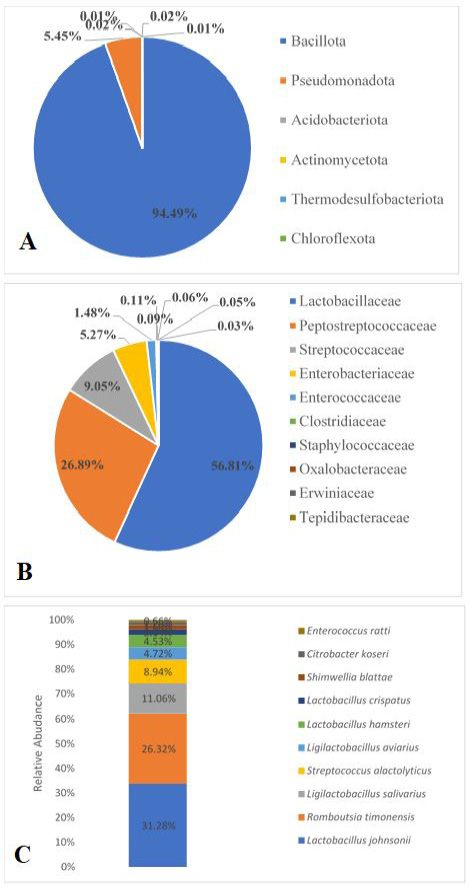
Long-read 16S rRNA metabarcoding of ileal digesta from healthy unmedicated broilers yielded a microbial community structure dominated, at the phylum level, by Bacillota (94.49%), followed distantly by Pseudomonadota (5.45%), while Chloroflexota, Actinomycetota, Thermodesulfobacteriota, and Acidobacteriota were each represented at minor relative abundances of less than 0.05% (Figure 1A). This Bacillota-centric architecture is consistent with reference profiles of clinically healthy broilers and reflects the established role of this phylum in luminal fermentation, mucosal homeostasis, and short-chain fatty acid (SCFA) generation that energetically supports the intestinal epithelium .
At the family level (Figure 1B), Lactobacillaceae predominated (56.81%), followed by Peptostreptococcaceae (26.89%) and Streptococcaceae (9.05%), while Enterobacteriaceae and Enterococcaceae accounted for 5.27% and 1.48%, respectively. The pronounced Lactobacillaceae dominance is mechanistically meaningful: this family encompasses the principal producers of host-relevant antimicrobial and immunomodulatory metabolites within the avian ileum and is consistently associated with stable, eubiotic microbiota states .
Species-level resolution enabled by full-length 16S rRNA reads from the Oxford Nanopore platform revealed Lactobacillus johnsonii as the most abundant taxon (31.28%), followed by Romboutsia timonensis (26.32%), Ligilactobacillus salivarius (11.06%), Streptococcus alactolyticus (8.94%), Ligilactobacillus aviarius (4.72%), and Lactobacillus hamsteri (4.53%) (Figure 1C). Sub-dominant taxa included Lactobacillus crispatus, Shimwellia blattae, Citrobacter koseri, and Enterococcus ratti (each <5%). The concomitantly high abundances of Lactobacillus johnsonii and Lactobacillus salivarius are particularly relevant from a functional perspective, since these species have been independently documented to enhance villus-to-crypt ratios, upregulate mucin-2 expression, and modulate broiler cecal microbial succession . The notable representation of Romboutsia timonensis a complex polysaccharide fermenter further reinforces the SCFA-generating capacity of the community . Collectively, this multi-level taxonomic profile justifies the rationale of selecting native LAB from the same host ileum for postbiotic development: the resident community is intrinsically enriched in functionally validated bioactive-producing taxa, providing a higher probability of recovering isolates whose secretome aligns with host physiology relative to allochthonous commercial reference strains.
Stationary-phase metabolite accumulation defines the optimal postbiotic harvest window
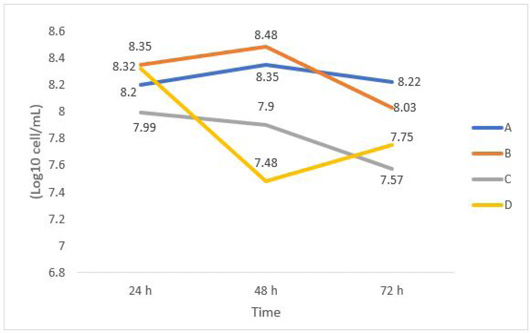
Cellular growth kinetics were characterized across 24, 48, and 72 hours of fermentation to identify the physiological window most permissive to bioactive metabolite accumulation (Figure 2). Growth kinetic analysis revealed distinct, strain-specific proliferation profiles among the four LAB isolates, rather than a uniform population dynamic. Isolates A and B exhibited a canonical biphasic growth trajectory, characterized by an ascending cell density between 24 and 48 hours before entering a measurable decline at 72 hours, consistent with a standard transition from the logarithmic phase into late stationarity. Conversely, Isolate C demonstrated a continuous, monotonic decline in viability across the 24, 48, and 72-hour intervals, suggesting an accelerated onset of the death phase under the evaluated culture conditions. Meanwhile, Isolate D displayed a unique fluctuating pattern, marked by an initial reduction in cell density from 24 to 48 hours, followed by a partial population recovery at 72 hours, a phenomenon potentially linked to cryptic growth or late-stage metabolic adaptation to secondary metabolites.
Isolate B reached the highest peak density (8.48 log cell/mL at 48 hours), while Isolate D showing the most pronounced 48 hour decrement before partial recovery at 72 hours. The temporal disjunction observed between maximal biomass (48 hours) and maximal antimicrobial activity (72 hours, see Section 3.3) is biologically informative: it indicates that the bioactive output of LAB postbiotic preparations is not a passive function of cell number but rather a regulated, stationary-phase-induced phenotype driven by nutrient depletion, quorum sensing, and stringent-response signaling . Under such conditions, LAB redirect metabolic flux from anabolic biomass synthesis toward production of secondary metabolites, exometabolites, organic acids, bacteriocins, and ribosomally synthesized antimicrobial peptides that operate as ecological-warfare effectors ; . From a postbiotic process-development perspective, this identifies 72 hours as the empirical harvest endpoint for CFS recovery and provides a translatable parameter for downstream industrial-scale optimization.
Antimicrobial performance establishes functional efficacy against enteropathogens
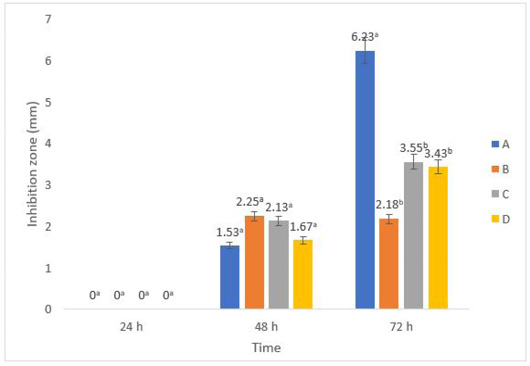
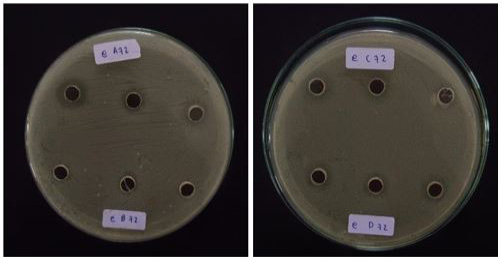
The well-diffusion assay was deployed against Escherichia coli and Salmonella sp. two of the most economically and zoonotically significant enteropathogens in commercial poultry production. The antimicrobial activity of CFS against Escherichia coli bacteria showed variations in inhibition influenced by the type of isolate and fermentation duration (Figures 3 and 4). At a fermentation duration of 24 hours, all isolates (A, B, C, and D) did not show an inhibition zone (0 mm), indicating that the antimicrobial compound had not accumulated in the early growth phase. A significant increase in the diameter of the inhibition zone began to be observed at a fermentation duration of 48 hours, with Isolate B producing the highest average inhibition zone of 2.25 mm, followed by Isolate C (2.13 mm), Isolate D (1.67 mm), and Isolate A (1.53 mm). The most optimal antimicrobial activity was achieved at a fermentation duration of 72 hours coinciding with the transition of bacteria to the final stationary phase. At this phase, Isolate A produced the largest increase in the diameter of the inhibition zone, namely 6.23 mm.
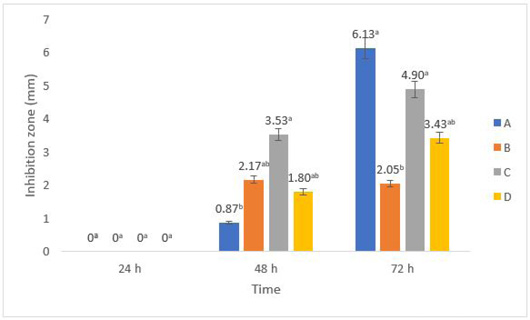
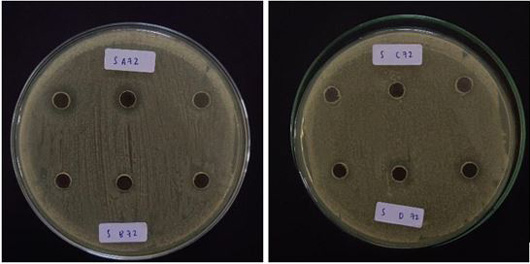
The antimicrobial activity of CFS against the growth of Salmonella sp. bacteria showed a varying increase pattern depending on the fermentation duration (Figures 5 and 6). At the initial fermentation duration (24 hours), all test isolates had not formed a clear zone (0 mm), indicating that the concentration of antimicrobial compounds in the media had not reached the minimum inhibition threshold. After entering the 48-hour fermentation period, the accumulation of bioactive metabolites began to show significant inhibitory activity. Isolate C produced the highest average inhibition zone diameter of 3.53 mm, followed by Isolate B (2.17 mm), Isolate D (1.80 mm), and Isolate A (0.87 mm). The most optimal antimicrobial effectiveness against Salmonella sp. was achieved significantly at a fermentation period of 72 hours. In the stationary phase, Isolate A produced the largest inhibition zone, namely 6,13 mm.
Mechanistically, postbiotic inhibition of Gram-negative enteropathogens proceeds through a cascade of complementary interactions. Lipophilic, protonated organic acids passively diffuse across the bacterial outer and cytoplasmic membranes, dissociate within the cytoplasm, and release H⁺ ions that acidify the intracellular milieu; the resulting collapse of the proton motive force forces an energetically costly proton-pump compensatory response that depletes ATP reserves and disrupts vital metabolism, protein synthesis, and membrane protein function . Bacteriocins act in a synergistic manner, forming pores in the cytoplasmic membrane that drive leakage of essential ions and intracellular molecules, while concomitantly impeding DNA replication and ribosomal protein synthesis . This multi-pronged mode of action is intrinsically refractory to resistance development relative to single-target antibiotics, since simultaneous mutational evasion across multiple structural and metabolic targets imposes a substantially higher fitness cost on the pathogen a property of major translational relevance for the AGP-replacement agenda.
Molecular identification and safety-relevant taxonomic positioning of isolate a
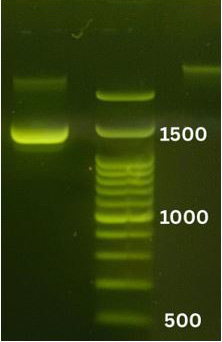
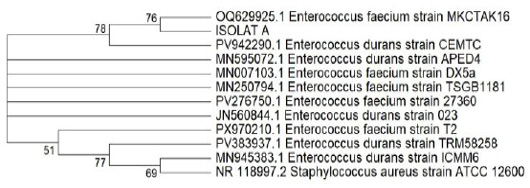
Agarose gel electrophoresis of the 27F/1492R PCR amplicon from Isolate A yielded a single, sharply defined band at approximately 1500 bp (Figure 7), consistent with successful full-length 16S rRNA amplification and validating the product for Sanger sequencing and BLASTn homology analysis. Isolate A showed genetic similarity to the Enterococcus genus based on 16S rRNA gene analysis, with a Query Cover value of 98-99% and Percentage Identity ranging from 93.75% to 94.21%. This similarity value indicates that Isolate A can be classified at the genus level but has not yet met the threshold for identification. The results of this genetic similarity are clarified through the construction of a phylogenetic tree in Figure 8, which shows the position of Isolate A within the Enterococcus genus group and its kinship relationship with the closest reference strain.
Table 1: Top BLASTn hits obtained from comparison of the 16S rRNA gene sequence of Isolate A with sequences deposited in the NCBI GenBank database.
Neighbor-Joining phylogenetic reconstruction (Figure 8) corroborates the BLASTn results: Isolate A clustered within the Enterococcus genus and was most closely related to Enterococcus faecium strain MKCTAK16 with a bootstrap value of 76%, which then formed a group with Enterococcus durans strain CEMTC with a bootstrap value of 78% (Table 1). This bootstrap value represents the stability of the branching results from the replicate analysis, not the degree of sequence similarity.
Placement of the most active isolate within the genus Enterococcus carries non-trivial implications for translational deployment as a postbiotic. The genus occupies a contested taxonomic and safety position, encompassing species with documented food-fermentation and probiotic functions (notably E. faecium, E. lactis, and certain E. durans lineages) alongside opportunistic pathogens implicated in nosocomial bloodstream and urinary tract infections, most prominently E. faecalis and selected vancomycin-resistant E. faecium clades ; . Critically, however, the postbiotic paradigm structurally circumvents the most pressing safety concerns associated with live Enterococcus administration namely, the potential dissemination of transferable resistance determinants (e.g., vanA/vanB, aac(6’)-Ie-aph(2’’)-Ia) and virulence factors (e.g., esp, hyl, asa1, cylA) because cell-free supernatant preparations exclude viable microbial cells and their genomic content by design . This functional dissociation between bioactivity and viability is the defining advantage of postbiotic over probiotic formats and is particularly consequential when working with taxonomically ambiguous genera. Nevertheless, prior to in vivo deployment of CFS from Isolate A, WGS-based genomic safety screening is recommended to definitively exclude transferable resistance and virulence determinants in accordance with EFSA QPS guidance principles for the genus .
Metabolomic architecture of the cell-free supernatant underpins multi-target antimicrobial action
Untargeted LC-HRMS profiling of the 72-hour CFS from Enterococcus sp. Isolate A resolved 22 high-confidence metabolites distributed across five biochemically distinct classes (Table 2) free amino acids and derivatives, indole derivatives, diketopiperazines (DKPs), phenolic compounds, and organic acids. This chemical breadth provides the molecular substrate for the multi-target mode of antimicrobial action inferred from the bioactivity data and rationalizes the convergent efficacy observed against both E. coli and Salmonella sp.
Tryptophan-derived indole compounds emerged as a particularly relevant antibacterial axis. Indole-3-acetic acid (IAA), indole-3-lactic acid (ILA), and indole-3-acrylic acid, all produced through the bacterial L-tryptophan catabolic pathway, have been independently characterized as quorum sensing (QS) inhibitors of Enterobacteriaceae. IAA antagonizes the LsrR receptor of the autoinducer-2 (AI-2) system in Salmonella enterica, thereby suppressing
Table 2: Chemical classification and biological relevance of metabolites identified from the Cell-Free Supernatant (CFS) of Enterococcus sp. Isolate A based on LC-HRMS analysis (ESI+/ESI−, mzCloud Best Match).
collective virulence-gene activation; ILA directly impairs E. coli virulence through competitive inhibition of tryptophanase ; and indole-3-acrylic acid suppresses flagellar gene expression, attenuating motility, host-cell invasion, and biofilm maturation. By disabling QS-orchestrated virulence rather than killing the pathogen outright, these metabolites complement the bactericidal axis of organic acids and bacteriocins and confer an anti-virulence dimension that may slow resistance selection.
Cyclic dipeptides cyclo(L-Pro-L-Val), cyclo(L-Pro-L-Phe), and cyclo(L-Pro-L-Leu) operate as additional QS co-inhibitors, disrupting acyl-homoserine lactone (AHL) signaling and destabilizing the outer-membrane integrity of Gram-negative bacteria. Phenolic compounds extend the mechanistic repertoire: 8-hydroxyquinoline chelates essential divalent metals (Fe²⁺, Zn²⁺) required for cytochrome-mediated anaerobic respiration, thereby suppressing pathogen bioenergetics , whereas vanillin imposes a dual hit on E. coli, compromising LPS-membrane integrity and depleting cellular ATP via TCA cycle perturbation . Layered on this network, the identified organic acids citric acid, cis,cis-muconic acid, and isobutyric acid lower extracellular pH and dissipate the proton motive force, producing the ionic-imbalance and energy-depletion phenotypes that drive Gram-negative cell death . The biochemical complementarity among amino-acid-derived modulators, indole-based anti-virulence agents, DKP QS inhibitors, metal-chelating phenolics, and pH-active organic acids defines a stratified, mechanistically redundant antimicrobial system whose collective activity is functionally inseparable from the parent CFS matrix.
Integrated positioning of Enterococcus sp. isolate a as a native postbiotic candidate
Synthesizing the metagenomic, growth-kinetic, antimicrobial, molecular, and metabolomic evidence presented above yields a coherent translational profile for Enterococcus sp. Isolate A as a promising candidate for native postbiotic development. First, its ecological provenance the ileum of healthy unmedicated broilers confers presumptive niche compatibility and host-adaptation advantages that are intrinsically inaccessible to allochthonous commercial probiotic strains . Second, the temporally optimized fermentation profile (peak antimicrobial activity at 72 h, coincident with the late stationary phase) defines a discrete and reproducible process-development parameter directly transferable to industrial bioreactor scale-up, where late-phase harvest is consistently associated with maximal secondary-metabolite recovery . Third, the broad-spectrum efficacy against both Ecscherichia coli and Salmonella sp. pivotal poultry enteropathogens driving substantial economic losses and zoonotic concerns establishes immediate industry relevance. Fourth, the chemical diversity of the resolved metabolome (organic acids, indole derivatives, DKPs, phenolic compounds, and amino-acid-derived modulators) implies a multi-mechanistic mode of action that is structurally refractory to single-target resistance development . Fifth, and critically, the postbiotic format itself decouples bioactivity from microbial viability, neutralizing the safety reservations historically associated with live Enterococcus administration ; . Translation of these findings into commercial deployment now requires (i) WGS-based genomic safety verification of Isolate A, (ii) in vivo evaluation of postbiotic CFS supplementation on broiler growth performance, intestinal morphometry, mucosal immunity, and cecal microbiota architecture, and (iii) downstream optimization of stabilization, encapsulation, and dose-response characterization for industrial feed inclusion.
CONCLUSIONS
This study identifies Enterococcus sp. Isolate A from the broiler ileum as a promising native postbiotic candidate with broad-spectrum antimicrobial activity against Escherichia coli and Salmonella sp. Peak bioactivity occurs at 72 h of fermentation, driven by a chemically diverse metabolome of organic acids, indole derivatives, diketopiperazines, and phenolic compounds.
ACKNOWLEDGEMENTS
The authors would like to express their deepest gratitude to the “Fundamental Basic Research” grant funded by the Ministry of Education, Culture, Research, and Technology (grant number 00738.6/UN10.A0501/B/PT.01.03.2/2025) for the financial support that made this research possible.
NOVELTY STATEMENT
This study presents the first integrated characterization of native lactic acid bacteria from the broiler ileum using a combined metagenomic, molecular, antimicrobial, and untargeted metabolomic framework to assess their potential as postbiotic candidates for AGP replacement. The work links host-derived microbiota composition with isolate-level functional validation and resolves the chemical basis of bioactivity, highlighting the potential of indigenous Enterococcus sp. as a mechanistically defined postbiotic source for sustainable poultry production.
AUTHORS CONTRIBUTION
ABMA: Conception and design of the research, acquisition of data, analysis and interpretation of data, and drafting the manuscript. MHN: Critical review and revision of the manuscript. FEH: Conception and design of the research and acquisition of data. HT: Critical review and revision of the manuscript. AAH: Critical review and revision of the manuscript. YFN: Drafting and critical review and revision of the manuscript.
Generative AI and AI assisted technology statement
The authors declare that no generative AI and AI assisted technology was used in the creation of this manuscript.
Conflict of interest
The authors have declared no conflict of interest.
Figures
Figure 1:.
Relative abundance of bacterial taxa in the intestines of healthy chickens at the phylum (A), family (B), and species (C) levels based on 16S rRNA metabarcoding analysis using the Oxford Nanopore PromethION 24 platform.
Figure 2:.
Growth curves of isolates A, B, C, and D in MRS broth measured at 24, 48, and 72 hours of fermentation, expressed as log CFU/mL.
Figure 3:.
Mean inhibition zone area (mm) of postbiotic preparations from four native LAB isolates (A, B, C, D) at 24, 48, and 72 hours of fermentation against Escherichia coli. Different letters within the same incubation time indicate significant differences (P < 0.05) based on Duncan’s Multiple Range Test (DMRT).
Figure 4:.
Representative agar diffusion plates showing inhibition zones against pathogenic Escherichia coli elicited by postbiotics after 72 hours of fermentation. Well notation: e (E. coli), A, B, C, D (microbial isolate variants), 72 (fermentation duration in hours).
Figure 5:.
Mean inhibition zone area (mm) of postbiotic preparations from four native LAB isolates (A, B, C, D) at 24, 48, and 72 hours of fermentation against Salmonella sp. Different letters within the same incubation time indicate significant differences (P < 0.05) based on Duncan’s Multiple Range Test (DMRT).
Figure 6:.
Representative agar diffusion plates showing inhibition zones against pathogenic Salmonella sp. elicited by postbiotics after 72 hours of fermentation. Well notation: s (Salmonella sp.), A, B, C, D (microbial isolate variants), 72 (fermentation duration in hours).
Figure 7:.
Agarose gel electrophoresis profile of the amplified 16S rRNA gene from Isolate A showing a sharp, specific band at approximately 1500 bp relative to the DNA molecular weight ladder.
Figure 8:.
Phylogenetic tree showing the evolutionary relationship of Isolate A with related Enterococcus species based on 16S rRNA gene sequences, constructed using the Neighbor-Joining method. Staphylococcus aureus ATCC 12600 (NR_118997.2) was used as the outgroup. Numbers at nodes represent bootstrap percentages from 1,000 replicates. GenBank accession numbers are indicated before species names.
References
Aguilar-Toalá JE, Garcia-Varela R, Garcia HS, Mata-Haro V, González-Córdova AF, Vallejo-Cordoba B, Hernández-Mendoza A (2018). Postbiotics: An evolving term within the functional foods field. Trends Food Sci. Technol., 75: 105–114. https://doi.org/10.1016/j.tifs.2018.03.009[CrossRef]
Alfariza ABM, Hermanto FE, Huda AN, Nuningtyas YF (2026). Lactic acid bacteria isolated from poultry: Phenotypic characterization based on total plate count, Gram staining test and hemolytic activity. BIO Web Conf., 218: 01006. https://doi.org/10.1051/bioconf/202621801006[CrossRef]
Bertolo A, Valido E, Stoyanov J (2024). Optimized bacterial community characterization through full-length 16S rRNA gene sequencing utilizing MinION nanopore technology. BMC Microbiol., 24: 101. https://doi.org/10.1186/s12866-024-03208-5[CrossRef]
Bhagwat M, Shrivastava S, Thakur P, Singhi S (2024). Chelation-mediated antimicrobial activity of 8-hydroxyquinoline derivatives against pathogenic bacteria. J. Antimicrob. Chemother., 79(3): 456–465.
Carvajal E, Contreras S, Díaz W, Martinez-Bello D, McCown M, Ardila Y, Vásquez MC (2023). Enterococcus isolated from poultry intestine for potential probiotic use. Vet. World, 16(8): 1605–1614. https://doi.org/10.14202/vetworld.2023.1605-1614[CrossRef]
Chen X, Liu Y, Zhao M, Gao H, Wang Z (2023). Vanillin exerts antibacterial activity against Escherichia coli through dual mechanisms targeting membrane integrity and energy metabolism. Food Microbiol., 110: 104167.
Chernonosov AA, Mednova IA, Levchuk LA, Mazurenko EO, Roschina OV, Simutkin GG, Bokhan NA, Koval VV, Ivanova SA (2024). Untargeted plasma metabolomic profiling in patients with depressive disorders: A preliminary study. Metabolites, 14(2): 110. https://doi.org/10.3390/metabo14020110[CrossRef]
Deng Z, Han D, Wang Y, Wang Q, Yan X, Wang S, Liu X, Song W, Zhang Y (2021). Lactobacillus casei protects intestinal mucosa from damage in chicks caused by Salmonella pullorum via regulating immunity and the Wnt signaling pathway and maintaining the abundance of gut microbiota. Poult. Sci., 100(8): 101283. https://doi.org/10.1016/j.psj.2021.101283[CrossRef]
Froebel L, Jalukar S, Lavergne T, Lee J, Duong T (2019). Administration of dietary prebiotics improves growth performance and reduces pathogen colonization in broiler chickens. Poult. Sci., 98(12): 6668–6676. https://doi.org/10.3382/ps/pez537[CrossRef]
Hage R El, Hage J El, Snini SP, Ammoun I, Touma J, Rachid R, Mathieu F, Sabatier J, Khattar ZA, Rayess Y El (2022). The detection of potential native probiotics Lactobacillus spp. against Salmonella Enteritidis, Salmonella Infantis and Salmonella Kentucky ST198 of Lebanese chicken origin. Antibiotics, 11(9): 1147. https://doi.org/10.3390/antibiotics11091147[CrossRef]
Hanchi H, Hammami R, Gingras H, Kourda R, Bergeron MG, Hamida J Ben, Ouellette M, Fliss I (2017). Inhibition of MRSA and of Clostridium difficile by durancin 61A: Synergy with bacteriocins and antibiotics. Future Microbiol., 12(3): 205–212. https://doi.org/10.2217/fmb-2016-0113[CrossRef]
Hermanto FE, Nuningtyas YF, Marwi F, Permata FS, Susilo A, Natsir MH (2024). Discovering the potential of teak, turmeric, and ginger in broiler chicken gut health: a network biology perspective on IL-6 inhibition. Adv. Anim. Vet. Sci., 12(4): 749-757. https://doi.org/10.17582/journal.aavs/2024/12.4.749.757[Full text][CrossRef]
Hug J, Krug D, Müller R (2020). Bacteria as genetically programmable producers of bioactive natural products. Nat. Rev. Chem., 4: 172–193. https://doi.org/10.1038/s41570-020-0176-1[CrossRef]
Ismail H, Ibrahim D, Sayed S, Wahdan A, El-Tarabili R, El-Ghareeb W, Alhawas B, Alahmad B, Abdel-Raheem S, El-Hamid M (2023). Prospective application of nanoencapsulated Bacillus amyloliquefaciens on broiler chickens’ performance and gut health with efficacy against Campylobacter jejuni colonization. Animals, 13(5): 775. https://doi.org/10.3390/ani13050775[CrossRef]
Ji M, Sun Y, Li X, Zhang L, Wang J (2023). Organic acids produced by lactic acid bacteria disrupt ionic balance and inhibit energy metabolism in pathogenic bacteria. Food Control, 147: 109598.
Jurášková D, Ribeiro SC, Silva CCG (2022). Exopolysaccharides produced by lactic acid bacteria: From biosynthesis to health-promoting properties. Foods, 11(2): 156. https://doi.org/10.3390/foods11020156[CrossRef]
Kaewchomphunuch T, Charoenpichitnunt T, Thongbaiyai V (2022). Cell-free culture supernatants of Lactobacillus spp. and Pediococcus spp. inhibit growth of pathogenic Escherichia coli isolated from pigs in Thailand. BMC Vet. Res., 18: 62. https://doi.org/10.1186/s12917-022-03140-8[CrossRef]
Koorakula R, Schiavinato M, Ghanbari M, Wegl G, Grabner N, Koestelbauer A, Klose V, Dohm JC, Domig KJ (2022). Metatranscriptomic analysis of the chicken gut resistome response to in-feed antibiotics and natural feed additives. Front. Microbiol., 13: 833790. https://doi.org/10.3389/fmicb.2022.833790[CrossRef]
Krawczyk B, Wityk P, Gałęcka M, Michalik M (2021). The many faces of Enterococcus spp. Commensal, probiotic and opportunistic pathogen. Microorganisms, 9(9): 1900. https://doi.org/10.3390/microorganisms9091900[CrossRef]
Marchei E, Ferri MA, Torrens M, Pacifici R, Pichini S (2021). Ultra-high performance liquid chromatography-high resolution mass spectrometry and high-sensitivity gas chromatography-mass spectrometry screening of classic drugs and new psychoactive substances and metabolites in urine of consumers. Int. J. Mol. Sci., 22(8): 4000. https://doi.org/10.3390/ijms22084000[CrossRef]
Mira P, Yeh P, Hall BG (2022). Estimating microbial population data from optical density. PLoS One, 17(10) https://doi.org/10.1371/journal.pone.0276040[CrossRef]
Mottet A, Tempio G (2017). Global poultry production: Current state and future outlook and challenges. World’s Poult. Sci. J., 73(2): 245–256. https://doi.org/10.1017/S0043933917000071[CrossRef]
Murray CJL, Ikuta KS, Sharara F, Swetschinski L, Robles Aguilar G, Gray A, Han C, Bisignano C, Rao P, Wool E, Johnson CO, Browne AJ, Chipeta MG, Fell F, Hackett S, Haines-Woodhouse G, Kashef Hamadani BH, Kumaran EAP, McManigal B, Agarwal R, Akech S, Albertson S, Amuasi J, Andrews J, Aravkin A, Ashley E, Babin FX, Bailey F, Baker S, Basnyat B, Bekker A, Bender R, Berkley JA, Bethou A, Bielicki J, Boonkasidecha S, Bukosia J, Carvalheiro C, Castañeda-Orjuela C, Chansamouth V, Chaurasia S, Chiurchiù S, Chowdhury F, Clotaire Donatien R, Cook AJ, Cooper B, Cressey TR, Criollo-Mora E, Cunningham M, Darboe S, Day NPJ, De Luca M, Dokova K, Dramowski A, Dunachie SJ, Duong Bich T, Eckmanns T, Eibach D, Emami A, Feasey N, Fisher-Pearson N, Forrest K, Garcia C, Garrett D, Gastmeier P, Giref AZ, Greer RC, Gupta V, Haller S, Haselbeck A, Hay SI, Holm M, Hopkins S, Hsia Y, Iregbu KC, Jacobs J, Jarovsky D, Javanmardi F, Jenney AWJ, Khorana M, Kissoon N, Kobeissi E, Kostyanev T, Phommasone K, Khusuwan S, Krapp F, Krumkamp R, Kumar A, Kyu HH, Lim C, Lim K, Limmathurotsakul D, Loftus MJ, Lunn M, Ma J, Manoharan A, Marks F, May J, Mayxay M, Mturi N, Munera-Huertas T, Musicha P, Musila LA, Mussi-Pinhata MM, Naidu RN, Nakamura T, Nanavati R, Nangia S, Newton P, Ngoun C, Novotney A, Nwakanma D, Obiero CW, Ochoa TJ, Olivas-Martinez A, Olliaro P, Ooko E, Ortiz-Brizuela E, Ounchanum P, Pak GD, Paredes JL, Peleg AY, Perrone C, Phe T, Plakkal N, Ponce-de-Leon A, Raad M, Ramdin T, Rattanavong S, Riddell A, Roberts T, Robotham JV, Roca A, Rosenthal VD, Rudd KE, Russell N, Sader HS, Saengchan W, Schnall J, Scott JAG, Seekaew S, Sharland M, Shivamallappa M, Sifuentes-Osornio J, Simpson AJ, Steenkeste N, Stewardson AJ, Stoeva T, Tasak N, Thaiprakong A, Thwaites G, Tigoi C, Turner C, Turner P, van Doorn HR, Velaphi S, Vongpradith A, Vongsouvath M, Vu H, Walsh T, Walson JL, Waner S, Wangrangsimakul T, Wannapinij P, Wozniak T, Young-Sharma TEMW, Yu KC, Zheng P, Sartorius B, Lopez AD, Stergachis A, Moor
Nuningtyas YF, Natsir MH, Widodo E, Rahman MM, Atole AFF, Utami MMD, Sjofjan O (2026). Postbiotics in broiler nutrition: A critical review of mechanisms, efficacy, and applications in antibiotic-free production systems. Poult. Sci., pp. 107199. https://doi.org/10.1016/j.psj.2026.107199[CrossRef]
Richards-Rios P, Fothergill J, Bernardeau M, Wigley P (2020). Development of the ileal microbiota in three broiler breeds. Front. Vet. Sci., 7: 17. https://doi.org/10.3389/fvets.2020.00017[CrossRef]
Rychlik I, Karasova D, Crhanova M (2023). Microbiota of chickens and their environment in commercial production. Avian Dis., 67(1): 1–9. https://doi.org/10.1637/aviandiseases-D-22-00048[CrossRef]
Rychen G, Aquilina G, Azimonti G, Bampidis V, Bastos MDL, Bories G, Chesson A, Cocconcelli PS, Kolar B, Kouba M, Marta L, Flachowsky G, Mantovani A, Mayo B, Ramos F, Saarela M, Villa RE, Wallace RJ, Wester P, Galobart J (2018). Guidance on the characterisation of microorganisms used as feed additives or as production organisms. EFSA J., 16(3). https://doi.org/10.2903/j.efsa.2018.5206[CrossRef]
Salminen S, Collado MC, Endo A, Hill C, Lebeer S, Quigley EMM, Sanders ME, Shamir R, Swann JR, Szajewska H, Vinderola G (2021). The international scientific association of probiotics and prebiotics (ISAPP) consensus statement on the definition and scope of postbiotics. Nat. Rev. Gastroenterol. Hepatol., 18(9): 649–667. https://doi.org/10.1038/s41575-021-00440-6[CrossRef]
Shang Y, Kumar S, Oakley B, Kim WK (2018). Chicken gut microbiota: Importance and detection technology. Front. Vet. Sci., 5: 254. https://doi.org/10.3389/fvets.2018.00254[CrossRef]
Sharma S, Seekatz A, Alizadeh M, Hassan H, Yitbarek A, Pratt S, Abdelaziz K (2025). Early-life poultry-derived lactobacilli drive microbial succession and gut immune modulation in broiler chickens. bioRxiv. https://doi.org/10.1101/2025.08.01.668251[CrossRef]
Singh S, Koo OK (2024). A comprehensive review exploring the protective role of specific commensal gut bacteria against Salmonella. Pathogens, 13(8): 642. https://doi.org/10.3390/pathogens13080642[CrossRef]
Sinha R, Singh AK, Bhardwaj A, Kaur S (2024). Indole derivatives as quorum sensing inhibitors modulating virulence of Salmonella enterica and Escherichia coli. Front. Microbiol., 15: 1382047.
Soltani S, Biron E, Said LB, Subirade M, Fliss I (2022). Bacteriocin-based synergetic consortia: A promising strategy to enhance antimicrobial activity and broaden the spectrum of inhibition. Microbiol. Spectr., 10(2): e00406-21. https://doi.org/10.1128/spectrum.00406-21[CrossRef]
Tian C, Wang L, Liu M, Liu J, Qiu M, Chen Y (2024). Isolation and identification of chicken-derived lactic acid bacteria: In vitro probiotic properties and antagonistic effects against Salmonella pullorum, Staphylococcus aureus, and Escherichia coli. Microorganisms, 12(4): 795. https://doi.org/10.3390/microorganisms12040795[CrossRef]
Ughy B, Nagyapati S, Lajko D, Letoha T, Prohaszka A, Deeb D, Dér A, Pettkó-Szandtner A, Szilák L (2023). Reconsidering dogmas about the growth of bacterial populations. Cells, 12(10): 1430. https://doi.org/10.3390/cells12101430[CrossRef]
Vinderola G, Sanders ME, Salminen S (2022). The concept of postbiotics. Foods, 11(8): 1077. https://doi.org/10.3390/foods11081077[CrossRef]
Wiersema ML, Koester LR, Schmitz-Esser S, Koltes DA (2020). Comparison of intestinal permeability, morphology, and ileal microbial communities of commercial hens housed in conventional cages and cage-free housing systems. Poult. Sci., 100(2): 1178–1191. https://doi.org/10.1016/j.psj.2020.10.052[CrossRef]
Winand R, Bogaerts B, Hoffman S, Lefevre L, Delvoye M, Braekel J Van, Fu Q, Roosens NHC, Keersmaecker SCJ De, Vanneste K (2020). Targeting the 16S rRNA gene for bacterial identification in complex mixed samples: Comparative evaluation of second (Illumina) and third (Oxford Nanopore Technologies) generation sequencing technologies. Int. J. Mol. Sci., 21(1): 298. https://doi.org/10.3390/ijms21010298[CrossRef]