Research Article · Volume 12, Issue 4, 25 February 2024 · Open Access
Discovering the Potential of Teak, Turmeric, and Ginger in Broiler Chicken Gut Health: A Network Biology Perspective on IL-6 Inhibition
· · · · ·
Affiliations & Notes ⌄
1Faculty of Animal Sciences, Brawijaya University, Malang, East Java 65145, Indonesia
2Faculty of Veterinary Sciences, Brawijaya University, Malang, East Java 65145, Indonesia. *Correspondence | Muhammad Halim Natsir, Faculty of Animal Sciences, Brawijaya University, Malang, East Java 65145, Indonesia
In conclusion, teak leaves, Turmeric, and ginger emerge as promising natural additives to enhance broiler chicken gut health by modulating mucosal immunity.
Their demonstrated anti-inflammatory properties and impact on gut microbiota offer a potential antibiotic substitute in the poultry industry.
Selected from the article's own text.
Abstract
Intestinal health is critical in the poultry industry due to its pivotal role in efficient food absorption. Given the constraints on antibiotic use in industrial settings, there is a growing interest in natural-derived products as potential enhancers of intestinal health through immune system modulation. Teak Leaves, Turmeric, and Ginger have emerged as promising feed additives for fortifying the mucosal immune system in broiler chickens. However, understanding how these herbs confer protective effects remains challenging, given the intricate nature of mucosal immunity and its role in maintaining gut health. This study adopts a network biological approach to decode the complex web of protein interactions within mucosal immunity and explore the immunomodulatory potential of bioactive compounds found in these herbs. Biological networks were constructed for gut health and mucosal immunity, focusing on common proteins to identify promising targets. Our analysis pinpoints Interleukin-6 (IL-6) as the central protein governing gut health and mucosal immunity. Further exploration reveals that several bioactives, primarily from Teak Leaves and Ginger, form tight interactions with IL-6. This interaction presents an opportunity to influence the IL-6 signaling pathway, ultimately modulating mucosal immunity. Notably, ß-sesquiphellandrene, Luteolin 7-O-diglucuronide, Verbacoside, and Quercetin emerge as promising IL-6 inhibitors, establishing multiple hydrogen bonds and demonstrating favorable binding affinities. Molecular dynamics simulations provide visual insights into the stability of these compounds during their interaction with IL-6. In summary, the potential mucosal immunomodulatory effects of Teak Leaves, Turmeric, and Ginger may be harnessed through IL-6 inhibition, thus fostering a healthier gut microstructure, optimizing nutrient absorption, and restoring physiological balance. These natural additives hold significant promise for revolutionizing poultry intestinal health in a sustainable, antibiotic-free manner.
Exploring the complex interactions between nutrition, immunity, and general health has received more attention in modern poultry farming. This focus is particularly vital given that broiler chickens, a significant portion of the world’s poultry production, frequently face gastrointestinal problems that harm their health and growth ; . Traditional approaches to treating gut health problems in the past relied on antibiotics . However, this approach has been plagued by well-documented adverse effects, most notably the emergence of antibiotic resistance . To overcome these obstacles and optimize the results of poultry production, incorporating natural products into animal feed has become a viable alternative (Abdelli et al., 2021; . These natural products are envisioned as potent feed additives capable of modulating the physiological equilibrium of broiler chickens, thereby enhancing their performance and well-being.
Teak (Tectona grandis) leaves, ginger (Zingiber officinale), and Turmeric (Curcuma longa) have been studied for their potential as mucosal immunoregulators or immunoregulatory activity in general ; ; . Previous studies have shown that these plants have anti-inflammatory properties and gained a perspective in the poultry industry (Abd El-Hack et al., 2020; ; . However, the use of those plants in combined ingredients remains no result. Moreover, specific studies associating those herbs with mucosal immunity still need to be available. While the anti-inflammatory properties of these herbs have been extensively elucidated, there still exists a significant knowledge gap concerning their specific mechanisms within the realm of chicken mucosal immunity.
Unlocking the latent potential of Teak, Turmeric, and Ginger concerning modulating gut health and mucosal immunity in broiler chickens necessitates the application of cutting-edge network biology methodologies. Network biology and network pharmacology are powerful tools used to identify potential targets for natural-derived compounds , and it has been applied to identify potential targets in avian diseases (Peng et al., 2022; ). These tools use computational methods to analyze complex biological systems and identify key nodes and pathways involved in a particular disease or condition. These studies demonstrate the potential of network biology and network pharmacology in identifying suitable targets for natural-derived compounds with anti-inflammatory properties. By employing network biology coupled with molecular docking and molecular dynamics simulation, this paper will unravel the potential of Teak Leaves, Turmeric, and Ginger as feed additives to improve gut health status by modulating mucosal immunity.
MATERIAL AND METHODS
Construction of Biological Network and Network Topology Analysis
Network biology was constructed by Cytoscape 3.10 . First, a network was constructed by a text-mining method employing PubMed queries using “gut health” and “mucosal immunity.” The network parameters were set as 0.5 as a confidence interval and specified for Gallus gallus proteins. After the gut health and mucosal immunity networks were constructed, those networks merged. The merged network was then analyzed for network topology by CytoHubba . Several algorithms were employed, and the most frequent protein with consistently high rank in each hub-ness algorithm was selected as the most suitable target for subsequent analysis.
Retrieval of Three-Dimensional Structures of the Protein and Compounds
The structure of IL-6 was obtained from the homology modeling method according to the amino acid sequence in the UniProt database (Q90YI0). The modeling was performed in the SwissModel webserver and the experimental structure with PDB ID 7NXZ was selected as a template. The obtained three-dimensional (3D) structure of IL-6 was then used for binding site prediction using P2Rank . The predicted binding sites are GLN89, ASP90, MET92, CYS93, PHE96, VAL98, CYS99, SER102, LYS209, HIS213, LEU216, and ARG217. Those residues are then used to guide specific docking in the subsequent analysis.
The list of bioactive compounds from Teak Leaves (Tectona grandis), Ginger (Zingiber officinale), and Turmeric (Curcuma longa) were retrieved from previous reports (Asdaq et al., 2022; ; . After listing all identified compounds, the 3D structure was downloaded from the PubChem database . The list of the bioactive compounds and the PubChem compound identity number (CID) is mentioned in the supplementary file (table S1). The 3D model was then used for molecular docking analysis.
Molecular Docking
Molecular docking was performed by treating the protein as a rigid molecule while the compounds were flexible . Specific docking was applied, referring to the previously predicted binding site. The docking was executed in PyRx 0.8 interface with the Vina 1.2.5 program ; . The top 10 compounds’ conformation was sorted and selected for further analysis according to the binding affinity. The conformation was then complexed with the protein to analyze the interaction chemistry for each formed complex using Biovia Discovery Studio 2019.
Molecular Dynamics
Molecular dynamics was performed to assess the stability of the protein-ligand complex according to the protein, ligand, and conformational interaction point of view. YASARA performed the simulation for 20 ns. The simulation was performed under YASARA2 forcefield in a physiological milieu as mentioned in a previous study with minor adjustments as follows: 7.4 pH; 310K temperature; 1 bar pressure; 0.9% of NaCl concentration; and 0.997 water density. The simulation was performed in a Cubic-shaped simulation chamber. The value of RMSD was used to identify atomic movement in the structure. In addition, RMSF was used to identify the highest fluctuation residue in each complex . In addition, binding free energy was also calculated using YASARA analyzebindingenergy.mcr macros under YASARA2 forcefield, Poisson-Boltzmann (PBS) method, surface tension term of 0.65 kJ/mol/A2, and by omitting the entropy terms as a large portion of MM/PBSA studies .
RESULT AND DISCUSSION
Network Biology Discovered Interleukin-6 as the Key Mediator in Mucosal Immunity to Achieve Gut Health in Broilers
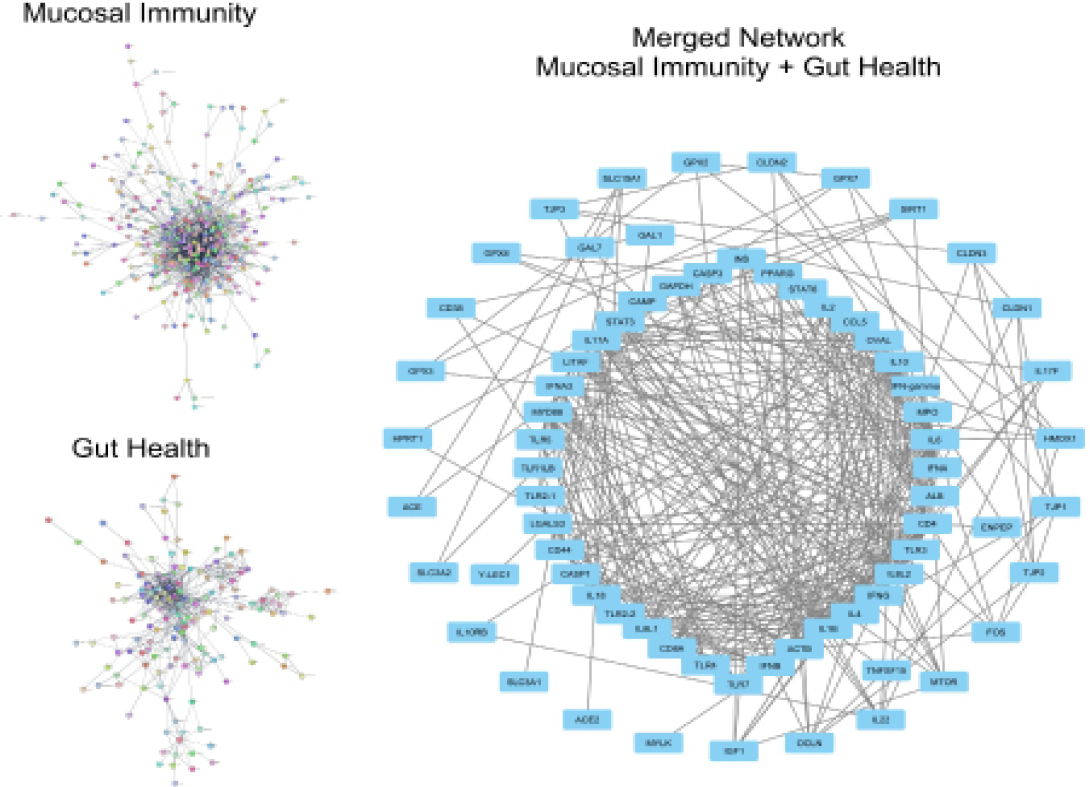
Intestinal health is intricately linked to the mechanisms of mucosal immunity , which plays a pivotal role in regulating the gut microbiota population while also orchestrating immune system responses ; . The complexity of these mechanisms renders identifying target molecules a non-trivial endeavor. Hence, network biology approaches are harnessed to facilitate the precise targeting of crucial components. Initially, a text-mining process is initiated, employing keywords such as “gut health” and “mucosal immunity” to compile a comprehensive biological network encompassing all proteins associated with these two mechanisms (Figure 1, left panel). Subsequently, a merging process is undertaken to identify proteins concurrently involved in both mechanisms. The results of this merging process are illustrated in Figure 1. After creating this composite network, potential targets are identified based on the network’s topological characteristics resulting from the merging process.
Topology analysis of the biological network was conducted utilizing algorithms integrated within the Cytohubba plugin within the Cytoscape 3.10 software . Based on the evaluation of
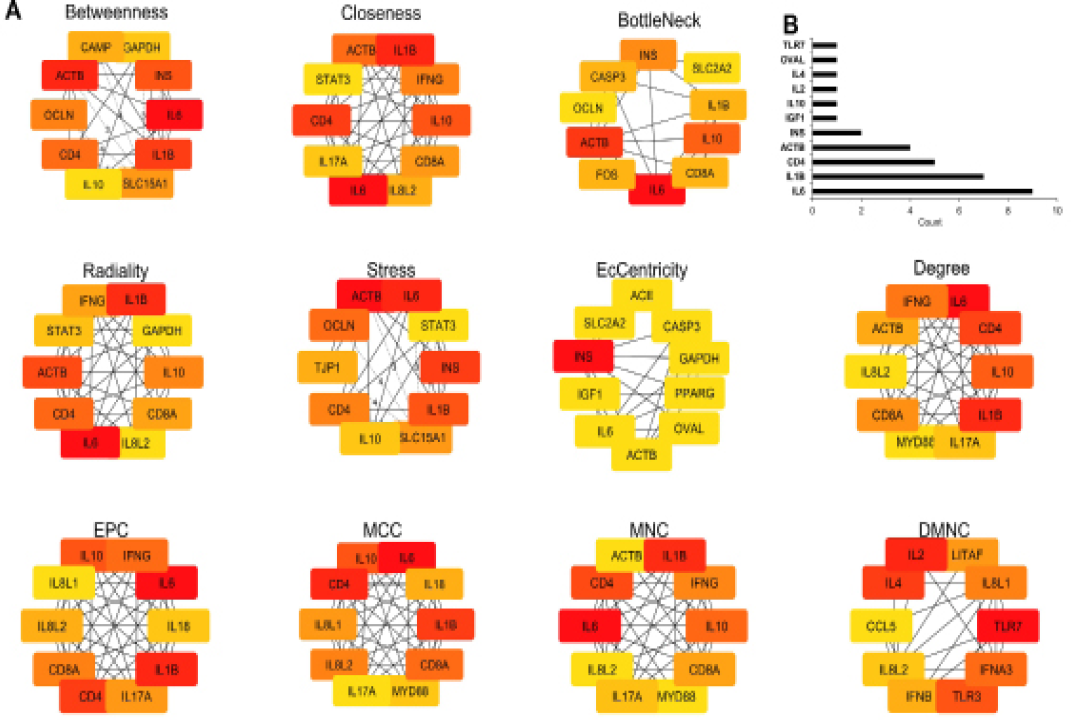
11 topological parameters within the biological network, it was discerned that interleukin-6 (IL-6) emerged as the strongest candidate for potential targeting in the regulation of both digestive health and mucosal immunity (Figure 2). This determination was arrived at by aggregating the results of the 11 distinct topological algorithms, consistently positioning IL-6 at the highest rank with the most substantial score. Consequently, in the ensuing analysis, predictions were made regarding the interactions of compounds derived from teak leaves, turmeric rhizomes, and ginger rhizomes as agents governing digestive health and mucosal immunity regulation.
As a part of immune regulators, IL-6 is essential for the immune response of mucosal tissues . In addition to controlling inflammation, cell proliferation, and differentiation, low levels of IL-6 help to keep the intestinal barrier functioning . Previous studies demonstrated that IL-6 attenuates intestinal permeability by altering tight-junction barriers in vitro and in vivo , suggesting that IL-6 inhibition may modulate intestinal permeability. In line with previous reports, obstructing IL-6 activity has been suggested as a potential method for enhancing intestinal morphology and health in broilers (Lin et al., 2023;Song et al., 2018; ). Inhibiting IL-6 has been shown in studies to reduce inflammation and improve intestinal barrier function, which in turn promotes growth and lowers mortality in broilers ( ; ). Therefore, targeting IL-6 to modulate mucosal immunity and gut health becomes a promising way.
Several Bioactive Compounds from Teak Leaves, Ginger, and Turmeric Interacted with IL-6 to Achieve Inhibitory Activity
The next step involves identifying interactions between compounds present in teak leaves, turmeric rhizomes, and ginger rhizomes in inhibiting IL-6. A total of 47 compounds were screened through molecular docking (MD) analysis, and calculated binding affinities ranged from -6.01 to 81.495 kcal/mol (supplementary file, table S1). The ten best-candidate compounds potentially inhibiting IL-6 were selected based on their binding affinity values. Among these ten candidates, five compounds were derived from teak leaves, four from ginger, and one from Turmeric (Table 1). These findings allow us to predict synergistic effects among the compounds in the three herbal combinations in inhibiting IL-6, which could be significant for regulating digestive health and mucosal immunity.
Table 1: The binding affinity values of the ten compounds with the lowest values were based on MD analysis.
Compound
Herbs
Binding Affinity (kcal/mol)
Reference
ß-sesquiphellandrene
Zingiber officinale
-6.01
Gumbarewicz et al., 2022
Zingiberene
Zingiber officinale
-5.837
Gumbarewicz et al., 2022
Ar-turmerone
Curcuma longa
-5.828
Chao et al., 2018
Luteolin 7-O-diglucuronide
Tectona grandis
-5.759
Asdaq et al., 2022
Apigenin 7-O-diglucuronide
Tectona grandis
-5.719
Asdaq et al., 2022
Verbascoside
Tectona grandis
-5.626
Asdaq et al., 2022
Ar-curcumene
Zingiber officinale
-5.597
Gumbarewicz et al., 2022
ß-bisabolene
Zingiber officinale
-5.467
Gumbarewicz et al., 2022
Quercetin
Tectona grandis
-5.463
Asdaq et al., 2022
Chlorogenic acid
Tectona grandis
-5.462
Asdaq et al., 2022
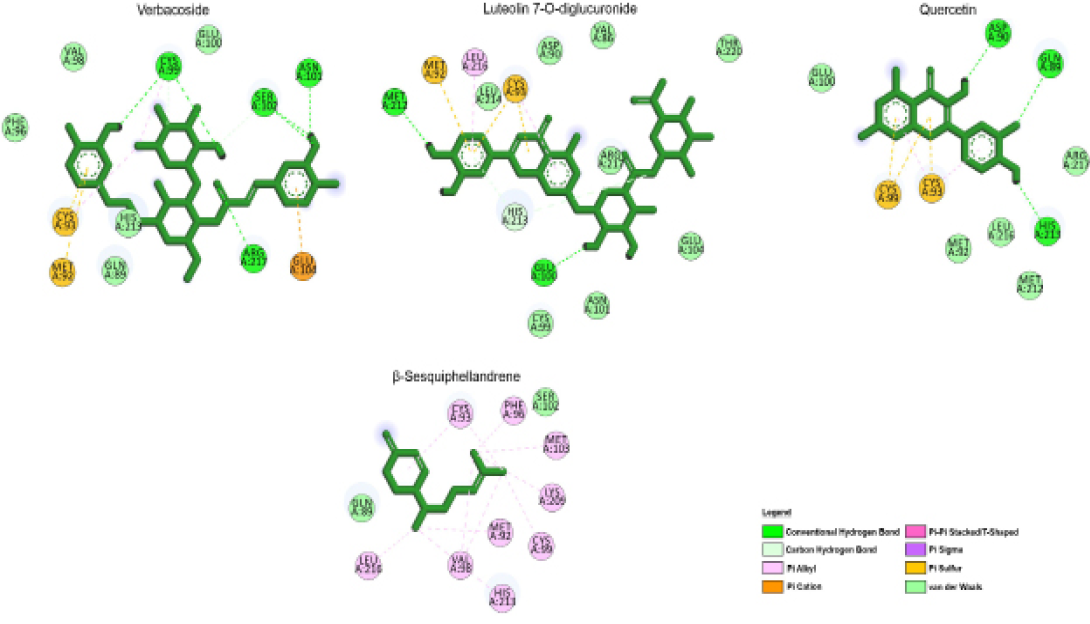
Next, an interaction chemistry analysis was conducted among the previously identified top 10 compounds with IL-6. The details of the interaction chemistry for each complex are described in the supplementary file (figure S1). Broadly, the chemical interactions analyzed fall into three main categories: hydrogen bonds, hydrophobic interactions, and van der Waals interactions . Hydrogen bonds are the most vital type of interaction, so compounds with the highest number of hydrogen bonds are expected to exhibit the best inhibitory activity compared to other compounds (Chen et al., 2016; ). However, the presence of hydrophobic bonds also contributes to the stability of interactions (; ), including pi-hydrophobic, alkyl hydrophobic, or mixed pi/alkyl hydrophobic (). In addition, compounds with more interaction at predicted binding sites were considered the most excellent candidates for IL-6 inhibitors. Referring to those requirements, Verbacoside emerged as the compound with the highest number of hydrogen bond interactions, supplemented by five hydrophobic bonds. Luteolin 7-O-diglucuronide and Quercetin were also found to have significant hydrogen bond interactions, supported by an adequate number of hydrogen bonds and Van der Waals interaction to stabilize their interactions with IL-6. Although no hydrogen bond was formed, ß-Sesquiphellandrene had 11 Alkyl bonds and the lowest binding affinity (Figure 3). Therefore, these compounds will be further examined for the stability of their interactions and structural confirmation using the molecular dynamics simulation (MDS) approach.
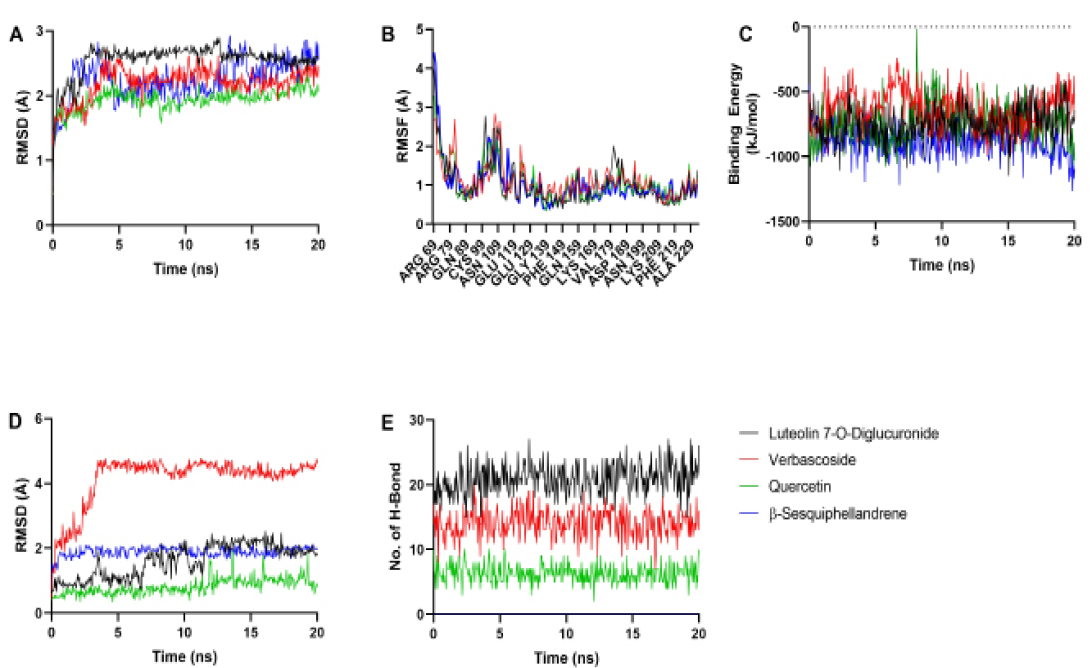
Referring to the MDS analysis, the interaction of those selected compounds slightly alters the structural integrity of IL-6 (figure 4A). Most of the complexes achieved stable conformation after the fifth ns of simulation, with IL6-Luteolin 7-O-diglucuronide appearing to have the highest value of RMSD (figure 4A). This pattern may appear due to the stabilization process of this compound, which induces more stable conformation after docking into IL-6. The data is also supported by the RMSF value, which indicates a low fluctuation below 3 Å. The highest RMSF value was displayed in each complex’s C-terminal region (figure 4B). This instability is a common feature in proteins , as also reported in other similar molecular dynamics studies , 2022b; ; .
Binding free energy revealed some energy fluctuations among analyzed complexes with no apparent difference (figure 4C). These values confirmed the molecular docking analysis, ß-Sesquiphellandrene, which showed the lowest binding free energy among analyzed complexes. Most simulated complexes displayed a fluctuation in energy value, and Verbacoside appeared to have the most fluctuation (figure 4C). Low and stable energy values described that the protein-compound complex had more favorable structural stability than the unbound state of the protein and the compound separately . The fluctuation of binding free energy appeared to be affected by the compounds’ conformational stability. This statement was supported by the high RMSD of ligand conformation of Verbacoside than other compounds. Again, ß-Sesquiphellandrene and Quercetin showed the most stable conformation upon binding with IL-6 (figure 4D). As previously described, structural stability had an entropic cost in forming a complex . Hence, Verbacoside may be less effective as an IL-6 inhibitor due to its conformational instability.
Hydrogen bond becomes the most influential interaction chemistry to support protein-ligand interaction stability ;, particularly related to the entropic penalty . Interestingly, Verbacoside had the second-highest hydrogen bond formation during the simulation period after Luteolin 7-O-diglucuronide (figure 4E). The protein and ligand frequently use robust hydrogen bonds such as N–H...O, O–H...O, N–H...N, and more feeble bonds like C–H...O and C–H...N . Combining strong-weak hydrogen bonds will alleviate protein-ligand binding affinity . Referring to those types of hydro
gen bonds, both Luteolin 7-O-diglucuronide and Verbacoside have mixed strong-weak hydrogen bonds due to the involvement of conventional and carbon-hydrogen bonds in their protein-ligand complexes (Figure 4). However, due to a stable structural conformation, Luteolin 7-O-diglucuronide may have advantages through the π-interactions, Van der Waals interactions, and the entropic penalty (figure 4D). As summarized earlier, π-interactions can provide additional stabilization to the protein-ligand complex, enhancing the binding affinity and specificity of the ligand . In addition, Van der Waals interactions, specifically dispersion interactions, dominate the ligand binding to the protein, contributing to favorable enthalpic contributions in the binding process . In summary, Luteolin 7-O-diglucuronide, Verbacoside, Quercetin, and ß-Sesquiphellandrene have excellent potential to inhibit IL-6 through their chemistry interactions and further stabilize their inhibitory activities. Inhibition of IL-6 may become beneficial in achieving intestinal gut health balance. Nevertheless, other factors, such as the contribution of gut microbiota, may also be involved in that mechanism. Thus, further studies are still required to comprehend the role of the bioactive of teak, ginger, and Turmeric in regulating intestinal immunoactivity.
CONCLUSIONS AND RECOMMENDATIONS
In conclusion, teak leaves, Turmeric, and ginger emerge as promising natural additives to enhance broiler chicken gut health by modulating mucosal immunity. Utilizing network biology and molecular docking identifies interleukin-6 as a pivotal mediator, unveiling potential targets for these herbs. Their demonstrated anti-inflammatory properties and impact on gut microbiota offer a potential antibiotic substitute in the poultry industry. Further research is essential to understand the protective mechanisms comprehensively and optimize their incorporation into feed formulations. Moreover, investigations should delve into specific mechanisms, explore synergies in combining these herbs, conduct in vivo studies for validation, and assess long-term effects on poultry health, performance, and economic feasibility in commercial feed formulations.
ACKNOWLEDGEMENTS
The authors thank the High-Performance Computing facility under the AI Center of Brawijaya University for supporting the molecular dynamics simulation. The authors also acknowledge Prof. Nashi Widodo, Ph.D.Med.Sc. for providing access to the subscribed version of YASARA. This research was funded by the Ministry of Education, Culture, Research, and Technology, Republic of Indonesia, under grant no. 1138.4/UN10.C10/TU/2023.
Novelty statement
This study pioneers a natural approach to boost mucosal immunity in poultry using Teak Leaves, Turmeric and Ginger. Through a network biological analysis, it pinpoints Interleukin-6 (IL-6) as a key player in gut health. Notably, bioactive compounds from Teak Leaves and Ginger tightly interact with IL-6, offering a unique avenue for immunomodulation. ß-sesquiphellandrene, Luteolin 7-O-diglucuronide, Verbacoside, and Quercetin, identified as potent IL-6 inhibitors, show promising stability in molecular dynamics simulations. This breakthrough holds potential for antibiotic-free poultry production, enhancing gut health, nutrient absorption, and physiological balance through IL-6 inhibition.
authors contribution
Feri Eko Hermanto: Data acquisition, Analysis, manuscript drafting
Muhammad Halim Natsir: Funding acquisition, conception and design
Conflict of interest
The authors declare no conflict of interest.
Figures
Figure 1:.
Biological network topology contains proteins involved in mucosal immunity, digestive health, and proteins involved in mucosal immunity and digestive health.
Figure 2:.
Identification of the level of importance of a protein in a biological network using 11 Cytohubba algorithms (A) and a summary of the proteins that consistently have the highest scores (B).
Figure 3:.
Interaction chemistry among selected compounds according to the molecular docking analysis.
Figure 4:.
Structural stability of selected complexes according to the value of RMSD backbone atom (A), RMSF of per-residue (B), binding free-energy estimations (C), RMSD of ligand conformation (D), and the number of hydrogen bonds (E).
References
Abd El-Hack M.E., Alagawany M., Shaheen H., Samak D., Othman S.I., Allam A.A., Taha A.E., Khafaga A.F., Arif M., Osman A., El Sheikh A.I., Elnesr S.S., Sitohy M. (2020). Ginger and Its Derivatives as Promising Alternatives to Antibiotics in Poultry Feed. Animals (Basel). 10: 452. https://doi.org/10.3390/ani10030452[CrossRef]
Abdelli N., Solà-Oriol D., Pérez J.F. (2021). Phytogenic Feed Additives in Poultry: Achievements, Prospective and Challenges. Animals (Basel). 11: 3471. https://doi.org/10.3390/ani11123471[CrossRef]
Al-Sadi R., Ye D., Boivin M., Guo S., Hashimi M., Ereifej L., Ma T.Y. (2014). Interleukin-6 Modulation of Intestinal Epithelial Tight Junction Permeability Is Mediated by JNK Pathway Activation of Claudin-2 Gene. PLoS One. 9: e85345. https://doi.org/10.1371/journal.pone.0085345[CrossRef]
Asdaq S.M.B., Nayeem N., Abida Alam Md.T., Alaqel S.I., Imran Mohd., Hassan E.-W.E., Rabbani S.I. (2022). Tectona grandis L.f: A comprehensive review on its patents, chemical constituents, and biological activities. Saudi J. Biolog. Sci. 29: 1456–1464. https://doi.org/10.1016/j.sjbs.2021.11.026[CrossRef]
Barratt E., Bingham R.J., Warner D.J., Laughton C.A., Phillips S.E.V., Homans S.W. (2005). Van der Waals Interactions Dominate Ligand−Protein Association in a Protein Binding Site Occluded from Solvent Water. J. Am. Chem. Soc. 127: 11827–11834. https://doi.org/10.1021/ja0527525[CrossRef]
Broom L.J., Kogut M.H. (2018). The role of the gut microbiome in shaping the immune system of chickens. Vet. Immunol. Immunopathol. 204: 44–51. https://doi.org/10.1016/j.vetimm.2018.10.002[CrossRef]
Chao I.-C., Wang C.-M., Li S.-P., Lin L.-G., Ye W.-C., Zhang Q.-W. (2018). Simultaneous Quantification of Three Curcuminoids and Three Volatile Components of Curcuma longa Using Pressurized Liquid Extraction and High-Performance Liquid Chromatography. Molecules. 23: 1568. https://doi.org/10.3390/molecules23071568[CrossRef]
Chen D., Oezguen N., Urvil P., Ferguson C., Dann S.M., Savidge T.C. (2016). Regulation of protein-ligand binding affinity by hydrogen bond pairing. Sci. Adv. 2: e1501240. https://doi.org/10.1126/sciadv.1501240[CrossRef]
Chin C.-H., Chen S.-H., Wu H.-H., Ho C.-W., Ko M.-T., Lin C.-Y. (2014). cytoHubba: identifying hub objects and sub-networks from complex interactome. BMC Syst. Biol. 8: 1–7. https://doi.org/10.1186/1752-0509-8-S4-S11[CrossRef]
Dallakyan S., Olson A.J. (2015). Small-molecule library screening by docking with PyRx. Methods Mol. Biol. 1263: 243–250. https://doi.org/10.1007/978-1-4939-2269-7_19[CrossRef]
Daramola OT (2022). Proximate composition and phytochemical screening of Teak (Tectona grandis) leaves as phytogenic feed additive in poultry diets. Nigerian J. Anim. Sci. 24: 121–127.
Duangnumsawang Y., Zentek J., Goodarzi Boroojeni F. (2021). Development and Functional Properties of Intestinal Mucus Layer in Poultry. Front. Immunol. 12.
Ducatelle R., Goossens E., Eeckhaut V., Van Immerseel F. (2023). Poultry gut health and beyond. Anim. Nutrit. 13: 240–248. https://doi.org/10.1016/j.aninu.2023.03.005[CrossRef]
Fan Q., Ma J., Xu Q., Zhang J., Simion D., Carmen G., Guo C. (2015). Animal-derived natural products review: focus on novel modifications and applications. Colloids Surf B Biointer. 128: 181–190. https://doi.org/10.1016/j.colsurfb.2015.02.033[CrossRef]
Ferenczy G.G., Kellermayer M. (2022). Contribution of hydrophobic interactions to protein mechanical stability. Computat. Struct. Biotechnol. J. 20: 1946–1956. https://doi.org/10.1016/j.csbj.2022.04.025[CrossRef]
Freitas R.F., de Schapira M. (2017). A systematic analysis of atomic protein–ligand interactions in the PDB. Med. Chem. Commun. 8: 1970–1981. https://doi.org/10.1039/C7MD00381A[CrossRef]
Fritsch J., Abreu M.T. (2019). The Microbiota and the Immune Response: What Is the Chicken and What Is the Egg? Gastrointest. Endosc. Clin. N. Am. 29: 381–393. https://doi.org/10.1016/j.giec.2019.02.005[CrossRef]
Genheden S., Ryde U. (2015). The MM/PBSA and MM/GBSA methods to estimate ligand-binding affinities. Expert Opin. Drug Discov. 10: 449–461. https://doi.org/10.1517/17460441.2015.1032936[CrossRef]
Gumbarewicz E., Jarząb A., Stepulak A., Kukula-Koch W. (2022). Zingiber officinale Rosc. in the Treatment of Metabolic Syndrome Disorders—A Review of In Vivo Studies. Int. J. Molecul. Sci. 23: 15545. https://doi.org/10.3390/ijms232415545[CrossRef]
Harun N.H., Mohamad M.F. (2022). The Immunomodulatory effects of Zingiber officinale (Ginger): A Systematic Review. Res. J. Pharm. Technol. 15: 3776–3781. https://doi.org/10.52711/0974-360X.2022.00634[CrossRef]
Hermanto F.E., Rifa’i M., Widodo (2019). Potential role of glyceollin as anti-metastatic agent through transforming growth factor-β receptors inhibition signaling pathways: A computational study. AIP Conference Proceed. 2155: 020035. https://doi.org/10.1063/1.5125539[CrossRef]
Hermanto F.E., Warsito W., Rifa’i M., Widodo N. (2022a). Understanding hypocholesterolemic activity of soy isoflavones: Completing the puzzle through computational simulations. J. Biomolecul. Struct. Dynam. 1–7. https://doi.org/10.1080/07391102.2022.2148752[CrossRef]
Hermanto F.E., Warsito W., Rifa’i M., Widodo N. (2022b). On The Hypolipidemic Activity of Elicited Soybeans: Evidences Based on Computational Analysis. Indones. J. Chem. 22: 1626–1636. https://doi.org/10.22146/ijc.75777[CrossRef]
Iwakura M., Honda S. (1996). Stability and reversibility of thermal denaturation are greatly improved by limiting terminal flexibility of Escherichia coli dihydrofolate reductase. J. Biochem. 119: 414–420. https://doi.org/10.1093/oxfordjournals.jbchem.a021257[CrossRef]
Khan R.U., Naz S., Javdani M., Nikousefat Z., Selvaggi M., Tufarelli V., Laudadio V. (2012). The use of Turmeric (Curcuma longa) in poultry feed. World’s Poult. Sci. J. 68: 97–103. https://doi.org/10.1017/S0043933912000104[CrossRef]
Kim S., Chen J., Cheng T., Gindulyte A., He J., He S., Li Q., Shoemaker B.A., Thiessen P.A., Yu B., Zaslavsky L., Zhang J., Bolton E.E. (2023). PubChem 2023 update. Nucl. Acids Res. 51: D1373–D1380. https://doi.org/10.1093/nar/gkac956[CrossRef]
Krieger E., Joo K., Lee Jinwoo, Lee Jooyoung, Raman S., Thompson J., Tyka M., Baker D., Karplus K. (2009). Improving physical realism, stereochemistry and side-chain accuracy in homology modeling: four approaches that performed well in CASP8. Proteins. 77: 114–122. https://doi.org/10.1002/prot.22570[CrossRef]
Krieger E., Vriend G. (2015). New ways to boost molecular dynamics simulations. J. Comput. Chem. 36: 996–1007. https://doi.org/10.1002/jcc.23899[CrossRef]
Krivák R., Hoksza D. (2018). P2Rank: machine learning based tool for rapid and accurate prediction of ligand binding sites from protein structure. J. Cheminformat. 10: 39. https://doi.org/10.1186/s13321-018-0285-8[CrossRef]
Kubinyi H. (2001). Hydrogen Bonding: The Last Mystery in Drug Design?, in: Pharmacokinetic Optimization in Drug Research. John Wiley & Sons, Ltd, pp. 513–524. https://doi.org/10.1002/9783906390437.ch28[CrossRef]
Lin Z.-X., Zhang M., Yang R., Min Y., Guo P.-T., Zhang J., Wang C.-K., Jin L., Gao Y.-Y. (2023). The anti-inflammatory effect of lutein in broilers is mediated by regulating Toll-like receptor 4/myeloid-differentiation-factor 88 signaling pathway. Poult. Sci. 102: 102622. https://doi.org/10.1016/j.psj.2023.102622[CrossRef]
Majewski M., Ruiz-Carmona S., Barril X. (2019). An investigation of structural stability in protein-ligand complexes reveals the balance between order and disorder. Commun. Chem. 2: 1–8. https://doi.org/10.1038/s42004-019-0205-5[CrossRef]
Meylani V., Rizal Putra R., Miftahussurur M., Sukardiman S., Hermanto F.E., Abdullah A. (2023). Molecular Docking Analysis of Cinnamomum zeylanicum Phytochemicals against Secreted Aspartyl proteinase 4-6 of Candida albicans as Anti-Candidiasis Oral. Results Chem. 5: 100721. https://doi.org/10.1016/j.rechem.2022.100721[CrossRef]
Panigrahi S.K. (2008). Strong and weak hydrogen bonds in protein-ligand complexes of kinases: a comparative study. Amino Acids 34, 617–633. https://doi.org/10.1007/s00726-007-0015-4[CrossRef]
Patil R., Das S., Stanley A., Yadav L., Sudhakar A., Varma A.K. (2010). Optimized hydrophobic interactions and hydrogen bonding at the target-ligand interface leads the pathways of drug-designing. PLoS One. 5: e12029. https://doi.org/10.1371/journal.pone.0012029[CrossRef]
Peng X., Wang K., Wang Yuhan, Lu Y., Lv F., Cui Y., Wang, Ying, Si H. (2022). Exploration of the Mechanism of the Control of Coccidiosis in Chickens Based on Network Pharmacology and Molecular Docking With the Addition of Modified Gegen Qinlian Decoction. Front. Vet. Sci. 9.
Roberts T., Wilson J., Guthrie A., Cookson K., Vancraeynest D., Schaeffer J., Moody R., Clark S. (2015). New issues and science in broiler chicken intestinal health: Emerging technology and alternative interventions. J. Appl. Poult. Res. 24: 257–266. https://doi.org/10.3382/japr/pfv023[CrossRef]
Rohman M.S., Lukitasari M., Kholis M.N., Wahyuni N.A., Chandra B.R., Hermanto F.E., Widodo N. (2023). Combination of decaffeinated green coffee and decaffeinated green tea ameliorates cardiomyopathy through cardiotrophin-1-dependent expression regulation in a metabolic syndrome rat model: a proposed mechanism. Beni-Suef University J. Basic Appl. Sci. 12: 53. https://doi.org/10.1186/s43088-023-00381-w[CrossRef]
Shah A., Patel V., Jain M., Parmar G. (2023). Network Pharmacology and Systems Biology in Drug Discovery, in: Rudrapal, M., Khan, J. (Eds.), CADD and Informatics in Drug Discovery, Interdisciplinary Biotechnological Advances. Springer Nature, Singapore., 231–252. https://doi.org/10.1007/978-981-99-1316-9_10[CrossRef]
Shannon P., Markiel A., Ozier O., Baliga N.S., Wang J.T., Ramage D., Amin N., Schwikowski B., Ideker T. (2003). Cytoscape: A Software Environment for Integrated Models of Biomolecular Interaction Networks. Genome Res. 13: 2498–2504. https://doi.org/10.1101/gr.1239303[CrossRef]
Song J., Li Q., Li P., Liu R., Cui H., Zheng M., Everaert N., Zhao G., Wen J. (2018). The effects of inulin on the mucosal morphology and immune status of specific pathogen-free chickens1. Poult. Sci. 97: 3938–3946. https://doi.org/10.3382/ps/pey260[CrossRef]
Syahraini A., Harnelly E., Hermanto F. (2023). Pro-Apoptosis Activity of Pogostemon cablin Benth. Against Nasopharyngeal Carcinoma through the BCL-2 Inhibition Signaling Pathway: A Computational Investigation. Makara J. Sci. 27: 208−216. https://doi.org/10.7454/mss.v27i3.1484[CrossRef]
Tan H., Zhen W., Bai D., Liu K., H,e X., Ito K., Liu Y., Li Y., Zhang Y., Zhang B., Ma Y. (2023). Effects of dietary chlorogenic acid on intestinal barrier function and the inflammatory response in broilers during lipopolysaccharide-induced immune stress. Poult. Sci. 102: 102623. https://doi.org/10.1016/j.psj.2023.102623[CrossRef]
Tarradas J., Tous N., Esteve-Garcia E., Brufau J. (2020). The Control of Intestinal Inflammation: A Major Objective in the Research of Probiotic Strains as Alternatives to Antibiotic Growth Promoters in Poultry. Microorganisms. 8: 148. https://doi.org/10.3390/microorganisms8020148[CrossRef]
Thimmulappa R.K., Mudnakudu-Nagaraju K.K., Shivamallu C., Subramaniam K.J.T., Radhakrishnan A., Bhojraj S., Kuppusamy G. (2021). Antiviral and immunomodulatory activity of curcumin: A case for prophylactic therapy for COVID-19. Heliyon. 7: e06350. https://doi.org/10.1016/j.heliyon.2021.e06350[CrossRef]
Trott O., Olson A.J. (2010). AutoDock Vina: improving the speed and accuracy of docking with a new scoring function, efficient optimization and multithreading. J. Comput. Chem. 31: 455–461. https://doi.org/10.1002/jcc.21334[CrossRef]
Waterhouse A., Bertoni M., Bienert S., Studer G., Tauriello G., Gumienny R., Heer F.T., de Beer T.A.P., Rempfer C., Bordoli L., Lepore R., Schwede T. (2018). SWISS-MODEL: homology modelling of protein structures and complexes. Nucl. Acids Res. 46: W296–W303. https://doi.org/10.1093/nar/gky427[CrossRef]
Wolf J., Rose-John S., Garbers C. (2014). Interleukin-6 and its receptors: A highly regulated and dynamic system. Cytokine., SI: 2014 ICIS Abstract Issue 70: 11–20. https://doi.org/10.1016/j.cyto.2014.05.024[CrossRef]
Wu Q., Yang F., Tang H. (2021). Based on network pharmacology method to discovered the targets and therapeutic mechanism of Paederia scandens against nonalcoholic fatty liver disease in chicken. Poult. Sci. 100: 55–63. https://doi.org/10.1016/j.psj.2020.09.087[CrossRef]
Zhang B., Zhong Q., Liu N., Song P., Zhu P., Zhang C., Sun Z. (2022). Dietary Glutamine Supplementation Alleviated Inflammation Responses and Improved Intestinal Mucosa Barrier of LPS-Challenged Broilers. Animals. 12: 1729. https://doi.org/10.3390/ani12131729[CrossRef]
Zhu Q., Sun P., Zhang B., Kong L., Xiao C., Song Z. (2021). Progress on Gut Health Maintenance and Antibiotic Alternatives in Broiler Chicken Production. Front Nutr. 8: 692839. https://doi.org/10.3389/fnut.2021.692839[CrossRef]