
Kappa-casein played critical role in the expression of milk protein. It stabilizes the milk micelle and gene 5’ flanking region which works valuably in transcription regulation. Current study illustrates that Kappa-casein gene 5ï¸ flanking region in Dromedary camel of Pakistan is highly polymorphic and it is phylogeneticaly linked with other mammals. The analyses of the sequence of 5ï¸ flanking region in various breeds reveals the presence of different polymorphic regions includes cysteine nucleotide deletion, AT bases insertion and transvertions (C>G; G>T). Deletion of A bases at c.1-1075 and hetrozygosity (CT) at the c1-1046 were analyzed along with some other SNPs are very important. These evidences points towards the change of expression of those protein which are nearest to the region of gene regulation and enhancer region. After observing taxas several distinct clads of camel breeds it was found that Kharani breed showed the close relationship with the C. dromedarius camel and all the breeds show a common ancestor that is sheep. For Casein loci in the Pakistani breeds these SNPs are the first to be reported.
Short Communication · Volume 52, Issue 4, 3 May 2020 · Open Access
5′ Flanking Region of Kappa-Casein Gene is Highly Polymorphic in Eight Dromedary Camel Breeds of Pakistan
Affiliations & Notes ⌄
- 1Department of Molecular Biology, Virtual University of Pakistan, Lahore, Pakistan. , * Corresponding author: masroor.ellahi@vu.edu.pk
Article Info ⌄
- Journal:
- Pakistan Journal of Zoology
- Published:
- 3 May 2020

From the article
- Phosphoproteins are the main important constituent of mammalian milk and Kappa-casein belong to this phosphoproteins family, also Kappa casein is a glycosilated protein, (as1, β, as2, κ).
- The examination of 5 flanking region of Kappa casein provides us very useful information about the transcription analysis factors.
- In the current study, to examine the presumed regulatory regions among various breeds of dromederius camel sequencing of 5 flanking region Kappa-casein gene was conducted for SNP discovery.
- In the upstream position of Kappa-casein gene, various polymorphic positions were observed as shown in the Table II.
Selected from the article's own text.
Abstract
Materials and methods
Blood samples were collected from Cholistan area of Pakistan in vaccutainers from different camel breads including Bareela, Pahri, Mareecha, Thari, Watni, Kachi, Kharani and mix breed and studied. Manual method were used to extract genomic DNA following the method of from each sample and concentrations were brought to the same level 50 mg/μl.
Amplification of purified extracted DNA was done using kappa-casein gene 5 flanking region. designing of primers was carried out by primer designing software known as primer3 software (Table I) and NCBI was used as source for the targeted gene sequence (Accession no. AJ409280.1). PCR amplification methods included following conditions such as initial denaturation at 95°C (5 min), primer annealing temperature was adjusted according to the (Table I), extension of the gene was performed at 72°C for 45 seconds and final extension was carried out at 72°C for 10 min. Then PCR product was sent for sequencing with ABI 3100 genetic (Applied Biosystem) sequence analyzer.
Sequenced data was manually aligned and analyzed. MEGA 6 software package was used for the construction of phylogenetic tree .
Table I. Kappa-casein gene 5’ flanking region primer list.
| Primer Name | Product Size (bp) | Primer sequence |
| k-casein3F | 390 | AGTGTGTGACCAGCTATTATCA AGGTCTTGCTTGGCAGTAG |
| k-casein3R | ||
| k-casein1F | 459 | CTGAACAGCAGAAGCCAACT |
| k-casein1R | AGGTGAAACATTCGGGAAAT | |
| k-casein2F | 598 | CCCCAGAGAAATGTATGCAA |
| k-casein2R | TCAATCAACGAGTTCCACCT |
Results and discussion
Phosphoproteins are the main important constituent of mammalian milk and Kappa-casein belong to this phosphoproteins family, also Kappa casein is a glycosilated protein, (as1, β, as2, κ). An important role is played by Kappa-casein for the calculation of specific function and size in caseinmicelle stabilization. The examination of 5 flanking region of Kappa casein provides us very useful information about the transcription analysis factors. About the expression regulation of gene this analysis is very helpful. Mutation of any type in this particular patch, change the mRNA stability or modify the transcription rat . So, this preceded to the alteration in the components of specific protein of milk. In the current study, to examine the presumed regulatory regions among various breeds of dromederius camel sequencing of 5 flanking region Kappa-casein gene was conducted for SNP discovery. In the upstream position of Kappa-casein gene, various polymorphic positions were observed as shown in the Table II.
Various single nucleotide substitutions, transversions (C>G, G>T), transition (A>G), deletion and insertion of nucleotide were observed. Transversions of G>T at the position 1578 has been described for the milk and yield of milk protein also in Holstein cattle. Genetic variations in camel milk protein alpha casein have also been reported . Kappeler et al. (1998) has described non-allelic variants of similar fraction of casein as an exchange of amino acid. Pauciullo et al. (2013) have been recently reported 17 SNPs (polymorphic sites) in camels and also analyzed CSN3 Kappa-casein gene. By using the available reference sequences of species including; Capra hericus, Bostaurus, Ovisaries, Camelusdromedarious and, a polygenetic tree of studied k-casein gene of camelbreeds from Pakistan was formulated to see the genetic accordance with them. Phylogenetic tree is shown in Figure 1.
In the cattle polymorphism in the κ-casein was described well by sheep ; and goat ; . In CSN3 gene cows and Goats express most allelic polymorphism than the other farm animals ; . Yahyaoui et al. (2003) described that the solubility of casein was affected by allelic polymorphism in κ-casein gene C-terminal region However, the analysis of coding region sequence of κ-casein in association studies is not always reliable and might be attributed to the existence of intragenic haplotypic variants combination in the noncoding and regulatory regions .
Kappeler et al. (2003) examined the close association with different species by describing the 5 flanking regions of milk gene for camel milk. 5’-upstream sequences arrangement of protein genes for camel milk was closely associated with their analogous complements from the other animal species. In the mammary gland, these are
Table II. Kappa casein gene 5’ flanking region polymorphic variations different breads of camel of Pakistan.
| Sr# | Position | Sequence change | Type of change | Sr # | Position | Sequence change | Type of change |
| Kachi breed | Watni breed | ||||||
| 1 | c.1-1075 | del. A | Deletion | 1 | c.1-1075 | del. A | Deletion |
| 2 | c.1-1046 | GT | Heterozygous | 2 | c.1-1046 | GT | Heterozygous |
| 3 | c.1-707 | del. G | Deletion | 3 | c.1-982 | GC | Heterozygous |
| 4 | c.1-684 | A>T | Transversion | 4 | c.1-707 | del. G | Deletion |
| 5 | c.1-683 | T>G | Transversion | 5 | c.1-1156 | AT | Insertion |
| 6 | c.1-402 | Ins. T | Insertion | ||||
| 7 | c.1-340 | Ins. T | Insertion | Kharani breed | |||
| 8 | c.1-321 | Ins. T | Insertion | 1 | c.1-1046 | GT | Heterozygous |
| 9 | c.1-1085 | del. A | Deletion | 2 | c.1-982 | GC | Heterozygous |
| 10 | c.1-1081 | Ins. A | Insertion | 3 | c.1-707 | del. G | Deletion |
| 11 | c.1-1036 | A>G | Transition | ||||
| 12 | c.1-1035 | A>G | Transition | Thari breed | |||
| 13 | c.1-682 | del. G | Deletion | 1 | c.1-707 | del. G | Deletion |
| 14 | c.1-525 | GA | Heterozygous | ||||
| Mareecha breed | Pahari breed | ||||||
| 1 | c.1-1075 | del. A | Deletion | 1 | c.1-1075 | del. A | Deletion |
| 2 | c.1-1046 | GT | Heterozygous | 2 | c.1-1046 | GT | Heterozygous |
| 3 | c.1-982 | GC | Heterozygous | 3 | c.1-982 | GC | Heterozygous |
| 4 | c.1-707 | del. G | Deletion | 4 | c.1-707 | del. G | Deletion |
| 5 | c.1-684 | A>T | Transversion | 5 | c.1-684 | A>T | Transversion |
| 6 | c.1-683 | T>G | Transversion | 6 | c.1-683 | T>G | Transversion |
| 7 | c.1-1088 | G>T | Transversion | 7 | C1-1057 | ins T | Insertion |
| 8 | c.1-1087 | A>G | Transition | ||||
| 9 | c.1-1054 | C>T | Transition | ||||
| Mixed Breed 3500-4000 | Breela Breed | ||||||
| 1 | c.1-1075 | del. A | Deletion | 1 | c.1-1075 | del. A | Deletion |
| 2 | c.1-1046 | GT | Heterozygous | 2 | c.1-1046 | GT | Heterozygous |
| 3 | c.1-982 | GC | Heterozygous | 3 | c.1-982 | GC | Heterozygous |
| 4 | c.1-707 | del. G | Deletion | 4 | c.1-707 | del. G | Deletion |
| 5 | c.1-684 | A>T | Transversion | 5 | c.1-684 | A>T | Transversion |
| 6 | c.1-683 | T>G | Transversion | 6 | c.1-1081 | ins. A | insertion |
| 7 | c.1-690 | ins. G | insertion | ||||
gene expression level independent in the other species. An interesting fact about the 5’-upstream sequences of camels is to show the significant relatedness in the conditions in which the particular genes were delineate to express a fantastically different level in various specie’s lactating mammary glands e.g. k-CN in case of camel and bovine . This sequence relatedness stipulate that the modulation of gene expression has to be regulate to little perpetuated areas within the 5’-upstream sequence. Mutations in these areas will commence, eradicate or modify the tissue and stage specific proclamation of milk protein genes.
Kappa-casein is considered as an important biomarker for milk production in dairy animals. On comparing different camel breeds, kappa-casein gene is observed to be very polymorphic from upstream region and could prove to be a proficient molecular marker in selection. As not enough information is available so the polymorphism found in in the current study in the casein cluster in camels can be used as the first genetic marker in the arrangement of the 5’-upstream sequence. Data collected from different breeds of camels in the current study which indicated polymorphic sites would promote practicability for a quick directional selection in esteem of such allele.
Statement of conflict of interest
The authors declare there is no conflict of interest.
Figures
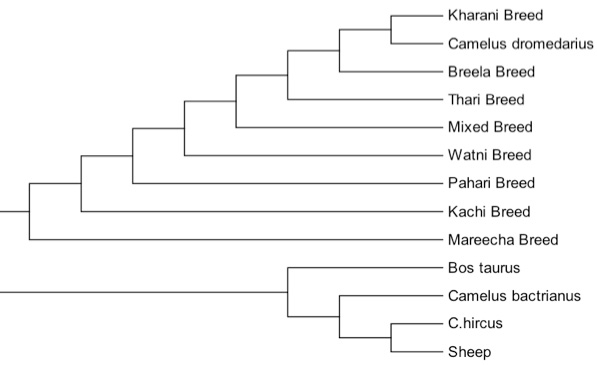
Evolutionary relationship of camel bread.
References
- Al-Ayadhi, L.Y., and Elamin, N.E., 2013. Evidence-based Complem. Altern. Med. eCAM, 2013: 602834. https://doi.org/10.1155/2013/602834[CrossRef]
- Al haj, O.A. and Al Kanhal, H.A., 2011. Int. Dairy. J., 20: 811-821. https://doi.org/10.1016/j.idairyj.2010.04.003[CrossRef]
- Alim, N., Fondrini, F., Bonizzi, I., Feligini, M. and Enne, G., 2005. Pakistan J. Nutri., 4: 112-116.
- Barłowska, J., Szwajkowska, M., Litwińczuk, Z. and Król, J., 2011. Compreh. Rev. Fd. Sci. Fd. Safe., 10: 291-302. https://doi.org/10.1111/j.1541-4337.2011.00163.x[CrossRef]
- Caroli, A.M., Chessa, S. and Erhardt, G.J., 2009. J. Dairy Sci., 92: 5335–5352. https://doi.org/10.3168/jds.2009-2461[CrossRef]
- Ceriotti, G., Chessa, S., Bolla, P., Budelli, E., Bianchi, L., Duranti, E. and Caroli, A., 2004. J. Dairy Sci., 87: 2606-2613. https://doi.org/10.3168/jds.S0022-0302(04)73386-X[CrossRef]
- El-Agamy, E.I., 2007. Small Rumin. Res., 68: 64-72. https://doi.org/10.1016/j.smallrumres.2006.09.016[CrossRef]
- Ereifej, K.I., Alu’datt, M.H., AlKhalidy, H.A., Alli, I. and Rababah, T., 2011. Fd. Chem., 127: 282-289. https://doi.org/10.1016/j.foodchem.2010.12.112[CrossRef]
- Farah, Z., Mollet, M., Younan, M. and Dahir, R., 2007. Livest. Sci., 110: 187-191. https://doi.org/10.1016/j.livsci.2006.12.010[CrossRef]
- Heck, J.M.L., Schennink, A. and van Valenberg, H.J.F., 2009. J. Dairy Sci., 92: 1192–1202. https://doi.org/10.3168/jds.2008-1208[CrossRef]
- Jann, O.C., Prinzenberg, E.M., Luikart, G., Caroli, A. and Erhardt, G., 2004. J. Dairy Res., 71: 188-195. https://doi.org/10.1017/S0022029904000093[CrossRef]
- Kappeler, S., Farah, Z. and Puhan, Z., 1998. J. Dairy Res., 65: 209-222. https://doi.org/10.1017/S0022029997002847[CrossRef]
- Kappeler, S.R., Farah, Z. and Puhan, Z., 2003. J. Dairy Sci., 86: 498–508. https://doi.org/10.3168/jds.S0022-0302(03)73628-5[CrossRef]
- Kumar, S., Stecher, G. and Tamura, K., 2016. MEGA7: Mol. Biol. Evolut., 33: 1870-1874.
- Lipkin, E., Tal-Stein, R., Friedmann, A. and Soller, M., 2008. J. Dairy Sci., 91: 1614-1627. https://doi.org/10.3168/jds.2007-0655[CrossRef]
- Nagarajan, G., Swami, S.K., Ghorui, S., Pathak, K., Singh, R. and Patil, N., 2012. Res. Vet. Sci., 92: 420-426. https://doi.org/10.1016/j.rvsc.2011.03.028[CrossRef]
- Ochirkhuyag, B., Chobert, J.M., Dalgalarrondo, M., Choiset, Y. and Haertlé, T., 1997. Lait, 77: 601-613. https://doi.org/10.1051/lait:1997543[CrossRef]
- Pauciullo, A., Shuiep, E.S., Cosenza, G., Ramunno, L. and Erhardt, G., 2013. Gene, 513: 22–30. https://doi.org/10.1016/j.gene.2012.10.083[CrossRef]
- Prinzenberg, E.M., Gutscher, K., Chessa, S., Caroli, A. and Erhardt, G., 2005. J. Dairy Sci., 88: 1490-1498. https://doi.org/10.3168/jds.S0022-0302(05)72817-4[CrossRef]
- Prinzenberg, E.M., Jianlin, H. and Erhardt, G., 2008. J. Dairy Sci., 91: 1198-1203. https://doi.org/10.3168/jds.2007-0746[CrossRef]
- Prinzenberg, E.M., Weimann, C. and Brandt, H., 2003. J. Dairy Sci., 86: 2696–2705. https://doi.org/10.3168/jds.S0022-0302(03)73865-X[CrossRef]
- Ramunno, L., Cosenza, G. and Rando, A., 2004. Gene, 334: 105–111. https://doi.org/10.1016/j.gene.2004.03.006[CrossRef]
- Rijnkels, M., Kooiman, P.M., Platenburg, G.J., van Dixhoorn, M., Nuijens, J.H., de Boer, H.A. and Pieper, F.R., 1998. Trans. Res., 7: 5-14. https://doi.org/10.1023/A:1008892720466[CrossRef]
- Sabahat, S., Nadeem, A., Javed, M., Zahoor, M.Y., Hashmi, A.S., Yasein, G. and Abbas, G., 2020. Pakistan J. Zool., 52: 1-4.
- Sambrook, J. and Russell, D., 2001. Molecular cloning: A laboratory manual. Cold Spring Harbor Laboratory, Cold Spring Harbor, NY.
- Sawaya, W.N., Khalil, J.K., Al-Shalhat, A. and Al-Mohammad, H., 1984. J. Fd. Sci., 49: 744-747. https://doi.org/10.1111/j.1365-2621.1984.tb13200.x[CrossRef]
- Schwartz, H., 1992. Anim. Res. Dev., 35: 86- 98. https://doi.org/10.1007/BF00400861[CrossRef]
- Shuiep, E.S., Giambra, I.J., Yas, M., Zubeir, I.E. and Erhardt, G., 2013. Int. Dairy J., 28: 88–93. https://doi.org/10.1016/j.idairyj.2012.09.002[CrossRef]
- Yahyaoui, M.H., Angiolillo, A., Pilla, F., Sanchez, A. and Folch, J.M., 2003. J. Dairy Sci., 86: 2715–2720. https://doi.org/10.3168/jds.S0022-0302(03)73867-3[CrossRef]
- Zhang, H., Yao, J., Zhao, D., Liu, H., Li, J. and Guo, M., 2005. J. Dairy Sci., 88: 3402-3410. https://doi.org/10.3168/jds.S0022-0302(05)73024-1[CrossRef]
Services
Article usage statistics
Loading…