
Milk composition depends largely on the breed’s genetics and ration fed. Different proteins can be found in milk. Beta-caseins are thought to be more important because some serious health-related issues in humans have been reported with the consumption of A1 milk (mutated casein variant). This study was planned to investigate the polymorphism in the beta-casein gene (CSN2) in Sahiwal (40), American Holstein Friesian (40) and the crossbred (Sahiwal × HF) (50). PCR-RFLP and conformational sequencing were performed to investigate the beta-casein polymorphism. Results of the present study showed that there was not any mutated genotype (A1A1) available in all of the three breeds. All three breeds possess dominant genotype A2A2 with genotypic frequency (0.925, 0.4, 0.64) respectively and we have also found some heterozygous genotypes A1A2 in all breeds with genotypic frequency (0.075, 0.6, 0.36) respectively. Findings of the present study revealed that A2 (the dominant allele) is present with a pretty much higher frequency (0.9625, 0.7, 0.82) in all the three studied breeds and the mutated allele A1 is present with very low allelic frequency (0.037, 0.3, 0.18).
Short Communication · Volume 54, Issue 3, 4 March 2022 · Open Access
β casein Polymorphism in Indigenous and Exotic Cattle Breeds of Pakistan
· · · · ·
Affiliations & Notes ⌄
- 1Department of Livestock Production, University of Veterinary and Animal Sciences, Ravi Campus Pattoki, Pakistan 2Institute of Biochemistry and Biotechnology, University of Veterinary and Animal Sciences, Lahore, Pakistan * Corresponding author: muhammad.dawood@uvas.edu.pk
Article Info ⌄
- Journal:
- Pakistan Journal of Zoology
- Published:
- 4 March 2022

From the article
- It was observed that most of the animals in Sahiwal breed have A2A2 genotype but a few of these showed heterozygous genotype A1A2.
- We have not found any mutated A1A1 genotype for beta-casein protein .
- The results from the present study showed that A2 was the dominant allele found in the studied population and we did not find any mutated genotype (A1A1).
- The majority of the studied animals from all three breeds possessed dominant allele A2 and dominant genotype A2A2.
Selected from the article's own text.
Abstract
Materials and methods
Whole blood samples (5 ml each) were collected from three cattle breeds-Sahiwal (n=40), HF (n=40) and Crossbred (Sahiwal x HF) (n=50). Sampling from Sahiwal cattle and Holstein Friesian (HF) was done at two Research and Training Farms at the University of Veterinary and Animal Sciences, Ravi Campus, whereas sampling from crossbred was done at Livestock Experiment Station, Qadirabad, Sahiwal. All unrelated animals were used for this study. Bovine gDNA was extracted using a standard protocol . PCR product was amplified using the following reported pair of primers .
F 5´- CCT TCT TTC CAG GAT GAA CTC CAG G- 3´
R 5´- GAG TAA GAG GAG GGA TGT TTT GTG GGA GGC TCT- 3´.
PCR reaction mixture (15 µl) contained PCR grade water, dNTPs, (NH4)2SO4 buffer, DNA, forward primer, reverse primer, and Taq polymerase. The following thermal cycle was followed: 94οC for 3 min; 94οC for 30 seconds, 30 repeats of 66οC for 30 second and 72οC for 30 second and final extension 72οC for 10 min.
For PCR-RFLP analysis, the PCR product (121 bp) was digested with 5 units of the DdeI enzyme overnight at 37οC. Agarose gel (4%) was used to visualize the digested fragments. Conformational sequencing was also performed to validate the RFLP results. Gene and genotypic frequencies were calculated using the pop gene 32 software .
Results and discussion
Table I shows genotype frequencies of three breeds. It was observed that most of the animals in Sahiwal breed have A2A2 genotype but a few of these showed heterozygous genotype A1A2. We have not found any A1A1 genotype in the Sahiwal population. In the present study, the frequency of the A2A2 genotype was observed as 0.925, while A1A2 come up with a frequency of 0.075 in Sahiwal cattle. Whereas the allelic frequencies were 0.9625 for the A2 allele and 0.0375 for the A1 allele (Table I). The sequence result revealed that the selected herd of Sahiwal breed had no A1A1 genotype (Fig. 1). Some studies on their native breeds like. Kangeyam breed carried only A2 allele , Zebu cattle carried A2 allele with frequency 0.987 , Slovak spotted breed carried A2 with frequency 0.7072 .
RFLP analysis of HF shows that all the individuals possess two genotypes, dominant genotype A2A2 and heterozygous genotype A1A2 with the genotypic frequency of 0.4 (A2A2) and 0.6 (A1A2) respectively. We have not found any mutated A1A1 genotype for beta-casein protein
Table I. Genotypic frequencies of three cattle breeds.
| Breeds | No. of samples | Genotyping frequencies | Allelic frequencies | |||
| A2A2 | A1A2 | A1A1 | A1 | A2 | ||
| Sahiwal | 40 | 0.925 | 0.075 | 0 | 0.037 | 0.9625 |
| Holstein friesian | 40 | 0.4 | 0.6 | 0 | 0.3 | 0.7 |
| Crossbred | 50 | 0.64 | 0.36 | 0 | 0.18 | 0.82 |
in the selected herd (Table II). Allelic frequency for beta-casein in Friesian cattle was observed as 0.3 (A1) and 0.7 (A2) (Table I). DNA sequence also revealed the absence of the A1A1 genotype in the selected herd of HF but the other two genotypes are available (A2A2, A1A2) (Fig. 1). Our results are partially supported by the findings of some researchers who reported that HF carried A2 as the abundant allele with frequency of 0.6322 but they also reported that HF carried all the three genotypes for beta-casein (A2A2, A1A2, and A1A1) with frequency of 0.4023, 0.4598, 0.1379 respectively .
Table II. Fragment size of different beta-casein (CSN2) genotypes after digestion of the PCR product (121 bp) with the DdeI restriction enzyme.
| Genotypes | Fragment size | No. of genotypes | ||
| Sahiwal (n=40) | Holstein friesian (n=40) | Crossbred (n=50) | ||
| A2A2 | 86 bp and 35 bp | 37 | 16 | 32 |
| A1A2 | 121 bp, 86 bp and 35 bp | 3 | 24 | 18 |
| A1A1 | 121 bp | 0 | 0 | 0 |
A study by Malamarthi et al. (2014) reported that HF carried a high frequency of A2 allele (0.595) and low frequency of A1 allele (0.405). A study on German Friesian and Hungary Friesian partially supported the findings of the present investigation reported that German Friesian and Hungary Friesian carried allele A2 with a frequency of 0.496 and 0.470 . A study also reported that Italian Friesians carried the highest frequency of A2 followed by A1. Dutch HF carried the highest frequency of A2 (0.692) followed by A1 (0.285), A3 (0.001) and B (0.022). In Swedish HF A2 (0.60) was predominant but A1 and B present in the lowest frequencies (0.34, 0.06) . A study on Chinese Holstein revealed that these cattle have the highest frequency of A1A2 (0.353) genotype and the lowest frequency of A1 (0.030). The allele A1 and A2 present with frequencies 0.432 and 0.459 .
Our results showed that most of the Crossbred animals possess dominant beta-casein genotype A2A2. No animal comes up with mutated casein genotype A1A1 (Table II), a few heterozygous animals (A1A2) are present in selected crossbred herd. RFLP analysis of crossbred cattle showed that in cross-bred genotypic frequency of A2A2 type was 0.64 and for A1A2 type was 0.36, whereas the allelic frequencies for A2 allele was observed 0.82 and for allele, A1 was 0.18 (Table I). Conformational DNA Sequence results revealed that A1A1 genotype is not present in the selected herd of crossbred, but the other two genotypes are available (A2A2, A1A2) (Fig. 1). These results are partially supported by the findings of some researchers who reported that crossbred (Sahiwal × HF) possesses high frequency of A2 allele (0.65) and A1 present in low frequency (0.35). Ganguly et al. (2013) showed that Frieswal had three genotypes A2A2 (0.44), A1A2 (0.41) and A1A1 (0.15). Another study reported that in HF crossbred there was the superiority of A1 allele (0.6383) and A2 allele was present in lower frequency (0.3617). This crossbred carried two genotypes A1A1 and A1A2 with frequencies 0.28 and 0.72 . Frieswal heifers carried high frequency of A2 (0.68) and had all three genotypes A2A2, A1A2, A1A1 with frequencies 0.48, 0.40, 0.12 . Another study revealed that Brazil breeds Gir and Guzerá carried 0.98 and 0.97 A2 allele, 0.96 and 0.93 A2A2 genotype . HF and Braunvieh maintained at Northern Italy (Emilia Romagna) carried an abundance of A2 allele (0.546) and A1A2 genotype (0.403) .
Conclusion
Beta casein is one of the major proteins found in milk and it has two important variants A1 and A2. The results from the present study showed that A2 was the dominant allele found in the studied population and we did not find any mutated genotype (A1A1). The majority of the studied animals from all three breeds possessed dominant allele A2 and dominant genotype A2A2.
Acknowledgments
This work was financially supported by the Livestock Production Department, UVAS Lahore. The authors acknowledge the staff at Livestock Experiment Station (Qadirabad), Dairy Animal Training and Research Centre (Pattoki), Research and Training Demonstration Farm (Pattoki) for their support and help in the completion of this project.
Statement of conflict of interest
The authors have declared no conflict of interest.
Figures
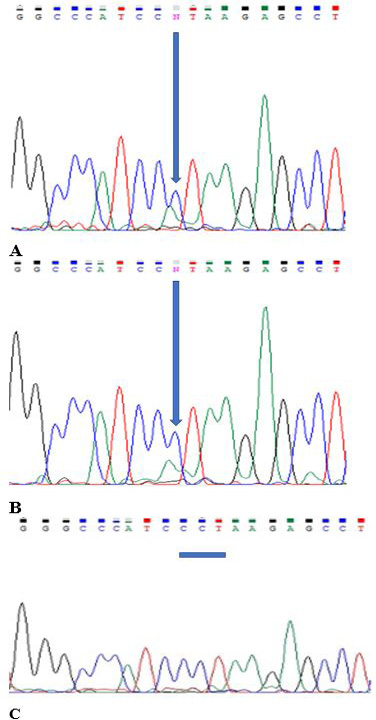
Sequence confirmation of genotype of Sahiwal (A), Holstein Friesian (B), and Crossbred (Sahiwal × Holstein Friesian) (C). Chromatograms CSN2 gene showing genotype A1A2 (in A and B) and A2A2 (in C).
References
- Barnett, M.P., McNabb, W.C., Roy, N.C., Woodford, K.B. and Clarke, A.J., 2014. Int. J. Fd. Sci. Nutr., 65: 720-727. https://doi.org/10.3109/09637486.2014.898260[CrossRef]
- Birgisdottir, B.E., Hill, J.P., Thorsson, A.V. and Thorsdottir, I., 2006. Annls. Nutri. Metab., 50: 177-183. https://doi.org/10.1159/000090738[CrossRef]
- Boro, P., Naha, B.C., Saikia, D.P. and Prakash, C., 2016. Int. J. Sci. Nat., 7: 01-05.
- Caroli, A.M., Chessa, S. and Erhardt, G.J., 2009. J. Dairy Sci., 92: 5335-5352. https://doi.org/10.3168/jds.2009-2461[CrossRef]
- Caroli, A.M., Savino, S., Bulgari, O. and Monti, E., 2016. Molecules, 21: 141. https://doi.org/10.3390/molecules21020141[CrossRef]
- Dai, R., Fang, Y., Zhao, W., Liu, S., Ding, J., Xu, K., Yang, L., He, C., Ding, F. and Meng, H., 2016. J. Dairy Res., 83: 312-316. https://doi.org/10.1017/S0022029916000303[CrossRef]
- Farrell, H.M., J.r., Jimenez, F.R., Bleck, G.T., Brown, E.M., Butler, J.E., Creamer, L.K., Hicks, C.L., Hollar, C.M., Ng-Kwai-Hang, K.F. and Swaisgood, H.E., 2004. J. Dairy Res., 87: 1641–1674. https://doi.org/10.3168/jds.S0022-0302(04)73319-6[CrossRef]
- Ganguly, I., Gaur, G.K., Singh, U., Kumar, S., Kumar, S. and Mann, S., 2013. Ind. J. Biotechnol., 12: 195-198.
- Ganguly, I., Kumar, S., Gaur, G.K., Singh, U., Kumar, A., Kumar, S., Mann, S. and Sharma, A., 2013. Int. J. Biotechnol. Bioeng. Res., 4: 249-256.
- Grimberg, J., Nawoschik, S., Belluscio, L., McKee, R., Turck, A. and Eisenberg, A., 1989. Nucl. Acids Res., 17: 8390. https://doi.org/10.1093/nar/17.20.8390[CrossRef]
- Ho, S., Woodford, K., Kukuljan, S. and Pal, S., 2014. Eur. J. clin. Nutr., 68: 994-1000. https://doi.org/10.1038/ejcn.2014.127[CrossRef]
- Laugesen, M. and Elliott, R., 2003. N. Z. Med. J., 116: U295.
- Malarmathi, M., Senthil Kumar, T.M.A., Parthiban, M., Muthuramalingam, T. and Palanisammi, A., 2014. Ind. J. Vet. Anim. Sci. Res., 43: 310-315.
- Massella, E., Piva, S., Giacometti, F., Liuzzo, G., Zambrini, A.V. and Serraino, A., 2017. Ital. J. Fd. Safe., 6: 6904. https://doi.org/10.4081/ijfs.2017.6904[CrossRef]
- McLachlan, C.N.S., 2006. Breeding and milking cows for milk free of β-casein A1. United States Patent, 7094949B2.
- Miluchova, M., Gabor, M. and Trakovicka, A., 2013. Acta Biochim. Pol., 60: 799-801.
- Miluchova, M., Gabor, M. and Trakovicka, A., 2014. Anim. Sci. Biotech., 47: 56-59.
- Mishra, B., Mukesh, M., Prakash, B., Sodhi, M., Kapila, R., Kishore, A., Kataria, R.R., Joshi, B.K., Bhasin, V., Rasool, T.J. and Bujarbaruah, K.M., 2009. Indian J. Anim. Sci., 79: 722-725.
- Rangel, A.H.N., Zaros, L.G., Lima, T.C., Borba, L.H.F., Novaes, L.P., Mota, L.F.M. and Silva, M.S., 2017. Genet. mol. Res., 16: gmr16029592. https://doi.org/10.4238/gmr16029592[CrossRef]
- Shende, T.C., Kulkarni, P.S. and Pawar, P.C., 2017. Ind. Res. J. Ext. Edu., 17: 105-107.
- Singh, L.V., Jayakumar, S., Sharma, A., Gupta, S.K., Dixit, S.P., Gupta, N. and Gupta, S.C., 2015. Meta Gene, 4: 85-91. https://doi.org/10.1016/j.mgene.2015.03.005[CrossRef]
- Trompette, A.L., Claustre, J., Caillon, F., Jourdan, G., Chayvialle, J.A. and Plaisancie, P., 2003. J. Nutri., 133: 3499 –3503. https://doi.org/10.1093/jn/133.11.3499[CrossRef]
- Ul-Haq, M.R., Kapila, R., Shandilya, U.K. and Kapila, S., 2014. Int. J. Fd. Prop., 17: 1726-1741. https://doi.org/10.1080/10942912.2012.712077[CrossRef]
- Ul-Haq, M.R., Kapila, R., Sharma, R., Saliganti, V. and Kapila, S., 2014. Eur. J. Nutri., 53: 1039-1049. https://doi.org/10.1007/s00394-013-0606-7[CrossRef]
- Yeh, F.C., Yang, R., Boyle, T.J., Ye, Z. and Xiyan, J.M., 2000. Popgene 32, Microsoft Windows based Freeware for Population Genetic Analysis. Version 1.32, Molecular Biology and Biotechnology Centre, University of Alberta, Edmonton, Canada, 2000
- Zoghbi, S., Trompette, A., Claustre, J., El Homsi, M., Garzόn, J., Jourdan, G., Scoazec, J.Y. and Plaisancié, P., 2005. Am. J. Physiol. Gastrointest. Liver Physiol., 290: G1105–G1113. https://doi.org/10.1152/ajpgi.00455.2005[CrossRef]
Services
Article usage statistics
Loading…