
The dusky cotton bug, Oxycarenus laetus Kirby. (Lygaidae: Hemiptera) had become a critical pest of cotton crop. Dusky cotton bug feeds on leaves, stems and seeds of host plants. Being a serious pest of many important crops, the present work will study on biology and bionomics of O. laetus on three different hosts Gossypium hirsutum, Abelmoschus esculentus and Helianthus annuus. Shorter nymphal duration was observed on Gossypium hirsutum 20.00±0.14 days as compared to Abelmoschus esculentus 21.00±0.26 days and Helianthus annuus 23.80±0.20 days. The longer adult life was observed on G. hirsutum (female 13.40±0.76 days and male 12.20±0.22 days) as compared to A. esculentus (female 9.40±0.40 days and male 8.20±0.37 days) and H. annuus (female 11.40±0.51 days and male 10.20±0.58 days). Fecundity (mean number of eggs) was significantly highestin case of G. hirsutum (16.33±0.88)as compared to A. esculentus (11.67±0.67) and H. annuus (6.67±0.33). Biology and bionomic study on different hosts will help the researchers make IPM strategies.
Short Communication · Volume 52, Issue 4, 3 May 2020 · Open Access
Biology and Bionomics of Dusky Cotton Bug (Oxycarenus laetus) (Lygaeidae: Hemiptera) on Three Different Hosts
· ·
Affiliations & Notes ⌄
- 1Department of Entomology, Faculty of Agricultural Sciences and Technology, Bahauddin Zakariya University, Multan, Pakistan. , * Corresponding author: zaka_ento@bzu.edu.pk
Article Info ⌄
- Journal:
- Pakistan Journal of Zoology
- Published:
- 3 May 2020

From the article
- First nymph: Duration of the first nymph was longer on H. annuus i.e. 4.40 ±0.24 days as compared to that of A. esculentus 4.00 ±0.32 days and G. hirsutum 3.80 ±0.22 days (P= 0.284, F= 1.40, df= 2, 14) (Fig. 1).
- The length of meso-leg was significantly greater on G. hirsutum 0.84 ±0.02 mm than that of H. annuus 0.76 ±0.04 mm and A. esculentus 0.74 ±0.02 mm (P= 0.041, F= 3.00, df= 2).
- The study concludes that G. hirsutum is the most preferable host for survival, longevity and fecundity of O. laetus as compared to A. esculentus and H. annuus.
- A. esculentus and H. annuus do not grow in G. hirsutum growing areas but O. laetus can successfully complete their life cycle on these hosts.
Selected from the article's own text.
Abstract
Materials and methods
The adults of O. laetus were collected from cotton field of Bahauddin Zakariya University, Multan, Punjab, Pakistan on 2 October, 2017. The adults were reared in plastic jar (11×4×4 inches). The mouth of jars were covered with the muslin cloth and tied with the rubber band. Rearing was done under the laboratory condition 27 ±2°C, 70 ±5% R.H and photoperiod L14: D10 h. For rearing, cotton seeds (Gossypium hirsutum) were obtained from cotton research station Multan, while okra seeds (Abelmoschus esculentus) and sun flower seeds (Helianthus annuus) were obtained from local nursery. Soaked seeds were provided in separate petri dishes for feeding of O. laetus. Seeds were changed after every two days. Cotton soaked in water and placed in each jar to maintain the moisture level.
To study the reproductive biology of O. laetus on three hosts, fifteen newly hatched nymphs were selected from the collection and placed in petri dishes separately provided (Gossypium hirsutum, Abelmoschus esculentus and Helianthus annuus) seeds and very small cotton soak for moisture. Nymphal duration and adult longevity of both male and female of O. laetus were also recorded by observing either with eyes or where necessary with a simple microscope.
For studying bionomics, five replications were made and each replication representing five individuals of each instar which were randomly selected. Length and width of each body parts were measured. Stage micrometer (0.01-1 mm) ocular micrometer (0.2-2.5 mm) and graded scales (1-150 mm) were used for taking the measurement of each body part.
The data were statistically analyzed according to Completely Randomized Design on Statistical Analysis System .
Results and discussion
First nymph: Duration of the first nymph was longer on H. annuus i.e. 4.40 ±0.24 days as compared to that of A. esculentus 4.00 ±0.32 days and G. hirsutum 3.80 ±0.22 days (P= 0.284, F= 1.40, df= 2, 14) (Fig. 1). The length of meso-leg was significantly greater on G. hirsutum 0.84 ±0.02 mm than that of H. annuus 0.76 ±0.04 mm and A. esculentus 0.74 ±0.02 mm (P= 0.041, F= 3.00, df= 2). Proboscis length 1.22 ±0.04 mm, antennal length 0.80 ±0.03 mm, length of pro-leg 0.62 ±0.04 mm, length of meta-leg 1.02 ±0.02 mm, body length 1.08 ±0.04 mm and body width 0.24 ±0.02 mm were found to be highest on G. hirsutum than other two hosts i.e. A. esculentus and H. annuus (Table I).
Second nymph: Duration of second nymph was longer on H. annuus i.e. 5.20 ±0.37 days as compared to A. esculentus 4.40 ±0.40 days and G. hirsutum 4.40 ±0.27 days (P= 0.210, F= 1.78, df= 2, 14) (Fig. 1). The body length of 2nd nymph was significantly greater on G. hirsutum 1.48 ±0.02 mm as compared to H. annuus 1.34 ±0.02 mm and A. esculentus 1.24 ±0.04 mm (P<0.0001, F= 16.67, df= 2). Measured length of proboscis 1.16 ±0.04 mm, length of antennae 0.94 ±0.02 mm, length of pro-leg 0.76 ±0.02 mm, length of meso-leg 0.96 ±0.02 mm, length of meta-leg 1.18 ±0.02 mm, and body width 0.38 ±0.02 mm were highest on G. hirsutum than other two hosts i.e. A. esculentus and H. annuus (Table I).
Third nymph: Duration of third nymph was longer on A. esculentus 5.00 ±0.45 days than other two hosts i.e. G. hirsutum and H. annuus (P= 0.291, F= 1.37. df= 2, 14) (Fig. 1). The size of pro-leg was same on G. hirsutum and A. esculentus 1.02 ±0.04 mm respectively and greater than H. annuus 0.94 ±0.04 mm. The length of meso-leg was significantly highest on G. hirsutum 1.24 ±0.02 mm as compared to H. annuus 1.16 ±0.02 mm and A. esculentus 1.14 ±0.02 mm (P= 0.031, F= 4.67, df= 2). Proboscis length 1.60 ±0.04 mm, antennal length 1.10 ±0.03 mm, length of meta-leg 1.46 ±0.02 mm, length of body 1.86 ±0.04 mm and length of width 0.78 ±0.04 were highest on G. hirsutum then A. esculentus and H. annuus (Table I).
Fourth nymph: Highest duration of fourth nymph 4.20 ±0.20 days was found on H. annuus than G. hirsutum 4.00 ±0.50 days and A. esculentus 3.40 ±0.51 days (P= 0.383, F= 1.04, df= 2, 14) (Fig. 1). Measured proboscis length 1.88 ±0.04 mm, antennal length 1.54 ±0.04 mm, length of pro-leg 1.36 ±0.02 mm, length of meso-leg 1.60 ±03 mm, length of meta-leg 1.94 ±0.05 mm and length of body 2.96 ±0.05 were greater on G. hirsutum than that of A. esculentus and H. annuus. The body width 1.16 ±0.02 mm was significantly higher on G. hirsutum than H. annuus and A. esculentus (P= 0.019, F= 5.56, df= 2) (Table I).
Fifth nymph: Duration of fifth nymph was significantly highest on H. annuus 5.20 ±0.20 days as compared to G. hirsutum 3.60 ±0.45 days and A. esculentus 4.20 ±0.49 days (P= 0.035, F= 4.45, df= 2, 14) (Fig. 1). The length of antennae 1.84 ±0.02 mm, length of meta-leg 2.32 ±0.04 mm, body length 3.58 ±0.04 mm and body width were significantly highest on G. hirsutum. Proboscis length 2.48 ±0.05 mm, length of pro-leg 1.56 ±0.02 mm and length of meso-leg 1.88 ±0.04 mm were found to be highest on G. hirsutum as compared to A. esculentus and H. annuus (Table I).
Table I. Bionomics of Oxycarenus laetus in relation to different stages.
| Ins-ectsta-ges | Seeds | Size of different body parts (mm ± S.E) | ||||||||
| Prob-oscis | Ante-nnae | Pro-leg | Meso-leg | Meta-leg | Body length | Body width | Fore wing | Hind wing | ||
| 1st instar | G. hirsutum | 1.22 ±0.04a | 0.80 ±0.03a | 0.62 ±0.04a | 0.84 ±0.02a | 1.02 ±0.02a | 1.08 ±0.04a | 0.24 ±0.02a | ||
| A. esculentus | 1.08 ±0.04a | 0.78 ±0.04a | 0.60 ±0.03a | 0.74 ±0.02b | 0.98 ±0.02a | 1.02 ±0.02a | 0.22 ±0.02a | |||
| H. annuus | 1.12 ±0.04a | 0.70 ±0.03a | 0.54 ±0.05a | 0.76 ±0.04ab | 0.96 ±0.04a | 1.04 ±0.02a | 0.18 ±0.04a | |||
| 2nd instar | G. hirsutum | 1.16 ±0.04a | 0.94 ±0.02a | 0.76 ±0.02a | 0.96 ±0.02a | 1.18 ±0.02a | 1.48 ±0.02a | 0.38 ±0.02a | ||
| A. esculentus | 1.10 ±0.04a | 0.92 ±0.04a | 0.68 ±0.04a | 0.90 ±0.03a | 1.10 ±0.03a | 1.24 ±0.04c | 0.30 ±0.03b | |||
| H. annuus | 1.10 ±0.04a | 0.90 ±0.03a | 0.70 ±0.05a | 0.88 ±0.04a | 1.10 ±0.03a | 1.34 ±0.02b | 0.34 ±0.02ab | |||
| 3rd instar | G. hirsutum | 1.60 ±0.04a | 1.10 ±0.03a | 1.02 ±0.04a | 1.24 ±0.02a | 1.46 ±0.02a | 1.86 ±0.04a | 0.78 ±0.04a | ||
| A. esculentus | 1.56 ±0.02a | 1.04 ±0.02a | 1.02 ±0.04a | 1.14 ±0.02b | 1.36 ±0.04a | 1.84 ±0.02a | 0.72 ±0.04a | |||
| H. annuus | 1.52 ±0.04a | 1.02 ±0.04a | 0.94 ±0.04a | 1.16 ±0.02b | 1.38 ±0.04a | 1.76 ±0.06a | 0.74 ±0.02a | |||
| 4th instar | G. hirsutum | 1.88 ±0.04a | 1.54 ±0.04a | 1.36 ±0.02a | 1.60 ±0.03a | 1.94 ±0.05a | 2.96 ±0.05a | 1.16 ±0.02a | ||
| A. esculentus | 1.86 ±0.02a | 1.42 ±0.04a | 1.30 ±0.03a | 1.58 ±0.04a | 1.86 ±0.02a | 2.66 ±0.05b | 1.06 ±0.02b | |||
| H. annuus | 1.84 ±0.04a | 1.46 ±0.05a | 1.30 ±0.03a | 1.52 ±0.04a | 1.86 ±0.05a | 2.86 ±0.05a | 1.06 ±0.02b | |||
| 5th instar | G. hirsutum | 2.48 ±0.05a | 1.84 ±0.02a | 1.56 ±0.02a | 1.88 ±0.04a | 2.32 ±0.04a | 3.58 ±0.04a | 1.46 ±0.02a | ||
| A. esculentus | 2.34 ±0.04a | 1.76 ±0.02b | 1.50 ±0.03a | 1.78 ±0.02a | 2.08 ±0.04b | 3.06 ±0.05b | 1.28 ±0.02b | |||
| H. annuus | 2.40 ±0.05a | 1.74 ±0.02b | 1.50 ±0.03a | 1.78 ±0.04a | 2.30 ±0.03a | 3.52 ±0.04a | 1.38 ±0.04a | |||
| Male adult | G. hirsutum | 2.60 ±0.03a | 2.16 ±0.04a | 2.00 ±0.04a | 2.24 ±0.05a | 2.82 ±0.04a | 4.38 ±0.04a | 1.38 ±0.04a | 2.98 ±0.04a | 2.46 ±0.05a |
| A. esculentus | 2.50 ±0.04a | 2.10 ±0.03a | 1.88 ±0.02b | 2.16 ±0.02ab | 2.56 ±0.02b | 3.92 ±0.04c | 1.28 ±0.02a | 2.82 ±0.04b | 2.44 ±0.02a | |
| H. annuus | 2.52 ±0.04a | 2.08 ±0.04a | 1.86 ±0.04b | 2.10 ±0.04b | 2.54 ±0.02b | 4.08 ±0.04b | 1.28 ±0.04a | 2.96 ±0.02a | 2.42 ±0.04a | |
| Fem-ale adult | G. hirsutum | 2.78 ±0.04a | 2.36 ±0.04a | 2.16 ±0.04a | 2.48 ±0.04a | 3.06 ±0.02a | 4.68 ±0.04a | 1.60 ±0.03a | 3.10 ±0.03a | 2.56 ±0.04a |
| A. esculentus | 2.72 ±0.02ab | 2.34 ±0.02a | 2.10 ±0.03a | 2.42 ±0.04ab | 2.96 ±0.02b | 4.52 ±0.04b | 1.52 ±0.04a | 3.04 ±0.02a | 2.42 ±0.04b | |
| H. annuus | 2.66 ±0.02b | 2.28 ±0.04a | 2.08 ±0.04a | 2.32 ±0.04b | 3.06 ±0.04a | 4.48 ±0.04b | 1.52 ±0.02a | 3.04 ±0.02a | 2.52 ±0.02ab | |
Means followed by the same latters along the column are statistically non-significant (P<0.05). Analysis of all the stages was done separately.
Adult male: Significant highest duration of adult male 12.20 ±0.22 days was found on G. hirsutum than that of H. annuus 10.20 ±0.58 days and A. esculentus 8.20 ±0.37 days (P< 0.0001, F= 23.08, df= 2, 14) (Fig. 1). The length of pro-leg 2.00 ±0.04 mm, length of meso-leg 2.24 ±0.05 mm, length of meta-leg 2.82 ±0.04 mm, body length 4.38 ±0.04 mm and length of fore-wing 2.98 ±0.04 mm were significantly highest on G. hirsutum than A. esculentus and H. annuus. Measured proboscis length 2.60 ±0.03 mm, antennal length 2.16 ±0.04 mm, body width 1.38 ±0.04 mm and length of hind-wing 2.46 ±0.05 mm were higher on G. hirsutum as compared to A. esculentus and H. annuus (Table I).
Adult female: Duration of adult female 13.40 ±0.76 days was significantly higher on G. hirsutum as compared to H. annuus 11.40 ±.51 days and A. esculentus 9.40 ±0.40 days (P< 0.0001, F= 13.64, df=2, 14) (Fig. 1). The length of proboscis 2.78 ±0.04 mm, length of meso-leg 2.48 ±0.04 mm, length of meta-leg 3.06 ±0.02 mm, body length 4.68 ±0.04 mm and length of hind-wing 2.56 ±0.04 mm were significantly highest on G. hirsutum as compared to A. esculentus and H. annuus. Length of antennae 2.36 ±0.04 mm, length of pro-leg 2.16 ±0.04 mm, body width 1.60 ±0.03 mm and length of fore-wing 3.10 ±0.03 mm were greater than A. esculentus and H. annuus (Table I). The body length, width, antenna size, proboscis, foreleg, hind leg, fore-wing and hind-wing explain the vigor of insects on the hosts . No previous studies have been found on the bionomics of O. laetus. In our study, we measured the body parts of both immature and mature stages of O. laetus. D. koenigii was reared on seeds of G. hirsutum and A. esculentus to keep up uniformity . Duration of nymphs was minimum on G. hirsutum. While, fecundity was maximum on G. hirsutum .
Fecundity: Fecundity of O. laetus was significantly highest, when fed on G. hirsutum 16.33 ±0.88 eggs as compared to A. esculentus 11.67 ±0.67 eggs and H. annuus 6.67 ±0.33 eggs (P<0.0002, F= 52.58, df= 2) (Fig. 2). The highest survival and reproductive rate of insects have variation when fed on different hosts .
Conclusion
The study concludes that G. hirsutum is the most preferable host for survival, longevity and fecundity of O. laetus as compared to A. esculentus and H. annuus. A. esculentus and H. annuus do not grow in G. hirsutum growing areas but O. laetus can successfully complete their life cycle on these hosts. This study provides the frame work for future detailed study on the immature and mature stages of O. laetus.
Acknowledgement
The authors wish to acknowledge the Department of Entomology, Central Cotton Research Institute for coordinating in the present research work and undergraduate students for helping in experiments.
Statement of conflict of interest
The authors declare there is no conflict of interest.
Figures
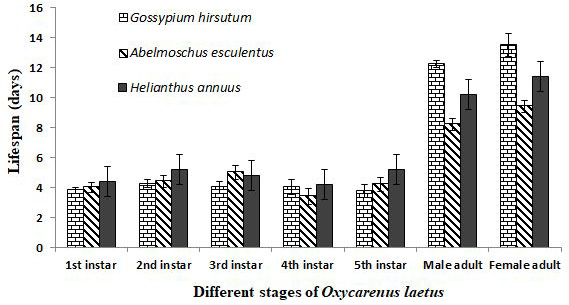
Life duration of each stage of Oxycarenus laetus on different hosts.
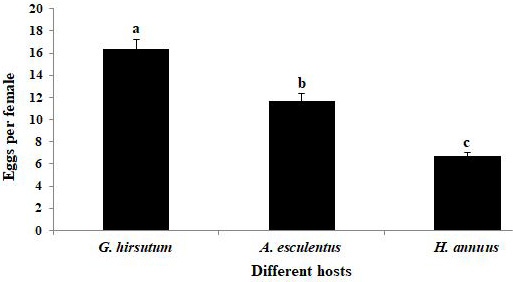
Number of eggs laid by Oxycarenus laetus on different hosts.
References
- Anonymous, 2015-16. Economic survey of Pakistan, Ministry of Finance, Government of Pakistan. http://www.finance.gov.pk
- Bakhsh, K., Hassan, I. and Maqbool, A., 2005. J. Agric. Soc. Sci., 1: 332-334.
- Bilgrami, A.L. and Gaugler, R., 2004. Feeding behaviour. Nematode behaviour (eds. R. Gaugler and A.L. Bilgrami). CABI, Wallingford,UK. pp. 91-126. https://doi.org/10.1079/9780851998183.0091[CrossRef]
- Henry, T., 1983. Pests not known to occur in the United States or of limited distribution, no. 38 cotton seed bug. United States Department of Agriculture, Animal and Plant Health Inspection Service. Plant Protection and Quarantine.
- Holtz, T. 2006. Qualitative analysis of potential consequences associated with the introduction of the cotton seed bug (Oxycarenus hyalinipennis) into the United States. Available online at http://www.Monsanto.co.uk/news/ ukshowlib.html?wid=8478.
- Kannan, M., Uthamasamy, S. and Mohan, S., 2004. Curr. Sci., 86: 726-729.
- Khan, M. and Ahmed, S., 2000. Acta Biol. Cracov. Zool., 42: 372-376.
- Kohno, K. and Ngan, B.T., 2004. Appl. Ent. Zool., 39: 183-187. https://doi.org/10.1303/aez.2004.183[CrossRef]
- Kumar, G. and Sahu, J., 2009. Eur. J. Ent., 106: 565-569. https://doi.org/10.14411/eje.2009.071[CrossRef]
- Nakache, Y. and Klein, M., 1992. The cotton seed bug attacked various crops in Israel in 1991.
- Samy, O., 2007. J. Nat. Hist., 5: 367-384. https://doi.org/10.1080/00222937100770281[CrossRef]
- SAS Institute, 2002. The SAS system for Windows, Release 9.0, SAS Institute, Cary, N.C.
- Saxena, K.N., 1969. Ent.. Exp. Appl., 12: 751-766. https://doi.org/10.1111/j.1570-7458.1969.tb02569.x[CrossRef]
- Schaefer, C.W. and Panizzi, A.R., 2000. Heteroptera of economic importance. CRC press. https://doi.org/10.1201/9781420041859[CrossRef]
- Sewify, G. and Semeada, A., 1993. Bull. Facul. Agric. Univ. Cairo, 44: 445-452.
- Sharma, H.C. and Pampapathy, G., 2006. Crop Prot., 25: 800-813. https://doi.org/10.1016/j.cropro.2005.11.002[CrossRef]
- Thangavelu, K., 2007. J. Nat. His., 12: 289-294. https://doi.org/10.1080/00222937800770161[CrossRef]
- USDA. 2009. Significant pest bulletin: Cotton seed bug. United States Department of Agriculture.
Services
Article usage statistics
Loading…