
With the imminent danger of global climate change threatening the Earth’s biodiversity, the camel proved to be a unique animal with physiological features. These attributes of the camel instigate us to explore its genetic architecture. Pakistan boasts a camel population of about 20 different breeds and a total of one million head. However, till date, scarce genetic data is available on Pakistani camel’s genomics. In efforts to explore the genetics of the camel, we chose to study the Inteferon beta 1 (IFNβ1) gene in in Mareecha camel and non-descript camel breeds in Pakistan. We amplified the IFNβ1 gene through PCR, followed by sequencing. All sequences were aligned and edited through Codon Code aligner and finally a 364 bp portion was selected for further analysis. Dual peaks/heterozygous conditions were identified at positions c.36 (A/C), c.87 and c.225 (Y, T/C). The phylogenetic tree was constructed through MEGA 6.1 software package using the Neighbor Joining method with a bootstrap value of 1000. Finally, the dromedary camel sequences from Pakistan were compared with corresponding genetic sequences of other animal species available on NCBI including European bison, Indian bison, Tibetan antelope, wild yak, domestic goat, sheep, water buffalo and cattle for biological positioning of dromedary camel. The results reconfirmed the classical biological classification.
Short Communication · Volume 53, Issue 3, 4 April 2021 · Open Access
Sequence Diversity of Interferon Beta-1 Gene in Dromedary Camel Breeds of Pakistan
· · ·
Affiliations & Notes ⌄
- 1Virtual University of Pakistan, Lahore, Pakistan , * Corresponding author: masroor.ellahi@vu.edu.pk
Article Info ⌄
- Journal:
- Pakistan Journal of Zoology
- Published:
- 4 April 2021

From the article
- The phylogenetic analysis of the IFNβ1 nucleotide sequences from different species using MEGA 6 showed clear separation of dromedary camel of Pakistan from other mammalian species.
- Our study analysis by neighbor joining method shows that there are five non-descript camel breeds due to no sequential breed information phylogenetically and five Mareecha camel breeds which shows sequential relation to Mareecha breed as shown in (Fig. 2).
- Few studies are concerned with genetic variations between camel breeds in Pakistan at DNA level.
- This tree was made using MEGA 6 software that showed the result in the form of a cladogram, depicting the lineage between different related species to the different dromedary camel breeds of Pakistan.
Selected from the article's own text.
Abstract
Materials and methods
DNA was extracted from blood samples through the inorganic method. Different blood samples from different camel breeds were used to analyze the immunological effect of IFNβ1. The specific primers i.e. IFNβ1-Fw CGGTGCCTCCTCCAGATGGTTC and IFNβ1-rev GGGGAACGATCGTGTCTTCCGT were designed by Primer3. Polymerase chain reaction (PCR) was used to amplify the end products of template DNA of camel breeds. The end products were then run on 0.8% agarose gel electrophoresis. Primers for Interferon Beta 1 (IFNβ1) were designed through Primer 3 software (Rozan and Skaletsky, 2000). The amplification of targeted regions (364 bp) was done through PCR using Bio-Rad C1000TM thermo cycler. The amplified PCR products were submitted for sequencing using Sanger sequencing method and these sequences were run on BLAST. The biological sequence alignment was done using BioEdit 7.0.9.0 . Sequence variation sites, nucleotide diversity and haplotype diversity were defined using DnaSP 5.1 software . Lastly, phylogenetic analysis was carried out usingthe MEGA 6 program which showed the Phylogenetic lineage and ancestral history within the same species .
Results and discussion
Figure 1 shows the nucleotide sequence of IFNβ1 gene fragment (364 bp) aligned with reported sequences of different breeds of camels. Dual peaks/heterozygous conditions were identified at positions c.36 (A/C), c.87 and c.225 (Y, T/C).
The phylogenetic analysis of the IFNβ1 nucleotide sequences from different species using MEGA 6 showed clear separation of dromedary camel of Pakistan from other mammalian species. Our study analysis by neighbor joining method shows that there are five non-descript camel breeds due to no sequential breed information phylogenetically and five Mareecha camel breeds which shows sequential relation to Mareecha breed as shown in (Fig. 2).
Camel’s natural habitat is characterized as harsh conditions in the desert . These animals can bear fluctuation in body temperature and water loss for a relatively long time . Despite the major importance of camels as locally adapted livestock in Pakistan, little information is available about the characterization of these economic animals . There are several camel breeds that can be morphologically (especially based on coat color) identified in Pakistan . Few studies are concerned with genetic variations between camel breeds in Pakistan at DNA level. This study aims to detect the molecular variations within and among some Camelus dromedarius for reconstructing the Neighbor-joining tree among applied camels. In addition, the study aims to explore the evolutionary variations between this species and other camelidae species based on some interferon beta gene sequences variations . This tree was made using MEGA 6 software that showed the result in the form of a cladogram, depicting the lineage between different related species to the different dromedary camel breeds of Pakistan. The results were confirmed by constructing a gene tree and a species tree. In species tree, Bos taurus was nearest to Bubalus bubalis followed by Ovis aries thereby grouping the whole Bovidae family together. The gene tree constructed with the help of neighbor joining method clearly clustered closely related species in one clad.
Comparison of dromedary camel sequences from Pakistan were done according to similarity on the basis of genetic sequences of other animal species available on NCBI including Indian bison, European bison, domestic goat, Tibetan antelope, wild yak, sheep, water buffalo and cattle for biological positioning of dromedary camel. The results reconfirmed the classical biological classification. It is the first time reporting on IFNβ1 gene in dromedary Pakistani camels and hopefully it will pave the path for further studies on immunity genes to explore the camel’s genetic worth.
Acknowledgements
The support of Dr. Muhammad Ashraf Iqbal at Camel Breeding and Research Station, Rakh Mahni, District Bhakkar, Punjab, (Livestock and Dairy Development Department, Punjab) Pakistan is acknowledged for help in blood sampling.
Conflict of interest
The authors have declared no conflict of interest.
Figures
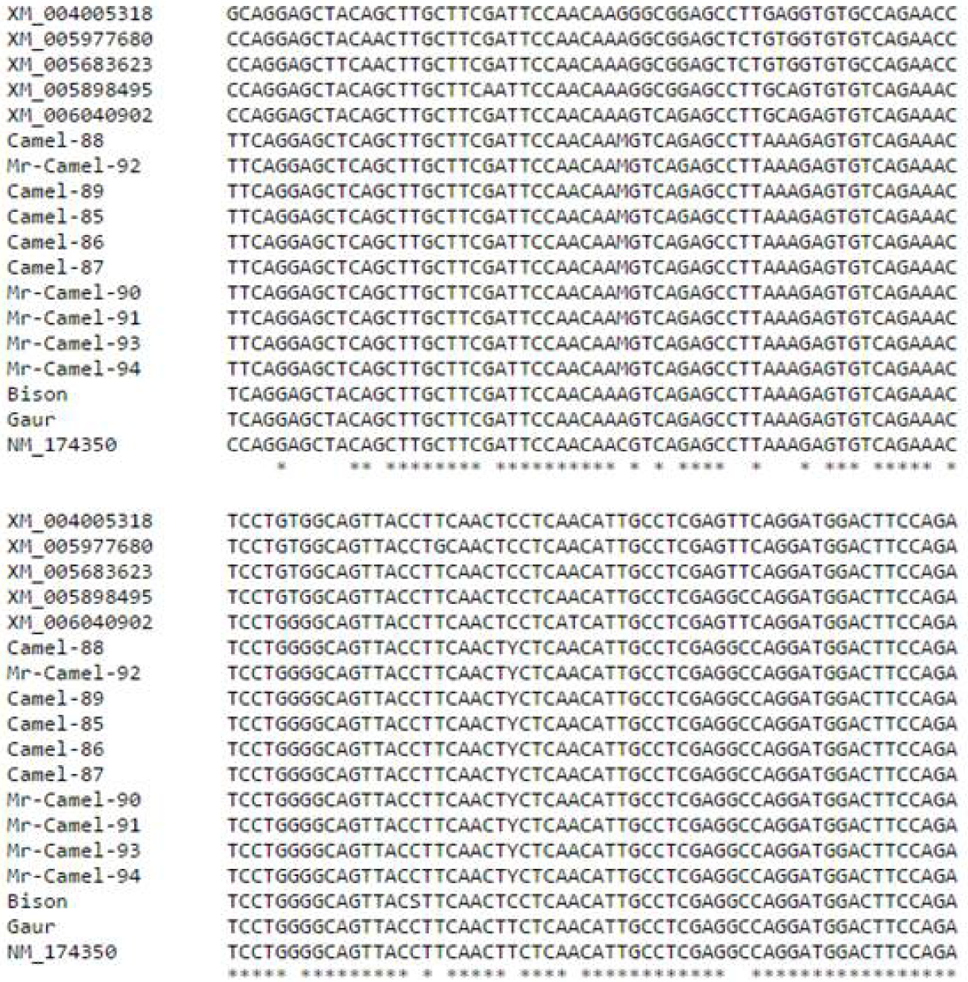
Multiple Sequence alignment of IFNβ1 gene in dromedary camel of Pakistan and other mammalian species reported in GenBank
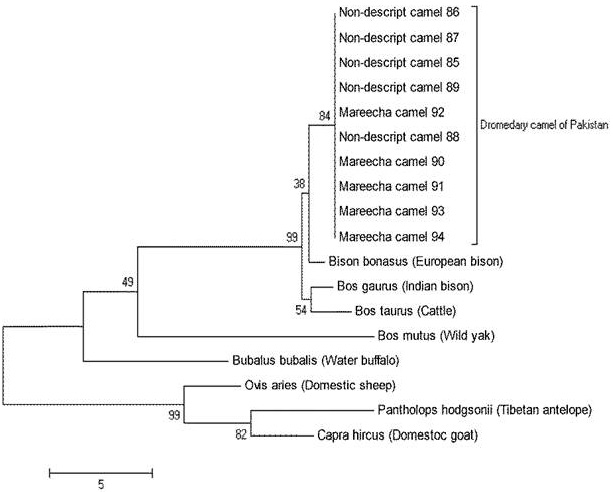
NJ method based Phylogenetic tree depicting INFβ1 nucleotide sequences from different mammalian species in comparison to dromedary camel from Pakistan using MEGA6.
References
- Ahmad, S., Yaqoob, M., Hashmi, N., Ahmad, S., Zaman, M.A. and Tariq, M., 2010. Pak. Vet. J., 30: 191-197.
- Al-Atiyat, R.M., Suliman, G., AlSuhaibani, E., El-Waziry, A., Al-Owaimer, A. and Basmaeil, S., 2016. Trop. Anim. Hlth. Prod., 48: 871-878. https://doi.org/10.1007/s11250-015-0990-5[CrossRef]
- Almathen, F., Elbir, H., Bahbahani, H., Mwacharo, J. and Hanotte, O., 2018. J. Hered., 109: 700-706. https://doi.org/10.1093/jhered/esy024[CrossRef]
- Al-Soudy, A., El-Sayed, A., El-Itriby, H.A. and Hussein, E.H.A., 2018. J. Biodiv. Endang. Sp., 6: 2.
- Ali, R., Hussain, T., Babar, M.E., Masood, F., Ahmad, N., Pervez, M.T. and Nawaz, A., 2018. Pak. J. agric. Sci., 55: 2.
- Belkahia, H., Said, M.B., Sayahi, L., Alberti, A. and Messadi, L., 2015. J. Infect. Dev. Countr., 9: 1117-1125. https://doi.org/10.3855/jidc.6950[CrossRef]
- Hall, T.A., 1999. Nucl. Acids symp. Ser., 41: 95-98.
- Khalkhali-Evrigh, R., Hafezian, S.H., Hedayat-Evrigh, N., Farhadi, A. and Bakhtiarizadeh, M.R., 2018. PLoS One, 13: 9, p.e0204028. https://doi.org/10.1371/journal.pone.0204028[CrossRef]
- Librado P. and Rozas J., 2009. Bioinformatics, 25: 1451-1452. https://doi.org/10.1093/bioinformatics/btp187[CrossRef]
- Nazir, M.M., Oneeb, M., Ayaz, M.M., Bibi, F., Ahmad, A.N., Waheed, A., Sajid, M.A., Sultan, M.T., Yasin, G. and Lindsay, D.S., 2017. Trop. Anim. Hlth. Prod., 49: 1081-1084. https://doi.org/10.1007/s11250-017-1300-1[CrossRef]
- Rozen, S. and Skaletsky, H., 2000. Bioinformatics methods protocols, pp. 365-386. http://bioinfo.ut.ee/primer3-0.4.0/
- Saad, Y.M., El Hanafy, A.A., Alkarim, S.A., Almehdar, H.A. and Redwan, E.M., 2017. Int. J. Anim. Vet. Sci., 11: 564-568.
- Sommer S., 2005. Front. Zool., 2: 1-18. https://doi.org/10.1186/1742-9994-2-16[CrossRef]
- Tadese, Y., Costa, V., Zelalem, R.M.G., Mengistu, N.A.A.U., Gebremeskel, M., Sisay, T., Kefelegn, K., Mohammed, Y.K., Solomon, A., Tadelle, D. and Beja-Pereira, A., 2019. Ethiop. J. agric. Sci., 29: 19-37.
- Tamura, K., Peterson, D., Peterson, N., Stecher, G., Nei, M. and Kumar, S., 2011. Mol. Biol. Evolut., 28: 2731-2739. https://doi.org/10.1093/molbev/msr121[CrossRef]
- Villela, A.D., Renard, G., Palma, M.S., Chies, J.M., Dalmora, S.L., Basso, L.A. and Santiago, D.S., 2010. J. Microb. Biochem. Technol., 2: 111-117.
- Vosoughi, R. and Marriott, J.J., 2014. Mult. Scler. Relat. Disord., 3: 321-325.
- Zidi, A., Sa`nchez, A., Ruff, G.O. and Amills, M., 2008. J. Dairy Sci., 91: 814-817. https://doi.org/10.3168/jds.2007-0342[CrossRef]
Services
Article usage statistics
Loading…