
Salmonella is considered as a foodborne pathogen causing many public health problems worldwide. However, salmonellosis is a zoonosis with wide range animal reservoirs; the role of migratory birds in the transmission of Salmonella spp. is not well known. This study aimed to underline the potential role of migratory birds in the transmission of virulent Salmonella enterica serovars and highlighting the possible zoonotic risk. Cloacal swabs were collected from 496 migratory birds (299 quails and 197 ducks) from Gamsa city, Egypt. The collected swabs were enriched and cultured for isolation of Salmonella. The isolates were identified using conventional methods including the colonial characters, Gram’s staining and biochemical tests. Moreover, molecular detection of invA, stn and spvC genes was performed among the obtained isolates to identify the virulent strains. Of the examined birds, 3 yielded Salmonella enterica giving an overall occurrence rate 0.6% (3/496) whereas only migratory ducks were positive for Salmonella spp. with a prevalence 1.5% (3/197). Moreover, pintail is the only duck species that yielded positive results 4.3% (3/70). All Salmonella isolates are considered virulent strains as they carry invA, stn and spvC genes. The BLAST and phylogenetic analyses of the spvC gene sequences revealed that these sequences showed high genetic relatedness with those isolated from humans (Nigeria), cattle and quails (USA). This study sheds more light on the role of migratory birds in the epidemiology of exotic virulent Salmonella enterica strains with a possible zoonotic risk.
Short Communication · Volume 57, Issue 3, 12 May 2025 · Open Access
Occurrence of Virulent Salmonella enterica Among Migratory Birds: A Potential Zoonotic Risk
· ·
Affiliations & Notes ⌄
- 1Department of Zoonoses, Faculty of Veterinary Medicine, Cairo University, Cairo, Egypt * Corresponding author: Aya.seleem9@gmail.com
Article Info ⌄
- Journal:
- Pakistan Journal of Zoology
- Published:
- 12 May 2025

From the article
- Out of 496 examined migratory ducks and quails, 3 yielded Salmonella enterica giving an overall occurrence rate 0.6%.
- Moreover, only pintail ducks (Anas acuta) were positive for Salmonella enterica 4.3% (Table I).
- All 3 Salmonella enterica isolates were found to be virulent strains as they possess invA, stn and spvC genes.
- The role of migratory birds especially pintail ducks as a transmitter of virulent Salmonella enterica strains during their migration journey with a potential zoonotic risk cannot be ruled out.
Selected from the article's own text.
Abstract
Materials and methods
Cloacal swabs collected from 496 migratory birds (299 quails and 197 ducks) after catching them directly at Gamasa city, Egypt. The birds were captured live by expert hunters using the nets. The collected swabs were inserted were inserted in sterile tubes containing buffer peptone water Van der Zee (2003) and transported to the laboratory in the icebox . The birds were identified according to Carboneras (1992).
The collected swabs in buffer peptone water tubes were incubated at 37 °C for 16-18 hours, then 1ml from each tube was added to 10 ml Rappaport-Vassiliadis (RV) broth (OXOID, England) and incubated at 42 °C for 24 h. Loop-fulls of RV broth were streaked on xylose lysine deoxycholate (X.L.D) medium at 37 °C for 24 h. The suspected Salmonella colonies were identified by Gram’s staining and conventional biochemical tests according to OIE (2018). Then, confirmed by RapID ONE System used for identification of Enterobacteriaceae (Oxoid, UK).
For molecular identification of virulent Salmonella enterica PCR reactions were performed to detect invA, stn and spvC genes among the obtained isolates. DNA was extracted from Salmonella isolates using boiling method then the extracted DNA was stored at -20°C for further investigation . Uniplex PCR was carried out, targeting invA, stn and spvC genes using specific primer sets. invA gene primers F (5′-GTGAAATTATCGCCACGTTCGGGCAA-3′) and R (5′-TCATCGCACCGTCAAAGGAACC-3′) amplify 284 bp according to Oliveira et al. (2003), while stn gene primers F (5′-TTGTGTCGCTATCACTGGCAACC-3′) and R (5′-ATTCGTAACCCGCTCTCGTCC-3′) target 617 bp according to Murugkar et al. (2003). spvC gene primers F (5′-ACCAGAGACATTGCCTTCC-3′) and R (5′-TTC TGATCGCCGCTATTCG-3′) amplify 467 bp according to Huehn et al. (2010). The amplification conditions of invA, stn and spvC genes were initial denaturation at 94°C for 5 min, denaturation 94°C for 30 sec, annealing at 55°C for 30 sec, 59°C for 40 sec and 58°C for 40 sec for stn, invA and spvC genes, respectively, extension at 72°C for 40 sec and final extension at 72°C for 7 min for 35 cycles. A T3 Thermal cycler (Biometra, Germany) PCR system was used for PCR reactions. The PCR products (10 μl) was run on 1.5% agarose. Amplicons of the three spvC positive isolates were purified using QIAquick PCR product extraction kit (Qiagen Inc. Valencia, CA) and the sequencing was conducted by using Applied Biosystems 3130 automated DNA Sequencer (ABI, 3130, USA). The obtained spvC gene sequences were deposited in the GenBank under the following accession numbers: MW701427 - MW 701428 - MW701429.
spvC gene sequences were analyzed using nucleotide BLAST on the NCBI website (www.ncbi.nlm.nih.gov/BLAST) to identify the most similar sequences available in the GenBank. Afterwards, spvC gene sequences were aligned against some selected similar sequences from different sources retrieved from the GenBank. The alignment of the sequences was done using Clustalw Multiple alignment (BioEdit 7.0.9) and a phylogenetic tree has been constructed using the neighbor-joining method based on spvC partial gene sequences with MEGA 7 software (version 7.0.26).
Results and discussion
Out of 496 examined migratory ducks and quails, 3 yielded Salmonella enterica giving an overall occurrence rate 0.6%. All isolates were obtained from migratory ducks with a prevalence rate 1.5%, while none of the examined quails yielded positive results. Moreover, only pintail ducks (Anas acuta) were positive for Salmonella enterica 4.3% (Table I). All 3 Salmonella enterica isolates were found to be virulent strains as they possess invA, stn and spvC genes.
Table I. Occurrence of Salmonella enterica among migratory birds.
| Species | Numbers examined | Numbers positive (%) | InvA gene | Stn gene | Spvc gene |
| Coturnix coturnix | 299 | 0 | - | - | - |
| Anas acuta (Pintail) | 70 | 3(4.3%) | +ve | +ve | +ve |
| Anas clypeata | 8 | 0 | - | - | - |
| Anas crecca | 109 | 0 | - | - | - |
| Anas platyrhynchos | 5 | 0 | - | - | - |
| Fulica atra | 5 | 0 | - | - | - |
| Total of the examined ducks | 197 | 3(1.5%) | +ve | +ve | +ve |
| Total | 496 | 3(0.6%) |
The identity percentages of the obtained spvC gene sequences based on BLAST analysis are shown in Table II. The phylogenetic bootstrap consensus trees of spvC gene sequences showed high genetic relatedness with those of both humans and animals in USA, Nigeria and Thailand (Fig. 1).
Table II. The identity of the spvC gene sequences of Anas acuta after BLAST analysis on GenBank.
| Source | Country | Identity % | Accession number | Study accession number |
| Human stool | Japan | 97.95 | AP020332 | MW701427 |
| Human stool | Nigeria | 97.95 | CP050990 | |
| Chicken meat | Thailand | 97.95 | CP053214 | |
| Cattle-lymph node | USA | 99.76 | CP 123663 | MW701428 |
| Beef | USA | 99.76 | CP123671 | |
| Sheep (cecal) | USA | 99.76 | CP123669 | |
| Comminuted beef | USA | 99.76 | CP119507 | MW701429 |
The movement of the migratory birds across countries and continents allows them to act as potential spreaders of many pathogens, especially zoonotic ones ; . There is a scarcity of data about the role of migratory birds in the transmission of Salmonella spp. which may be owed to the difficulties in collection of samples from migratory birds. Majority of previous researches focused on the role of migratory Northern pintail as a reservoir for avian influenza virus ; .
The current study revealed that the overall occurrence of Salmonella enterica among the examined migratory birds was 0.6%. Only ducks yielded positive results with a prevalence rate 1.5%. Interestingly, all Salmonella isolates were recovered from pintail ducks giving a prevalence rate 4.3%. Such result is higher than that detected by Wei et al. (2020), who recorded that the overall occurrence of Salmonella among pintail ducks was 0.93% and higher than that detected by Grigar et al. (2017) who did not isolate any Salmonella spp. from pintail ducks in their study.
On the other side, none of the examined quails yielded Salmonella spp., such result which is matched with that obtained by Dipineto et al. (2014) who found that all examined common quails were negative for Salmonella spp., Also, Musa et al. (2023) who did not isolate Salmonella spp. from migratory birds including quails.
Since the spvC gene is important in Salmonella pathogenesis, it was selected for gene sequencing. The results of the BLAST analysis of the obtained sequences revealed that spvC gene sequences of Salmonella enterica isolated from migratory ducks (pintail) showed high identity (97.95%) with those of Salmonella enterica isolated from human stool in Nigeria and Japan also showed high identity with those of cattle lymph node and sheep in USA. Moreover, it showed high identity percentages with those isolated from chicken meat (Thailand) and comminuted beef (USA).
Furthermore, the phylogenetic tree of spvC gene sequences demonstrated that one of these sequences is found in the same clade with Salmonella enterica isolated from a quail in the USA and a human from Nigeria, whereas, the other two sequences were placed in the same clade with Salmonella enterica from both chicken meat in Thailand and comminuted beef in the USA. Strikingly, the results of the phylogenetic analysis is strongly augmented by the migration pathway of the birds according to Birdlife International Fact Sheet (2023) which determined the northern pintail distribution countries to include Egypt, USA, Mexico, Japan, China and Thailand. Moreover, Miller et al. (2005) recorded that the northern pintail may migrate to North America while Jahangir et al. (2009) and Wei et al. (2020) pointed out that northern pintail migrates to South Korea, Japan and China. Accordingly, pintail may catch such Salmonella strains which circulated in one country and subsequently distribute such exotic strains along the migration journey. A matter which explains the high genetic relatedness between the obtained isolates and those circulated among different hosts in the countries along the migration pathway to draw a conclusion about the role of migratory pintail in the epidemiology of such virulent Salmonella enterica strains and underscore the potential zoonotic risk through handling of such birds or consuming their contaminated meat by migratory game bird meat lovers.
Conclusion
The role of migratory birds especially pintail ducks as a transmitter of virulent Salmonella enterica strains during their migration journey with a potential zoonotic risk cannot be ruled out.
Ethics statement
The protocol of this study was approved by the institutional animal care and use committee (IACUC), faculty of veterinary medicine, Cairo University. Approval number: Vet Cu 28/04/2021/298
Statement of conflict of interest
The authors declare no conflict of interest.
Figures
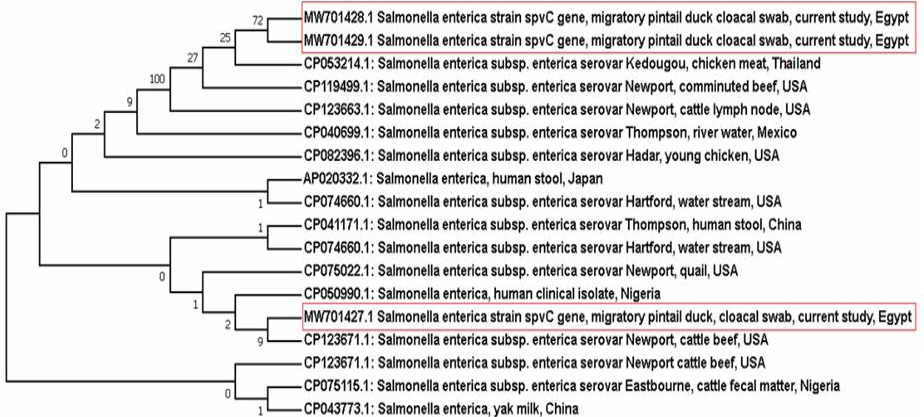
Neighbor-joining phylogenetic bootstrap consensus tree shows the evolutionary history and genetic relatedness of the obtained spvC gene sequences of Salmonella enterica recovered from migratory ducks and selected similar sequences retrieved from the GenBank records.
References
- Altizer, S., Bartel, R., and Han, B.A., 2011. Science, 331: 296-302. https://doi.org/10.1126/science.1194694[CrossRef]
- Abdel-Kader, F., Hamza, E., Abdel-Moein, K.A. and Sabry, M.A., 2022. Retail chicken giblets contaminated with extended-spectrum cephalosporin-and carbapenem-resistant Salmonella enterica carrying blaCMY-2. https://doi.org/10.14202/vetworld.2022.1297-1304[CrossRef]
- Benskin, C.M.H., Wilson, K., Jones, K. and Hartley, I.R., 2009. Biol. Rev., 84: 349-373. https://doi.org/10.1111/j.1469-185X.2008.00076.x[CrossRef]
- Bird Life International, 2023. Species factsheet: Anas acuta. Downloaded from http://datazone.birdlife.org/species/factsheet/northern-pintail-anas-acuta on 14/10/2023.
- Carboneras C., 1992. Family anatidae (ducks, geese and swans). In: Handbook of the birds of the world (eds. J. del Hoyo, A. Elliott, J. Sargatal). Vol. 1. Lynx Edicions, Barcelona. 1992. pp. 528–628.
- Chaudhary, J.H., Nayak, J.B., Brahmbhatt, M.N. and Makwana, P.P., 2015. Vet. World, 8: 121. https://doi.org/10.14202/vetworld.2015.121-124[CrossRef]
- Contreras, A., Gomez-Martin, A., Paterna, A., Tatay-Dualde, J., Prats-Van Der Ham, M., Corrales, J.C. and Sánchez, A., 2016. Rev. Sci. Tech., 35: 845-862. https://doi.org/10.20506/rst.35.3.2574[CrossRef]
- Costa, J., Mafra, I., Oliveira, B.B. and Amaral, J.S., 2016. Game: Types and composition. The encyclopedia of food and health. https://doi.org/10.1016/B978-0-12-384947-2.00345-7[CrossRef]
- Das Neves, G.B., Araújo, D.N., Pick, E., Bitner, D.S., Brisola, M.C., Crecencio, R.B. and Stefani, L.M., 2020. Annls mol. Genet. Med., 4: 006-011.
- Deguenon, E., Dougnon, V., Lozes, E., Maman, N., Agbankpe, J., Abdel-Massih, R.M. and Dougnon, J., 2019. BMC Res. Notes, 12: 1-7. https://doi.org/10.1186/s13104-019-4341-x[CrossRef]
- Dipineto, L., Russo, T.P., Gargiulo, A., Borrelli, L., De Luca Bossa, L.M., Santaniello, A. and Fioretti, A., 2014. Avian Pathol., 43: 498-500. https://doi.org/10.1080/03079457.2014.966055[CrossRef]
- Ehuwa, O., Jaiswal, A.K. and Jaiswal, S., 2021. Foods, 10: 907. https://doi.org/10.3390/foods10050907[CrossRef]
- Eng, S.K., Pusparajah, P., Ab Mutalib, N.S., Ser, H.L., Chan, K.G. and Lee, L.H., 2015. Front. Life Sci., 8: 284-293. https://doi.org/10.1080/21553769.2015.1051243[CrossRef]
- Fuller, T., Bensch, S., Müller, I., Novembre, J., Pérez-Tris, J., Ricklefs, R.E. and Waldenström, J., 2012. EcoHlth, 9: 80-88. https://doi.org/10.1007/s10393-012-0750-1[CrossRef]
- García, C., Soriano, J.M., Benítez, V. and Catalá-Gregori, P., 2011. Poult. Sci., 90: 1581-1585. https://doi.org/10.3382/ps.2010-01104[CrossRef]
- Giannella, R.A., 1996. Salmonella. In: Medical microbiology (eds. S. Baron). 4th edition. Galveston (TX): University of Texas Medical Branch at Galveston; 1996. Chapter 21.
- Giorgio, A., De Bonis, S., Balestrieri, R., Rossi, G. and Guida, M., 2018. Microorganisms, 6: 124. https://doi.org/10.3390/microorganisms6040124[CrossRef]
- Grigar, M.K., Cummings, K.J. and Rankin, S.C., 2017. Zoonoses Publ. Hlth., 64: 689-692. https://doi.org/10.1111/zph.12380[CrossRef]
- Hedman, H.D., Varga, C., Duquette, J., Novakofski, J. and Mateus-Pinilla, N.E., 2020. Vet. Sci., 7: 188. https://doi.org/10.3390/vetsci7040188[CrossRef]
- Huehn, S., La Ragione, R.M., Anjum, M., Saunders, M., Woodward, M.J., Bunge, C., Helmuth, R., Hauser, E., Guerra, B., Beutlich, J., Brisabois, A., Peters, T., Svensson, L., Madajczak, G., Litrup, E., Imre, A., Herrera-Leon, S., Mevius, D., Newell, D.G. and Malorny, B., 2010. Foodb. Pathog. Dis., 7: 523-535. https://doi.org/10.1089/fpd.2009.0447[CrossRef]
- Jahangir, A., Ruenphet, S., Shoham, D., Okamura, M., Nakamaura, M. and Takehara, K., 2009. Virus Res., 145: 329-333. https://doi.org/10.1016/j.virusres.2009.07.015[CrossRef]
- Kim, M.S., Yoon, Y.S., Seo, J.G., Lee, H.G., Chung, M.J. and Yum, D.Y., 2013. Toxicol. Res., 29: 129-135. https://doi.org/10.5487/TR.2013.29.2.129[CrossRef]
- Konicek, C., Vodrážka, P., Barták, P., Knotek, Z., Hess, C., Račka, K. and Troxler, S., 2016. J. Wildl. Dis., 52: 850-861. https://doi.org/10.7589/2016-02-038[CrossRef]
- Korytár, Ľ., Prokeš, M., Ondrejková, A. and Zemanová, S., 2020. Folia Vet., 64: 27-31. https://doi.org/10.2478/fv-2020-0004[CrossRef]
- Kurtz, J.R., Goggins, J.A. and McLachlan, J.B., 2017. Immunol. Lett., 190: 42-50. https://doi.org/10.1016/j.imlet.2017.07.006[CrossRef]
- Malik, Y.S., Milton, A.A.P., Ghatak, S. and Ghosh, S., 2021. Role of birds in transmitting zoonotic pathogens. https://doi.org/10.1007/978-981-16-4554-9[CrossRef]
- Miller, M.R., Takekawa, J.Y., Fleskes, J.P., Orthmeyer, D.L., Casazza, M.L. and Perry, W.M., 2005. Can. J. Zool., 83: 1314-1332. https://doi.org/10.1139/z05-125[CrossRef]
- Milner-Gulland, E.J. and Bennett, E.L., 2003. Trends Ecol. Evol., 18: 351-357. https://doi.org/10.1016/S0169-5347(03)00123-X[CrossRef]
- Mthembu, T.P., Zishiri, O.T. and El-Zowalaty, M.E., 2019. Pathogens, 8: 124. https://doi.org/10.3390/pathogens8030124[CrossRef]
- Murugkar, H.V., Rahman, H. and Dutta, P.K., 2003. Indian J. med. Res., 117: 66-70.
- Musa, L., Stefanetti, V., Casagrande, P.P., Grilli, G., Gobbi, M., Toppi, V. and Franciosini, M.P., 2023. Animals, 13: 1776. https://doi.org/10.3390/ani13111776[CrossRef]
- Nakano, M., Yamasaki, E., Ichinose, A., Shimohata, T., Takahashi, A., Akada, J.K. and Kurazono, H., 2012. Dis. Models Mech., 5: 515-521. https://doi.org/10.1046/j.1472-765X.2003.01294.x[CrossRef]
- OIE, 2018. Manual of diagnostic tests and vaccines for terrestrial animals.
- Olivera, S.D., Rodenbusch, C.R., Ce, M.C., Rocha, S.L.S. and Canal, C.W., 2003. Lett. appl. Microbiol., 36: 217-221.
- Sauvala, M., Woivalin, E., Kivistö, R., Laukkanen-Ninios, R., Laaksonen, S., Stephan, R. and Fredriksson-Ahomaa, M., 2021. Fd. Microbiol., 98: 103768. https://doi.org/10.1016/j.fm.2021.103768[CrossRef]
- Seleem, A., Sabry, M.A. and Abdel-Moein, K.A., 2021. Int. J. Vet. Sci. Med., 9: 52-58. https://doi.org/10.1080/23144599.2021.1989937[CrossRef]
- Soumet, C., Ermel, G., Fach, P. and Colin, P., 1994. Lett. appl. Microbiol., 19: 294-298. https://doi.org/10.1111/j.1472-765X.1994.tb00458.x[CrossRef]
- Van der Zee, H., 2003. Prog. Ind. Microbiol., 37: 195-208. https://doi.org/10.1016/S0079-6352(03)80016-4[CrossRef]
- Wei, B., Shang, K., Cha, S.Y., Zhang, J.F., Kang, M. and Jang, H.K., 2020. Vet. Microbiol., 249: 108829. https://doi.org/10.1016/j.vetmic.2020.108829[CrossRef]
- Zuo, L., Zhou, L., Wu, C., Wang, Y., Li, Y., Huang, R. and Wu, S., 2020. Front. Microbiol., 11. https://doi.org/10.3389/fmicb.2020.562491[CrossRef]
Services
Article usage statistics
Loading…