In the present study, cats with FCM-type benign breast neoplasms, as well as those with stage II BC were examined. All cats had a preliminary diagnosis of BC in the operable stage of the oncological process. In all cases, the same type of surgical treatment, in the form of a unilateral mastectomy with simultaneous hysterovariectomy, was performed. The final diagnosis was made according to histological examination of the surgical material. In accordance with this, the operated animals were divided into two groups: (1) stage II BC, and (2) FCM.
Some significant differences in laboratory parameters between animals with BC and with FCM were identified.
In general, changes in hematological parameters were quite typical, reflecting the presence of a chronic inflammatory process, which usually develops in patients with tumors (Lim et al., 2018). In cats with BC and FCM, a significant increase in ESR was determined. This indicator was especially high in cats with BC, which is apparently associated with the induction of inflammatory reactions due to the formation of a large number of necrosis zones in the tumour tissue (which was shown during histological examination of the tumour tissue). The development of paraneoplastic syndrome in animals with BC is apparently associated with inhibition of thrombocytopoiesis, which is manifested by statistically significant (a < 0.05) thrombocytopenia, as well as increased levels of creatinine and urea in the blood. A general trend was established: all of these haematological and biochemical parameters were higher in cats with BC compared to those with FCM.
Particularly noticeable changes in the blood formula in tumour-bearing animals were found in relation to the lymphoid component of the blood. A statistically significant (a < 0.05) decrease in the percentage of lymphocytes was found both in animals with BC and with FCM. However, in cats with BC, the tendency to develop lymphopenia was much more pronounced: the absolute content of lymphocytes in the blood of these animals was more than 2-fold lower than in healthy control animals. In general, this is a fairly well-known haematological phenomenon, typical of oncological processes of different histogenesis (Menetrier-Caux et al., 2019). There was a decrease in the number and competence of the immune system lymphoid elements against the background of a predominance of granulocyte blood elements, which are participants in non-specific inflammatory processes occurring in the body of tumour-bearing patients (Ocana et al., 2017). Despite the differential diagnostic value of such criteria being relative, in combination with more targeted tests designed to assess immunological and other parameters characterising the mechanisms of cellular and molecular antitumour surveillance, the assessment of the above haematological criteria is quite applicable.
The expression pattern studied in this work is represented by genes, the expression of which turned out to be diagnostically significant in our previous work (Tsybulsky et al., 2022). To this gene spectrum in this study, we added an analysis of the rb1 and cdkn2a gene expression. The products of these genes are important elements of the molecular cell cycle control systems and antitumour resistance. A deficiency in the function of these factors leads to increased resistance of tumour cells to apoptosis-inducing mechanisms (Chakraborty et al., 2021).
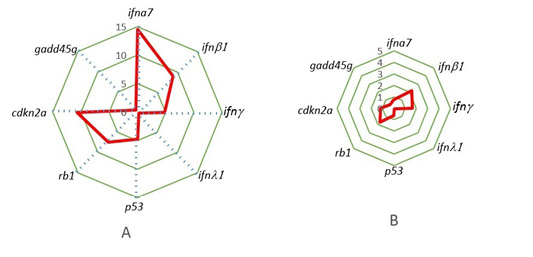
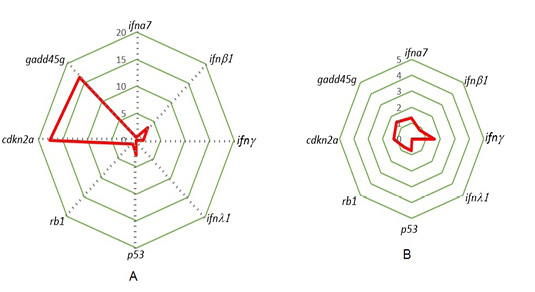
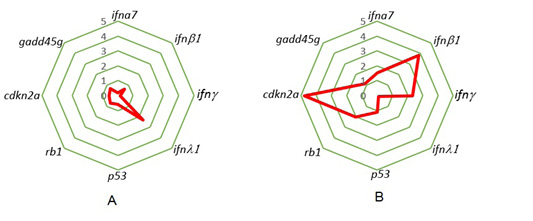
The expression of the IFN system and tumour-suppressor genes chosen in this study differed significantly between cats with benign and malignant breast diseases. To the greatest extent, these differences were pronounced in the breast tumour tissue itself and in WBCs.
A significant (5–15-fold) increase was found in the expression of ifnα7, ifnβ1, ifnγ, cdkn2a, rb1 and p53 genes in BC tumour tissue. Expression of these genes in the MG metaplastic tissue from cats with FCM was significantly lower and, in general, did not differ significantly from that of control animals. This indicates the relative inertness of these censor systems in the tumour tissue of animals with FCM.
Along with large differences in most parameters of the expression pattern, we were able to identify a common molecular criterion that is characteristic for both groups of animals with BC pathology: inhibition of the ifnλ1 and gadd45g gene expression in tumour tissue (Figure 1).
The products of the gadd45 gene are one of the most significant components of the tumour suppression system, of which the GADD45g variant attracts special attention (Tamura et al., 2012). A decrease in the expression level of this protein is associated with a wide variety of oncological diseases of different histogenesis. With regard to BC, there is evidence that the GADD45g protein inhibits the growth of human BC cells in vivo and in vitro, acting as an antitumour agent (Zhang et al., 2021). Moreover, the antitumour effect of the GADD45g protein can be realised independently of other important molecular factors that counteract carcinogenesis (P53, pRB, etc.; Zhang et al., 2014). The ifnλ1 gene product is a type III IFN system specialised for epithelial tissues, whose role, along with protection against viral pathogens, is extremely important for maintaining the genetic stability of endothelial cells and epithelial tissues (Lasfar et al., 2016; Walker et al., 2021).
Thus, insufficient expression of the ifnλ1 and gadd45g genes may indicate a reduced activity of molecular censor systems that counteract the processes of mutagenesis and carcinogenesis. We have previously found the same changes in the expression pattern in cats with lymphoblastoses. Moreover, a decrease in the expression activity of these genes is correlated with the risk of the disease transition to a more aggressive phase (Tsybulsky et al., 2021). According to our assumptions, such changes in the expression pattern may serve as a prognostic criterion for forms of oncological pathology in cats, such as BC. It can be supposed that it is advisable to correct these indicators by methods of targeted induction of the corresponding genes. Substitution therapy with appropriate recombinant products as part of the complex therapy for oncological diseases also seems to be a promising method for disease treatment. Testing these working hypotheses requires more extensive research and the development of appropriate therapeutic technologies. These questions relate to the area of our scientific interests and the genetic engineering technologies being developed.
It must be noted that the development of such methods of targeted therapy should be more focused on the activation of the expression of these genes in tumour cells themselves or in immunocompetent cells infiltrating the tumour. This is due to the fact that the expression of the gadd45g gene is at a very high level in peripheral blood leukocytes against the background of its expression inhibition in the tumour tissue itself. With regard to the ifnλ1 gene, the need to induce the expression of this gene in situ is even more clear, since peripheral WBCs are not specialised producers of this cytokine.
(Wack et al., 2015). It is difficult to explain that a noticeable expression inhibition of the entire range of genes studied (with the exception of ifnλ1) was found in the uterine tissue of cats with BC. Moreover, in two cats with BC the expression rates of the entire group of tumour-suppressor genes were less than 50% of the corresponding indicators in the control animals. In the uterine tissue of these animals, the expression of ifnα7 and ifnγ genes was practically absent. Speculatively, these data can be interpreted as evidence of the suppression of antitumour surveillance mechanisms in the reproductive system of animals with BC, as well as evidence of the absence of tissue infiltration by immunocompetent cells and, accordingly, the absence of inflammation. To a certain extent, this can also be associated with the formation of a state of lymphopenia, which is most pronounced in cats with BC.
However, all these assumptions require appropriate experimental verification. It should be noted that the features of the expression pattern presented in this report were established precisely in animals with stage II BC, i.e., at the operable stage of the disease. A separate study requires the assessment of changes in the expression of the studied spectrum of genes in animals with BC at other clinical stages.