
Effects of beta-cypermethrin, abamectin, chlorpyrifos, thiamethoxam and bisultap on toxicity against 1st-6th instar larvae in Phauda flammans Walker (Lepidoptera: Zygaenidae) were tested using the leaf-dipping method. Meanwhile, effects of these pesticides on detoxifying and protective enzymes in P. flammans larvae were also measured. Results showed that the LC50 value of beta-cypermethrin, abamectin, chlorpyrifos, thiamethoxam and bisultap against P. flammans larvae were related to the instar and pesticide. Control efficacy of beta-cypermethrin was the best among of these pesticides, and the LC50 value of which against 1st instar larvae in P. flammans reached 2.038 mg/L at 8 h after treatment, and reached 6.416-48.764 mg/L for 2nd-6th instar larvae at 24 h after treatment. Control efficacy of abamectin was less than beta-cypermethrin, and the LC50 value of which against 1st instar larvae in P. flammans reached 241.953 mg/L at 8 h after treatment, and reached 19.285-266.207 mg/L for 2nd-6th instar larvae at 24 h after treatment. Control efficacy of chlorpyrifos, thiamethoxam and bisultap was less than the first two pesticides. Changes of detoxifying and protective enzymes in P. flammans larvae were related to the kinds of enzyme and its sensitivity to pesticide after treatment with different pesticides. Compared with control, effect of beta-cypermethrin on Carboxylesterase (CarE) was the most obvious than other four pesticides; activity of glutathione-s transferase (GST) was inhibited by abamectin, while the trend was in the opposite direction for other four pesticides; activity of superoxide dismutase (SOD) was promoted by beta-cypermethrin and chlorpyrifos, and inhibited by abamectin and bisultap; Activity of catalase (CAT) was promoted by beta-cypermethrin, chlorpyrifos and bisultap, inhibited the influence of promotion by thiamethoxam. Results suggested that P. flammans larvae could be effectively controlled by beta-cypermethrin 10 mg/L and abamectin 25 mg/L with alternate spray, which could prevent the resistance to pesticides in this pest.
Research Article · Volume 51, Issue 4, 15 May 2019 · Open Access
Effects of Five Pesticides on Toxicity, Detoxifying and Protective Enzymes in Phauda flammans Walker (Lepidoptera: Zygaenidae)
· · · · · · ·
Affiliations & Notes ⌄
- 1Guangxi Key Laboratory of Agric-Environment and Agric-Products Safety, College of Agriculture, Guangxi University, Nanning 530004, China , Ailing Huang and Lingyu Meng have contributed equally to this work. , * Corresponding author: zheng-xia-lin@163.com
Article Info ⌄
- Journal:
- Pakistan Journal of Zoology
- Published:
- 15 May 2019

From the article
- Results from the current study showed that beta-cypermethrin promoted the activities of both CarE and GST in P. flammans larvae, while abamectin promoted CarE activity but inhibited GST activity.
- It indicated that the sub-lethal concentration of beta-cypermethrin induced the increase of detoxifying enzymes activity to enhance the detoxification ability of P. flammans larvae.
- Abamectin could inhibit SOD activity, but effect of abamectin on CAT activity was not significant, which suggested that abamectin could destroy protective enzymes when it acted on P. flammans larvae for killing them.
- Although the toxicity of beta-cypermethrin was the best in this study, it significantly activated the activity of detoxifying enzymes in P. flammans which may lead to insect resistance.
Selected from the article's own text.
Abstract
Introduction
Ficus (Urticales: Moraceae) are important decorative trees which used to line avenues in the urban landscapes of China and Southeast Asian countries . However, biodiversity descended obviously in an ecosystem or landscape with the increasing of the cultivated area of Ficus resulting in a sharp rise of pest species ; .
Phauda flammans Walker (Lepidoptera: Zygaenidae) is one of the notorious defoliating pests of Ficus in southern China (Liu et al., 2015a), India ; , Vietnam (FOF, 2015) and Tailand . P. flammans develops 2-3 generations per year in Nanning City, Guangxi, southern China. Adults fly in the daytime. Eggs are aggregated on leaves. The larval peaks of the first and second generations occur from mid-May to late June and early August to mid-October, respectively. Most larvae prefer to pupate near roots and tussocks exposed on the ground, and only a few individuals pupate in the topsoil. Larvae of this species can be found on F. microcarpa leaves even during winter , 2015a). P. flammans is a chill-intolerant species, which larvae can live safely on F. concinna and F. benjamina leaves during winter (Liu et al., 2015b;.
Although four species of insect parasitoids were identified from P. flammans, chemical control is one of the main ways for the management of P. flammans due to the lower parasitoid rates of their enemies . However, much less is known of the effective pesticides and its concentrations to control them, especially during the period of outbreak.
The detoxifying and protective enzymes of insects, removing or dissolving toxic substances in the body for self-protection, mainly include carboxylesterase (CarE), glutathione-s transferase (GST), and superoxide dismutase (SOD), catalase (CAT) ; . The activities of detoxifying and protective enzymes varied after different pesticides act on insects due to the different mechanisms . Thus, study on the effects of different pesticides on detoxifying and protective enzymes in insects can provide theoretical basis for rational using of pesticides ; Allen` and Balin, 1989).
The purpose of this study is to explore the effects of several pesticides on toxicity against P. flammans larvae, and their effects on detoxifying and protective enzymes. Addressing this issue is conducive to provide reasonable suggestion to manage the P. flammans population.
Materials and methods
Insects
Larvae of 1st - 6th instar were collected from Guangxi University (108°29’E, 22°85’N) in Nanning City, Guangxi, southern China. Three P. flammans larvae were reared with fresh leaves of F. microcarpa on each petri dish (d = 9 cm) in laboratory with a light photoperiod of L16:D8 h and 70 ± 5% relative humidity maintained at 27 ± 1 °C. Leaves were renewed daily. Larval instars were determined according to Liu et al. (2015a).
Pesticides
Five pesticides were tested: beta-cypermethrin 3% EW, abamectin 16% SW, chlorpyrifos 30% EW, thiamethoxam 25% SC and 36% bisultap mother liquor. All of the pesticides were provided by Guangxi Tianyuan Biochemical Co., Ltd. (Guangxi, China).
Chemicals
Carboxylesterase (CarE) activity determination kit, glutathione-s transferase (GST) assay kit, superoxide dismutase (SOD) test box, catalase (CAT) test box, coomassie brilliant blue G-250 were provided by Nanjing Jiancheng Bioengineering Institute (Nanjing, China). Bovine serum albumin, dibasic sodium phosphate (Na2HP04), sodium dihydrogen phosphate (NaH2PO4), phosphoric acid (analytical reagent, purity ≥ 95%), ethanol (analytical reagent, purity ≥ 95%), acetic acid (analytical reagent, purity ≥ 95%), acetone (analytical reagent, purity ≥ 95%) were obtained from Tianjin Fuyu Fine Chemical Co. Ltd. (Tianjin, China).
Toxicity of pesticides against P. flammans larvae
The leaf-dipping method was used to determine the toxicity of five pesticides to P. flammans larvae. Based on the preliminary experiments, pesticides were diluted to a series of concentrations as the experimental treatment and the distilled water as the control ; . The leaves of F. microcarpa without any pesticides were punched by puncher (Φ = 2cm), and immersed in the diluted pesticides for 10 s. These leaves were used to rear 1st - 6th instar larvae (3 larvae / petri dish) after natural drying, and maintained at 27 ± 1 °C placed with a light photoperiod of L16: D8 hr and 70 ± 5% relative humidity in laboratory.
This experiment was three replications with total of 60 per instars in each concentration and pesticide. After treatment of 8 h, 12 h, 24 h, 48 h, the number of dead larvae of P. flammans were counted. In this experiment, the volume concentrations of beta-cypermethrin, abamectin, chlorpyrifos, thiamethoxam and bisultap were 6, 7.5, 10, 15 and 30 mg/L; 32, 40, 53.3, 80 and 160 mg/L; 60, 75, 100, 150 and 300 mg/L; 50, 62.5, 83.3, 125 and 250 mg/L; 72, 90, 120, 80 and 360 mg/L.
Effects of pesticides on detoxifying and protective enzymes
According to the results of toxicity, the LC50 of each pesticide was selected as sub-lethal metrology to study the effects of five pesticides on detoxifying and protective enzymes in 4th instar larvae of P. flammans. The result of this experiment was expressed as the enzyme specific activity ; . The leaf-dipping method was used as mentioned above, and the 4th instar larvae after treatments for 24 h and 48 h were collected as experimental materials.
Enzymatic preparation
Larvae (n = 9) treated by different pesticides and times were selected, respectively. All selected larvae were placed in precooled mortar, and then 2 mL phosphate buffer (0.1 mol/L, pH = 7.0) were put to mill in the ice bath. The mixture were centrifugalized with TGL-16 high-speed refrigerated centrifuge (Hunan Xiangyi Laboratory Instrument Development Co. Ltd., Hunan, China) in the 2 ml centrifuge tube (4 °C, 10000 r/min) for 15 min after milling. The supernatant stored at -20°C for the following experiments.
Determination of protein content
According to Bradford (1976) method, 0.1 ml enzyme, 0.9 ml distilled water and 5 ml Coomassie Brilliant Blue G-250 were added to a test tube and the contents mixed either by inversion or vortexing. The control group without enzyme was added in the same reagents as the experiment group. The absorbance at 595 nm was measured with visible spectrophotometer (Spectrumlab 722 sp, Shanghai Jiguang Technology Co. Ltd., Shanghai, China) after 2-3 min, and this experiment was three replications. The protein content was calculated according to the standard curve of bovine serum protein.
Table I.- Toxicity of five pesticides to 1st - 6th instar larvae in Phauda flammans.
| Insecticides | Instar | Treatment time (h) | Regression equation | χ2 | P | LC50 (mg/L) | 95% Fiducial limit |
| Beta-cypermethrin | 1 | 8 | y=-0.967+3.130x | 0.335 | 0.953 | 2.038 | - |
| 2 | 24 | y=-2.437+3.019x | 3.835 | 0.28 | 6.416 | 5.057-7.475 | |
| 3 | 24 | y=-0.888+1.065x | 0.563 | 0.905 | 6.82 | 2.885-9.572 | |
| 48 | y=-0.853+1.664x | 0.253 | 0.969 | 3.256 | 1.055-4.944 | ||
| 4 | 24 | y=-1.113+1.254x | 4.391 | 0.222 | 7.719 | 4.547-10.228 | |
| 48 | y=-1.298+1.926x | 0.398 | 0.941 | 4.722 | 2.620-6.255 | ||
| 5 | 24 | y=-1.230+1.241x | 0.383 | 0.944 | 9.799 | 6.727-13.000 | |
| 48 | y=-0.952+1.346x | 1.364 | 0.714 | 5.097 | 2.190-7.166 | ||
| 6 | 24 | y=-1.356+0.028x | 4.909 | 0.179 | 48.764 | 33.601-149.585 | |
| 48 | y=-2.145+1.955x | 0.705 | 0.872 | 12.511 | 10.313-15.450 | ||
| Abamectin | 1 | 8 | y=-4.352+1.826x | 0.521 | 0.914 | 241.953 | 163.273-580.977 |
| 2 | 24 | y=-1.880+1.463x | 0.135 | 0.987 | 19.285 | 6.568-28.902 | |
| 3 | 24 | y=-4.459+3.018x | 1.404 | 0.705 | 30.034 | 22.473-35.582 | |
| 48 | y=-3.930+3.315x | 1.085 | 0.781 | 15.324 | 1.860-23.278 | ||
| 4 | 24 | y=-3.565+2.213x | 1.229 | 0.746 | 40.849 | 32.486-48.141 | |
| 48 | y=-2.778+2.094x | 0.116 | 0.99 | 21.205 | 11.142-28.549 | ||
| 5 | 24 | y=-2.850+1.626x | 2.669 | 0.445 | 56.645 | 44.475-70.568 | |
| 48 | y=-2.340+1.671x | 0.351 | 0.95 | 25.127 | 13.129-33.896 | ||
| 6 | 24 | y=-1.944+0.802x | 0.828 | 0.843 | 266.207 | 131.157-36274.553 | |
| 48 | y=-2.295+1.502x | 1.859 | 0.602 | 33.672 | 20.307-43.711 | ||
| Chlorpyrifos | 1 | 8 | y=-4.507+2.476x | 9.27 | 0.026 | 66.046 | 2.299-102.087 |
| 2 | 24 | y=-3.758+2.735x | 0.569 | 0.904 | 23.665 | 1.846-39.591 | |
| 3 | 24 | y=-1.260+0.838x | 0.36 | 0.948 | 31.956 | 0.484-60.031 | |
| 48 | y=-1.700+1.310x | 0.98 | 0.806 | 19.846 | 1.390-38.629 | ||
| 4 | 24 | y=-4.234+2.105x | 6.23 | 0.101 | 102.666 | 55.268-165.564 | |
| 48 | y=-1.895+1.196x | 1.638 | 0.651 | 38.486 | 10.151-59.701 | ||
| 5 | 24 | y=-3.337+1.634x | 2.591 | 0.459 | 110.155 | 87.865-136.959 | |
| 48 | y=-2.650+1.496x | 0.945 | 0.814 | 59.046 | 34.405-77.293 | ||
| 6 | 24 | y=-4.170+1.578x | 2.506 | 0.474 | 438.66 | 290.298-1113.188 | |
| 48 | y=-3.461+1.745x | 0.159 | 0.984 | 96.299 | 76.144-117.040 | ||
| Thiamethoxam | 1 | 8 | y=-2.580+2.029x | 1.603 | 0.659 | 18.684 | 2.669-32.036 |
| 2 | 24 | y=-3.302+2.011x | 3.292 | 0.349 | 43.773 | 27.803-55.724 | |
| 3 | 24 | y=-2.592+1.055x | 0.77 | 0.857 | 286.866 | 180.019-1245.596 | |
| 48 | y=-4.322+2.207x | 1.942 | 0.584 | 90.758 | 76.629-107.144 | ||
| 4 | 24 | y=-2.915+1.029x | 0.097 | 0.992 | 680.492 | 300.340-49718.394 | |
| 48 | y=-2.354+1.137x | 1.242 | 0.743 | 117.768 | 85.174-191.653 | ||
| 5 | 24 | y=-1.861+0.574x | 0.33 | 0.954 | 1754.739 | - | |
| 48 | y=-1.975+0.910x | 0.599 | 0.897 | 148.041 | 102.677-385.708 | ||
| 6 | 24 | y=-1.891+0.482x | 0.143 | 0.986 | 8319.048 | - | |
| 48 | y=-2.729+1.083x | 0.436 | 0.933 | 331.013 | 200.551-1631.084 | ||
| Bisultap | 1 | 8 | y=-3.645+2.123x | 1.231 | 0.746 | 52.096 | 23.481-71.487 |
| 2 | 24 | y=-4.125+2.280x | 4.586 | 0.205 | 64.472 | 38.039-82.536 | |
| 3 | 24 | y=-3.961+1.711x | 0.989 | 0.804 | 206.475 | 166.847-285.195 | |
| 48 | y=-3.522+1.642x | 0.936 | 0.817 | 139.884 | 111.079-177.169 | ||
| 4 | 24 | y=-4.171+1.744x | 0.546 | 0.909 | 246.348 | 195.658-361.874 | |
| 48 | y=-3.788+1.706x | 0.579 | 0.901 | 168.891 | 135.276-214.532 | ||
| 5 | 24 | y=-4.024+1.659x | 2.613 | 0.455 | 266.572 | 208.327-411.650 | |
| 48 | y=-3.470+1.531x | 0.871 | 0.832 | 184.82 | 148.113-255.082 | ||
| 6 | 24 | y=-3.349+1.357x | 5.109 | 0.164 | 293.475 | 215.709-563.172 | |
| 48 | y=-4.090+1.783x | 2.900 | 0.407 | 196.482 | 161.407-260.268 |
Determination of detoxifying and protective enzymes
activities
CarE, GST, SOD and CAT activities were determined by using assay kit (Nanjing Jiancheng Biotechnology Institute, Nanjing, China), and the tests were carried out strictly with the assay kit directions. The experiments were replicated three times.
Data analysis
Statistical analysis was performed using SPSS 16.0 (SPSS, Chicago, IL, USA). Duncan’s multiple range tests was used for significance test (P ≤ 0.05).
Results
Effect on P. flammans larvae
The LC50 values of the same pesticide increased gradually with increasing of the larval instar of P. flammans. The LC50 values of the same pesticide decreased gradually with increasing of the treatment time (Table I). Beta-cypermethrin showed the highest toxicity for P. flammans larvae in the five pesticides. Abamectin had no significant lethal effect for P. flammans 1st instar larvae at 8 h after treatment in the five pesticides. Bisultap had the lowest toxicity for P. flammans 2th instar larvae at 24h after treatment and 3th - 5th instar larvae at 48h after treatment, while the lowest toxicity for P. flammans 6th instar larvae at 48h after treatment was thiamethoxam. The order of toxicity against P. flammans larvae from high to low for the five pesticides was as follows: beta-cypermethrin, abamectin, chlorpyrifos, thiamethoxam and bisultap.
Effects on detoxifying enzymes
There were different effects of five pesticides on detoxifying enzymes in P. flammans larvae (Fig. 1A, B). Compared with control, CarE activity in P. flammans 4th instar larvae at 24h (F = 55.938, df = 5, 17, P < 0.001) and 48h (F = 15.148, df = 5, 17, P < 0.001) after treatment were significant difference in the five pesticides. Activity of CarE was promoted by beta-cypermethrin, the effect of which on CarE activity was the most obvious (Fig. 1A). Compared with control, GST activity in P. flammans 4th instar larvae at 24h (F = 6.926, df = 5, 17, P < 0.01) and 48h (F = 21.771, df = 5, 17, P < 0.001) after treatment were significant difference in the five pesticides. Beta-cypermethrin, thiamethoxam and bisultap played a significant role in promoting GST activity. Beta-cypermethrin and bisultap promoted the activity of GST, and weakened slowly, but thiamethoxam always enhanced the activity of GST (Fig. 1B). As the results showed, effects of beta-cypermethrin on the CarE and GST activities were the most obvious among the five pesticides.
Effects on protective enzymes
Five pesticides had different effects on detoxifying enzymes of P. flammans larvae (Fig. 1C, D). Compared with control, SOD activity in P. flammans 4th instar larvae at 24h (F = 76.773, df = 5, 17, P < 0.01) and 48h (F = 116.253, df = 5, 17, P < 0.001) after treatment were statistical significance in the five pesticides. Beta-cypermethrin and chlorpyrifos promoted the activity of SOD, while abamectin and bisultap inhibited SOD activity; thiamethoxam inhibited the SOD activity at first and promoted it at later (Fig. 1C). Compared with control, CAT activity in P. flammans 4th instar larvae at 24h (F = 3.320, df = 5, 17, P < 0.05) and 48h (F = 57.217, df = 5, 17, P < 0.001) after treatment were statistical significance in the five pesticides. Effects of beta-cypermethrin, chlorpyrifos and bisultap on CAT activity had positive impacts, while abamectin and thiamethoxam showed no significant effects on CAT activity compare with the control (Fig. 1D). As the results, effect of beta-cypermethrin on the SOD activity was the most obvious among five pesticides, and chlorpyrifos had the greatest effect on CAT activity.
Discussion
Beta-cypermethrin, a pyrethroid pesticide, is an efficient isomer of cypermethrin with high biological activity, which has the characteristics of wide insecticide controlling spectrum, rapid effects and high insecticidal activity . Wang et al. (2012) found that beta-cypermethrin had high toxicity in the toxicity test of 6 pesticides on Histia rhodope Ceamer. Our results also indicated that low-dose beta-cypermethrin had good control effect on 1st-6th instar larvae of P. flammans. Abamectin, an antibiotic pesticide, had high toxic activity to Achelura yunnanensis Horie&Xue . In our study, the mortality of larvae rose with treated time delay of abamectin. The changes of detoxifying and protective enzymes in insects are different under the action of pesticides ; . In order to achieve detoxification, insects will oxidize, restore, hydrolyze or combine the toxic compounds entered into the body from natural environment by increasing the activity of their detoxifying enzymes, so as to enhance the water-solubility of the toxic compounds, and make it easy to eliminate toxins from the body or turn them into low-toxic or non-toxic substances ; ; Jia et al., 2016a). The enhancement of detoxifying enzymes activity is one of the mechanisms for insects to improve the resistance against pesticides. For example, abamectin and beta-cypermethrin could induce the increasing of GST activity in Plutella xylostella L. . However, some pesticides killed insects by inhibiting the activity of detoxifying enzymes. For example, sub-lethal concentration of abamectin could obviously inhibit the GST activity of Diadegma semiclausum Hellen (Jia et al., 2016b). Results from the current study showed that beta-cypermethrin promoted the activities of both CarE and GST in P. flammans larvae, while abamectin promoted CarE activity but inhibited GST activity. It indicated that the sub-lethal concentration of beta-cypermethrin induced the increase of detoxifying enzymes activity to enhance the detoxification ability of P. flammans larvae. Therefore, we speculated that P. flammans might resist beta-cypermethrin when it used for a long time. The sub-lethal concentration of abamectin inhibited detoxifying enzymes activity in P. flammans, which reduced the ability of larvae to degrade pesticides and enhanced its toxicity. Furthermore, effect of beta-cypermethrin on SOD activity in Blattella germanica appeared a trend of “rise-decrease-rise”, which was reported by Ma et al. (2009). However, it was different from the positive effects of beta-cypermethrin on SOD and CAT activities in P. flammans larvae. It hinted that P. flammans larvae resisted beta-cypermethrin mainly by enhancing the protective enzymes activity. Abamectin could inhibit SOD activity, but effect of abamectin on CAT activity was not significant, which suggested that abamectin could destroy protective enzymes when it acted on P. flammans larvae for killing them.
Although the toxicity of beta-cypermethrin was the best in this study, it significantly activated the activity of detoxifying enzymes in P. flammans which may lead to insect resistance. Effect of abamectin on toxicity was slightly inferior than beta-cypermethrin, but it effectively inhibited detoxifying and protective enzymes activities. Therefore, we recommend that P. flammans larvae could be effectively controlled by beta-cypermethrin 10 mg/L and abamectin 25 mg/L with alternate spray, which could prevent the resistance to pesticides in this pest.
Acknowledgements
We are grateful to the anonymous referees for their valuable comments on an earlier version. This work was supported by the National Natural Science Foundation of China (31660206) and Natural Science Foundation of Guangxi (2015GXNSFAA139056).
Statement of conflict of interest
Authors have declared no conflict of interest.
Figures
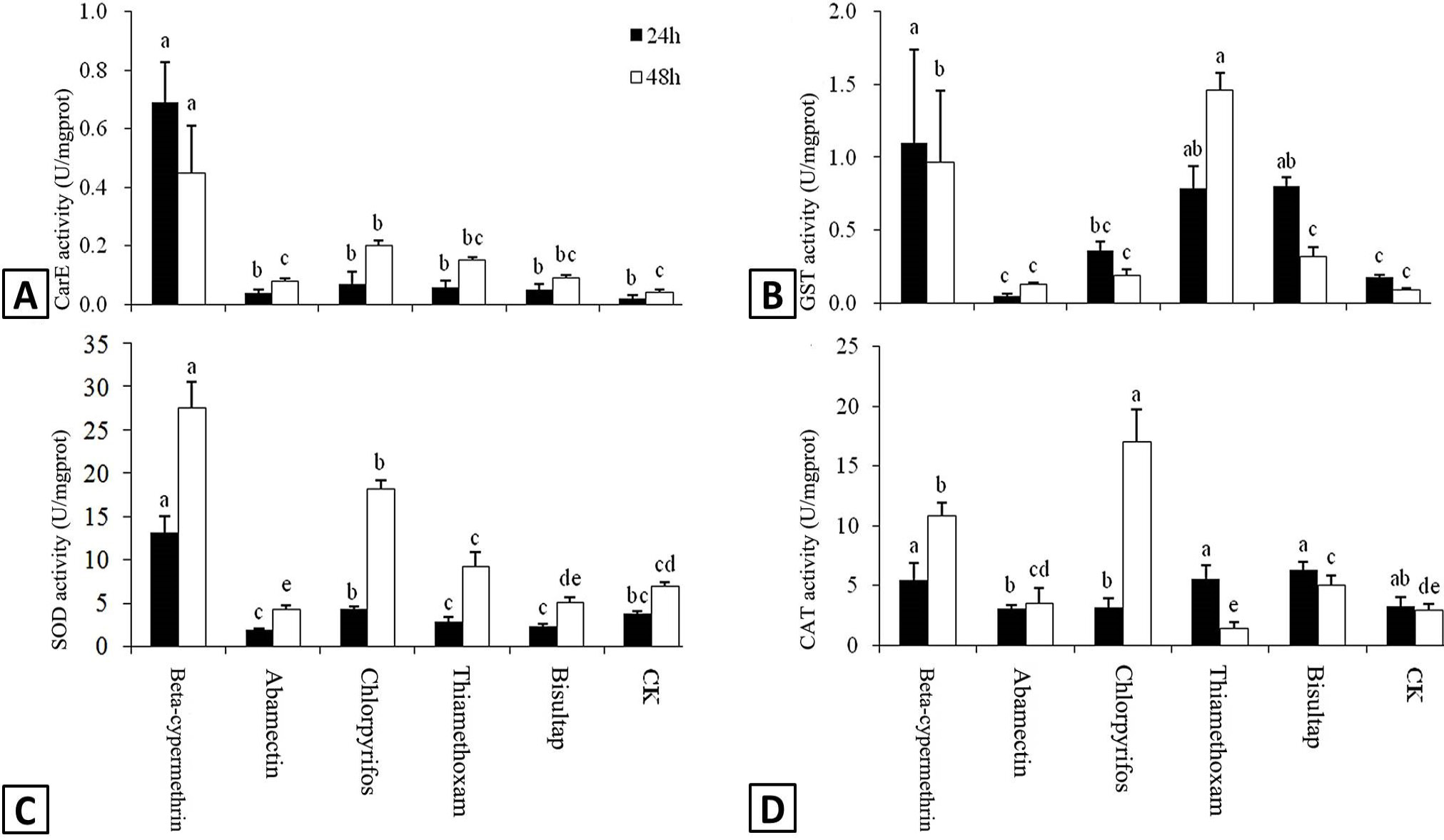
Effects of five insecticides on the activities of CarE (A), GST (B), SOD (C) and CAT (D) in Phauda flammans.
References
- Allen, R.G. and Balin, A.K., 1989. Oxidative influence on development and differentiation: an overview of a free radical theory of development. Free Radic. Biol. Med., 6: 631-661. https://doi.org/10.1016/0891-5849(89)90071-3[CrossRef]
- Anonymous, 2017. Hosts - A database of the world’s Lepidopteran Hostplants. Available at: http://www.nhm.ac.uk/our-science/data/hostplants/search/list.dsml?beginIndex=140280&browse.dsml=Callidulidae%253D%253D%253D%253DFamily.
- Arthurs, S.P., Chen, G.X. and Chen, J.J., 2016. Host specificity evaluation for Gynaikothrips uzeli (Thysanoptera: Phlaeothripidae) on ornamental Ficus (Rosales: Moraceae). Fla. Entomol., 99: 481-486. https://doi.org/10.1653/024.099.0321[CrossRef]
- Bhandari, B.P. and Cheng, Z.Q., 2016. Trunk injection of systemic insecticides to control stem and leaf gall wasps, Josephiella species (Hymenoptera: Agaonidae), on Chinese banyan (Rosales: Moraceae) in Hawaii. Fla. Entomol., 99: 172-177. https://doi.org/10.1653/024.099.0203[CrossRef]
- Bolter, C.J. and Chefurka, W., 1990. Extra mitochondrial release of hydrogen peroxide from insect and mouse liver mitochondria using the respiratory inhibitors phosphine, myxothiazol, and antimycin and spectral analysis of inhibited cytochromes. Arch. Biochem. Biophys., 278: 65-72. https://doi.org/10.1016/0003-9861(90)90232-N[CrossRef]
- Bradford, W.W., 1976. A rapid and sensitive method for the quantitation of microgram quantities of protein utilizing the principle of protein dye binding. Anal. Biochem., 72: 248-254. https://doi.org/10.1016/0003-2697(76)90527-3[CrossRef]
- Desneux, N., Decourtye, A. and Delpuech, J.M., 2007. The sublethal effects of pesticides on beneficial arthropods. Annu. Rev. Ent., 52: 81-106. https://doi.org/10.1146/annurev.ento.52.110405.091440[CrossRef]
- Ding, S.Y., Li, H.Y., Li, X.F. and Zhang, Z.Y., 2001. Effects of two kinds of transgenic poplar on protective enzymes system in the midgut of larvae of American white moth. J. Forest. Res., 12: 119-122. https://doi.org/10.1007/BF02867209[CrossRef]
- FOF, 2015. Diurnal leaf skeletonizing moth from Vietnam: Phauda flammans. Available at: https://www.whatsthatbug.com/2015/06/08/diurnal-leaf-skeletonizing-moth-from-vietnam-phauda-flammans/
- Jia, B.T., Jiao, P. and Yang, S.M., 2016a. Effects of sublethal concentrations of lufenuron on endogenous protective and detoxifying enzymes in the diamondback moth, Plutella xylostella (L.). J. Pl. Protect., 43: 293-299.
- Jia, B.T., Hong, S.S., Zhang, Y.C. and Cao, Y.W., 2016b. Effect of sublethal concentrations of abamectin on protective and detoxifying enzymes in Diagegma semclausum. J. environ. Ent., 38: 990-995.
- Li, Z.Z., Shen, H.J., Jiang, Q.H. and Ji, B.Z., 1994. Several kinds of insect protective enzyme system in vivo dynamic research. Acta Ent. Sin., 37: 399-403.
- Liang, P., Xia, B., Shi, T. and Gao, X.W., 2003. Effect of sublethal doses of abamectin and β-cypermethrin on glutathione S-transferases in diamondback moth Plutella xylostella (L.). J. Chin. Agric. Univ., 8: 65-68.
- Liu, J.Y., He, Q.L., Su, S., Wei, H., Yang, J., Lu, W. and Zheng, X.L., 2014. Investigated method of Phauda flammans pupae. Chin. Pl. Protect., 33: 72-74.
- Liu, J.Y., He, Q.L., Wei, H., Yang, J., Li, J., Lu, W. and Zheng, X.L., 2015a. Biological characteristics of Phauda flammans (Lepidoptera: Zygaenidae). Pl. Protec., 41: 188-192.
- Liu, J.Y., He, Q.L., Wei, H., Yang, J., Li, J., Lu, W. and Zheng, X.L., 2015b. Developmental duration, threshold temperature and effective accumulated of Phauda flammans under natural temperatures indoor. Pl. Protec., 41: 137-140.
- Liu, J.Y., Ma, Z.H., Wu, S.Y., Lin, M.Y., Zhang, J., Lu, W. and Zheng, X.L., 2016. Studies on the feeding preferences of Phauda flammans Walker (Lepidoptera: Zygaenidae). J. environ. Ent., 38: 924-930.
- Ma, Y., Huo, X.B., Ma, M. and Hong, A., 2009. Effect of lambda-cyhalothrin on protective enzyme in Blattella germanica and its new control measure. Chin. J. Vector Biol. Contr., 20: 303-306.
- Nageshchandra, B.K., Rajagopal, B.K. and Balasubramanian, R., 1972. Occurrence of slug caterpillar Phauda flammans Wlk. (Lepidoptera: Zygaenidae) on Ficus racemosa L. in South India. Mysore J. agric. Sci., 6: 186-189.
- Qu, Y.Y., Xiao, D., Liu, J.J., Chen, Z., Song, L.F., Desneux, N., Benelli, G., Gao, X.W. and Song, D.L., 2017. Sublethal and hormesis effects of beta-cypermethrin on the biology, life table parameters and reproductive potential of soybean aphid Aphis glycines. Ecotoxicology, 26: 1002-1009. https://doi.org/10.1007/s10646-017-1828-x[CrossRef]
- Quan, L.F., Zhang, H.J., Sun, L.N., Li, Y.Y., Yan, W.T., Yue, Q. and Qiu, G.S., 2016. Research advances in sublethal effect of pesticide. J. Agric., 6: 33-38.
- Rong, C.H., Wang, S.J., Liu, L., Yang, F., Wu, Y., Zhao, S.J. and Yan, Z.L., 2016. Toxicity test of 5 insecticides against Achelura yunnanensis. J. West Chin. Forest. Sci., 45: 142-144.
- Rumpf, S., Hetzel, F. and Frampton, C., 1997. Lacewings (Neuroptera: Hemerobiidae and Chrysopidae) and integrated pest management: Enzyme activity as biomarker of sublethal insecticide exposure. J. econ. Ent., 90: 102-108. https://doi.org/10.1093/jee/90.1.102[CrossRef]
- Verma, T.D. and Dogra, G.S., 1982. Occurrence of Phauda flammans Wlk. (Lepidoptera: Zygaenidae) on Ficus species in Himachal Pradesh. J. Tree Sci., 1: 130-132.
- Wang, F., Xu, Y., Zhao, Z.Y. and Ju, R.T., 2012. Toxicity test and control efficacy of six insecticides against Histia rhodope. Forest Pest Dis., 31: 39-42.
- Xing, J., Liang, P. and Gao, X.W., 2011. Effects of sublethal concentrations of chlorantraniliprole on insecticide susceptibility and detoxifying enzyme activity in Plutella xylostella. Chin. J. Pestic. Sci., 13: 464-470.
- Zhang, W.C., Wang, K.Y., Niu, F., Wang, D. and Ren, X.X., 2009. Induction of chlorfenapyr on endogenous protective and detoxifying enzymes in beet armyworm, Spodoptera exigua (Hübner). Acta Phytophy. Sin., 36: 455-460.
- Zhang, C., Zhang, H.Z, Chang, J. and Li, H.P., 2015. Toxicity and the effects of four pyrethroid insecticides on the activity of ATPase and GSTs in Aphis sp. Chin. J. Pestic. Sci., 17: 235-240.
- Zheng, X.L., Li, J., Su, L., Liu, J.Y., Meng, L.Y., Lin, M.Y. Zhang, J. and Lu, W., 2015. Ecological and morphological characteristics of parasitoids in Phauda flammans (Lepidoptera: Zygaenidae). Parasite, 22: 36. https://doi.org/10.1051/parasite/2015036[CrossRef]
- Zheng, X.L., Liu, J.Y., Huang, Z.Y., Meng, L.Y., Li, J. and Lu, W., 2017. Cold hardiness of Phauda flammans (Lepidoptera: Zygaenidae) larvae. Ent. Fenn., 28: 9-15.
- Zou, C.S., Lv, C.H., Wang, Y.J., Cao, C.W. and Zhang, G.C., 2017. Larvicidal activity and insecticidal mechanism of Chelidonium majus on Lymantria dispar. Pestic. Biochem. Physiol., 142: 123-132. https://doi.org/10.1016/j.pestbp.2017.04.009[CrossRef]
Services
Article usage statistics
Loading…