Research Article · Volume 35, Issue 1, 30 April 2020 · Open Access
Changes in Glutathione S-transferase Activity and Total Protein Contents of Labeo rohita
· · · ·
Affiliations & Notes ⌄
- 1Department of Zoology, Wildlife and Fisheries, University of Agriculture Faisalabad, Pakistan 2Department of Zoology, Cholistan University of Veterinary and Animal Sciences, Bahawalpur, Pakistan 3Animal Sciences and Technology, Guangxi University, China , Corresponding author: Huma Naz, dr.humanaz98@yahoo.com, humanaz@cuvas.edu.pk
Article Info ⌄
- Journal:
- Punjab University Journal of Zoology
- Published:
- 30 April 2020

Abstract
Introduction
The widespread use of insecticides in agriculture leads to the contamination of environment . These insecticides contaminate the aquatic bodies either via direct spraying on target species or surface runoff. When these insecticides reached to water bodies caused detrimental effects on non-target organisms especially to aquatic animals including fish which have high economic value for humans ; .
Organophosphate pesticide such as chlorpyrifos (CPF) is widely used to kill the various agricultural pests and domestic species . Toxicity associated with chlorpyrifos is an alarming threat not only to aquatic animals but also to human health . Chlorpyrifos induces toxicity by changing the physiological and antioxidant activities of fish . It also directly affects the nervous system by inhibiting the acetylcholine esterase (AChE) activity and can also amass in tissues of aquatic individuals .
Pesticides cause oxidative stress by stimulating the production of reactive oxygen species (ROS) which contain oxygen like OH-, H2O2 and O-2 radicals which inhibit the activities of antioxidants in fish . To minimize the ROS toxicity, organisms have antioxidant defense mechanism which contains superoxide dismutase, glutathione peroxidase, catalase and glutathione S-transferase .
Glutathione S-transferase (GST) belongs to a phase II family responsible for detoxification of toxicants such as pesticides and polyaromatic hydrocarbons by the conjugation of glutathione ; . By keeping in view above mentioned toxicity of chlorpyrifos, this research was carried out to check the total protein contents and glutathione S-transferase of Labeo rohita under sub-lethal effects of chlorpyrifos.
Materials and Methods
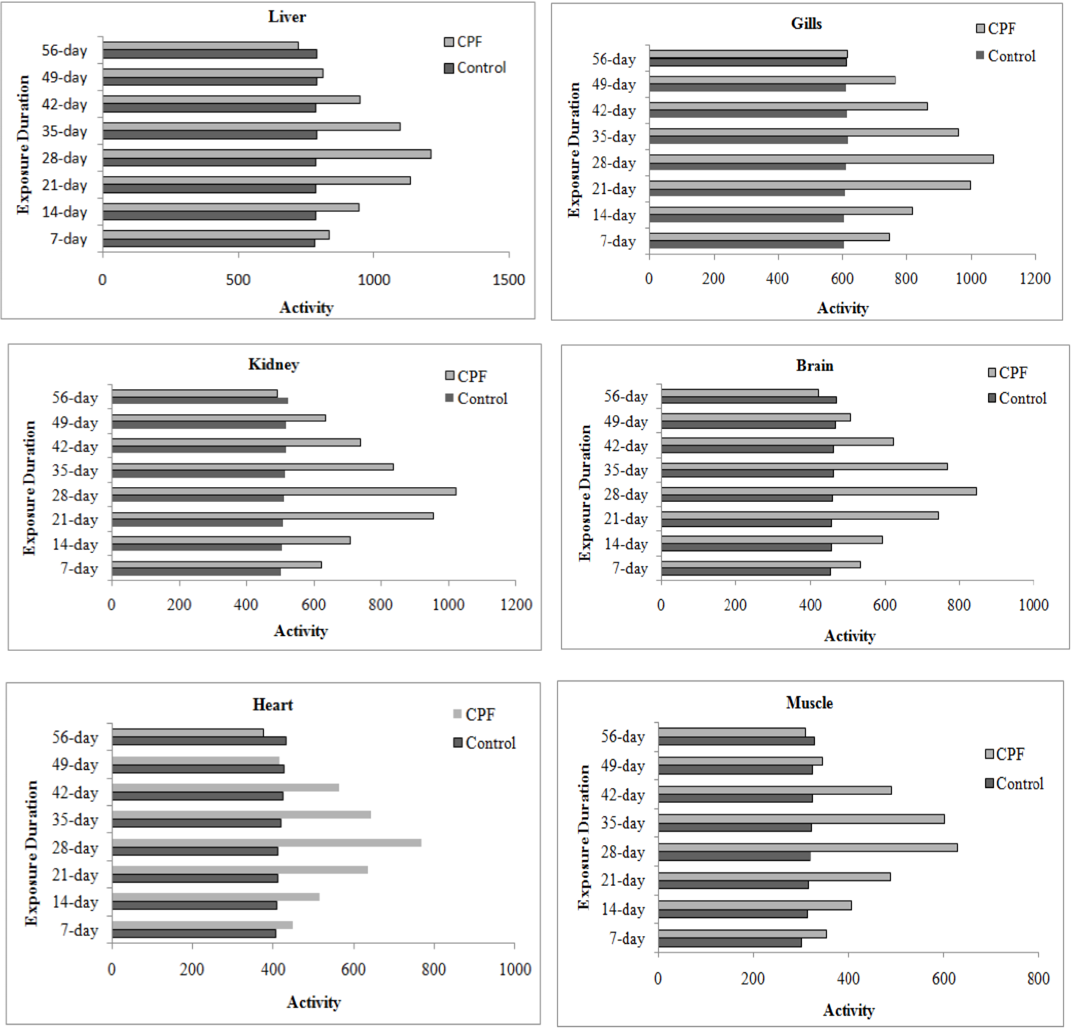
Labeo rohita was chosen for this experiment. Fish were obtained from Fish Seed Hatchery, Faisalabad and shifted into cemented tank at Fisheries Research Farm, UAF for acclimatization. The tests were carried out in glass aquaria (70-L) each having a group of fish (n=10). The technical grade insecticide chlorpyrifos was used as a test chemical. The LC50 (96 h) value as 16.53 μgL-1 of chlorpyrifos for L. rohita was estimated by Illyas (2015). On the base of this LC50 value fish were kept under sub-lethal dose (4.13μgL-1) of chlorpyrifos for two months (Figure 1). The tests were conducted with triplet at stable pH (7.25), total hardness (245 mgL-1) and temperature (27 ᵒC). Fish was sampled on weekly basis and sacrificed to get the tissues viz. brain, gills, kidney, heart, muscle and liver.
Tissue homogenate
To prepare tissues homogenate, each organ viz. brain, gills, kidney, heart, muscle and liver were isolated. Each organ was homogenate for 12 minutes in phosphate buffer of pH 6.5 mixed in the ratio of 1:4 (w/v). The homogenate was filtered and obtained filtrate was centrifuged in refrigerated centrifugal machine at 4 ᵒC and 10,000 rpm for 10 minutes. Supernatant was separated for GST estimation.
Glutathione S-transferase (GST)
Activity of GST was measured by spectrophotometer at A340nm by adopting the procedure of Mannervik (1985).
Total protein contents (TPCs)
According to Gornall et al. (1949) protocol the Biuret method was applied to check the total protein contents of samples.
Analyses of data
Data was analyzed by appropriate methods of Statistics . Analysis of variance was applied to compare difference between treatments by using Statistix version 8.1.
Results and Discussion
Estimation of GST
It was noted that the GST level in all observed tissues of chlorpyrifos stressed fish was significantly increased in first 28-day after that it was dropped off up to 56-day in comparison to control. The trend of GST activity in tissues of fish was observed as muscle<heart<brain<kidney<gills< liver. Similarly, Naz et al. (2019) noted the increased GST level in all tissues of L. rohita under endosulfan+chlorpyrifos mixture. Abdullah et al. (2018) also studied the higher level of GST in gills, liver, muscle and kidney of Channa striata under endosulfan+deltamethrin expousure. Batool et al. (2018) also reported the increased GST activity in hepatic tissues of Wallago attu under sub-lethal dose of toxicants. Sub-lethal dose of malathione stimulated the GST level in liver, kidney and gills of rohu . Nile tilapia showed increase in liver GST activity under sub-lethal stress of chlorpyrifos . Cypermethrin and chlorpyrifos treated African catfish showed increased GST activity in liver, muscle and gills . Huculeci et al. (2009) documented the malathion caused modulation GST level in kidney and gills of Carassius auratus gibelio. Alterations in gills, muscle and liver GST of rainbow trout due to diazinon and methyl parathion was noted by Isik and Celik (2008).
Estimation of TPCs
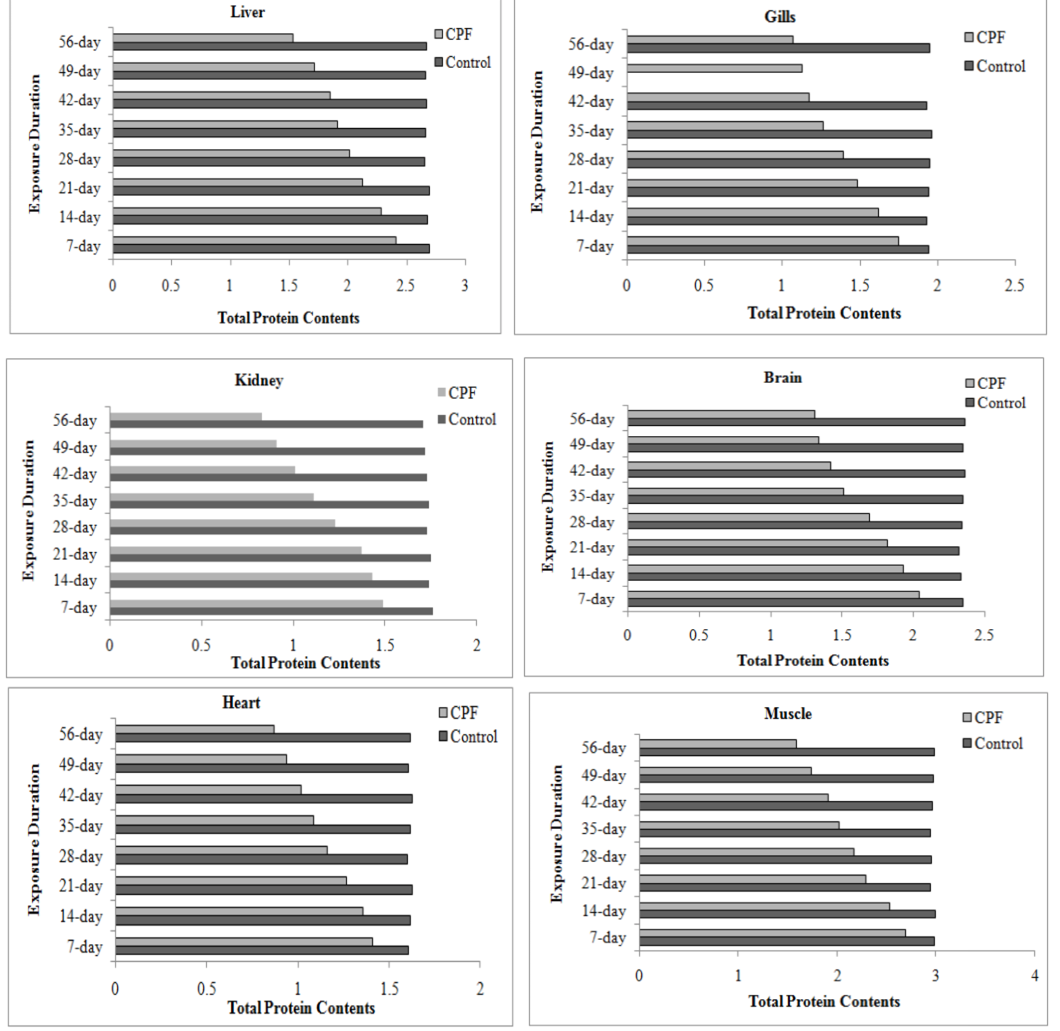
The TPCs in all organs of chlorpyrifos stressed L. rohita were significantly reduced in relation to control (Figure 2). Comparison among tissues for TPCs in fish showed the following trend: muscle>liver>brain>gills>kidney>heart. It was also noted that TPCs were significantly reduced with increasing time of exposure. Similarly, Batool et al. (2018) also noted the lower TPCs in liver of Wallago attu due to sub-lethal dose of toxicants. Phenthoate exposure caused reduction in TPCs of liver, brain and gills of L. rohita . Some authors said that the decreased TPCs may be due to metabolic consumption of keto acids in the production of glucose or for the ionic and osmatic regulation ; ; . ; ; Tilak et al. (2003) also confirmed the decline in TPCs. Agrhari et al. (2006) examined the similar results in C. punctatus.
Conclusion
In conclusion GST activity and TPCs are good biomarkers for evaluation of pesticides toxicity in aquatic animals. Fish is a suitable indicator for bio-monitoring the aquatic pollution.
Conflict of interest
No conflicts of interest.
Figures

Effect of chlorpyrifos on GST activity of L. rohita.

Effect of chlorpyrifos on total protein contents of L. rohita.
References
- Abdullah, S., Mateen, A., Abbas, K., Naz, H., Hassan, W. and Anum, S., 2018. Changes in glutathione s-transferase activity in fish Channa striata exposed to different aquatic pollutants (heavy metals and pesticides mixture). Pakistan J. Zool. Suppl. Ser., No.13: 42-47.
- Adeyemi, J.A., Atere, T.G. and Deaton, L.E., 2014. Oxidative damage and changes in glutathione S-transferase activity in juvenile African catfish, Clariasgariepinus exposed to cypermethrin and chlorpyrifos. Biokemistri., 25: 113-117.
- Agrahari, S., Gopal, K. and Pandey K.C., 2006.Biomarkers of monocrotophos in behaviour of freshwater fish Channapunctatus(Bloch). J. Environ. Biol., 27: 453-457.
- Batool, Y., Abdullah, S., Naz, H. and Abbas, K., 2018. Sub-lethal effect of waterborne cadmium exposure on glutathione s-transferase and total protein contents in liver of carnivorous fish, Wallago attu. Proc. Pak. Acad. Sci. B. Life Environ. Sci., 55: 21–25.
- Chezhian, A., Kabilan, N., Kumar, S.T., Senthamilselvan, D. and Sivakumari, K., 2010. Impact of common mixed effluent of spicot industrial estate on histopathological and biochemical changes in estuarine fish Lates calcarifer. Curr. Res. J. Boil. Sci., 2: 201-209.
- Gornall, A.G., Bardwill, C.S. and David, M.M., 1949. Determination of serum proteins by means of biuret reaction. J. Biol. Chem., 177: 751-766.
- Hamed, H.S., 2015. Impact of a short-term malathion exposure of Nile tilapia, (Oreochromis niloticus): The Protective Role of Selenium. Int. J. Environ. Monit. Anal., 3: 30-37.
- Huculeci, R., Dinu, D., Staicu, A.C., Munteanu, M.C., Costache, M. and Dinischiotu, A., 2009. Malathion induced alteration of the antioxidant defence system in kidney, gill, and intestine of Carassiusauratusgibelio. Environ. Toxicol., 24: 523-530. https://doi.org/10.1002/tox.20454[CrossRef]
- Illyas, R., 2015. Effect of selected pesticides on growth and DNA damage in peripheral blood erythrocytes of fish. Ph.D. Thesis. Department of Zoology and Fisheries, University of Agriculture, Faisalabad, Pakistan. pp. 1-329.
- Isik, I. and Celik, I., 2008. Acute effects of methyl parathion and diazinon as inducers for oxidative stress on certain biomarkers in various tissues of rainbow trout (Oncorhynchusmykiss). Pesti. Biochem. Physiol., 92: 38-42. https://doi.org/10.1016/j.pestbp.2008.06.001[CrossRef]
- Karmakar, S., Patra, K., Jana, S., Mandal, D.P. and Bhattacharjee, S., 2016. Exposure to environmentally relevant concentrations of malathion induces significant cellular, biochemical and histological alterations in Labeorohita. Pestic. Biochem. Physiol., 126: 49-57. https://doi.org/10.1016/j.pestbp.2015.07.006[CrossRef]
- Kumar, N., Prabhu, P.A.J., Pal, A.K., Remya, S., Aklakur, M., Rana, R.S., Gupta, S., Raman, R.P. and Jadhao, S.B., 2011. Anti-oxidative and immuno-hematological status of Tilapia (Oreochromismossambicus) during acute toxicity test of endosulfan. Pestic. Biochem. Physiol., 99: 45-52. https://doi.org/10.1016/j.pestbp.2010.10.003[CrossRef]
- Kumari, M., 2007. Biochemical changes induced by the pesticides abate in the liver of cat fish Heteropneutesfossilis(Bloch). Environ. Eco., 225: 1164-1166.
- Mannervik, B., 1985. The isozymes of glutatione S-transferase. Adv. Enzymol. Relat. Areas Mol. Biol., 57: 357-417. https://doi.org/10.1002/9780470123034.ch5[CrossRef]
- Monteiro, D.A., De-Almeida, J.A., Rantin, F.T. and Kalinin, A.L., 2006. Oxidative stress biomarkers in the freshwater characid fish, Brycon cephalus, exposed to organophosphorus insecticide Folisuper 600 (methyl parathion). Comp. Biochem. Physiol., 143: 141-149. https://doi.org/10.1016/j.cbpc.2006.01.004[CrossRef]
- Muley, D., Karanjkar, D. and Maske, S., 2007. Impact of industrial effluents on the biochemical composition of fresh water fish Labeorohita. J. Environ. Biol., 28: 245-249.
- Naz, H., Abdullah, S., Abbas, K., Hassan, W., Batool, M., Perveen, S., Maalik, S. and Mushtaq, S., 2019. Toxic Effect of Insecticides Mixtures on Antioxidant Enzymes in Different Organs of Fish, Labeo rohita. Pakistan J. Zool., 51: 1355-1361. https://doi.org/10.17582/journal.pjz/2019.51.4.1355.1361[Full text][CrossRef]
- Oruc, E.O., 2010. Oxidative stress, steroid hormone concentrations and acetylcholine esterase activity in Oreochromisniloticusexposed to chlorpyrifos. Pestic. Biochem. Physiol., 96: 160-166. https://doi.org/10.1016/j.pestbp.2009.11.005[CrossRef]
- Richardson, K.L., Gold-Bouchot, G. and Schlenk, 2009. The characterization of cytosolic glutathione S-transferase from four species of sea turtles: Logger head (Carettacaretta), green (Cheloniamydas), olive ridley (Lepido chelysolivacea), and hawksbill (Eretmo chelysimbricata). Comp. Biochem. Physiol. Toxicol. Pharmacol., 150: 279-284. https://doi.org/10.1016/j.cbpc.2009.05.005[CrossRef]
- Saravanan, M., Kumar, K.P. and Ramesh, M., 2011.Haematological and biochemical responses of freshwater teleost fish Cyprinuscarpio (Actinopterygii: Cypriniformes) during acute and sub-lethal exposure to lindane. Pestic. Biochem. Physiol., 100: 206-211. https://doi.org/10.1016/j.pestbp.2011.04.002[CrossRef]
- Shittu, M., Ayo, J.O., Ambali, S.F., Fatihu, M.Y., Onyeanusi, B.I. and Kawu, M.U., 2012. Chronic chlorpyrifos induced oxidative changes in the testes and pituitary gland of wistar rats: ameliorative effects of vitamin C. Pestic. Biochem. Physiol., 102: 79-85. https://doi.org/10.1016/j.pestbp.2011.10.014[CrossRef]
- Somaiah, K., Sunita, K. and Nagaraj, U., 2014. Effect of phenthoate on protein levels of freshwater fish Labeorohita(hamilton). Int. Q. J. Biol. Life Sci., 2: 475-479.
- Steel, R.G.D., Torrie, J.H. and Dickey, D., 1997. Principles and procedure of statistics: A biometrical approach, 3rd Ed. McGraw Hill Book Co. Inc., New York, pp. 352-358.
- Strange, R.C., Jones, P.W. and Fryer, A.A., 2000. Glutathione S-transferase: genetics and role in toxicology. Toxicol. Lett., 112: 357-363. https://doi.org/10.1016/S0378-4274(99)00230-1[CrossRef]
- Tilak, K.S. and Rao, D.K., 2003. Chlorpyrifos toxicity of freshwater fish. J. Aquat. Biol., 8: 161-166.
- Tripathi, G. and Shasmal, J., 2010. Reparation of chlorpyrifos induced impairment bythyroxine and vitamin C in fish. Ecotoxicol. Environ. Safe., 73: 1397-1401.
- Venktramana, G.V., Sadhya-Rani, P.N. and Murthy, P.S., 2006. Impact of malathion on the biochemical parameters of gobiid fish, Glossogobiusgiurus(Ham). J. Environ. Biol., 27: 119-122.
- Vutukuru, S.S., 2005. Acute effects of hexavalent chromium on survial, oxygen consumption, hematological parameters and some biochemicals profiles of Indian major carp, Labeorohita. Int. J. Environ. Res. Publ. Hlth., 2: 456-462. https://doi.org/10.3390/ijerph2005030010[CrossRef]
- Xing, H., Wang, X., Sun, G., Gao, X., Xu, S. and Wang, X., 2012. Effects of atrazine and chlorpyrifos on activity and transcription of glutathione S-transferase in common carp (Cyprinuscarpio L.). Environ. Toxicol. Pharmacol., 33: 233-244. https://doi.org/10.1016/j.etap.2011.12.014[CrossRef]
- Yonar, M.E. and Sakin, F., 2011. Ameliorative effect of lycopene on antioxidant status in Cyprinuscarpio during pyrethroiddeltamethrin exposure. Pestic. Biochem. Physiol., 99: 226-231. https://doi.org/10.1016/j.pestbp.2010.12.008[CrossRef]
- Yonar, M.E., Yonar, S.M., Ural, M.S., Silici, S. and Dusukcan, M., 2012. Protective role of propolis in chlorpyrifos-induced changes in the haematological parameters and the oxidative/antioxidative status of Cyprinuscarpiocarpio. Food Chem. Toxicol. ,50: 2703-2708. https://doi.org/10.1016/j.fct.2012.05.032[CrossRef]
Services
Article usage statistics
Loading…