
The invasive fall armyworm species, Spodoptera frugiperda (J.E. Smith) (Lepidoptera: Noctuidae), was first time reported in Pakistan during March 2019 causing severe damage to maize crop. As a new pest, there is little information available on its susceptibility to insecticides in Pakistan. We evaluated selective synthetic insecticides with different modes of action to control S. frugiperda larvae in the laboratory as well as under semi-field and field conditions. All insecticides performed well in controlling S. frugiperda larvae under laboratory conditions. Though, chlorantraniliprole @ 50 mL/100L (58.0–100%), abamectin @ 400 mL/100L (56.0–100%), lambda-cyhalothrin @ 250 mL/100L (52.0–100%) and chlorpyrifos @ 1000 mL/100L (52.0–98.0%) showed significantly (P < 0.05) higher mortality than other chemicals. Higher concentrations of abamectin (6000 ppm), chlorpyrifos (12000 ppm) and chlorantraniliprole (700 ppm) showed 100% larval mortality at 24 h post-exposure. Lambda-cyhalothrin (3500 ppm) showed 95% larval mortality at 24 h and 100% mortality at 48 h of application. The medium dose rate of abamectin (4000 ppm) and chlorantraniliprole (600 ppm) also showed 100% larval mortality at 48 h of application. In semi-field and field conditions, chlorantraniliprole showed 100% larval mortality at 48 h, while abamectin and chlorpyrifos showed 87–89% and 94–81% larval mortality respectively in semi-field to field conditions after 72 h of application. Overall study results demonstrate the effectiveness of chlorantraniliprole, abamectin and chlorpyrifos and these synthetic insecticides should be considered as components of integrated management of S. frugiperda in Pakistan.
Research Article · Volume 56, Issue 1, 11 December 2023 · Open Access
The Efficacy of Selected Synthetic Insecticide Formulations against Fall Armyworm Spodoptera frugiperda (J.E. Smith) Under Laboratory, Semi-Field and Field Conditions
· · · · ·
Affiliations & Notes ⌄
- 1Department of Entomology, College of Agriculture, University of Sargodha, Sargodha 40100, Pakistan * Corresponding author: zeeshan.majeed@uos.edu.pk
Article Info ⌄
- Journal:
- Pakistan Journal of Zoology
- Published:
- 11 December 2023

From the article
- Some insecticides showed greater mortality of 2nd instar larvae in the laboratory trials and high to moderate larval mortality was achieved with chlorantraniliprole, lambda-cyhalothrin, abamectin, chlorpyrifos, fipronil, deltamethrin, lufenuron, emamectin benzoate and profenophos.
- Findings of dose-mortality response demonstrated that higher concentrations of abamectin (6000 ppm) and chlorantraniliprole (700 ppm) and chlorpyrifos (12000 ppm) had 100% efficacy against S. frugiperda at 24 h post-exposure.
- This study demonstrates that the application of the synthetic insecticides chlorantraniliprole, abamectin and chlorpyrifos are effective in controlling S. frugiperda.
- These insecticides had the highest toxicity and fastest knockdown effect on S. frugiperda larvae in the field.
Selected from the article's own text.
Abstract
INTRODUCTION
The fall armyworm species, Spodoptera frugiperda (J.E. Smith) (Lepidoptera: Noctuidae) is an invasive pest and causes huge crop losses. This pest is endemic to the tropical regions of the Western Hemisphere ; , and was reported first time in sub-Saharan Africa in December 2015 . Its year-round distribution is usually limited to warm and moist areas, due to the inability to diapause under harsh conditions . This pest is a serious threat to global food security as the populations of S. frugiperda have become established in Africa, India and China ; , where maize and rice are staple food crops. In Pakistan, it was first reported in Sindh province on maize and vegetable crops during 2019 and now it has been well-established in almost all maize-producing areas of the country. S. frugiperda endures a threat to food security due to its wide range of host plants , having high reproductive potential, short life cycle , great dispersal abilities , and adaptability to diverse agro-ecological conditions .
S. frugiperda feeds on a wide range of host plants and over 353 host plants belonging to 76 different families including Poaceae (106 species), Asteraceae (31 species), and Fabaceae (31 species) have been reported . It can attack almost all stages of maize crop and neonate larvae feed on the underside of the leaves and make transparent patches, called windows. Mature larvae normally penetrate the leaf whorls ; FAO, 2018). About 33% loss of maize has been reported previously due to feeding of S. frugiperda, causing a loss of around 1 million tons in maize production annually in Kenya .
Control of S. frugiperda is difficult due to its feeding behavior under the protection of leaves and whorls; however, the application of synthetic insecticides remains the main option. Thus, there is a need to determine the effectiveness of insecticides against S. frugiperda to add to IPM practices. In India, use of chlorantraniliprole, spinetoram and thiamethoxam plus lambda cyhalothrin has been recommended by the Central Insecticide Board and Registration Committee (CIBRC) for the effective management of S. frugiperda population in the field . With the introduction of this pest in Pakistan, farmers are using different synthetic insecticides without knowing their efficacy. As the larva of this pest remains in the whorl of maize plants during its whole life, its contact with insecticides is minimal (FAO, 2018). Further, multiple applications of insecticides may enhance the resistance level of pests against insecticides, as has been reported previously (Gutierrez-Moreno et al., 2019). To provide baseline data and to find out the most effective insecticides, a study of dose-mortality response to various insecticides is needed .
Although, various differential-chemistry (other than conventional ones) synthetic insecticides having different modes of action have been in practice to control lepidopteran pests, the effective synthetic insecticides against S. frugiperda have yet to be explored. Many insecticides are reported to be effective against S. frugiperda, but no insecticide is registered in Pakistan. As a new pest in our country, it is necessary to determine the most effective insecticides and share information about the dose rate, application method, and time with maize growers. Extensive use of insecticides may impact the sustainability of farmers and thus those insecticides should be used that are economically justifiable. Keeping in view the economic losses of this new pest and no recommended insecticide against this pest in our country, the study was conducted to assess the toxicity of different synthetic insecticides in the laboratory, semi-field and field conditions.
MATERIALS AND METHODS
S. frugiperda culture
Larvae of S. frugiperda were collected from the maize field of research area of the College of Agriculture (32°08’07.9”N: 72°41’14.4”E) and brought to the laboratory of Entomology and were kept in clean Petri-plates. The culture was maintained under controlled conditions of 25±2ºC, 60±5% RH and 16:8 (L: D) photoperiod. Insects were fed on a chickpea flour based artificial diet described by Sorour et al. (2011). Pupae were kept in Petri-plates over moist filter paper and after emergence; adults were shifted into the rearing box for mating and ovipositioning. The adults were fed on 10% honey solution. Eggs of S. frugiperda were collected from cages on daily basis and were kept in Petri-plates containing a layer of artificial diet . The F3 generation of S. frugiperda was used in the bioassay.
Screening of nine insecticides in the laboratory
Nine synthetic insecticides were used for laboratory bioassay. Detail of selected insecticides having different groups with a different mode of action is given in Table I. The recommended doses of selected insecticides were tested against S. frugiperda larvae to screen out the effective insecticide in laboratory conditions. Total 10 treatments were used including nine insecticides with control (water). The leaf dip bioassay method was used to check the toxicity of these insecticides against S. frugiperda. Fresh leaves of cauliflower were collected from the field and brought into the laboratory. Leaves were washed with tap water and kept for drying at room temperature for 1h. After drying, leaf disks were prepared according to the size of the Petri-plate. Agar (1.5%) solution was prepared and was poured as 1mm layer into each glass Petri-plates (9 cm wide and 2.5 cm deep) and was allowed to dry at room temperature for 20–30 min. Leaf disks were dipped into treatment solutions for 5–10 sec. Then these discs were dried at ambient temperature for 10–15 min before placing them into glass Petri-plates. Five 2nd instar larvae were released on each treated leaf disc in glass Petri-plates and all plates were placed in controlled conditions (same as rearing condition). Complete randomized design (CRD) layout was used with ten replications of each treatment. Mortality data was recorded after 3, 6, 12, 24, 48 and 72 h of post-exposure.
Dose-mortality response of S. frugiperda to insecticides in laboratory
After the screening of various insecticides, four most effective insecticides were used further to evaluate lethal effects on S. frugiperda larvae. The same bioassay was performed as in study 1. A stock solution of each insecticide was prepared and further serial dilution was made. Five concentrations of each insecticide were prepared (in parts per million). The experiment was conducted with completely randomized design with six replications per concentration. Data of larval mortality were recorded after 3, 6, 12, 24, 48 and 72 h of post-exposure.
Table I. List of selected synthetic insecticides evaluated against 2nd instar larvae of Spodoptera frugiperda in this study.
| Trade name | Active ingredient | IRAC group | Formulation | Mode of action | Label dose (ml) |
| Chacha® | Abamectin | 28 Diamides | 1.8% EC | Glutamate-gated chloride channel allosteric modulator | 400 |
| Coragen® | Chlorantraniliprole | 1B Organophosphate | 20% SC | Ryanodine receptor modulator | 50 |
| Chopat® | Chlorpyrifos | 6 Avermectins | 40% EC | Acetylcholinesterase (AChE) inhibitors | 1000 |
| Decis Super® | Deltamethrin | 3A Pyrethroid | 2.8% EC | Sodium channel modulators | 80 |
| Proclaim® | Emamectin benzoate | 6 Avermectins | 19% EC | Glutamate-gated chloride channel allosteric modulator | 200 |
| Fipronil® | Fipronil | 2B Phenylpyrazoles | 5% SC | GABA-gated chloride channel blockers | 480 |
| Lambda® | Lambda-cyhalothrin | 3A Pyrethroid | 2.5% EC | Sodium channel modulators | 250 |
| Match® | Lufenuron | 15 Benzoylureas | 50% EC | Chitin synthesis inhibitor (IGR) | 200 |
| Curacron® | Profenophos | 1B Organophosphate | 50% EC | Acetylcholinesterase (AChE) inhibitors | 750 |
Efficacy of insecticides against S. frugiperda under greenhouse/semi-field conditions
Cauliflower planting was performed in plastic pots containing peat moss and soil with 1:1 ratio. The pots were watered as required. After 2 months of germination when plant height reached 6 to 7 inches, the plants were used in the experiment. The solutions of the four most effective insecticides were prepared according to their label recommended doses and were sprayed on the plants. Four plants were selected for each insecticide considering each plant as a replication. In the control treatment, water was applied. Five 2nd instar larvae from the laboratory-reared F3 generation were released on each potted plant. Data of larval mortality were recorded at 12, 24, 48 and 72 h of post-exposure time.
Field-efficacy of selected insecticides against S. frugiperda
Cauliflower (Brassica oleracea L. Botrytis) was planted in the research area of University. Ten seedlings in one ridge and total 100 plants were maintained in 10 ridges were sown in the field. All the crop-raising practices were followed to retain healthy plants. No insecticides except those included in our study were applied on the plants. When the height of cauliflower leaves was reached 7 to 8 inches in the field, the four most effective insecticides were applied on label recommended dose. Insecticide was applied with a hand sprayer. Five 2nd instar larvae of S. frugiperda were released on each plant and data of larval mortality were recorded after 12, 24, 48 and 72 h of insecticide application. The control plots were sprayed with water. Randomized Complete Block Design (RCBD) was used for the experiment with four replications.
Data analysis
Data for percent larval mortality recorded from all laboratory and field trials were subjected to a one-way analysis of variance (ANOVA) by keeping insecticide as the main factor. Median lethal time (LT50) values for selected differential-chemistry synthetic insecticides were calculated by probit analysis. Means were separated by using Tukey’s honest significant difference test (α = 0.05). All statistical analyses were performed using the Minitab 17.0 statistical software.
RESULTS
Efficacy of insecticides against 2nd instar larvae of S. frugiperda under laboratory conditions
The results showed that there was a significant difference in larval mortality after application of insecticides at 12 h (F = 17.6, P < 0.001), 24 h (F = 20.2, P < 0.001), 48 h (F = 36.2, P < 0.001) and 72 h (F = 82.2, P < 0.001). All the insecticides showed good results in controlling S. frugiperda larvae. At 72 h of exposure time, chlorantraniliprole, abamectin, and lambda-cyhalothrin showed 100% larval mortality. Furthermore, considerable larval mortality (86–98%) was recorded for chlorpyrifos, fipronil, deltamethrin and lufenuron after 72 h of application (Table II). Moreover, median lethal time (LT50) values indicated the same trend in the effectiveness of insecticides against 2nd instar larvae of S. frugiperda. Probit analysis showed chlorantraniliprole, abamectin and chlorpyrifos as effective insecticides with LT50 values of 8.32 h (0.55–16.09), 9.71 h (2.58–16.88) and 10.39 h (1.919–18.80), respectively (Table III).
Table II. Percent larval mortality (means ± SE) of 2nd instar larvae of Spodoptera frugiperda exposed to label-recommended dose rates of different synthetic insecticides.
| Insecticides | 12 h | 24 h | 48 h | 72 h |
| Deltamethrin B | 48.0±3.26a | 63.0±3.0a | 69.0±7.06b | 89.5±3.53ab |
| Lufenuron B | 48.0±3.26a | 61.0±5.67a | 69.0±7.06b | 85.5±5.29ab |
| Chlorantraniliprole A | 58.0±4.67a | 73.0±5.17a | 96.0±2.67a | 100.0a |
| Emamectin benzoate B | 48.0±3.26a | 61.0±5.67a | 67.0±5.58b | 85.5±4.37ab |
| Abamectin A | 56.0±4.98a | 71.0±6.75a | 95.5±3.02a | 100.0a |
| Fipronil B | 48.0±3.26a | 61.5±3.34a | 68.0±5.33b | 90.0±4.47ab |
| Lambda-cyhalothrin A | 52.0±5.33a | 68.0±6.11a | 96.0±2.67a | 100.0a |
| Profenophos B | 48.0±3.26a | 61.0±5.67a | 69.0±7.66b | 83.5±5.06b |
| Chlorpyrifos A | 52.0±3.26a | 67.0±3.67a | 92.0±4.42a | 98.0±2.0ab |
| Control C | 0.00b | 0.00b | 0.00c | 0.00c |
Means sharing similar letters within a column are not significantly different at P > 0.05. Capital letters show overall statistical difference among the insecticidal treatments (factorial ANOVA followed by HSD at α = 0.05).
Table III. Median lethal time (LT50) values for selected differential-chemistry synthetic insecticides evaluated against 2nd instar larvae of Spodoptera frugiperda at 12, 24, 48 and 72 h post-exposure time under laboratory.
| Treatment | LT50 (hr) | Lower–upper 95% fiducial limit (hr) | X2 | P value |
| Deltamethrin | 12.43 | 1.373–26.25 | 807.7 | < 0.001 |
| Lufenuron | 12.24 | 3.373–27.86 | 193.9 | < 0.001 |
| Chlorantraniliprole | 8.323 | 0.554–16.09 | 427.6 | < 0.001 |
| Emamectin benzoate | 12.60 | 3.227–28.42 | 586.1 | < 0.001 |
| Abamectin | 9.731 | 2.582–16.88 | 448.8 | < 0.001 |
| Fipronil | 13.87 | 0.473–27.28 | 357.8 | < 0.001 |
| Lambda-cyhalothrin | 12.29 | 6.151–18.43 | 464.3 | < 0.001 |
| Profenophos | 11.49 | 5.540–28.53 | 212.3 | < 0.001 |
| Chlorpyrifos | 10.39 | 1.919–18.80 | 320.2 | < 0.001 |
*Since the significance level is less than 0.15, a heterogeneity factor is used in the calculation of confidence limits.
Toxicity of effective insecticides at different concentrations against S. frugiperda
A significant difference in larval mortality was recorded after application of insecticides at 6 h (F =13.1, P < 0.001), 12 h (F = 26.9, P < 0.001), 24 h (F = 37.5, P < 0.001), 48 h (F = 32.1, P < 0.001) and 72 h (F = 25.9, P < 0.001). Abamectin at 6000 ppm concentration gave 65.0% larval mortality after 6 h, 90.0% after 12 h and 100% after 24 h. When this insecticide was tested at 5000 ppm, it showed 60.0, 90.0 and 100% larval mortality after 12, 24 and 48 h of application. Similarly, abamectin at 4000 ppm showed 70.0% larval mortality after 24 h and 100% after 48 h. The lowest concentrations (3000 and 2000 ppm, respectively) of abamectin showed 90.0% and 80.0% larval mortality after 72 h of application. Lambda-cyhalothrin at 2500 ppm gave 90% mortality of larvae after 72 h and 3000 ppm gave similar control at 48 h. A higher concentration (3500 ppm) of lambda-cyhalothrin controlled 95% larvae at 24 h and 100% at 48 h of application. The lowest concentrations of chlorpyrifos didn’t perform well in controlling larvae of S. frugiperda. However, 11000 ppm concentration of chlorpyrifos showed 90% mortality at 72 h and 12000 ppm showed 100% larval mortality at 24 h of application. Similar findings were observed in the case of chlorantraniliprole which showed 70% larval mortality at 400 ppm. By using a higher concentration (500 ppm) of this insecticide, 100% of larvae were found to be dead at 24 h of exposure (Table IV).
Efficacy of insecticides against 2nd instar larvae of S. frugiperda under semi-field conditions
When insecticides were tested under semi-field conditions, a significant difference in larval mortality was recorded after application of insecticides at 12 h (F = 19.2, P < 0.001), 24 h (F = 49.3, P < 0.001), 48 h (F = 36.5, P < 0.001) and 72 h (F = 42.6, P < 0.001). After 24 h, about 93.8% larval mortality was recorded with the application of chlorantraniliprole which was increased to 100% at 48 h. Chlorpyrifos gave 93.7% control of S. frugiperda larvae after 72 h of application. While 87.5% mortality was recorded with the application of abamectin and 76.3% with lambda-cyhalothrin at 72 h exposure time (Fig. 1).
Table IV. Percent larval mortality (means ± SE) of 2nd instar larvae of Spodoptera frugiperda exposed to different concentrations of synthetic insecticides.
| Insecticides | Conc. ( ppm) | 6 h | 12 h | 24 h | 48 h | 72 h |
| Abamectin A | 2000 | 15.0±5.00cde | 25.0±3.04e-h | 45.0±5.01cd | 65.0±5.00b-e | 80.0±2.02abc |
| 3000 | 15.0±5.00cde | 35.0±5.00d-g | 50.0±5.77cd | 75.0±9.57abc | 90.0±5.77ab | |
| 4000 | 30.0±5.77bcd | 50.0±5.77b-e | 70.0±4.77bc | 100.0a | 100.0a | |
| 5000 | 35.0±9.57bc | 60.0±8.16bcd | 90.0±3.37ab | 100.0a | 100.0a | |
| 6000 | 65.0±9.57a | 90.0±5.77a | 100.00a | 100.0a | 100.0a | |
| Lambda-cyhalothrin B | 1500 | 0.00e | 20.0±1.00fgh | 25.0±2.32d-g | 55.0±9.57c-f | 65.0±5.00cde |
| 2000 | 5.0±0.02de | 25.0±1.00e-h | 35.0±2.43def | 60.0±8.16cde | 70.0±5.77b-e | |
| 2500 | 10.0±1.77cde | 25.0±1.00e-h | 45.0±3.04cd | 65.0±5.00b-e | 90.0±5.77ab | |
| 3000 | 30.0±2.77bcd | 45.0±3.00c-f | 70.0±5.54bc | 90.0±5.77ab | 100.0a | |
| 3500 | 45.0±5.00ab | 70.0±5.34abc | 95.0±5.00ab | 100.0a | 100.0a | |
| Chlorpyrifos C | 8000 | 0.00e | 0.00h | 10.0±1.23fg | 30.0±2.54fg | 50.0±5.77e |
| 9000 | 0.00e | 0.00h | 15.0±1.65efg | 30.0±2.22fg | 55.0±5.00de | |
| 10000 | 0.00e | 10.0±1.77gh | 25.0±2.00d-g | 45.0±5.00def | 75.0±9.57bcd | |
| 11000 | 15.0±2.00cde | 25.0±2.00e-h | 50.0±5.43cd | 70.0±5.77bcd | 90.0±5.77ab | |
| 12000 | 30.0±2.77bcd | 70.0±5.77abc | 100.0a | 100.0a | 100.0a | |
| Chlorantraniliprole B | 300 | 0.00e | 0.00h | 15.0±1.00efg | 40.0±0.00ef | 65.0±5.00cde |
| 400 | 10.0±1.77cde | 25.0±3.00e-h | 40.0±1.55de | 55.0±9.57c-f | 70.0±5.77b-e | |
| 500 | 10.0±1.77cde | 30.0±5.77efg | 50.0±5.77cd | 75.0±9.57abc | 90.0±5.77ab | |
| 600 | 25.0±2.00b-e | 50.0±5.77b-e | 85.0±5.00ab | 100.00a | 100.0a | |
| 700 | 50.±5.77ab | 75.0±5.00ab | 100.0a | 100.00a | 100.0a | |
| Control D | 0.00e | 0.00h | 0.00±0.00g | 5.00±0.02g | 10.0±1.12f |
Means sharing similar letters within a column are not significantly different at P > 0.05. Capital letters show overall statistical difference among the insecticidal treatments (factorial ANOVA followed by HSD at α = 0.05).
Efficacy of effective insecticides against 2nd instar larvae of S. frugiperda in field conditions
In field conditions, similar results of selected insecticides were found as in semi-field conditions. Chlorantraniliprole showed 100% mortality at 48 h of application that was significantly (F = 37.4, P < 0.001) higher than other chemicals. Abamectin showed 88.7% larval mortality after 72 h of application in the field. Chlorpyrifos showed 26.2–81.2% and lambda-cyhalothrin showed 15.0–71.2% larval mortality in the field (Fig. 2).
DISCUSSION
S. frugiperda has a wide range of host plants and damages various economic crops including rice, maize, cabbage, cauliflower, sugarcane, millet and cotton ; ; . As a new pest in our country, farmers are using different synthetic insecticides to suppress the population of this pest, while there is no registered product available in the market yet. We evaluated different insecticides against this pest in laboratory and field conditions. In laboratory study, all tested insecticides showed good results in controlling S. frugiperda larvae. Some insecticides showed greater mortality of 2nd instar larvae in the laboratory trials and high to moderate larval mortality was achieved with chlorantraniliprole, lambda-cyhalothrin, abamectin, chlorpyrifos, fipronil, deltamethrin, lufenuron, emamectin benzoate and profenophos. However, more than 95% larval mortality was achieved by chlorantraniliprole, lambda-cyhalothrin, abamectin and chlorpyrifos at 72 h. The LT50 of chlorantraniliprole, abamectin and chlorpyrifos against S. frugiperda larvae were found to be low; therefore, the high insecticidal toxicity and rapid efficiency of these insecticides make them a good candidate to manage S. frugiperda larval population. Findings of dose-mortality response demonstrated that higher concentrations of abamectin (6000 ppm) and chlorantraniliprole (700 ppm) and chlorpyrifos (12000 ppm) had 100% efficacy against S. frugiperda at 24 h post-exposure. By increasing the concentration of insecticides, mortality of S. frugiperda larvae was also increased.
Our results corroborate the findings of Ahmed et al. (2022) showing significant morality of 3rd instar larvae of S. frugiperda by emamectin benzoate, chlorpyrifos and chlorantraniliprole. Lambda-cyhalothrin is a combination of isomers of cyhalothrin that is a synthetic organic insecticide . As a broad-spectrum pyrethroid insecticide, it is used to manage several insect pests in different crops . Chlorpyrifos is an organophosphate insecticide used to kill a wide range of insect pests . Abamectin is classified in the group of avermectins, made by the soil microorganism known as Streptomyces avermitilis . Abamectin acts as an agonist to GABA receptors in insect’s nervous system and is well documented as an effective insecticide against various insect pests ; ; ; . Chlorantraniliprole is a newer class of insecticides, anthranilic diamides and it is highly selective to ryanodine receptors in insect’s body ; . Chlorantraniliprole has been reported earlier as a good candidate to control Spodoptera spp. ; ; ; .
In greenhouse and field trials, the most effective insecticides from laboratory bioassay were tested against S. frugiperda larvae. The findings demonstrated that chlorantraniliprole, abamectin and chlorpyrifos were effective to control S. frugiperda. About 87–100% larval mortality was achieved at 72 h of application in greenhouse and field conditions. It was also noted that the mortality of 2nd instar larvae was increased over time after the application of synthetic insecticides in the laboratory and field, showing the residual toxicity of these insecticides to S. frugiperda.
The recent attack of S. frugiperda has forced the farmers to massive spraying of synthetic insecticides on maize fields for quick control of this pest. Due to heavy damage to maize crop, farmers are using synthetic chemicals not recommended yet against this pest. This massive use of insecticides may increase the chances of resistance development in this pest against insecticides. As recently, Gutierrez-Moreno et al. (2020) reported that field-collected S. frugiperda might be developing resistance to different insecticides including diamides, chlorantraniliprole and flubendiamide. Thus, resistance monitoring in S. furgiperda is also needed.
Due to having multiple generations, dispersal ability and feeding on various host plants makes S. frugiperda difficult pest to control. As a new threat to global food security, quick action, national, regional and international collaboration are needed to suppress the population of this pest. An effective integrated pest management strategy is required to tackle the adverse effects of this pest. Our findings, therefore, are helpful to the management of this pest in screening effective insecticides. However, these insecticides should be the last option in the IPM program of S. frugiperda. Other control measures including the use of biopesticides, natural enemies and cultural practices should be integrated into the IPM program for this pest.
CONCLUSIONS
This study demonstrates that the application of the synthetic insecticides chlorantraniliprole, abamectin and chlorpyrifos are effective in controlling S. frugiperda. These insecticides had the highest toxicity and fastest knockdown effect on S. frugiperda larvae in the field. These synthetic insecticides are hence recommended combating S. frugiperda infestations in maize. However, there is a need of IPM approach to control this pest, as only chemical control may increase the chance of S. frugiperda resistance to insecticides.
ACKNOWLEDGEMENT
The authors would like to acknowledge the Department of Plant Pathology and Farm Manager of the College of Agriculture, University of Sargodha, for providing research facilities.
Funding
The study was financially supported by the internal funds of the Department of Entomology, College of Agriculture, University of Sargodha, Sargodha.
Statement of conflict of interest
The authors have declared no conflict of interest.
Figures
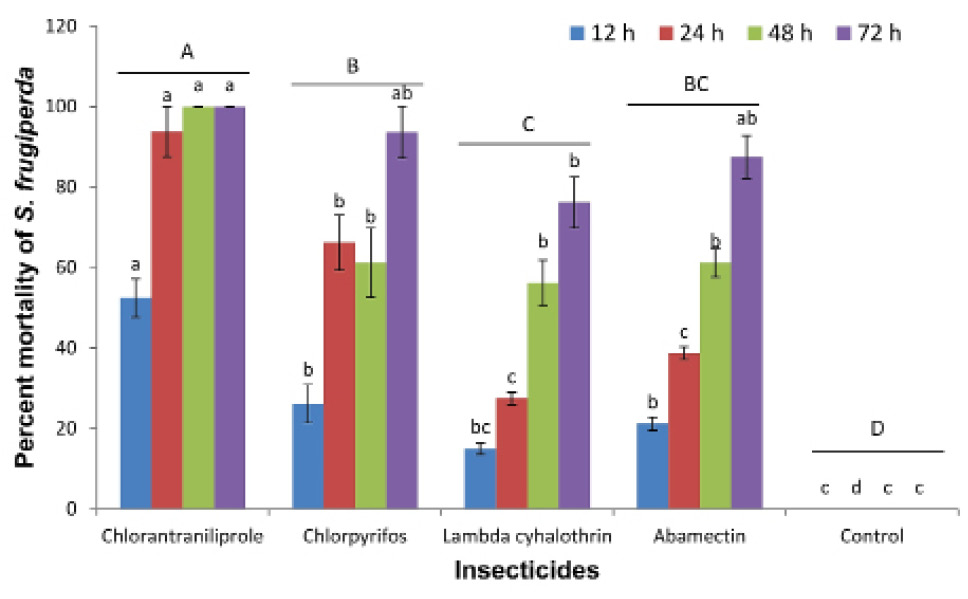
Percent larval mortality (means ± SE) of 2nd instar larvae of Spodoptera frugiperda exposed to label-recommended dose rates of different synthetic insecticides under semi-field conditions. Small letters show statistical difference among the treatments for each time interval, while capital letters show overall statistical difference among the insecticidal treatments (factorial ANOVA followed by HSD at α = 0.05).
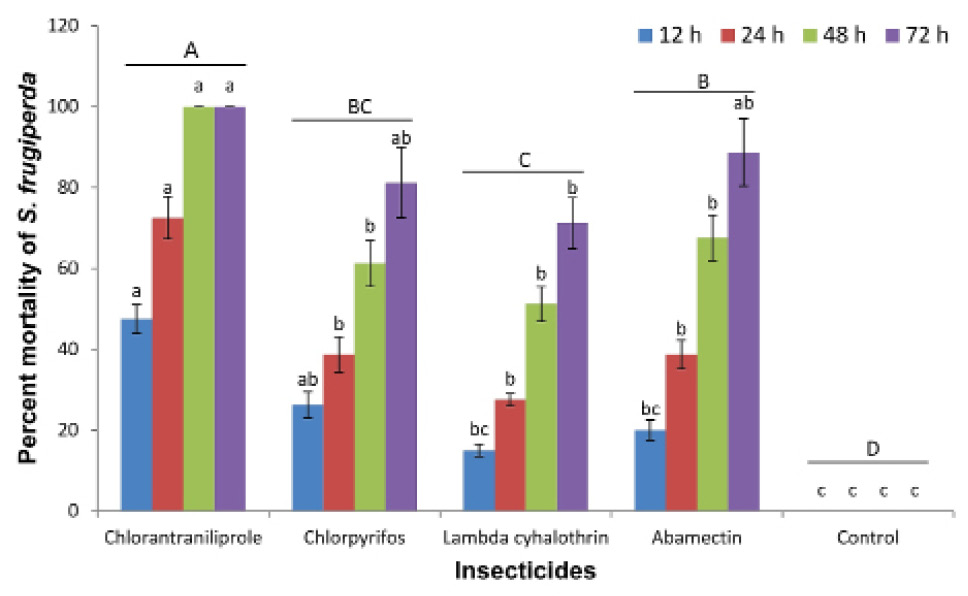
Percent larval mortality (means ± SE) of 2nd instar larvae of Spodoptera frugiperda exposed to label-recommended dose rates of different synthetic insecticides under field conditions. Small letters show statistical difference among the treatments for each time interval, while capital letters show overall statistical difference among the insecticidal treatments (factorial ANOVA followed by HSD at α = 0.05).
References
- Ahmad, M., Iqbal, M. and Ahmad, Z., 2003. Susceptibility of Helicoverpa armigera (Lepidoptera: Noctuidae) to new chemistries in Pakistan. Crop Prot., 22: 539–544. https://doi.org/10.1016/S0261-2194(02)00219-3[CrossRef]
- Ahmed, K.S., Idrees, A., Majeed, M.Z., Majeed, M.I., Shehzad, M.Z., Ullah, M.I. and Li, J., 2022. Synergized toxicity of promising plant extracts and synthetic chemicals against fall armyworm Spodoptera frugiperda (JE Smith) (Lepidoptera: Noctuidae) in Pakistan. Agronomy, 12: 1289. https://doi.org/10.3390/agronomy12061289[CrossRef]
- Altaf, N., Arshad, M., Majeed, M.Z., Ullah, M.I., Latif, H., Zeeshan, M., Yousuf, G. and Afzal, M., 2022. Comparative effectiveness of chlorantraniliprole and neem leaf extract against fall armyworm, Spodoptera frugiperda (J.E. Smith) (Lepidoptera: Noctuidae). Sarhad J. Agric., 3: 833–840. https://doi.org/10.17582/journal.sja/2022/38.3.833.840[Full text][CrossRef]
- Burg, R.W., Miller, B.M., Baker, E.E., Birnbaum, J., Currie, S.A., Hartman, R., Kong, Y.L., Monaghan, R.L., Olson, G. and Putter, I., 1979. Avermectins, new family of potent anthelmintic agents: producing organism and fermentation. Antimicrob. Agent. Chemotherap., 15: 361–367. https://doi.org/10.1128/AAC.15.3.361[CrossRef]
- Capinera, J.L., 2017. Fall armyworm, Spodoptera frugiperda (J.E. Smith) (Insecta: Lepidoptera: Noctuidae). EENY098, Revised 29-10-2020. http://edis.ifas.ufl.edu/in255
- Clark, P.L., Molina-Ochoa, J., Martinelli, S., Skoda, S.R., Isenhour, D.J., Lee, D.J., Krumn, J.T., and Foster, J.E., 2007. Population variation of Spodoptera frugiperda (J.E. Smith) in the Western Hemisphere. The University of Nebraska – Lincoln ProQuest Dissertations Publishing. pp. 24. https://doi.org/10.1673/031.007.0501[CrossRef]
- Cokola, M.C., Mugumaarhahama, Y., Noël, G., Kazamwali, L.M., Bisimwa, E.B., Mugisho, J.Z., Aganze, V.M., Lubobo, A.K. and Francis, F., 2021. Fall armyworm Spodoptera frugiperda (Lepidoptera: Noctuidae) in South Kivu, DR Congo: Understanding how season and environmental conditions influence field scale infestations. Neotrop. Ent., 50: 145–155. https://doi.org/10.1007/s13744-020-00833-3[CrossRef]
- Cook, D.R., Leonard, B.R., and Gore, J., 2004. Field and laboratory performance of novel insecticides against armyworms (Lepidoptera: Noctuidae). Fla. Entomol., 87: 433–439. https://doi.org/10.1653/0015-4040(2004)087[0433:FALPON]2.0.CO;2[CrossRef]
- Cordova, D., Benner, E.A., Sacher, M.D., Rauh, J. J., Sopa, J.S., Lahm, G.P., Selby, T.P., Stevenson, T.M., Flexner, L., Gutteridge, S., Rhoades, D.F., Wu. L., Smith, R.M. and Tao, Y. 2006. Anthranilic diamides: A new class of insecticides with a novel mode of action, ryanodine receptor activation. Pestic. Biochem. Physiol., 84: 196–214. https://doi.org/10.1016/j.pestbp.2005.07.005[CrossRef]
- Day, R., Abrahams, P., Bateman, M., Beale, T., Clottey, V., Cock, M., Colmenarez, Y., Corniani, N., Early, R., Godwin, J. and Gomez, J., 2017. Fall armyworm: impacts and implications for Africa. Outlook. Pest Manage., 28: 196–201. https://doi.org/10.1564/v28_oct_02[CrossRef]
- De Groote, H., Kimenju, S.C., Munyua, B., Palmas, S., Kassie, M., and Bruce, A., 2020. Spread and impact of fall armyworm (Spodoptera frugiperda J.E. Smith) in maize production areas of Kenya. Agric. Ecosyst. Environ., 292: 106804. https://doi.org/10.1016/j.agee.2019.106804[CrossRef]
- DPPQS, 2019. Directorate of Plant Protection, Quarantine and Storage. 2019. Advisory on exotic pest fall armyworm (FAW) Spodoptera frugiperda on maize in Karnataka State, India. http://ppqs.gov.in/advisories-section (last accessed 15 September 2022).
- FAO, Food and Agriculture Organization. 2018. Integrated management of the fall armyworm on maize: A guide for farmer field schools in Africa. Food and Agricultural Organization of the United Nations, Rome. http://www.fao.org/3/i8741en/I8741EN.pdf
- Fitzgerald, J., 2004. Laboratory bioassays and field evaluation of insecticides for the control of Anthonomus rubi, Lygus rugulipennis and Chaetosiphon fragaefolii, and effects on beneficial species, in UK strawberry production. Crop. Prot., 23: 801–809. https://doi.org/10.1016/j.cropro.2003.12.005[CrossRef]
- Goergen, G., Lava, K.P., Sankung, S.B., Togola, A., and Tamò, M., 2016. First report of outbreaks of the fall armyworm, Spodoptera frugiperda (JE Smith) (Lepidoptera, Noctuidae): A new alien invasive pest in west and central Africa. PLoS One, 11: e0165632. https://doi.org/10.1371/journal.pone.0165632[CrossRef]
- Gouamene-Lamine, C.N., Yoon, K.S. and Clark, J.M., 2003. Differential susceptibility to abamectin and two bioactive avermectin analogs in abamectin-resistant and susceptible strains of Colorado potato beetle, Leptinotarsa decemlineata (Say) (Coleoptera: Chrysomelidae). Pestic. Biochem. Physiol., 76: 15–23. https://doi.org/10.1016/S0048-3575(03)00053-1[CrossRef]
- Gutierrez-Moreno, R., Mota-Sanchez, D., Blanco, C.A., Chandrasena, D., Difonzo, C., Conner, J., Head, G., Berman, K. and Wise, J., 2020. Susceptibility of fall armyworms (Spodoptera frugiperda J.E.) from Mexico and Puerto Rico to Bt Proteins. Insects, 11: 831. https://doi.org/10.3390/insects11120831[CrossRef]
- Gutiérrez-Moreno, R., Mota-Sanchez, D., Blanco, C.A., Whalon, M., Terán-Santofimio, H., Rodriguez-Maciel, J.C., and Difonzo, C., 2019. Field-evolved resistance of the fall armyworm (Lepidoptera: Noctuidae) to synthetic insecticides in Puerto Rico and Mexico. J. econ. Ent., 112: 792–802. https://doi.org/10.1093/jee/toy372[CrossRef]
- Johnson, S.J., 1987. Migration and the life history strategy of the fall armyworm, Spodoptera frugiperda in the Western Hemisphere. Int. J. Trop. Ins. Sci., 8: 543–549. https://doi.org/10.1017/S1742758400022591[CrossRef]
- Kong, F., Song, Y., Zhang, Q., Wang, Z. and Liu, Y., 2021. Sublethal effects of chlorantraniliprole on Spodoptera litura (Lepidoptera: Noctuidae) moth: Implication for attract-and-kill strategy. Toxics, 9: 20. https://doi.org/10.3390/toxics9020020[CrossRef]
- Lahm, G.P., Stevenson, T.M., Selby, T.P., Freudenberger, J.H., Cordova, D., Flexner, L., Bellin, C.A., Dubas, C.M., Smith, B.K., Hughes, K.A., Hollingshaus, J.G., Clark, C.E. and Benner, E.A., 2007. Rynaxpyr: A new insecticidal anthranilic diamide that acts as a potent and selective ryanodine receptor activator. Bioorg. Med. Chem. Lett., 17: 6274–6279. https://doi.org/10.1016/j.bmcl.2007.09.012[CrossRef]
- Leistra, M., Zweers, A.J., Warinton, J.S., Crum, S.J., Hand, L.H., Beltman, W.H. and Maund, S.J., 2004. Fate of the insecticide lambda-cyhalothrin in ditch enclosures differing in vegetation density. Pest Manage. Sci., 60: 75–84. https://doi.org/10.1002/ps.780[CrossRef]
- Montezano, D.G., Specht, A., Sosa-Gómez, D.R., Roque-Specht, V.F., Sousa-Silva, J.C., Paulamoraes, D.E., Peterson, J.A. and Hunt, T., 2018. Host Plants of Spodoptera frugiperda (Lepidoptera: Noctuidae) in the America (2018). Afr. Entomol., 26: 286–300. https://doi.org/10.4001/003.026.0286[CrossRef]
- Murúa, M.G., Molina-Ochoa, J. and Fidalgo, P., 2009. Natural distribution of parasitoids of larvae of the fall armyworm, Spodoptera frugiperda, in Argentina. J. Insect. Sci., 9: 1–17. https://doi.org/10.1673/031.009.2001[CrossRef]
- Nagoshi, R.N., Murúa, M.G., Hay-Roe, M., Juárez, M.L., Willink, E. and Meagher, R.L., 2012. Genetic characterization of fall armyworm (Lepidoptera: Noctuidae) host strains in Argentina. J. econ. Ent., 105: 418–428. https://doi.org/10.1603/EC11332[CrossRef]
- Prowell, D.P., Mcmichael, M. and Silvain, J.F., 2004. Multilocus genetic analysis of host use, introgression, and speciation in host strains of fall armyworm (Lepidoptera: Noctuidae). Ann. entomol. Soc. Am., 97: 1034–1044. https://doi.org/10.1603/0013-8746(2004)097[1034:MGAOHU]2.0.CO;2[CrossRef]
- Rathod, A.L. and Garg, R.K., 2017. Chlorpyrifos poisoning and its implications in human fatal cases: A forensic perspective with reference to Indian scenario. J. Foren. Legal Med., 47: 29–34. https://doi.org/10.1016/j.jflm.2017.02.003[CrossRef]
- Robert, L.M., 2002. Insect control in Ullmann’s encyclopedia of industrial chemistry. Wiley-VCH: Weinheim, Germany.
- Seal, D.R., Ciomperlik, M., Richards, M.L., and Klassen, W., 2006. Comparative effectiveness of chemical insecticides against the chilli thrips, Scirtothrips dorsalis Hood (Thysanoptera: Thripidae), on pepper and their compatibility with natural enemies. Crop Prot., 25: 949–955. https://doi.org/10.1016/j.cropro.2005.12.008[CrossRef]
- Silva, C.S.B.D. and Parra, J.R.P., 2013. New method for rearing Spodoptera frugiperda in laboratory shows that larval cannibalism is not obligatory. Rev. Brasil. Ent., 57: 347–349. https://doi.org/10.1590/S0085-56262013005000029[CrossRef]
- Sisay, B., Tefera, T., Wakgari, M., Ayalew, G. and Mendesil, E., 2019. The efficacy of selected synthetic insecticides and botanicals against fall armyworm, Spodoptera frugiperda, in maize. Insects, 10: 45. https://doi.org/10.3390/insects10020045[CrossRef]
- Sorour, M.A., Khamiss, O., El-Wahab, A.S.E., El-Sheikh, M.A.K. and Abul-Ela, S., 2011. An economically modified semi-synthetic diet for mass rearing the Egyptian cotton leaf worm Spodoptera littoralis. J. Ent., 4: 118–123.
- Sparks, A.N., 1979. A review of the biology of the fall armyworm. Fla. Entomol., 62: 82–87. https://doi.org/10.2307/3494083[CrossRef]
- Ullah, U.N., Ashraf, A.M., Iqbal, N. and Saeed, S., 2019. First authentic report of Spodoptera frugiperda (J.E. Smith) (Noctuidae: Lepidoptera) an alien invasive species from Pakistan. Appl. Sci. Bus. Econ., 6: 1–3.
- White, S.M., Dunbar, D.M., Brown, R., Cartwright, B., Cox, D., Eckel, C., Jansson, R.K., Moorkerjee, P.K., Norton, J.A., Peterson, R.F. and Starner, V.R. 1997. Emamectin benzoate: A novel avermectin derivative for control of lepidopterous pests in cotton. In: Proceedings of belt wide cotton conference, 7–10 January 1997, New Orleans, USA, pp. 1078–1082.
- Wu, Q.L., Jiang, Y.Y. and Wu, K.M., 2019. Analysis of migration routes of fall armyworm, Spodoptera frugiperda (J. E. Smith) from Myanmar to China. Pl. Prot., 45: 1–9.
Cited by 1 article
In journals published by ResearchersLinks.
Services
Article usage statistics
Loading…