
Ambient temperature is an especially important factor associated with the development and survival of ectotherms. To minimize the effect of temperature variation, ectotherms have developed specific physiological and biochemical adaptations. Heat shock proteins and other molecular chaperones play specific physiological roles in such thermal adaptation. Here, we analyzed heat shock protein 70 (Hsp70) expression in six lizard species to investigate the variation in Hsp70 response contributing to thermal adaptation. At first, we collected three lizard species of the genus Takydromus from different geographical locations. We found that either the constitutive expression pattern in different organs or the inducible expression pattern under higher ambient temperature were the same. The expression of Hsp70 was higher in the muscles. In liver, Hsp70 expression significantly increased after 38°C heat shock. We then collected other three lizard species, Plestiodon chinensis, Sphenomorphus indicus, and Scincella modesta, from geographical locations near each other, but with different microhabitats. We observed considerable variation in Hsp70 expression; the constitutive Hsp70 expression varied between organs and between species under heat shock. P. chinensis began to express Hsp70 significantly at 39°C and with the maximum expression at 41°C. S. indicus and S. modesta began to express Hsp70 significantly at 35°C, and a temperature above 37°C resulted in fatality for some individuals. Taken together, these results indicated that both microhabitat and active temperature range contributed to the differences in Hsp70 expression in lizards at normal and elevated ambient temperatures.
Research Article · Volume 50, Issue 3, 22 April 2018 · Open Access
Differential Regulation of Hsp70 Expression in Six Lizard Species under Normal and High Environmental Temperatures
· · · · ·
Affiliations & Notes ⌄
- 1Hangzhou Key Laboratory of Animal Adaptation and Evolution, School of Life and Environmental Sciences, Hangzhou Normal University, Hangzhou 310036, Zhejiang, China 2Key Laboratory of Animal Ecology and Conservation Biology, Institute of Zoology, Chinese Academy of Sciences, Beijing, 100101, China , * Corresponding author: honglianglu@live.cn
Article Info ⌄
- Journal:
- Pakistan Journal of Zoology
- Published:
- 22 April 2018

From the article
- In the three species from the genus Takydromus, Hsp70 expression significantly increased at the high temperature of 38°C. At 35°C, Hsp70 expression significantly increased after a few hours in Sp.
- Research into the regulation of Hsp70 expression has also demonstrated that heat shock factor (HSF) expression changes according to the ambient temperature.
- The results of this study demonstrated that Hsp70 constitutive expression varied between species and that Hsp70 expression was modulated by ambient temperature in lizards.
- The microhabitat and active temperature range were more important for the thermal adaptation to higher ambient temperature in lizards than were their relative geographic locations.
Selected from the article's own text.
Abstract
Introduction
Environmental temperatures have extensive biological significance for all organisms. Ectotherms are dependent on the environment to adjust their body temperature, unlike endotherms, giving ambient temperature a fundamental influence on their life histories. Thus, the distribution of ectotherm species is greatly influenced by environmental temperatures ; ; Tian et al., 2017). Empirical studies have illustrated that temperatures affect embryonic energy use , hatchling phenotypes ; and even immunity . Furthermore, the effects of variation in environmental temperatures may induce changes in physiology and behavior of animals ; . The capacity for thermal adaptation developed in ectotherms to cope with the challenges of temporal variation in environmental temperature, and ectotherms from differing climates possess specific suitable temperature ranges .
The processes of thermal adaptation involve phenotypic plasticity ; , and both genetic and epigenetic adaptation . Phenotypic plasticity is the ability of an organism to change its phenotype in response to changes in the environment ; . Regarding genetic adaptation, some genetic factors, such as metabolic enzymes and molecular chaperones ; ; Narum et al., 2013) have been identified and related to thermal tolerance. Here, we focused on the alteration in expression of one molecular chaperone during thermal tolerance to extreme temperature. Epigenetic adaptation, which involves changes in DNA methylation, microRNA expression, and histone modification, has received extensive attention in mammals such as humans ; , than in ectotherms.
Heat shock proteins (HSPs), which act as molecular chaperones in cells, are sensitive to temperature variation during the development of organisms ; . Transcription of HSPs is also induced in response to other stresses such as mechanical damage , heavy metal exposure , oxidative stress , and infection . Hsp70 (heat shock protein 70), which is central to the chaperone system, is capable of interacting with almost all unfolded or partially unfolded proteins and assists in protein folding, transportation across membranes, and directing some unfolded proteins for degradation . Structurally, Hsp70 contains an N-terminal nucleotide binding domain (NBD) that has weak ATPase activity. The hydrophobic amino acid residues of the substrate can bind to a C-terminal substrate binding domain (SBD) . The diverse activities of Hsp70 are feasible due to their ATPase activity. Hsp70 releases substrate proteins after undergoing conformational changes over the course of its ATPase cycle ; . But Hsp70 does not work individully during the process that alters the conformations of substrate proteins. According to the client proteins, Hsp70 need to work together with Hsp40, Hsp90 or other cofactors as a heterocomplex . Meanwhile, Hsp70 is regulated during the signal transduction. Hsp70-interacting protein interfere with the ATP-dependent reaction cycle to modulate the activity of Hsp70 . Heat shock factors, which interact with members of the ATF1/CREB family, bind to the promoter region of the Hsp70 gene for expression regulation .
Data from the Inter-governmental Panel on Climate Change (IPCC) in 2013 showed that global warming is an undeniable fact , and many species have become extinct over the last few decades . There may be considerable variation in the levels of thermal resistance even in the same species where populations inhabit different environments with different temperature ranges . Hsp70, which is important in coping with extreme temperatures, has been frequently studied in the context of thermal adaptation. Studies of some species have illustrated that levels of Hsp70 are directly correlated with the level of thermal resistance (Narum et al., 2013; ; . Both the constitutive expression level and the inducible expression level of Hsp70 can be different among populations of the same species from various environments.
We used lizards as an animal model for research about thermal adaptation and acclimation of ectotherms. In this study, we obtained the partial sequence of an Hsp70 homolog from Takydromus and analyzed Hsp70 expression in Takydromus sexlineatus, Takydromus wolteri, Takydromus septentrionalis and three other species, Plestiodon chinensis, Sphenomorphus indicus, and Scincella modesta. We confirmed that the difference in Hsp70 expression can be attributed to microhabitats and the active temperature range.
Materials And Methods
Lizards
Our experimental procedures complied with the current laws on animal welfare and research in China, and were specifically approved by the animal welfare and ethics committee of Hangzhou Normal University (HZNU-201106-003). All the lizards collected were males and adults. In early May 2011, 10 individuals of the species T. sexlineatus were collected from Zhaoqing (23°3’N, 112°28’12”E), Guangzhou, in southeast China, and 10 those of T. wolteri were collected from Chuzhou (32°18’N, 118°18’E), Anhui, in central China. 10 T. septentrionalis individuals were collected from Zhoushan (30°N, 112°12’E), Zhejiang, in the East China Sea. In early May 2012, 35 P. chinensis individuals were collected from Lishui (28°27’N, 119°55’12”E), Zhejiang, in East China. 35 Sp. indicus individuals were collected form Hangzhou (30°16’48”N, 120°9’E) Zhejiang, in East China. 35 Sc. modesta individuals were collected from Hangzhou (30°16’48”N, 120°11’E) Zhejiang, in East China. These lizards were distributed into cages (60 cm × 30 cm × 30 cm) containing sand at a depth of 10 cm and using rocks and pieces of clay tiles as shelter. The cages, which contained 5 lizards each, were placed in a room at an ambient temperature of 24°C and a 12 light (L):12 dark (D) photoperiod before experiments.
Tissue collection and cDNA synthesis
In order to examine the constitutive expression levels of Hsp70, brain, heart, kidney, liver, and muscle samples were taken aseptically from five lizards of each species of Takydromus; brain, heart, kidney, liver, muscle, and lung samples were taken aseptically from three lizards of each species of the other three species. We set an extreme temperature of 38°C for three species of Takydromus and 35°C for the other three species. The temperatures were designed according to the temperatue range published or the unpublished results that we collected. After 2 h and 24 h of heat exposure, lizards were sacrificed to collect tissue samples.
After the analysis of Hsp70 expression under the extrem temperatures, we designed temperature gradient for P. chinensis, Sp. indicus and Sc. modesta. The temperature gradient beginning at 33°C with 2°C increase in each test was used to examine Hsp70 expression in liver after 2 h of heat exposure.
All the tissues were frozen using a liquid nitrogen flash freezer, and stored at -80°C for subsequent total RNA extraction and cDNA synthesis. Total RNA was isolated with TRIzol (Invitrogen, Carlsbad, USA). One microgram of total RNA was used for cDNA synthesis with a PrimeScript™ RT Reagent Kit with gDNA eraser (Perfect Real Time) (TaKaRa, Dalian, China).
Gene fragment of Hsp70 and β-actin from Takydromus
We used the NCBI GenBank to identify Hsp70 and β-actin gene sequences in species that have close phylogenetic relationships with lizards. Primers were designed according to the sequence alignment result in the conserved domain of Hsp70. In Takydromus, fragments of Hsp70 and β-actin were obtained by PCR and rapid amplification of cDNA ends (RACE) using the SMART RACE cDNA Amplification Kit (Clontech, San Francisco, USA).
Quantitative Real Time Reverse Transcriptase PCR (qRT-PCR) analysis of Hsp70 expression in lizard tissues
Primers were designed according to the sequences obtained above. The primers used to amplify the β-actin gene were Actin RTF1 (5′- TGAACCCCAAAGCCAACAGA -3′) and Actin RTR1 (5′- GGGCGTAGCCTTCGTAGATG -3′); the primers used to amplify Hsp70 in all three species were Hsp70 RTF1 (5′- GCAAGGAACTCAACAAAAGCA -3′) and Hsp70 RTR1 (5′- CTCGATCCCCAGCGACAG -3′). We run PCR using the cDNA collected from the six lizards to confirm the primers were suitable to perform qRT-PCR. The PCR products were sequenced and aligned. qRT-PCR were performed by using a C1000TM thermal cycler (Bio-Rad, Hercules, CA, USA) with an iTaq Universal SYBR Green Supermix kit (Bio-Rad, Hercules, CA, USA) as described previously . Each assay was performed in triplicate with β-actin mRNA as the control. The products of qRT-PCR were run on a gel to confirm that single bands were observed. All data were given in terms of relative mRNA and expressed as the mean plus or minus standard errors of the mean (SE). The constitutive expression levels were detected using cDNA from tissues collected under normal temperature as templates, and the inducible levels were detected using cDNA from tissues collected under high temperatures.
Statistical analysis
Hsp70 expression levels were analyzed using the 2-ΔΔCT method . Organs with the lowest expression of Hsp70 under normal conditions were chosen as controls for the relative constitutive expression levels, and untreated lizards under room temperature were used as controls to calculate the relative inducible expression level. Analysis of variance (ANOVA) in the STATISTICA 6.0 package was used to analyze the differences in gene expression levels. In all cases, the significance level was defined as P < 0.05.
Results
Gene
In this study, we identified partial sequence of Hsp70 homolog (Genebank No. KY172638) and the open reading frame of β-actin (Genebank No. KY172639) from T. septentrionalis. The obtained partial sequences of the Hsp70 gene contains the C-terminal substrate binding domain. We also used genomic DNA as a template to confirm the absence of intron in the obtained partial sequence. We designed primers to examine the Hsp70 expression level at the transcriptional level based on the conserved sequence. The sequence obtained from these six lizards by the primers had more than 98% similarity. The products of qRT-PCR were run on a gel, and single bands were observed.
Constitutive expression of Hsp70 in the six lizard species
qRT-PCR was carried out to examine the expression profile of Hsp70 in different organs of the six lizard species. In the three related species, T. sexlineatus, T. wolteri and T. septentrionalis, Hsp70 was expressed in a similar pattern in different organs at the normal experimental temperature of 24°C. Hsp70 expression in all three species of Takydromus was highest in muscle tissue. In T. sexlineatus and T. septentrionalis, Hsp70 expression was lowest in liver tissue. However, in T. wolteri, Hsp70 expression was lowest in kidney samples, and second lowest in the liver. The other tissues showed moderate Hsp7.0 expression (Fig. 1A). In contrast, Hsp70 expression patterns were different at 24°C in the other three species, P. chinensis, Sp. indicus and Sc. modesta. For P. chinensis, Hsp70 expression was the highest in the lung and the lowest in the liver. In Sp. indicus, Hsp70 expression was highest in muscle and lowest in the lung. In Sc. modesta, Hsp70 expression was highest in the heart and lowest in the lung (Fig. 1B).
Expression of Hsp70 in response to high temperature
To examine the effect of high temperature on Hsp70 expression in different species, lizards were incubated in a high temperature environment. The temperatures were set by referring to the critical thermal maximum. For the three species of Takydromus, the high temperature was set at 38°C, and for the other three species, the high temperature was set at 35°C. Hsp70 expression in liver was analyzed by qRT-PCR at 2 h and 24 h. The results showed that Hsp70 expression changed significantly after the 2 h incubation with a 92.4-fold increase in T. sexlineatus, a 16-fold increase in T. wolteri and a 79-fold increase in T. septentrionalis. The expression levels in T. sexlineatus and T. wolteri returned to normal after 24 h of heat exposure, whereas T. septentrionalis maintained a significantly high expression level, with an 89.1-fold increase over the control (Fig. 2A). For P. chinensis, Hsp70 expression did not significantly change during the heat exposure. Hsp70 expression in both Sp. indicus and Sc. modesta was significantly affected by ambient temperature, with a 50-fold and 9.6-fold increase respectively after 2 h of heat exposure. The Hsp70 expression in Sp.indicus and Sc. modesta decreased, but was maintained at a significantly high level after 24 h of heat exposure (Fig. 2B).
The critical thermal maximum of P. chinensis, Sp. indicus and Sc. modesta are significantly different. We supposed that may contribute to the HSP70 expression difference under 35°C. So we set a temperature gradient for P. chinensis, Sp. indicus and Sc. modesta to examine Hsp70 expression after 2 h of heat exposure. For P. chinensis, Sp. indicus and Sc. modesta, expression peaked at 41°C, 35°C, and 37°C separately. For P. chinensis and Sp. indicus, expression declined at higher temperatures (Fig. 3). Measurements above 37°C for Sp. indicus and Sc. modesta were omitted because the temperature would have resulted in mortality for some individuals.
Discussion
Hsp70 is sensitive to temperature variation. We chose different Hsp70 induction temperatures for the two groups of lizards, because the habitats, temperature range, and critical thermal maxima (CTM) are different. The microhabitats mainly contributed to temperature range and CTM of species . Although these three species of Takydromus were captured from locations far from each other’s, the microhabitats temperatures of Takydromus were similar when they were obtained in grass or low bushes. T. sexlineatus has a temperature preference of 31.5°C and an upper lethal temperature of 42.2°C ; . T. wolteri has a preferred temperature of 30°C for optimal locomotion , but the CTM is unknown. T. septentrionalis has a preferred temperature of 30°C and a CTM of 42.3°C . The three species P. chinensis, Sp. indicus and Sc. modesta were sympatric species, and collected from locations in close proximity. However, the microhabitats occupied by these three species were significantly different. Compared with Sp. indicus and Sc. modesta, P. chinensis occupies a microhabitat with fewer trees, more rocks, and higher ambient temperatures ; . P. chinensis has a preferred temperature of 31.2°C and a CTM of 42.3°C . Sp. indicus has a preferred temperature of 25.7°C and a CTM of 37.6°C . Sc. modesta has a preferred temperature of 23.9°C and a CTM of 36.2°C.
When we analyzed the constitutive Hsp70 expression in different organs, we found that the expression patterns of the three species from the genus Takydromus were similar, but the expression patterns of the other species were different. Although the microhabitats of Sp. indicus and Sc. modesta were similar, but the expression patterns were still different. So we came to the conclusion that the same genus and similar microhabitats contributed to the similar consititutive Hsp70 expression patterns of the three species from the genus Takydromus. In the three species from the genus Takydromus, Hsp70 expression significantly increased at the high temperature of 38°C. At 35°C, Hsp70 expression significantly increased after a few hours in Sp. indicus and Sc. modesta, but there were no significant changes in expression in P. chinensis. McMillan et al. (2011) also reported no effect of heat exposure on Hsp70 expression in lizards from southern collection sites in contrast with lizards from northern sites. Therefore, we set a temperature gradient for P. chinensis, Sp. indicus and Sc. modesta, to determine whether Hsp70 expression was related with the induction temperature.
In P. chinensis, significantly high Hsp70 expression began at 39°C, which was higher than in Sp. indicus and Sc. modesta. Ulmasov et al. (1992) found the same phenomenon in some thermophilic lizards. The putative explanation was that the constitutive expression level at normal physiological temperature was higher than in the other two species. At the same time, our results were consistent with the results by Zatsepina et al. (2000) who reported that induction of Hsp70 expression in desert lizards starts and finishes at a temperature 3-7°C higher than that in the non-desert species. Studies in other species, such as fishes and fruit flies, have also indicated that Hsp70 induction may be more dependent upon the relative increase in environmental temperature than upon the absolute temperature experienced ; Narum et al., 2013).
Additionally, we found that the Hsp70 expression decreased at 43°C and 35°C in P. chinensis and Sp. indicus separately. The highest expression levels did not apear at the highest temperature that lizards could tolerate. The same phenomenon was also found in other studies ; . We might arribute the decrease of Hsp70 expression under critical temperature to the balance of Hsp70 expression and the costs of stress resistance. Sørensen et al. (2003) pointed out that there is a trade-off between the benefit of increased stress resistance and the physiological costs of producing HSPs, such as high energy demands, impaired growth, and reduced fitness. We also induced embryonic overexpression of Hsp70 in Pelodiscus sinensis. Thermal tolerance of the embryos and hatching success under a high incubation temperature increased significantly, whereas thermal tolerance of hatchlings decreased due to the costs of prolonged Hsp70 overexpression . But for Sc. modesta we did not found the decrease at 37°C. The set of our temperature interval after 37°C may be too large to get the limit point.
Hsp70 is an important factor associated with temperature acclimation. Research into the regulation of Hsp70 expression has also demonstrated that heat shock factor (HSF) expression changes according to the ambient temperature. The active (trimeric) form can bind to the promoter of the Hsp gene . Expression of other HSPs family members, such as Hsp47, Hsc70, Hsp90 was also reported to be related to thermal adaptation of ectotherms ; Narum et al., 2013; . To maintain individual homeostasis, the alteration of specific enzyme activities is also an important way to acclimate. Lactate dehydrogenase and cytochrome-c oxidase, which are associated with energy metabolism, were found to have differential expression in animals from temperature areas with different heritable evolutionary adaptation ; ; ; . As sequencing technology has developed, more genes have been reported as having an association with thermal adaptation. The complex networks of thermal adaptation mechanisms will become clearer after the identification and characterization of specific functional genes.
Conclusion
The results of this study demonstrated that Hsp70 constitutive expression varied between species and that Hsp70 expression was modulated by ambient temperature in lizards. The microhabitat and active temperature range were more important for the thermal adaptation to higher ambient temperature in lizards than were their relative geographic locations.
Acknowledgments
This work was supported by grants from Zhejiang Provincial Natural Science Foundation (Grant No. LQ12C03003), National Natural Science Foundation of China (Grant No. 31200310, 31100275, 31260621, 31160240), the Agricultural Research and Development Program of Hangzhou (Grant No. 20150432B04) and the China Scholarship Council.
Statement of conflict of interest
The authors have no conflicts of interest. The manuscript has been submitted solely to the Pakistan Journal of Zoology and is not being published, considered for publication, or submitted elsewhere.
Figures
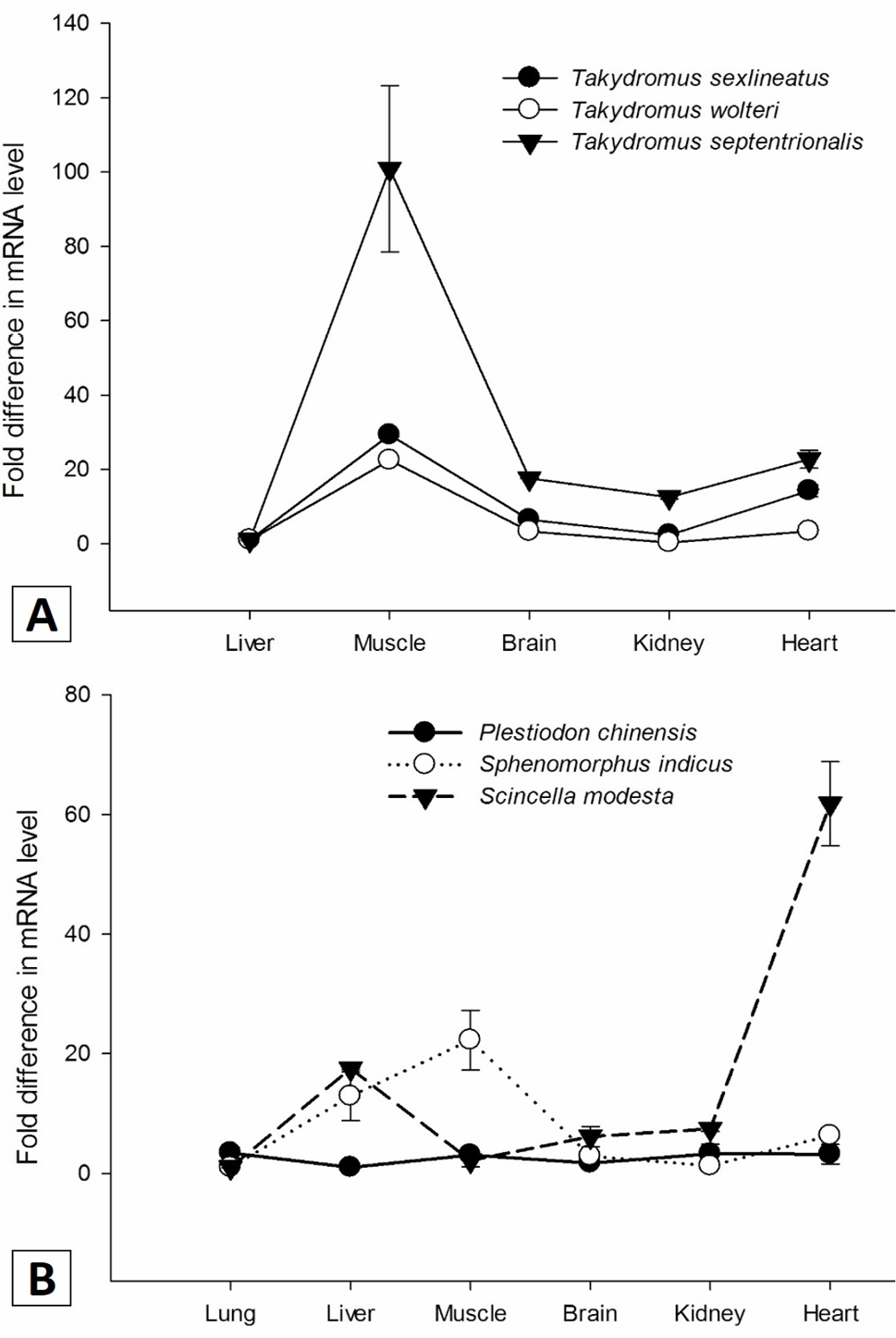
Hsp70 expression in different tissues of the six lizards species detected by quantitative real time reverse transcriptase PCR. Hsp70 expression levels in different organs were normalized to that of β-actin mRNA. For Takydromus, the normalized Hsp70 mRNA level in liver was set as 1. For P. chinensis, Sp. indicus and Sc. modesta, the normalized Hsp70 mRNA level in lung was set as 1. Vertical bars represent means±SE (n=5).
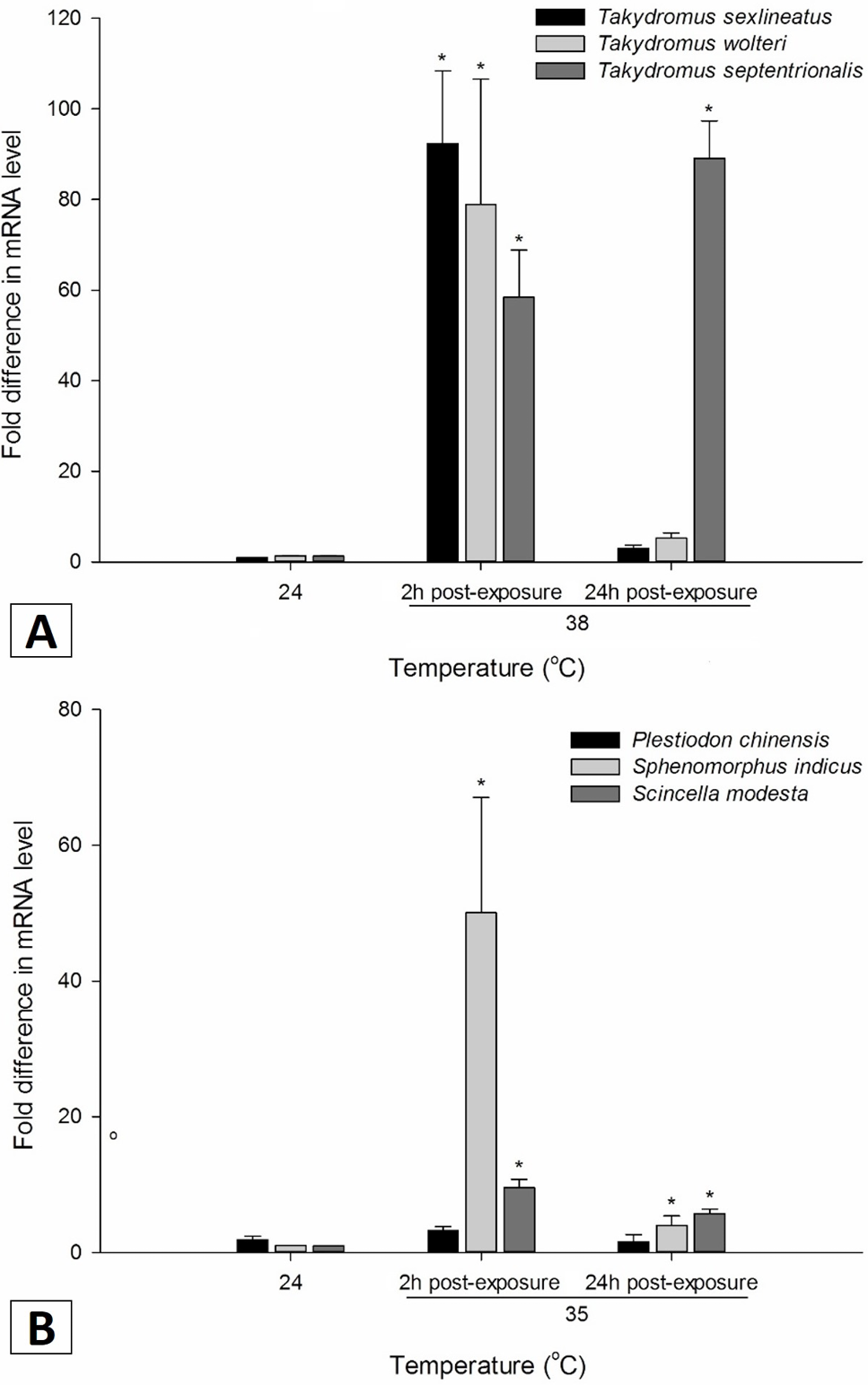
Hsp70 Expression of six lizards species in response to heat shock. Hsp70 expression in liver was determined by quantitative real time reverse transcriptase PCR at various times post-exposure. The mRNA level of Hsp70 was normalized to that of β-actin mRNA. Values are shown as means ± SE (n = 5). Significances between room temperature lizards and heat post-exposure lizards are indicated with asterisks. *P < 0.05.
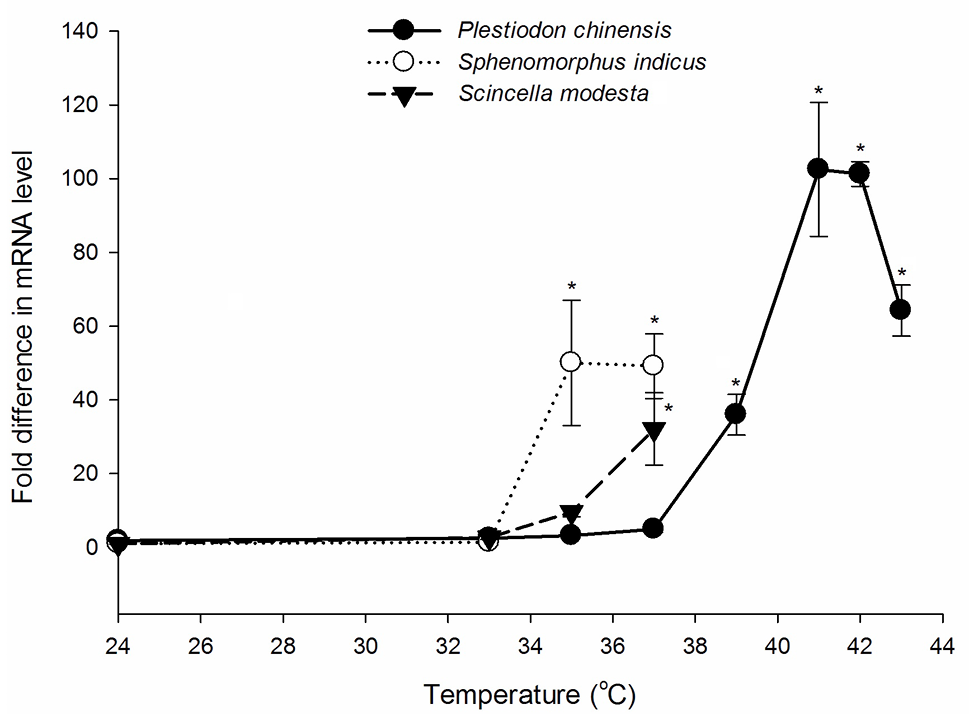
Hsp70 expression of P. chinensis, Sp. indicus and Sc. modesta in response to different temperature in short time. Hsp70 expression in liver was determined by quantitative real time reverse transcriptase PCR at various times post-exposure. The mRNA level of Hsp70 was normalized to that of β-actin mRNA. Values are shown as means ± SE (n = 5). Significances between room temperature lizards and heat post-exposure lizards are indicated with asterisks. *P < 0.05.
References
- Alderson, T.R., Kim, J.H., Cai, K., Frederick, R.O., Tonelli, M. and Markley, J.L., 2014. The specialized Hsp70 (HscA) interdomain linker binds to its nucleotide-binding domain and stimulates ATP hydrolysis in both cis and trans configurations. Biochemistry, 53: 7148-7159.
- Breckels, R.D. and Neff, B.D., 2013. The effects of elevated temperature on the sexual traits, immunology and survivorship of a tropical ectotherm. J. exp. Biol., 216: 2658-2664. https://doi.org/10.1242/jeb.084962[CrossRef]
- Burdon, R.H., 1987. Temperature and animal cell protein synthesis. Symp. Soc. exp. Biol., 41: 113-133.
- Chen, X.J., Xu, X.F. and Ji, X., 2003. Influence of body temperature on food assimilation and locomotor performance in white–striped grass lizards, Takydromus wolteri (Lacertidae). J. exp. Biol., 28: 385-391. https://doi.org/10.1016/S0306-4565(03)00022-6[CrossRef]
- Crawford, D.L. and Powers, D.A., 1992. Evolutionary adaptation to different thermal environments via transcriptional regulation. Mol. Biol. Evol., 9: 806-813.
- Dang, W., Hu, Y.H., Zhang, M. and Sun, L., 2010. Identification and molecular analysis of a stress–inducible Hsp70 from Sciaenops ocellatus. Fish Shellf. Immunol., 29: 600-607.
- Dang, W., Zhang, W. and Du, W.G., 2015. Incubation temperature affects the immune function of hatchling soft–shelled turtles, Pelodiscus sinensis. Sci. Rep., 5: 10594. https://doi.org/10.1038/srep10594[CrossRef]
- Davidsson, J., 2014. The epigenetic landscape of aneuploidy: Constitutional mosaicism leading the way? Epigenomics, 6: 45-58. https://doi.org/10.2217/epi.13.78[CrossRef]
- Dowd, W.W. and Somero, G.N., 2013. Behavior and survival of Mytilus congeners following episodes of elevated body temperature in air and seawater. J. exp. Biol., 216: 502-514. https://doi.org/10.1242/jeb.076620[CrossRef]
- Du, W., Shou, L. and Shen, J., 2006. Habitat selection in two sympatric Chinese skinks, Eumeces elegans and Sphenomorphus indicus: do thermal preferences matter? Can. J. Zool., 84: 1300-1306. https://doi.org/10.1139/z06-116[CrossRef]
- Elran, R., Raam, M., Kraus, R., Brekhman, V., Sher, N., Plaschkes, I., Chalifa–Caspi, V. and Lotan, T., 2014. Early and late response of Nematostella vectensis transcriptome to heavy metals. Mol. Ecol., 23: 4722-4736. https://doi.org/10.1111/mec.12891[CrossRef]
- Esquerre, D., Keogh, J.S. and Schwanz, L.E., 2014. Direct effects of incubation temperature on morphology, thermoregulatory behaviour and locomotor performance in jacky dragons (Amphibolurus muricatus). J. exp. Biol., 43: 33-39. https://doi.org/10.1016/j.jtherbio.2014.04.007[CrossRef]
- Fernandez, A.F., Torano, E.G., Urdinguio, R.G., Lana, A.G., Fernandez, I.A. and Fraga, M.F., 2014. The epigenetic basis of adaptation and responses to environmental change: perspective on human reproduction. Adv. exp. med. Biol., 753: 97-117. https://doi.org/10.1007/978-1-4939-0820-2_6[CrossRef]
- Foray, V., Desouhant, E., Voituron, Y., Larvor, V., Renault, D., Colinet, H. and Gibert, P., 2013. Does cold tolerance plasticity correlate with the thermal environment and metabolic profiles of a parasitoid wasp? Comp. Biochem. Physiol. A., 164: 77-83. https://doi.org/10.1016/j.cbpa.2012.10.018[CrossRef]
- Furusawa, C. and Kaneko, K., 2013. Epigenetic feedback regulation accelerates adaptation and evolution. PLoS One, 8: e61251. https://doi.org/10.1371/journal.pone.0061251[CrossRef]
- Gaitan-Espitia, J.D., Belen Arias, M., Lardies, M.A. and Nespolo, R.F., 2013. Variation in thermal sensitivity and thermal tolerances in an invasive species across a climatic gradient: lessons from the land snail Cornu aspersum. PLoS One, 8: e70662. https://doi.org/10.1371/journal.pone.0070662[CrossRef]
- Gao, J., Zhang, W., Dang, W., Mou, Y., Gao, Y., Sun, B.J. and Du, W.G., 2014. Heat shock protein expression enhances heat tolerance of reptile embryos. Proc. R. Soc. B., 281: 1135. https://doi.org/10.1098/rspb.2014.1135[CrossRef]
- Gradil, A.M., Wright, G.M., Speare, D.J., Wadowska, D.W., Purcell, S. and Fast, M.D., 2014. The effects of temperature and body size on immunological development and responsiveness in juvenile shortnose sturgeon (Acipenser brevirostrum). Fish Shellf. Immunol., 40: 545-555.
- Gvozdik, L., 2012. Plasticity of preferred body temperatures as means of coping with climate change? Biol. Lett., 8: 262-265. https://doi.org/10.1098/rsbl.2011.0960[CrossRef]
- Hardewig, I., Van Dijk, P., Moyes, C. and Pörtner, H.O., 1999. Temperature–dependent expression of cytochrome-c oxidase in Antarctic and temperate fish. Am. J. Physiol., 277: R508-R516. https://doi.org/10.1152/ajpregu.1999.277.2.R508[CrossRef]
- Hartl, F.U., 1991. Heat shock proteins in protein folding and membrane translocation. Semin. Immunol., 3: 5-16.
- Holsinger, K., Schultz, R.J. and Hightower, L.E., 1996. Quantitative evidence that both Hsc70 and Hsp70 contribute to thermal adaptation in hybrids of the livebearing fishes Poeciliopsis. Cell Stress Chaperons., 1: 139. https://doi.org/10.1379/1466-1268(1996)001<0139:QETBHA>2.3.CO;2[CrossRef]
- Huey, R.B., 1991. Physiological consequences of habitat selection. Am. Nat., 137: S91-S115. https://doi.org/10.1086/285141[CrossRef]
- Huey, R.B. and Berrigan, D., 2001. Temperature, demography, and ectotherm fitness. Am. Nat., 158: 204-210. https://doi.org/10.1086/321314[CrossRef]
- IPCC, 2013. Climate change 2013: The physical science basis. Technical Summary.
- Ji, X., 1995. Some aspects of thermal biology of the skink (Eumeces chinensis). Acta Zool. Sinica., 41: 268-274.
- Ji, X., Sun, P.Y. and Du, W.G., 1996. Selected body temperature, thermal tolerance and food assimilation in a viviparous skink, Sphenomorphus Indicus. Neth. J. Zool., 47: 103-110. https://doi.org/10.1163/156854297X00283[CrossRef]
- Ji, X., Du, W.G. and Sun, P.Y., 1996. Body temperature, thermal tolerance and influence of temperature on sprint speed and food assimilation in adult grass lizards, Takydromus septentrionalis. J. exp. Biol., 21: 155-161.
- Knapp, M. and Nedved, O., 2013. Gender and timing during ontogeny matter: Effects of a temporary high temperature on survival, body size and colouration in Harmonia axyridis. PLoS One, 8: e74984. https://doi.org/10.1371/journal.pone.0074984[CrossRef]
- Knies, J.L. and Kingsolver, J.G., 2010. Erroneous Arrhenius: modified arrhenius model best explains the temperature dependence of ectotherm fitness. Am. Nat., 176: 227-233. https://doi.org/10.1086/653662[CrossRef]
- Krebs, R.A., 1999. A comparison of Hsp70 expression and thermotolerance in adults and larvae of three Drosophila species. Cell Stress Chaperons., 4: 243. https://doi.org/10.1379/1466-1268(1999)004<0243:ACOHEA>2.3.CO;2[CrossRef]
- Lee, H., Kang, C., Yoo, Y.S., Hah, D.Y., Kim, C.H., Kim, E. and Kim, J.S., 2013. Cytotoxicity and the induction of the stress protein Hsp 70 in Chang liver cells in response to zearalenone–induced oxidative stress. Environ. Toxicol. Pharmacol., 36: 732-740. https://doi.org/10.1016/j.etap.2013.06.005[CrossRef]
- Li, Z., Hartl, F.U. and Bracher, A., 2013. Structure and function of Hip, an attenuator of the Hsp70 chaperone cycle. Nat. Struct. Mol. Biol., 20: 929-935. https://doi.org/10.1038/nsmb.2608[CrossRef]
- Livak, K.J. and Schmittgen, T.D., 2001. Analysis of relative gene expression data using real–time quantitative PCR and the 2−ΔΔCT. Methods, 25: 402-408. https://doi.org/10.1006/meth.2001.1262[CrossRef]
- Logan, C.A. and Somero, G.N., 2010. Transcriptional responses to thermal acclimation in the eurythermal fish Gillichthys mirabilis (Cooper 1864). Am. J. Physiol. Regul. Integr. Comp. Physiol., 299: R843-852. https://doi.org/10.1152/ajpregu.00306.2010[CrossRef]
- Lu, H.L., Ji, X., Lin, L.H. and Zhang, L., 2006. Relatively low upper threshold temperature in lizards from cool habitats. J. exp. Biol., 31: 256-261. https://doi.org/10.1016/j.jtherbio.2005.10.003[CrossRef]
- McMillan, D.M., Irschick, D.J. and Rees, B.B., 2011. Geographic variation in the effects of heat exposure on maximum sprint speed and Hsp70 expression in the western fence lizard Sceloporus occidentalis. Physiol. Biochem. Zool., 84: 573-582. https://doi.org/10.1086/662385[CrossRef]
- Mizrahi, T., Heller, J., Goldenberg, S. and Arad, Z., 2012. Heat shock proteins and survival strategies in congeneric land snails (Sphincterochila) from different habitats. Cell Stress Chaperons., 17: 523-527. https://doi.org/10.1007/s12192-012-0341-7[CrossRef]
- Narum, S.R., Campbell, N.R., Meyer, K.A., Miller, M.R., Hardy, R.W., 2013a. Thermal adaptation and acclimation of ectotherms from differing aquatic climates. Mol. Ecol., 22: 3090-3097. https://doi.org/10.1111/mec.12240[CrossRef]
- Nord, A. and Nilsson, J.A., 2011. Incubation temperature affects growth and energy metabolism in blue tit nestlings. Am. Nat., 178: 639-651. https://doi.org/10.1086/662172[CrossRef]
- Podrabsky, J.E. and Somero, G.N., 2004. Changes in gene expression associated with acclimation to constant temperatures and fluctuating daily temperatures in an annual killifish Austrofundulus limnaeus. J. exp. Biol., 207: 2237-2254. https://doi.org/10.1242/jeb.01016[CrossRef]
- Pounds, J.A., Bustamante, M.R., Coloma, L.A., Consuegra, J.A., Fogden, M.P., Foster, P.N., La Marca, E., Masters, K.L., Merino-Viteri, A. and Puschendorf, R., 2006. Widespread amphibian extinctions from epidemic disease driven by global warming. Nature, 439: 161-167. https://doi.org/10.1038/nature04246[CrossRef]
- Pratt, W.B. and Toft, D.O., 2003. Regulation of signaling protein function and trafficking by the hsp90/hsp70-based chaperone machinery. Exp. Biol. Med., 228: 111-133. https://doi.org/10.1177/153537020322800201[CrossRef]
- Price, T.D., Qvarnstrom, A. and Irwin, D.E., 2003. The role of phenotypic plasticity in driving genetic evolution. Proc. biol. Sci., 270: 1433-1440. https://doi.org/10.1098/rspb.2003.2372[CrossRef]
- Qi, R., Sarbeng, E.B., Liu, Q., Le, K.Q., Xu, X., Xu, H., Yang, J., Wong, J.L., Vorvis, C., Hendrickson, W.A., Zhou, L. and Liu, Q., 2013. Allosteric opening of the polypeptide–binding site when an Hsp70 binds ATP. Nat. Struct. Mol. Biol., 20: 900-907. https://doi.org/10.1038/nsmb.2583[CrossRef]
- Sørensen, J.G., Kristensen, T.N. and Loeschcke, V., 2003. The evolutionary and ecological role of heat shock proteins. Ecol. Lett., 6: 1025-1037. https://doi.org/10.1046/j.1461-0248.2003.00528.x[CrossRef]
- Sajjadi, A.Y., Mitra, K. and Grace, M., 2013. Expression of heat shock proteins 70 and 47 in tissues following short–pulse laser irradiation: Assessment of thermal damage and healing. Med. Engin. Physics., 35: 1406-1414. https://doi.org/10.1016/j.medengphy.2013.03.011[CrossRef]
- Schottner, K., Waterhouse, J. and Weinert, D., 2011. The circadian body temperature rhythm of Djungarian Hamsters (Phodopus sungorus) revealing different circadian phenotypes. Physiol. Behav., 103: 352-358. https://doi.org/10.1016/j.physbeh.2011.02.019[CrossRef]
- Seebacher, F., Guderley, H., Elsey, R.M. and Trosclair, P.L., 2003. Seasonal acclimatisation of muscle metabolic enzymes in a reptile (Alligator mississippiensis). J. exp. Biol., 206: 1193-1200. https://doi.org/10.1242/jeb.00223[CrossRef]
- Sun, B.J., Li, T., Gao, J., Ma, L. and Du, W.G., 2015. High incubation temperatures enhance mitochondrial energy metabolism in reptile embryos. Sci. Rep., 5: 8861. https://doi.org/10.1038/srep08861[CrossRef]
- Sunday, J.M., Bates, A.E., Kearney, M.R., Colwell, R.K., Dulvy, N.K., Longino, J.T. and Huey, R.B., 2014. Thermal–safety margins and the necessity of thermoregulatory behavior across latitude and elevation. Proc. natl. Acad. Sci. U.S.A., 111: 5610-5615. https://doi.org/10.1073/pnas.1316145111[CrossRef]
- Takii, R., Fujimoto, M., Tan, K., Takaki, E., Hayashida, N., Nakato, R., Shirahige, K. and Nakai, A., 2015. ATF1 modulates the heat shock response by regulating the stress–inducible heat shock factor 1 transcription complex. Mol. Cell. Biol., 35: 11-25. https://doi.org/10.1128/MCB.00754-14[CrossRef]
- Tian. W., Zhang. H.Y., Zhang, J., Zhao, L., Miao. M.S. and Huang. H., 2017. Responses of zooplankton community to environmental factors and phytoplankton biomass in Lake Nansihu, China. Pakistan J. Zool., 49: 493-504. http://dx.doi.org/10.17582/journal.pjz/2017.49.2.493.504[CrossRef]
- Ulmasov, K.A., Shammakov, S., Karaev, K. and Evgen’ev, M.B., 1992. Heat shock proteins and thermoresistance in lizards. Proc. natl. Acad. Sci. U.S.A., 89: 1666-1670. https://doi.org/10.1073/pnas.89.5.1666[CrossRef]
- Zatsepina, O.G., Ulmasov, K.A., Beresten, S.F., Molodtsov, V.B., Rybtsov, S.A. and Evgen’ev, M.B., 2000. Thermotolerant desert lizards characteristically differ in terms of heat–shock system regulation. J. exp. Biol., 203: 1017-1025.
- Zhang, Y.P. and Ji, X., 2004. The thermal dependence of food assimilation and locomotor performance in southern grass lizards, Takydromus sexlineatus (Lacertidae). J. exp. Biol., 29: 45-53. https://doi.org/10.1016/j.jtherbio.2003.10.007[CrossRef]
Cited by 1 article
In journals published by ResearchersLinks.
Services
Article usage statistics
Loading…