Abdelkareem Abdallah Ahmed1*, Hassan Hussein Musa2, Amal Zakaria Sifaldin1, Taha Hussein Musa3, Jaafar Sulieman Fedail4
1Department of Physiology and Biochemistry, Faculty of Veterinary Sciences, University of Nyala, Nyala, Sudan; 2Faculty of Medical Laboratory Sciences, University of Khartoum, Khartoum, Sudan; 3Key Laboratory of Environmental Medicine, Ministry of Education, School of Public Health, Southeast University, Nanjing 210009, Jiangsu, China; 4Department of Biology, Faculty of Education, University of Nyala, Nyala, Sudan.
*Correspondence | Abdelkareem Abdallah Ahmed, University of Nyala, Nyala, Sudan; Email: kareemo151@gmail.com
Abstract
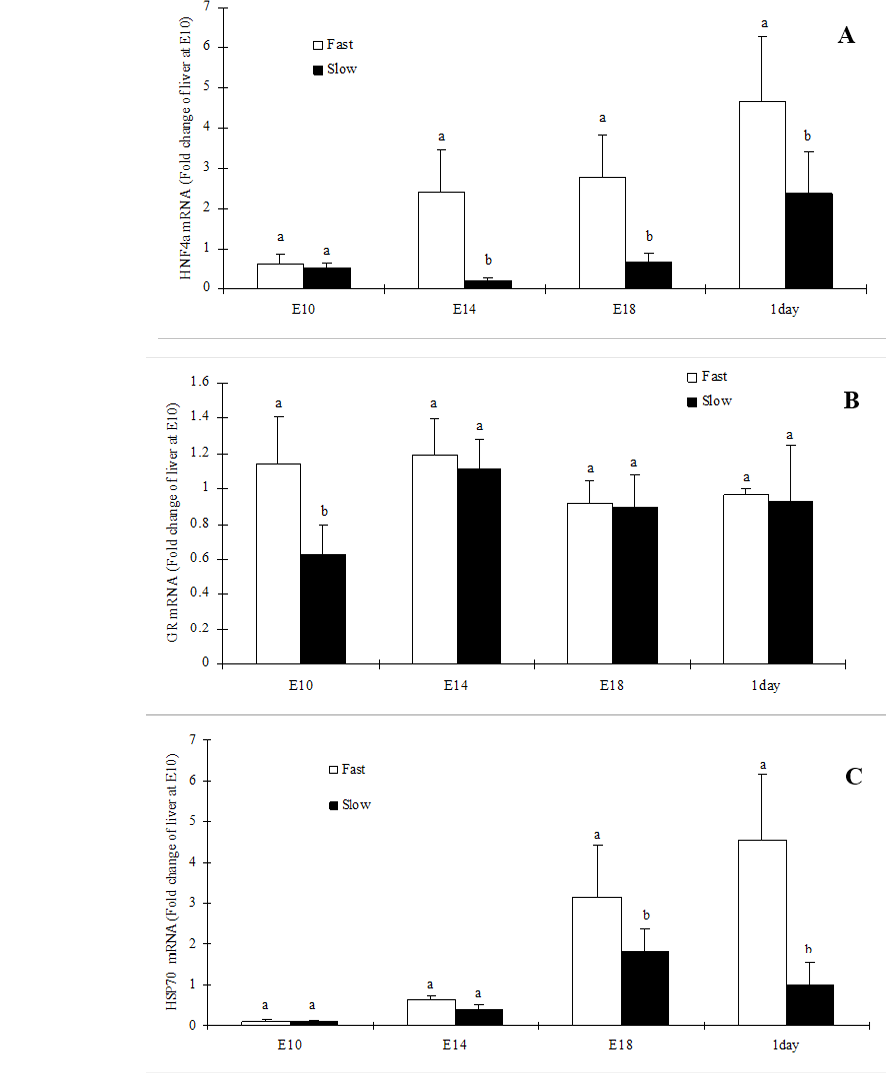
Glucocorticoids (GCs) play a vital role during embryonic development. Hepatocyte nuclear factor 4 alpha (HNF4α) is a transcription factor that has been shown to be crucial for hepatocyte differentiation and development of the liver. Here we aimed to disclose the differences in embryonic expression of hepatic HNF4-α, glucocorticoid receptor (GR) and heat shock protein 70 (HSP70) between slow and fast growing broiler chickens embryos. Fast-growing chicken and slow-growing chicken eggs were incubated and liver samples from the embryonic development at embryo 10 (E10), (E14), (E18) and day 1 post hatch (D1) were collected. Quantitative PCR used to measure hepatic mRNA expression of GR, HSP70 and HNF4-α. Hepatic mRNA expression of HNF4-α was significantly higher in fast-growing chicken embryos at all the embryonic stages investigated. However, hepatic GR mRNA expression was significantly higher in fast-growing chicken embryos only on E10. Hepatic mRNA expression of HSP70 was significantly (P<0.05) higher in fast-growing chicken embryos at E18 and D1 posthatch stages. Our data may provide the first evidence that hepatic expression of HNF4-α, GR and HSP70 differs between fast-growing and slow-growing chickens embryos, which may account to some extent for the breed disparities in embryonic development.
Keywords | Chicken embryo, GR, HSP70, HNF4-α, Liver