
This study recorded the first nesting attempt of the Eurasian Spoonbill (Platalea leucorodia) in Al-Fanateer Island, located about 1.5 km east of Jubail Industrial City, Eastern Province, Saudi Arabia. A trail camera was used to record and describe the nest attendance behavior of this species over 24 h. The results showed that the egg was incubated more than 80% in each two-hour period except for the periods (00:00 - 01:59 h; 02:00 - 03:59 h and 20:00 - 21:59 h) when it was incubated 56.67 %, 29.17 % and 45.00 % respectively. The incubating parent spent more time sitting on the egg rather than standing on the nest in each two-hour period except for the periods (02:00 - 03:59 h and 20:00 - 21:59 h) when the parent never sat on the egg during the period (02:00 - 03:59 h) and sat for only 16.67 % during the period (20:00 - 21:59 h). Moreover, the incubating adult seemed to avoid facing the sun which may be considered a behavioral mechanism to protect the egg from direct sunlight.
Short Communication · Volume 54, Issue 1, 24 December 2021 · Open Access
The First Record of Eurasian Spoonbill (Platalea leucorodia) Nesting in the Eastern Province of Saudi Arabia with a Description of Nest Attendance Behavior
· ·
Affiliations & Notes ⌄
- 1Department of Biology, Faculty of Science, University of Ha’il, PO Box 2440, Ha’il, Saudi Arabia. 2Department of Zoology, Faculty of Science, University of Khartoum, Khartoum, Sudan. 3Department of Biology, Faculty of Science, Taif University, PO Box 11099, Taif 21944, Saudi Arabia. , * Corresponding author: m.alrashidi@uoh.edu.sa
Article Info ⌄
- Journal:
- Pakistan Journal of Zoology
- Published:
- 24 December 2021

From the article
- The incubating parent spent more time sitting on the egg rather than standing on the nest in each two-hour period except for the periods (02:00-03:59 h and 20:00 - 21:59 h) when the parent never sat on the egg during the period (02:00- 03:59 h) and sat for only 16.67 % during the period (20:00- 21:59 h) (Fig. 2).
- The incubating parent faced the west from midnight until the period (12:00-13:59 h), then it faced the east during the consecutive periods (12:00-13:59 h; 14:00-15:59 h and 16:00-17:59 h) (Fig. 3).
- The incubating parent seemed to avoid facing the south, particularly during the day’s hottest periods (Fig. 3).
- However, the camera recorded that both parents were standing together on the nest, indicating that both parents may participate alternately in incubating the egg (Supplementary Fig. 2).
Selected from the article's own text.
Abstract
Materials and methods
Al-Fanateer Island is a human-made island about 1.5 km east of Jubail Industrial City, Eastern Province, Saudi Arabia. Al-Fanateer Island is a bird sanctuary under the authority of the Royal Commission for Jubail and Yanbu. The island is covered by dense vegetation, which is dominated by halophytic shrubs (mainly Salsola vermiculata and Suaeda baryosma) (Supplementary Fig. 1). While we were conducting a survey of breeding seabirds on Al-Fanateer Island on the first of June in 2016, we found a nest of Eurasian Spoonbill; we photographed the nest and recorded its location using a GPS receiver. We used a trail camera (Moultrie M-880i Gen 2, Trail Camera, Mossy Oak Bottomland) to record the nest attendance behavior of this species over 24 h. The camera was placed about 1 m from the nest and was set up to take an image every minute. The camera can record the ambient temperature every minute and stamp that on the image. The camera does not emit any flash and records nocturnal activities with infrared sensors. In total, 1440 images were obtained and analyzed. The temperature under the egg directly was recorded every minute for 24 h using a temperature data logger (Thermochron iButton, Embedded Data Systems, DS1922L-F5).
For data analysis we divided the nest data into 12 two-hour periods. Following AlRashidi et al. (2010), the behavioral variable, nest attendance, which could be defined as the percentage of the nest attendance time by incubating adults, was calculated for each period. From the still image, we recorded two types of nest attendance, (1) the percentage when the incubating parents sat on the nest and its belly feathers touched the egg, and (2) the percentage when the incubating parents stood on the nest, and its belly feathers did not touch the egg. Following AlRashidi (2016a), we calculated the percentage of incubating adults’ orientation in each direction (North, South, East, and West). Averages of the ambient temperature and the temperature under the egg were taken for each period. Excel 36٥ was used for statistical analyses and drawing figures. Values are given as mean±SE.
Results
The nest of Eurasian Spoonbill was 35 cm in diameter and was built above a halophytic shrub, about 70 cm from the ground. The nest was constructed of halophyte sticks, and its central area was lined with twigs, feathers, and seaweeds (Supplementary Fig. 1). The nest was located within the northwest side of a colony of Western Reef Heron (Egretta gularis) and contained only one egg, unfortunately, the egg did not hatch, and we found it had fallen off the nest on the 14th of July.
Figure 1 shows the diurnal temperature variations. The average of the ambient temperature for the hottest two-hour period of the day (10:00-11:59 h) was 53.23±0.04 °C, whereas its average for the coldest two-hour period of the day (00:00 - 01:59 h) was 26.24±0.04 °C. The average temperature under the egg ranged between 27.70±0.06 °C during the two-hour period (02:00 - 03:59 h) and 35.85±0.11 °C during the two-hour period (12:00 - 13:59 h).
Figure 2 shows the daily routine of nest attendance. The egg was incubated more than 80 % in each two hour period except for the periods (00:00 - 01:59 h; 02:00-03:59 h and 20:00-21:59 h) where it was incubated 56.67 %, 29.17 % and 45.00 %, respectively. The incubating parent spent more time sitting on the egg rather than standing on the nest in each two-hour period except for the periods (02:00-03:59 h and 20:00 - 21:59 h) when the parent never sat on the egg during the period (02:00- 03:59 h) and sat for only 16.67 % during the period (20:00- 21:59 h) (Fig. 2). The incubating parent faced the west from midnight until the period (12:00-13:59 h), then it faced the east during the consecutive periods (12:00-13:59 h; 14:00-15:59 h and 16:00-17:59 h) (Fig. 3). The incubating parent seemed to avoid facing the south, particularly during the day’s hottest periods (Fig. 3). In contrast, during the two hottest periods of the day (10:00-11:59 h and 12:00-13:59 h), the incubating parent faced the north with minor proportions 16.67 % and 22.50 %, respectively (Fig. 3).
Due to the similarity in morphology among incubating adults, we could not distinguish between the male and the female from the still image (Supplementary Fig. 1). Moreover, the camera did not capture any image that showed any change-over behavior, that is, when one parent was relieved by the other parent from incubation duty (AlRashidi et al., 2011; AlRashidi, 2016b). However, the camera recorded that both parents were standing together on the nest, indicating that both parents may participate alternately in incubating the egg (Supplementary Fig. 2). No threat nor disturbance of the incubating bird was recorded.
Discussion
The study found a single nest located within the colony of the Western Reef Herons (Egretta gularis). This result is in line with that reported by Jennings (2010) that a single nest of this species may be found within the colonies of the Cattle Egret (Bubulcus ibis), the Western Reef Heron (Egretta gularis) and the Grey Heron (Ardea cinereal).
In only one two-hour period (02:00-03:59 h), the incubating adult spent all its time standing on the nest and did not incubate the egg, the average temperature under the egg in this period was 27.70 ± 0.06 °C. This behavior may be attributed to the fact that, although the thermal range of avian embryonic development is limited between 30 and 40 °C , some avian species that nest in scorching environments have temperature-resistant embryos ; ; .
The Eurasian Spoonbill incubating adult seemed to avoid facing the sun, which may be considered a behavioral mechanism to shade the egg and protect the egg from direct sunlight. AlRashidi (2016a) found that the incubating lesser crested terns, which breed on Jana Island, located approximately 45 km east of Al-Fanateer Island, changed their body orientation with the sun. They generally faced the west in the morning, and they rotated themselves clockwise until they faced east in the evening.
Conclusion
In sum, this study recorded the first nesting attempt of the Eurasian Spoonbill in the Eastern Province of Saudi Arabia. It may also close some knowledge gaps in this species’ breeding biology, particularly the nest attendance behavior. Thus, follow-up studies are required to ascertain whether this species nests elsewhere in the Eastern Province of Saudi Arabia and document all aspects of this species’ breeding biology, if any.
Acknowledgments
This work was supported by the University of Ha’il, represented by the Deanship of Scientific Research through a grant number (160966). Also, we are thankful to Taif University Saudi Arabia, for support under Researcher Supporting project number TURSP-2020/06. We would like to thank the Saudi Wildlife Authority for providing help in logistics and field facilities. We also wish to extend thanks to all those who contributed to the fieldwork, particularly Khalid Al-Shaikh, Tareq AlQhtani and Jaber Haressi.
Supplementary material
There is supplementary material associated with this article. Access the material online at: https://dx.doi.org/10.17582/journal.pjz/20201005061049
Statement of conflict of interest
The authors have declared no conflict of interest.
Figures
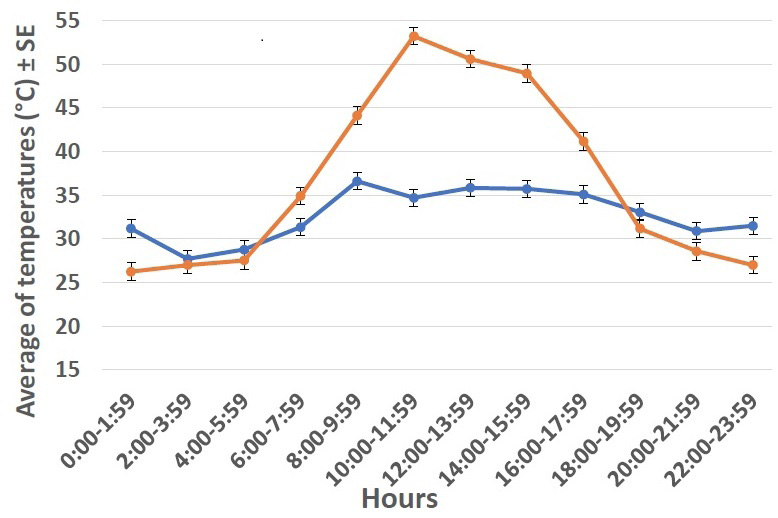
Ambient temperature about 1 m from the nest (red line), the temperature under the egg directly (blue line), (mean ± SE for each two-h-time period).
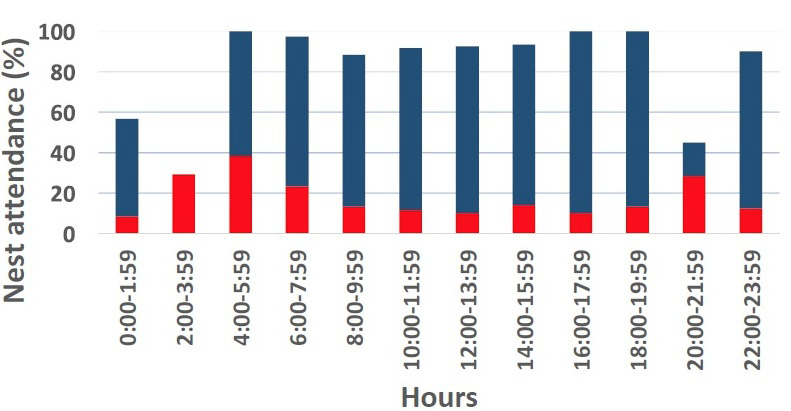
Nest attendance (%), the percentage when the incubating parent sat on the nest, and its belly feathers touched the egg (blue color), the percentage when the incubating parent stood on the nest, and its belly feathers did not touch the egg (red color).
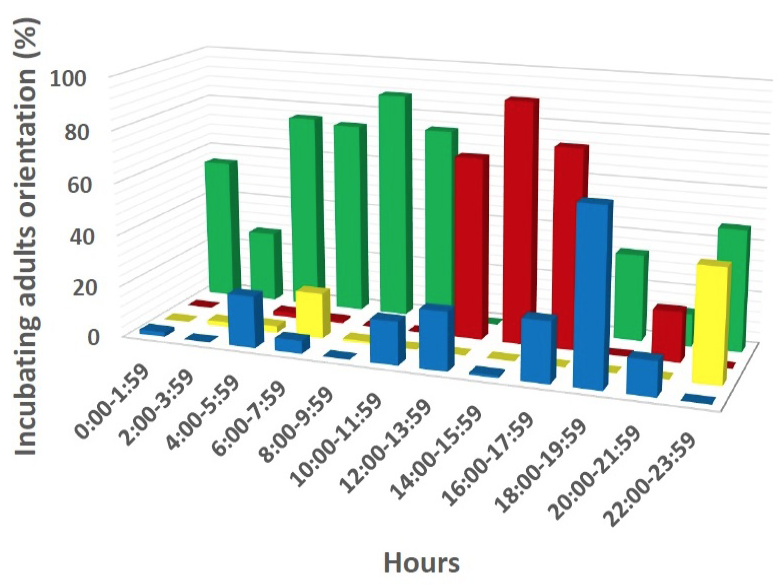
Incubating adult orientation (%), West (green color), East (red color), North (blue color) and South (yellow color).
References
- Aguilar, R.E., Guerra, C.G., Fitzpatrick, L.C. and Luna, G.S., 1998. Estud. Oceanol., 17: 7–12. https://doi.org/10.1675/063.039.0214[CrossRef]
- AlRashidi, M., 2016a. Waterbirds, 39: 215–221.
- AlRashidi, M., 2016b. Zool. Middle East, 62: 1–7. https://doi.org/10.1080/09397140.2016.1182771[CrossRef]
- AlRashidi, M., Kosztolányi, A., Küpper, C., Cuthill, I.C., Javed, S. and Székely, T., 2010. Front. Zool., 7: 1. https://doi.org/10.1186/1742-9994-7-1[CrossRef]
- AlRashidi, M., Kosztolányi, A., Shobrak, M., Küpper, C. and Székely, T., 2011. Anim. Behav., 82: 235–243. https://doi.org/10.1016/j.anbehav.2011.04.019[CrossRef]
- Aspinal, S., 2010. Breeding birds of the United Arab Emirates. UAE: Environment Agency Abu Dhabi, Abu Dhabi.
- Bennett, A.F. and Dawson, W.R., 1979. Physiol. Zool., 52: 413–421. https://doi.org/10.1086/physzool.52.4.30155933[CrossRef]
- Bennett, A.F., Dawson, W.R. and Putnam, R.W., 1981. Physiol. Zool., 54: 146–159. https://doi.org/10.1086/physzool.54.1.30155813[CrossRef]
- BirdLife International, 2020. Species factsheet: Platalea leucorodia. Downloaded from http://www.birdlife.org on 21/08/2020.
- Castell, P., Coburn, J., Pleasance, B., Quittenden, T. and Shobrak, M., 2002. Sandgrouse, 24: 33–37.
- Harrison, C.J.O. and Castell, P., 1998. Collins field guide Bird nests, eggs and nestlings of Britain and Europe with North Africa and the Middle East. Harper Collins Publishers Ltd (Revised Edition), London, UK.
- Jennings, M.C., 2010. Fauna Arabia, 25: 339–341.
- Miller, J.D., Loughland, R.A. and Al-Abdulkader, K.A., 2009. Island biodiversity in the Western Arabian Gulf. Environmental Protection Department, Saudi Aramco, Dhahran, Saudi Arabia. (Unpublished report).
- Newton, S.F. and Al-Suhaibany, A.H., 1996. Distribution and abundance of summer breeding seabirds in the Saudi Arabian Red Sea in 1996. NCWCD, Riyadh. (Unpublished report).
- Symes, A., Taylor, J., Mallon, D., Porter, R., Simms, C. and Budd, K., 2015. The conservation status and distribution of the breeding birds of the Arabian Peninsula. Environment and Protected Areas Authority, Cambridge, UK.
- Triplet, P., Overdijk, O., Smart, M., Nagy, S., Schneider-Jacoby, M., Karauz, E.S., Pigniczki, C.s., Baha El-Din, S., Kralj, J., Sandor, A. and Navedo, J.G., 2008. International single species action plan for the conservation of the Eurasian Spoonbill (Platalea leucorodia). AEWA Technical Series No. 35. Bonn, Germany.
- Webb, D.R., 1987. Condor, 89: 874–898. https://doi.org/10.2307/1368537[CrossRef]
- Zhang, F., Cui, S., Gao, S., Hough, R., Hu, P., Zhang, Z., Fu, Q., Yu, T. and Li, K., 2020. Ecol. Eng., 157: 105993. https://doi.org/10.1016/j.ecoleng.2020.105993[CrossRef]
Supplementary material
Cited by 1 article
In journals published by ResearchersLinks.
Services
Article usage statistics
Loading…