
The purpose of this study is to compare and analyze the carcass traits of french giant meat quail and savimalt meat quail in order to provide reference for breeding and improvement of meat quail. The results show that french giant meat quail shows far higher body weight, carcass weight, carcass net weight, breast muscle weight (total), leg muscle weight (single) and leg muscles rate compared to savimalt meat quail (P<0.05). Moreover, heart weight, liver weight, slaughter rate, whole net carcass rate, heart rate and breast muscle rate of french giant meat quail are slightly higher than those of savimalt meat quail (P>0.05). For savimalt meat quail, carcass weight shows extremely significantly postive correlations with carcass net weight, heart weight, liver weight, breast muscle weight (total), leg muscle weight (single), slaughter rate and whole net carcass rate (P<0.01), the correlation coefficients are 0.988, 0.596, 0.557, 0.926, 0.899, 0.467 and 0.706, respectively. For the french giant quail, carcass weight shows extremely significantly postive correlations with carcass net weight, liver weight, breast muscle weight (total), leg muscle weight (single) and slaughter rate (P<0.01), the correlation coefficients are 0.949, 0.410, 0.863, 0.590 and 0.395, respectively.
Short Communication · Volume 53, Issue 6, 16 October 2021 · Open Access
Comparative Analysis of Carcass Traits of Two Meat Quail Breeds (Coturnix coturnix)
· · · · · ·
Affiliations & Notes ⌄
- 1College of Animal Science and Technology, Henan University of Science and Technology,263 Kaiyuan Avenue, Luolong District, Luoyang City, Henan Province, China,471023, China , * Corresponding author: junyanbai@163.com
Article Info ⌄
- Journal:
- Pakistan Journal of Zoology
- Published:
- 16 October 2021

Abstract
Materials and methods
60 samples of french giant meat quail and savimalt meat quail were collected, respectively. The culture room was provided with 24h lights and quail were allowed to drink water and eat freely throughout the expeirment. Fodders were supplemented artificially on the morning and evening every day. The culture temperature and humidity were determined according to culture management requirements.
At the end of culture experiment (5 weeks old), quail samples were killed by jugular vein bleeding, removed hairs and then dissected. Weights of all parts were measured by an electronic scale. The carcass traits measured included body weight, carcass weight, carcass net weight, heart weight, liver weight, breast muscle weight (total) and leg muscle weight (single).
Results and discussion
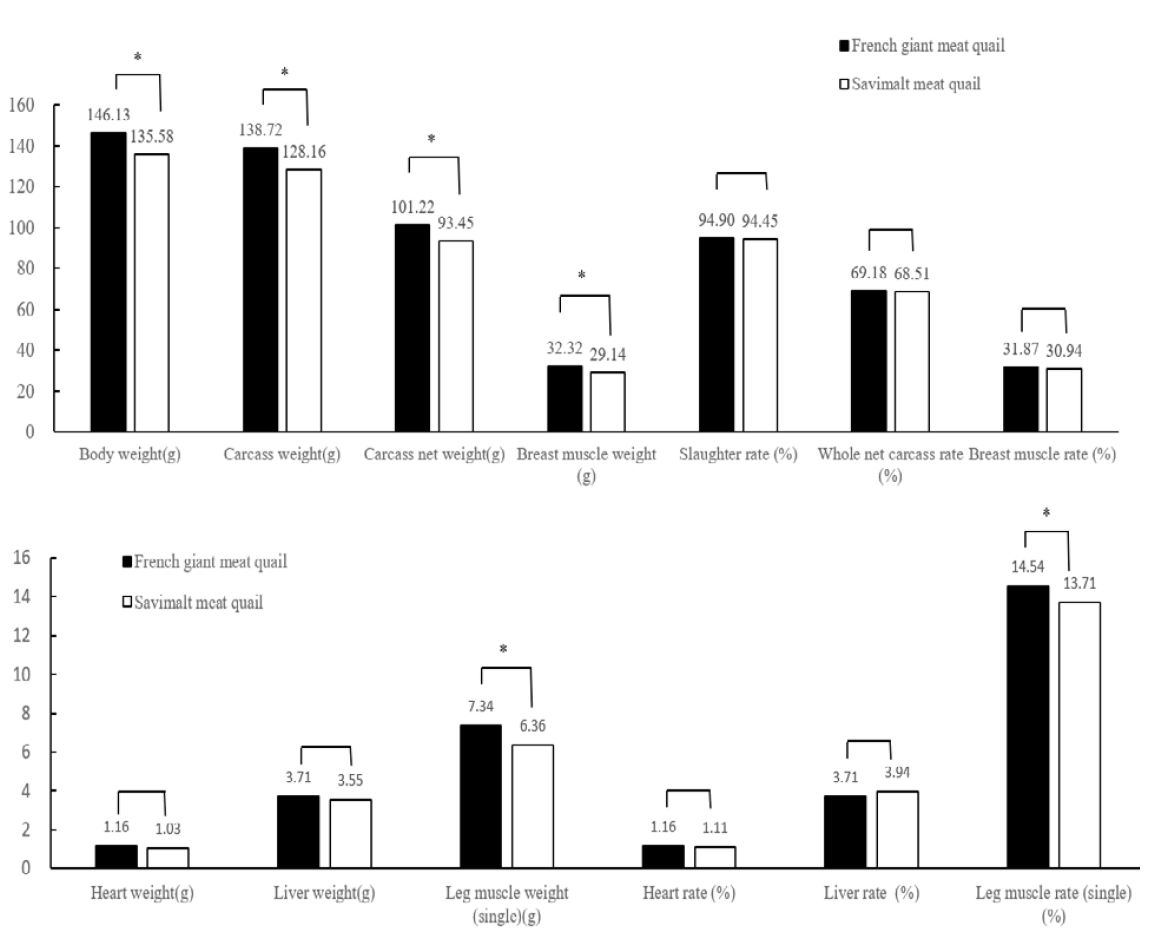
As can be seen from Figure 1, the results show that french giant meat quail shows far higher body weight, carcass weight, carcass net weight, breast muscle weight (total), leg muscle weight (single) and leg muscles rate compared to savimalt meat quail (P<0.05). Moreover, heart weight, liver weight, slaughter rate, whole net carcass rate, heart rate and breast muscle rate of french giant meat quail are slightly higher than those of savimalt meat quail (P>0.05). Bai et al. (2020b) showed that the body weight of 3-5 week old french giant meat quail was significantly higher than that of savimalt meat quail (P<0.05). The results of this study were similar to those of Bai et al. (2020b). Wei et al. (2011) demonstrated that body weight of Fengxian line of french giant meat quail reached 141.67g at the 4th week, while body weight of Wuxi line reached 177.63g. In the present study, body weight of French giant meat quail at the 5th week reached 146.13g, which is slightly lower than that reported by Wei et al. (2011).
* indicates significant difference (P < 0.05), while others indicate no significant difference (P > 0.05).
Body weight of savimalt meat quail has extremely significantly positive correlations with carcass weight, carcass net weight, heart weight, liver weight, breast muscle weight (total), leg muscle weight (single) and whole net carcass rate (P<0.01), the correlation coefficients are 0.998, 0.988, 0.600, 0.564, 0.926, 0.906 and 0.701, respectively (Supplementary Table I). Carcass weight also has extremely significantly positive correlations with carcass net weight, heart weight, liver weight, breast muscle weight (total), leg muscle weight (single), slaughter rate and whole net carcass rate (P<0.01), the correlation coefficients are 0.988, 0.596, 0.557, 0.926, 0.899, 0.467 and 0.706. Carcass net weight has extremely significantly positive correlations with heart weight, liver weight, breast muscle weight (total), leg muscle weight (single), slaughter rate and whole net carcass rate (P<0.01), the correlation coefficients are 0.609, 0.516, 0.954, 0.895, 0.436 and 0.798, respectively.
Body weight of french giant meat quail shows extremely significantly positive correlations with carcass weight, carcass net weight, liver weight, breast muscle weight (total) and leg muscle weight (single) (P<0.01), with correlation coefficients amounted to 0.996, 0.947, 0.395, 0.865 and 0.593. Besides, carcass weight shows extremely significantly positive correlations with carcass net weight, liver weight, breast muscle weight (total), leg muscle weight (single) and slaughter rate (P<0.01), with correlation coefficients amounted to 0.949, 0.410, 0.863, 0.590 and 0.395. Carcass net weight has extremely significantly positive correlations with breast muscle weight (total), leg muscle weight (single), slaughter rate and whole net carcass rate (P<0.01), with correlation coefficients amounted to 0.892, 0.578, 0.364 and 0.547.
Acknowledgements
Sincere gratitude goes to the sponsor of National Natural Science Foundation (31201777) and Industry-University-Research Cooperation Project in Henan Province (152107000095.0).
Supplementary material
There is supplementary material associated with this article. Access the material online at: https://dx.doi.org/10.17582/journal.pjz/20200401090428
Statement of conflict of interest
The authors have declared no conflict of interest.
Figures
References
- Bai, J.Y., Cao, H., Yang, S., Pang, Y.Z., Jiang, M.J., Fan, H.D., Fu, X.Y., Zhang, J.Y. and Shi, H.J., 2020a. Indian J. Anim. Res., 54: 392-395.
- Bai, J.Y., Pang, Y.Z., Qi, Y.X., Zhang, X.H. and Yun, X.Y., 2016a. Brazilian J. Poult. Sci., 18: 27-32. https://doi.org/10.1590/1806-9061-2015-0124[CrossRef]
- Bai, J.Y., Pang, Y.Z., Qi, Y.X., Zhang, X.H. and Yun, Y.X., 2017. Indian J. Anim. Res., 51: 851-855.
- Bai, J.Y., Pang, Y.Z., Wu, S.J., Yu, M.Q. and Zhang, X.H., 2016b. Indian J. Anim. Res., 50: 1-7.
- Bai, J.Y., Pang, Y.Z., Zhang, X.H. and Li, Y.X., 2016c. Brazilian J. Poult. Sci., 18: 91-93. https://doi.org/10.1590/1806-9061-2015-0177[CrossRef]
- Bai, J.Y., Pang, Y.Z., Zhang, X.H., Yun, Y.X. and Qi, Y.X., 2016d. Brazilian J. Poult. Sci., 18: 519-524. https://doi.org/10.1590/1806-9061-2015-0101[CrossRef]
- Bai, J.Y., Wu, X.H., Yang, S., Pang, Y.Z., Cao, H., Fan, H.D., Fu, X.Y., Shi, K.P. and Lu, X.N., 2020b. Pakistan J. Zool., 52: 1165-1167. https://doi.org/10.17582/journal.pjz/20190402080453[Full text][CrossRef]
- Li, Y.X., Zhang, X.H., Pang, Y.Z., Qi, Y.X. and Zhao, S.J., 2019. J. Poult. Sci., 56: 84-90. https://doi.org/10.2141/jpsa.0180058[CrossRef]
- Wei, L.X., Wang, F.Q. and Dai, L.Q., 2011. Shanghai Anim. Husband. Vet. Commun., 4: 39.
Supplementary material
Services
Article usage statistics
Loading…