
SSCP were employed to investigate the genetic polymorphism of sheep GH gene and to analyze the correlation of genetic polymorphic sites with growth traits. The results showed that AA, AB and BB genotypes were detected in exon II of GH gene in the six sheep populations. The highest frequencies of AB genotype detected in Mongolia sheep, Small-tailed han sheep, Tong sheep, Lanzhou large-tailed sheep and Henan large-tailed Han sheep were 0.375, 0.531, 0.545, 0.350 and 0.596, respectively, and the highest frequency of BB genotype in Yuxi fatty-tailed sheep was 0.378. Exon II of GH gene was significantly correlated with body weight, carcass weight, chest width and hip height (P<0.05). Moreover body weight and carcass weight of AB genotype were significantly higher than those of AA and BB genotypes (P<0.05) and chest width and hip height of AB genotype were remarkably higher than those of AA genotype (P<0.05).
Short Communication · Volume 54, Issue 4, 26 April 2022 · Open Access
Association Analysis between Exon II of GH Gene and Growth Traits in Sheep
· · · · ·
Affiliations & Notes ⌄
- 1College of Animal Science and Technology, Henan University of Science and Technology, Luoyang 471023, China * Corresponding author: byezi@163.com
Article Info ⌄
- Journal:
- Pakistan Journal of Zoology
- Published:
- 26 April 2022

Abstract
Materials and methods
Fifty sheep were sampled for each breed, 10 mL of jugular venous blood was collected in the presence of anticoagulant ACD from each sheep and preserved at -20 oC. Genomic DNA was extracted by the whole-blood DNA kit (Shanghai Bioengineering Co., Ltd.). The primer sequences of exon II of GH gene are as follows: F: TCTAGGACACATCTCTGGGG, R: CTCTCCCTAGGGCCCCGGAC (Hu et al., 2007) and the annealing temperature is 57 oC.
Seven μL of each PCR product was mixed with 13 μL of loading buffer containing. After denaturation at 94°C for 5 min and snap-cooling on a freeze-block (-20°C), 20μL of each sample was loaded onto a 0.5×MDE gel and subjected to electrophoresis in a Mini-Protean 3 Cell (Bio-Rad, USA) at 120 V and 20°C for 5 h using 0.5×TBE as the buffer. After electrophoresis, gels were stained with ethidium bromide for 1 h and photographed using ultraviolettransillumination.
SPSS17.0 statistical software was used to analyze the association between different genotypes and growth traits, and Duncan multiple comparison method was used to make multiple comparison. The final results were expressed in the form of mean value + standard error.
Results and discussion
The PCR amplification results of exon II of GH gene
Table I. Genetic polymorphism of exon II of GH gene in sheep.
| Population | Genotype frequency | Gene frequency | Population genetic polymorphism | |||||
| AA | AB | BB | A | B | Heterozygosity | Polymorphism information content | Number of effective alleles | |
| Mongolia sheep | 0.313 | 0.375 | 0.312 | 0.500 | 0.500 | 0.500 | 0.375 | 2.000 |
| Small-tailed han sheep | 0.281 | 0.531 | 0.188 | 0.547 | 0.453 | 0.496 | 0.373 | 1.982 |
| Tong sheep | 0.364 | 0.545 | 0.091 | 0.636 | 0.364 | 0.463 | 0.356 | 1.862 |
| Yuxi fatty-tailed sheep | 0.311 | 0.311 | 0.378 | 0.467 | 0.533 | 0.498 | 0.374 | 1.991 |
| Lanzhou large-tailed sheep | 0.350 | 0.350 | 0.300 | 0.525 | 0.475 | 0.499 | 0.374 | 1.995 |
| Henan large-tailed han sheep | 0.213 | 0.596 | 0.191 | 0.511 | 0.489 | 0.500 | 0.375 | 1.999 |
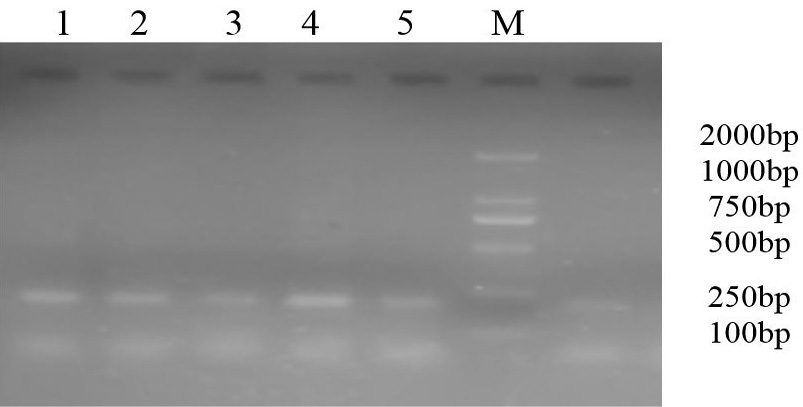
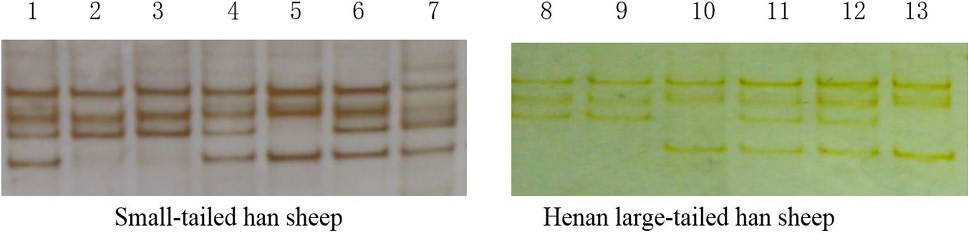
in five sheep populations are shown in Figure 1. PCR product was subjected to SSCP. According to Figure 2 three genotypes were detected by exon II of GH gene in sheep, being AA, AB and BB, respectively.
Table I shows that the highest AB genotype frequencies in Mongolia sheep, small-tailed han sheep, Tong sheep, Lanzhou large-tailed sheep and Henan large-tailed han sheep were 0.375, 0.531, 0.545, 0.350 and 0.596, respectively, and the BB genotype frequency was the highest in Yuxi fatty-tailed sheep (0.378). The genetic heterozygosity values were the same in Mongolia sheep and Henan large-tailed han sheep, both being 0.500, and the polymorphic information contents in the two sheep populations were also the highest (0.375), namely genetic diversity of Mongolia sheep and Henan large-tailed han sheep was quite abundant.
As an important candidate gene, GH gene has been reported largely. Zhou et al. (2009) found that G→C mutation occurred at the 11th site of exon II of GH gene in Hainan black goat, which led to change of coding amino acid, three genotypes including AA, AB and BB were detected in exon II of GH gene. Li (2007) found that AA and AB genotypes of exon II of GH gene could be detected in three goat populations. Marques et al. (2003) found that A/B genotype was detected from exon II of GH gene in Jarlnelistae goat population. Hu et al. (2007) detected AB and BB genotypes from exon II of GH gene in five goat populations. Han (2016) detected three genotypes from exon II of GH gene in China Tibetan sheep, and found a g.498G>C mutation site. In this study, AA, AB and BB genotypes were detected from exon II of GH gene in the three sheep populations, and the sequencing results indicated that exon II of GH gene experienced G→C mutation, which was according to the study result of Han (2016).
It can be seen from Table II that body weight and carcass weight of AB genotype were significantly higher than those of AA and BB genotypes (P<0.05), and AA and BB genotypes had no significant differences in the body weight and carcass weight (P>0.05). Chest width and hip height of AB genotype were remarkably higher than those of AA genotype (P<0.05), but AB genotype and BB genotype had insignificant differences in the aspect of chest width and hip height (P>0.05). Therefore, exon II of GH gene had no significant influence on other growth traits (P>0.05). Abdelmoneim et al. (2017) indicated that intron II, intron IV and exon IV of GH gene had significant correlations with 120d body weight and daily weight gain of Harri sheep. The study by Han (2016) manifested that exon II (g.498G>C) of GH gene was significantly correlated with sheep body weight in all of the three sheep populations. The study by Yousefi et al. (2012) showed that exon V of GH gene had no remarkable influence on one-year-old body weight of Zel sheep. The study by Hu et al. (2007) indicated that exon II of GH gene had no significant correlation with body weight, body height and chest circumference of Xinong Saanen dairy goat. This study pointed out that exon II of GH gene had significant correlations with body weight, carcass weight, chest width and hip height of sheep (P<0.05), and AB genotype showed certain advantages, and this study result was similar to that of Han (2016).
Table II. Correlation analysis between exon II of GH gene and growth traits in sheep.
| Growth traits | AA | AB | BB |
| Body weight (g) | 46.25+11.25b | 54.003+1.78a | 46.769+1.20b |
| Body height (cm) | 69.00+11.00a | 69.50+2.08a | 65.00+3.21a |
| Body length (cm) | 68.00+14.00a | 69.47+1.76a | 66.62+1.64a |
| Chest width (cm) | 22.50+3.50b | 29.24+1.23a | 26.92+1.179ab |
| Rump height (cm) | 71.00+9.00a | 71.03+3.24a | 68.92+1.87a |
| Hip height (cm) | 57.00+6.00 b | 69.06+1.76 a | 64.23+2.27 ab |
| Foreleg height(cm) | 22.50+4.50a | 26.06+2.33a | 26.08+3.01a |
| Head length (cm) | 18.00+2.00a | 21.35+0.69a | 19.31+0.83a |
| Chest circumference (cm) | 88.50+16.50a | 90.68+2.14a | 91.54+2.29a |
| Circumference of cannon bone (cm) | 9.50+1.50 a | 10.12+0.36a | 9.23+0.34a |
| Rump length (cm) | 22.00+1.00a | 23.94+1.02a | 22.54+0.93a |
| Neck length (cm) | 22.50+3.50a | 33.03+3.18a | 31.54+3.02a |
| Waist width (cm) | 22.50+5.50a | 20.47+3.01a | 27.08+2.88a |
| Hip width (cm) | 21.50+2.50a | 20.77+0.83a | 19.39+1.05a |
| Chest depth (cm) | 32.50+5.50a | 33.94+1.11a | 33.08+0.85a |
| Head depth (cm) | 18.50+4.50a | 17.35+0.69a | 16.50+0.75a |
| Back height (cm) | 68.00+8.00a | 72.79+1.62a | 70.00+1.63a |
| Carcass weight (cm) | 21.00+5.50b | 24.41+0.86a | 20.64+1.42b |
| Hip circumference (cm) | 92.00+8.00a | 93.88+1.91a | 89.46+3.74a |
| Abdomen circumference (cm) | 98.00+17.00a | 97.47+3.08a | 97.62+2.72a |
Note: different letters showed significant difference (P<0.05); the same letter showed no significant difference (P>0.05).
Acknowledgements
Sincere gratitude goes to the sponsor of National Natural Science Foundation (31201777).
Statement of conflict of interest
The authors have declared no conflict of interest.
Figures
References
- Abdelmoneim, T.S., Brooks, P.H., Afifi, M. and Swelum, A.A.A., 2017. Indian J. Anim. Res., 51: 205-211.
- Afifi, M., Alkaladi, A., Kadasa, N.M., Saddick, S., Baeshen, M., Al-Farga, A., Aqlan, F.M., Almulaiky, Y.Q., Alkhaled, M., Alayafi, A.A.M., Ali, H.A., Warsi, M. K., Allogmani, A.S. and Abdelazim, A. 2019. Indian J. Anim. Res., 53: 423-428.
- Bai, J.Y., Cao, H., Yang, Y.B., Zhang, Y., Li, X.Y., Li, Z.H., Hao, W.G. and Zheng, F.Y., 2020. Indian J. Anim. Res., 54: 138-142.
- Bai, J.Y., Jia, X.P., Yang, Y.B., Pang, Y.Z. and Wang, Y.Q., 2017. Indian J. Anim. Res., 51: 856-859.
- Bai, J.Y., Jia, X.P., Yang, Y.B., Zhang, X.H., Pang, Y.Z., Wang, Y.Q. and Qi, Y.X., 2014. J. Anim. Pl. Sci., 24: 965-968.
- Bai, J.Y., Wang, X., Yang, Y.B., Zhang, X.H., Pang, Y.Z. and Li, H.W. 2016. Rev. Bras. Zoot., 45: 604-607. https://doi.org/10.1590/S1806-92902016001000004[CrossRef]
- Han, Y.C., 2016. Polymorphism of MyoG, GH and CKM genes and their association with growth and development traits of Tibetan sheep. Qinghai: Qinghai Normal University, pp. 86-88.
- Hu, S.R., Lan, X.Y., Chen, H., Su, L.H. and Lei, C.C., 2007. J. Northw. A.F Univ., 35: 11-15, 20.
- Li, Z.Y., 2007. Partial sequence polymorphism and bioinformatics analysis of GH gene in goats. Nanjing Agricultural University, Jiangsu. pp. 62-65.
- Marques, P.X., Pereira, M. and Marques, M.R., 2003. Small Ruminant Res., 50: l77-185. https://doi.org/10.1016/S0921-4488(03)00104-4[CrossRef]
- Warwich, J.M. and Wallis, M., 1984. Biochem. Soc. Trans., 12: 247-248. https://doi.org/10.1042/bst0120247[CrossRef]
- Yousefi, S. and Azari, M.A., 2012. Arch. Tierzucht., 55: 303-306. https://doi.org/10.5194/aab-55-303-2012[CrossRef]
- Zhou, H.L., Guan, S., Li, Q., Wang, J.D., Hou, G.Y. and Zeng, H.P., 2009. Chinese J. Trop. Agric., 29: 31-35.
Services
Article usage statistics
Loading…