
The purpose of this study was to find candidate genes regulating the growth and development of sheep. The polymorphism of GHSR gene in five sheep populations was analyzed by PCR and sequencing techniques. The results showed that large tailed han sheep, small tailed han sheep, yuxi fatty tailed sheep, dorper sheep, hu sheep all have two mutation sites (C155T and C624T). For locus C155T, allele frequencies of C in large tailed han sheep, small tailed han sheep, yuxi fatty tailed sheep, dorper sheep and hu sheep were 0.73, 0.83, 0.54, 0.69 and 0.68 respectively, which indicated that C was the dominant allele in five sheep populations. For locus C624T, allele frequencies of C in large tailed han sheep, small tailed han sheep, yuxi fatty tailed sheep, dorper sheep and hu sheep were 0.70, 0.87, 0.52, 0.70 and 0.76 respectively, which indicated that C was the dominant allele in five sheep populations. The C155T mutation site of GHSR-3 gene led to a codon change from GCC to GCT, both of which coding the same aa, alanine, indicating C155T was a synonymous mutation site. The C624T mutation site of GHSR-4 gene led to a code change from CTT to CCT, and the corresponding aa changed from leucine to proline, which was a missense mutation site.
Short Communication · Volume 52, Issue 3, 15 March 2020 · Open Access
Analysis of Polymorphism of Growth Hormone Secretagogue Receptor in Sheep
· · · · · ·
Affiliations & Notes ⌄
- 1College of Animal Science and Technology, Henan University of Science and Technology, Luoyang 471003, China , * Corresponding author: junyanbai@163.com
Article Info ⌄
- Journal:
- Pakistan Journal of Zoology
- Published:
- 15 March 2020

From the article
- For locus C624T, allele frequencies of C in large tailed han sheep, small tailed han sheep, yuxi fatty tailed sheep, dorper sheep and hu sheep were 0.70,0.87,0.52,0.70,0.76, respectively, which indicated that C was the dominant allele in five sheep populations (Table Ⅱ).
- In this study, C155T and C624T mutation sites were found in GHSR exons 2 to 3’ -UTR in five Henan local sheep.
- Sequence comparison confirmed that there were two mutation sites in sheep.
- Amino acid comparison of C624T mutation site of GHSR-4 gene showed that the mutation site changed from CTT to CCT, from leucine to proline, and was a missense mutation site (Fig. 3).
Selected from the article's own text.
Abstract
Materials and methods
Blood samples (10mL) were collected from venous in wings of large tailed han sheep (50), small tailed han sheep (50), yuxi fatty tailed sheep (50), dorper sheep (50), hu sheep (50) and processed by ACD anti-freezing (1:6). Genomic DNA was extracted by whole blood DNA kit provided by Beijing Dingguo.
The primer sequences of GHSR gene were from Song et al. (2015) (Table I). The primers were synthesized by Beijing Dingguo Changsheng Biotechnology Co., ltd. The total size of the PCR reaction system was 12.5μL, including 8.65μL of ddH2O, 1.25μL of 10×buffer, 0.75μL of Mg2+(25 mmol/L), 0.5μL of DNA template, 0.5μL (10 mmol/L) of upstream and downstream primers, 0.25μL of dNTPs, and 0.1μL of Taq enzyme. The PCR amplification process was as follows: denaturation for 3 min at 95℃; denaturation for 45 s at 94℃, annealing for 60s at 55℃ or, extension for 60s at 72℃ and 30 cycles, extension for 12 min at 72℃, and preserving at 4℃. GHSR-3and GHSR-4 amplification products of mixed DNA were sent to Beijing Qinke Xinye Biotech Co., Ltd for sequencing. Assembly analysis of sequencing results was carried out by DNAStar and SeqMan program.
Sequencing peak diagram read by SeqMan program in DNAStar software and Chromas software for calibration and sequencing comparison of sequencing results. Scaleplate in Mwsnap software was
Table I. The information of primer sequences.
| Primer name | Sequences | Amplifi-cation fragment | Produc-tion size (bp) | Annealing temper-ature (℃) |
| GHSR-3 | F:CGTTCTCTTTCTCATTGTCTTTTCA R:TCCCAAGTTCTGCTGTGCTAT | E2-3’UTR | 413 | 55.0 |
| GHSR-4 | F:TCACTCATTATTCTACACCAGAAGC R: ACACCCAATGTCCAAATTAAGG | 3’UTR-E2 | 549 | 57.3 |
Table II. Estimation of SNP allele frequency of GHSR gene in sheep.
| Loci | Large tailed han sheep | Small tailed han sheep | Yuxi fatty tailed sheep | Dorper sheep | Hu sheep |
| C155T | C (0.73) | C (0.83) | C (0.54) | C (0.69) | C (0.68) |
| T (0.27) | T (0.17) | T (0.46) | T (0.31) | T (0.32) | |
| C624T | C (0.70) | C (0.87) | C (0.52) | C (0.70) | C (0.76) |
| T (0.30) | T (0.13) | T (0.48) | T (0.30) | T (0.24) |
used to measure peak height corresponding to different SNP alleles. Gene frequency was estimated according to the following formula (Bai et al., 2016a, 2016b, 2017): F1= Hi/(H1+H2) (i=1, 2), where F1 is frequency of an allele at SNP site, H1 and H2 are heights of peak 1 and peak 2 of this SNP allele on the sequencing diagram.
Results and discussion
Figure 1 shows agarose gel electrophoresis (2%) results of PCR amplification products of GHSR gene in sheep. PCR products of GHSR-3 and GHSR-4 have single band (Fig. 1).
Based on comparison observation of sequencing results, it found that large tailed han sheep, small tailed han sheep, yuxi fatty tailed sheep, dorper sheep, hu sheep all have two mutation sites (SNP sites). C155T and C624T were detected in PCR products of GHSR-3 and GHSR-4. Sequencing maps of these two mutation sites are shown in Figure 2.
For locus C155T, allele frequencies of C in large tailed han sheep, small tailed han sheep, yuxi fatty tailed sheep, dorper sheep and hu sheep were 0.73,0.83,0.54,0.69,0.68,
respectively, which indicated that C was the dominant allele in five sheep populations. For locus C624T, allele frequencies of C in large tailed han sheep, small tailed han sheep, yuxi fatty tailed sheep, dorper sheep and hu sheep were 0.70,0.87,0.52,0.70,0.76, respectively, which indicated that C was the dominant allele in five sheep populations (Table Ⅱ).
At present, there are few studies on SNPs of GHSR and GHRL genes. Liu et al. (2013) found exons 2 and 3’UTR of GHSR in Qianbei Ma sheep and found G996A locus, which is closely related to body weight. Song et al. (2015) detected G200A mutation in exon 2 of GHSR to exon 3 of Guizhou white goat and Guizhou black goat, and C14T mutation in exon 4 of GHRL. Luo et al. (2014) found C345T mutation in GHRL gene exon of Guizhou goats, which was significantly associated with body weight, height and chest circumference. In this study, C155T and C624T mutation sites were found in GHSR exons 2 to 3’ -UTR in five Henan local sheep. Sequence comparison confirmed that there were two mutation sites in sheep.
By comparing the amino acid of C155T mutation site of GHSR-3 gene, it was found that the mutation site changed from GCC to GCT, and both before and after mutation were alanine, which was synonymous mutation site (Fig. 3). Amino acid comparison of C624T mutation site of GHSR-4 gene showed that the mutation site changed from CTT to CCT, from leucine to proline, and was a missense mutation site (Fig. 3).
Prediction of amino acid structure showed that the fat index of CTT of GHSR-4 gene was higher than that of CCT, which belonged to hydrophobic structure, had good stability and was conducive to fat deposition. The prediction of secondary structure of GHSR-4 showed that the structure of GHSR-4 was mainly alpha-helix, which was consistent with the prediction of secondary protein of Song et al. (2015), The transformation of amino acid CTT into CCT resulted in the transformation of protein 17-22 beta into beta folding. The results of gene localization and functional prediction showed that CCT protein encoded more in nucleus and mitochondria, and increased fatty acid metabolism, which was consistent with the results of long-term evolution of sheep.
Acknowledgements
Sincere gratitude goes to the much starker choices-and graver consequences-in national modern mutton sheep industry technology system (CARS-39) and National spark program(2015GA750002).
Statement of conflict of interest
The authors declare no conflict of interest.
Figures
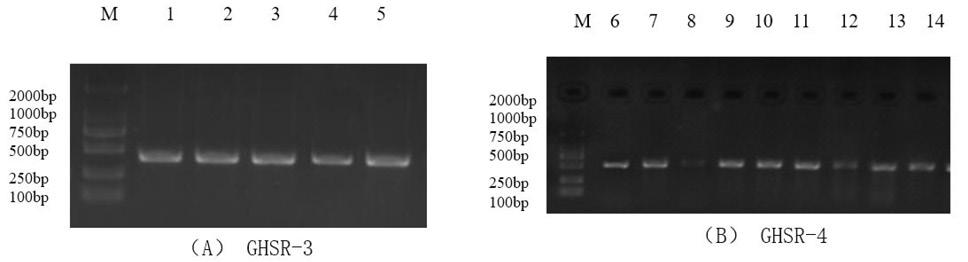
Agarose electrophoresis detection of GHSR-3 and GHSR-4; Note: M: marker DL2000,1ËŽ6ËŽ7: Large tailed han sheep, 2ËŽ8ËŽ9ËŽSmall tailed han sheep, 3ËŽ10ËŽ11ËŽYuxi fatty tailed sheep, 4ËŽ12ËŽ13ËŽDorper sheep, 5ËŽ14ËŽHu sheep.
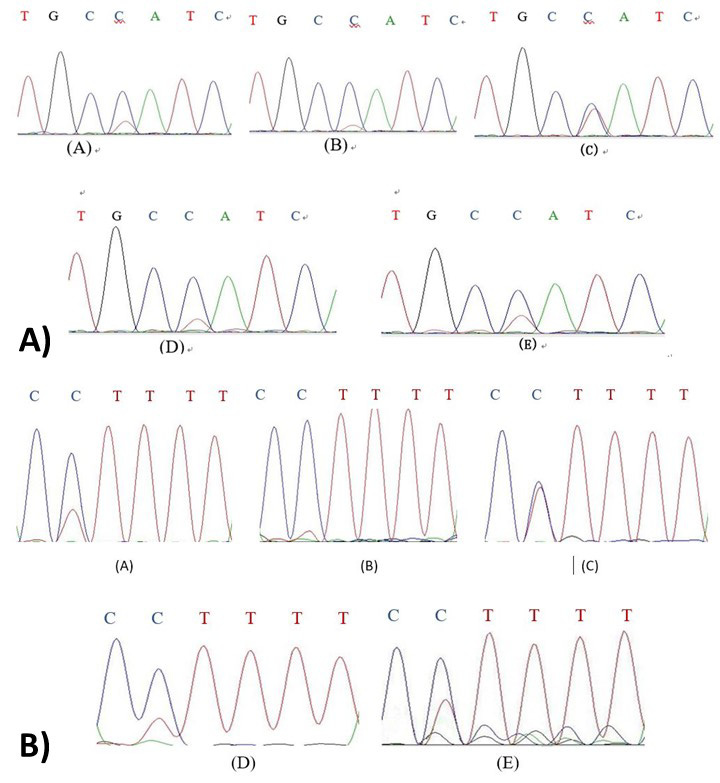
Polymorphism detection of C155T Site and C624T Site; Note: (A) Large tailed han sheep; (B) Small tailed han sheep; (C) Yuxi fatty tailed sheep; (D) Dorper sheep; (E) Hu sheep.
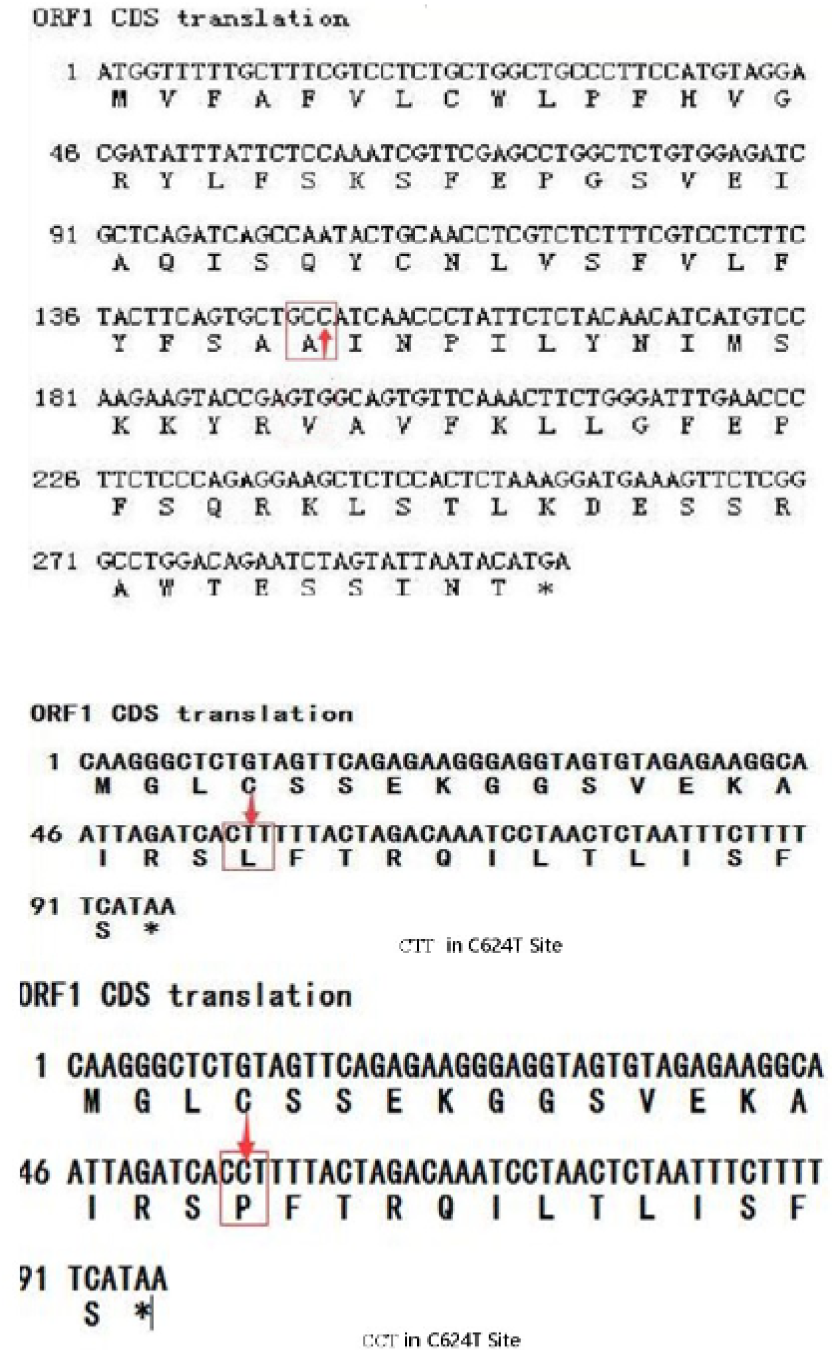
Amino acid alignment of C155T and C624T mutation in sheep.
References
- Bai, J.Y., Jia, X.P., Yang, Y.B., Pang, Y.Z. and Wang, Y.Q., 2017. Indian J. Anim. Res., 51: 856-859.
- Bai, J.Y., Wang, X., Yang, Y.B., Zhang, X.H., Pang, Y.Z. and Li, H.W., 2016a. R. Bras. Zootec., 45: 604- 607. https://doi.org/10.1590/S1806-92902016001000004[CrossRef]
- Bai, J.Y., Jia, X.P., Yang, Y.B., Pang, Y.Z. and Qi, Y.X., 2016b. Pakistan J. Zool., 48:931-935.
- Bai, J.Y., Zhao, Y.G. and Wang, Y.Q., 2019. Pakistan J. Zool., 51:1-4.
- Li, H.F., Zhu, W.Q., Xu, W.J., Song, W.D., Gao, Y. and Chen, K.W., 2009. Jiangsu J. agric. Sci., 25: 576-582.
- Li, J.Y., Zhan, K., Xu, Y.Y., Zhao, R.H. and Tang, Z.J., 2010. J. Anhui. agric. Sci., 10: 7379-7381.
- Liu, B., Luo, W.X., Cai, H.F. and Sun, Y.Y., 2013. Guangdong agric. Sci., 22: 161-165.
- Luo, K.P., Song, T.W., Sun, Y.Y., Liu, B., Luo, W.X., Huang, A.Z. and Zhang, X., 2014. Guangdong agric. Sci., 1: 162-165.
- Nie, Q., Fang, M., Xie, L., Peng, X., Xu, H., Luo, C. and Zhang, D., 2009. J Biomed. Biotechnol., 567120. https://doi.org/10.1155/2009/567120[CrossRef]
- Song, T.W., Cai, H.F., Luo, W.X., Liu, R.Y., Zhang, Y.Y., Sun, Y.Y. and Liu, B., 2015. Sci. Agric. Sin., 1: 140-153.
- Zhang, A.L., Zhang, L., Yang, M.M., Zhang, L.Z. and Chen, H., 2011. J. S. Chin. Agric. Univ., 32: 92-96.
Services
Article usage statistics
Loading…