
We evaluated the mitochondrial genome characteristics of tropical freshwater fish Hyphessobrycon columbianus, analyzed the phylogenetic relationships among Characidae species, and explored the taxonomic status and potential biodiversity conservation measures. The mitochondrial genome sequence of H. columbianus collected in Fuzhou, Fujian, China was obtained by high-throughput sequencing after morphological identification. Phylogenetic trees were constructed using the Bayesian inference and maximum likelihood methods. The mitochondrial genome sequence of H. columbianus (GenBank ID: OP613012) has a total length of 16,645 bp, and encodes 37 genes, including 13 protein-coding genes, 22 transfer RNA genes, two ribosomal RNA genes, and an AT-rich control region. The A, T, G, and C contents in the entire mitochondrial genome of H. columbianus are 29%, 29.7%, 15.9%, and 25.4%, respectively, indicating significant AT bias. The mitochondrial genome characteristics of H. columbianus are consistent with those of most known fish species. At the family classification level, the trees obtained using the two methods revealed similar tree topologies. H. columbianus and H. elachys converged into one branch. The complete mitochondrial genome of H. columbianus disclosed in this study provides a molecular biology reference for exploring the mitochondrial whole genomes of other Hyphessobrycon species, and provide basic data for the later biodiversity investigation in the Minjiang region.
Research Article · Volume 57, Issue 5, 29 August 2025 · Open Access
Mitochondrial Genome Characteristics and Implications for Biodiversity of Tropical Freshwater Fish Hyphessobrycon columbianus in the Minjiang River
· ·
Affiliations & Notes ⌄
- 1Fujian Environmental Protection Design Institute Co., Ltd, Fuzhou 350001, China * Corresponding author: 15280443960@163.com
Article Info ⌄
- Journal:
- Pakistan Journal of Zoology
- Published:
- 29 August 2025

From the article
- The total length of the mitochondrial genome of H. columbianus is 16,645 bp (Fig. 1, Table I).
- The rrnS and rrnL genes in the mitochondrial genome of H. columbianus are located between the H-chain trnF and trnL2 genes, with trnV in the interval.
- We determined the complete mitochondrial hole genome of H. columbianus, analyzed its structural characteristics, and constructed phylogenetic trees using the ML and BI methods.
- The mitochondrial genome data provided in this study provide a reference for mining the mitochondrial genomes of other Hyphessobrycon species and novel molecular evidence for the systematic evolution of Hyphessobrycon in Characidae.
Selected from the article's own text.
Abstract
INTRODUCTION
Mitochondria are double-membrane organelles found in eukaryotic cells. The biochemical reactions that occur within mitochondria provide energy for normal cellular activities; therefore, mitochondria are known as the power workshop of the cell . Mitochondria are semi-autonomous organelles that, in addition to being regulated by the nuclear genome, possess their own genetic material and genetic system . In fish, the mitochondrial genome is a covalently closed circular double-stranded DNA molecule, generally 14–21 kb in length and stably encoding 37 genes, including 13 protein-coding genes (PCGs), 22 transfer (t)RNA-coding genes, and two ribosomal (r)RNA coding genes, as well as an AT-rich non-coding control region . Compared to the nuclear genome, the mitochondrial genome has a relatively small molecular weight, maternal inheritance, fast evolution rate, and no introns . It is widely used as an effective molecular marker in species identification, systematic geography, population genetics, and phylogenetic biology research .
Hyphessobrycon columbianus, which belongs to the order Characiformes and family Characidae, is an omnivorous fish. It is distributed in the Acadi River drainage (Caribbean slope of Colombia) and drainages in San Blas province (Southeastern Panama) in South America . It is large in size, with a maximum length of 7 cm. Its initial body colors are dark gray and bright silver, with shiny and opaque scales and transparent or yellow fins. After coloring, male H. columbianus fish have a blue-green metallic reflection on the body surface, and their fins turn red and the tail fins deep red. Because of their colorful appearance, they are known as red-tail dream lamp. Because of its relatively large body size, it has a significant advantage in terms of height and weight compared to light fish and therefore often wins in combative behavior .
At present, the classification of Characidae is uncertain. We used next-generation sequencing technology to sequence the complete mitochondrial genome of H. columbianus, which was then analyzed for its basic structural composition and annotated. Our aim was to provide a basis and reference for mitochondrial genome mining in other Hyphessobrycon species and novel molecular evidence for the systematic evolution and biodiversity of Hyphessobrycon in Characidae.
MATERIALS AND METHODS
Sample collection
This study aimed to investigate the impact of ornamental fish on biodiversity conservation. H. columbianus was collected in January 2023 at the Fuzhou Flower and Bird Market in Cangshan, Fuzhou, Fujian, China, and was also found for the Minjiang River basin in Fujian, China. The collected samples were placed in a 10-mL centrifuge tube containing 95% ethanol, transferred to the laboratory, and stored at –20 °C until use. We referred to relevant books for the morphological identification of the collected samples.
DNA extraction and sequencing
Total DNA was extracted from the pectoral fin muscle tissue of H. columbianus based on the magnetic bead method using an Animal Genome DNA Extraction Kit [Bioengineering (Shanghai) Co., Ltd.]. The integrity of the total DNA was assessed using 1% agarose gel electrophoresis, and DNA quality was evaluated using a NanoDrop 2000 instrument (Thermo). The qualified samples were sent to Bioengineering (Shanghai) Co., Ltd. for sequencing using an the NovaSeq6000 platform (Illumina, USA) for second-generation sequencing and assembly.
Data analysis
The spliced complete mitochondrial genome was uploaded to the MITOS web server (http://mitos2.bioinf.uni-leipzig.de/index.py). Preliminary annotation was conducted according to Bernt et al. (2013). The 13 PCGs were annotated using the ORF website (http://www.bioinformatics.org/sms2/orf_find.html). The genome positions of tRNAs and rRNAs were determined using the RNAfold website (http://rna.tbi.univie.ac.at/cgi-bin/rnawebsuite/rnafold.cgi). MEGA-X was used to analyze the base composition and codon usage, and base composition bias was calculated using the formulas AT skew = (A – T)/(A + T) and GC skew = (G – C)/(G + C). The secondary structures of the tRNAs were predicted using MITOS and tRNAscan-SE . The secondary structure of rRNAs were predicted using MITOS and compared with those of nearby species. Based on the mitochondrial genomes of 39 fish species belonging to 19 genera and 10 subfamilies of Characidae, phylogenetic trees were constructed using the Bayesian inference (BI) and maximum likelihood (ML) methods, using Oliotius oligolepis (Cyprinidae) as an outgroup. The 13 PCGs were aligned using PhyloSuite v1.2.1 in MAFFT and then, the sequences were trimmed using Gblocks . After concatenation, the optimal model of sequence evolution was determined using Model Finder . In Bayesian inference, four Markov chain Monte Carlo algorithms were run for 1,000,000 generations, with samples taken every 100 generations and 25% of aging samples being discarded. The confidence level of each branch node in the maximum likelihood phylogenetic tree was determined using the ultrafast bootstrap approach, with 10,000 repeated samples.
RESULTS
The total length of the mitochondrial genome of H. columbianus is 16,645 bp (Fig. 1, Table I). The genome comprises 37 genes, including 13 PDGs, 22 tRNA genes, and two rRNA genes, and one AT-rich region and forms a closed double-stranded circular structure. Among the 37 genes, one PCG (nad6) and eight tRNA genes (trnQ, trnA, trnN, trnC, trnY, trnS2, trnE, and trnP) are located on the L-chain, whereas the remaining 28 genes are located
Table I. Annotation of the mitochondrial genome of Hyphessobrycon columbianus.
| Gene | Position | Size (bp) | Intergenic nucleotides | Codon | Str-and | ||
| From | To | Start | Stop | ||||
| trnF (gaa) | 1 | 68 | 68 | 0 | H | ||
| rrnS | 69 | 1018 | 950 | 0 | H | ||
| trnV (tac) | 1019 | 1090 | 72 | 0 | H | ||
| rrnL | 1091 | 2753 | 1663 | 0 | H | ||
| trnL2 (taa) | 2754 | 2828 | 75 | 0 | H | ||
| nad1 | 2829 | 3797 | 969 | 10 | ATG | TAA | H |
| trnI (gat) | 3808 | 3879 | 72 | -1 | H | ||
| trnQ (ttg) | 3879 | 3934 | 56 | 7 | L | ||
| trnM (cat) | 3942 | 4013 | 72 | 1 | H | ||
| nad2 | 4015 | 5079 | 1065 | 31 | ATG | TAA | H |
| trnW (tca) | 5111 | 5180 | 70 | 6 | H | ||
| trnA (tgc) | 5187 | 5255 | 69 | 1 | L | ||
| trnN (gtt) | 5257 | 5329 | 73 | 31 | L | ||
| trnC (gca) | 5361 | 5427 | 67 | -1 | L | ||
| trnY (gta) | 5427 | 5497 | 71 | 1 | L | ||
| cox1 | 5499 | 7052 | 1554 | -9 | GTG | AGG | H |
| trnS2 (tga) | 7044 | 7115 | 72 | 1 | L | ||
| trnD (gtc) | 7117 | 7185 | 69 | 15 | H | ||
| cox2 | 7201 | 7888 | 688 | 0 | ATG | T | H |
| trnK (ttt) | 7889 | 7961 | 73 | 1 | H | ||
| atp8 | 7963 | 8130 | 168 | 17 | ATG | TAG | H |
| atp6 | 8148 | 8802 | 655 | 0 | ATG | T | H |
| cox3 | 8803 | 9586 | 784 | 0 | ATG | T | H |
| trnG (tcc) | 9587 | 9657 | 71 | 0 | H | ||
| nad3 | 9658 | 10006 | 349 | 0 | ATG | T | H |
| trnR (tcg) | 10007 | 10076 | 70 | 0 | H | ||
| nad4L | 10077 | 10373 | 297 | -7 | ATG | TAA | H |
| nad4 | 10367 | 11747 | 1381 | 0 | ATG | T | H |
| trnH (gtg) | 11748 | 11816 | 69 | 0 | H | ||
| trnS1 (gct) | 11817 | 11884 | 68 | 1 | H | ||
| trnL1 (tag) | 11886 | 11958 | 73 | 0 | H | ||
| nad5 | 11959 | 13806 | 1848 | -16 | ATG | AGG | H |
| nad6 | 13791 | 14306 | 516 | 0 | ATG | TAG | L |
| trnE (ttc) | 14307 | 14374 | 68 | 3 | L | ||
| cytb | 14378 | 15511 | 1134 | 6 | ATG | TAA | H |
| trnT (tgt) | 15518 | 15591 | 74 | -2 | H | ||
| trnP (tgg) | 15590 | 15658 | 69 | -1 | L | ||
| control region | 15658 | 16645 | 988 | H | |||
on the H-chain. There are seven gene overlaps in the mitochondrial genome of H. columbianus, totaling 37 bp, with the longest overlap of 16 bp being between nad5 and nad6. There are 15 gene intervals, totaling 132 bp. The A, T, G, and C contents in the complete mitochondrial genome of H. columbianus are 29%, 29.7%, 15.9%, and 25.4%, respectively. The AT content is 58.7% (Table II), and the GC content is 41.3%, indicating significant AT bias. AT and GC skewness are –0.012 and –0.230, respectively, indicating that the T base content in the mitochondrial genome is higher than that of A, and the C content is higher than that of G.
Table II. Nucleotide composition of the complete mitochondrial genome of Hyphessobrycon columbianus.
| Regions | Size (bp) | A | T | G | C | AT (%) | GC (%) | AT skew | GC skew |
| atp6 | 655 | 25.6 | 36.3 | 13.9 | 24.1 | 61.9 | 38 | -0.172 | -0.269 |
| atp8 | 168 | 36.3 | 28.6 | 10.1 | 25 | 64.9 | 35.1 | 0.119 | -0.424 |
| cox1 | 1554 | 24.2 | 32.4 | 18.7 | 24.8 | 56.6 | 43.5 | -0.144 | -0.141 |
| cox2 | 688 | 28.2 | 30.1 | 15.6 | 26.2 | 58.3 | 41.8 | -0.032 | -0.254 |
| cox3 | 784 | 24.4 | 31.9 | 17.2 | 26.5 | 56.3 | 43.7 | -0.134 | -0.213 |
| cytb | 1134 | 26.6 | 34.3 | 13.8 | 25.2 | 60.9 | 39 | -0.126 | -0.291 |
| nad1 | 969 | 28 | 30.8 | 14.2 | 27 | 58.8 | 41.2 | -0.047 | -0.31 |
| nad2 | 1065 | 27 | 30.1 | 14.3 | 28.5 | 57.1 | 42.8 | -0.054 | -0.333 |
| nad3 | 349 | 22.3 | 38.4 | 15.2 | 24.1 | 60.7 | 39.3 | -0.264 | -0.226 |
| nad4 | 1381 | 28.1 | 31.3 | 14 | 26.6 | 59.4 | 40.6 | -0.054 | -0.312 |
| nad4L | 297 | 21.9 | 35.7 | 15.5 | 26.9 | 57.6 | 42.4 | -0.24 | -0.27 |
| nad5 | 1848 | 29.4 | 31.8 | 12.9 | 25.8 | 61.2 | 38.7 | -0.039 | -0.332 |
| nad6 | 516 | 16.5 | 39.1 | 30.8 | 13.6 | 55.6 | 44.4 | -0.408 | 0.389 |
| rrnL | 1663 | 35.1 | 22.1 | 19.2 | 23.6 | 57.2 | 42.8 | 0.228 | -0.101 |
| rrnS | 950 | 32.7 | 21.4 | 20.6 | 25.3 | 54.1 | 45.9 | 0.21 | -0.101 |
| Full genome | 16645 | 29 | 29.7 | 15.9 | 25.4 | 58.7 | 41.3 | -0.012 | -0.23 |
The total length of the PCG sequences in the mitochondrial genome of H. columbianus is 11,408 bp, accounting for approximately 68.54% of the total mitochondrial genome sequence. The nad5 gene is the longest (1,848 bp), whereas the atp8 gene is the shortest (168 bp). The AT content of the 13 PCGs is greater than the GC content. Except for cox1, which starts with GTG, all PCGs start with the standard codon ATG. The cox1 and nad6 genes terminate with AGG, whereas cox2, atp6, cox3, nad3, and nad4 terminate with T, and the remaining termination codons are TAA/TAG. There are a total of 60 different codons, among which the most frequently used are AUU (Ile, 208 times), UUA (Leu, 2,181 times), CUU (Leu, 1,164 times), UUU (Phe, 161 times), CUA (Leu, 1,139 times), and AUA (Met, 127 times), all entirely composed of A or U (Fig. 2).
The genome annotation results showed that all 22 tRNA genes have lengths ranging from 56 to 75 bp. There are two rRNA genes in the mitochondrial genome of H. columbianus. The rrnL (1,363 bp) gene is located between trnV and trnL2, whereas the rrnS (950 bp) gene is located between the trnF and trnV regions, both of which have a high AT content. Based on the tandem sequences of the 13 PCGs in the mitochondrial genome. Using the BI and ML methods, the phylogenetic relationships of 40 fish species were analyzed, using Oliotius oligolepis (ON864407) as an outgroup. BI trees (Fig. 3) and ML trees (Fig. 4) were constructed. The two phylogenetic analysis methods yielded similar tree topologies, with H. columbianus and H. elachys converging into one branch, and the 39 Characidae 39 species being well separated from the outgroup. However, the clustering of species within the family was relatively chaotic.
DISCUSSION
The H. columbianus mitochondrial genome assembled in this study is 16,645 bp in size, and there is no evidence of gene rearrangement in the mitochondrial structure. The GC content is 41.3%, indicating significant AT bias. This finding is consistent with the preference of mitochondrial base composition for bases A and T in teleost fish ; . The G content is 15.9%, showing significant anti-G bias, consistent with research results in most fish. Among the 13 PCGs, cox1 uses GTG as the start codon, whereas the remaining genes use ATG, which has the highest translation efficiency . The appearance of incomplete termination codons such as T-- in PCG termination codons is because these genes are followed by a gene encoded on the same chain, allowing transcription to terminate without a complete codon . The presence of incomplete termination codons is common in fish mitochondrial genomes and may be due to the addition of a poly(A) tail during mRNA processing . The AT skew and GC skew of PCGs were negative. Generally, the amplitude of AT tilt is smaller than that of GC tilt, and in many cases, it is not statistically significant. Here, AT skew was lower than GC skew (absolute value), which is in line with traditional preferences . The maximum value of AT skew and minimum value of GC skew both occurred in atp8, and the AT/GC skeleton value of this gene fluctuated greatly. Nucleotide bias may be due to the balance between mutation and selection pressures during replication and transcription, providing a potential direction for gene replication . The rrnS and rrnL genes in the mitochondrial genome of H. columbianus are located between the H-chain trnF and trnL2 genes, with trnV in the interval. The 12S rRNA gene is more conserved than the 16S rRNA gene . The D-loop region is located between trnP and trnF, similar to the arrangement in most other vertebrates.
Constructing phylogenetic trees based on mitochondrial genomes to determine the evolutionary relationships of species has become a common method for phylogenetic analysis. Miya et al. (2015) summarized the development mitochondrial genomes and their contribution to phylogenetics over the past 15 years, suggesting that mitochondrial genome analysis and high-throughput sequencing are becoming important methods for species classification. We constructed a phylogenetic tree based on the 13 PCGs and analyzed the phylogenetic relationships of H. columbianus, using Oliotius oligolepis as an outgroup. The ML and BI trees indicated that H. columbianus and H. elachys converge into one branch, consistent with morphological findings. This study provides fundamental support for the investigation of fish biodiversity in the Minjiang River. Related fish have been found in both the Minjiang River and the flower and bird markets, indicating the widespread release of ornamental fish in the region.
CONCLUSIONS
We determined the complete mitochondrial hole genome of H. columbianus, analyzed its structural characteristics, and constructed phylogenetic trees using the ML and BI methods. The results suggested that the taxonomic status of H. columbianus is close to that of H. elachys. Our study provided molecular data for exploring the phylogenetic origin and biodiversity evolution of the genus Hyphessobrycon. The mitochondrial genome data provided in this study provide a reference for mining the mitochondrial genomes of other Hyphessobrycon species and novel molecular evidence for the systematic evolution of Hyphessobrycon in Characidae. This study provides fundamental support for the investigation of fish biodiversity in the Minjiang River.
Funding
The study received no external funding.
Statement of conflict of interest
The authors have declared no conflict of interest.
Figures
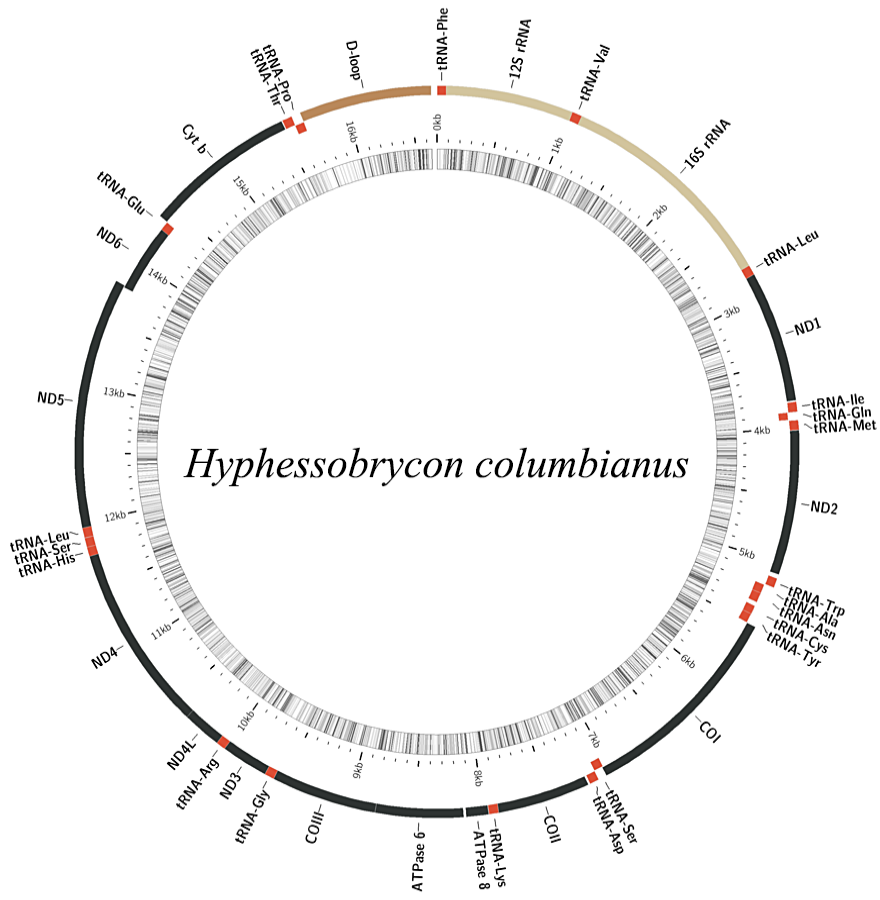
Structure of the mitochondrial genome of Hyphessobrycon columbianus.
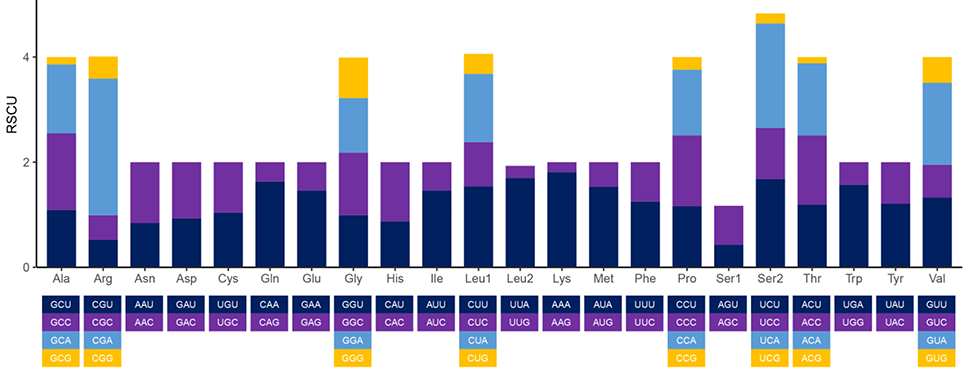
Codon usage in protein-coding genes in the mitochondrial genome of Hyphessobrycon columbianus.
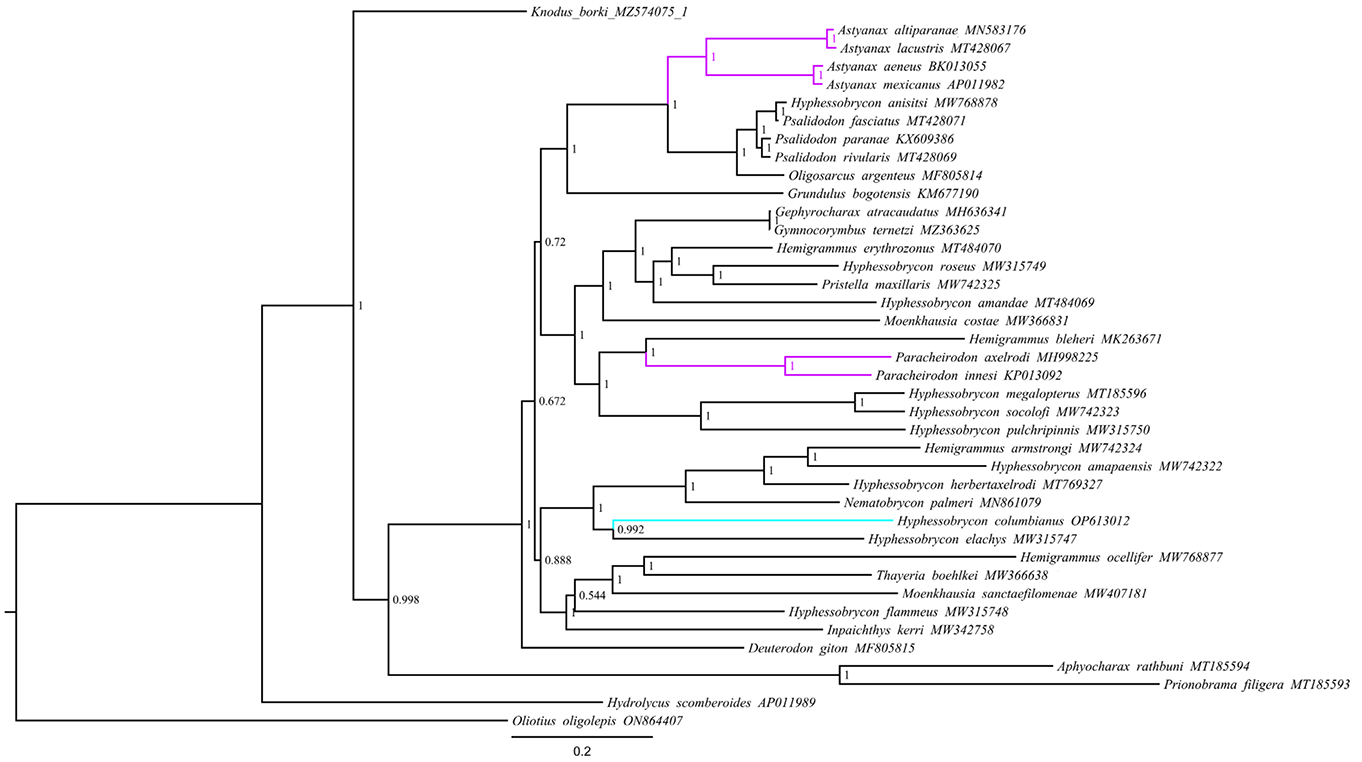
Bayesian phylogenetic tree of Characidae based on the sequences of the 13 protein-coding genes in the mitochondrial genome.
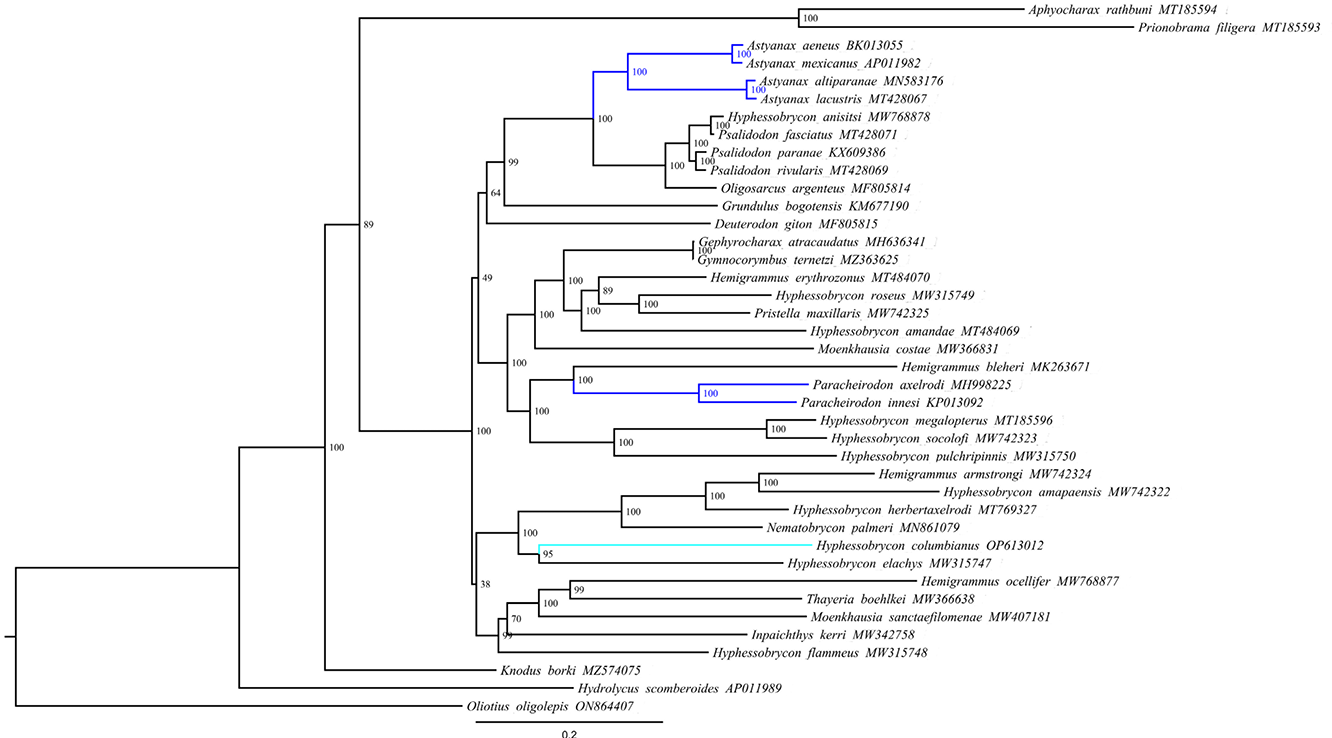
Maximum likelihood phylogenetic tree of Characidae based on the sequences of the 13 protein-coding genes in the mitochondrial genome.
References
- Bernt, M., Donath, A., Jühling, F., Externbrink, F., Florentz, C., Fritzsch, G., Pütz, J., Middendorf, M. and Stadler, P.F., 2013. MITOS: Improved de novo metazoan mitochondrial genome annotation. Mol. Phylogenet. Evol., 69: 313-319. https://doi.org/10.1016/j.ympev.2012.08.023[CrossRef]
- Cameron, S.L., 2014. Insect mitochondrial genomics: Implications for evolution and phylogeny. Annu. Rev. Ent., 59: 95-117. https://doi.org/10.1146/annurev-ento-011613-162007[CrossRef]
- Consuegra, S., John, E., Verspoor, E. and de Leaniz, C.G., 2015. Patterns of natural selection acting on the mitochondrial genome of a locally adapted fish species. Genet Select Evol., 47: 1-10. https://doi.org/10.1186/s12711-015-0138-0[CrossRef]
- Garcia-Alzate, C.A., Roman-Valencia, C. and Taphorn, D.C., 2010. A new species of Hyphessobrycon (Teleostei: Characiformes: Characidae) from the San Juan River drainage, Pacific versant of Colombia. Zootaxa, 2349: 55-64. https://doi.org/10.11646/zootaxa.2349.1.4[CrossRef]
- Hecht, A., Glasgow, J., Jaschke, P.R., Bawazer, L.A., Munson, M.S., Cochran, J.R., Endy, D. and Salit, M., 2017. Measurements of translation initiation from all 64 codons in E. coli. Nucleic Acids Res., 45: 3615-3626. https://doi.org/10.1093/nar/gkx070[CrossRef]
- Kalyaanamoorthy, S., Minh, B.Q., Wong, T.K., Von Haeseler, A. and Jermiin, L.S., 2017. Model finder: Fast model selection for accurate phylogenetic estimates. Nat. Methods, 14: 587-589. https://doi.org/10.1038/nmeth.4285[CrossRef]
- Lima, F.C. and Moreira, C.R., 2003. Three new species of Hyphessobrycon (Characiformes: Characidae) from the upper rio Araguaia basin in Brazil. Neotrop. Ichthyol., 1: 21-33. https://doi.org/10.1590/S1679-62252003000100003[CrossRef]
- Liu, Y. and Cui, Z., 2009. The complete mitochondrial genome sequence of the cutlassfish Trichiurus japonicus (Perciformes: Trichiuridae): Genome characterization and phylogenetic considerations. Mar. Genom., 2: 133-142. https://doi.org/10.1016/j.margen.2009.07.003[CrossRef]
- Lowe, T.M. and Eddy, S.R., 1997. tRNAscan-SE: A program for improved detection of transfer RNA genes in genomic sequence. Nucleic Acids Res., 25: 955-964. https://doi.org/10.1093/nar/25.5.955[CrossRef]
- Miya, M. and Nishida, M., 2015. The mitogenomic contributions to molecular phylogenetics and evolution of fishes: A 15-year retrospect. Ichthyol. Res., 62: 29-71. https://doi.org/10.1007/s10228-014-0440-9[CrossRef]
- Nass, M.M. and Nass, S., 1963. Intramitochondrial fibers with DNA characteristics: I. Fixation and electron staining reactions. J. Cell Biol., 19: 593-611. https://doi.org/10.1083/jcb.19.3.593[CrossRef]
- Osellame, L.D., Blacker, T.S. and Duchen, M.R., 2012. Cellular and molecular mechanisms of mitochondrial function. Best Pract. Res. Clin. Endocrinol. Metab., 26: 711-723. https://doi.org/10.1016/j.beem.2012.05.003[CrossRef]
- Satoh, T.P., Miya, M., Mabuchi, K. and Nishida, M., 2016. Structure and variation of the mitochondrial genome of fishes. BMC Genom., 17: 1-20. https://doi.org/10.1186/s12864-016-3054-y[CrossRef]
- Sun, C.H., Liu, H.Y., Xu, N., Zhang, X.L., Zhang, Q. and Han, B.P., 2021. Mitochondrial genome structures and phylogenetic analyses of two tropical Characidae fishes. Front. Genet., 12: 627402. https://doi.org/10.3389/fgene.2021.627402[CrossRef]
- Sun, C.H., Sun, P.Y., Lao, Y.L., Wu, T., Zhang, Y.N., Huang, Q. and Zhang, Q., 2023. Mitogenome of a monotypic genus, Oliotius Kottelat, 2013 (Cypriniformes: Cyprinidae): genomic characterization and phylogenetic position. Gene, 851: 147035. https://doi.org/10.1016/j.gene.2022.147035[CrossRef]
- Sun, C.H., Zhang, Y.N., Zeng, X.S., Liu, D.W., Huang, Q., Zhang, X.L. and Zhang, Q., 2022. Mitogenome of Knodus borki (Cypriniformes: Characidae): Genomic characterization and phylogenetic analysis. Mol. Biol. Rep., 49: 1-8. https://doi.org/10.1007/s11033-021-06983-w[CrossRef]
- Talavera, G. and Castresana, J., 2007. Improvement of phylogenies after removing divergent and ambiguously aligned blocks from protein sequence alignments. Syst. Biol., 56: 564-577. https://doi.org/10.1080/10635150701472164[CrossRef]
- Touchon, M. and Rocha, E.P., 2008. From GC skews to wavelets: A gentle guide to the analysis of compositional asymmetries in genomic data. Biochimie, 90: 648-659. https://doi.org/10.1016/j.biochi.2007.09.015[CrossRef]
- Yu, P., Zhou, L., Zhou, X.Y., Yang, W.T., Zhang, J., Zhang, X.J., Wang, Y. and Gui, J.F., 2019. Unusual AT-skew of Sinorhodeus microlepis mitogenome provides new insights into mitogenome features and phylogenetic implications of bitterling fishes. Int. J. Biol. Macromol., 129: 339-350. https://doi.org/10.1016/j.ijbiomac.2019.01.200[CrossRef]
- Zhang, D., Gao, F., Jakovlić, I., Zou, H., Zhang, J., Li, W.X. and Wang, G.T., 2020. Phylo suite: An integrated and scalable desktop platform for streamlined molecular sequence data management and evolutionary phylogenetics studies. Mol. Ecol. Resour., 20: 348-355. https://doi.org/10.1111/1755-0998.13096[CrossRef]
- Zimmer, E.A. and Wen, J., 2015. Using nuclear gene data for plant phylogenetics: Progress and prospects II. Next-gen approaches. J. Syst. Evol., 53: 371-379. https://doi.org/10.1111/jse.12174[CrossRef]
Services
Article usage statistics
Loading…