
Squalidus nitens is a common small-bodied freshwater fish endemic to the middle and lower reaches of the Yangtze River. Genetic information on the species is quite scarce, as well as scientists have long disagreed on how to dispose of Squalidus and its related genera. In this study, we primarily reported the complete mitochondrial DNA genome of S. nitens by high-throughput sequencing, and explored the phylogenetic position of S. nitens within the subfamily Gobioninae. The entire length of the mitochondrial genome is 16,606 bp, containing 13 protein-coding genes (PCGs), 2 ribosomal RNA (rRNA) genes, 22 transfer RNA (tRNA) genes, and a control region (D-loop). The nucleotide composition was made up of 29.97% A, 27.26% C, 16.93% G, and 25.84% T, respectively, indicating an A + T (55.81%)-rich feature in the S. nitens. Squalidus shares close skinship with Hemibarbus, and both were found at the base of the evolutionary tree of subfamily Gobioninae by creating sister groups in a well-supported way, according to ML and BI analyses. The closest relatives to S. nitens are S. chankaensis and S. gracilis, not S. argentatus.
Research Article · Volume 57, Issue 1, 15 January 2025 · Open Access
The Complete Mitochondrial Genome Sequence and Phylogenetic Analysis of Squalidus nitens (Cypriniformes: Cyprinidae: Gobioninae)
· · · ·
Affiliations & Notes ⌄
- 1College of Life Science, Southwest Branch of the National Freshwater Fishery Engineering Technology Research Center, China West Normal University, Nanchong 637000, China. * Corresponding author: zengyu@cwnu.edu.cn
Article Info ⌄
- Journal:
- Pakistan Journal of Zoology
- Published:
- 15 January 2025

From the article
- In conclusion, this report could enrich the mitogenome resource of S. nitens and seemed to be useful for evolutionary and conservation studies on subfamily Gobioninae fish species.
- Our study was based on whole sequence evidence of mitochondrial genes.
- It also indicated that Squalidus has close skinship with Hemibarbus and that both were located at the base of the phylogenetic tree of subfamily Gobioninae by forming sister groups.
- In conclusion, the newly obtained S. nitens complete mitochondrial genome sequence would provide valuable molecular information fundamental to protect subfamily Gobioninae species and be useful for species delimitation and phylogenetic reconstruction.
Selected from the article's own text.
Abstract
Introduction
Squalidus nitens (Günther, 1873) is an endemic and primary freshwater species in the subfamily Gobioninae, which was identified as the synonym of Gobio sihuensis Chu in 1995. The species mainly inhabited the middle or lower reaches of the Yangtze River and were of vital economic value. However, the phylogenetic relationship of the genus to which S. nitens belongs is still being debated. With the difference in analytical methods and the development of technical means, the current research on this genus has obtained different results in morphology and molecule. Based on morphological traits, it is considered that the closely related groups of Squalidus are Gnathopogon ; or Gobio . In recent years, molecular studies have shown that Squalidus has a close kinship with Hemibarbus genera. Yang et al. (2006) discovered that Squalidus and Hemibarbus are located at the most basic part of the phylogeny of the subfamily Gobioninae based on evidence from the cytb gene, as well as Tang et al. (2011) proved the same with the cytb gene, COI gene, Rag1 gene, and RH gene. To summarize, more in-depth research is needed to determine the phylogenetic relationship of this genus.
Mitochondrial DNA is a covalently closed circular double-stranded DNA molecule that functions independently of the nucleus in the areas of autonomous replication, transcription, and translation. Mitochondrial genes have a high level of coding efficiency, are simple to copy, and closely adhere to maternal inheritance ; . As a result, mitochondrial DNA is commonly used in studies of fish evolutionary relationships. Among the researches related to mitochondrial DNA, in comparison to single gene data, complete mitochondrial genomes provide significant comparative advantages for resolving shallow-level phylogenetic and taxonomy problems . Nowadays, there is no complete mitochondrial genetic information available for S. nitens. The paucity of sequence data hampered S. nitens research significantly. Meanwhile, data on the mitogenomes of S. nitens is crucial for phylogenetic analysis and molecular evolution of Squalidus mitogenomes.
Therefore, in this paper, we characterized the complete mitochondrial genome from this species for the first time, and obtained all 33 complete mitogenomes accessible for the subfamily Gobioninae to utilize in phylogenetic analysis. The complete mitochondrial gene sequencing of S. nitens not only complemented the species’ molecular genetic data, but also offered significant information for comprehending the Gobioninae’s evolutionary link.
Materials and Methods
Sampling, DNA extraction and sequencing
The specimen of Squalidus nitens used in this study was collected from Cang Xi section of the Jialing River (31°42′N, 105°54′E) in May 2021. Morphological identification of S. nitens was performed according to Ding as reference. Total DNA was extracted from alcohol-preserved muscle tissue using Marine Animals DNA Kit. Subsequently, the complete mitochondrial genome was sequenced by delivering to the Tsingke Biological Technology Company (Chengdu, China).
Sequence assembly, mitogenome annotation and sequence analysis
A shotgun DNA library was constructed and sequenced by Illumina NovaSeq. Using Fastp 0.20.0 to control the quality of raw Illumina reads A de novo assembly of a complete circular mitochondrial genome from clean data was performed with GetOrganelle1.7.5 . BLAST 2.7.1 was used to compare the assembly results with the reference genome of closely related species. The candidate sequences were determined based on the comparison. MITOS2 (http://mitos2.bioinf.uni-leipzig.de/index.py), a special platform for mitochondrial genomes, was employed to annotate the genome structure. The composition of nucleotides and relative synonymous codon usage (RSCU) were analyzed with MEGA X . The skewness of the strands was calculated using the following formulas: AT-skew = (A-T)/(A+T) and GC-skew = (G-C)/(G+C) .
Phylogenetic analysis
To investigate the phylogenetic position of S. nitens and phylogenetic relationships within the Gobioninae, we obtained mitogenomes from 33 species belonging to the subfamily Gobioninae from GenBank (http://www.ncbi.nlm.nih.gov) (Table I). Outgroups were chosen from the Acheilognathinae subfamily, which is closely related to Gobioninae: Acheilognathus intermedia and Rhodeus notatus. PhyloSuite was used to conduct, manage, and streamline the analyses.
Table I. List of the 33 Cyprinidae species in phylogenetic analysis, with their GenBank accession numbers.
| Subfamily/ Species | GenBank No | Size (bp) |
| Gobioninae | ||
| Abbottina obtusirostris | NC_026900 | 16,599 |
| Acanthogobio guentheri | MF787799 | 16,604 |
| Biwia springeri | NC_022188 | 16,606 |
| Coreius heterodon | JF906110 | 16,611 |
| Coreoleuciscus splendidus | EU848546 | 16,566 |
| Gnathopogon herzensteini | MT295103 | 16,597 |
| Gobio cynocephalus | NC_032294 | 16,605 |
| Gobiobotia pappenheimi | NC_032293 | 16,605 |
| Gobiocypris rarus | JN116719 | 16,601 |
| Hemibarbus labeo | DQ347953 | 16,612 |
| Ladislavia taczanowskii | NC_024634 | 16,613 |
| Microphysogobio liaohensis | NC_032290 | 16,609 |
| Paracanthobrama guichenoti | NC_024430 | 16,607 |
| Platysmacheilus longibarbatus | NC_032289 | 16,615 |
| Pseudogobio vaillanti | NC_032292 | 16,607 |
| Pseudopungtungia nigra | EU332752 | 16,605 |
| Pseudorasbora elongata | KF051938 | 16,587 |
| Pungtungia herzi | NC_008664 | 16,600 |
| Rhinogobio ventralis | NC_022720 | 16,604 |
| Romanogobio ciscaucasicus | NC_031558 | 16,603 |
| Sarcocheilichthys kiangsiensis | JX401522 | 16,672 |
| Saurogobio dabryi | KU314696 | 16,609 |
| Squalidus argentatus | NC_023336 | 16,607 |
| Squalidus chankaensis | NC_050647 | 16,611 |
| Squalidus gracilis | NC_024561 | 16,605 |
| Squalidus longifilis | NC_051941 | 16,607 |
| Squalidus mantschuricus | NC_051940 | 16,605 |
| Squalidus multimaculatus | NC_029387 | 16,597 |
| Squalidus nitens | This study | 16,606 |
| Squalidus wolterstorffi | NC_022190 | 16,602 |
| Xenophysogobio boulengeri | KU314699 | 16,615 |
| Acheilognathinae | ||
| Acheilognathus intermedia | NC_013705 | 16,610 |
| Rhodeus notatus | NC_029718 | 16,735 |
13 sequences were aligned in batches with MAFFT using auto strategy and codon alignment mode. The alignments were refined using the codon-aware program MACSE v. 2.03 . Ambiguously aligned fragments of 13 alignments were removed in batches using Gblocks . ModelFinder was used to select the best-fit model using the AIC criterion. The IQ-TREE model was used for 20000 ultrafast bootstraps, as well as the Shimodaira Hasegawa like approximate likelihood-ratio test . Bayesian Inference (BI) phylogenies were inferred using MrBayes 3.2.6 under the GTR+I+G+F model. Phylogenetic trees were visualized through the online tool Interactive Tree of Life .
Results
Mitogenome organization
The complete mitochondrial DNA sequence of S. nitens was a 16,606 bp circular molecule with two ribosomal RNA (rRNA) genes (16S and 12S), 22 transfer RNA genes (tRNA), 13 protein-coding genes (PCGs) and one non-coding regulatory region (D-loop) (Table I). The overall base nucleotide makeup was 29.97% A, 27.26% C, 16.93% G, and 25.84% T, with a comparatively higher AT content (55.81%). The composition was skewed away from A in favor of T (the AT-skew was +0.074) but was almost balanced for G and C (the GC-skew was −0.234). The mitochondrial genome map and gene content were shown in Figure 1, Table II, respectively.
All 13 of the typical PCGs were encoded on the heavy strand except ND6. Twelve PCGs used ATG as the initiation codon, whereas COI began with GTG. Notably, ten PCGs terminated with the complete stop codons TAA (ND1, COI, ATPase8, ATPase6, ND4L and ND5) or TAG (ND2, ND3, ND4 and ND6), while the remaining ended with an incomplete stop codon T (COII and Cytb) or TA– (COIII). Twenty-two tRNA genes were interspersed across the mitogenome of S. nitens, ranging in size from 69 to 76 bp, which was typical for this subfamily . Fourteen tRNAs were found on the heavy strand, while the remaining eight were found on the light strand. Among the two rRNA genes, the 12S rRNA gene and the 16S rRNA gene were separated by tRNA-Val (Table II).
In the whole mitogenome, there were four pairs of adjacent PCs, ATP8–ATP6, ATP6–COIII, ND4L–ND4, and ND5–ND6 had the overlapping genes, and they overlap by seven, one, seven and four nucleotides, respectively. The D-loop was 925 bp in length and was located between the tRNA-Phe and tRNA-Pro.
Table II. Characteristics of the complete mitochondrial genome of S. nitens.
| Gene | Start | End | Length (bp) | Amino acid | Codon Start/Stop | Anti Codon | Strand | Intergenic region |
| tRNA-Phe | 1 | 69 | 69 | GAA | + | 0 | ||
| 12S rRNA | 70 | 1026 | 957 | + | 2 | |||
| tRNA-Val | 1029 | 1100 | 72 | TAC | + | 0 | ||
| 16S rRNA | 1101 | 2791 | 1691 | + | 0 | |||
| tRNA-Leu | 2792 | 2867 | 76 | TAA | + | 1 | ||
| ND1 | 2869 | 3843 | 975 | 324 | ATG/TAA | + | 4 | |
| tRNA-Ile | 3848 | 3919 | 72 | GAT | + | -2 | ||
| tRNA-Gln | 3918 | 3988 | 71 | TTG | - | 1 | ||
| tRNA-Met | 3990 | 4058 | 69 | CAT | + | 0 | ||
| ND2 | 4059 | 5105 | 1047 | 348 | ATG/TAG | + | -2 | |
| tRNA-Trp | 5104 | 5174 | 71 | TCA | + | 1 | ||
| tRNA-Ala | 5176 | 5244 | 69 | TGC | - | 1 | ||
| tRNA-Asn | 5246 | 5318 | 73 | GTT | - | 2 | ||
| rep_origin | 5321 | 5350 | 30 | + | 0 | |||
| tRNA-Cys | 5351 | 5418 | 68 | GCA | - | 1 | ||
| tRNA-Tyr | 5420 | 5490 | 71 | GTA | - | 1 | ||
| COⅠ | 5492 | 7042 | 1551 | 516 | GTG/TAA | + | 0 | |
| tRNA-Ser | 7043 | 7113 | 71 | TGA | - | 3 | ||
| tRNA-Asp | 7117 | 7188 | 72 | GTC | + | 13 | ||
| COII | 7202 | 7892 | 691 | 230 | ATG/T | + | 0 | |
| tRNA-Lys | 7893 | 7968 | 76 | TTT | + | 1 | ||
| ATP8 | 7970 | 8134 | 165 | 54 | ATG/TAA | + | -7 | |
| ATP6 | 8128 | 8811 | 684 | 227 | ATG/TAA | + | -1 | |
| COIII | 8811 | 9595 | 785 | 261 | ATG/TA | + | -1 | |
| tRNA-Gly | 9595 | 9666 | 72 | TCC | + | 0 | ||
| ND3 | 9667 | 10017 | 351 | 116 | ATG/TAG | + | -2 | |
| tRNA-Arg | 10016 | 10084 | 69 | TCG | + | 0 | ||
| ND4L | 10085 | 10381 | 297 | 98 | ATG/TAA | + | -7 | |
| ND4 | 10375 | 11757 | 1383 | 461 | ATG/TAG | + | -1 | |
| tRNA-His | 11757 | 11825 | 69 | GTG | + | 0 | ||
| tRNA-Ser | 11826 | 11894 | 69 | GCT | + | 1 | ||
| tRNA-Leu | 11896 | 11968 | 73 | TAG | + | 0 | ||
| ND5 | 11969 | 13804 | 1836 | 611 | ATG/TAA | + | -4 | |
| ND6 | 13801 | 14322 | 522 | 173 | ATG/TAG | - | 0 | |
| tRNA-Glu | 14323 | 14391 | 69 | - | 4 | |||
| CYTB | 14396 | 15536 | 1141 | 380 | ATG/T | + | 0 | |
| tRNA-Thr | 15537 | 15608 | 72 | TGT | + | -1 | ||
| tRNA-Pro | 15608 | 15677 | 70 | TGG | - | 0 | ||
| D-loop | 15678 | 16606 | 929 | + | 0 |
+ and - represent heavy strand and light strand, respectively. In the intergenic region column, negative numbers indicate an overlap between two adjacent genes. T/TA represent incomplete stop codons.
Phylogenetic analysis
To better understand the relationships among the Squalidus and other related species, phylogenetic trees were created using ML and BI techniques based on concatenated nucleotide sequences of 13 PCGs, 22 tRNA, and 2 rRNA from 31 Gobioninae minnows and 2 Acheilognathidae fishes. The results of the phylogenetic trees exhibited two similar topological structures with strong supports by both methods, which displayed three major clades: Gobionini, Sarcocheilichthyini, and Hemibarbus + Squalidus (Figs. 2 and 3). The two trees showed a marked consistency, disregarding the different support values for certain nodes. Hemibarbus and Squalidus, formed a separate clade at the base of the tree. Meanwhile, Gobionini and Sarcocheilichthyini formed sister-groups.
Discussion
The mitogenome of S. nitens is structurally organized in a manner that is strikingly similar to that of other Gobioninae species . COI, like other bony fish, began with GTG, whereas the other twelve PCGs began with ATG . Ten PCGs featured conventional stop codons (TAA and TAG), whereas the remaining three PCGs had two types of incomplete stop codons (T- and TA-), which could be completed by post-transcriptional polyadenylation . The non-coding region of S. nitens mitogenome, which ranged from 1 to 929 bp, might be important as splicing recognition sites during the process of transcription. Similar to other bony fish, the second largest spacer was located between tRNA-Asn and tRNA-Cys genes and was 30 bp in length. In conclusion, this report could enrich the mitogenome resource of S. nitens and seemed to be useful for evolutionary and conservation studies on subfamily Gobioninae fish species.
The results of ML and BI analyses in the current study showed similar topologies and both presented three major clades (Gobionini, Sarcocheilichthyini, and Hemibarbus + Squalidus group), which was in accordance with previous molecular studies ; . However, it contradicted the claim of Yang et al. (2006) that four lineages exist. The close relationship of Squalidus to Hemibarbus was supported by sequence data for Yang et al. (2006) using a single gene cytb and Tang et al. (2011) using four genes (cytb, COI, RAG1 and rhodopsin), whereas morphological data indicated that Squalidus was close to Gnathopogon ; or Gobio . Our study was based on whole sequence evidence of mitochondrial genes. It also indicated that Squalidus has close skinship with Hemibarbus and that both were located at the base of the phylogenetic tree of subfamily Gobioninae by forming sister groups. It’s different from early research that the closest relation to S. nitens is not the S. argentatus, but S. chankaensis and S. gracilis. As Jeon et al. (2018) relied on a single mitochondrial gene to infer the phylogeny (NJ, ML and BI analyses based on the complete cytb gene dataset), it is likely that incomplete markers did not provide sufficient phylogenetic information for analysis .
In conclusion, the newly obtained S. nitens complete mitochondrial genome sequence would provide valuable molecular information fundamental to protect subfamily Gobioninae species and be useful for species delimitation and phylogenetic reconstruction.
Acknowledgements
We are grateful to Ling Mao for her help in sample collection and identification. The study was supported by the Fundamental Research Funds of Technical Office in Sichuan Province (2022NSFSC0129), and the National Natural Science Foundation of China (No.51779210).
Statement of conflict of interest
The authors have declared no conflict of interest.
Figures
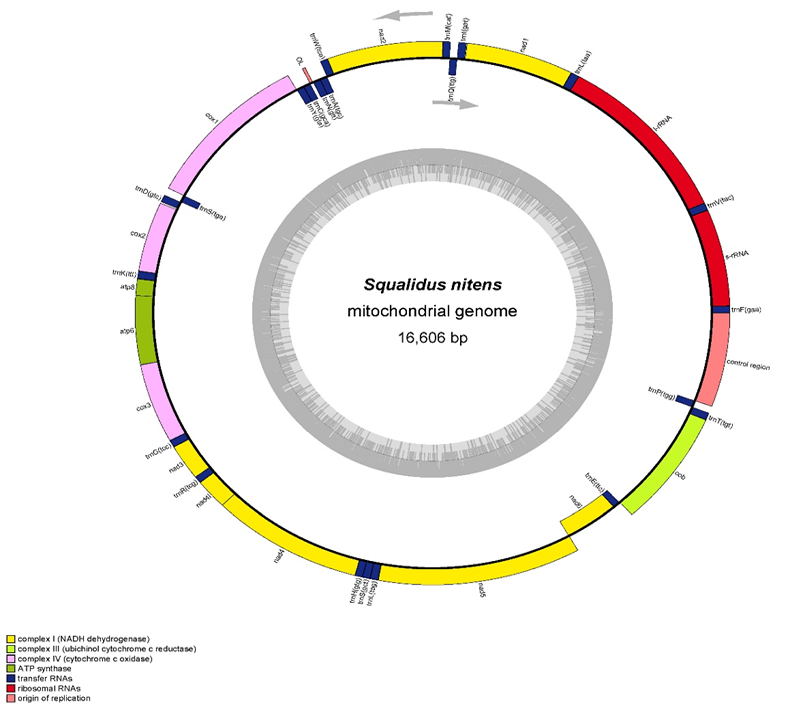
The map of the mitochondrial genome of S. nitens. Genes encoded on the light and heavy strand are shown inside and outside the circle respectively. The gray histogram represents the GC content of the genome.
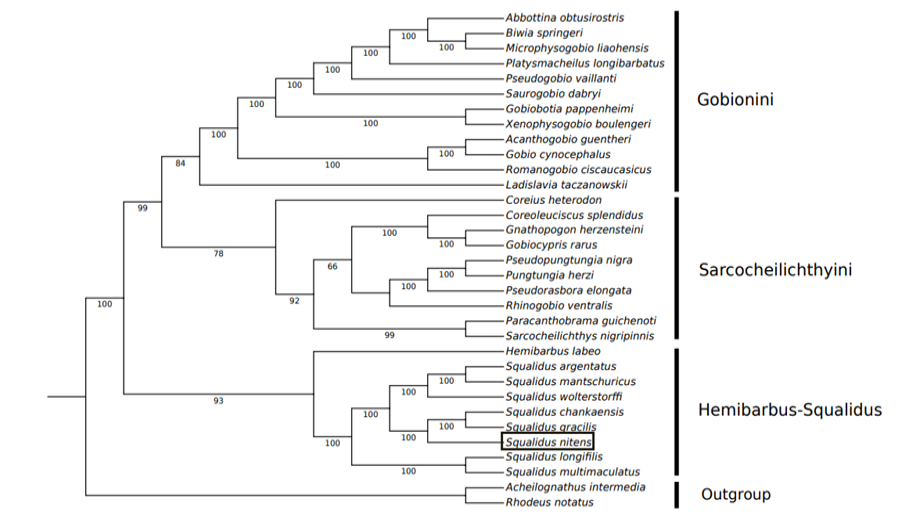
Maximum likelihood (ML) tree showing the phylogenetic position of Squalidus nitens (black frame) among Gobioninae species. Only Bootstrap support (BP) greater than 50% are shown.
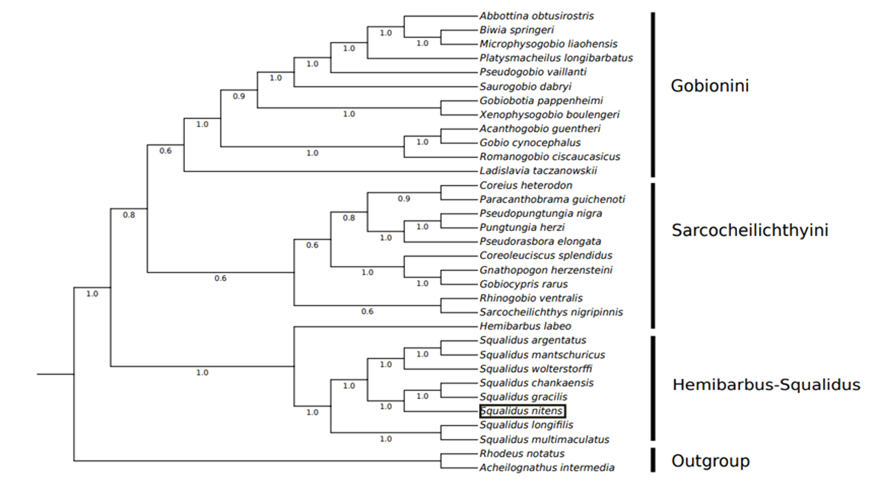
Bayesian Inference (BI) tree showing the phylogenetic position of Squalidus nitens (black frame) among Gobioninae species. Only Bootstrap support (BP) greater than 50% are shown.
References
- Avise, J.C., Neigel, J.E. and Arnold, J., 1984. Demographic influences on mitochondrial DNA lineage survivorship in animal populations. J. mol. Evol., 20: 99-105. https://doi.org/10.1007/BF02257369[CrossRef]
- Bănărescu, P. and Nalbant, T., 1965. Studies on the systematics of Gobioninae (Pisces: Cyprinidae). Rev. Roum. Biol. Zool., 10: 219-228.
- Chai, J. and Fu, C., 2020. Three mitochondrial genomes of freshwater fishes in the genus Squalidus (Cypriniformes: Gobionidae). Mitochondrial DNA B., 5: 3761-3763. https://doi.org/10.1080/23802359.2020.1835583[CrossRef]
- Ding, R.H., 1994. The fishes of Sichuan. Science and Technology Press, Chengdu
- Duchene, S., Frey, A., Alfaro-Núñez, A., Dutton, P.H. and Morin, P.A., 2012. Marine turtle mitogenome phylogenetics and evolution. Mol. Phylogenet. Evol., 65: 241-250. https://doi.org/10.1016/j.ympev.2012.06.010[CrossRef]
- Gerard, T. and Jose, C., 2007. Improvement of phylogenies after removing divergent and ambiguously aligned blocks from protein sequence alignments. Syst. Biol., 56: 564-577. https://doi.org/10.1080/10635150701472164[CrossRef]
- Guindon, S., Dufayard, J.F., Lefort, V., Anisimova, M., Hordijk, W. and Gascuel, O., 2010. New algorithms and methods to estimate maximum-likelihood phylogen-ies: Assessing the performance of PhyML 3.0. Syst. Biol., 59: 307-321. https://doi.org/10.1093/sysbio/syq010[CrossRef]
- Hosoya, K., 1986. Interrelationships of the Gobioninae (Cyprinidae). In: Indo-pacific fish biology (ed. T. Uyeno). Indo-Pacific Fish Biology: proceeding of the Second International Conference on Indo-Pacific Fishes Ichthyological Society of Japan, Tokyo: 484–501.
- Huelsenbeck, J.P., 2012. MrBayes 3.2: Efficient bayesian phylogenetic inference and model choice across a large model space. Syst. Biol., 61: 539-542. https://doi.org/10.1093/sysbio/sys029[CrossRef]
- Jeon, H.B., Kim, D.Y., Lee, Y.J, Bae, H.G. and Suk, H.Y., 2018. The genetic structure of Squalidus multimaculatus revealing the historical pattern of serial colonization on the tip of East Asian continent. Nature, 8: 10629. https://doi.org/10.1038/s41598-018-28340-x[CrossRef]
- Jian, J.J., Yu, W.B., Yang, J.B., Song, Y. and Li, D.Z., 2019. GetOrganelle: A fast and ve-rsatile toolkit for accurate de novo assembly of organelle genomes. Genome Biol., 21: 241. https://doi.org/10.1186/s13059-020-02154-5[CrossRef]
- Kalyaanamoorthy, S., Minh, B.Q., Wong, T., Haeseler, A.V. and Jermiin, L.S., 2017. Model finder: Fast model selection for accurate phylogenetic estimates. Nat. Methods, 14: 587-589. https://doi.org/10.1038/nmeth.4285[CrossRef]
- Kazutaka, K. and Standley, D.M., 2013. MAFFT multiple sequence alignment software version 7: Improvements in performance and usability. Mol. Biol. Evol., 30: 772-780. https://doi.org/10.1093/molbev/mst010[CrossRef]
- Kumar, S., Stecher, G., Li, M., Knyaz, C. and Tamura, K., 2018. MEGA X: Molecular evolutionary genetics analysis across computing platforms. Mol. Biol. Evol., 35: 1547-1549. https://doi.org/10.1093/molbev/msy096[CrossRef]
- Nguyen, L.T., Schmidt, H.A., Von Haeseler, A. and Minh, B.Q., 2015. IQ-TREE: A fast and effective stochastic algorithm for estimating maximum-likelihood phylogenies. Mol. Biol. Evol., 32: 268-274. https://doi.org/10.1093/molbev/msu300[CrossRef]
- Letunic, I. and Bork, P., 2019. Interactive tree of life (iTOL) v4: Recent updates and new developments. Nucl. Acids Res., 47: 256-259. https://doi.org/10.1093/nar/gkz239[CrossRef]
- Mao, L., Zeng, Y., Li, J., Zhang, F.B., Liu, Y.Y. and Gong, J.H., 2021. The complete mitochondrial genome sequence and phylogenetic analysis of Gnathopogon herzensteini (Cypriniformes, Cyprinidae, Gobioninae). Biologia, 76: 1087-1094. https://doi.org/10.2478/s11756-020-00667-9[CrossRef]
- Minh, B.Q., Nguyen, M.A.T. and Haeseler, A.V., 2013. Ultrafast approximation for phylogenetic bootstrap. Mol. Biol. Evol., 30: 1188-1195. https://doi.org/10.1093/molbev/mst024[CrossRef]
- Miya, M., Takeshima, H., Endo, H., Ishiguro, N.B., Inoue, J.G., Mukai, T., Satoh, T.P., Yamaguchi, M., Kawaguchi, A., Mabuchi, K., Shirai, S.M. and Nishida, M., 2003. Major patterns of higher teleostean phylogenies: A new perspective based on 100 complete mitochondrial DNA sequences. Mol. Phylogenet. Evol., 26: 121-138. https://doi.org/10.1016/S1055-7903(02)00332-9[CrossRef]
- Ojala, D., Montoya, J. and Attardi, G., 1981. tRNA punctuation model of RNA processing in human mitochondria. Nature, 290: 470-474. https://doi.org/10.1038/290470a0[CrossRef]
- Perna, N.T. and Kocher, T.D., 1995. Patterns of nucleotide composition at fourfold degenerate sites of animal mitochondrial genomes. J. mol. Evol., 41: 353-358. https://doi.org/10.1007/BF01215182[CrossRef]
- Tang, K.L., Agnew, M.K., Chen, W.J., Hirt, M.V., Raley, M.E., Sado, T., Schneider, L.M., Yang, L., Bar,t H.L. and He, S., 2011. Phylogeny of the gudgeons (Teleostei: Cyprinidae: Gobioninae). Mol. Phylogenet. Evol., 61: 103-124. https://doi.org/10.1016/j.ympev.2011.05.022[CrossRef]
- Vincent, R., Douzery, E.J.P., Cédric, C., Nathalie, C. and Frédéric, D., 2018. MACSE v2: Toolkit for the alignment of coding sequences accounting for frameshifts and stop codons. Mol. Biol. Evol., 10: 2582-2584. https://doi.org/10.1093/molbev/msy159[CrossRef]
- Yang, J., He, S., Freyhof, J., Kai, W. and Liu, H., 2006. The phylogenetic relationships of the gobioninae (Teleostei: Cyprinidae) inferred from mitochondrial cytochrome b gene sequences. Hydrobiologia, 553: 255-266. https://doi.org/10.1007/s10750-005-1301-3[CrossRef]
- Yue, P., 1995. Revision of the classification on the cyprinid fishes of the genus Squalidus from China. Acta Hydrobiol. Sin., 19: 89-91.
- Zhang, D., Gao, F., Jakovli, I., Zou, H. and Wang, G.T., 2020. PhyloSuite: An integrated and scalable desktop platform for streamlined molecular sequence data management and evolutionary phylogenetics studies. Mol. Ecol. Resour., 20: 348-355. https://doi.org/10.1111/1755-0998.13096[CrossRef]
Services
Article usage statistics
Loading…