
Scrapie is a fatal neurodegenerative disease caused by the accumulation of improperly folded forms of host-encoded cellular-prion protein (PrPc) in the central nervous system (CNS) and in some peripheral tissues in sheep and goats. Scrapie resistant/susceptibility have been associated with the presence of PRNP gene polymorphisms. We analyzed the polymorphisms in PRNP gene sequences in 49 wild Punjab urial (Ovis vignei punjabiensis). Four novel amino acids polymorphisms (p.Q149E, p.Q155E, p.Y228L and p.L253F) were detected in PRNP gene. The urial was monomorphic at codon 149 and 155 and polymorphic at codon 228 and 253. These amino acid polymorphisms were combined in four alleles and six genotypes. Investigating the polymorphisms at codon 136, 154 and 171, the only genotype ARQ/ARQ was detected in Punjab urial. The PRNP gene sequences in Punjab urial showed low variability and is resemble to previous findings for wild animals. Prevalence-estimate, transmissibility, distribution, and host-range of prion disease in wild-animals remain undetermined.
Short Communication · Volume 54, Issue 1, 19 December 2021 · Open Access
Variations in the Prion Protein Gene (PRNP) Sequences of Wild Punjab Urial from Pakistan
· · · · · · · ·
Affiliations & Notes ⌄
- 1Center of Agricultural Biochemistry and Biotechnology, University of Agriculture, Faisalabad 2Department of Biotechnology, Virtual University of Pakistan, 1-Davis Road, Lahore 3Department of Molecular Biology, Virtual University of Pakistan, 1-Davis Road, Lahore 4Department of Zoology, Lahore College for Women University, Lahore. Nida Sadaqat and Abdul Wajid contributed as first author. , * Corresponding author: tanveer.hussain@vu.edu.pk
Article Info ⌄
- Journal:
- Pakistan Journal of Zoology
- Published:
- 19 December 2021

From the article
- Sequencing analysis of the PRNP gene revealed overall four novel amino acid aa variations in the studied 49 samples from wild urial sheep breed at position p.Q149E, p.Q155E, p.Y228L and p.L253F (Table I).
- The allele and genotype type frequencies of the aa variations were calculated for Punjab urial.
- The maximally detected allele was E149Q155Y228F253 found in wild urial sheep with the frequency of 0.4497 and followed by E149Q155L228F253 (0.2244) and allele E149Q155L228L253 (0.1020) was found with lowest frequencies in the studied samples (Table II).
- Apparently low variability of the PRNP gene coding region was detected in wild Punjab urial with merely four alleles in 49 individuals (8.16%).
Selected from the article's own text.
Abstract
Materials and methods
According to a report of IUCC (2000), wild Punjab urial is currently classified as endangered species within the protected areas in the IUCN Red Data Book for mammals and also demonstrated as vulnerable by IUCN Red List of Threatened Species. The species is also protected under the Punjab Wildlife (Protection, Preservation, Conservation, and Management) Act, 1974 . This research work was approved by the Departmental Ethical Research Committee of the Virtual University of Pakistan, the samples were used only for scientific study and we didn’t kill any animal for this purpose.
The present study was conducted to genetically investigate the PRNP gene in wild endangered Punjab urial (Ovis vignei punjabiensis) of Pakistan. A total of 49 samples were collected from wild Punjab Urial in this study. Skin and blood samples were collected from Chakwal, Sargodha, Attock, Mianwali and Jehlum districts, LoiBher Wildlife Park Rawalpindi, Lahore zoo and Jotana House of Lahore. The skin samples were provided by the Punjab Wildlife department and blood samples were collected from the Zoo and capture animals.
For isolation of genomic DNA, skin samples and blood samples (2ml) collected in EDTA-containing vacutainers were used for DNA extraction using DNeasy blood and tissue kit (Qiagen, USA) following the manufacturer’s recommended protocol.
For PCR amplification of PRNP gene primer pair (forward primer 5’-1-CTTTAAGTGATTTTTACGTGG-21-3’ and reverse primer 5’-854-TGGCAAAGATTAAGAAGATAATG-876-3’) used by Babar et al. (2008) were used to amplify the fragment size of 771 bp containing the complete coding region in exon 3 of the PRNP gene. PCR was performed using a total volume of 25µl containing genomic DNA (100 ng/µl) 1.5µl, forward and reverse primer 1 µl each, 200µM dNTPs 1.5 µl, 5 U Taq polymerase (Fermentas, USA) 0.5 µl, 2.0 mM MgCl2, 10 mM Taq buffer (NH4)2SO4 6 µl and 13.5µl UltraPure DEPC-Treated water. PCR condition was standardized of initial denaturation at 95oC for 5 min, denaturation at 95oC for 45 seconds, annealing at 60oC for 2 min, extension at 72oC for 45 seconds and final extension was optimized at 72oC for 10 min. The amplified PCR products were run on 1% agarose gel and Gene JET gel extraction kit was used for purification of amplified products as per manufacturer’s instructions. The purified samples were sequenced by ABI Prism 3130xL automated sequencer (Applied Biosystems, Inc., Foster City, CA). The obtained PRNP gene sequences were edited, assembled and analyzed for single nucleotide polymorphisms (SNPs) through BLAST and by BioEdit v7 . To infer the evolutionary history phylogenetic tree was built using the neighbor-joining method and evolutionary distances were computed through Maximum Composite Likelihood method using the MEGA software v6 .
Results and discussion
Sequencing analysis of the PRNP gene revealed overall four novel amino acid aa variations in the studied 49 samples from wild urial sheep breed at position p.Q149E, p.Q155E, p.Y228L and p.L253F (Table I). These aa variations were combined in four alleles and six genotypes detected in the studied samples. The allele and genotype type frequencies of the aa variations were calculated for Punjab urial. The maximally detected allele was E149Q155Y228F253 found in wild urial sheep with the frequency of 0.4497 and followed by E149Q155L228F253 (0.2244) and allele E149Q155L228L253 (0.1020) was found with lowest frequencies in the studied samples (Table II). Apparently low variability of the PRNP gene coding region was detected in wild Punjab urial with merely four alleles in 49 individuals (8.16%). In Punjab urial, the maximally and minimally detected genotypes were E149Q155Y228Y253 /E149Q155F228F253 (0.5102) and E149Q155L228Y253/E149Q155L228 L253 (0.0612) and E149Q155L228Y253/E149Q155F228F253 (0.0612) (Table III).
Table I. The locus, genotype, amino changes and frequencies in PRNP gene for Punjab wild urial.
| S.N. | Locus | Genotype | Amino acid | Wild urial |
| 1 | 447 a (149 b) | cc | | 0.00 |
| cg | EQ | 0.00 | ||
| gg | EE | 100.00 | ||
| 2 | 465 (155) | aa | KK | 0.00 |
| ac | KQ | 0.00 | ||
| cc | | 100.00 | ||
| 3 | 684 (228) | aa | LL | 28.57 |
| at | LY | 6.13 | ||
| tt | YY | 65.30 | ||
| 4 | 759 (253) | cc | LL | 8.16 |
| ct | LF | 0.00 | ||
| tt | FF | 91.84 |
a, Nucleotide position; b, Amino acid position.
Table II. Allele frequency distribution of the PRNP gene in Punjab urial at codons 149, 155, 228 and 253.
| Alleles | Punjab urial (n = 49) |
| E149Q155L228L253 | 0.1020 |
| EQYL | 0.1836 |
| EQLF | 0.2244 |
| EQYF | 0.4497 |
Table III. Genotype frequency distribution of PRNP gene in Punjab Urial.
| Genotypes | Punjab urial (n = 49) |
| EQLL/EQLL | 0.1020 |
| EQLY/EQLL | 0.0612 |
| EQYY/EQFF | 0.5102 |
| EQLL/EQFF | 0.1632 |
| EQLY/EQFF | 0.0612 |
| EQYY/EQLL | 0.1020 |
Genotyping of the wild sheep breed was performed for three significant codons 136, 154 and 171 involved with susceptibility to scrapie. AA136RR154QQ171 was the only genotype (1.000) that was present in all studied samples. There are five risk groups (R1 to R5), as described by Dawson et al. (1998) with very low-risk group ARR/ARR to high-risk group VRQ/VRQ. The result showed that the Punjab urial at moderate risk (R-3) with genotype ARQ/ARQ (100%). In addition, the leucine into phenylalanine polymorphism at codon 141 has been recognized as an increased risk-factor for atypical scrapie. Leucine was the most prominent aa found in codon 141 in all studied samples of Punjab urial.
The phylogenetic tree included PRNP gene sequences from domestic and wild sheep buffalo, cattle, yak, horse, deer, camel, and human being sequences. Phylogenetic analysis based on the PRNP gene confirmed the evolutionary relationships among the animals and consistent with previous studies using other gene sequences (Hussain et al., 2016). The phylogenetic tree grouped the related PRNP gene sequences into three main clades of Caprinae, Bovinae and Cervidae and camel, horse and human being sequences as an outgroup (Fig. 1).
This is the preliminary study, to investigate the genetic structure of PRNP gene in wild Punjab urial sheep population in any Asian country. The analysis included 49 animals sampled from different geographical regions in Pakistan.
Sequencing of the PRNP gene of 49 Punjab urial showed three alleles of which allele EQYF was maximally found with an overall frequency of 0.4497 followed by second most frequent allele EQLF (0.2244), and minimally found allele was EQLL with allele frequency of 0.1020. The maximally detected genotype was EQYY/EQFF (0.5102) and minimally detected genotype was EQLY/EQLL (0.0612) and EQLY/EQFF (0.0612).
The present study suggests the studied wild Punjab urial is vulnerable to scrapie if expose to typical scrapie agents. Genotyping of PRNP gene of 49 Punjab urials at major codons 136, 154 and 171 showed a frequency of 100% for AA, RR and QQ genotypes. The five risk groups in term of haplotypes characterized by Dawson et al. (1998). The PRNP gene carrying polymorphism Q171R confers the highest resistance to sheep scrapie. Thus, all the individuals of Punjab urial were observed with ARQ/ARQ genotype (100%) classified into the moderate risk group. The most scrapie-susceptible variant (A136V) was not detected, conversely, the most scrapie-resistant variant (Q171R) was also not detected in this study. Babar et al. (2008) showed the allele ARQ was most frequently observed in other Pakistani domestic sheep breeds with the total frequency of 0.75% followed by ARH (0.16%), AHQ (0.03%) and ARR (0.06) . ARR has been considered the most resistant allele to classical scrapie was detected with very low frequency in other studied Pakistani sheep breeds i.e. Damani and Hashtngri (average = 0.107) , Kajli (0.07), Lohi (0.07), Thali (0.03), Hissardale (0.20) and Awassi (0.05) , hence, lower value raising the scrapie risk in the studied animals. The present data along with previous studies suggest that the native breeds of Pakistan are vulnerable to infection by typical scrapie agents, so strict regulations need to be implemented on the importation of sheep from infected countries.
Acknowledgment
We thank Punjab Wildlife Department and National Zoos providing the samples for this study.
Statement of conflict of interest
The authors have declared no conflict of interest.
Figures
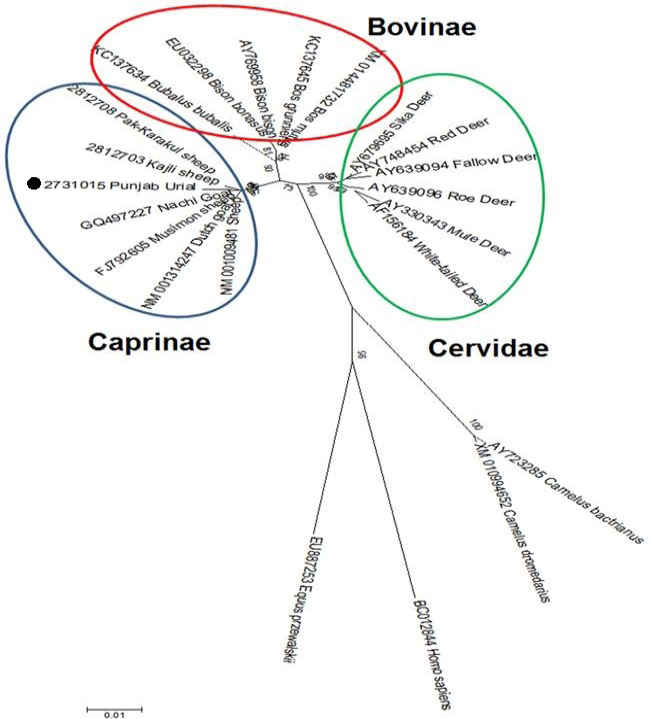
Neighbor-joining phylogenetic analysis performed using prion gene sequences of wild Punjab urial with other mammalian species.
References
- Awan, G.A., Ahmad, T. and Festa Bianchet, M., 2004. J. Sci., 14: 1-14.
- Babar, M., Farid, A., Benkel, B.F., Ahmad, J., Sajid, I.A., Imran, M., Hussain, T. and Nadeem, A., 2008. J. Genet., 87: 187-190. https://doi.org/10.1007/s12041-008-0029-z[CrossRef]
- Babar, M.E., Farid, A., Benkel, B.F., Ahmad, J., Nadeem, A. and Imran, M., 2009. Mol. Biol. Rep., 36: 561–565. https://doi.org/10.1007/s11033-008-9214-7[CrossRef]
- Dawson, M., Hoinville, L.J., Hosie, B.D. and Hunter, N., 1998. Vet. Rec., 23: 623-625.
- Fantazi, K., Migliore, S., Kdidi, S., Racinaro, L., Tefiel, H., Boukhari, R., Federico, G., Marco, VD., Presti, L., Gaouar, SBS. and Vitale, M., 2018. Ital. J. Anim. Sci., 17: 578–585. https://doi.org/10.1080/1828051X.2017.1420430[CrossRef]
- Favole, A., Mazza, M., Costassa, E.V., D’Angelo, A., Lombardi, G., Marconi, P., Crociara, P., Berrone, E., Gallo, M., Palmitessa, C., Orrù, C.D., Caughey, B., Acutis, P.L., Caramelli, M., Casalone, C. and Corona, C., 2019. Sci. Rep., 9: 6173. https://doi.org/10.1038/s41598-019-42449-7[CrossRef]
- Goldmann, W., 2008. Vet. Res., 39: 30. https://doi.org/10.1051/vetres:2008010[CrossRef]
- Hall, T.A., 1999. Nucl. Acids Symp. Ser., 41: 95-98. https://doi.org/10.1099/00222615-48-1-95[CrossRef]
- Hussain, A., Babar, M.E., Imran, M., Haq, I.U. and Javed, M.M., 2011. Virol. J., 8: 246. https://doi.org/10.1186/1743-422X-8-246[CrossRef]
- Hussain, T., Babar, M.E. and Wajid, A., 2016. J. Anim. Pl. Sci., 26: 1890-1893.
- IUCN 2020. The IUCN red list of threatened species. Version 2020-2. Available at www.iucnredlist.org.
- Kim, S.K., Kim, Y.C., Won, S.Y. and Jeong, B.H., 2019. Sci. Rep., 9: 15293. https://doi.org/10.1038/s41598-019-51621-y[CrossRef]
- Prusiner, S.B., 1982. Science, 216: 136–144. https://doi.org/10.1126/science.6801762[CrossRef]
- Punjab Wildlife and Parks Department (2010). Protection, preservation, conservation and management. Amendment, Act 2007. Amendment in rules up to 31st December 2010. pp. 55.
- Stepanek, O. and Horin, P., 2016. J. appl. Genet., 58:111-121.
- Tamura, K., Stecher, G., Peterson, D., Filipski, A. and Kumar, S., 2013. Mol. Biol. Evol., 30: 2725–2729. https://doi.org/10.1093/molbev/mst197[CrossRef]
- Vitale, M., Migliore, S., Giglia, M.L., Alberti, P., Presti, V.D.M.L. and Langeveld, J.P.M., 2016. BMC Vet. Res., 12: 141. https://doi.org/10.1186/s12917-016-0766-9[CrossRef]
Services
Article usage statistics
Loading…