
Gender identiï¬cation of wild ungulates is imperative and critical, particularly for juveniles. Accurate gender determination is important for studying ecology and conservation biology. Therefore, a simple molecular technique, that is precise with non-invasive sampling approaches such as faeces, would be valuable. In the present study a set of molecular markers was developed exploiting the AMLx/y gene to assess gender of Punjab urial population in Kala Bagh, using faecal samples as the DNA source. In our study, among 92 urial samples, 54 (58.69%) were identified as female samples, 34 (36.95%) were recognized as males while for remaining 4 (4.34%) samples there was no amplification, resulting in their gender not being able to be assessed. This non-invasive sampling technique accurately identiï¬es gender and has importance in developing conservation application for Punjab urials as well as equally applicable to other wild ungulates.
Short Communication · Volume 53, Issue 1, 31 December 2020 · Open Access
DNA-Based Gender Identification of Punjab Urial (Ovis vignei punjabiensis) using Non-Invasive Sampling
· · · · · · · · ·
Affiliations & Notes ⌄
- 1Institute of Biochemistry and Biotechnology, University of Veterinary and Animal Sciences, Lahore 54000, Pakistan 2Department of Parasitology, University of Veterinary and Animal Sciences, Lahore 54000, Pakistan 3Department of Forensic Sciences, University of Health Sciences, Lahore 4Department of Wildlife and Ecology, University of Veterinary and Animal Sciences, Lahore 4942, Pakistan , * Corresponding author: Wasim.shehzad@uvas.edu.pk
Article Info ⌄
- Journal:
- Pakistan Journal of Zoology
- Published:
- 31 December 2020

From the article
- The results of gender-specific primers showed that among 92 urial samples, 54 (58.69%) were identified as female samples, 34 (36.95%) were recognized as males while for the remaining 4 (4.34%) samples there was no amplification: this could be because of poor quality and quantity of DNA.
- Gender identification via non-invasive sampling is of primary importance in conservation genetics.
- The present study presents a reliable, accurate, reproducible and efficient procedure to identify the gender of Punjab urials from non-invasive samples.
- This system can be applied to other threatened ungulates species to improve the reliability of gender-ratio and population-size estimates based on non-invasive samples.
Selected from the article's own text.
Abstract
Materials and methods
The faecal samples were collected in several field tours between April 2016 and May 2017 from Kala Bagh Game Reserve, District Mianwali. The faecal samples were collected from the ground rather than direct collection from the rectum. Initially the samples were collected in sterilized falcon tubes containing 90% ethanol and transferred to the working laboratory where they were further shifted in silica gel for prolonged storage. A total of 92 samples of urials were used for gender determination. Positive control faecal samples of Punjab urials (both male and female) were collected from Lahore Zoological Gardens, required for standardization of procedures and comparison of results.
DNA isolation was performed with a starting material of 20mg of each faecal sample. DNA extractions were conducted using commercial Gene All Exgene Stool SV Kit following the manufacturer’s instructions. The DNA extracts were eluted in a total volume of 150µl. Blank extractions were also performed to monitor possible contaminants during the extraction process. The DNA samples of urials, were then amplified using primers designed for this study against the AMLx/y gene (URI_AML_F: 5′- CAGCCAAACCTCCCTCTGCC -3′, URI_AML_R: 5′- TTGGTCTTGTCTGTTGCTGGCCA-3′). The PCR reactions were conducted in a total volume of 25 µl reaction using 0.2 mM dNTPs, 1X PCR buffer, 2 mM MgCl2, 0.2µM of each forward and reverse primer, 2µl of DNA extract and 1U Thermo Scientific™ Taq DNA Polymerase. Amplifications were performed in a Bio-Rad thermocycler with an initial denaturation at 95°C for 5 min, followed by 45 cycles at 94°C for 30 s (denaturation), 64°C for 30 s (annealing) and 72°C for 45 s (extension) followed by final extension at 72°C for 5 min. Positive and negative controls were also used in all reactions to monitor validation of results. The replicate amplifications (three) were also performed for all reactions for comparison. PCR products were then run on 2.5% agarose gel to visualize the results.
The amplified PCR products were purified by Gene All Exp in Gel SV kit according to the manufacturer’s instructions before sequencing. The PCR products were then subjected to sequencing using an ABI 3130 Genetic Analyzer. The sequencing results were analyzed by aligning the sequencing data with reported sequences of Ovis aries using Bio Edit Sequence Alignment Editor Version 7.2.5. Only positive controls and two samples one male and one female samples were sequenced for confirmation. The designed protocol does not require sequencing of all samples except for standardization of protocol, as gender can be differentiated by performing gel electrophoresis only.
Results and discussion
The results of gender-specific primers showed that among 92 urial samples, 54 (58.69%) were identified as female samples, 34 (36.95%) were recognized as males while for the remaining 4 (4.34%) samples there was no amplification: this could be because of poor quality and quantity of DNA. All samples were designated as male and female by taking consensus of banding pattern in each of the replicates of the samples using the designed primer set. Female samples produced a single band (~250bp) while males produce double bands (~195bp and ~255bp) consistently (Fig. 1). A previous study reported that the male/female adult gender ratio was close to unity (89:100) but in our study it was biased towards females (1.5).
Moreover, the difference in product length of X and Y alleles presents a suitable and effective method for gender differentiation using even low-quality DNA by agarose gel electrophoresis. The application of the procedure will offer the first chance to assess the gender ratio of Punjab urial in Kala Bagh Game Reserve, District Mianwali using molecular techniques. Our approach indicates that the protocol can be successfully performed using non-invasive genetic sampling. The technique used is robust for gender determination of Punjab urial population to get an idea about population dynamics of the wild sheep. The same procedure can be used for gender determination of other urial sub species (Ovis vegnei vegnei and Ovis vegnei blanfordi) endemic in Pakistan. Although these primers have not been practically used for gender determination of other ungulates, it is certainly likely to work for them. The BLAST results have shown a strong resolution power of the primers, possibly being able to amplify DNA in other ungulate species. The method described here can also equally apply to both young and adult animals in gender determination. The problems associated with the gender determination, based upon morphological characters, such as horn length and style may now be overcome through the proposed approach, thus overcoming the biases of either relying on public opinion or physical counting.
Conclusion
Gender identification via non-invasive sampling is of primary importance in conservation genetics. The present study presents a reliable, accurate, reproducible and efficient procedure to identify the gender of Punjab urials from non-invasive samples. Although only a single species was tested in this study, the BLAST results demonstrate that the designed primers are efficient for other ungulate species as well. This system can be applied to other threatened ungulates species to improve the reliability of gender-ratio and population-size estimates based on non-invasive samples.
Acknowledgements
The authors are grateful to Syed Ghulam Mohayud Din Hashmi and Mr. Khizar for cooperation in sampling from the study area.
Statement of conflict of interest
The authors declare that there is no conflict of interests regarding the publication of this article.
Figures
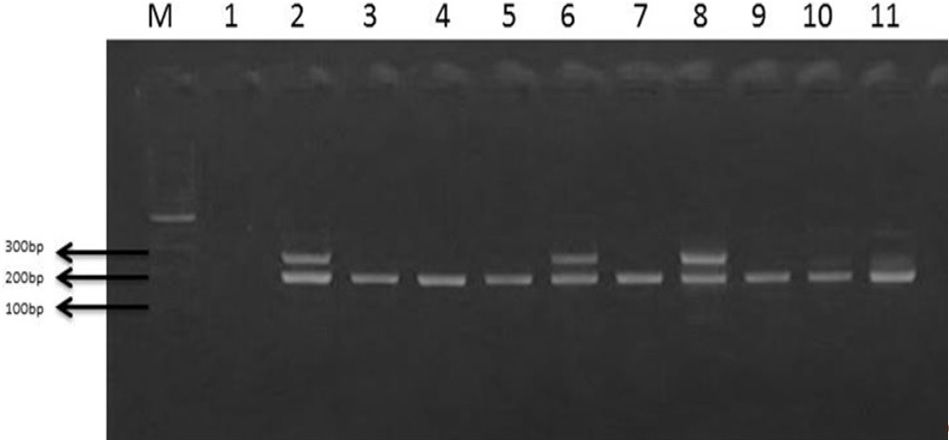
PCR results of PCR products of AMEL gene from control positives and samples. Lane M: 100bp DNA marker, Lane 1: Control negative, Lane 2: Male control positive, Lane 3: Female control positive, Lane 4: Female sample, Lane 5: female sample, Lane 6: Male sample, Lane 7: Female sample, Lane 8: Male sample, Lane 9: Female sample, Lane 10: Female sample, Lane 11: Female sample.
References
- Awan, G., Ahmad, T., Festa-Bianchet, M., 2004. Islamabad J. Sci., 14: 1-14.
- Awan, G.A., 2006. Conservation of Punjab urial (Ovis vignei punjabiensis) through long-term monitoring of marked individuals. A report to the Rufford Maurice Laing Foundation, London, UK. https://doi.org/10.2981/0909-6396(2006)12[443:PRACOP]2.0.CO;2[CrossRef]
- Awan, G.A., Festa-Bianchet, M. and Ahmad, T., 2006. Wildl. Biol., 12: 443-449. https://doi.org/10.2981/0909-6396(2006)12[443:PRACOP]2.0.CO;2[CrossRef]
- Brinkman, T.J. and Hundertmark, K.J., 2009. Conserv. Genet., 10: 1189-1193. https://doi.org/10.1007/s10592-008-9747-2[CrossRef]
- Claphaml, P.J., Palsbøll, P.J. and Mattila, D.K., 1993. Mar. Mammal. Sci., 9: 213-220. https://doi.org/10.1111/j.1748-7692.1993.tb00448.x[CrossRef]
- Habiba, U., Anwar, M., Hussain, I. and Rais, M., 2015. J. Anim. Pl. Sci., 25: 650-655.
- Khan, W., Ahmed, M., Yaqub, A., Ali, H. and Arshad, M., 2015. J. Anim. Pl. Sci., 25: 851-859.
- Reed, J., Tollit, D., Thompson, P. and Amos, W., 1997. Mol. Ecol., 6: 225-234. https://doi.org/10.1046/j.1365-294X.1997.00175.x[CrossRef]
- Richard, K.R., McCarrey, S.W. and Wright, J.M., 1994. Canad. J. Zool., 72: 873-877. https://doi.org/10.1139/z94-118[CrossRef]
- Schaller, G.B., 1977. Mountain monarchs. Wild sheep and goats of the Himalaya, University of Chicago Press.
- Shehzad, W., Riaz, T., Nawaz, M.A., Miquel, C., Poillot, C., Shah, S.A., Pompanon, F., Coissac, E. and Taberlet, P., 2012. Mol. Ecol., 21: 1951-1965. https://doi.org/10.1111/j.1365-294X.2011.05424.x[CrossRef]
- Taberlet, P., Camarra, J.J., Griffin, S., Uhres, E., Hanotte, O., Waits, L., Dubois-Paganon, C., Burke, T. and Bouvet, J., 1997. Mol. Ecol., 6: 869-876. https://doi.org/10.1111/j.1365-294X.1997.tb00141.x[CrossRef]
- Taberlet, P., Mattock, H., Dubois-Paganon, C. and Bouvet, J., 1993. Mol. Ecol., 2: 399-403. https://doi.org/10.1111/j.1365-294X.1993.tb00033.x[CrossRef]
- Valdez, R., 2008. Ovis orientalis. The IUCN Red List of Threatened Species. https://www.iucnredlist.org/species/15739/5076068
Services
Article usage statistics
Loading…