
House crow (Corvus splendens) is a native species of the Indian subcontinent. It shows greater tractability as it can easily adapt to new environment where food supply and garbage are found in abundance. Their intelligence is also acknowledged duly. They are also obligate to human presence. We can assume that “where there is human, there is house crow essentially”. The present article documents the ecology of this bird in Dir Lower, Khyber Pakhtunkhwa, Pakistan. The house crow population has reached a considerable size in the study area. The species has colonized both rural and urban areas and has dispersed throughout the study area. One of the most important factors for its population increase is the increased number of dumping sites in the area.
Short Communication · Volume 54, Issue 1, 19 December 2021 · Open Access
Ecology of House Crow (Corvus splendens) in Dir Lower, Khyber Pakhtunkhwa, Pakistan
· · ·
Affiliations & Notes ⌄
- 1Department of Zoology, University of Malakand, Chakdara 18800, Dir Lower, Khyber Pakhtunkhwa, Pakistan 2Environmental Chemistry, Ecotoxicology and Applied Ecology Laboratory, Environmental Chemistry Section, Department of Chemistry, University of Malakand, Chakdara 18800, Dir Lower, Khyber Pakhtunkhwa, Pakistan , * Corresponding author: hazratali@uom.edu.pk
- 2hazrataliuom@gmail.com
Article Info ⌄
- Journal:
- Pakistan Journal of Zoology
- Published:
- 19 December 2021

From the article
- One of the study sites in the area was observed with no crow, probably due to the absence of nearby trees, where they could perch, and due to a passageway of people.
- The house crow is very important organism in the food chain.
- The house crow is an integral part of the ecosystem and it plays a crucial role in the environment as a scavenger.
- House crow population has increased in the study area during the last two decades .
Selected from the article's own text.
Abstract
Materials and methods
We studied population biology of house crow in different areas (Supplementary Table I) of Dir Lower, Khyber Pakhtunkhwa, Pakistan. Dir Lower is a northern district of Khyber Pakhtunkhwa province with an area of 1583 km2 and a population of 1.436 million individuals (PBS, 2017). Dir Lower includes urban areas of Timergara and Chakdara. Besides this, Dir Lower has hilly areas along with plane areas. The urbanization rate is high in most of the study area where commercial buildings, houses, school buildings and roads are constructed at a high rate.
We surveyed six different study sites (Supplementary Table I) for counting of house crow at different times of the day. We counted birds in morning and evening for roost counts because they assemble at specific places on these times. We also counted birds in noon and afternoon at different dumping sites. At the end we estimated our counts separately for different locations. We intentionally grounded 10 inactive nests to closely examine their composition (Fig. 1). We separated all the components of the nests and then found out their nature. Meanwhile, we closely observed house crows at their nests to know their behavior.
Results
The dumping sites, where they congregate and share resources of the site, were observed to be full of garbage. They picked food and perched on nearby trees. A dumping site visited near University of Malakand was full of smoke from burning of plastics. The dumping site was surrounded by standing domestic wastewaters with very bad smell. The different materials observed at the site included broken clay cups, broken energy-saver bulbs, plastic spoons, plastic bags, juice packs, tablet spills, jars, chips packs, milk packs, glasses, cloth pieces, peanuts, cigarette packs, pampers, banana stems and animal dung. Small flies were found on the stagnant water. When observed from close, the birds were feeding on fruit residues, vegetables like tomato and potato, wasted meat and chicken pieces, corns and poultry egg pieces. When disturbed, they flew away and waited for peace. One of the study sites in the area was observed with no crow, probably due to the absence of nearby trees, where they could perch, and due to a passageway of people.
Table I. Nest composition of house crow (Corvus splendens) observed in the study area.
| Nest material | Number of pieces | Percentage |
| Wires | 26 | 5.76 |
| Twigs | 150 | 33.25 |
| Plastics | 22 | 4.87 |
| Leaves | 75 | 16.62 |
| Feathers | 57 | 12.63 |
| Roots | 121 | 26.82 |
| Total | 451 | 100 |
The nests were constructed on thicker branches on the tree (Supplementary Fig. 1). The nests of house crow were composed of different materials (Table I). The composition of nest materials of the house crow was nearly the same in the observed nests in the study area. Nests were made of essentially one or two metal wires which were used in the nest base and firmly held the nest to the tree. Small twigs of trees and grasses were used to seal the nest. Twigs contributed more than other components (33.25%) followed by roots of shrubs (26.82%), leaves (16.62%), feathers (12.63%) and plastic (4.87%).
Figure 1 shows that the house crow preferred rivers to other locations for nest building in the study area. A total of 668 nests were located, the highest number of nests being located at river sides (321) followed by garbage dumps (143) and the least number of nests located in parks (5). No nest was observed in markets and hills.
House crow prefers to nest at high altitudes in trees in contrast to chakor partridge Alectoris chukar which nests in shrubs on the ground . The house crow prefers different trees for nesting in different regions of the world. It prefers trees having large crown and at a certain height to prevent accessibility by humans and to see food more easily. However, Shimba and Jonah (2017) have reported that nesting success of house crow does not depend on height, canopy and tree species. In Singapore, they prefered to nest in Peltophorum pterocarpum and Samanea saman . In Mombasa, Kenya, Mangifera indica and Azandirachta indica have been reported as their most preferred nesting trees because of their large crown and height . Twelve species of trees have been reported to be used by this bird for nesting in Durban, South Africa . In Kolkata, India, 46 different species of trees have been reported to be selected by house crow for nesting . In Hazara Pakistan, four different tree species namely Bakain Melia azedarach, Chir pine Pinus roxburghii, Chinar Platanus orientalis and Obhan Populus euphratica have been found as nesting sites by this bird . In this study, we found that house crow used three tree species for nesting i.e., Lombardy poplar Populus nigra mostly while mulberry Morus nigra and Bakain Melia azedarach occasionally. Dutta and Raut (2013) have reported that for maximum survival and protection and for success to get food easily, house crows are habituated to construct nests near humans, without any hesitation. The location of nests of house crow is highly subjected to the source of food in an area .
The population of house crow in the study area has increased during the last two decades. Observations show that during this time they seem to be highly successful in the study area. Their numbers increase from year to year as the current conditions favor their feeding behavior. Roost count and total count methods were used during morning and evening to enumerate their population in the study area. The number of crows were the highest in Chakdara (347) and the lowest in Timergara (16).
Conclusions
The house crow is very important organism in the food chain. The roadside killed animals and other dead bodies are scavenged by the house crow and keeps the environment clean from debris and detritus. This bird is beneficial for populated areas as it can consume the waste from dumps, streets, houses and clean the environment and ecosystem. The house crow is an integral part of the ecosystem and it plays a crucial role in the environment as a scavenger.
House crow population has increased in the study area during the last two decades . Its breeding season in the study area starts in April when it builds nests and subsequently lays eggs in May, June and July. They have successively adapted to the study area. They construct nests at heights in trees away from human disturbance; preferring to nest in Populus nigra trees. Regarding behavior, this bird is very social and bold.
Supplementary material
There is supplementary material associated with this article. Access the material online at: https://dx.doi.org/10.17582/journal.pjz/20190716190702
Statement of conflict of interest
The authors have declared no conflict of interest.
Figures
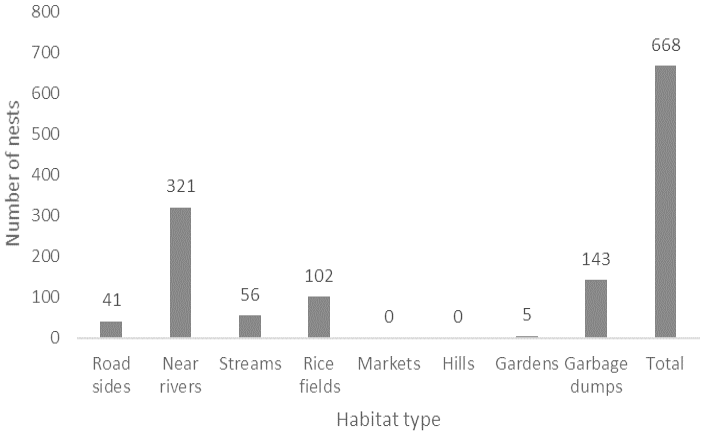
Habitat preference of house crow (Corvus splendens) for nest building in the study area.
References
- Ali, H., 2008. Behaviour and ecology of the house crow (Corvus splendens) in Islamabad-Rawalpindi and adjoining areas. PhD Thesis, Department of Zoology and Fisheries, Faculty of Science, University of Agriculture, Faisalabad (Pakistan), pp. 1-150.
- Allan, D.G. and Davies, G.B., 2005. Ostrich, 76: 21-31. https://doi.org/10.2989/00306520509485469[CrossRef]
- Awais, M., Ahmed, S., Mahmood, S., Mahmood, T. and Alvi, H., 2015. Podoces, 10: 1−7.
- Brook, B.W., Sodhi, N.S., Soh, M.C.K. and Lim, H.C., 2003. J. Wildl. Manage., 67: 808-817. https://doi.org/10.2307/3802688[CrossRef]
- Cheke, A., 2008. Phelsuma, 16: 65-68. https://doi.org/10.1111/j.1399-0004.1979.tb00853.x[CrossRef]
- Chongomwa, M.M., 2011. J. Geogr. Reg. Plan., 4: 87-97.
- Cibois, A. and Pasquet, E., 1999. Ibis, 141: 297-306. https://doi.org/10.1111/j.1474-919X.1999.tb07552.x[CrossRef]
- Dutta, S.K. and Raut, S.K., 2013. Proc. zool. Soc., 66: 141-148. https://doi.org/10.1007/s12595-013-0060-9[CrossRef]
- Dutta, S.K. and Raut, S.K., 2015. Proc. zool. Soc., 68: 96-108. https://doi.org/10.1007/s12595-014-0101-z[CrossRef]
- Fraser, D.L., Aguilar, G., Nagle, W., Galbraith, M. and Ryall, C., 2015. ISPRS Int. J. Geo-Inform., 4: 725-740. https://doi.org/10.3390/ijgi4020725[CrossRef]
- Grimmett, R., Inskipp, C. and Inskipp, T., 2013. Birds of the Indian Subcontinent: India, Pakistan, Sri Lanka, Nepal, Bhutan, Bangladesh and the Maldives. Bloomsbury Publishing.
- Khalid, S., Awan, M.S., Minhas, R.A., Ashraf, N., Khawaja, B.A., Shafi, N. and Abassi, S., 2017. Pakistan J. Zool., 49: 2331-2334. https://doi.org/10.17582/journal.pjz/2017.49.6.sc4[CrossRef]
- Kuruvilla, K., 2014. J. Entomol. zool. Stud., 2: 01-06.
- Lim, H.C. and Sodhi, N.S., 2009. Raffles Bull. Zool., 57: 561-568.
- Mahmood, T., Ahmad, I., Akrim, F., Hamid, A., Waseem, M., Hussain, A. and Nadeem, M.S., 2019. Pakistan J. Zool., 51: 265-271. https://doi.org/10.17582/journal.pjz/2019.51.1.265.271[Full text][CrossRef]
- Nyári, Á., Ryall, C. and Townsend-Peterson, A., 2006. J. Avian Biol., 37: 306-311. https://doi.org/10.1111/j.2006.0908-8857.03686.x[CrossRef]
- PBS, 2017. Provisional summary results of 6th population and housing census-2017, district wise census results. Pakistan Bureau of Statistics, Government of Pakistan.
- Peh, K.S.H., 2002. Raffles Bull. Zool., 50: 257-262.
- Ruxton, G.D. and Houston, D.C., 2004. J. Theoret. Biol., 228: 431-436. https://doi.org/10.1016/j.jtbi.2004.02.005[CrossRef]
- Ryall, C., 1995. Bull. Br. Ornithol. Club, 115: 185-187.
- Ryall, C. and Meier, G., 2008. Wildl. Middle East News, 3.
- Shimba, M.J. and Jonah, F.E., 2017. Ostrich, 88: 27-31. https://doi.org/10.2989/00306525.2016.1223766[CrossRef]
- Soh, M.C.K., Sodhi, N.S., Seoh, R.K.H. and Brook, B.W., 2002. Landscape Urban Plan., 59: 217-226. https://doi.org/10.1016/S0169-2046(02)00047-6[CrossRef]
- Veit, L. and Nieder, A., 2013. Nat. Comm., 4: Article No. 2878. https://doi.org/10.1038/ncomms3878[CrossRef]
Supplementary material
Cited by 1 article
In journals published by ResearchersLinks.
Services
Article usage statistics
Loading…