Research Article · Volume 41, Issue 2, 2 October 2026 · Open Access
Tick Repellent and Acaricidal Effect of Neem (Azadirachta indica) Leaf Extract Alone and in Combination with Garlic (Allium sativum) in Cattle
· · · · ·
Affiliations & Notes ⌄
1Department of Theriogenology, Shaheed Benazir Bhutto University of Veterinary and Animal Sciences Sakrand Pakistan. 2Department of Veterinary Medicine, Shaheed Benazir Bhutto University of Veterinary and Animal Sciences Sakrand Pakistan. 3Department of Wild Life Management, Shaheed Benazir Bhutto University of Veterinary and Animal Sciences Sakrand Pakistan. 4Department of Veterinary Pharmacology, Sindh Agriculture University Tandojam, Pakistan Corresponding Author: Sajad Ali Laghari TH04-2k23@s
The control, neem only, garlic only, and neem + garlic groups’ mean tick counts on Day 0 did not change substantially (P > 0.05), suggesting a similar degree of infestation at baseline.
In a similar vein, the tick burden gradually but significantly decreased over time in the garlic only group, but to a lesser extent than that seen with neem therapy.
Throughout all post treatment observation days, the combined neem + garlic treatment resulted in the most significant and most reliable decrease in tick numbers.
The mean number of engorged female ticks decreased from 13.5 ± 2.2 to 4.1 ± 0.7, or 69.6%, with the combination neem + garlic treatment having the biggest effect.
Selected from the article's own text.
Abstract
Ticks are prominent ectoparasites in cattle, causing direct harm through blood loss and skin irritation, as well as indirect losses through tick-borne pathogen transmission. Plant based therapies like neem (Azadirachta indica) and garlic (Allium sativum) are safer alternatives to synthetic acaricides. This study assessed the tick repellent and acaricidal efficiency of neem leaf extract, garlic juice, and their combination in naturally infested cattle in the field in Shaheed Benazirabad, Sindh. Forty indigenous cattle were randomly divided into four groups (n = 10): control (no treatment), neem, garlic, and neem plus garlic. Tick counts across treatment groups were compared over time using repeated measures ANOVA. The overall tick burden per animal was calculated by adding the tick counts on predetermined body locations (neck, dewlap, flank, groin, and tail base). Treatments were administered topically, and tick counts were taken on days 0, 7, 14, and 21. Both neem and garlic reduced tick infestations, with neem being more effective than garlic. By Day 21, the neem + garlic treatment reduced tick numbers and female tick engorgement by 71.1% and 69.6%, respectively (P < 0.05). A few animals in the neem treated groups developed mild and temporary skin responses but resolved with 48 h, and garlic alone had no adverse effects. Farmer acceptability was high for all treatments, particularly the combined therapy, which was the most cost effective and likely to be adopted. These findings show that neem and garlic are safe, effective, and farmer-friendly plant-based tick control options for cattle, with an enhanced effect when applied together.
Novelty Statement | This study presents novel field-based evidence for the acaricidal activity of Azadirachta indica and Allium sativum in naturally affected cattle under real farm conditions. It demonstrates that this eco-friendly combination significantly outperforms individual botanical treatments, offering a cost-effective and farmer-accepted alternative to synthetic acaricides.
Introduction
Global livestock production is undergoing rapid transformation, particularly in developing nations . The rapidly rising demand for animal products is causing it to change in developing countries ; . Growth in the human population, rising incomes, and urbanization have all historically contributed significantly to changes in the demand for livestock products, especially beef . Cattle production is important in global agriculture as it contributes significantly to food security, rural livelihoods, and national economies, particularly in developing nations. Cattle provide a variety of products, including meat, milk, hides, draft power, and manure, making them an important component in mixed farming systems (FAO, 2019). Indigenous cattle breeds are well adapted to harsh climatic conditions and low-input systems in tropical and subtropical regions; however, their productivity is frequently limited by poor nutrition, inadequate husbandry practices, and high disease pressure, particularly from parasitic infestations .
Ticks are among the most important ectoparasites affecting cattle, causing direct harm through blood loss, skin irritation, and decreased production, as well as indirect losses through the transmission of infections such as babesiosis, anaplasmosis, and theileriosis. Conventional tick treatment mainly relies on synthetic acaricides; however, their indiscriminate use has resulted in acaricide resistance, environmental contamination, residual problems in animal products, and higher production costs ; .
In recent years, there has been a shift toward plant-based solutions for ectoparasite management that are biodegradable, locally available, and environmentally friendly. Neem (Azadirachta indica) is well known for its insecticidal, repellent, and growth regulating capabilities due to bioactive substances such azadirachtin . Several studies have established the acaricidal activity of neem extracts against various tick species. Garlic (Allium sativum), which is well known for its antibacterial and antiparasitic capabilities, has also been observed to alter ectoparasite burden when applied to livestock.
Despite the recognized constraints of synthetic acaricides, few field studies have evaluated plant-based alternatives in indigenous cattle under tropical conditions, that’s why, the current study was conducted to assess the tick repellent and acaricidal efficiency of neem leaf extract alone and in combination with garlic in naturally infested cattle on a farm in the Shaheed Benazirabad area of Sindh.
Materials and Methods
Study area and animals
The study was conducted under field conditions in a tick endemic rural areas of district Shaheed Benazirabad. A total of 40 indigenous cattle naturally infested with ticks were selected. Animals were clinically healthy and managed under similar feeding and grazing systems. The study was conducted under semi-arid climatic conditions of Sindh, Pakistan, from March 2025 to April 2025. Animals were maintained under traditional grazing and semi-intensive management systems. Average environmental temperature ranged between 28–38 °C with moderate humidity. Animals were housed in open sheds with routine grazing access.
Experimental design
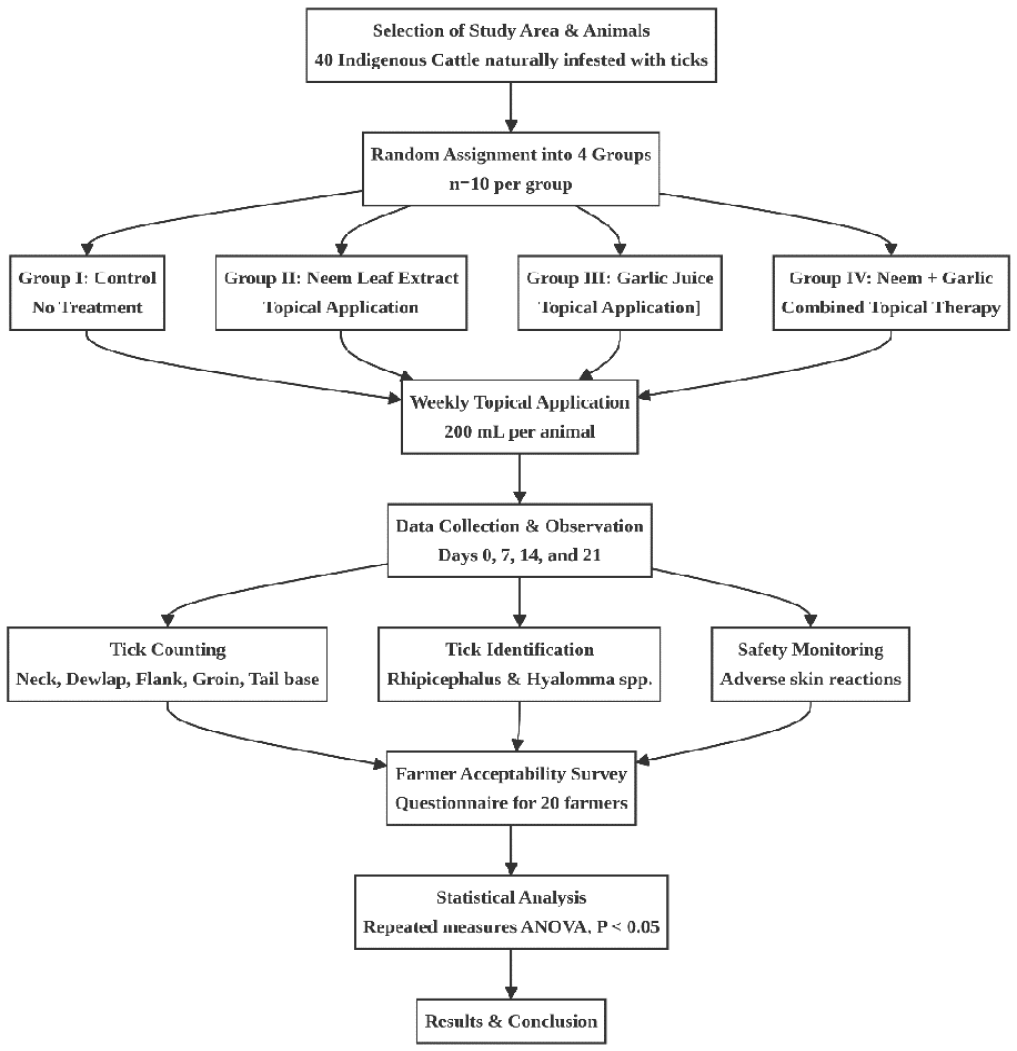
Cattle were randomly assigned to four experimental groups, each containing ten animals. Group I served as the untreated control, receiving no intervention. Group II received a topical application of aqueous neem (Azadirachta indica) leaf extract, while Group III received a topical application of garlic juice (Allium sativum). Group IV received a combined therapy of neem leaf extract and garlic applied topically. This experimental design allowed for a comparative analysis of the individual and combined effects of neem and garlic on tick infestation in field conditions The overall methodology is illustrated in Figure 1.
Preparation and application of neem leaf extract
Fresh neem leaves (1 kg) were collected, washed, crushed, mixed with 2 L water and boiled for 1-2 min and then kept for cooling to normal temperature. The extract was filtered through muslin cloth and applied topically using a hand sprayer, ensuring thorough coverage of tick predilection sites. Applied to the entire selected group weekly and volume applied was approximately 200 mL per animal.
Preparation and application of garlic juice
Fresh garlic cloves (1 kg) crushed and mixed with 2 L water and boiled for 1-2 min and then after coming to normal temperature used as topical application to the entire selected group weekly. Volume applied per animal was approximately 200 mL.
Preparation of combination of neem leaf extract and garlic juice
Fresh neem leaves (1 kg) were gathered, cleaned, crushed, and mixed in 2 L water, one Kg of fresh garlic cloves, crushed and combined with the neem leaf extract and then boiled for 1-2 min then allowed to cool to room temperature (25–30 °C) and applied to the entire selected group weekly. Equal proportions of neem and garlic extracts were mixed before application. Boiling for 1–2 min was chosen to ensure sterility and improve extraction of water-soluble organosulfur compounds (e.g., S-allylcysteine) that are more heat-stable. Cold maceration was not used because of the risk of microbial contamination under field conditions. Although prolonged heating may reduce allicin stability, short-duration heating was used to improve extract homogenization under field conditions.
Tick counting and observation
Tick counts were recorded on Days 0, 7, 14, and 21 by counting ticks on predefined body regions (neck, dewlap, flank, groin, and tail base). Engorged female ticks were recorded separately. Animals were also monitored for adverse skin reactions and behavioral changes.
Tick species and their identification
Tick species identified at the study are were from genus Rhipicephalus and genus Hyalomma. A stereomicroscope (10–40×) was used to study and identify adult ticks based on their morphology. Approximately 60% were identified as Rhipicephalus spp. and 40% as Hyalomma. According to standard taxonomic keys, Hyalomma spp. were identified by an elongated body, rectangular basis capituli, long mouthparts, banded legs, and posterior anal groove, while Rhipicephalus spp. were identified by a hexagonal basis capituli, short mouthparts, inornate scutum, and posterior anal groove.
Farmer acceptability and adoption
A standardized questionnaire was used to interview 20 farmers (5 per treatment group) following the 21-day study. They rated each treatment a score between 1-10 for cost-effectiveness, ease of preparation, and adoption willingness.
Statistical analysis
Data were expressed as mean ± standard error (SE). Repeated measures analysis of variance (ANOVA) was used to compare tick counts among treatment groups over time. Differences were considered statistically significant at P < 0.05. Percentage reduction in tick infestation was calculated using standard formulae.
Results
The four study groups Control, Neem only, Garlic only, and Neem + Garlic, each contained ten experimental animals with baseline characteristics. Animals in all groups had similar mean ages, ranging from 4.4 ± 0.7 to 4.7 ± 0.9 years, suggesting a consistent age distribution. Comparable dietary and health state at the beginning of the experiment was reflected in the closely matched body condition ratings between groups, with mean values ranging from 5.4 ± 0.4 to 5.8 ± 0.3 on a 1–10 scale. All groups had comparable baseline tick infestation levels, with mean tick counts ranging from 36.7±5.8 to 39.1±5.9. Overall, the data show that there were no discernible variations between the experimental groups in terms of age, body condition, or baseline tick burden, indicating that the animals were well matched before treatments started. The baseline characteristics of the experimental animals are presented in Table 1.
Table 1: Baseline characteristics of experimental animals.
Parameters
Control (n = 10)
Neem Only
(n = 10)
Garlic only
(n = 10)
Neem + Garlic
(n = 10)
Mean age in years
4.6±0.8a
4.4 ± 0.7a
4.7 ± 0.9a
4.5 ± 0.6a
Body condition score (1-10)
5.4±0.4a
5.6 ± 0.5a
5.6 ± 0.4a
5.8 ± 0.3a
Mean baseline tick count
38.3±6.2a
36.7±5.8a
37.9±6.1a
39.1±5.9a
Body condition score (BCS) was assessed on a 1–10 scale (1 = emaciated, 10 = obese) according to . There was no significant difference between groups at baseline (P > 0.05).
Over the course of the 21 day observation period, the animals in each treatment group had mean tick counts (± SE). The control, neem only, garlic only, and neem + garlic groups’ mean tick counts on Day 0 did not change substantially (P > 0.05), suggesting a similar degree of infestation at baseline. Over the course of the trial, tick numbers in the control group did not significantly decrease from Day 0 to Day 21. On the other hand, starting on Day 7, all treatment groups showed a significant reduction in mean tick counts in comparison to the control group (P < 0.05). By Day 7, the number of ticks in animals treated with neem alone had significantly dropped, and by Day 14 and Day 21, it had continued to decline. In a similar vein, the tick burden gradually but significantly decreased over time in the garlic only group, but to a lesser extent than that seen with neem therapy. Throughout all post treatment observation days, the combined neem + garlic treatment resulted in the most significant and most reliable decrease in tick numbers. This group had the lowest tick counts of all groups (P < 0.05), with a highly significant decline starting on Day 7 and continuing through Days 14 and 21. Overall, the findings show that both garlic and neem have acaricidal activity, and when applied together, they have a synergistic effect that improves tick control above either treatment alone. Mean tick counts are shown in Table 2.
Table 2: Mean tick counts (± SE) on several days of observation.
Treatment
Day 0
Day 7
Day 14
Day 21
Control
38.3 ± 6.2ᵃ
36.9 ± 6.0ᵃ
37.5 ± 6.1ᵃ
39.0 ± 6.3ᵃ
Neem only
36.7 ± 5.8ᵃ
28.4 ± 4.3ᵇ
19.6 ± 3.1ᵇ
21.8 ± 3.5ᵇ
Garlic only
37.9 ± 6.1ᵃ
34.2 ± 5.0ᵇ
29.1 ± 4.8ᵇ
26.7 ± 4.2ᵇ
Neem + Garlic
39.1 ± 5.9ᵃ
21.6 ± 3.5ᶜ
13.7 ± 2.8ᶜ
11.3 ± 2.2ᶜ
Superscripts (a, b, c) indicate significant differences between columns (P < 0.05).
The percentage reduction in tick infestation at various post treatment observation days for the treated groups. Tick infestation was somewhat reduced in the neem only group, with a 22.6% decrease by Day 7 and a noticeable improvement by Day 14 (46.6%), followed by a minor loss in efficacy by Day 21 (40.6%). The slight decline in efficacy for the neem-only group on Day 21 (40.6% vs 46.6% on Day 14) may be attributed to the natural degradation of bioactive compounds in the aqueous garlic extract over time under field conditions. It may be due to possible re-infestation or reduced residual activity over time.
Beginning at 9.8% on Day 7 and rising to 23.2% and 29.6% by Day 14 and Day 21, respectively, the garlic only therapy demonstrated a somewhat smaller but steady decrease in tick infestation. Over the period of the investigation, the neem + garlic therapy showed the greatest and longest lasting efficacy against tick infestation. By Day 7, a significant decrease of 44.8% was noted; by Day 14, it had grown to 65.0%, and by Day 21, it had reached 71.1%. Overall, these results show that although neem and garlic both lessen tick infestation when applied alone, their combined use is noticeably more successful, indicating a synergistic acaricidal impact. Percentage reduction in tick infestation is presented in Table 3.
Table 3: Percentage reduction in tick infestation following different botanical treatments.
Treatment
Day 7 (%)
Day 14 (%)
Day 21 (%)
Neem only
22.6
46.6
40.6
Garlic only
9.8
23.2
29.6
Neem + Garlic
44.8
65.0
71.1
Formula used: Percentage reduction (%) = ((Day 0 − Day X) / Day 0) × 100
The impact of various treatments on the average number of female ticks that were engorged between Day 0 and Day 21, as well as the corresponding percentage decrease. The mean number of engorged female ticks at baseline (Day 0) was similar in all groups, suggesting a consistent level of infestation before treatment. By Day 21, the control group’s engorged female tick population had only slightly decreased (3.0%), indicating the lack of any successful tick control measures. On the other hand, on Day 21, the quantity of engorged female ticks was significantly decreased in all treated groups. Tick feeding and development were significantly inhibited by the neem only treatment, which produced an almost 50% reduction (49.6%). Although it had a less noticeable effect than neem, the garlic only group also showed a significant reduction (40.0%). The mean number of engorged female ticks decreased from 13.5 ± 2.2 to 4.1 ± 0.7, or 69.6%, with the combination neem + garlic treatment having the biggest effect. Overall, our findings imply that both garlic and neem prevent tick engorgement, and that using them together has a better and possibly synergistic effect than using them separately. Treatment effects on engorged female ticks are summarized in Table 4.
Table 4: Treatment effects on engorged female ticks.
Treatment
Day 0
(Mean ± SE)
Day 21
(Mean ± SE)
Tick reduction (%)
Control
13.2 ± 2.1
12.8 ± 2.0
3.0
Neem only
12.7 ± 2.0
6.4 ± 1.1
49.6
Garlic only
13.0 ± 2.3
7.8 ± 1.6
40.0
Neem + Garlic
13.5 ± 2.2
4.1 ± 0.7
69.6
Reduction (%) = ((Day 0 mean engorged females – Day 21 mean engorged females) / Day 0 mean) × 100.
Observations made during the trial period on skin reactions and the general safety of the therapies. None of the animals in the control group experienced any negative skin responses, hair loss, or behavioral changes. Similarly, animals given garlic alone did not exhibit any signs of skin irritation, hair loss, or aberrant behavior, suggesting that the medication was well tolerated. One out of ten animals in the neem only group had moderate skin irritation, but no instances of hair loss or altered behavior were noted. Two animals experienced moderate skin irritation as a result of the neem + garlic therapy Mild skin irritation was observed in 2 out of 10 cattle treated with Neem extract; however, these reactions were temporary and unrelated to any noticeable behavioral changes or hair loss. With only modest and mild skin responses observed in a small number of animals receiving neem-based therapies and condition resolved within 48 h, the results indicate that all treatments were generally safe and well tolerated. Safety observations are presented in Table 5.
Table 5: Observations regarding skin reactions and safety
Treatment
Animals observed
Skin irritation
Hair loss
Behavioral changes
Control
10
0
0
None
Neem only
10
1 (mild, resolved within 48 h)
0
None
Garlic only
10
0
0
None
Neem + Garlic
10
2 (mild, resolved within 48 h)
0
None
Note: No severe adverse effects were recorded.
Farmers rated the different treatments on a 1-10 scale based on simplicity of preparation, cost efficacy, and willingness to adopt. All treatments achieved good acceptability scores, showing that farmers typically have a positive attitude toward them. The garlic only treatment had the greatest ease of preparation score (8.5±0.2), indicating that farmers found it the easiest to prepare and apply, while the neem only and neem + garlic treatments received similarly values. The combination neem + garlic treatment scored the highest (8.8±0.2) in terms of cost effectiveness, closely followed by neem only (8.6±0.2) and garlic only (8.3±0.3), indicating farmers’ perceptions of good value in relation to the observed efficacy. While the neem only therapy also demonstrated great acceptance (8.1±0.4), the neem + garlic combo treatment had the highest willingness to adopt (8.8±0.2), closely followed by the the garlic only (8.7±0.2). All treatments were generally well received by farmers, according to the results, with the combination neem+garlic treatment achieving a good balance between perceived cost effectiveness and adoption potential. Farmer acceptability scores are shown in Table 6.
Table 6: Farmer acceptance score (1–10 scale).
Parameter
Neem only
Garlic only
Neem +Garlic
Ease of preparation
8.2 ± 0.3
8.5 ± 0.2
8.0 ± 0.4
Cost effectiveness
8.6 ± 0.2
8.3 ± 0.3
8.8 ± 0.2
Willingness to adopt
8.1 ± 0.4
8.7 ± 0.2
8.8 ± 0.3
Discussion
This field study found that both Azadirachta indica (neem) leaf extract and garlic (Allium sativum) juice significantly reduced tick infestation in naturally infested cattle, with the combined neem + garlic treatment having the greatest acaricidal and repellent effects compared to individual treatments. The reduction in tick counts and engorged females throughout a 21 days observation period highlights the possibility of plant based therapies as sustainable alternatives to synthetic acaricides in practical applications.
The acaricidal and repellent efficacy of neem found in this study is consistent with previous research demonstrating the bioactivity of neem ingredients, particularly azadirachtin and related limonoids, against ticks and other ectoparasites. In the neem-only group, tick infestation decreased by 22.6% by Day 7, improved noticeably by Day 14 (46.6%), and then somewhat decreased by Day 21 (40.6%). The small reduction in an efficacy for the neem-only group on Day 21 (40.6% vs. 46.6% on Day 14) could be attributed to the natural breakdown of bioactive components in the aqueous garlic extract over time under natural conditions. It could be also due to re-infestation or a decrease in residual activity over time. Laboratory studies have found that exposure to neem extracts leads in significant mortality rates for several tick species, though the results can vary depending on the extract type and processing method used. While using more concentrated formulations than aqueous garlic extracts used in field studies like ours, hexane extracts of neem seed, for example, demonstrated strong acaricidal action comparable to commercial acaricides in controlled settings, achieving 100% mortality against Hyalomma dromedarii within 24 hours at higher concentrations . Similarly, neem aqueous garlic extracts have demonstrated significant mortality and repellency in lab trials against other ixodid species, supporting neem’s broad acaricidal profile .
Prior research has documented the efficiency of garlic extracts and oils against hard ticks, supporting the acaricidal capabilities demonstrated in the current investigation. In vitro, high quantities of garlic oil were shown to kill Boophilus annulatus adults and larvae within 24-48 hours, indicating that organosulfur compounds such as allicin contribute to tick mortality and hinder developmental phases . A subsequent study demonstrated that garlic extracts have repellent action against Hyalomma rufipes, with increased repellency at higher dosages in laboratory bioassays . These laboratory results are supported by the current field trial’s constant decrease in mean tick counts and engorged female ticks in the garlic only group, which shows that garlic’s acaricidal actions are retained, although to a lesser extent, under natural infestation conditions.
Importantly, the synergistic efficacy of neem and garlic in our trial, as indicated by the largest percentage decreases in overall tick load (up to 71.1% by Day 21) and engorged female ticks (69.6%), supports additive or synergistic interactions between bioactive components in these two botanicals. This synergy is conceptually supported by research in which mixtures of plant extracts produced greater bioactivity than individual components, an approach usually recommended to increase acaricidal benefits in ethnoveterinary applications . The combined efficacy of neem and garlic may be explained by complimentary mechanisms: azadirachtin in neem impairs ecdysis and reproduction, whilst organosulfur chemicals in garlic (e.g., allicin) give direct contact toxicity and repellency (Kristianto et al., 2023). The combination produced a greater effect than either component alone, indicating a potential additive effect. The enhanced effect of the neem+garlic combination likely arises from complementary molecular mechanisms. Neem’s limonoids (especially azadirachtin) interfere with ecdysteroid synthesis, blocking tick molting and reproduction. They also disrupt chemoreception, reducing host recognition and attachment. Garlic’s organosulfur compounds (allicin, ajoene) cause direct contact toxicity by oxidizing thiol groups in tick proteins, inhibiting acetylcholinesterase, and disrupting cell membrane integrity. Together, these compounds may impair tick feeding, reduce engorgement success, and increase mortality through synergistic stress on multiple physiological targets (Kristianto et al., 2023). Compared to chemical acaricides, plant based treatments provide considerable advantages. The use of synthetic acaricides has been linked to resistance development, environmental contamination, and residues in animal products, posing issues for long term sustainability in livestock systems . In contrast, neem and garlic are biodegradable, locally available, and widely accepted by farmers, as evidenced by the high acceptability scores reported in this study. The use of neem based medicines in cattle was generally benign, with only a few animals experiencing mild skin reactions. This is consistent with previous studies of low toxicity of plant extracts when applied topically.
Despite promising field results, there is still variability in efficacy between plant species, tick species, and extract types, highlighting the importance of consistent techniques and concentration adjustment to maximize field performance. A recent systematic study found that, whereas many plant extracts exhibit strong acaricidal activity in laboratory trials, field validation is limited, and performance varies greatly depending on species and preparation method . However, the current field data offer important proof of the usefulness of neem and garlic as environmentally friendly tick control agents in tick endemic areas and serve as a basis for additional formulation development and improvement.
The current field study definitely shows that neem (Azadirachta indica) leaf extract and garlic (Allium sativum) juice are efficient plant based tick control alternatives in cattle under natural farm conditions. When both botanicals were used separately, they considerably reduced overall tick load and engorged female ticks; however, the combined neem + garlic treatment consistently produced the best acaricidal and repellent effects during the 21 days period. The synergistic activity of neem + garlic resulted in significant reductions in tick numbers and engorgement, indicating that tick feeding and growth were disrupted more effectively than with single plant applications.
Importantly, all treatments were usually safe and well tolerated, with just a few animals exhibiting moderate and temporary cutaneous reaction to neem based applications. High farmer acceptability scores emphasize the practical importance of these treatments, which show their ease of preparation, cost effectiveness, and high potential for adoption in smallholder and resource limited farming settings.
Overall, the findings support the use of neem and garlic in tick management programs that are sustainable and environmentally friendly, with the goal of lowering reliance on synthetic acaricides. The preparation cost of botanical extracts was substantially lower than commercial acaricides because neem leaves and garlic were locally available materials. Future research focused on dose optimization, formulation refinement, longer term efficacy, and evaluation against various tick species will increase the botanicals’ utility for integrated tick control in cattle production systems.
Conclusion
The current study shows that, in natural field conditions, Azadirachta indica (neem) and Allium sativum (garlic) are efficient plant-based treatment for controlling tick infestation in cattle. Tick burden and engorged female ticks were significantly reduced by both treatments; however, their combined application consistently exhibited the best efficacy, suggesting an enhanced additive impact most likely due to complementing mechanisms of action. Notably, all treatments were primarily safe and well tolerated; just a few animals experienced modest, temporary skin responses. The high degree of farmer acceptance emphasizes the usefulness of these plant-based treatment, especially in farming systems with limited resources where locally accessible and affordable remedies are essential. Overall, the results are in favorable of using garlic and neem in sustainable tick control methods to decrease the dependence on artificial acaricides. Their relevance in integrated parasite control programs will be strengthened by additional study that focuses on formulation optimization, dose standardization, and long-term field evaluation.
Future research should evaluate the shelf-life and storage stability of aqueous neem and garlic extracts under different conditions, as well as their indirect effects on tick-borne disease transmission (e.g., Theileriosis, Babesiosis) by measuring pathogen prevalence in ticks and cattle post-treatment.
Declarations
Acknowledgement
Authors are highly thankful to local farmers and local villagers who allow us to conduct trial on their animals and providing valuable feedback after using this plant-based acaricide.
Funding
The study received no external funding.
IRB approval
The study protocol was reviewed and approved by the Department of Theriogenology, Shaheed Benazir Bhutto University of Veterinary and Animal Sciences, Sakrand, Pakistan.
Ethical statement
All procedures involving animals were carried out according to the ethical guidelines of Shaheed Benazir Bhutto University of Veterinary and Animal Sciences, Sakrand, Pakistan. Prior informed consent was obtained from livestock owners before including their animals in the study. The study involved only topical application of botanical extracts under field conditions, and all efforts were made to minimize animal discomfort.
Generative AI and AI-assisted technology statement
The authors declare that they have used AI tools (https:// deepseek.com/) to correct English and minimize grammatical errors only. All the scientific data and final editing were performed by authors, who take full responsibility for accuracy and scientific content of the study.
Statement of conflict of interest
The authors have declared no conflict of interest.
Figures
Figure 1:.
Flow chart of methodology.
References
Aboelhadid, S.M., Kamel, A.A., Arafa, W.M. and Shokier, K.A., 2013. Effect of Allium sativum and Allium cepa oils on different stages of Boophilus annulatus. Parasitol. Res., 112: 1883–1890. https://doi.org/10.1007/s00436-013-3344-0[CrossRef]
Akshaya, K.M., 2023. Chemical composition and pesticidal activity of Cinnamomum malabatrum leaf essential oil against Sitophilus oryzae (Unpublished master’s dissertation). University of Calicut.
Ali, M., Rehman, A.U., Ullah, N., Tariq, M., Bibi, S., Ullah, S., Khan, A., Ramzan, F., Ayub, M., Imam, A. and Jamil, M., 2023. Anti-tick properties/repellency of neem, Azadirachta indica on Rhipicephalus sanguineus (Acarina) under laboratory conditions. J. Bioresour. Manage., 10: 48-54.
Bisht, N., Fular, A., Ghosh, S. and Nanyiti, S., 2025. Systematic review and meta-analysis of acaricidal properties of plant derived products against Ixodid ticks population. Discover Appl. Sci., 7: Article 189. https://doi.org/10.1007/s42452-025-06629-7[CrossRef]
Cao, Y. and Li, D., 2013. Impact of increased demand for animal protein products in Asian countries: Implications on global food security. Anim. Front., 3: 48-55. https://doi.org/10.2527/af.2013-0024[CrossRef]
Food and Agriculture Organization of the United Nations, 2019. The global beef market and cattle production systems. Rome. https://www.fao.org/publications
Gareh, A., Hassan, D., Essa, A., Kotb, S., Karmi, M., Mohamed, A.E.H., Alkhaibari, A.M., Elbaz, E., Elhawary, N.M., Hassanen, E.A.A., Lokman, M.S., El-Gohary, F.A. and Elmahallawy, E.K., 2022. Acaricidal properties of four neem seed extracts (Azadirachta indica) on the camel tick Hyalomma dromedarii (Acari: Ixodidae). Front. Vet. Sci., 9: Article 946702. https://doi.org/10.3389/fvets.2022.946702[CrossRef]
Gupta, R.C., Doss, R.B., Srivastava, A., Lall, R. and Sinha, A., 2019. Nutraceuticals for control of ticks, fleas, and other ectoparasites. In: (eds. R.C. Gupta, R. Lall and A. Srivastava), Nutraceuticals in veterinary medicine. Springer International Publishing. pp. 625–633. https://doi.org/10.1007/978-3-030-04624-8_43[CrossRef]
Herrero, M., Grace, D., Njuki, J., Johnson, N., Enahoro, D., Silvestri, S. and Rufino, M.C., 2013. The roles of livestock in developing countries. Animal, 7(s1): 3-18. https://doi.org/10.1017/S1751731112001954[CrossRef]
Jaime B.H.O. and Giraldo, R.C., 2019. Economic and health impact of the ticks in production animals. IntechOpen.
Juma, P., Njau, N., Micheni, C.M., Khan, H.A., Mitalo, O.W. and Odongo, D., 2022. Trends in neem (Azadirachta indica) based botanical pesticides. In: New and future development in biopesticide research: Biotechnological exploration. Springer Nature Singapore (eds. B. Singh, K.K. Sinha and N.K. Dubey). pp. 137–156. https://doi.org/10.1007/978-981-16-3989-0_5[CrossRef]
Kebede, A., Mitiku, A., Tilahun, A., Oli, Y. and Gutata, M., 2024. Prevalence of ixodidae ticks and its associated risk factors in local breed (Zebu) cattle at Mao Komo Special District Benishangul Gumuz Regional States, Western Ethiopia. World J. Vet. Sci., 12: 1–7. https://doi.org/10.12970/2310-0796.2024.12.01[CrossRef]
Kristianto, S.S., Brotodjojo, R.R., Solichah, C. and Lakatos, L., 2023. Efficacy of extracts of garlic (Allium sativum) and neem leaves (Azadirachta indica) against Liriomyza spp. BIO Web Conf., 69: 01031. EDP Sciences. https://doi.org/10.1051/bioconf/20236901031[CrossRef]
Nchu, F., Magano, S.R. and Eloff, J.N., 2016. Repellent activities of dichloromethane extract of Allium sativum (garlic) (Liliaceae) against Hyalomma rufipes (Acari). J. S. Afr. Vet. Assoc., 87: e1–e5. https://doi.org/10.4102/jsava.v87i1.1356[CrossRef]
Ngalim, A.N., 2015. Cattle rearing systems in the North West Region of Cameroon: Historical trends on changing techniques and strategies. J. Educ. Policy Entrepren. Res., 2: 175–189.
Roche, J.R., Dillon, P.G., Stockdale, C.R., Baumgard, L.H. and VanBaale, M.J., 2004. Relationships among international body condition https://doi.org/10.3168/jds.S0022-0302(04)73441-4 scoring systems. J. Dairy Sci., 87: 3076-3079.[CrossRef]
Thomas, D. and Rangnekar, D., 2004. Responding to the increasing global demand for animal products: implications for the livelihoods of livestock producers in developing countries. BSAP Occas. Publ., 33: 1-35. https://doi.org/10.1017/S1463981500041637[CrossRef]
Zaman, M.A., Iqbal, Z., Abbas, R.Z., Khan, M.N., Muhammad, G., Younus, M. and Ahmed, S., 2012. In vitro and in vivo acaricidal activity of a herbal extract. Vet. Parasitol., 184: 221–226.
Tick Repellent and Acaricidal Effect of Neem (Azadirachta indica) Leaf Extract Alone and in Combination with Garlic (Allium sativum) in Cattle · ResearchersLinks