
Ticks infestation is the most common constraint to the livestock production in terms of drop in meat and milk production, decline in hide worth, physical damage to the skin of animals and susceptibility to infestation of tick borne parasitic infections. Conventionally acaricides are used in the treatment of tick infestation in livestock but potentially satisfactory alternative technique is the immunological control against ticks infestation. Therefore, this study was planned to investigate the effect of crude extract of hard ticks and its application as a vaccine against hard ticks of the cattle. For this purpose, ticks were collected from cattle and crude extract of ticks was prepared using standard procedures i.e. mixed with formalin, antibiotic and vegetable oil to prepare the vaccine. This vaccine was administered thrice (at weekly interval) in 15 cattle @ 1ml/50 Kg of the body weight of each animal accordingly. Fifteen cohort cattle of different age groups served as controls, administered with the standard acaricidal drug, ivermectin. At the end of each week post administration of this oil based whole crude larval extract, the number of hard ticks was counted with naked eye and the efficacy of this crude tick vaccine was determined in terms of reduction in tick number. Control of ticks and the clinical efficacy of the prepared vaccine were determined on the basis of number of ticks infesting the vaccinated and control group over 01-month period, post vaccination. The results revealed that physically the number of ticks were significantly reduced (P<0.05%) using crude larval extract vaccine (78.4%) than standard acaricidal drugs, ivermectin (63.24%) being conventionally used.
Short Communication · Volume 53, Issue 6, 15 October 2021 · Open Access
Efficacy of Whole Crude Extract of Hard Ticks in the Treatment and Control of Tick Infestation in Livestock
· · · · · · · · · · ·
Affiliations & Notes ⌄
- 1Livestock Research and Development Station, Paharpur, Dera Ismail Khan 29050, Pakistan 2Department of Clinical Medicine and Surgery, University of Agriculture, Faisalabad 38040, Pakistan 3Gomal College of Veterinary Sciences, Gomal University Dera Ismail Khan 29050, Pakistan 4Livestock and Dairy Development (Extension), Khyber Pakhtunkhwa, Dera Ismail Khan 29050, Pakistan , * Corresponding author: drarsalankhandvm@gmail.com
Article Info ⌄
- Journal:
- Pakistan Journal of Zoology
- Published:
- 15 October 2021

From the article
- From the present study, it has been concluded that whole crude tick extract vaccine is more effective than ivermectin in the treatment and control of ticks infestation in cattle, with better recovery rate and no harmful impacts.
- Moreover, the ivermectin is effective only for 2-3 weeks while crude tick vaccine is effective for long period.
Selected from the article's own text.
Abstract
Materials and methods
The present study was designed for experimental vaccination of cattle against hard ticks using their whole crude larval extract. Thirty cattle of different age groups were randomly selected for the study and were divided into two equal groups comprising 15 in each group. Group 1 was vaccinated, while group II served as control was administered with ivermectin which is used as conventional drug. Ticks were collected from cattle of various herds in district Faisalabad. The fully engorged female ixodid ticks imbibed huge amount of blood, were counted and identified on the basis of morphological features using stereomicroscope, based on the taxonomic and structural differences of the species, different instars and sexes as described by Walker et al. (2003). Five to seven partially engorged hard ticks collected from each infested cattle and were chilled at 4◦C for 30 min and washed with 70% alcohol. Then ticks were rinsed with normal saline three times to remove the debris. The rinsed ticks were ground in ice-cold 0.15M PBS (pH 7.2) at the rate of 10 ticks per ml, and filtered through 4 layers of muslin cloth. The resulting crude tick extract was centrifuged and the supernatant was stored at -40◦C. The total protein content of the supernatant was estimated by the kit method ; ; . The vaccine was prepared using 1% formalin, 5% antibiotic (oxytetracycline, 100mg) and 40% vegetable oil in the ticks extract in this collected supernatant. Animals of Group I were vaccinated with whole crude tick extract vaccine via subcutaneous route @1ml/50 Kg body weight of the animal, in 3 successive doses at weekly interval. Group II served as control and was administered with standard acaricidal drug (ivermectin).
At the end of each week post administration of whole crude tick extract vaccine, the number of hard ticks was counted with naked eye and the efficacy of the vaccine was determined in terms of reduction in number of infesting ticks. Weight of the engorged ticks was calculated to determine the amount of blood sucked from the hosts accordingly. Control of ticks was determined on the basis of number of ticks infesting the vaccinated and control group over period of 01 month, post vaccination. Moreover, immunoglobulin G (IgG) level was detected in the animals on weekly basis using ELISA technique.
Results and discussion
Table I shows the number of ticks counted at the end of each week on different parts of the body of the animals like udder, thighs, ear etc. Group A was administered with whole crude tick extract vaccine and Group B was treated with acaricidal drug (ivermectin) in 3 successive doses at weekly interval.
The results of the current study revealed that whole crude tick extract vaccine was more effective in the control of ticks compared to standard acaricidal drug ivermectin.
Table I. Ticks collected from different sites of experimental cattle before and after vaccination.
| Group | No. of Animals | No. of adult ticks collected | Ticks collected from thighs | Ticks collected from ears | Ticks collected from udder | Mean | |||||
| Pre-vac | Post-vac | Pre-vac | Post-vac | Pre-vac | Post-vac | Pre-vac | Post-vac | Pre-vac | Post-vac | ||
| Group A | 15 | 123 | 27 | 45 | 12 | 58 | 8 | 20 | 7 | 41±3.86 | 9 ±0.23 |
| Group B | 15 | 117 | 43 | 38 | 18 | 63 | 14 | 16 | 11 | 39±2.97 | 14.33±2.1 |
| Total | 30 | 240 | 70 | 83 | 30 | 121 | 22 | 36 | 18 | ||
Pre-vac,before vaccination; Post-vac, after vaccination. A, administred with crude ticks extract; B, treated with ivermectin.
In group A, 78.4% ticks were significantly (P<0.05%) eliminated from different parts of the animals and in Group B the recovery/ticks elimination rate was 63.24% from the infested animals (Fig. 1). Similar studies were conducted on sheep in which Hyalomma anatolicum anatolicum were used for larval antigen preparation and administered via subcutaneous route @ 0.1ml and sheep were found resistant to ticks infestation . It was also reported from a study that antigen from midgut of Hyalomma anatolicum anatolicum was administered in rabbits and that maximum resistance was reported against tick infestation (H. a. anatolicum) in the immunized rabbits .
The hematological parameters of the cattle infested with ticks were determined and compared to the healthy cattle free from ticks (Table II). A similar study also revealed that the hematological parameters were significantly affected (P<0.001) in calves, due to tick infestations .
The IgG level was determined at the end of each week and it showed significant increase i.e. 1590, 1698, 1838, 2055 and 2140 mg/dl of IgG level in the blood. At the end of 5th week, IgG level as maximum showing maximum resistant against tick infestation in cattle.
It is further added that no doubt ticks are ectoparasites, but ticks attach to the body of the host and sucks the blood that contain antibodies. A study was conducted on the similar concept of anti tick vaccine, whereby the efficacy of the Bm86 midgut antigen and the cytosolic Subolesin (SUB) antigen was evaluated in vitro and it was concluded that R. australis larval feeding was significantly reduced. Similarly, Salp 15 antibodies were also considered effective against ticks infestations. In another study it was observed that hosts developed immune response to tick salivary proteins following repeated tick exposure that impaired tick and pathogen viability, including cutaneous inflammation and resulted in itch and an increased awareness of infesting ticks ; .
Table II. Comparison of hematological parameters of ticks infested and healthy cattle.
| Parameters | Healthy | Infected |
| Red blood cells x 1012/l | 4.8 | 2.06 |
| Hematocrit (l/l) | 0.26 | 0.13 |
| Hemoglobin (g/dl) | 7.5 | 3.7 |
| Mean cell volume (fl) | 54.0 | 61 |
| Mean cell hemoglobin concentration (g/dl) | 30 | 29.36 |
| WBCs (x109/l) | 11.7 | 17 |
| Neutrophils (x109/l) | 4.79 | 6.46 |
| Lymphocytes (x109/l) | 7.19 | 0.34 |
| Platelets (x109/l) | 310 | 115 |
| Myeloid: erythroid ratio | 2.47 | - |
| Myeloblasts (in marrow) | 2.6 | - |
Conclusion
From the present study, it has been concluded that whole crude tick extract vaccine is more effective than ivermectin in the treatment and control of ticks infestation in cattle, with better recovery rate and no harmful impacts. Moreover, the ivermectin is effective only for 2-3 weeks while crude tick vaccine is effective for long period.
Statement of conflict of interest
The authors have declared no conflict of interest.
Figures
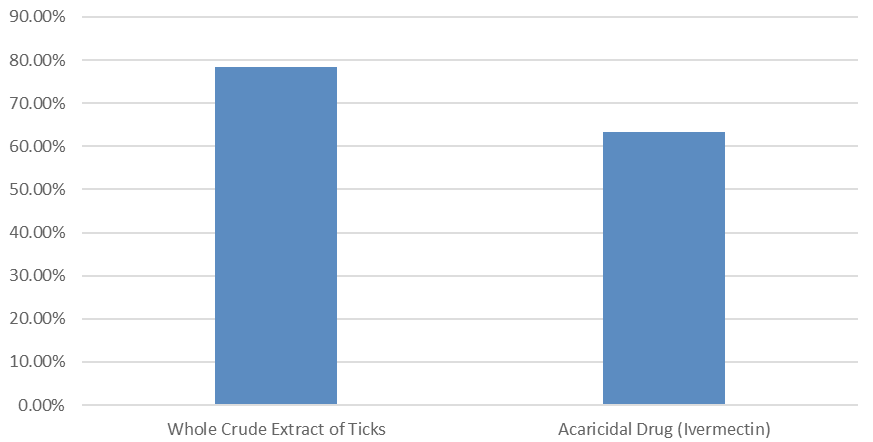
Clinical efficacy of whole crude extract of hard ticks for the treatment and control of tick infestation in cattle.
References
- Ali, Z., Maqbool, A., Muhammad, K., Altaf, I., Khan, M.S., Rabbani, M., Hanif, A. and Iqbal, H.J., 2009. Pakistan J. Zool. Suppl. Ser., 9: 167-172.
- Chaidez, F.A., Ryan, R., Wikel, S., Dardick, K., Lawler, C., Foppa, I.M., Tomas, P., Cushman, A., Hsieh, A. and Spielman, A., 2006. Clin. Vaccine Immunol., 3: 1217-1222.
- Ghosh, S., Khan, M.H. and Gupta, S.C., 1998. Indian J. Exp. Biol., 36: 167-170.
- Iqbal, R.Z., Hua, H.S., Jun, C.W., Abdullah, A. and Chenwen, X., 2006. J. Zhejiang. Univ. Sci., 7: 912-921. https://doi.org/10.1631/jzus.2006.B0912[CrossRef]
- Kaur, D., Jaiswal, K. and Mishra, S., 2017. J. Ent. Zool. Stud., 5: 107-111.
- Madani, R., Golchinfar, F., Dadmehr, A. and Abdigoudarzi, M., 2008. Arch. Razi Inst., 63: 47-52.
- Merino, O., Alberdi, P., Perezdela Lastra, J.M. and Fuente, J., 2013. Cell Inf. Micro., 30: 1-10.
- Muhammad, G., Naureen, A., Firyal, S. and Saqib, M., 2008. Pak. Vet. J. 28: 43-50.
- Mustafa, B.H.S., 2012. Int. J. Pl. Anim. Environ. Sci., 2: 227-231.
- Patarroyo, J.H., Portela, R.W., De Castro, R.O., Pimentel, C., Guzman, F., Patarroyo, M.E., Vargas, M.I., Prates, A.A. and Mendes, M.A., 2002. Vet. Immunol. Immunopathol., 88: 163-172. https://doi.org/10.1016/S0165-2427(02)00154-X[CrossRef]
- Trentelman, J.J.A., Teunissen, H., Kleuskens, J.A.G.M., Crommert, J., Fuente, J., Hovius, J.W.R. and Schetters, T.P.M., 2019. Parasit. Vectors, 12: 362. https://doi.org/10.1186/s13071-019-3616-3[CrossRef]
- Walker, A.R., Bouattour, A., Camicas, J.L., Estrada-Pena, A., Horak, I.G., Latif, A., Pegram, R.G. and Preston, P.M., 2003. Biosci. Rep., London, UK.
- Wikel, S.K., 1996. Annu. Rev. Entomol., 41: 1–22. https://doi.org/10.1146/annurev.en.41.010196.000245[CrossRef]
Services
Article usage statistics
Loading…