
Physiological adjustments to seasonal variations of the environment, such as changes in body mass and energy metabolism, are important adaptive strategies for small mammals. Ambient cues, as temperature and photoperiod, play important roles in animals’ physiological adjustments. In order to determine the contributions of temperature and photoperiod to seasonal changes in body mass and thermogenesis in Apodemus chevrieri, we examined seasonal-acclimatized and lab-acclimated animals on several physiological, hormonal, and biochemical markers indicative of thermogenic capacity. The results showed that A. chevrieri adapt to winter or under cold condition by increasing thermogenesis and food intake. The present results suggest that the observed physiological regulation from the organismal, hormonal levels to the cellular levels of this alpine small mammal were important and allowed A. chevrieri to overcome the physiological challenges of an change to cold environment in winter successfully with the seasonal variations. Cold can induce an increase in mitochondrial protein contents and COX activity both in liver and brown adipose tissue, suggesting that A. chevrieri was more sensitive to cold than that of photoperiod. Together, these data suggested that A. chevrieri mainly depend on increasing thermogenic capacity to cope with cold or winter condition.
Research Article · Volume 49, Issue 1, 4 October 2016 · Open Access
Thermal Physiology and Bioenergetics in Ambient or Seasonal Acclimatization in Apodemus chevrieri
·
Affiliations & Notes ⌄
- 1Key Laboratory of Adaptive Evolution and Ecological Conservation on Plants and Animals in Southwest Mountain Ecosystem of Yunnan Higher Education Institutes, School of Life Sciences, Yunnan Normal University, 1st Yuhua District, Chenggong County, Kunming City, Yunnan Province, People’s Republic of China, 650500 Email: zwl_8307@yahoo.com
Article Info ⌄
- Journal:
- Pakistan Journal of Zoology
- Published:
- 4 October 2016

From the article
- Changes in body mass and energy metabolism are important adaptive strategies for small mammals under seasonal variations of the environment.
- Data from our study suggested that A. chevrieri showed seasonal adaptations of body mass regulation.
- Together, these data suggested that A. chevrieri mainly depend on increasing food take and thermogenic capacity to cope with cold or winter condition.
Selected from the article's own text.
Abstract
Introduction
Physiological adjustments, such as changes of body mass and energy metabolism, to seasonal variations of the environment are important adaptive strategies for small mammals ; . It is well known that small mammals possess physiological adaptive strategies to cope with variations in the environment such as photoperiod and/or temperature changes . However, endotherms require appropriate responses and efficient thermoregulatory mechanisms to regulate body mass and thermogenic capacity (nonshivering thermogenesis, NST) to cope with winter-like conditions ; ; ; ; Zhang et al., 2011; Zhang and Wang, 2007; ; . Liver metabolism accounts for 20–25% of RMR . Brown adipose tissue (BAT) is the structure mostly responsible for NST during cold climate or winter ; , during which the NST increases through a process that involves hypothalamic-pituitary-thyroid axis and sympathetic nervous system . BAT capacity to produce NST entirely depends on uncoupling protein 1(UCP1) . As the cytochrome c oxidase (COX) represents the terminal enzyme of oxidative phosphorylation in mitochondria, and is involved in mitochondrial energy metabolism .Triiodothyronine (T3), affects almost every physiological process in the body, including growth, development and metabolism . Thyroxine (T4) is tyrosine-based hormone produced by the thyroid gland that is primarily responsible for regulation of metabolism . Thyroid-stimulating hormone (TSH) is a hormone that stimulates the thyroid gland to produce T4, and then T3 which stimulates the metabolism of almost every tissue in the body .
Apodemus chevrieri is a inherent species in Hengduan mountain region . Previous studies had demonstrated the presence of a seasonal variation in digestive tract morphology in A. chevrieri (Zhu et al., 2012a). Specifically, cold environment reduced serum leptin levels but enhance thermogenic capacity in A. chevrieri , whereas the short photoperiod enhance thermogenic capacity (Zhu et al. 2013a). However, we know nothing about seasonal changing, both temperature and photoperiod influenced its physiological adaptation from the hormonal levels to the cellular levels. The aim of the present study was to determine the response of body mass, enzyme activity and hormone concentrations in A. chevrieri under seasonal acclimatized and lab acclimated. We hypothesized that A. chevrieri showed seasonal changes of body mass, and temperature and photoperiod may play roles in its body mass regulation. We predicted that A. chevrieri would show significant seasonal changes in body mass, enzyme activity and hormone concentrations among different seasons, and temperature and photoperiod play important roles in its physiological adjustments.
Materials and methods
Samples
A. chevrieri were captured in farmland (26°15´-26°45´N; 99°40´-99°55´E; altitude 2,590m) in Jianchuan County, Yunnan province. All animals were healthy adults. A. chevrieri was housed individually in a wire cage (350×300×250mm3). Food and water were provided ad libitum. All pregnant, lactating or young individuals were excluded. All animal procedures were licensed under the Animal Care and Use Committee of School of Life Sciences, Yunnan Normal University (Permit No.: 13-0901-011).
Experiment 1
The experiment was performed in 2014-2015. A. chevrieri were wild-captured in mid-July and October 2014, mid-January and late April 2015 (referred to as the summer, autumn, winter and spring groups hereafter). Between capture and food intake analysis, the animals were kept individually in plastic cages (350×300×250 mm) in a room with natural temperature and photoperiod, spring (5.4°C), summer (23.9°C), fall (16.6°C) and winter (−3.8°C). After the measurement of body mass and food intake, subjects were sacrificed by puncture of the posterior vena cava within 4 days after capture for all the four seasons, and blood and tissue samples were taken for measurement of physiological parameters . A total of 40 adult A. chevrieri were used in the present study (summer, n=10; autumn, n=10; winter, n=10; spring, n=10). Between capture and metabolic analysis, the animals were kept individually in a metabolic cage (40×40×40cm3) in a room with natural temperature and photoperiod. Food intake was calculated as the mass of food missing from the hopper, subtracting orts mixed in the bedding.
Experiment 2
Animals used in Experiment 2 were offspring of adult A. chevrieri, that were captured in mid-July 2014 and then transported to School of Life Sciences of Yunnan Normal University, housed in plastic box (350×300×250mm3) individually. In order to test singularly or associate the effects of ambient temperature, photoperiod on mitochondrial protein content and COX activity and serum hormones, 40 adult weight-matched A. chevrieri were housed individually (were maintained at 12L: 12D (light on at 08:00am), 25±1ºC, respectively), and kept for at least 2 weeks to familiarize with the environment. After the acclimatizing period, the animals were randomly assigned to the following four groups: long photoperiod (LD, 16L: 8D) cold (5±1°C), LD, and warm (30±1°C), short photoperiod (SD, 8L: 16D) cold, SD and warm; each group included 10 individuals. Animals were acclimated for 4 weeks. Food intake was calculated as the mass of food missing from the hopper, subtracting orts mixed in the bedding.
Measurement of mitochondria respiration
After the measurements of food intake , animals were killed between 1200 and 1400 by decapitation and blood was collected for hormone determination. The blood was centrifuged at 4,000 rpm for 30 min after a 30-min interval and the serum was collected and stored at -72°C for hormone determination. Liver, BAT and testicular were carefully and quickly removed and weighted (0.1mg), and their adhering tissues separated. Liver and BAT were blotted, weighed, and placed in ice-cold sucrose-buffered medium and then homogenized for the isolation of mitochondria . The protein content of mitochondria was determined by the Folin phenol method with bovine serum albumin as standard . State 4 (ST4) of mitochondrial respiration of liver and BAT were measured by Hanstech Oxy-Lab Chloroab 2 oxygen electrode (Hansatech Instruments LTD., England).
Measurement of enzyme activity
The COX (EC 1.9.3.1) activity of liver and BAT was measured with polarographic method using oxygen electrode (Hansatech Instruments LTD., England) , and the α-glycerophosphate oxidase (a-PGO; EC 1.1.3.21) was determined polarographically according to Steffen and Roberts . Thyroxin 5’-deiodinase (T4 5’-DII; EC 1.97.1.10) activity in BAT was assayed as previously described .
Measurements of hormone concentration
The concentrations of triiodothyronine (T3), thyroxine (T4), Thyroid-stimulating hormone (TSH), and testosterone (T) in the serum were determined by radioimmunoassay using RIA kits (China Institute of Atomic Energy). These kits were validated for all species tested by cross-activity. Intra- and inter-assay coefficients of variation were 2.4% and 8.8% for the T3, 4.3% and 7.6% for T4, 3.6% and 6.9% for TSH, and 7.6% and 8.1% for T, respectively.
Statistical analysis
Data were analyzed using SPSS 16.0 software (SPSS Inc., Chicago, IL, USA). Prior to all statistical analyses, data were examined for assumptions of normality and homogeneity of variance using the Kolmogorov–Smirnov and Levene tests, respectively. Seasonal data such as COX activity, mitochondrial protein content and thyroid hormones were analyzed by one-way analysis of variance (ANOVA). Two-way ANCOVA was used to detect the effect of photoperiod and temperature on thermogenic properties in liver, BAT and hormones, using body mass as the covariate. Differences among groups were detected by Duncan. Since no gender effects were found on almost all measured parameters, data from females and males were combined. Results are presented as mean ± SE (n sample size) in the test, and P<0.05 was considered to be statistically significant.
Results
Changes in mitochondrial protein content and COX activity
There was a significant difference in the absolute mass of BAT among different seasons (F=5.32, P<0.05, Table I). The mitochondrial protein content (MtP) and BAT COX activity varied significantly among seasons (MtP: F=2.35, P<0.01; COX: F=6.54, P<0.01). The MtP and COX activity in winter were significantly higher than that of other seasons. There was a significant difference in the absolute mass of liver (F=4.59, P<0.01, Table I). The MtP and COX activity in liver varied significantly among seasons (MtP: F=6.25, P<0.01; COX: F=5.89, P<0.01, Table I). The MtP and COX activity in winter were markedly higher than that of other seasons.
Changes in serum hormones
Seasonal alterations were also detected in testicular mass (F= 5.36, P<0.01, Fig. 1A), which was significantly lower in winter than that in summer. Seasonal alterations were also detected in T3 and testosterone (T) levels (T3: F=5.35, P<0.01, Table I; T: F=6.16, P<0.01, Fig. 1B). Serum T4 and TSH levels gradually decreased from warmer to colder months, but showed no significant differences. Food intake showed significant differences among different seasons (Fig. 2).
Effects of photoperiod and/or temperature on mitochondrial protein content and COX activity
Both photoperiod and temperature, or by the interaction of the two parameters had significant effects on ST4 and COX activity in liver (Table II). In BAT, TP contents, MP contents, ST4 levels, COX activity, T4 5’-DII activity and UCP 1 contents were affected by both photoperiod and temperature, or by the interaction of the two parameters (Table II). But BAT mass was influenced significantly only by temperature (photoperiod: F=0.64, P>0.05; temperature: F=4.21, P<0.01, interaction: F=0.95, P>0.05, Table II).
Effect of photoperiod and/or temperature on serum hormones
Temperature, but not photoperiod or the interaction of photoperiod and temperature, had a significant effect on T4 levels for A. chevrieri (Table II). Temperature or photoperiod and the interaction of both parameters had a significant effect on T3 levels for A. chevrieri (photoperiod: F=4.31, P<0.01; temperature: F=5.45, P<0.01; interaction:
Table I.- Thermogenic properties in liver, brown adipose tissue and hormones in Apodemus chevrieri under different seasons
| Spring(n=10) | Summer(n=10) | Autumn(n=10) | Winter(n=10) | |
| Body mass | 31.23±2.8b | 38.65±3.8 a | 36.24±1.6 a | 30.01±2.3 b |
| Brown adipose tissue | ||||
| Mass (g) | 0.20±0.07 a | 0.13±0.07 b | 0.12±0.06b | 0.23±0.05a |
| % body mass | 0.58±0.02 b | 0.34±0.02 c | 0.33±0.01 c | 0..77±0.04 a |
| TP (mg·g-1) | 226.41±11.23a | 165.39±8.97 b | 176.59±8.02b | 236.69±10.81a |
| MtP (mg·g-1) | 32.21±1.94b | 26.92±1.02c | 27.58±0.84 c | 39.98±2.95a |
| ST4 (nmol O2 mg-1 MtP min-1) | 35.89±3.45 a | 28.36±3.15 b | 29.11±2.36 b | 36.95±4.26 a |
| COX (μg atoms O2min-1 mg-1 MtP) | 84.63±5.12b | 54.33±3.25 c | 58.69±4.69c | 95.41±5.21a |
| T4 5’-DII (pmol O2 ·mg-1 ·MtP min-1) | 34.38±2.51 a | 24.61±2.23 b | 25.64±1.78b | 38.45±2.36a |
| Liver | ||||
| Mass (g) | 2.32±0.16b | 1.67±0.22c | 1.73±0.21 c | 2.78±0.16a |
| % body mass | 7.42±0.56 a | 4.32±0.15 b | 4.77±0.35 b | 9.26±0.95 a |
| TP (mg·g-1) | 231.25±12.47 a | 182.81±13.26 b | 186.59±12.64 b | 237.52±15.23a |
| MtP (mg·g-1) | 49.61±3.21b | 35.41±3.95c | 36.11±2.22 c | 55.33±4.11a |
| ST4 (nmol O2 mg-1 MtP min-1) | 37.27±2.96 a | 25.57±1.61 b | 26.98±1.84 b | 39.25±3.48a |
| COX (μg atoms O2min-1 mg-1 MtP) | 69.24±3.34b | 56.64±4.12c | 60.14±2.36 c | 75.02±2.42a |
| Hormones | ||||
| Tri-iodothyronine (T3, ng·ml-1) | 1.25±0.11ab | 0.85±0.05c | 0.88±0.13b | 1.36±0.12a |
| Thyroxine (T4, ng·ml-1) | 13.25±0.78 a | 14.26±0.32 a | 14.33±0.16 a | 14.69±0.51 a |
| T3/T4 (×100) | 9.43±0.34 a | 5.96±0.15 b | 6.14±0.12 b | 9.26±0.61a |
| Thyroid-stimulating hormone (TSH, ng·ml-1) | 0.91±0.05 a | 0.88±0.07 a | 0.89±0.05 a | 0.92 ±0.09 a |
Different superscripts in each row means significantly different (P<0.05).
F=2.85, P<0.05, Table II). Temperature and photoperiod had significant effects on TSH levels for A. chevrieri, but no effect of the interaction of photoperiod and temperature was found (photoperiod: F=2.92, P<0.05; temperature: F=4.25, P<0.05; interaction: F=0.225, P>0.05, Table II).
Discussion
Changes in body mass and energy metabolism are important adaptive strategies for small mammals under seasonal variations of the environment. Ambient cues, such as temperature and photoperiod, play important roles in animals’ physiological adjustments . Data from our study suggested that A. chevrieri showed seasonal adaptations of body mass regulation. For example, thermogenic capacity to adapt to winter like conditions (increased of COX activity with cold and short photoperiod), regulation of the appetite (increased food intake), variation of modification of biochemical and hormonal markers indicated that animals’ abilities to adapt the variations of the environment in its natural habitat. In particular, temperature and photoperiod were important factors that influences the enzyme activity and hormone concentrations in A. chevrieri.
Seasonal variations in biochemical and hormonal markers
In the prior reports, A. chevrieri showed an decrease in body mass in winter (Zhu et al., 2012a). In the current study, A. chevrieri also showed a significant seasonal variation in body mass, which was highest in summer and lowest in winter. Similar results were found in other species, such as Microtus maximowiczii , M. pennsylvanicus , M. ochrogaster and A. draco (Zhu et al., 2012b). Small mammals mainly increase thermogenic capacity to cope with cold stress . In the present study, there were significant seasonal variations in several biochemical markers indicative of thermogenic capacity, which was supported by the MtP contents, the COX activity in liver and BAT, showing a consistency with the findings of previous studies on Ochotona curzoniae , Acomys russatus and A. draco (Zhu et al., 2013b). T4, the primary thyroid-product, is relatively inactive until deiodinated to T3 , and TSH stimulates circulating concentrations of T3 and T4 . Thyroid hormones are major modulators of cold-induced NST : T3 is the only active form of thyroxins, and mainly affect the expression of UCP1 . In the present study, T4 5’-DII activity in winter was significantly higher than that in summer, it is responsible for the production of T4 by thyroid gland and its transformation in the peripheral tissues into T3. T3 concentration in winter was significantly higher than
Table II.- Influences of photoperiod and/or temperature on thermogenic properties in liver, brown adipose tissue and hormones in Apodemus chevrieri
| Short photoperiod | Long photoperiod | |||
| 5ºC (n=10) | 30ºC (n=10) | 5ºC (n=10) | 30ºC (n=10) | |
| Body mass | 26.35±1.54 c | 32.36±1.21 a | 29.35±0.89 b | 35.24±1.25 a |
| Food intake(g/d) | 9.23±1.02 a | 6.25±0.54 b | 8.62±0.82 a | 6.03±0.46 b |
| Brown adipose tissue | ||||
| Mass (g) | 0.23±0.02 a | 0.17±0.04 b | 0.21±0.05 a | 0.16±0.03 b |
| % body mass | 0.97±0.02 a | 0.52±0.01 b | 0.53±0.02 b | 0.45±0.01 c |
| TP (mg·g-1) | 236.68±23.65 a | 156.32±10.23 c | 212.32±15.32 b | 145.35±11.02 c |
| MtP (mg·g-1) | 37.12±1.81 a | 18.65±1.12 c | 32.1±1.91 b | 16.73±1.56 c |
| ST4 (nmol O2 mg-1 MtP min-1) | 45.25±2.36 a | 28.36±1.54 b | 43.78±4.21 a | 25.36±2.21 c |
| COX (μg atoms O2min-1 mg-1 MtP) | 102.36±9.56 a | 70.02±6.35 c | 94.36±6.35 b | 65.32±4.21 c |
| T4 5’-DII (pmol O2 ·mg-1 MtP min-1) | 31.21±2.35 a | 18.54±2.36 c | 35.26±2.12 b | 16.98±1.92 c |
| Liver | ||||
| Mass (g) | 2.06±0.53 a | 1.58±0.22 c | 1.89±0.34 b | 1.32±0.33 c |
| % body mass | 7.81±0.25 a | 4.88±0.26 c | 6.43±0.33 b | 3.74±0.21 d |
| TP (mg·g-1) | 231.23±11.25 a | 88.61±7.93 c | 202.36±11.63 b | 84.36±6.32 c |
| MtP (mg·g-1) | 43.72±5.31 a | 28.51±6.42 b | 40.91±3.51 a | 27.11±4.12 b |
| ST4 (nmol O2 mg-1 MtP min-1) | 40.67±2.31 a | 22.51±3.21 c | 39.72±4.11 b | 18.75±3.72 c |
| COX (μg atoms O2min-1 ·mg-1MtP) | 85.61±10.11 a | 55.82±9.82 c | 78.52±8.42 b | 52.91±4.82 d |
| Hormones | ||||
| Tri-iodothyronine (T3, ng·ml-1) | 1.53±0.12 a | 0.52±0.02 b | 1.23±0.06 a | 0.51±0.03 b |
| Thyroxine (T4, ng·ml-1) | 13.53±0.94 a | 6.47±0.58 c | 11.41±1.12 b | 6.24±0.56 c |
| T3/T4 (×100) | 11.30±0.12 a | 8.03±0.15 c | 10.78±0.13 b | 8.17±0.16 c |
| Thyroid-stimulating hormone (TSH, ng·ml-1) | 1.18±0.15 a | 0.77±0.14 b | 0.89±0.11b | 0.69±0.12 c |
Different superscripts in each row means significantly different (P<0.05).
that in summer, associated with seasonal changes in NST. In A. chevrieri, the testosterone concentration and testicular mass in summer and autumn (the breeding seasons) were significantly higher than in winter, suggesting the possible use in protecting the territory and fighting for mates . Our findings may indicate that variations of thermogenesis may be not only subjected by endocrine regulation, but also depended on the changes of the physiology of breeding. This adjustment mechanism may be supported with “challenge hypothesis”, which predicts that seasonal patterns in testosterone levels are a function of mating system (monogamy versus polygyny), paternal care, and male-male aggression in seasonal breeders .
Effects of photoperiod and/or temperature in enzyme activity and serum hormones
In prior reports had been shown that both short photoperiod or cold temperature are important environmental cues that can influence the decrease in body mass, increase in food intake and thermogenic capacity in A. chevrieri (Zhu et al. 2012a). As a key element of the adipostatic mechanism for regulating body mass were influenced by both short photoperiods and cold in A. chevrieri (Table II). The variations in thermogenesis at individual level were supported by biochemical markers such as MP content and COX activity. We found differences in serum T3 and T4 contents, the serum T3 and T4 were higher in short photoperiod and cold group than that in long photoperiod and warm group, then short photoperiod and cold induced increases in TSH level (Table II). We also found that the T4 5’-DII was higher in the short photoperiod in cold group than that in other groups. T3 and T4 concentration is associated with the activity of T4 5’-DII. In fact, TSH may indicate that the process of transformation of T4 into T3, and promoted by T4 5’-DII activity increasing, with a consequent higher sensitivity of A. chevrieri to cold than that of photoperiod.
Conclusions
In conclusion, environmental factors play key roles in the regulation of seasonal adaptation of body mass, hormonal and biochemical markers, and food intake in A. chevrieri. The present results suggested that the observed physiological regulation from the organismal, hormonal levels to the cellular levels of this alpine small mammal were important and allowed A. chevrieri to overcome the physiological challenges of an change to cold environment in winter successfully with the seasonal variations. Together, these data suggested that A. chevrieri mainly depend on increasing food take and thermogenic capacity to cope with cold or winter condition.
Acknowledgments
This research was financially supported by National Science Foundation of China (No. 31260097; 31560126), and Launch scientific research projects of Yunnan Normal University. Thank you for the two anonymous reviewers and the editor of the journal for their valuable comments.
Competing interests
The authors declare that they have no competing interests.
Figures
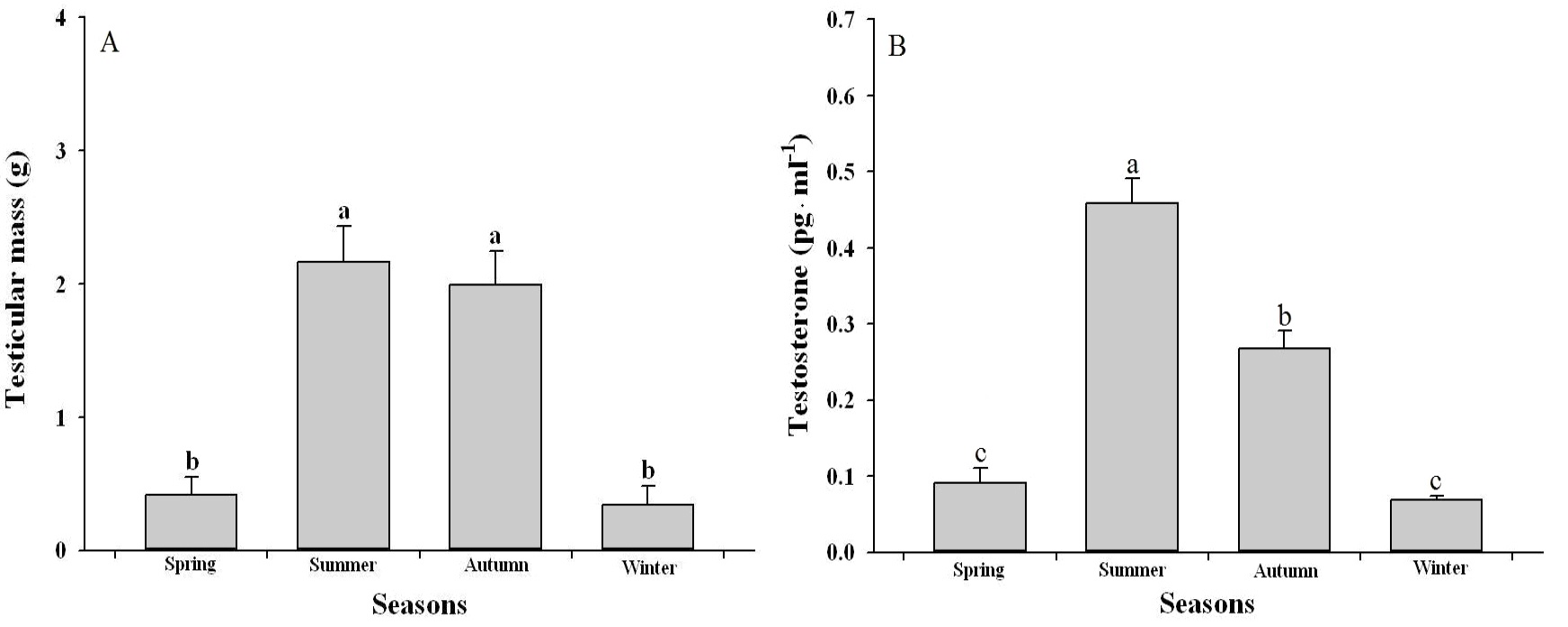
Seasonal variations of testicular mass (A) and testosterone (B) in Apodemus chevrieri. Different superscripts in each row means significantly different (P<0.05).
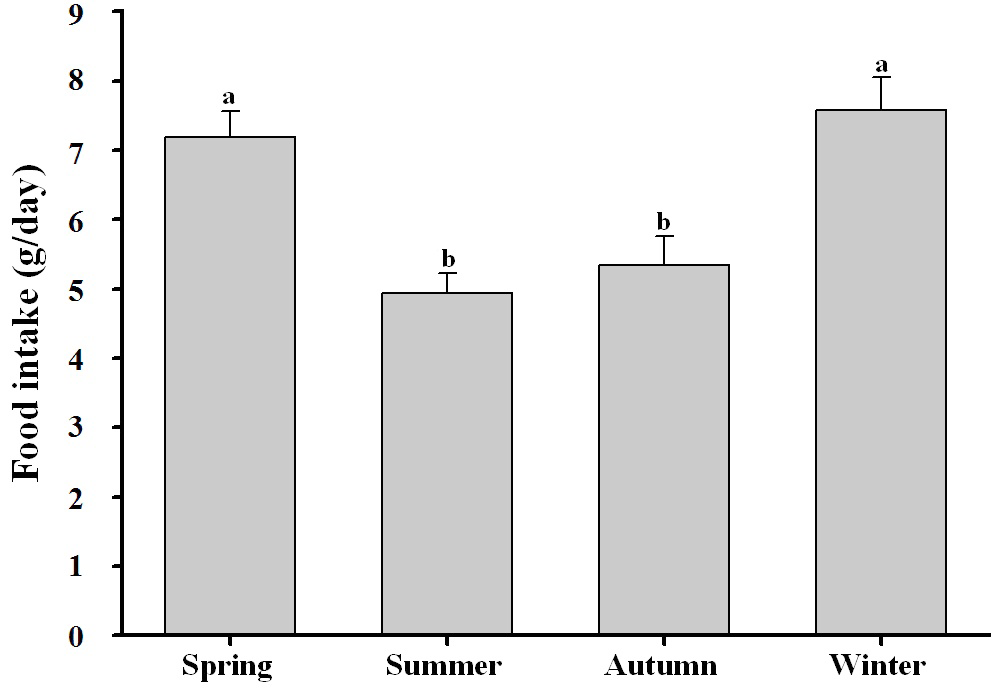
Seasonal variations of food intake in Apodemus chevrieri.
Different superscripts in each row means significantly different (P<0.05).
References
- Cannon, B. and Lindberg, O., 1979. Mitochondria from brown adipose tissue: isolation and properties. Methods Enzymol., 55: 65-78. http://dx.doi.org/10.1016/0076-6879(79)55010-1[CrossRef]
- Cannon, B. and Nedergaard, J., 2004. Brown adipose tissue: function and physiological significance. Physiol. Rev., 84: 277-359. http://dx.doi.org/10.1152/physrev.00015.2003[CrossRef]
- Chen, J.F., Zhong, W.Q. and Wang, D.H., 2012. Seasonal changes in body mass, energy intake and thermogenesis in Maximowiczi’s voles (Microtus maximowiczii) from the Inner Mongolian grassland. J. comp. Physiol., 182: 275-285. http://dx.doi.org/10.1007/s00360-011-0608-9[CrossRef]
- Chi, Q.S. and Wang, D.H., 2011. Thermal physiology and energetics in male desert hamsters (Phodopus roborovskii) during cold acclimation. J. comp. Physiol., 181: 91-103. http://dx.doi.org/10.1007/s00360-010-0506-6[CrossRef]
- Concannon, P., Levac, K., Rawson, R., Tennant, B. and Bensadoun, A., 2001. Seasonal changes in serum leptin, food intake, and body weight in photoentrained woodchucks. Am. J. Physiol.- Reg., 281: 951-959.
- Couture, P. and Hulbert, AJ., 1995. Relationship between body mass, tissue metabolic rate, and sodium pump activity in mammalian liver and kidney. Am. J. Physiol., 268: 641-650.
- Dark, J. and Zucker, I., 1986. Photoperiodic regulation of body mass and fat reserves in the meadow vole. Physiol. Behav., 38: 851-854. http://dx.doi.org/10.1016/0031-9384(86)90053-3[CrossRef]
- Flier, J.S., Harris, M. and Hollenberg, A.N., 2000. Leptin, nutrition, and the thyroid: the why, the wherefore, and the wiring. J. clin. Invest., 105: 859-861. http://dx.doi.org/10.1172/JCI9725[CrossRef]
- Gaston, K.J., 2009. Geographic range limits of species. Proc. R. Soc. B, 276: 1391-1393. http://dx.doi.org/10.1098/rspb.2009.0100[CrossRef]
- Gaston, K.J. and Spicer, J.I., 2001. The relationship between range size and niche breadth: a test using five species of Gammarus (Amphipoda). Global Ecol. Biogeogr., 10: 179-188. http://dx.doi.org/10.1046/j.1466-822x.2001.00225.x[CrossRef]
- Heldmaier, G., Steinlechner, S. and Rafael, J., 1982. Nonshivering thermogenesis and cold resistance during seasonal acclimatization in the Djungarian hamster. J. comp. Physiol., 149: 1-9. http://dx.doi.org/10.1007/BF00735708[CrossRef]
- Janský, L., 1973. Nonshivering thermogenesis and its thermoregulatory significance. Biol. Rev., 48: 85-132. http://dx.doi.org/10.1111/j.1469-185X.1973.tb01115.x[CrossRef]
- Kadenbach, B., Hüttemann, M., Arnold, S., Lee, I. and Bender, E., 2000. Mitochondrial energy metabolism is regulated via nuclear-coded subunits of cytochrome c oxidasel. Free Radical Bio. Med., 29: 211-221. http://dx.doi.org/10.1016/S0891-5849(00)00305-1[CrossRef]
- Kelly, T.F. and Lieberman, D.Z., 2009. The use of triiodothyronine as an augmentation agent in treatment-resistant bipolar II and bipolar disorder NOS. J. Affect Disord., 116: 222-226. http://dx.doi.org/10.1016/j.jad.2008.12.010[CrossRef]
- Klingenspor, M., Niggemann, H. and Heldmaier, G., 2000. Modulation of leptin sensitivity by short photoperiod acclimation in the Djungarian hamster, Phodopus sungorus. J. comp. Physiol., 170: 37-43. http://dx.doi.org/10.1007/s003600050005[CrossRef]
- Kirkegaard, C. and Faber, J., 1998. The role of thyroid hormones in depression. Eur. J. Endocrinol., 138: 1-9. http://dx.doi.org/10.1530/eje.0.1380001[CrossRef]
- Król, E. and Speakman, J.R., 2007. Regulation of body mass and adiposity in the field vole, Microtus agrestis: a model of leptin resistance. J. Endocrinol., 192: 271-278. http://dx.doi.org/10.1677/JOE-06-0074[CrossRef]
- Kriegsfeld, L.J. and Nelson, R.J., 1996. Gonadal and photoperiodic influences on body mass regulation in adult male and female prairie voles. Am. J. Physiol.- Reg., 270: 1013-1018.
- Kronfeld-Schor, N., Haim, A., Dayan, T., Zisapel, N., Klingenspor, M. and Heldmaier, G., 2000. Seasonal thermogenic acclimation of diurnally and nocturnally active desert spiny mice. Physiol. Biochem. Zool., 73: 37-44. http://dx.doi.org/10.1086/316718[CrossRef]
- Leonard, J.L., Mellen, S.A. and Larsen, R.P., 1983. Thyroxine 5′-deiodinase activity in brown adipose tissue. Endocrinology, 112: 1153-1155. http://dx.doi.org/10.1210/endo-112-3-1153[CrossRef]
- Li, X.S. and Wang, D.H., 2005. Regulation of body weight and thermogenesis in seasonally acclimatized Brandt’s voles (Microtus brandti). Horm. Behav., 48: 321-328. http://dx.doi.org/10.1016/j.yhbeh.2005.04.004[CrossRef]
- Lowell, B.B. and Spiegelman, B.M., 2000. Towards a molecular understanding of adaptive thermogenesis. Nature, 404: 652-660.
- Lowry, O.H., Rosebrough, N.J., Farr, A.L. and Randall, R.J., 1951. Protein measurement with the Folin phenol reagent. J. biol. Chem., 193: 265-75.
- Nieminen, P. and Hyvarinen, H., 2000. Seasonality of leptin levels in the BAT of the common shrew (Sorex araneus). Z. Naturforsch., 55: 455-460.
- Parmentier, M., Libert, F., Maenhaut, C., Lefort, A., Gérard, C., Perret, J., Van-Sande, J., Dumont, J.E. and Vassart, G., 1989. Molecular cloning of the thyrotropin receptor. Science, 246: 1620-1622. http://dx.doi.org/10.1126/science.2556796[CrossRef]
- Silva, J.E., 2006. Thermogenic mechanisms and their hormonal regulation. Physiol. Rev., 86: 435-464. http://dx.doi.org/10.1152/physrev.00009.2005[CrossRef]
- Soto-Gamboa, M., Villalón, M. and Bozinovic, F., 2005. Social cues and hormone levels in male Octodon degus (Rodentia): a field test of the Challenge Hypothesis. Horm. Behav., 47: 311-318. http://dx.doi.org/10.1016/j.yhbeh.2004.11.010[CrossRef]
- Steffen, J.M. and Roberts, J.C., 1977. Temperature acclimation in the Mongolian gerbil (Meriones unguiculatus): Biochemical and organ weight changes. Comp. Biochem. Physiol., 58: 237-242. http://dx.doi.org/10.1016/0305-0491(77)90196-1[CrossRef]
- Sundin, U., Moore, G., Nedergaard, J. and Cannon, B., 1987. Thermogenin amount and activity in hamster brown fat mitochondria: effect of cold acclimation. Am. J. Physiol.- Reg., 252: 822-832.
- Tomasi, T.E., 1991. Utilization rates of thyroid hormones in mammals. Comp. Biochem. Physiol., 100: 503-516. http://dx.doi.org/10.1016/0300-9629(91)90363-H[CrossRef]
- Wang, J.M., Zhang, Y.M. and Wang, D.H., 2006. Seasonal regulations of energetics, serum concentrations of leptin, and uncoupling protein 1 content of brown adipose tissue in root voles (Microtus oeconomus) from the Qinghai-Tibetan plateau. J. comp. Physiol., 176: 663-671. http://dx.doi.org/10.1007/s00360-006-0089-4[CrossRef]
- Wingfield, J.C., Hegner, R.E., Dufty, Jr.A.M. and Ball, G.F., 1990. The “challenge hypothesis”: Theoretical implications for patterns of testosterone secretion, mating systems, and breeding strategies. Am. Nat., 136: 829-846. http://dx.doi.org/10.1086/285134[CrossRef]
- Zhang, L., Wang, R., Zhu, W.L., Liu, P., Cai, J., Wang, Z., Sivasakthivel, S. and Lian, X., 2011. Adaptive thermogenesis of the liver in tree shrew (Tupaia belangeri) during cold acclimation. Anim. Biol., 61: 385-401. http://dx.doi.org/10.1163/157075511X596873[CrossRef]
- Zhang, X.Y. and Wang, D.H., 2006. Energy metabolism, thermogenesis and body mass regulation in Brandt’s voles (Lasiopodomys brandtii) during cold acclimation and rewarming. Horm. Behav., 50: 61-69. http://dx.doi.org/10.1016/j.yhbeh.2006.01.005[CrossRef]
- Zhang, X.Y. and Wang, D.H., 2007. Thermogenesis, food intake and serum leptin in cold-exposed lactating Brandt’s voles Lasiopodomys brandtii. J. exp. Biol., 210: 512-521. http://dx.doi.org/10.1242/jeb.02659[CrossRef]
- Zhu, W., Jia, T., Lian, X. and Wang, Z., 2010. Effects of cold acclimation on body mass, serum leptin level, energy metabolism and thermognesis in Eothenomys miletus in Hengduan Mountains region. J. Therm. Biol., 35: 41-46. http://dx.doi.org/10.1016/j.jtherbio.2009.10.006 http://dx.doi.org/10.1016/j.jtherbio.2010.09.002[CrossRef]
- Zhu, W.L., Wang, B., Cai, J.H., Lian, X. and Wang, Z.K., 2011a. Thermogenesis, energy intake and serum leptin in Apodemus chevrieri in Hengduan Mountains region during cold acclimation. J. therm. Biol., 36:181-186. http://dx.doi.org/10.1016/j.jtherbio.2011.02.002[CrossRef]
- Zhu, W., Yang, S., Zhang, L. and Wang, Z., 2012a. Seasonal variations of body mass, thermogenesis and digestive tract morphology in Apodemus chevrieri in Hengduan mountain region. Anim. Biol., 62: 463-478. http://dx.doi.org/10.1163/157075612X650140[CrossRef]
- Zhu, W., Jia, T., Cai, J., Xiao, L. and Wang, Z., 2012b. The effect of cold-acclimation on energy strategies of Apodemus draco in Hengduan Mountain region. J. Therm. Biol., 37: 41-46. http://dx.doi.org/10.1016/j.jtherbio.2011.10.008[CrossRef]
- Zhu, W., Zhang, L. and Wang, Z., 2013a. The thermogenic and metabolic responses to photoperiod manipulations in Apodemus chevrieri. Anim. Biol., 63: 241-255.
- Zhu, W., Zhang, L. and Wang, Z.K., 2013b. Thermogenic property and its hormonal regulation in a south China field mouse, Apodemus draco, under seasonal acclimatization. Pakistan J. Zool., 45: 423-431.
- Zhu, W.L. and Wang, Z.K., 2016. Effect of random food deprivation and re-feeding on energy metabolism, behavior and hypothalamic neuropeptide expression in Apodemus chevrieri. Comp. Biochem. Physiol., 201: 71-78. http://dx.doi.org/10.1016/j.cbpa.2016.06.034[CrossRef]
Services
Article usage statistics
Loading…