
To investigate the influence of different ecological factors in Apodemus chevrieri during the process of seasonal changing, we designed a three-factor experiment of temperature, photoperiod and food quantity in A. chevrieri in the present study. Animals were divided into 8 groups randomly: moderate temperature, longer photoperiod with no food-restricted group; moderate temperature, longer photoperiod with food-restricted group; moderate temperature, shorter photoperiod with no food-restricted group, moderate temperature, shorter photoperiod with food-restricted group; lower temperature, longer photoperiod with no food-restricted group; lower temperature, longer photoperiod with food-restricted group; lower temperature, shorter photoperiod with no food-restricted group, lower temperature, shorter photoperiod with food-restricted group, which were acclimated for 4 weeks. Body mass, resting metabolic rate (RMR) and non shivering thermogenesis (NST), leptin levels and hypothalamic neuropeptide gene expression were measured in each group. The results showed that body mass in A. chevrieri was significantly affected by temperature, food and photoperiod, which was decreased by low temperature, food restriction and short photoperiod. RMR and NST were significantly affected by temperature and food quantity. The content of leptin was significantly affected by temperature, photoperiod and food quantity. Low temperature, short photoperiod and food restriction all decreased the content of leptin. Expression levels of NPY and AgRP were significantly affected by temperature and food quantity. Low temperature and food restriction up-regulated the expression levels of NPY and AgRP. While POMC expression was only affect by food quantity, CART expression was significantly different under the influence of temperature and food quantity. These results suggested that temperature, photoperiod and food quantity had different effects on physiological indexes and energy balance in A. chevrieri, and leptin was involved in the regulation of body mass in A. chevrieri.
Research Article · Volume 55, Issue 1, 2 November 2022 · Open Access
Effects of Temperature, Photoperiod and Food Quantity on Body Mass and Thermogenesis in Apodemus chevrieri
· ·
Affiliations & Notes ⌄
- 1Yunnan Medical Health College, 1st Yuhua District, Chenggong County, Kunming City, Yunnan Province, 650106, China 2School of Life Sciences, Yunnan Normal University, 1st Yuhua District, Chenggong County, Kunming City, Yunnan Province, 650500, China * Corresponding author: monica_8209@163.com, zwl_8307@163.com
Article Info ⌄
- Journal:
- Pakistan Journal of Zoology
- Published:
- 2 November 2022

From the article
- In our results, RMR in A. chevrieri under low temperature group was higher than that of normal temperature group; Low temperature and short photoperiod increased NST in A. chevrieri, while food restriction decreased RMR and NST.
- The results of the present study showed that the leptin content in A. chevrieri is significantly affected by temperature, photoperiod and food quantity after 28 days of domestication.
- NPY and AgRP expressions were significantly affected by temperature and food quantity, indicating that temperature and food quantity were important factors affecting their survival.
- Moreover, leptin and hypothalamic neuropeptide expression may be involved in the regulation of body mass in A. chevrieri.
Selected from the article's own text.
Abstract
Introduction
The animals living in wild often face challenges from ecological factor, such as temperature, photoperiod and food quantity. Therefore, survival strategies need to be adjusted in time to obtain the best survival opportunity ; . When seasonal changes occur, the most significant change is environmental temperature. The temperature change cause adjustments in body mass, thermogenesis and this series of changes are species-specific . Low temperature is the main factor inducing the enhancement of resting metabolic rate (RMR) and non shivering thermogenesis (NST). Most animals showed the enhancement of thermogenesis when facing seasonal changes or under cold temperature (Mineo et al., 2012). Temperature affects the body mass of mammals usually in three cases: Low temperature has no significant effect on body mass, or low temperature decline body mass, or increase body mass. For example, temperature has no significant effect on the body mass in striped hamster (Cricetulus barabensis), but low temperature significantly increases its food intake and thermogenesis . Low temperature significantly reduced the body mass in female Peromyscus maniculatus and Eothenomys melanogaster and promoted the increase of metabolic rate ; . However, Tupaia belangeri increased its body mass under low temperature . Photoperiod is also an important signal of seasonal change, and HPV axis recognized the changes of photoperiod, and then stimulates hormone secretion, adjusting food intake and energy metabolism in mammals . There are three main types of mammalian body mass changes response to photoperiod: body mass is not affected by photoperiod changes, short photoperiod inhibits body mass, and body mass gain under short photoperiod . Generally, metabolisms of mammals under short photoperiod were higher than those under long photoperiod. Microtus oeconomus showed a decreasing trend in body mass and enhanced thermogenesis under short photoperiod . Similarly, NST in Lasiopodomys brandtii was enhanced under short photoperiod, while the serum leptin level was significantly affected by photoperiod . Change of food quantity is also an important factor affecting their survival when mammals face seasonal changes ; . Studies have shown that Eothenomys milletus can reduce body mass, metabolic rate to cope with food shortage . Mus musculus become more active and consume more energy after food restriction, resulting in lower body mass and fat mass .
Leptin is a protein mainly expressed in adipose tissue, which regulates animals’ weight and energy metabolism by binding to specific receptors in hypothalamus . The changes of environmental factors affect the leptin content. For example, low temperature and short photoperiod reduce the leptin content in T. belangeri, L. brandtii and Meriones unguiculatus ; . It is reported that serum leptin levels in mammals decrease during food restriction . The hypothalamus regulates the feeding and energy of animals through neuropeptide Y (NPY), agouti related protein (AgRP), pro-opiomelanocortin (POMC) and cocaine and amphetamine regulated transcription peptide (CART) .
Apodemus chevrieri, is a typical Paleoboreal animal . Previous studies reported that A. chevrieri lost weight and increased thermogenesis under cold acclimation . Short photoperiod inhibited the body mass in A. chevrieri, stimulated the increase of thermogenesis and reduced the concentration of serum leptin . Food restriction decreased body mass and thermogenic capacity in A. chevrieri significantly . Based on the above research, the three factor experiment of temperature, photoperiod and food quantity in A. chevrieri was designed to determine the relationship between temperature, photoperiod, food quantity and energy balance of A. chevrieri, we hypothesized that temperature, photoperiod and food quantity will affect the energy metabolism in A. chevrieri, and the effects of those three ecological factors were different, further clarify the relationship between leptin and body mass regulation, and better understand the impact of seasonal changes in energy metabolism in A. chevrieri.
Materials and Methods
Animals
The experimental animals were collected in 2020 in Jianchuan County, Dali City, Yunnan Province (99°75´E, 26°43´N, altitude 2590 m). After disinfecting and killing fleas, the captured animals were brought back to the single cage in the animal feeding room of Yunnan Normal University, and housed individually in a wire cage (26 cm×16 cm×15 cm). Water and foods were provided ad libitum.
The three factor experiment of temperature, photoperiod and food quantity in A. chevrieri was designed. The animals were randomly divided into 8 groups (n=48, ♀:17, ♂: 31): moderate temperature, longer photoperiod with no food-restricted group (normal temperature LC), 25 oC, 16L: 8D, free feeding and drinking; moderate temperature, shorter photoperiod with no food-restricted group, 25oC, 8L: 16D, free feeding and drinking (normal temperature SC); moderate temperature, longer photoperiod with food-restricted group, 25oC, 16L: 8D, the amount of food was 80% of the daily intake, and free drinking (normal temperature LF); moderate temperature, shorter photoperiod with food-restricted group, 25 oC, 8L: 16D, the amount of food was 80% of the daily intake, and free drinking (normal temperature SF); low temperature, longer photoperiod with no food-restricted group, 5 oC, 16L: 8D, free feeding and drinking (low temperature LC); low temperature, shorter photoperiod with no food-restricted group, 5 oC, 8L: 16D, free to feeding and drinking (low temperature SC); low temperature, longer photoperiod with food-restricted group, 5 oC, 16L: 8D, the amount of food was 80% of the daily intake, and free drinking water (low temperature LF); low temperature, shorter photoperiod with food-restricted group, 5 oC, 8L: 16D, the amount of food was 80% of the daily intake, and free drinking (low temperature SF); 8 groups of animals were domesticated under their respective conditions for 4 weeks, the number of animals in each group was 6. Body mass was measured on day 0 and 28, and the animals were killed after 28 days. Thermogenic capacity, serum leptin content and hypothalamic neuropeptide gene expression were measured on day 28.
Measurement of RMR and NST
Body mass, RMR, and NST were measured using the metabolic system (BXY-R, Sable Systems). A. chevrieri were acclimated to calorimetry cages prior to 30 min the study and data collection, see details for specific measurement methods in Zhang et al. (2011).
Measurement of serum leptin levels and hypothalamic neuropeptide gene expression
After the experiment, the animals were killed, and the serum leptin content was measured by leptin radioimmunoassay kit (Linco company, USA) . The gene expression of hypothalamic neuropeptide NPY, AgRP, POMC and CART was determined, the primers for amplification sequence and measurement methods are detailed in the literature .
Statistical analysis
Data were analyzed using the software package SPSS 22.0. Prior to all statistical analyses, data were examined for assumptions of normality and homogeneity of variance using Kolmogorov–Smirnov and Levene tests, respectively. Since no gender effects were found on almost all measured parameters, data from females and males were combined. The change of body mass was tested by Three-Way ANOVA. The differences of RMR and NST, leptin content and hypothalamic neuropeptide expression between groups were tested by Three-Way ACNOVA, in which body mass was used as covariate. Results are presented as means ± SE, and P<0.05 was considered to be statistically significant.
Results
Body mass
There was no significant difference of body mass in A. chevrieri in 8 groups before the experiment (P > 0.05). After 28 days, body mass in A. chevrieri was significantly affected by temperature, food quantity and photoperiod. Low temperature, food restriction and short photoperiod reduced body mass in A. chevrieri (temperature: F1,40 = 6.65, P < 0.01; photoperiod: F1,40 = 2.15, P < 0.05; food quantity: F1,40 = 9.87, P < 0.01, Fig. 1).
RMR and NST
RMR was significantly affected by temperature and food quantity after 28 days in A. chevrieri (temperature: F1,40 = 12.32, P < 0.01; food quantity: F1,40 = 15.32, P < 0.01). RMR in low temperature group was higher than that of normal temperature group, and food restriction decreased RMR (Fig. 2). On day 28, NST was significantly affected by temperature, food quantity and photoperiod (temperature: F1,40 = 9.36, P < 0.01; photoperiod: F1,40 = 3.21, P < 0.05; food quantity: F1,40 = 6.57, P < 0.01). Low temperature and short photoperiod increased NST, while food restriction decreased NST in A. chevrieri (Fig. 2).
Serum leptin levels and hypothalamic neuropeptide gene expression
Serum leptin levels was significantly affected by temperature, photoperiod and food quantity after 28 days of domestication in A. chevrieri (temperature: F1,40 = 12.32, P < 0.01; photoperiod: F1,40 = 5.63, P < 0.01; food quantity: F1,40 = 32.32, P < 0.01). Low temperature, short photoperiod and food restriction decreased the leptin content (Fig. 3). NPY expression was significantly affected by temperature and food quantity (temperature: F1,40 = 17.63, P < 0.01; food quantity: F1,40 = 13.32, P < 0.01); AgRP expression was also significantly affected by temperature and food quantity (temperature: F1,40 = 8.93, P < 0.01; food quantity: F1,40 = 6.28, P < 0.01). Low temperature and food restriction increased the expression of NPY and AgRP (Fig. 4). POMC expression was significantly affected by food quantity (F1,40 = 15.32, P < 0.01). CART expression was significantly affected by temperature and food quantity (temperature: F1,40 = 21.32, P < 0.01; food quantity: F1,40 = 35.62, P < 0.01). Low temperature and food restriction reduced CART expression (Fig. 4).
Discussion
Body mass of mammals will adjust to varying degrees when environmental changing . It is reported that some small rodents lose body mass and increase thermogenic capacity under low temperature or short photoperiod . For example, Microtus maximowiczii and Lasiopodomys brandtii decreased body mass significantly when exposed to cold temperature and short photoperiod . Body mass of some animals showed the opposite trend. For example, body mass in T. belangeri increased when they were affected by low temperature and short photoperiod . Quantity and quality of food often become an important factor limiting their survival in mammals. Studies have shown that food restriction can lead to weight loss of most small mammals, including M. unguiculatus, C. barabensis and E. miletus ; ; . This is mainly because hunger increases during the period of food shortage, resulting in increased food consumption, leading to body fat mass reduction and weight loss . In the present study, low temperature, short photoperiod and food restriction reduced the body mass in A. chevrieri, which is consistent with the results of weight loss in winter during seasonal changes , indicating that A. chevrieri needs to reduce body energy consumption by reducing body mass in winter, so as to resist the stress of extreme conditions and obtain the best survival opportunity.
Temperature affects the metabolism of mammals, which is mainly reflected under low temperature, promotes the increase of metabolism . Ochotona curzoniae and Microtus oeconomus in the Qinghai Tibet Plateau of China mainly rely on increasing their metabolic rate to cope with the extreme cold environment and improve their cold tolerance ; . During cold acclimation, animals will significantly increase their thermogenic capacity, such as Mus musculus and Phodopus roborovskii ; . The change of photoperiod also affects energy consumption in many small mammals . Affected by the short photoperiod in winter, RMR and NST in C. barabensis were higher than those of in summer . Short photoperiod not only reduced the body mass in Phodopus roborovski, but also increased their adaptive thermogenesis . However, M. unguiculatus have different effects on photoperiod . In our results, RMR in A. chevrieri under low temperature group was higher than that of normal temperature group; Low temperature and short photoperiod increased NST in A. chevrieri, while food restriction decreased RMR and NST. The results were similar to that of smallest mammals. These results showed that A. chevrieri needed to increase thermogenesis under conditions similar to winter; when food resource is limited, it is necessary to reduce the energy consumption for RMR and NST to maintain the relative energy balance.
Leptin further affects the synthesis and release of appetite neuropeptides by binding receptors in hypothalamus through blood circulation, inhibiting food intake and promoting energy consumption . Temperature, photoperiod and food quantity affected leptin content and hypothalamic neuropeptide expression. For example, leptin decreased in winter in E. miletus as a hunger signal, allowing increased energy intake . Under starvation, the decrease of leptin level usually stimulates the expression of NPY/AgRP and inhibits the expression of POMC/CART . The results of the present study showed that the leptin content in A. chevrieri is significantly affected by temperature, photoperiod and food quantity after 28 days of domestication. Low temperature, short photoperiod and food restriction all reduce the leptin content in A. chevrieri, which is consistent with the previous research results of seasonal changes and food restriction in A. chevrieri , 2013b), indicating that leptin may be involved in body mass changes caused by temperature, photoperiod and food restriction. NPY and AgRP expressions were significantly affected by temperature and food quantity, indicating that temperature and food quantity were important factors affecting their survival. POMC expression was significantly affected by food quantity; CART expression was significantly affected by temperature and food quantity. These results show that A. chevrieri can actively increase the expression of appetite promoting neuropeptides, promote food intake and meet the survival needs of the body under the condition of low temperature and food shortage.
conclusion
In conclusion, different physiological indexes in A. chevrieri were affected by temperature, photoperiod and food quantity to varying degrees, suggesting that A. chevrieri can adapt to different environmental conditions by adjusting the changes of body mass and thermogenic capacity. Moreover, leptin and hypothalamic neuropeptide expression may be involved in the regulation of body mass in A. chevrieri.
Acknowledgments
This research was financially supported by Scientific Research Fund Project of Yunnan Provincial Department of Education (2021J1360), Yunnan Ten Thousand Talents Plan Young and Elite Talents Project (YNWR-QNRC-2019-047). We wish to thank Pro. Burkart Engesser at Historisches Museum Basel, Switzerland for correcting the English usage in the draft. Thank you for the anonymous reviewers and the editor of the journal for their valuable comments.
Ethics statement
The protocol and study were approved by the Animal Care and Use Committee of the School of Life Sciences, Yunnan Normal University (No. 13-0901-011).
Statement of conflict of interest
The authors have declared no conflict of interest.
Figures
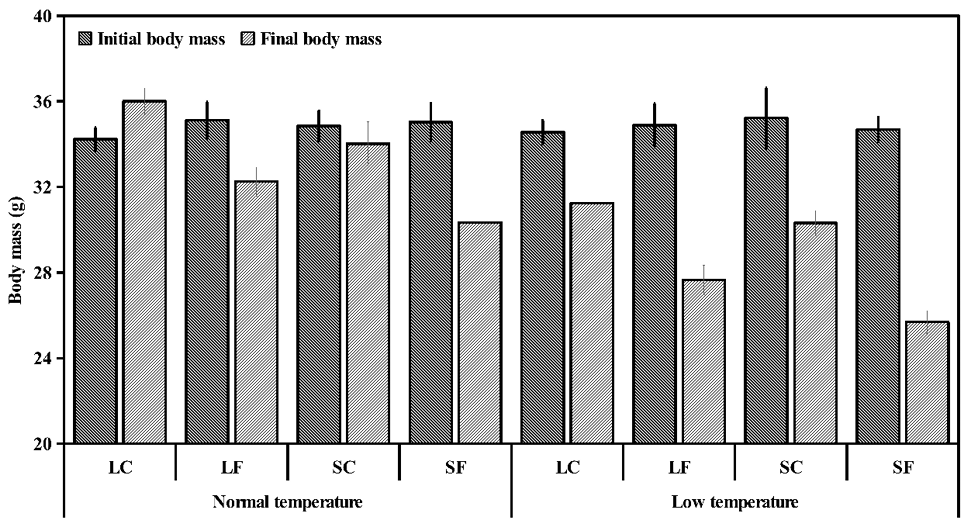
Effect of temperature, photoperiod and food quantity on body mass in Apodemus chevrieri.
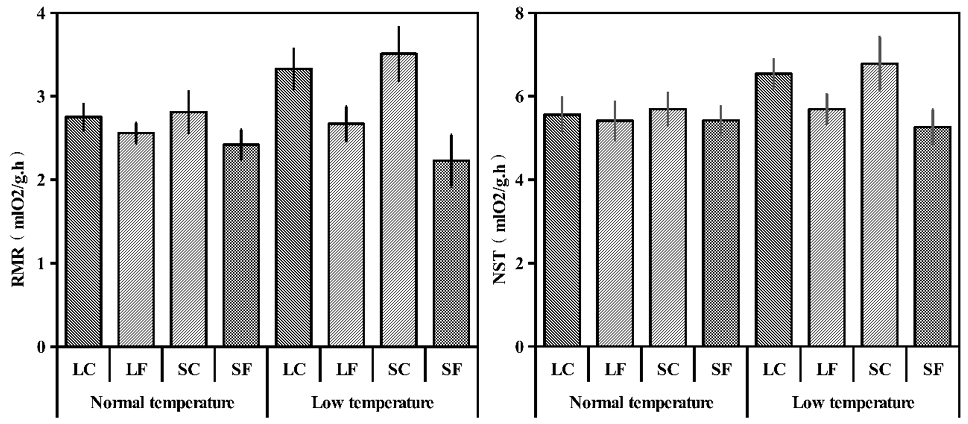
Effect of temperature, photoperiod and food quantity on RMR and NST in Apodemus chevrieri.
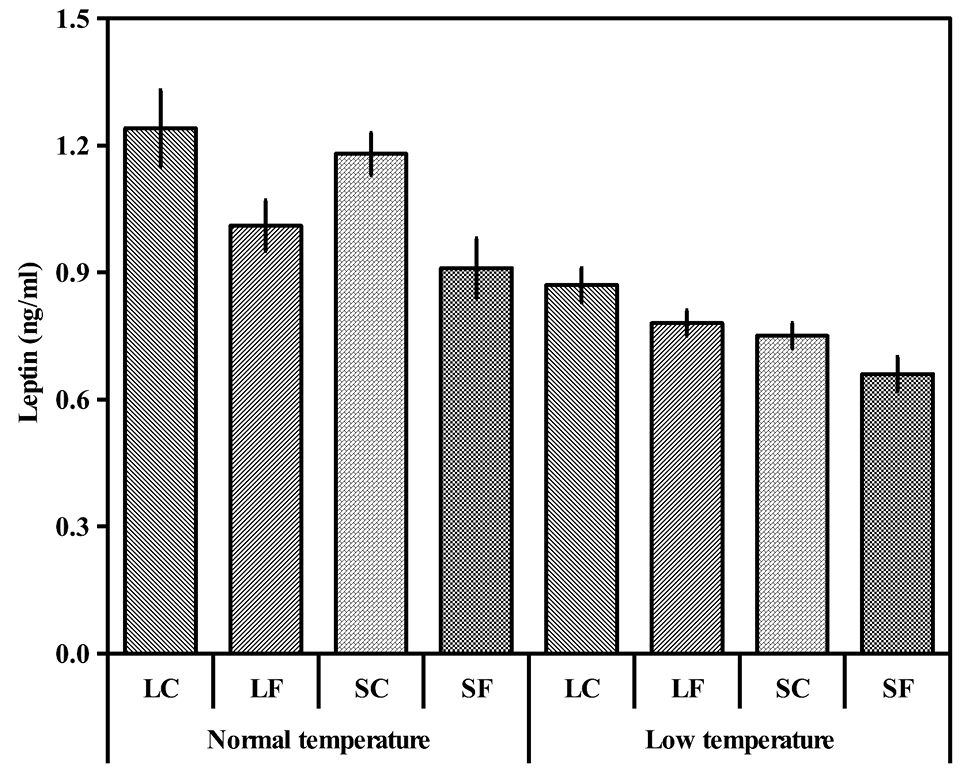
Effect of temperature, photoperiod and food quantity on serum leptin levels in Apodemus chevrieri.
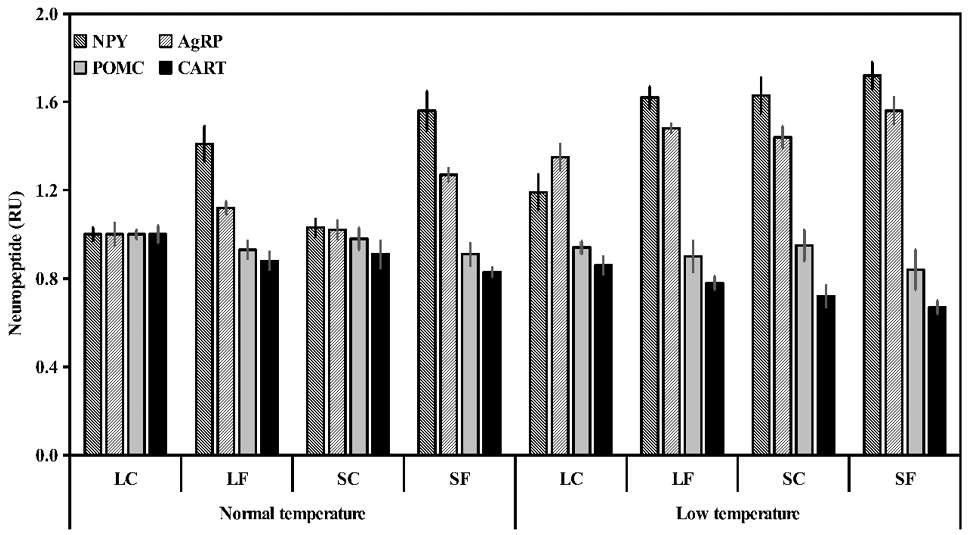
Effect of temperature, photoperiod and food quantity on hypothalamic neuropeptide genes expression in Apodemus chevrieri.
References
- Akhtar, M., Naz, S., Iqbal, M., Azeem, W. and Beg, M.A., 2017. Effect of seasonal swings and age specific variations on body weight of Indian Gerbille (Tatera indica). Pakistan J. Zool., 49: 2319-2322. https://doi.org/10.17582/journal.pjz/2017.49.6.sc1[CrossRef]
- Chen, J.F., Zhong, W.Q. and Wang, D.H., 2012. Seasonal changes in body mass, energy intake and thermogenesis in Maximowiczis’ voles (Microtus maximowiczii) from the Inner Mongolian grassland. J. comp. Physiol. B, 182: 275-285. https://doi.org/10.1007/s00360-011-0608-9[CrossRef]
- Chi, Q.S. and Wang, D.H., 2011. Thermal physiology and energetics in male desert hamsters (Phodopus roborovskii) during cold acclimation. J. comp. Physiol. B, 181: 91-103. https://doi.org/10.1007/s00360-010-0506-6[CrossRef]
- Corbet, G.B., 1978. The mammals of the Palaearctic region: A taxonomic review. British Museum (Natural History), London. pp. 200-314.
- Fink, B.D., Herlein, J.A., Almind, K., Cinti, S., Kahn, C.R. and Sivitz, W.I., 2007. Mitochondrial proton leak in obesity-resistant and obesity-prone mice. Am. J. Physiol. Regul. Integr. Comp. Physiol., 293: 1773-1780. https://doi.org/10.1152/ajpregu.00478.2007[CrossRef]
- Friedman, J.M. and Halaas, J.L., 1998. Leptin and the regulation of body weight in mammals. Nature, 395: 763-770. https://doi.org/10.1038/27376[CrossRef]
- Gao, W.R., Zhu, W.L. and Meng, L.H., 2013. Effects of photoperiod and high fat diet on energy intake and thermogenesis in female Apodemus chevrieri. Acta Ecol. Sin., 33: 5696-5703. https://doi.org/10.5846/stxb201304290870[CrossRef]
- Gutman, R., Hacmon-Keren, R., Choshniak, I., and Kronfeld-Schor, N., 2008. Effect of food availability and leptin on the physiology and hypothalamic gene expression of the golden spiny mouse: A desert rodent that does not hoard food. Am. J. Physiol. Regul. Integr. Comp. Physiol., 295: 2015-2023. https://doi.org/10.1152/ajpregu.00105.2008[CrossRef]
- Hou, D.M., Ren, X.Y., Zhu, W.L. and Zhang, H., 2020. Comparative study on phenotypic differences in Eothenomys miletus under food restriction and refeeding between Xianggelila and Jianchuan from Hengduan mountain regions. Indian J. Anim. Res., 54: 835-840. https://doi.org/10.18805/ijar.B-1151[CrossRef]
- Hu, S.N., Zhu, Y.Y., Lin, L., Zheng, W.H. and Liu, J.S., 2017. Temperature and photoperiod as environmental cues affect body mass and thermoregulation in Chinese bulbuls, Pycnonotus sinensis. J. exp. Biol., 220: 844-855. https://doi.org/10.1242/jeb.143842[CrossRef]
- Karakas, A., Camsaril, C., Serin, E. and Gündüz, B., 2005. Effects of photoperiod and food availability on growth, leptin, sexual maturation and maintenance in the Mongolian gerbils (Meriones unguiculatus). Zool. Sci., 22: 665-670. https://doi.org/10.2108/zsj.22.665[CrossRef]
- Karol, Z., Zbigniew, B., Szafrańska P.A., Monika, W. and Marek, K., 2014. Lower body mass and higher metabolic rate enhance winter survival in root voles, Microtus oeconomus. Biol. J. Linn. Soc., 113: 297-309. https://doi.org/10.1111/bij.12306[CrossRef]
- Kirkwood, T.B. and Shanley, D.P., 2005. Food restriction, evolution and ageing. Mech. Ageing Dev., 126: 1011-1016. https://doi.org/10.1016/j.mad.2005.03.021[CrossRef]
- Li, X.S. and Wang, D.H., 2005. Seasonal adjustments in body mass and thermogenesis in Mongolian gerbils (Meriones unguiculatus): The roles of short photoperiod and cold. J. comp. Physiol. B, 175: 593-600. https://doi.org/10.1007/s00360-005-0022-2[CrossRef]
- Li, X.S. and Wang, D.H., 2007. Photoperiod and temperature can regulate body mass, serum leptin concentration, and uncoupling protein 1 in Brandt’s voles (Lasiopodomys brandtii) and Mongolian gerbils (Meriones unguiculatus). Physiol. Biochem. Zool., 80: 326-334. https://doi.org/10.1086/513189[CrossRef]
- Lu, Q., Zhong, W.Q. and Wang, D.H., 2007. Effects of photoperiod history on body mass and energy metabolism in Brandt’s voles (Lasiopodomys brandtii). J. exp. Biol., 210: 3838-3847. https://doi.org/10.1242/jeb.010025[CrossRef]
- Mineo, P.M., Cassell, E.A., Roberts, M.E. and Schaeffer, P.J., 2012. Chronic cold acclimation increases thermogenic capacity, non-shivering thermogenesis and muscle citrate synthase activity in both wild-type and brown adipose tissue deficient mice. Comp. Biochem. Physiol. A, 161: 395-400. https://doi.org/10.1016/j.cbpa.2011.12.012[CrossRef]
- Morton, G.J., Cummings, D.E., Baskin, D.G. and Brash, D.G., 2006. Central nervous system control of food intake and body weight. Nature, 443: 289-295. https://doi.org/10.1038/nature05026[CrossRef]
- Powell, C.S., Blaylock, M.L., Wang, R., Hunter, H.L. and Nagy, T.R., 2002. Effects of energy expenditure and UCP1 on photoperiod-induced weight gain in collared lemmings. Obes. Res., 10: 541-550. https://doi.org/10.1038/oby.2002.73[CrossRef]
- Ren, Y., Liu, P.F., Zhu, W.L., Zhang, H. and Cai, J.H., 2020. Higher altitude and lower temperature regulate the body mass and energy metabolism in male Eothenomys miletus. Pakistan J. Zool., 52: 139-146. https://doi.org/10.17582/journal.pjz/2020.52.1.139.146[Full text][CrossRef]
- Rezende, E.L., Chappell, M.A. and Hammond, K.A., 2004. Cold-acclimation in Peromyscus: temporal effects and individual variation in maximum metabolism and ventilatory traits. J. exp. Biol., 207: 295-305. https://doi.org/10.1242/jeb.00760[CrossRef]
- Rousseau, K., Atcha, Z. and Loudon, A.S.I., 2003. Leptin and seasonal mammals. J. Neuroendocrinol., 15: 409-414. https://doi.org/10.1046/j.1365-2826.2003.01007.x[CrossRef]
- Szafranska, P.A., Zub, K. and Konarzewski, M., 2013. Seasonal variation of resting metabolic rate and body mass in free-living weasels Mustela nivalis. Physiol. Biochem. Zool., 86: 791-798. https://doi.org/10.1086/673286[CrossRef]
- Tang, G.B., Cui, J.G. and Wang, D.H., 2009. Role of hypoleptinemia during cold adaptation in Brandt’s voles (Lasiopodomys brandtii). Am. J. Physiol. Regul., Integr. Comp. Physiol., 297: 1293-1301. https://doi.org/10.1152/ajpregu.00185.2009[CrossRef]
- Wang, J.M., Zhang, Y.M. and Wang, D.H., 2006. Photoperiodic regulation in energy intake, thermogenesis and body mass in root voles (Microtus oeconomus). Comp. Biochem. Physiol. A Mol. Integr. Physiol., 145: 546-553. https://doi.org/10.1016/j.cbpa.2006.08.034[CrossRef]
- Wanner, S.P., Almeida, M.C. and Shimansky, Y.P., 2017. Cold-induced thermogenesis and inflammation-associated cold-seeking behavior are represented by different dorsomedial hypothalamic sites: A three-dimensional functional topography study in conscious rats. J. Neurosci., 37: 6956-6971. https://doi.org/10.1523/JNEUROSCI.0100-17.2017[CrossRef]
- Xu, J., Bao, Y. X., Zhang, L.L., Shen, L., Wei, D. and Wang, C., 2010. Seasonal changes of thermogenic capacity in Melano-bellied oriental voles (Eothenomys melanogaster). Acta Ecol. Sin., 31: 78-83. https://doi.org/10.1016/j.chnaes.2010.11.013[CrossRef]
- Yom-Tov, Y. and Yom-Tov, J., 2005. Global warming, Bergmann’s rule and body size in the masked shrew Sorex cinereus Kerr in Alaska. J. Anim. Ecol., 74: 803-808. https://doi.org/10.1111/j.1365-2656.2005.00976.x[CrossRef]
- Zhang, L.N. and Wang, D.H., 2008. Effects of food restriction and refeeding on energy balance regulation in Mongolian gerbils (Meriones unguiculatus). Appetite, 51: 751-764. https://doi.org/10.1016/j.appet.2008.05.032[CrossRef]
- Zhang, L., Zhu, W.L., Yang, F. and Wang Z.K., 2014. Influence of photoperiod on cold-adapted thermogenesis and endocrine aspects in the tree shrew (Tupaia belangeri). Anim. Biol., 64: 1-17. https://doi.org/10.1163/15707563-00002426[CrossRef]
- Zhang, L., Yang, F., Huang, C.M., Zhu, W.L. and Wang Z.K., 2015. The role of photoperiod on the expression of hypothalamic genes regulating appetite in Chevrier’s field mouse (Apodemus chevrieri). Anim. Biol., 65: 45-56. https://doi.org/10.1163/15707563-00002460[CrossRef]
- Zhang, X.Y., Zhang, Q. and Wang, D.H., 2011. Pre-and post-weaning cold exposure does not lead to an obese phenotype in adult Brandt’s voles (Lasiopodomys brandtii). Horm. Behav., 60: 210-218. https://doi.org/10.1016/j.yhbeh.2011.05.004[CrossRef]
- Zhang, X.Y., Zhao, Z.J., Vasilieva, N, Khrushchova, Anastassia and Wang, D.H., 2015. Effects of short photoperiod on energy intake, thermogenesis, and reproduction in desert hamsters (Phodopus roborovskii). Integr. Zool., 10: 207-215. https://doi.org/10.1111/1749-4877.12115[CrossRef]
- Zhao, Z.J., Cao, J., Liu, Z.C., Wang, G.Y. and Li, L.S., 2010. Seasonal regulations of resting metabolic rate and thermogenesis in striped hamster (Cricetulus barabensis). J. Therm. Biol., 35: 401-405. https://doi.org/10.1016/j.jtherbio.2010.08.005[CrossRef]
- Zhao, Z.J., Chi, Q.S. and Zhao, L., 2015. Effect of food restriction on energy budget in warm-acclimated striped hamsters. Physiol. Behav., 147: 220-226. https://doi.org/10.1016/j.physbeh.2015.04.048[CrossRef]
- Zhao, Z.J, Li, J.J., Zhang, H., Yu, R. and Zhao, Y.L., 2011. Body mass and behavior in Swiss mice subjected to continuous or discontinuous food restriction and refeeding. Acta Theriol., 56: 129-139. https://doi.org/10.1007/s13364-010-0004-y[CrossRef]
- Zhu, W.L., Wang, B., Cai, J.H., Lian, X. and Wang, Z.K., 2011. Thermogenesis, energy intake and serum leptin in Apodemus chevrieri in Hengduan Mountains region during cold acclimation. J. Therm. Biol., 36: 181-186. https://doi.org/10.1016/j.jtherbio.2011.02.002[CrossRef]
- Zhu, W.L., Zhang, H. and Wang, Z.K., 2012a. Seasonal changes in body mass and thermogenesis in tree shrews (Tupaia belangeri): The roles of photoperiod and cold. J. Therm. Biol., 37: 479-484. https://doi.org/10.1016/j.jtherbio.2012.04.007[CrossRef]
- Zhu, W.L., Yang, S.C., Zhang, L. and Wang, Z.K. ,2012b. Seasonal variations of body mass, thermogenesis a digestive tract morphology in Apodemus chevrieri in Hengduan mountain region. Anim. Biol., 62: 463-478. https://doi.org/10.1163/157075612X650140[CrossRef]
- Zhu, W.L., Zhang, L. and Wang, Z.K., 2013a. The thermogenic and metabolic responses to photoperiod manipulations in Apodemus chevrieri. Anim. Biol., 63: 241-255. https://doi.org/10.1163/15707563-00002408[CrossRef]
- Zhu, W.L., Mu, Y., Zhang, H., Zhang, L. and Wang, Z.K., 2013b. Effects of food restriction on body mass, thermogenesis and serum leptin level in Apodemus chevrieri (Mammalia: Rodentia: Muridae). Ital. J. Zool., 80: 337-344. https://doi.org/10.1080/11250003.2013.796409[CrossRef]
- Zhu, W.L., Mu, Y., Zhang, H., Gao, W.R., Zhang, L. and Wang, Z.K., 2014. Effects of random food deprivation on body mass, behavior and serum leptin levels in Eothenomys miletus (Mammalia: Rodentia: Cricetidae). Ital. J. Zool., 81: 227-234. https://doi.org/10.1080/11250003.2014.902511[CrossRef]
Services
Article usage statistics
Loading…