
Reproduction of wild rodents in the temperate regions is adaptively timed with the season under the influence of photoperiod, temperature and food availability. The aim of this study was to investigate the responses of three small-sized murine species to the same physical and ecological conditions in a locality of Great Kabylia (Algeria). Apodemus sylvaticus, and Mus spretus synchronized their reproduction in winter and spring, Lemniscomys barbarus in spring and summer. Photoperiod and temperature cannot explain this reproduction shift that might be linked to the feeding ecology of the species.
Research Article · Volume 54, Issue 5, 13 June 2022 · Open Access
Seasonal Reproduction Shift among Three Murine Rodents in a Mediterranean Area of North-Western Africa
· · ·
Affiliations & Notes ⌄
- 1Laboratoire Ecologie et Biologie des Organismes Terrestres, Université Mouloud Mammeri, Bastos Tizi-Ouzou 15000, Algérie 2Comportement et Ecologie de la Faune sauvage, INRAE, Université de Toulouse, CS 52627, 31326 Castanet-Tolosan cedex, France * Corresponding author: n_khammes@hotmail.com
Article Info ⌄
- Journal:
- Pakistan Journal of Zoology
- Published:
- 13 June 2022

From the article
- The 1620 night-trappings provided the capture of 165 small mammals, including 150 murine species: 65 Apodemus sylvaticus (43.3%), 47 Mus spretus (31.3%) and 38 Lemniscomys barbarus (25.3%).
- Trapping result varied along the year with larger numbers in winter (December to February) and lower numbers in summer (June to September) for A. sylvaticus and M. spretus, which no specimen was trapped in June, July and August (Fig. 1A).
- Juveniles of L. barbarus were trapped in June and July (Fig. 1B) and sub-adults mainly from August to December (Fig. 1C), suggesting a winter break of reproduction.
- Our main result is the seasonal reproduction shift between A. sylvaticus and M. spretus on one side, and Lemniscomys barbarus on the other.
Selected from the article's own text.
Abstract
INTRODUCTION
All latitudes find some mammals reproducing seasonally, even in the deep tropics . In the temperate regions the reproductive process of wild rodents is adaptively timed with the season contrary to synanthropic species which can have litters along the year . Winter is a period of high energetic demand and many rodents show a break in reproductive activity , under the main influence of poorer foraging conditions and shorter photoperiod. Ovulation more than spermatogenesis is commonly sensitive to both low temperature and food restriction in small mammals . Hence the end of winter usually initiates the reproductive period in response to lengthening of days, rising of temperature and vegetation growth (e.g. . Within the reproductive period extending from spring to the beginning of autumn many species show a peak of reproductive activity depending mostly on their feeding ecology, herbivores being earlier than granivores, as they face an enormous energetic drain during lactation . However, this reproductive pattern can be softened by winter reproduction for some members of the population (e.g. or even be inverted for the whole population. So, for example, populations of wood mouse (Apodemus sylvaticus) breed from March to November in Britanny (north-western France), and from November to April in Doñana (southern Spain), Pyrénées-Orientales (southern France) and Corsica ; .
In North Africa, rodent females usually give birth during winter and spring, after autumn rainfalls, either in Dipodidae, Gerbillinae, Murinae or Ctenodactylidae ; . For some species, the reproductive period may vary geographically, according to the wet season in the most arid zones, to the temperature in mountains. So, for the lesser Egyptian gerbil (Gerbillus gerbillus), it extends from January to May in Egypt and from July to September in Mauritania . Pregnant wood mouse females have been recorded from September to February or April in Tunisia, Algeria and Moroccan lowlands ; ; ; ; , while the reproductive period extends to May in Moroccan high mountains where there is also a winter break . The Algerian mouse (Mus spretus) exhibits a similar last pattern with an approximately three-month winter rest period ; ; , like in southern Spain , 1991; . However, Orsini et al. (1982) reported an absence of reproduction in summer in southern France. The Barbary striped grass mouse (Lemniscomys barbarus) is the third non-commensal murine species widely distributed in north-western Africa . Zaime (1985) trapped juveniles mainly during winter and spring periods in central Morocco, suggesting births from September-October or December-January depending on the year. However, pregnant females were reported in May, June and September in Tunisia , in spring/summer months in northern Morocco .
Investigating such variations was the starting point of a study in a Mediterranean area where the three small-sized murine species live sympatrically. We aimed to identify the specific responses to the same physical and ecological conditions in the wild. We hypothesized that all three species may adapt similarly to photoperiod and temperature variations for adjusting their reproductive activity to vegetation growth.
Materials and methods
Study site
The study site is located at Boudjima (36°48’50”N, 4°09’32”E, 429 m), 21 km north-west of Tizi-Ouzou (Great Kabylia, northern Algeria). According to Daget (1977), the climate is sub-humid and winter is cool. The mean monthly temperatures vary from 9.9°C in Januray to 29.7°C in July. Rainfalls extends irregularly from November to April, with a peak in January with 130.6 mm; summer is usually dry, July is the driest month. Vegetation is relatively dense including the trees and shrubs Olea europea, O. oleaster, Ficus carica, Pistacia lentiscus, Calycotome spinosa, Rubus ulmifolius, Rosa canina. Grasses and forbs include mainly Phragmites sp., Centaurea napifolia, Malva sylvestris, Apiaceae sp., Emex spinosa, Poaceae sp., Hedysarum sp., Borago officinallis and Galactite tomentosa. Human activity is restricted around some sparse buildings.
Study plan
Rodents were trapped along a 150 m linear transect, a low disturbing but efficient method for sampling rodent populations in the temperate zone . Three-day captures were conducted each month from January to December 2017. Baited traps with bread and pilchard were 3-meter spaced, giving a total of 1620 night-trappings. Animals were euthanized, sexed, aged, measured and any sexual activity was recorded. According to Kowalski (1985), males were considered sexually active when the diameter of testes was over 10 mm and seminal vesicles were developed. For females, reproductive state was estimated by appearance of open vagina, developed mammary glands and uterus (including embryos). They were considered sexually active when gestating and/or lactating .
Age classes were identified according to upper molar wear after cleaning the skulls by boiling heads and then soaking them in bleaching water during 5-10 min. For Apodemus sylvaticus, we followed Saint-Girons (1972) who considered three age classes: juveniles, sub-adults and adults. For Mus spretus, we identified the same three age classes according to Palomo et al. (1983). For Lemniscomys barbarus, we adapted the table published by Van der Straeten (1980) for L. linulus to our trapped specimens for identifying the same three age classes.
Results
The 1620 night-trappings provided the capture of 165 small mammals, including 150 murine species: 65 Apodemus sylvaticus (43.3%), 47 Mus spretus (31.3%) and 38 Lemniscomys barbarus (25.3%). Trapping result varied along the year with larger numbers in winter (December to February) and lower numbers in summer (June to September) for A. sylvaticus and M. spretus, which no specimen was trapped in June, July and August (Fig. 1A). The monthly low number of L. barbarus (maximum 6 specimens in November) was quite similar along the year. The gross sex-ratio was balanced for A. sylvaticus (33:32) and in favour of males for M. spretus (32:15) and L. barbarus (28:10), including deep monthly variations for the two first species and not for the third one, males being always more numerous than females (Fig. 2). No female of L. barbarus was trapped from March to May, in August and October.
Few juveniles were trapped for any species except for M. spretus with 11 juveniles over 26 specimens. Juveniles of L. barbarus were trapped in June and July (Fig. 1B) and sub-adults mainly from August to December (Fig. 1C), suggesting a winter break of reproduction. At the opposite, juveniles of M. spretus were trapped from September to May, and sub-adults from November to May. A quite similar pattern was observed for A. sylvaticus with juveniles from October to May and sub-adults from December to March. None of sub-adults was sexually active as well as none adult male of A. sylvaticus trapped from June to September, the first gestating female being recorded in December. Adult males of L. barbarus were sexually active from April to October.
Two nests of L. barbarus with litters of 6 pups were found in June at Mekla (36°41’16”N, 4°16’05”E), a locality 33 km from our study site (Fig. 3).
Discussion
The vegetation of our study site is relatively dense, so it is not surprising that Apodemus sylvaticus was the most trapped species among small mammals. This species which prefers forest or forest edges is found in a wide variety of habitats (Denys, 2017a), including mountain grasslands, shrubs and undergrowth cover (lower woody vegetation) in Kabylia ; . Mus spretus is associated with Mediterranean scrub, bush, grasslands and cultivated fields (Denys, 2017b), and was found syntopic with wood mouse where high woody vegetation is sparse despite some competition for food . Lemniscomys barbarus prefers bushes and grasses habitats with dense ground cover whereas M. spretus includes a high percentage of bare ground in its home range in Kabylia . Such occurrence of the three murine species has been rarely reported, for example in cultivated fields of Esperada (Morocco), among 17 sampled sites, and Lansarine region (Tunisia) with a low number of A. sylvaticus each time ; . In Kabylia, these three species were previously trapped in four sites: Bouberak , Azazga , Cap Djinet and Boukhalfa , with a lower number of L. barbarus each time, like in our study site.
Sex-ratio was balanced for A. sylvaticus, contrary to Hamdine and Poitevin (1994) who reported a larger percentage of males, as we recorded for M. spretus and L. barbarus. An unbalanced sex-ratio is most often observed in trapped small murine species, particularly during the breeding period for A. sylvaticus and after the breeding period for M. spretus ; . In L. barbarus males are more often trapped than females after the age of five months when the later become more sedentary . Juvenile dispersal and exploratory behaviour are widely reported in small mammals to explain sex ratios skewed in favour of males in trapping sessions .
Despite the small sample size our results clearly suggest a different reproductive period for A. sylvaticus and M. spretus with a summer break (June to August), and L. barbarus with a winter break (November to January). In the Mediterranean region, the reproductive period of A. sylvaticus was linked to the availability of food, usually reduced in summer as a consequence of drought, and abundant in autumn (fruits and berries) and winter after vegetation growth following autumn rainfalls ; ; ; . Similarly, the reproductive period of M. spretus is linked to water availability and vegetation growth, mainly mast production and grass seeds in southern France .
Similarly, according to Zaime (1985) food availability synchronized the reproductive period of L. barbarus and the two syntopic gerbilline species Meriones grandis and Gerbillus campestris. But this period is spread over winter and spring in this sub-arid study site of central Morocco, before the spring and summer period estimated from our data which are supported by previous studies in Tunisia and northern Morocco , where the climate is sub-humid. These results confirm that, in the Mediterranean area, small mammals are irresponsive to variation in photoperiod . For a species which reproduces along the whole year in captivity , the reproduction shift agrees with the hypothesis of an adjustment of the breeding activity to vegetation growth. Moreover, Lenkiewicz and Saint-Girons (1964) showed that activity declined in cold weather, which can contributes to delay the reproductive period to hotter days in some parts of its range.
The influence of temperature on the shift of reproductive period among the three murine species is hardly supported by our data. First, the mean January temperature is lower in central Morocco than in Boudjima. Second, L. barbarus, a diurnal species, should be less affected by winter cold nights than A. sylvaticus and M. spretus, which are mainly nocturnal. Then, feeding ecology remains the main likely cause of this seasonal reproduction shift. A. sylvaticus is omnivorous, but predominant food is seeds and acorns, and M. spretus eats mainly fruits, seeds and green parts of plants (Denys, 2017b). In Kabylia, both species are primarily granivorous ; . L. barbarus is “probably herbivorous” , like most Lemniscomys species and its reproductive activity seems to respond to herbaceous vegetation growth starting at the end of winter, whereas the two granivorous species get an energetic source from seed and acorn production in autumn and winter.
Conclusion
The occurrence of the three small-sized non commensal murine species in one area is a quite rare event that is worth to be reported, mainly when populations seem to be almost balanced, contrary to previous trapping sites reported in the literature. As some competition between Apodemus sylvaticus and Mus spretus was recorded by Fons and Saint Girons, (1988), our study site provides a good opportunity for investigating their interactions with a third phylogenetically related species that could influence their population dynamics.
Our main result is the seasonal reproduction shift between A. sylvaticus and M. spretus on one side, and Lemniscomys barbarus on the other. Roughly, the summer break of the formers stands in opposition to the winter break of the later. This pattern cannot be related to physical factors widely reported to influence reproductive period, such as photoperiod or temperature. Ecological factors are also poorly relevant since, even if they exhibit different daily activity pattern, the three species are living in syntopy. However, a more comprehensive study could reveal some different use of the study area. More likely, the reproduction shift among the three species is linked to their feeding ecology that should be investigated, our study site becoming a higher research spot.
Statement of conflict of interest
Authors have declared no conflict of interest.
Figures
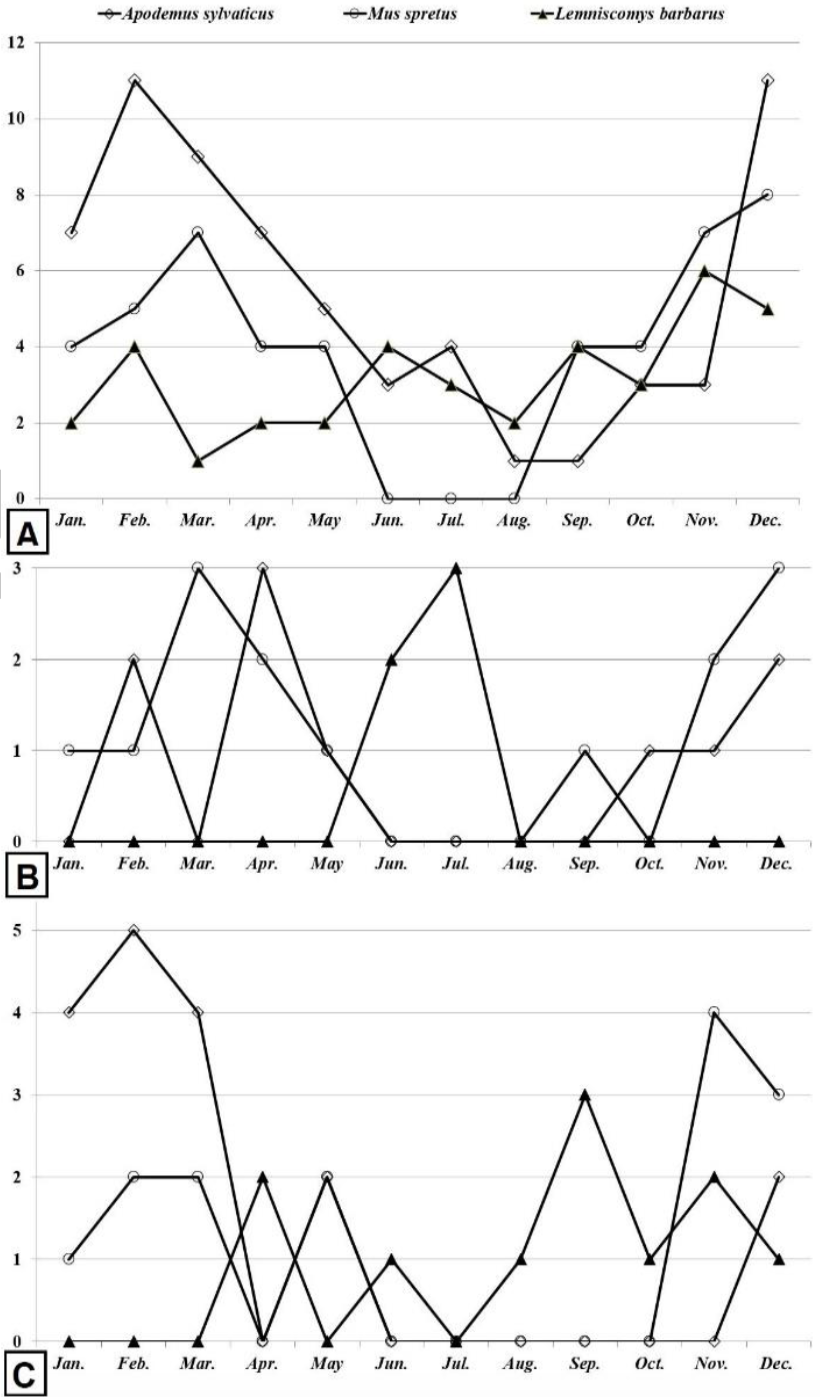
Monthly captures of adults (A), juveniles (B) and sub-adults (C) of three wild murine species at Boudjima (Great Kabylia, Algeria).
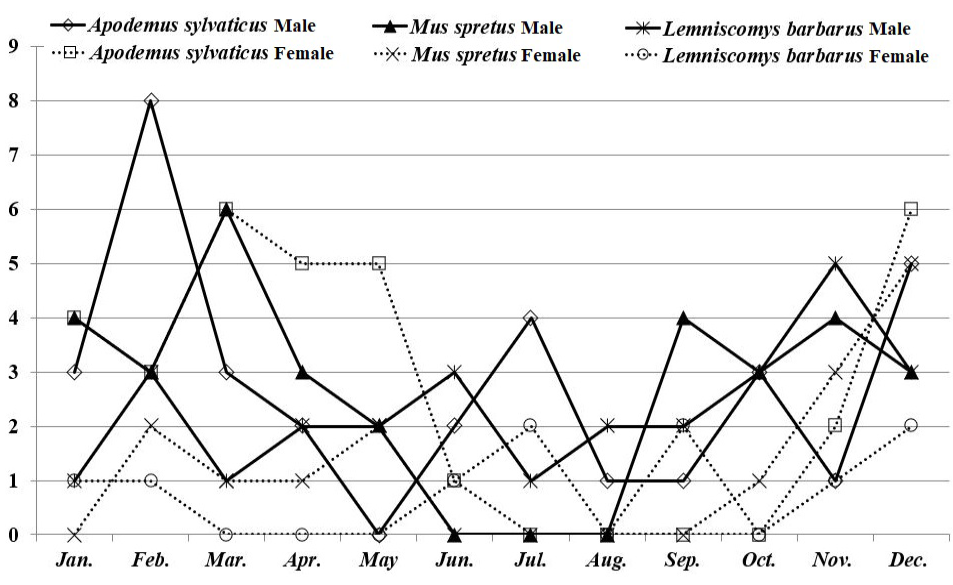
Monthly captures of males and females of three wild murine species at Boudjima (Great Kabylia, Algeria).
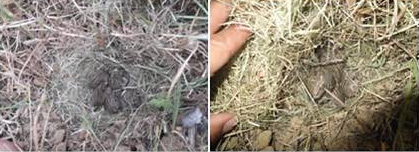
Nests of Lemniscomys barbarus (Mekla, Great Kabylia, Algeria, June 2017).
References
- Amrouche-Larabi, L., Denys, C., Boukhemza, M., Bensidhoum, M., Hamani, A., Nicolas, V., Khifer, L. and Mamou, R., 2015. Inventaire des petits vertébrés terrestres de quelques localités du Nord algérien. Trav. Inst. Sci. Sér. Gén., 8: 85-95.
- Antuñez, A., Vargas, J.M., Sans-Coma, V. and Palomo, L.J., 1990. Quelques aspects du cycle biologique de Mus spretus au sud de la Péninsule Ibérique. Vie Milieu, 40: 196-200.
- Ben Ibrahim, A., Ben Salem, I., Labidi, I., Chetoui, M. and Nouira, S., 2019. Suivi local d’une communauté de rongeurs dans la région de Lansarine au nord de la Tunisie : activité et distribution spatiale et temporelle des espèces. Ecol. Medit., 45: 67-74. https://doi.org/10.3406/ecmed.2019.2076[CrossRef]
- Bernard, J., 1969. Les Mammifères de Tunisie et des régions voisines. Bull. Facul. Agro. Tunis, 24/25: 38-160. https://doi.org/10.1007/978-3-642-92977-9_11[CrossRef]
- Birkan, M., 1968. Répartition écologique et dynamique des populations d’Apodemus sylvaticus et Clethrionomys glareolus en pinède à Rambouillet. Rev. Ecol., 3: 231-273.
- Bronson, F.H., 2009. Climate change and seasonal reproduction in mammals. Phil. Trans. R. Soc. B., 364: 3331-3340. https://doi.org/10.1098/rstb.2009.0140[CrossRef]
- Bronson, F.H. and Perrigo, G., 1987.Seasonal regulation of reproduction in muroid rodents. Am. Zool., 37: 929-940. https://doi.org/10.1093/icb/27.3.929[CrossRef]
- Butet, A. and Paillat, G., 1997. Insectivores et Rongeurs de France: le Mulot sylvestre – Apodemus sylvaticus (Linné, 1758). Arvicola, 9: 7-23. https://doi.org/10.3406/ecmed.1997.1818[CrossRef]
- Cassaing, J. and Croset H., 1985. Organisation spatiale, compétition et dynamique des populations sauvages de souris (Mus spretus Lataste et Mus musculus domesticus Rutty) du Midi de la France. Z. Säugetierk., 50: 271-284. https://doi.org/10.1080/00231940.1985.11758043[CrossRef]
- Daget, P., 1977. Le bioclimat méditerranéen: analyse des formes climatiques par le système d’Emberger. Vegetatio, 34: 87-103. https://doi.org/10.1007/BF00054477[CrossRef]
- Denys, C., 2017a. Apodemus sylvaticus. In: Handbook of the mammals of the World. 6. Rodents II (eds. D.E. Wilson, R.A. Mittermeier and T.E. Lacher). Lynx, Barcelona, pp. 780-781.
- Denys, C., 2017b. Mus spretus. In: Handbook of the mammals of the World. 6. Rodents II (eds. D.E. Wilson, R.A. Mittermeier and T.E. Lacher). Lynx, Barcelona, pp. 789-790.
- Denys, C., Stoetzel, E., Lalis, A., Nicolas, V., Delapre, A., Mataame, A., Tifraouine, L., Rihane, A., El Brini, H., Liefrid, S., Fahd, S., Ouarour, A., Cherkaoui, A., Fekhaoui, M., Benhoussa, A., El Hassani, A. and Benazzou, T., 2015. Inventaire des petits mammifères de milieux anthropisés et naturels du Maroc septentrional. in: Approche intégrative de la 6ème extinction : influence de l’installation des hommes modernes au Maroc sur l’évolution de la biodiversité des petits vertébrés terrestres. Trav. Inst. Sci. Sér. Gén., 8: 113-126.
- Díaz, M. and Alonso, C.L., 2003. Wood mouse Apodemus sylvaticus winter food supply, density, condition breeding, and parasites. Ecology, 84: 2680-2691. https://doi.org/10.1890/02-0534[CrossRef]
- Fons, R. and Saint Girons, M.C., 1993. Le cycle sexuel chez le Mulot sylvestre, Apodemus sylvaticus (L., 1758), (Muridae) en région méditerranéenne. Z. Säugetierk., 58: 38-47.
- Fons, R., Grabulosa, I., Saint-Girons, M.C., Galan- Puchades, M.T. and Feliu, C., 1988. Incendie et cicatrisation des écosystèmes méditerranéens dynamique du repeuplement en micromammifères. Vie Milieu, 38: 259-280.
- Gockel, J. and Ruf, T., 2001. Alternative seasonal reproductive strategies in wild rodent populations. J. Mammal., 82: 1034-1046. https://doi.org/10.1644/1545-1542(2001)082<1034:ASRSIW>2.0.CO;2[CrossRef]
- Hamdine, W. and Poitevin, F., 1994. Données préliminaires sur l’écologie du Mulot sylvestre Apodemus sylvaticus Linné, 1758, Parc national du Djurdjura, Algérie. Rev. Ecol., 49: 181-186. https://doi.org/10.1016/0034-4257(94)90013-2[CrossRef]
- Happold, D.C.D., 2013. Lemniscomys barbarus Barbary grass mouse (Barbary lemniscomys). In: Mammals of Africa, Volume III. Rodents, hares and rabbits (ed. D.C.D. Happold). Bloomsbury Publications, London, pp. 443-444.
- Harich, N. and Benazzou, T., 1990. Contribution à l’étude de la Biologie du Mulot (Apodemus sylvaticus, Rongeurs, Muridés) de la plaine côtière du Maroc. Mammalia, 54: 47-59. https://doi.org/10.1016/0006-3207(90)90041-M[CrossRef]
- Khammes, N., 1998. Biologie comparée du Mulot sylvestre Apodemus sylvaticus Linnaeus, 1758 et de la Souris sauvage Mus spretus Lataste, 1883 en region méditerranéenne d’Algérie. Magist. Biol. thesis, M. Mammeri University, Tizi-Ouzou, Algeria, pp. 109.
- Khammes, N. and Aulagnier, S., 2007. Diet of the wood mouse, Apodemus sylvaticus, in three biotopes of Kabylie of Djurdjura (Algeria). Folia Zool., 56: 243-252.
- Khidas, K., 1993. Distribution des rongeurs en Kabylie du Djurdjura (Algérie). Mammalia, 57: 207-212. https://doi.org/10.1515/mamm.1993.57.2.207[CrossRef]
- Khidas, K., Khammes, N., Khelloufi, S., Lek, S. and Aulagnier, S., 2002. Abundance of the wood mouse Apodemus sylvaticus and the Algerian mouse Mus spretus (Rodentia, Muridae) in different habitats of Northern Algeria. Mammal. Biol., 67: 34-41. https://doi.org/10.1078/1616-5047-00003[CrossRef]
- Klein, J.M., Poulet, A.R. and Simonkovich, E., 1975. Observations écologiques dans une zone enzootique de peste en Mauritanie. I. Les rongeurs, et en particulier Gerbillus gerbillus Olivier, 1801 (Rodentia, Gerbillinae). Cah. Orstom. Sér. Ent. méd. Parasitol., 13: 13-28. https://doi.org/10.1063/1.3068763[CrossRef]
- Kowalski, K., 1985. Annual cycle of reproduction in Apodemus sylvaticus in Algeria. Acta Zool. Fenn., 173: 85-86. https://doi.org/10.1016/0040-6031(85)87036-2[CrossRef]
- Kowalski, K. and Rzebik-Kowalska, B., 1991. Mammals of Algeria. Ossolineum, Wroclaw, pp. 370.
- Lahmam, M., El M’rabet A., Ouarour A., Pevet P. and Challet E., 2008. Daily behavioral rhythmicity and organization of the suprachiasmatic nuclei in the diurnal rodent, Lemniscomys barbarus. Chronobiol. Int., 25: 882-904. https://doi.org/10.1080/07420520802553556[CrossRef]
- Lenkiewicz, S. and Saint Girons, M.C., 1964. Notes sur le rythme nycthéméral d’activité chez Lemniscomys barbarus (L., 1766) au laboratoire. Mammalia, 28: 453-461. https://doi.org/10.1515/mamm.1964.28.3.453[CrossRef]
- Martinet, L. and Spitz, F., 1971. Variations saisonnières de la croissance et de la mortalité du Campagnol des champs, Microtus arvalis. Rôle du photopériodisme et de la végétation sur ces variations. Mammalia, 35: 38-84. https://doi.org/10.1515/mamm.1971.35.1.38[CrossRef]
- Moreno, S. and Kufner, M.B., 1988. Seasonal pattern in the wood mouse population in Mediterranean scrubland. Acta Theriol., 33: 79-85. https://doi.org/10.4098/AT.arch.88-7[CrossRef]
- Orsini, P., Cassaing, J., Duplantier, J.M. and Croset, H., 1982. Premières données sur l’écologie des populations naturelles de Souris, Mus spretus Lataste et Mus musculus domesticus Rutty dans le midi de la France. Rev. Ecol., 36: 321-336.
- Osborn, D.J. and Helmy, I., 1980. The contemporary land mammals of Egypt (including Sinai). Field Zool. N.S., 5: 1-579.
- Palomo, L.J., España, M., López-Fuster, M.J., Gosálbez, J. and Sans Coma, V., 1983. Sobre la variabilidad genética y morfométrica de Mus spretus Lataste, 1883 en la Península Ibérica. Misc. Zool., 7: 171-192.
- Palomo, L.J., Antuñez, A., Ibañez, C., Vargas, J.M. and Sans Coma, V., 1985. Estudio taxonómico de Mus spretus Lataste, 1883 del norte de Marruecos. Misc. Zool., 9: 367-374.
- Rosário, I.T. and Mathias, M.L., 2004. Annual weight variation and reproductive cycle of the wood mouse (Apodemus sylvaticus) in a Mediterranean environment. Mammalia, 68: 133-140. https://doi.org/10.1515/mamm.2004.014[CrossRef]
- Saint Girons, M.C., 1972. Le genre Apodemus Kaup, 1892, au Maroc. Z. Säugetierk., 37: 362-371. https://doi.org/10.1515/mamm.1973.37.3.439[CrossRef]
- Soriguer, R.C. and Amat, J.A., 1979. Datos sobre la biología y dinámica numérica de una población de ratones de campo (Apodemus sylvaticus) en Andalucía occidental. Bol. Est. Central Ecol., 8: 79-83.
- Spitz, F., Le Louarn, H., Poulet, A. and Dassonville, B., 1974. Standardisation des piégeages en ligne pour quelques espèces de rongeurs. Terre Vie, 28: 564-578.
- Stenseth, N.C. and Lidicker, W.Z., 1992. Animal dispersal: Small mammals as a model. Chapman and Hall, London, pp. 365. https://doi.org/10.1007/978-94-011-2338-9[CrossRef]
- Taylor, P.J., 2017. Lemniscomys barbarus. In: Handbook of the mammals of the World. 6. Rodents II (eds. D.E. Wilson, R.A. Mittermeier and T.E. Lacher). Lynx, Barcelona, pp. 769.
- Torre, I., Arrizabalaga, A. and Díaz, M., 2002. Ratón de campo Apodemus sylvaticus (Linnaeus, 1758). Galemys, 14: 1-26.
- Van der Straeten, E., 1980. Étude biométrique de Lemniscomys linulus (Afrique Occidentale) (Mammalia, Muridae). Rev. Zool. Afr., 94: 185-201. https://doi.org/10.1093/genetics/94.1.185[CrossRef]
- Vargas, J.M., España, A., Haro, R. and Sans- Coma, V., 1984. Estructura poblacional de Mus spretus Lataste, 1883 en cultivos de caña de azúcar del sur de la Península Ibérica Misc. Zool., 8: 253-262.
- Vargas, J.M., Palomo, L.J. and Palmquist, P., 1991. Reproduction of the Algerian mouse (Mus spretus Lataste, 1883) in the south of the Iberian Peninsula. Bonn. Zool. Beitr., 42: 1-10.
- Zaime, A., 1985. Contribution à l’étude éco-éthologique de trois rongeurs des milieux arides et semi-arides au Maroc, Meriones shawi, Gerbillus campestris et Lemniscomys barbarus. Doct. Ing. Ecol. Ethol. thesis, Rennes 1 University, France, pp. 236.
Services
Article usage statistics
Loading…