
Understanding morphological responses to climate variation is crucial for predicting species resilience under global warming. This study evaluates the effects of regional temperature gradients on wingspan plasticity in Danaus chrysippus (Plain Tiger) across seven regions of the Punjab province of Pakistan. Between February and August 2024 morphometric measurements were obtained from 30 undamaged specimens. A striking inverse correlation was detected between ambient temperature and wingspan (r = –0.910, p = 0.001), and the random-effect model indicated that location explained 78.5% of wingspan variance. These findings support the hypothesis that lower temperature promotes larger wingspan, by linking temperature-driven morphological plasticity to ecological resilience. This study provides a conceptual basis for using butterfly morphology as an early indicator of climate-induced change in natural communities.
Short Communication · Volume 58, Issue 6, 12 October 2026 · Open Access
Thermal Constraints on Morphological Plasticity in Butterflies: Wingspan Variation in Plain Tiger Across Temporal Gradients
· · ·
Affiliations & Notes ⌄
- 1Department of Biological Sciences, Virtual University, Kala Shah Kaku Campus, Lahore, Pakistan. * Corresponding author: ishrat.aziz@vu.edu.pk
Article Info ⌄
- Journal:
- Pakistan Journal of Zoology
- Published:
- 12 October 2026

From the article
- Mean adult wingspan (± SD) varied among sites, with the largest wingspan recorded from lower temperature and smaller ones from higher.
- Butterflies from lower temperature exhibited larger wingspans, up to 82 mm (temperature 14°C), while those from higher temperature had smaller wingspans, as low as 50 mm (44 °C).
- Pearson’s correlation analysis revealed a strong inverse relationship between temperature and wingspan (r = –0.910, p = 0.001; Fig. 2) supporting the hypothesis that lower temperature facilitates greater wingspan in D. chrysippus.
- This significant negative correlation (r = -0.910, p = 0.001) indicates that individuals developing under lower temperature attain larger wingspans, whereas those in higher temperature exhibit reduced size.
Selected from the article's own text.
Abstract
Materials and methods
Field surveys were conducted across seven regions of Punjab province, Pakistan: Gujranwala, Warburton, Jhang, Bahawalpur, Rawalpindi, Gujar Khan, and Sheikhupura (Fig. 1). Sampling occurred from February to August 2024. Butterflies were collected using sweep nets and hand-picking during peak activity hours (0900-1400 h), and observed under controlled conditions prior to euthanasia via thorax pinching.
Specimens were identified using Evans’ guide to Indian butterflies . Morphological traits were measured using a magnifier and ruler, with special attention to wingspan. Morphometric measurements were obtained from 30 intact specimens representing different locations and temperature ranges.
Mean daily ambient temperature for each collection and location was obtained from Google Weather historical records on the day of collection . These values were directly matched to each measured individual rather than using site-wide averages.
The relationship between ambient temperature and wingspan was analyzed in Python using a random-effect model that combined Pearson’s correlation with location-based variance estimation based on measurements from 30 specimens (p < 0.05).
Results and discussion
Thirty specimens of Danaus chrysippus were collected across seven regions of Punjab (province), Pakistan. Morphometric data for 30 intact specimens (Table I) showed clear variation in wingspan along the temperature gradient. Mean adult wingspan (± SD) varied among sites, with the largest wingspan recorded from lower temperature and smaller ones from higher.
Table I. Sample size (n), temperature range, and mean adult wingspan (± SD) of Danaus chrysippus across seven regions of Punjab, Pakistan during February–August 2024.
|
Site |
n |
Temperature range (°C) |
Mean wingspan ± SD (mm) |
|
Gujranwala |
6 |
14-21°C |
81.25 ± 0.99 |
|
Sheikhupura |
3 |
25-34°C |
72.83 ± 2.57 |
|
Gujar khan |
5 |
24-34°C |
72.90 ± 2.13 |
|
Jhang |
2 |
23-30.5°C |
77.50 ± 3.54 |
|
Bahawalpur |
6 |
17-32°C |
76.17 ± 3.86 |
|
Warburton |
4 |
29-41°C |
72.00 ± 4.76 |
|
Rawalpindi |
4 |
35-44°C |
58.75 ± 7.50 |
Butterflies from lower temperature exhibited larger wingspans, up to 82 mm (temperature 14°C), while those from higher temperature had smaller wingspans, as low as 50 mm (44 °C).
Pearson’s correlation analysis revealed a strong inverse relationship between temperature and wingspan (r = –0.910, p = 0.001; Fig. 2) supporting the hypothesis that lower temperature facilitates greater wingspan in D. chrysippus. The random-effect model further showed that location explained 78.5% of wingspan variance, indicating substantial site-level influence on morphological response.
This significant negative correlation (r = -0.910, p = 0.001) indicates that individuals developing under lower temperature attain larger wingspans, whereas those in higher temperature exhibit reduced size. Similar temperature-size patterns have been documented in other butterfly species, supporting the temperature-size rule for ectotherms ; ; .Within Pakistan, Khan and Hanif (2016) and Perveen and Fazal (2013) reported larger wingspan of Danaus chrysippus in cooler northern sites, while comparable trends were observed in India and parts of Sindh . Globally, cooler climates have been linked to increased adult size in temperature and montane butterfly species ; .
From an ecological perspective, larger wingspans in cooler environments may enhance thermoregulation, flight efficiency, and dispersal, while smaller wingspans in hotter regions may reduce desiccation risk and metabolic demands. Given projected increases in average temperatures, such phenotypic shifts could influence population persistence, mating success and pollination services.
While the observed pattern is robust, the relatively small morphometric sample size and absence of other environmental covariates (e.g., host plant availability, humidity) suggest caution in generalizing results. Future work should integrate controlled rearing experiments and multi-site long-term monitoring to confirm causal mechanisms and assess potential evolutionary responses to observe the sustainability and resilience of the concerned phenomenon. These findings contribute a baseline dataset for South Asia and highlight the value of butterfly morphology as a cost-effective bioindicator for detecting climate-driven ecological change.
Conclusion
This study demonstrates a strong negative relationship between temperature and plasticity of wingspan in Danaus chrysippus across Punjab, Pakistan, with low temperature producing larger wingspan and notable location-based differences reflecting environmental influence. These findings align with the temperature-size rule and emphasize the potential of butterfly morphology as a rapid, low-cost bioindicator of climate change impacts. Establishing such regions-specific baselines is essential for future monitoring and conservation planning in thermally stressed ecosystems.
Declarations
Acknowledgements
We thank the nursery owners and field volunteers across Pakistan who facilitated butterfly observations and collections. Special thanks to Dr. Ishrat Aziz for her mentorship throughout the research.
Funding
No external funding was received for this study.
Generative AI and AI assisted technology statement
The authors declare that no generative AI and AI assisted technology was used in the creation of this manuscript.
Statement of conflict of interest
The authors have declared no conflict of interest.
Figures
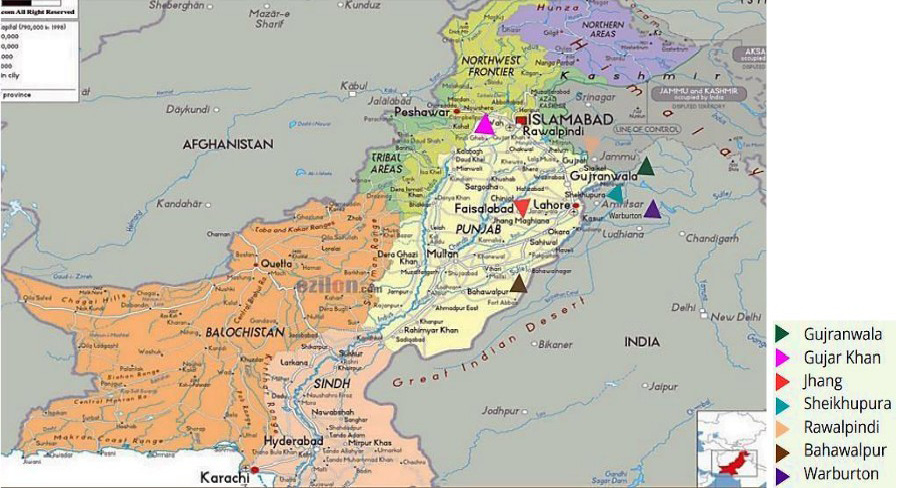
Selected regions where the butterfly specimens were observed and collected throughout the research are highlighted with different colored triangles.
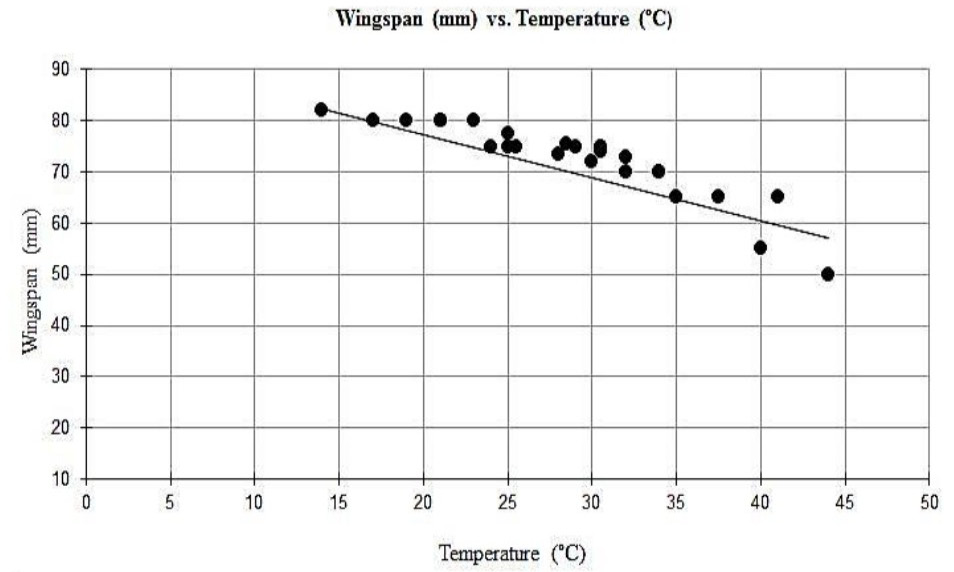
Relationship between ambient temperature and wingspan of Danaus chrysippus across sampling sites in Punjab, Pakistan (n=30).
References
- Berwaerts, K., Van Dyck, H. and Aerts, P., 2002. Funct. Ecol., 16: 484–491. https://doi.org/10.1046/j.1365-2435.2002.00650.x[CrossRef]
- Bonebrake, T.C., Ponisio, L.C., Boggs, C.L. and Ehrlich, P.R., 2010. Biol. Conserv., 143: 1831–1841. https://doi.org/10.1016/j.biocon.2010.04.044[CrossRef]
- Brakefield, P.M. and Larsen, T.B., 1984. Biol. J. Linn. Soc., 22: 1–12. https://doi.org/10.1111/j.1095-8312.1984.tb00795.x[CrossRef]
- Evans, W.H., 1932. The identification of Indian butterflies. Bombay Natural History Society, India.
- Google Weather, 2024. Historical daily weather data. Available at: https://www.google.com/search?q=weather (accessed 1 February – 30 August, 2024).
- Khan, H.A. and Hanif, H., 2016. Int. J. entomol. Res., 1: 27–30.
- Ki, T.L., Beale, C.M., Huertas, B. and Hill, J.K., 2024. Insect Conserv. Divers., 17: 788–799. https://doi.org/10.1111/icad.12744[CrossRef]
- Kingsolver, J.G. and Huey, R.B., 2008. Size, temperature, and fitness: Three rules. Evol. Ecol. Res., 10: 251–268.
- Lushai, G., Goulson, D. and Allen, J.A., 2003. Biol. J. Linn. Soc., 79: 233–238.
- Mangi, A., Panhwar, W.A., Shaikh, A.M., Sirohi, M.H., Soomro, S.R.S., Mirbhar, A.A. and Mustafa, S.B., 2023. J. appl. Res. Pl. Sci., 4: 385–389. https://doi.org/10.38211/joarps.2023.04.01.46[CrossRef]
- Minter, M., Dasamahapatra, K.K., Morecroft, M.D., Thomas, C.D. and Hill, J.K., 2024. Ecol. Ent., 49: 983–988. https://doi.org/10.1111/een.13369[CrossRef]
- Nylin, S. and Gotthard, K., 1998. Annu. Rev. Ent., 43: 63–83. https://doi.org/10.1146/annurev.ento.43.1.63[CrossRef]
- Perveen, F. and Fazal, F., 2013. Open J. Anim. Sci., 3: 28–36. https://doi.org/10.4236/ojas.2013.32A004[CrossRef]
- Rafi, M.A., Akbar, S.A. and Ghafoor, A., 2014. Zool. Stud., 53: 1–10.
- Rao, K.E., Chandar, G.S. and Atluri, J.B., 2016. J. Pharma. Biol. Sci., 11: 91–98.
- Zografou, K., Knop, E., Sewall, B.J., Schweiger, O., De Moraes, C.M., Whitaker, M. and Kati, V., 2025. bioRxiv, pp. 2025-02. https://doi.org/10.1101/2025.02.06.636804[CrossRef]
Services
Article usage statistics
Loading…