During the present study, 32 species of butterflies from 22 genera, 11 subfamilies, and four families were reported.
The most abundant family was Nymphalidae family with 14 species (11 genera), followed by the Pieridae with 13 species (seven genera), the Lycaenidae with three species (three genera), and the Papilionidae with two species (one genus).
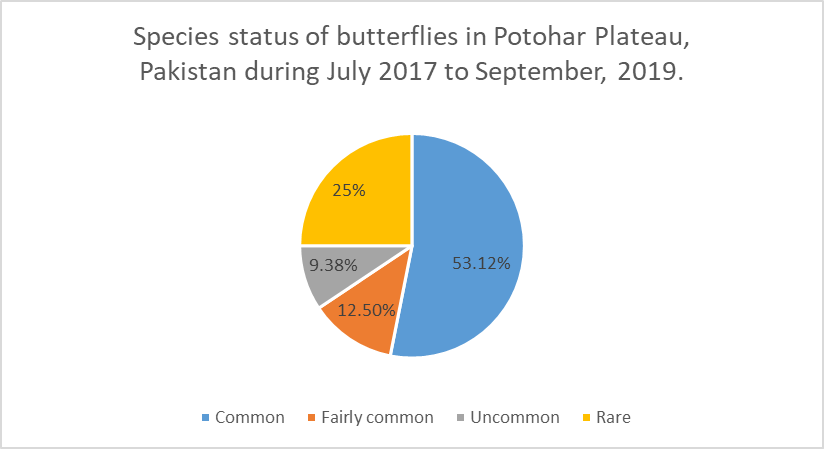
With regard to occurrence status, species of butterfly fauna found to be 17(53.12%) as common, four (12.5%) are fairly common, three (9.38%) are uncommon and eight (25%) are rare ones species in the study area.
A description of the butterfly species found in Punjab, Pakistan’s Potohar Plateau, was made in this paper.
Selected from the article's own text.
Abstract
Butterflies are stunning and attractive insects that are also important pollinators and members of a well-studied taxonomic group, order Lepidoptera of class Insecta. In order to explore the diversity of the butterfly fauna, a field survey was conducted every two weeks from June 2017 to September 2019 in selected locales of the Potohar Plateau, Punjab, Pakistan. An annotated checklist of the butterfly fauna was prepared using a total of 1117 specimens of butterflies from 32 species across 22 genera, 11 subfamilies, and four families from this study. With 14 (43.75%) species, the Nymphalidae family was dominated that was followed by the Pieridae family, which had 13 (40.62%) species, the Lycaenidae family, which had three (9.37%) species, and the Papilionidae family, which had two (6.25%) species. With regard to occurrence status, species of butterfly fauna found to be 17(53.12%) as common, four (12.5%) are fairly common, three (9.38%) are uncommon and eight (25%) are rare ones species in the study area. The commonly found 17 species of butterfly fauna are as follow; Papilio demoleus, Pieris canidia, Pieris brassicae, Pontia daplidice, Belenois aurota, Colotis etridae, Colias fieldii, Catopsilia crocalae, Catopsilia pomona, Catopsilia pyranthae, Eurema hecabe, Euchrysops cnejus, Danaus chrysippus, Ypthima asterope, Ariadne merione, Junonia orithya and Junonia almana; four Fairly Common (F.C.) species are; Colias eratae, Catopsilia florella, Tarucus theophrastus and Ypthima nareda; three Un-Common (U.C.) species are; Papilio polytes, Melanitis leda and Junonia hierta and eight Rare (R) species are; Colotis calais, Zizeeria maha, Tirumala limniace, Hipparchia parisatis, Polyura agraria, Neptis sappho, Vanessa cardui and Phalanta phalantha. Furthermore, the biodiversity of butterfly fauna found in the present study at Potohar Plateau, Punjab, Pakistan could be protected by the government and wild life conservation agencies for sustainable management of these resources.
Novelty Statement | This study shows that butterfly species (Potohar Plateau, Punjab, Pakistan) are threatened due to increased predator population and habitat destruction due to human intervention and excessive use of insecticides and pesticides and should be preserved and protected by biodiversity and wild life conservation schemes.
Introduction
In total 157338 species of lepidopterous insects (butterflies, moth and skippers) have been reported in the Catalogue of Life ; . In the world, around 18000 species of butterflies are estimated ; , 1318 butterfly species are reported in India ; , whereas, in Pakistan 436 species of butterflies have been reported . Members of the order Lepidoptera (especially butterflies) are most suitable for comparative quantitative study of insect fauna due to their response to climate and vegetation, species richness, abundance, advanced taxonomy and ease of sampling ; ; ; .
Butterflies are very important for pollination in plants (Morris et al., 1991). They are important for monitoring effects of environment whenever we are using chemicals like insecticides and pesticides to control insect pests (Morris et al., 1991). They are also helpful in identification of key areas in conservation biology (Morris et al., 1991). Butterflies fly due to their two pairs of wings. On their wings, beautiful scales are intricately overlapped. They warm up their bodies by basking in winter . They are very beneficially important for economic point of view. They serve as a pollination agent ; . Due to their important role as an assisting agent in the development of flowers, fruits, seeds, and food crops, they are extremely important for the survival of animal, insect, and human diversity on this planet, Earth ; . They also play a role of environmental indicator species due to their many environmental indicating distinguishing characters. They are affected by weather extremities due to their sensitivity to environmental changes. So, whenever, there are changes in structure and composition of vegetation then there will also be changes in abundance and distribution of butterfly species ; . They are simply more visible than the other insects that are equally adversely affected. That’s why they are such good indicator species, easy to survey and follow. Moreover, It is a bitter reality that butterflies are most adversely affected than any other animal or insect species as they are declining in their abundance, distribution and species richness due to increasing trend of urbanization features like construction of housing societies, buildings, roads, mowed lawns and industrialization ; . However, every ecosystem on earth has butterflies, with the exception of the Arctic, Antarctica, and snow-covered mountains. They are an integral element of flowering plants and vegetation .
In 2001, 320 species of butterflies were recorded in Pakistan , but as of late, 436 species have been identified . Although, the butterfly fauna of various regions in Pakistan has been explored but the study area had not previously received much attention ; ; ; ; ; ; . This is an effort to investigate the variety of butterfly fauna in some selected areas of the Potohar Plateau in Punjab, Pakistan. Therefore, the primary goal of this research study was to gather, catalog, and identify the species of butterflies found on Pakistan’s Potohar Plateau ; ; ; ; ; ; ; ; .
Materials and Methods
Study area
The Potohar Plateau in Pakistan is located between 32.50 N to 34.00N and 720 E to 740E ; ; Khanam et al., 2017a; Khanam et al., 2017b). It is situated at the junction point of Oriental and Palearctic biogeographical region .
It is rain fed area. The elevation level of this region from the sea level is 350 to 575 m. It has semi-arid to humid climate. Average annual rain fall of this region is from 250 -500 mm. In summer, mean temperature is 45 C o but in winter season, it is below than freezing point. It is comprised of 22000 km2 area, out of which 10000 km2 area is used for agricultural purpose (Khanam et al., 2017a; Khanam et al., 2017b). There is deficiency in systematic study of crop productivity due to lack of water supply as this area is rain fed area . The human population of this region is about 2 million people; out of which 30% population is urban and 70% population is rural. In rural population, people manly dependent on agriculture for their living subsistence .
It is administratively comprised of Pakistan’s Islamabad Capital Territory (ICT) and Jhelum, Chakwal, Rawalpindi, and Attock districts of the Punjab province (Khanam et al., 2017a; Khanam et al., 2017b).
Sampling and Identification of Butterfly Species
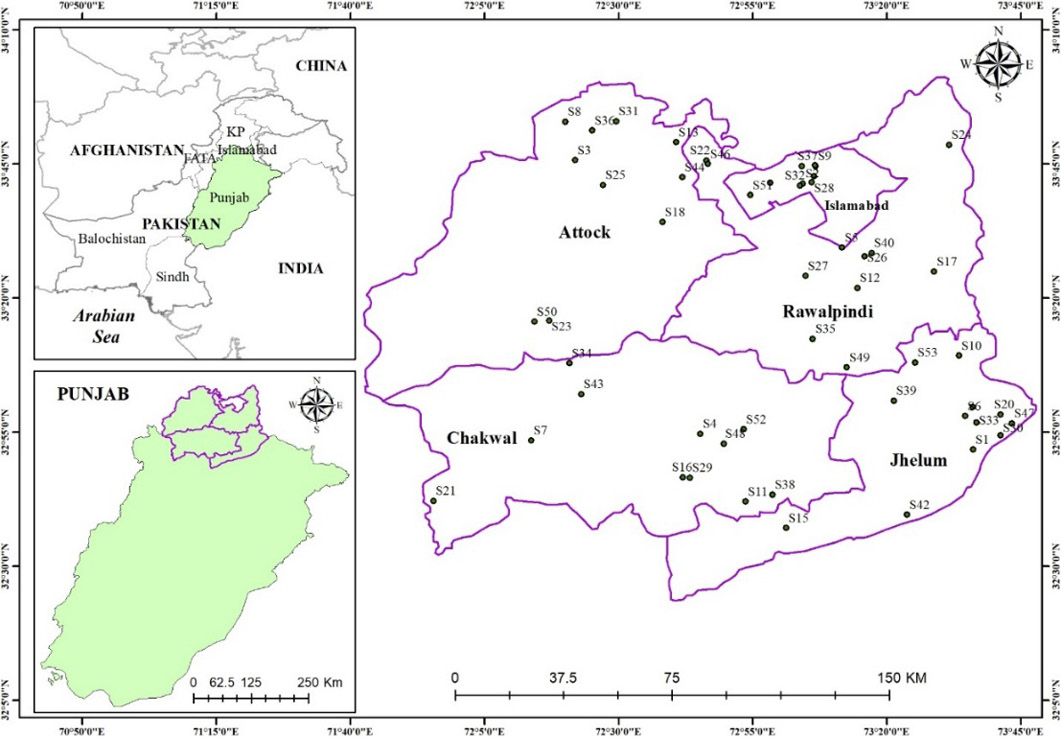
The sampling was done from 53 locales of the agro-eco system of all districts; Jhelum, Chakwal, Rawalpindi and Attock of Potohar, Punjab, Pakistan during June 2017 to September 2019 on fortnightly basis (Figure 1 and Supplementary Table 1 and 2). We identified butterfly species by using the taxonomic keys, literature and taxonomic procedures ; ; ; .
Results and Discussion
Following is a systematic check list of the butterfly species found in the Potohar Plateau, Pakistan;
Systematic Classification of Collected Butterflies
Phylum: Arthropoda
Class: Insecta
Order: Lepidoptera
Family: Papilionidae
Subfamily: Papilioninae
Common Mormon, Papilio polytes, Linnaeus, 1758
Lime butterfly, Papilio demoleus, Linnaeus, 1758
Family: Pieridae
Subfamily: Pierinae (Whites)
Alpine or Kashmir large white, Pieris canidia, De Niceville, 1883
Large cabbage white, Pieris brassicae, Linnaeus, 1758
Bath white, Pontia daplidice, Linnaeus, 1758
Pioneer, Belenois aurota, Moore, 1881
Little orange tip, Colotis etridae, Boisduval, 1836
Table 1: Overview of the identified species of butterflies in Potohar Plateau, Pakistan during July, 2017 to September, 2019.
S.No.
Name of species
1
Papilio polytes, Linnaeus, 1758
2
Papilio demoleus, Linnaeus, 1758
3
Pieris canidia, De Niceville, 1883
4
Pieris brassicae, Linnaeus, 1758
5
Pontia daplidice, Linnaeus, 1758
6
Belenois aurota, Moore, 1881
7
Colotis etridae, Boisduval, 1836
8
Colotis calais, Cramer, 1775
9
Colias eratae, Butler, 1880
10
Colias fieldii, Menetries, 1855
11
Catopsilia crocalae, Cramer, 1775
12
Catopsilia pomona, Fabricius, 1775
13
Catopsilia florella, Fabricius, 1775
14
Catopsilia pyranthae, Linnaeus, 1758
15
Eurema hecabe, Linnaeus, 1758
16
Tarucus theophrastus, Fabricius, 1793
17
Zizeera maha, Kollar, 1844
18
Euchrysops cnejus, Fabricius, 1798
19
Danauas chryssipus, Linnaeus, 1758
20
Tirumala limniace, Cramer, 1775
21
Ypthima nareda, Kollar, 1844
22
Ypthima aestrope, Klug, 1829
23
Melanitis leda, Linnaeus, 1758
24
Hipparchia parisatis, Kollar, 1849
25
Polyura agraria, Swinhoe, 1887
26
Ariadne merione, Moore, 1884
27
Neptis sappho, Pallas, 1771
28
Vanessa cardui, Linnaeus, 1758
29
Junonia orithya, Linnaeus, 1758
30
Junonia hierta, Fabricius, 1798
31
Junonia almana, Linnaeus, 1758
32
Phalanta phalantha, Drury, 1770
Table 2: Composition and status of butterfly species in Potohar Plateau, Pakistan during July, 2017 to September, 2019.
S.#
Family
No. of species
Occurrence
Common (C)
Fairly common (FC)
Uncommon (UC)
Rare (R)
1
Papilionidae
2
1
0
1
0
2
Pieridae
13
10
2
0
1
3
Lycaenidae
3
1
1
0
1
4
Nymphalidae
14
5
1
2
6
∑=4
∑= 32
∑=17
∑=4
∑=3
∑=8
%
100%
53.12%
12.50%
9.38%
25%
At 53 locales in the Potohar Plateau, Pakistan, a total of 1117 individuals of 32 butterfly species from 22 genera, 11 subfamilies, and four families were recorded during the study period from July 2017 to September 2019 (Table 1 and 2).
In terms of number and percentage of species composition, most abundant family was family Nymphalidae with 14 (43.75%) butterfly species followed by family Pieridae with 13 (40.62%) butterfly species, family Lycaenidae with three (9.37%) butterfly species and family Papilionidae with two (6.25%) butterfly species (Table 2 and 3).
The observed butterfly fauna was divided into four groups based on their relative numbers as, Common >9-10, Fairly Common includes 6-8, Un-Common, 3-5 and Rare includes 0-2 ; . So, occurrence status of butterfly fauna in Potohar Plateau, Pakistan was calculated in study area. Out of 32 species recorded, 17(53.13%) species are Common; four (12.50%) species are Fairly Common; three (9.38%) species of family Nymphalidae are Un-Common and eight (25%) species of family Nymphalidae are Rare (Table 2 and 3).
Out of 17 common species, 13 common species are found in family Pieridae, two common species in family Papilionidae and also two common species are found in family Lycaenidae. In study area, 17 common species are; Papilio demoleus, Pieris canidia, Pieris brassicae, Pontia daplidice, Belenois aurota, Colotis etridae, Colias fieldii, Catopsilia crocalae, Catopsilia pomona, Catopsilia pyranthae, Eurema hecabe, Euchrysops cnejus, Danaus chrysippus, Ypthima asterope, Ariadne merione, Junonia orithya and Junonia almana. Out of four fairly common (FC), three fairly common species are found in family Nymphalidae and one fairly common species is found in family Lycaenidae. Four fairly common species (F.C.) are; Colias eratae, Catopsilia florella, Tarucus theophrastus and Ypthima nareda. Three uncommon species (U.C.) of family Nymphalidae are; Papilio polytes, Melanitis leda and Junonia hierta. While eight rare (R) species of family Nymphalidae are; Colotis calais, Zizeeria maha, Tirumala limniace, Hipparchia parisatis, Polyura agraria, Neptis sappho, Vanessa cardui and Phalanta phalantha (Table 2 and 3; Figure 2).
Adult butterflies exhibit significant aesthetic and commercial value . Numerous researchers investigated the butterfly flora in specific Pakistani regions and prepared check lists as well ; ; ; ; ; ; .
In Kohat, Khyber Pakhtunkhwa, Pakistan, an entomological study was carried out from September to December 2008, and a checklist of the local butterfly fauna was created. The researchers discovered 21 species that belonged to three families. Pieris brassicae, Pieris ajaka, Pieris rapae, Pieris napi, Catopsilia pomona, Colias etrida, Colias croceus, Eumera hecabe, Ixias pyrene, Belenois aurota, Colotis protractus and Gonepteryx rhamni were among the 12 identified species of the family Pieridae. Nine identified species of the family Nymphalidae included Ariadne merione, Argynnis hyperbius, Cynthia cardui, Junonia almanac, Junonia orithya, Hipparchia parisatis, Phalanta phalantha, Danaus chryssipus and Danaus genutia .
In union council Koaz Bahram Dheri, Khyber Pakhtunkhwa Pakistan, a checklist of the butterfly fauna was published from July to October 2012. They gathered 232
Table 3: Check list of butterfly fauna at Potohar Plateau, Pakistan during July 2017 to September, 2019 (Where, n= Number of individuals; Status, C= Common, FC= Fairly common, UC= Uncommon & R= Rare).
Family
Subfamily
Taxonomic Names
Common Names
n
Status
Papilionidae (6.25%)
Papilioninae
Papilio polytes, Linnaeus, 1758
Common Mormon
3
UC
Papilio demoleus, Linnaeus, 1758
Lime butterfly
15
C
Pieridae (40.63%)
Pierinae
Pieris canidia, De Niceville, 1883
Alpine large white
124
C
Pieris brassicae, Linnaeus, 1758
Large cabbage white
77
C
Pontia daplidice, Linnaeus, 1758
Bath white
13
C
Belenois aurota, Moore, 1881
Pioneer
46
C
Colotis etridae, Boisduval, 1836
Little orange tip
10
C
Colotis calais, Cramer, 1775
Small salmon arab
1
R
Coliadinae
Colias eratae, Butler, 1880
Pale clouded yellow
7
FC
Colias fieldii, Menetries, 1855
Fiery clouded yellow
29
C
Catopsilia crocalae, Cramer 1775
Common emigrant
14
C
Catopsilia pomona, Fabricius, 1775
Lemon emigrant
137
C
Catopsilia florella, Fabricius, 1775
Common Vagrant
8
FC
Catopsilia pyranthae, Linnaeus, 1758
African / Mottled emigrant
211
C
Eurema hecabe, Linnaeus, 1758
Common grass yellow
112
C
Lycaenidae (7.37%)
Polyommatinae
Tarucus theophrastus, Fabricius, 1793
Blue Pierrot
8
FC
Zizeera maha, Kollar, 1844
Pale grass blue
1
R
Euchrysops cnejus, Fabricius, 1798
Gram blue
9
C
Nymphalidae (43.75%)
Danainae
Danauas chryssipus, Linnaeus, 1758
Plain tiger
162
C
Tirumala limniace, Cramer, 1775
Blue Pansy
2
R
Satyrinae
Ypthima nareda, Kollar, 1844
Large three ring
6
FC
Ypthima aestrope, Klug, 1829
Common three ring
12
C
Melanitis leda, Linnaeus, 1758
Common evening brown
3
UC
Hipparchia parisatis, Kollar, 1849
White edge rock brown
1
R
Charaxinae
Polyura agraria, Swinhoe, 1887
Nawab butterflies
2
R
Biblidinae
Ariadne merione, Moore, 1884
Common Castor
45
C
Limenitidinae
Neptis Sappho, Pallas, 1771
Common glider
2
R
Nymphalinae
Vanessa cardui, Linnaeus, 1758
Painted lady
2
R
Junonia orithya, Linnaeus, 1758
Blue Pansy
28
C
Junonia hierta, Fabricius, 1798
Yellow Pansy
3
UC
Nymphalinae
Junonia almana, Linnaeus, 1758
Peacock Pansy
22
C
Heliconinae
Phalanta phalantha, Drury, 1770
Common leapord
2
R
specimens, of which 13 species, belonging to 11 genera and three families, were identified. Cynthia cardui, Junonia orithya, Danaus chrysippus, Junonia almana, Catopsilia pyranthae, Cercyonis sthenele and Phalanta phalantha were the seven species of the Nymphalidae family that were identified. Five species of the family Pieridae have been identified: Colias croceus, Eurema hecabe, Catopsilia pomona, Pieris canidia and Colotis amata. Only one species, Papilio demoleus of the family Papilionidae has been documented .
Bhojoo Mal and colleagues worked on the checklist of Sindh, Pakistan’s butterfly fauna (Lepidoptera: Rhopalocera) during 2012-2013.They collected 1964 specimens from different study sites of Sindh, Pakistan. They identified 67 species which belonged to 41 genera, 16 subfamilies and 6 families. Highest number of butterflies were reported from the family Lycaenidae that was 28% which includes 19 species, followed by the family Pieridae that was 27% which included 18 species, followed by the two families Nymphalidae and Hesperidae, each of which comprised of 16% butterflies specimens and included 11 species. Then subfamily Danainae of the family Nymphalidae included five species that was 8% and minimum number of butterflies were reported from the family Papilionidae which included only three species that was 5% .
In addition, a checklist of the butterfly (Insecta: Lepidoptera) fauna found in tehsil Tangi, Khyber Pakhtunkhwa, Pakistan was prepared . A total of 506 specimens, representing 23 species, 18 genera, and three families, were gathered. Highest number of butterflies belong to Nymphalidae family that was 13 (49.8 %) species, moderate number of butterflies belong to family Pieridae that was 8 (42.89 %) species and minimum % of butterflies belong to family Papilionidae that was two (7.31 %) species. There were 13 species of the family Nymphalidae that were identified, including Junonia orytha, Junonia hierta, Junonia almana, Danaus chrysippus, Hipparchia parisatis, Argyreus hyperbius, Caynthia cardui, Ariadne merione, Tirumala limniace, Neptis mahendra, Venesa indica, Lethe confuse, and Euthalia garuda, and eight species of the family Pieridae, including Catopsila pomona, Catopsila pyranthe, Pieris canidia, Eurema hecabe, Colias fieldii, Colias erate, Colotis etrida, and Belonias aurota. While only two identified species of family Papilionidae were; Papilio polytes and Papilio demoleus .
In 2013-2014, butterfly fauna of district Gujrat, Punjab, Pakistan was explored . He collected 232 speimens by hand net sweep method and identified 12 species which belong to eight genra, four subfamilies and three families. The six identified species of the Pieridae family were; Pieris canidia, Pieris brassicae, Catopsilia florella, Catopsilia pyranthae Eurema hecabe and Anapheis aurota; four identified species of the subfamily Nymphalinae of the family Nymphalidae family were; Ergolis merione, Vanessa cardui, Junonia orithya and Junonia almana and two identified species of the subfamily Danainae of the family Nymphalidae were; Danaus genutia and Danaus chryssipus .
An annotated list of the butterfly fauna of Quetta, Pakistan during April to October, 2012 was also prepared . They collected 249 specimens from different study sites of Quetta, Baluchistan, Pakistan. They identified 23 species which belong to six families. Seven identified species of the family Pieridae were; Belenois aurota, Colotis fausta, Colias philodice, Colias erate, Catopsilia Pomona, Pieris rapae and Pieris brassicae; six identified species of the family Nymphalidae were; Cynthia cardui, Dannus chrysippus, Hipparchia parisiatis, Pseudochazara alpine, Pseudochazara panjshria , and Pseudochazara kanishka, six identified species of the family Lycaenidae were; Aricia agestis, Cupido minimus, Hemiargus isola, Lampides boeticus, Lycaena phlaeas arctodon and Polyommatus icarus, three identified species of family Hesperidae were; Carcharodus dravira, Cymaenes l. laurelolus and Pelopidas agna agna while only one identified species of the family Papilionidae was Papilio machaon .
Although taxonomists have conducted research related to butterflies in the Pakistan but very little is known about the butterfly fauna with regard to occurrence and conservation status.
In Potohar Plateau, Pakistan, Syed Waqar Shah worked on butterfly fauna . He worked on Pierid (Lepidoptera: Pieridae) pests and their new crucifer’s hosts during January, 2012 to December, 2013. He has found four species of butterflies belonging to Pieridae family on cultivated and non-cultivated cruciferous plants that were Pontia, daplidice, Pieris brassicae, Pieris canidia and Pieris rapae. These four species of butterflies belong to two genera and one family. Pieris rapae and Pontia daplidice were reported from the study area for the first time . In addition, he worked on the biogeographical aspect of pierids butterflies (Lepidoptera: Pieridae) in Potohar Plateau of Pakistan during January 2012 to February 2015. He reported 17 species that belonged to one family, two subfamilies, and two genera. Pierinae and Coliadinae are two of the subfamilies of the family Pieridae. Subfamily Pierinae includes 10 species that were; Pontia daplidice, Delias eucharis, Anapheis aurota/ Belenois aurota, Pieris brassicae, Pieris canidia, Pieris rapae, Colotis amata, Colotis etrida, Colotis protractus and Ixias pyrene. Subfamily Colidinae included seven species that were; Catopsilia pyranthae, Catopsilia pomona, Colias fieldi, Colias eratae, Eurema laeta, Eurema hecabe and Gonepteryx nepalensis. Six species that were Colotis protractus, Colotis amata, Colotis etrida, Delias eucharis and Anapheis aurota/ Belenois aurota were firstly reported in the study area .
The current study was the second attempt to gather data on the butterfly fauna of Pakistan’s Potohar Plateau. Prior to this, Shah et al. (2017) conducted a survey of the butterfly fauna alongside their host plants from 75 chosen sites of the Potohar Plateau, Pakistan, and discovered 17 butterfly species, all of which belonged to the Pieridae family, during January 2012 and February 2015 .While the current entomological study was carried out in the same study region and involved a total of 32 butterfly species from 4 families found in 53 different locations across Pakistan’s Potohar Plateau from July 2017 to September 2019.
Out of 17 butterfly species reported by Shah et al., 2017, six species were reported previously but not found in the present study were; Gonepteryx nepalensis, Eurema laeta, Delias eucharis, Pieris rapae, Ixias pyrene and Colotis protractus . While, 11 butterfly species reported by Shah et al. (2016) were also reported in this study and these 11 commonly reported butterfly species (in both studies) were; Pieris canidia, Pieris brassicae, Pontia daplidice, Belenois aurota, Colotis etridae, Colotis calais, Colias eratae, Colias fieldii, Catopsilia pomona, Catopsilia pyranthae and Eurema hecabe. However, in the current study, butterfly species which were not reported previously were; Papilio polytes, Papilio demoleus, Catopsilia crocalae, Catopsilia florella, Tarucus theophrastus, Zizeeria maha, Euchrysops cnejus, Danaus chrysippus, Tirumala limniace, Ypthima nareda, Ypthima asterope, Melanitis leda, Hipparchia parisatis, Polyura agraria, Ariadne merione, Neptis sappho, Vanessa cardui, Junonia orithya, Junonia hierta, Junonia almana and Phalanta phalantha. This difference may be due to harsh weather extremities during study period as a result of global environmental changes.
Conclusions and Recommendations
During the present study, 32 species of butterflies from 22 genera, 11 subfamilies, and four families were reported. The most abundant family was Nymphalidae family with 14 species (11 genera), followed by the Pieridae with 13 species (seven genera), the Lycaenidae with three species (three genera), and the Papilionidae with two species (one genus). As for as percentage of family composition is concerned, most of the butterfly (n=14) 43.75% species belonged to the family Nymphalidae then second most abundant butterfly (n=13)40.56% species belonged to the family Pieridae; whereas, least butterfly (n= 2) 6.25% species was recorded from family Papilionidae and moderate butterfly (n= 3) 9.35% species was reported from family Lycaenidae.
With regard to occurrence status, species of butterfly fauna found to be 17(53.12%) as common, four (12.5%) are fairly common, three (9.38%) are uncommon and eight (25%) are rare ones species in the study area. The commonly found 17 species of butterfly fauna are as follow; Papilio demoleus, Pieris canidia, Pieris brassicae, Pontia daplidice, Belenois aurota, Colotis etridae, Colias fieldii, Catopsilia crocalae, Catopsilia pomona, Catopsilia pyranthae, Eurema hecabe, Euchrysops cnejus, Danaus chrysippus, Ypthima asterope, Ariadne merione, Junonia orithya and Junonia almana; four Fairly Common (F.C.) species are; Colias eratae, Catopsilia florella, Tarucus theophrastus and Ypthima nareda; three Un-Common (U.C.) species are; Papilio polytes, Melanitis leda and Junonia hierta and eight Rare (R) species are; Colotis calais, Zizeeria maha, Tirumala limniace, Hipparchia parisatis, Polyura agraria, Neptis sappho, Vanessa cardui and Phalanta phalantha. However, in the current study, butterfly species which were not reported previously by Shah et al., 2017, were; Papilio polytes, Papilio demoleus, Catopsilia crocalae, Catopsilia florella, Tarucus theophrastus, Zizeeria maha, Euchrysops cnejus, Danaus chrysippus, Tirumala limniace, Ypthima nareda, Ypthima asterope, Melanitis leda, Hipparchia parisatis, Polyura agraria, Ariadne merione, Neptis sappho, Vanessa cardui, Junonia orithya, Junonia hierta, Junonia almana and Phalanta phalantha.
A description of the butterfly species found in Punjab, Pakistan’s Potohar Plateau, was made in this paper. In this regard, a great deal more effort is required, and more collections are important for obtaining a precise estimate of the faunal richness of butterfly species in this region on a regular basis. In the end, it is hoped that this research will result in the creation of standardized monitoring techniques that could be useful in assessing the environmental stability of the area under cultivation for various crops and forecasting the impact of tropical forest destruction on the structure of the butterfly (lepidopteran insect) population ; . In the future, it is recommended that butterfly fauna and its habitat of the said research area in Pakistan should be preserved and protective measures should be adopted by the government, biodiversity, and wild life conservation agencies.
Declarations
Acknowledgements
The authors are grateful to the teaching & non-teaching staff, Department of zoology, University of Gujrat for their help in this research work.
Funding Sources
This research did not receive any specific grant from funding agencies in the public, commercial or nonprofit sectors.
Conflict of Interest
The authors declare that they have no known competing financial interests or personal relationships that could have appeared to influence the work reported in this paper.
Figures
Figure 1:.
Study sites in the Potohar Plateau, Punjab, Pakistan (For coordinates along altitude of sites, see appendix Table 1).
Figure 2:.
Species status of butterflies during July, 2017 to September, 2019 in Potohar Plateau, Pakistan.
References
Aslam, M. 2013. Checklist Of Moth Fauna Of Peshawar, Pakistan. Arthropods, 2: 237-241.
Barlow, H. and Woiwod 1989. Moth diversity of a tropical forest in Peninsular Malaysia. J. Trop. Ecol., 5: 37-50. https://doi.org/10.1017/S0266467400003205[CrossRef]
Bogtapa, S. 2015. Diversity Of butterflies from District Solan, Himachal Pradesh, India. J. New Biol. Rep., 4: 139-148.
Chaudhary, Q.Z. and Rasul, G. 2004. Agro-climatic classification of Pakistan. Sci. Vision, 9: 59-66.
Clark, P.J., Reed, J.M. and Chew, F.S. 2007. Effects of urbanization on butterfly species richness, guild structure, and rarity. Urban Ecosyst., 10: 321-337. https://doi.org/10.1007/s11252-007-0029-4[CrossRef]
Elanchezhyan, K., Samraj, J. and Reuolin, S. 2017. Butterfly Diversity at the agricultural college campus, Killikulam, Tami Nadu, India. J. Entomol. Zool. Stud., 5: 1389-1400.
Haroon, S.A.M., Rafi, M.A. and Ahmad, T. 2014. Checklist and species habitat of butterfly fauna in union council koaz Bahram Dheri Khyber Pakhtunkhwa Pakistan. Int. J. Fauna Biol. Stud., 1: 37-39.
Hasan , S.A. 1994. Butterflies Of Islamabad & The Murree Hills, University Of Chicago,Usa., Asian Study Group, University Of Chicago,Usa..
Iqbal, W., Malik, M.F., Hussain, M., Ashraf, H., Sarwar, M.K., Azam, I. and Umar, M. 2016. Butterfly diversity, District Gujrat, Punjab, Pakistan. J. Biodivers. Environ. Sci., 9: 235-243.
Irungbam, J.S. and Irungbam, M.J. 2018. An updated checklist of butterflies (Lepidoptera: Rhopalocera) from tsirang District, Bhutan. Species, 19: 55-67.
Khanam, S., Mushtaq, M., Kayani, A.R., Nadeem, M.S. and Beg, M.A. 2017a. Small mammal community composition and abundance in rural human habitations of Pothwar, Pakistan. Trop. Ecol., 58: 515-524.
Khanam, S., Mushtaq, M., Nadeem, M.S. and Kayani, A.R. 2017b. Population characteristics of suncus murinus in rural commensal habitats Of Pothwar, Pakistan. Asian J. Agric. Biol., 5: 270-279.
Mal, B., Memon, N., Turk, J.K., Memon, S.A., Shah, M.A. and Shah, N.A. 2014. Checklist of butterfly fauna (Lepidoptera: Rhopalocera) of Sindh, Pakistan. Pure Appl. Biol., 3: 199-203. https://doi.org/10.19045/bspab.2014.34010[CrossRef]
Morris, M.G., Thomas, J.A., Ward, L.K., Snazell, R.G., Pyell, R.F., Stevenson, M.J. And Webb, N.R., 1994. Re-Creation of early-successional stages for threatened butterflies-an ecological engineering approach. J. Environ. Manage., 42(2):119-135. https://doi.org/10.1006/jema.1994.1065[CrossRef]
Noor, S., Ahmed, H.A., Mengal, F., Durrani, S., Rasheed, S., Abang, F. and Sani, I.A. 2018. An annotated list of the butterfly fauna of Quetta, Pakistan. J. Entomol. Zool. Stud., 6: 771-777.
Perveen, F. and Ahmad, A. 2012. Checklist of butterfly fauna of Kohat, Khyber Pakhtunkhwa, Pakistan. Arthropods, 1:112-117.
Perveen, F., Khan, A. and Sikandder. 2014. Characteristics of butterfly (Lepidoptera) fauna from Kabal, Swat. J. Entomol. Zool. Stud., 2: 56-69.
Perveen, F.K. and Haroon 2015. Checklist of butterfly (Insecta: Lepidoptera) fauna of tehsil Tangi, Khyber Pakhtunkhwa, Pakistan. Arthropods, 4: 98-106.
Perveen, F.K. and Haroon 2016. A contribution key for identification of butterflies (Lepidoptera) of Tehsil Tangi, Khyber Pakhtunkhwa, Pakistan. Arthropods, 5: 97-108.
Roberts, T.J. 2001. The Butterflies Of Pakistan, Uk, Oxford University Press, Uk.
Sawchik, J., Dufrêne, M. and Lebrun, P. 2005. Distribution patterns and indicator species of butterfly assemblages of wet meadows in Southern Belgium. Belgian J. Zool.gy, 135: 43-52.
Shah, S.W. and Rafi, M.A. 2016. Pierid (Lepidoptera: Pieridae) pests and their new crucifers hosts in Pothwar Region Of Pakistan. Pak. J. Agric. Res., 29: 273-282.
Shah, S.W., Rafi, M.A., Zia, A. and Sultana, R. 2017. The Biogeography of pierids butterflies (Lepidoptera: Pieridae) in Potohar Region Of Pakistan. Orient. Insects, 51: 92-107. https://doi.org/10.1080/00305316.2016.1254688[CrossRef]
Shahid, A., Mohammad, K. and Zaheer-Ul-Ikram. 1990. Soil and water conservation and integrated land use in Pothwar, Pakistan. Soil Physics: Application under stress environments. Proceedings of the international symposium on applied soil physics in stress environments, Islamabad, Pakistan, 22-26 January 1989., 1990. Pakistan Agricultural Research Council (PARC), 301-312.
Stork, N.E. 2018. How many species of insects and other terrestrial arthropods are there on earth? Annu. Rev. Entomol., 63: 31-45. https://doi.org/10.1146/annurev-ento-020117-043348[CrossRef]
Taj, S., Akmal, N., Sharif, M. and Abbas, M. 2007. Gender Involvement in rainfed agriculture of Pothwar. Pak. J. Life Soc. Sci., 5: 20-23.
Tshikolovets, V. and Pagès, J. 2016. The Butterflies Of Palearctic Asia, Xii, The Butterflies Of Pakistan (Lepidoptera, Rhopalocera), Vadim Tshikolovets, Belehradska- 271, 53009, Pardubice, - Czechia, Europe, 12(1):1-318.
Varshney, R. and Smetacek, P. 2015. A Synoptic Catalogue Of The Butterflies Of India, New Delhi, Butterflies Research Centre, The Retreat, Jones Estate, Bhimtal, Uttarkhand, 263 136.
Zhang, Z.Q., 2011. Animal Biodiversity: An Outline Of Higher-Level Classification And Survey Of Taxonomic Richness. Magnolia Press. https://doi.org/10.11646/zootaxa.3148.1.2[CrossRef]
Zhang, W. and Wei, W. 2009. Spatial succession modeling of biological communities: A multi-model approach. Environ. Monit. Assess., 158: 213-230. https://doi.org/10.1007/s10661-008-0574-1[CrossRef]
Supplementary Table 1: Study sites along its coordinates & altitude during July, 2017 to September, 2019 in Potohar Plateau, Pakistan.
Sangohi , district Jhelum
Loke Virsa Shakar Parrian, Islamabad, Capital
Attock city, district Attock
Murid village, district Chakwal
Rawat, district Rawalpindi
Rohtas fort Road, tehsil Dina, district Jhelum
Dhok Faqiran, tehsil Tala Gang, district Chakwal
Haji Shah village, tehsil Hazro, district Attock
Noor Pur Shahan , Islamabad ,Capital
Lehri village, tehsil Sohawa, district Jhelum.
Dalwal, tehsil Choa Saidan Shah, district Chakwal.
Mandra, tehsil Gujar Khan, district Rawalpindi.
Hassan Abdal City, district Attock.
Bari Imam village, Islamabad, Capital.
Khewra, tehsil Pinddan Khan, district Jhelum.
Chakora village, tehsil Kallar Kahar, district Chakwal.
Choha Khalsa, tehsil Kallar Syedan, district Rawalpindi.
Fateh Jang city, tehsil Fateh Jang, district Attock.
Golra Sharif village, Islamabad ,Capital
Kala Gujran village, tehsil & district Jhelum.
Lawa, tehsil Lawa, district Chakwal.
Wah Cantt, tehsil Rawalpindi, district Rawalpindi.
Pindi Gheb city, tehsil Pindi Gheb, district Attock.
Kotli Sattian, tehsil Kotli Sattian, district Rawalpindi.