
The full-length of the mitochondrial (mt) genome of leopard cat (Prionailurus bengalensis euptilurus) was first determined in this study and consisted of a 17,246bp fragment , including 13 protein-coding genes, two rRNA genes, 22 tRNA genes, a control region (CR), and an origin of L-strand replication (OLR). The total base composition of the heavy strand was A, 33.05%; G, 13.52%; C,25.94%; and T, 27.49%, with a slight AT bias of 60.54%. The complete mitochondrial data of P. b.euptilurus may provide an important for further phylogenetic and taxonomic analyses of Genus Prionailurus species.
Short Communication · Volume 58, Issue 1, 3 January 2026 · Open Access
The Complete Mitochondrial Genome of Leopard Cat, Prionailurus bengalensis euptilurus (Carnivora:Felidae)
·
Affiliations & Notes ⌄
- 1Beijing Wildlife Rescue & Rehabilition Center, China. 2Jiangsu Key Laboratory for Biodiversity and Biotechnology, College of Life Sciences, Nanjing Normal University, Nanjing, 210023, China * Corresponding author: radio6182000@163.com
Article Info ⌄
- Journal:
- Pakistan Journal of Zoology
- Published:
- 3 January 2026

From the article
- The full-length of P.b euptilurus mitogenome consists of a 17,246 bp fragment and the gene content of the mitogenome is identical to most of other vertebrates (Table I).
- The base composition of mitochondrial genome, protein-coding gene and rRNA gene were calculated respectively.
- The creation of circos was used to map the whole mitochondrial genome, and the results were shown in (Fig. 1).
- It contains 13 protein-coding genes, 22 tRNAs, two rRNAs, one control region, and an origin of L-strand .
Selected from the article's own text.
Abstract
Materials and methods
This sample was obtained from Cuihu Wetland Park (116°11′26.52”E,40°6′25.08”N), Haidian District, Beijing, China. On the night of December 13, 2021, Blood samples are stored in the Animal Hospital of Beijing Wildlife Rescue Center. Sample number is 2021121301 and the email address of the collection director is bwrrc@126.com.the leopard cat was hit by a car in Cuihu Wetland Park and was saved by Beijing Wildlife Rescue Center. We employed polymerase chain reaction (PCR) methods to amplify the complete of the P. b. chinensis with the PCR primers designed by ourselves. A previous published sequence (NC_016189) of Amur leopard cat was used to design these primers for PCR-amplification and a template for gene annotation.
The genome sequence data that support the findings of this study are openly available in GenBank of NCBI at (https://www.ncbi.nlm.nih.gov; https://www.ncbi.nlm.nih.gov/) under the accession no. OR282482.
Results
The full-length of P.b euptilurus mitogenome consists of a 17,246 bp fragment and the gene content of the mitogenome is identical to most of other vertebrates (Table I). The base composition of mitochondrial genome, protein-coding gene and rRNA gene were calculated respectively. The creation of circos was used to map the whole mitochondrial genome, and the results were shown in (Fig. 1).
It contains 13 protein-coding genes, 22 tRNAs, two rRNAs, one control region, and an origin of L-strand
Table I. Characteristics of the mitochondrial genome of Prionailurus bengalensis euptilurus.
| Gene | Position | Length (bp) | Codon | Intergenic nucleotidesb | Str-and | ||
| From | To | Start | Stopa | ||||
| tRNAPhe | 1 | 70 | 70 | 0 | H | ||
| 12S rRNA | 71 | 1030 | 960 | 0 | H | ||
| tRNAVal | 1028 | 1095 | 68 | H | |||
| 16S rRNA | 1094 | 2666 | 1573 | H | |||
| tRNALeu (UUR) | 3148 | 3222 | 75 | +2 | H | ||
| nd1 | 2754 | 3701 | 948 | ATG | TA- | 0 | H |
| tRNAIle | 3701 | 3769 | 69 | -3 | H | ||
| tRNAGln | 3767 | 3840 | 74 | +1 | L | ||
| tRNAMet | 4322 | 4390 | 69 | 0 | H | ||
| nd2 | 3929 | 4954 | 1026 | ATG | T-- | H | |
| tRNATrp | 5433 | 5500 | 68 | H | |||
| 5035 | 5103 | 69 | +1 | L | |||
| tRNAAsn | 5105 | 5177 | 73 | 0 | L | ||
| OriL | 5178 | 5210 | 33 | 0 | L | ||
| tRNACys | 5691 | 5755 | 65 | L | |||
| tRNATyr | 5756 | 5342 | 67 | +1 | L | ||
| cox1 | 5350 | 6888 | 1539 | ATG | TAA | -3 | H |
| tRNASer (UCN) | 7366 | 7434 | +6 | L | |||
| tRNAAsp | 6961 | 7029 | 69 | 0 | H | ||
| cox2 | 7030 | 7713 | 684 | ATG | TAA | +3 | H |
| tRNALys | 7717 | 7785 | 69 | +1 | H | ||
| atp8 | 7787 | 7990 | 204 | ATG | TAA | -43 | H |
| atp6 | 7948 | 8628 | 681 | ATG | TAA | -1 | H |
| cox3 | 8628 | 9462 | 835 | ATG | T-- | 0 | |
| tRNAGly | 9412 | 9480 | 69 | 0 | H | ||
| nd3 | 9478 | 9837 | 360 | ATA | TA- | 0 | H |
| tRNAArg | 9828 | 9896 | 69 | 0 | |||
| nd4l | 9903 | 10193 | 291 | ATG | TAA | -7 | H |
| nd4 | 10187 | 11562 | 1376 | ATG | A-- | 0 | H |
| tRNAHis | 11565 | 11633 | 69 | 0 | H | ||
| tRNASer (AGY) | 11634 | 11692 | 59 | 0 | H | ||
| tRNALeu (CUN) | 11693 | 11762 | 70 | 0 | |||
| nd5 | 12378 | 13746 | 1369 | ATA | TAA | +4 | H |
| nd6 | 13567 | 13932 | 366 | ATG | TAA | 0 | L |
| tRNAGlu | 14095 | 14163 | 69 | +3 | L | ||
| cytb | 14176 | 15271 | 1096 | ATG | AGA | 0 | H |
| tRNAThr | 15307 | 15375 | 69 | 0 | |||
| tRNAPro | 15376 | 15442 | 67 | 0 | L | ||
| Control region | 15443 | 17246 | 1804 | H | |||
aT– – and TA– represent incomplete stop codons. bNumbers correspond to the nucleotides separating adjacent genes. Negative numbers indicate overlapping nucleotides.
replication (OLR). The total base composition of the heavy strand was A, 33.05%; G, 13.52%; C,25.94%; and T, 27.49%, with a slight AT bias of 60.54%. All 13 protein-coding genes share the start codon ATG, except for ND4 and ND5, which start with ATA. Twelve out of 13 protein-coding genes are encoded on the heavy strand, while ND6 is encoded on the light strand. As in other mammals, most protein-coding genes share the typical termination codon TAA (COXI, COXII, ATPase8, ATPase 6, ND4L, ND5, and ND6), while Cytb terminates with AGA. In particular, incomplete stop codons are found in ND1 (TA–) and ND2, ND3, ND4, COX3 (T––). The length of 22 tRNAs ranges from 59 to 75 bp. The two ribosomal RNAs, 12S rRNA (960 bp) and 16S rRNA (1573 bp), are located between tRNAPhe and tRNALeu(UUR) and separated by tRNAVal. Additionally, it is also important to note that the L-strand replication origin (OL) (33 bp in length) is located within the WANCY region containing five tRNA genes (tRNATrp, tRNAAla, tRNAAsn, tRNACys, and tRNATyr) as in the most vertebrates .
The other non-coding region, the control region (1804 bp in length), is bound by tRNAPro and tRNAPhe. It is expected that the complete mitogenomic data of P. b. euptilurus could provide an important data set for further phylogenetic and taxonomic analyses of Genus Prionailurus species.
Discussion
We downloaded the sequences of another 11 ocelots from NCBI to construct the phylogenetic tree, the phylogenetic tree reveals that Prionailurus viverrinus nests in the P. bengalensis ontogenetic population, close to Prionailurus bengalensis euptilurus, its Acession ID are JN392459 and NC016189, the similarity is 48 percent (Fig. 2). It is necessary to further examine the monophyly of P. bengalensis and taxonomy of the species P. viverrinus using more samples and/or morphological and molecular data.
Declarations
Funding
This research was supported by a financial project of Beijing terrestrial wildlife rescue breeding daily operation and maintenance project, its number is 11000022T000000430317.
Animal ethics declaration
The experiment was approved by Beijing Municipal Bureau of Landscape and Afforestation in advance, passed the review of animal ethics, and was in line with the Wildlife Protection Law of the People’s Republic of China.
Data availability statement
The genome sequence data that support the findings of this study are openly available in GenBank of NCBI at (https://www.ncbi.nlm.nih.gov) (https://www.ncbi.nlm.nih.gov/) under the accession OR282482. The associated **BioProject**, **SRA**, and **Bio-Sample** numbers are PRJCA022082, CRA014553, and PRJCA022082, respectively.
Statement of conflict of interest
The author report that they have no conflicts of interest. Author Solely responsible for the content and writing of the paper. This research was supported by a financial project of Beijing terrestrial wildlife rescue breeding daily operation and maintenance project, its number is 11000022T000000430317.
Figures
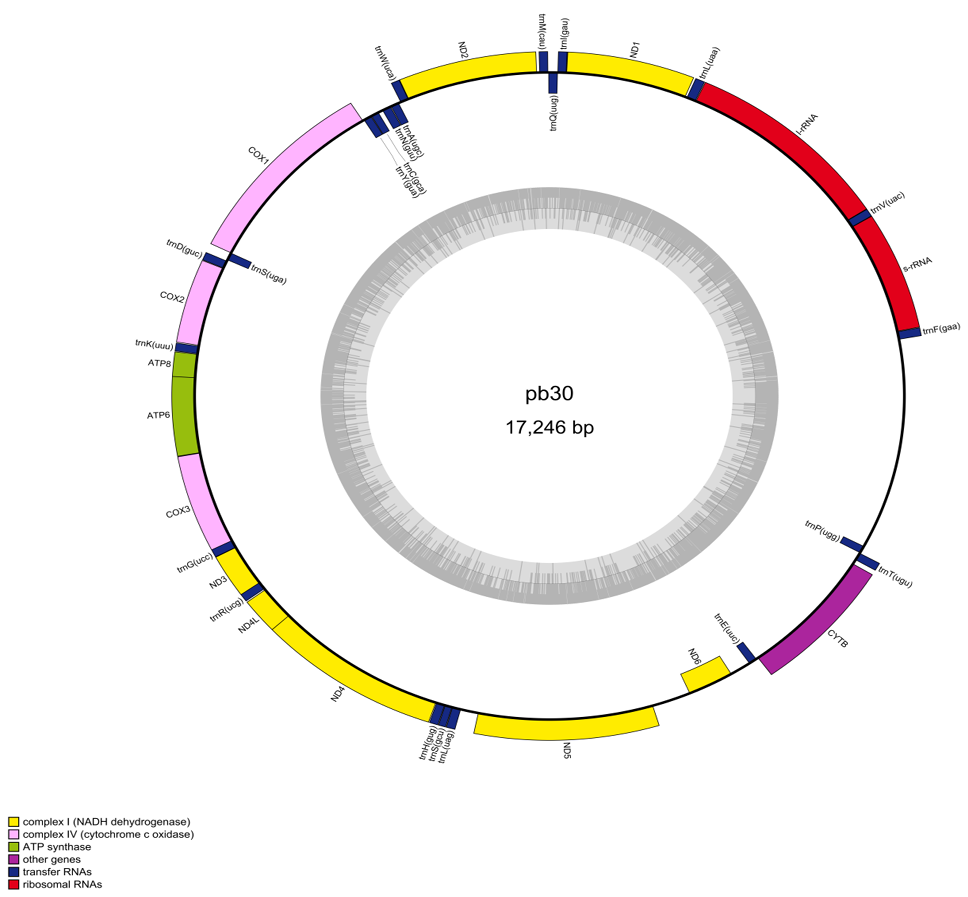
Mitochondrial complete genome circle.
Note: From outside to inside are: genome structure chart, coverage of reads on genome, GC content.
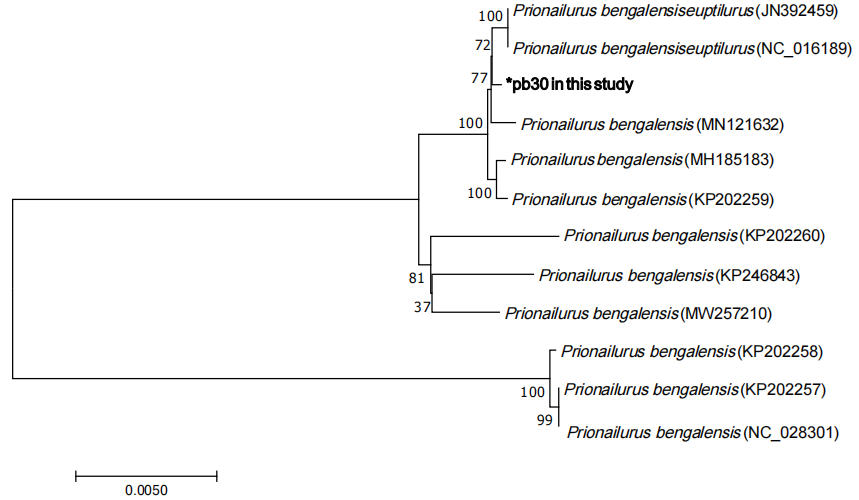
Phylogenetic tree of Prionailurus bengalensis based on 13 protein-coding genes.
References
- Andrew, T. and Smith, Y.X., 2009. A guide to the mammals of China. Hunan Education Press.
- Chen, W., Gao, W. and Fu, B.Q., 2002. Zoology of Beijing. China Forestry Publishing Press, Beijing.
- Nowell, K. and Jackson, P., 1996. Wild cats: Status survey and conservation action plan. IUCN, Switzerland.
- Park, Y.C., 2011. Mitochond. DNA, 22: 89–90. https://doi.org/10.3109/19401736.2011.624607[CrossRef]
- Seutin, G., Lang, B.F., Mindell, D.P. and Morais, R., 1994. Mol. Biol. Evol., 11: 329–341.
- Shuai-Tan, Jie-Tian, X., Fang-Dong, Z., Que-Kun, P. and Rui, P., 2015. Mitochond. DNA early online, 1–2: 1940-1736.
- Tamada, T., Siriaroonrat, B., Subramaniam, V., Hamachi, M., Lin, L.K., Oshida, T., Rerkamnuaychoke, W. and Masuda, R., 2006. Zool. Sci., 25: 154–163. https://doi.org/10.2108/zsj.25.154[CrossRef]
- Wilson, D.E. and Mittermeier, R.A., 2009. Handbook of the mammals of the world. Vol 1: Carnivores. Lynx Edicions, Barcelona, Spain.
- Zhang, J.J., Liang, Y.L. and Ren, Z.M., 2019. Mitochond. DNA B, 4: 3072-3074. https://doi.org/10.1080/23802359.2019.1666678[CrossRef]
Services
Article usage statistics
Loading…