
Reintroduction is an important wildlife conservation method, through artificial methods to reintroduce some endangered animals to their extinction places, form stable populations, and save endangered or extinct precious wildlife. In the past 20 years, reintroduction has become a common way to restore local natural ecosystems and improve the food chain. In order to enrich the wild population of roe deer and regulate the population structure, we carried out the reintroduction project of roe deer. This paper recorded the survival and natural reproduction of roe deer in Wuling mountain nature reserve.
Short Communication · Volume 58, Issue 1, 3 January 2026 · Open Access
The Captive Roe Deer Successfully Bred Naturally after Being Released into the Wuling Mountain Nature Reserve in Beijing
· · ·
Affiliations & Notes ⌄
- 1Beijing Wildlife Rescue & Rehabilition Center, 101300, China 2Miyun District Wuling Mountain Nature Reserve Management Office (Beijing Miyun District Wuling Mountain Forest Farm), 101500, China 3Miyun district landscaping Bureau,101500, China * Corresponding author: radio6182000@163.com
Article Info ⌄
- Journal:
- Pakistan Journal of Zoology
- Published:
- 3 January 2026

From the article
- Post-release monitoring revealed that the reintroduced roe deer predominantly stayed near the release site within the reserve.
- Notably, on June 22, 2023, a female roe deer with two fawns was observed in the reserve (Fig. 1), indicating successful breeding of the reintroduced population (Fig. 2).
- The wild release of captive animals is a systematic project that costs a lot of money, time and manpower.
- The results of the release of captive roe deer in Wuling Mountain Nature Reserve show that the project is feasible, and long-term monitoring after release is the key to evaluate the success of the project.
Selected from the article's own text.
Abstract
Materials and methods
In September 2020, Beijing Wildlife Rescue Center launched the reintroduction study of captive roe deer in the “Beijing Fasting Artificial breeding site Wildlife Disposal” project. Subsequently, 10 roe deer were released to Wuling Mountain Nature Reserve in two batches on June 22, 2021 and August 17, 2021. Beijing Wuling Mountain Nature Reserve is located in the east of Miyun District of Beijing (40°34 ‘~ 40°38’ N, 117°19 ‘~ 117°25’ E), with a total area of 41.5 km2. There are 167 species of terrestrial vertebrates of 22 orders, 65 families, including 7 orders, 18 families and 32 species of mammals found in the area.
The satellite positioning signal transmitter (Hunan Global Trust, solar and battery dual power supply, HQAN40S animal collar, 160g) was used to monitor animal activity track and field status.
Results and discussion
Post-release monitoring revealed that the reintroduced roe deer predominantly stayed near the release site within the reserve. Out of the ten reintroduced deer, two deaths were reported one due to poaching and another from unknown causes and one deer went missing, resulting in a 70% survival rate. Notably, on June 22, 2023, a female roe deer with two fawns was observed in the reserve (Fig. 1), indicating successful breeding of the reintroduced population (Fig. 2).
Through direct field observation, infrared camera monitoring and tracking satellite launcher monitoring, it was found that reintroduced roe deer mainly moved 36 km2 in the protection area and surrounding area near the wild release site of Wuling Mountain Nature Reserve.
Conclusion
The ultimate goal of wildlife reintroduction is to establish self-sustaining wild populations . The wild release of captive animals is a systematic project that costs a lot of money, time and manpower. The process of release cannot be separated from the participation of biologists, the policy support of relevant authorities and the effective organization and management of the release project. The success of reintroduction programs is difficult to assess because it requires long-term data and generally accepted criteria for success. The results of the release of captive roe deer in Wuling Mountain Nature Reserve show that the project is feasible, and long-term monitoring after release is the key to evaluate the success of the project.
Declarations
Acknowledgments
We would like to thank the Beijing Miyun District Landscaping Bureau and the Beijing Miyun District Wuling Mountain Nature Reserve Management Office (Beijing Miyun District Wuling Mountain Forest Farm) for their help in carrying out the project. Thanks to Dehuai Zhang, Xinmin Fang, Zhihong Ma, Guoqing Zhao and other staff members for their warm hospitality and contribution to the data recording. Finally, we would like to thank the anonymous reviewers for their constructive comments on this paper.
Funding
This research was supported by a financial project of Beijing Terrestrial Wildlife Rescue Breeding Daily Operation and Maintenance Project (11000022T000000430317) and Beijing Municipal Bureau of Landscaping.
Animal ethics Declaration
The experiment was approved by Beijing Municipal Bureau of Landscape and Afforestation in advance, passed the review of animal ethics, and was in line with the Wildlife Protection Law of the People’s Republic of China.
Statement of conflict of interest
Figures
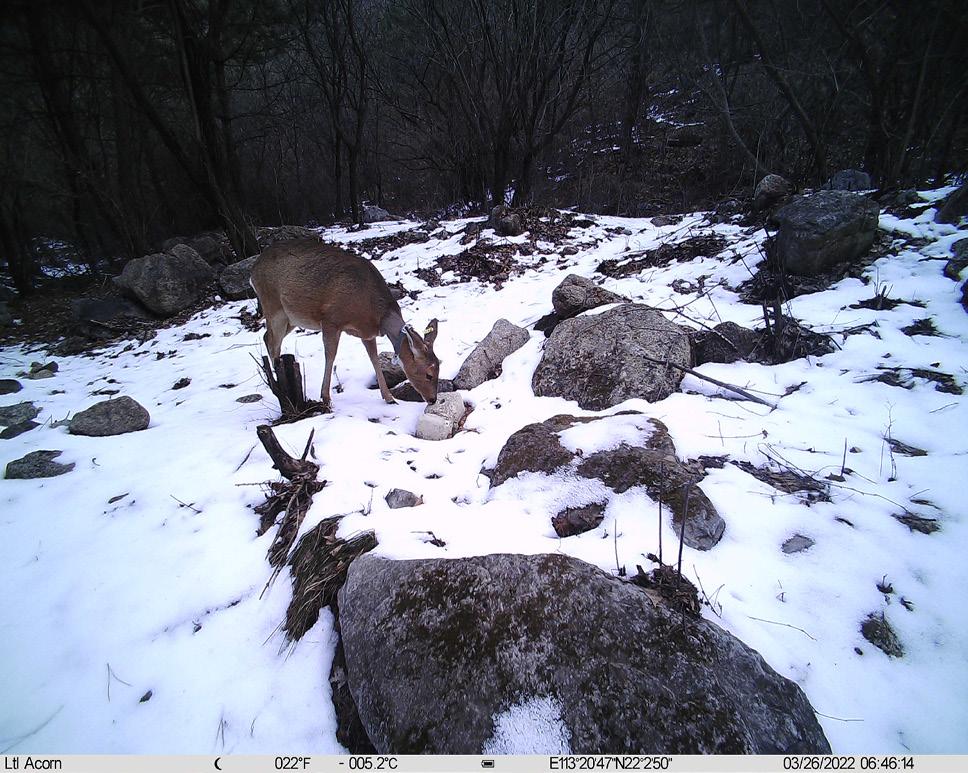
Reintroduced roe deer activities in winter.
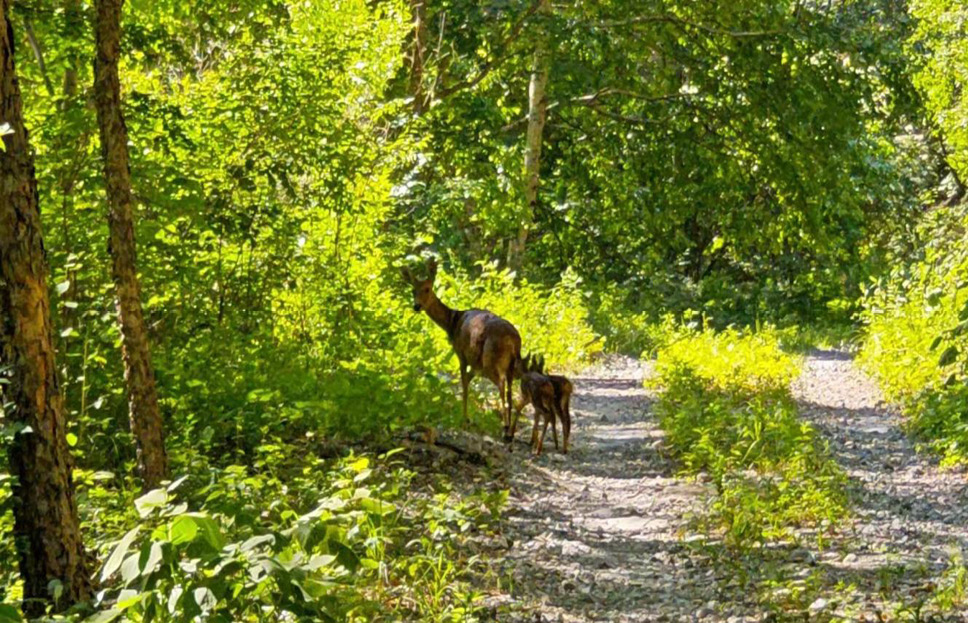
Successful breeding of re-introduced Roe deer (left 1, ♀) in Wuling mountain mountain nature reserve.
References
- Beck, B.B., Rapaport, L.G., Stanley, P.M.R. and Wilson, A.C., 1994. Reintroduction of captive-born animals. In: Creative conservation: Interactive management of wild and captive animals (eds. P.J.S. Olmey, G.M. Mace and A.T.C. Feistner). London: Chapman and Hall, pp. 265-286. https://doi.org/10.1007/978-94-011-0721-1_13[CrossRef]
- Fischer, J.D. and Lindenmayer, B., 2000. Biol. Conserv., 96: 1–11. https://doi.org/10.1016/S0006-3207(00)00048-3[CrossRef]
- IUCN, 1998. Guidelines for reintroductions. IUCN, Gland, Swizerland and Cambridge, UK. http://www.iucn.org/hemes/ssc/publications/policy/reinte.htm
- Miller, B., Ralls, K., Reading, R.P., Scott, J.M. and Estes, J., 1999. Anim. Conserv., 2: 59–68. https://doi.org/10.1017/S1367943099000360[CrossRef]
- Noss, R.F., Quigley, H.B., Hornocker, M.G., Merrill, T. and Paquet, P.C., 1996. Conserv. Biol., 10: 949–963. https://doi.org/10.1046/j.1523-1739.1996.10040949.x[CrossRef]
- Terborgh, J., Lopez, L., Nunez, P., Rao, M., Shahabuddin, G., Orihuela, G., Riveros, M., Ascanio, R., Adler, G.H., Lambert, T.D. and Balbas, L., 2001. Science, 294: 1923–1926. https://doi.org/10.1126/science.1064397[CrossRef]
- Yin Q Q., 2023. Genetic status, feeding habits and human-animal conflict of North China leopard population in fragmented habitat in the Loess Plateau. Master’s thesis, Qufu Normal University, Qufu, China.
Services
Article usage statistics
Loading…