
The study examined the existing literature on environmental sustainability in context of agriculture carbon footprints, renewable energy, trade and macro-economic drivers. Because of broad coverage of peer-reviewed publications in environmental science, agricultural sustainability, energy economics, and development studies, Scopus was chosen as the main database for literature review. The review also focused on highlighting the research gaps and challenges faced for achieving the environmental sustainability. Agriculture sector is main driver of economic development in developing and underdeveloped countries and therefore is one of the main contributor of greenhouse gas (GHG) emissions as well as source of environmental degradation. This review adopted Preferred Reporting Items for Systematic Reviews and Meta Analysis (PRISMA) and a thematic review was conducted on (i) measurement and accounting of agricultural carbon footprints, (ii) agricultural activities and greenhouse gas emissions, (iii) renewable energy adoption and its sustainability effects, (iv) institutional quality, trade, and policy as enablers of environmental sustainability and (v) macroeconomic and trade drivers of environmental degradation. The review of literature highlights that in order to achieve sustainable environment, integrated approach should be adopted in combination with adoption of renewable energy, technological advancement, strengthening governance indicators, effective trade policy and macroeconomic management. Major findings of the study showed that while trade openness, technical innovation, renewable energy, and robust institutions reduce environmental constraints, energy usage, GDP growth and the exploitation of natural resources increase emissions. In order to support climate-smart agricultural transitions and sustainable development goals, future research should give priority to context-specific, multi-scalar, and policy-relevant assessments.
Research Article · Volume 39, Issue 3, 13 September 2026 · Open Access
Systematic Review of Environmental Sustainability in Context of Agriculture Carbon Footprints, Renewable Energy and Trade
·
Affiliations & Notes ⌄
- 1PhD Scholar, The Superior University, Lahore, Pakistan
- 2Associate Professor, Department of Economics, The Superior University, Lahore, Pakistan. *Correspondence | Saqib Shakeel Abbasi, PhD Scholar, The Superior University, Lahore, Pakistan
- 3Email: saqib2985@gmail.com
Article Info ⌄
- Journal:
- Pakistan Journal of Agricultural Research
- Published:
- 13 September 2026
From the article
- First, energy systems, trade patterns, institutional contexts, and farm-level behaviors all influence agriculture carbon footprints.
- The number of cross-country panel studies that concurrently examine institutional quality, renewable energy adoption, and agricultural carbon footprints is still limited, particularly in the context of developing countries.
- Furthermore, future research should move toward an integrated analytical framework combining (i) multi-scale carbon accounting (farm, regional, and national levels), (ii) technology-specific renewable energy adoption models, and (iii) macro-institutional variables within unified empirical structures.
- In order to support climate-smart agricultural transitions and sustainable development goals in South and East Asia, future research should give priority to context-specific, multi-scalar, and policy-relevant assessments.
Selected from the article's own text.
Abstract
Introduction
Environmental sustainability and agricultural development are becoming more and more important on research and policy agendas. For rapidly growing Asian economies, where population increase, economic expansion, and resource-intensive production systems are putting increasing stress on ecological systems, environmental degradation and climate change pose serious threats . In South and East Asia, the industry supports national income, rural livelihoods, and food security, but it also contributes significantly to greenhouse gas (GHG) emissions, especially carbon dioxide (CO₂), nitrous oxide (N2O), and methane (CH₄) ; . Although the effects of agriculture on the environment are widely known throughout the world, the scope, composition, and causes of emissions in Asian agricultural systems vary significantly due to high population density, intense land usage, and reliance on inputs derived from fossil fuels.
There are three major paths identified by researchers that connect agriculture to degradation of environment, it includes bio-emission from production of different crops, both cereal and horticulture and the livestock, similarly, the emissions sourced through different inputs like, mechanization, irrigation, fertilizer activities and aligned activities of value addition of agricultural products ; . While mechanization and changing in land use patterns are increasing the carbon dioxide (CO₂) levels, excess use of fertilizer, water irrigation system and increased cattle farming result in increased levels of nitrous oxide (N₂O) and methane (CH₄) emissions driven by fossil fuels ; . These emissions at different agriculture production stages are taken together to calculate the total greenhouse gas emissions (GHG) in carbon dioxide equivalent (CO2e) create agriculture carbon footprints (ACF). Life cycle assessment (LCA) frameworks are commonly used in order to measure these emissions in agriculture supply chain system to highlight high impact stages .
In Asia, intensive use of inputs in agriculture had resulted in increased emissions, particularly in the regions where fertilizer subsidies, diesel-powered irrigation and rapid land conversion are dominated in crop production process ; . In order to lower the emissions in agriculture sector as well as overall economy, it has become crucial to shift towards renewable energy (RE) source as it is seen as a major mitigating measure in context of reducing emissions and fostering growth . Biogas digesters, biomass energy and solar irrigation systems are some of the technologies that results in reduction in emissions as well as dependence on fossil fuels in agriculture sector .
According to panel based research conducted in south and east Asia, the adoption of RE improves environmental performance, though, the level of effect is dependent on certain indicators such as technical innovation, income level and institutional capacity ; . Furthermore, an integrated energy approach is required to achieve long term strategic objectives, like energy security and climate targets . This shows the importance of incorporating the energy transition plans into sustainable agricultural system.
With trade openness and globalization, the relationship between agriculture and environment is getting more complex. Trade may reduce the environmental issues due to transfer of knowledge, clean production techniques and efficiency, but it can also result in higher emissions because of increased scale and extraction of resources ; For example, under certain technological and legislative settings, China’s agricultural exports has been linked to a decrease in carbon emissions . Nonetheless, carbon leakage is still a problem in countries with less environmental protocols as they move towards intensive production . Trade’s environmental effects are therefore dependent upon the quality of institutions, levels of policy coordination and environmental governance. .
Environmental related issues are additionally shaped by certain macroeconomic factors like the scale of output and the utilization of resources in agriculture due to economic expansion, financial development, urbanization, and capital formation ; . The Environmental Kuznets Curve (EKC) hypothesis is mostly used to study the environmental degradation that shows a nonlinear link between wealth and environmental degradation . However, multiple studies show a conflicting empirical data especially from Asia that suggest that spread of renewable energy, institutional and structural changes are more important as compared to income growth in reducing emissions . While strong governance frameworks can invest towards sustainable practices and greener technologies, the weak institutional structure may allow financial expansion in order to encourage environmentally intensive activities .
Across the regions, sustainability challenges continue to vary significantly. East and Southeast Asian region experiences environmental effect due to rapid industrialization and export based economic growth, South Asian countries such as Pakistan, India and Bangladesh have higher climatic vulnerabilities and also remain dependent on agriculture led growth and higher fossil fuel consumption. ; . Due to these structural differences, context specific measures are required to be incorporated for sustainable agriculture, renewable energy and environment friendly trade practices.
The measurement and accounting of agricultural carbon footprints; the role of agricultural practices and energy use in GHG emissions; the contribution of renewable energy adoption to environmental sustainability; the impact of trade openness, macroeconomic growth, and institutional quality; and the policy implications of integrating technological, financial, and governance dimensions in sustainable agriculture are the five interrelated themes on which this review fills this gap. This review paper’s goal is to investigate how agricultural expansion and environmental sustainability can coexist in quickly changing economies by combining several lines of data. The present review study specifically aimed to answer the following questions:
- How agricultural carbon footprints are measured?
- How agricultural practices contribute to GHG emissions?
- To what extent does renewable energy adoption reduce agricultural related emissions?
- How does the macroeconomic growth, trade openness and institutional quality mediate ecological outcomes?
- What policy implications emerge from integrating technological, financial, and governance dimensions in sustainable agriculture?
This study contributes to the literature by integrating agricultural carbon footprints, renewable energy transitions, and macroeconomic-institutional dynamics within a unified systematic review framework. Unlike prior studies that examine these domains in isolation, this review provides a cross-disciplinary synthesis that identifies structural interlinkages and policy-relevant insights, particularly for developing economies in South and East Asia.
Methodology
The study adopted a systemized review of literature in order to integrate already existing research on agriculture carbon footprints, renewable energy and sustainable development. Preferred Reporting Items for Systematic Reviews and Meta-Analyses (PRISMA) framework is used as a transparent and structured review design. The study aimed to present a detailed and logically organized review in which macro-economic governance, renewable energy transitions, and agricultural production systems interact to affect environmental sustainability outcomes.
The quality of included studies was assessed using a structured qualitative framework based on (i) methodological rigor (e.g., econometric robustness, LCA completeness), (ii) data reliability (sample size, temporal coverage), and (iii) policy relevance. Studies employing advanced econometric techniques (e.g., CS-ARDL, NARDL, spatial models) and standardized emission accounting approaches (e.g., IPCC-based or LCA frameworks) were given greater analytical weight.
Scopus database was used for retrieval of literature because of its broad coverage of peer reviewed journals in the areas of developmental studies, energy economics, agricultural sustainability, and environmental sciences. To reduce database bias and to identify recently published and regional specific publications, additional searchers were carried out through ScienceDirect and Google Scholar. The search strategy was structured around three conceptual domains: macroeconomic and institutional drivers of environmental change, renewable energy transitions, and agricultural emissions.
To search the relevant literature, the TITLE-ABS-KEY sections were interrogated using combinations of Boolean and keyword operators. Search for the terms such as “agricultural greenhouse gas emissions” OR “methane agriculture” OR “economic growth” OR “institutional quality” AND “environmental degradation” OR “CO₂ emissions” OR “nitrous oxide agriculture” OR “renewable energy adoption” AND “sustainable development” OR “green energy transition” OR “trade openness” OR “agricultural carbon footprint”. To ensure balanced representation of research articles in the field of energy, agriculture
Table 1: Measuring agricultural sustainability and carbon footprints
|
Objective |
Methodology |
Major mitigation options |
Key findings |
Author(s) |
|
Explore spatial and temporal variations in agricultural GHG emissions across Bangladesh districts |
Descriptive statistical analysis, spatial–temporal analysis (mean center, standard deviational ellipse), per capita emission assessment |
Region-specific mitigation policies, promote low-emission farming practices, improve livestock and fertilizer management |
Strong regional disparities; northern and central districts contribute disproportionately; emission hotspots persist; per capita emissions vary |
|
|
Quantify carbon footprints of paddy-wheat and cotton-wheat rotations in Punjab, India |
One-way ANOVA, Tukey pairwise comparison; field survey; on-site measurements; emission factors from literature |
Adoption of Resource Conservation Technologies (RCTs), crop diversification, residue management |
Paddy has highest carbon footprint (11,911 ± 2,754 kg CO₂eq/ha); RCTs reduce emissions by 1–98%; cotton-wheat rotation emits 3.5× less than paddy-wheat |
|
|
Assess global crop emission mitigation using Integrated Crop Emission Mitigation Framework (ICEMF) |
Meta-analysis, effect size estimation, I² heterogeneity, funnel plots, Phillips & Sul panel club convergence, spatially explicit modeling |
Precision fertilization, legume rotations, biochar, integrated mitigation strategies |
Nitrogen management interventions reduce N₂O; context-specific emissions; spatially explicit mitigation estimates; regional disparities |
|
|
Review GHG sources and mitigation strategies in agriculture (India focus, global context) |
Literature synthesis of 140 articles; review approach |
Water management, crop variety selection, controlled fertilizer use, carbon sequestration, agri-voltaic systems |
Agriculture contributes ~80% of anthropogenic N₂O, 40% CH₄; flooded rice and livestock are major CH₄ sources; mitigation strategies reduce emissions |
|
|
Map agricultural sustainability using Life Cycle Assessment (LCA) |
Bibliometric analysis (h-index, g-index, co-citation), narrative synthesis, SDG mapping |
Incorporate LCA in policy, improve evidence-based decisions, promote environmental and economic sustainability |
LCA identifies environmental hotspots, trade-offs, upstream/downstream impacts (30–70%), aligns research with SDGs; geographical bias toward Europe/North America |
|
|
Review carbon farming adoption and impact worldwide |
Bibliometric analysis (co-authorship, keyword co-occurrence, citation analysis) |
Promote carbon farming via subsidies, grants, carbon credits, policy support |
Carbon farming improves soil carbon, reduces GHGs, enhances productivity and resilience; research concentrated in developed countries; six major keyword clusters identified |
|
|
Quantify carbon footprint across agro-industrial chains |
Meta-analysis, LCA, correlation & regression analysis |
Optimize industrial processes, energy use, on-farm livestock operations |
On-farm livestock emissions dominate; industrial phase emissions in crop industries higher than agricultural phase; fertilizers and electricity major drivers |
|
|
Assess regenerative agriculture for climate mitigation |
Field experiments, meta-analysis, LCA, surveys, interviews |
Integrated regenerative practices (organic amendments, cover crops, reduced tillage, agroforestry) |
Organic practices reduce CH₄; integrated approaches improve carbon sequestration, soil health, ecosystem resilience; effects context-specific |
|
|
Measure carbon footprint and GHG emissions of rice-based cropping systems in Bangladesh |
Field measurements of CH₄ & N₂O, IPCC Tier 1 emission factors, C footprint calculation tool |
Promote cropping patterns with fallow periods, SOC management, CH₄ & N₂O mitigation strategies |
Continuous rice systems had highest CH₄; dryland crops higher N₂O but lower overall GWP; boro and aus rice sequester minor C |
and governance sector, multiple round of refinement was carried out. The literature published between 2020 to 2025 was focused in order to acquire more recent information on the topic. Duplicate record was removed after initial findings of studies from the databases.
To guarantee uniformity and applicability, explicit inclusion and exclusion criteria were used. Research that looked at greenhouse gas emissions or carbon footprints from agriculture, studied the adoption of renewable energy in connection to sustainability or environmental outcomes, or examined macroeconomic, trade, financial, or institutional drivers of emissions was included. We only took into account empirical research, systematic reviews, and meta-analyses that were published in peer-reviewed publications. The evaluation prioritized studies published during the previous decade to reflect contemporary methodological and policy breakthroughs, while permitting inclusion of earlier fundamental contributions when theoretically relevant. To ensure uniformity in interpretation, only materials written in English were included. Studies that addressed non-agricultural emissions unrelated to land-use systems, lacked methodological transparency, or just concentrated on technical farm-management techniques without conducting an environmental impact assessment were disqualified. In order to preserve academic rigor, editorials, opinion pieces, conference abstracts, and non-peer-reviewed papers were also disqualified (Figure 1).
PRISMA-style steps of identification, screening, eligibility evaluation, and final inclusion were followed in the study selection procedure. The screening process comprised of multiple stages. At first, study titles and abstracts were reviewed and excluded the studies that were not related to environmental factors, agriculture sustainability and renewable energy. Afterwards, pure agronomic studies and macro-economic articles, not covering the environmental dimension were removed. After evaluating the full text of the articles/research papers to evaluate the methodology, contribution of research and thematic relevancy, the studies with lack of empirical research were excluded. The last section finalized the studies that used diverse and acceptable methodological approaches, such as panel econometrics, nonlinear ARDL models, life cycle assessment (LCA) and bibliometric techniques. Studies were selected from BRICS, OIC member countries, Belt and Road Initiative economies, Europe, Asia, and Africa.
The robustness of the included papers was assessed using a qualitative quality assessment, despite the lack of a formal statistical meta-analysis. Research using sophisticated quantitative methods, sizable cross-country or long-term datasets, clear variable definitions, and thorough robustness tests were accorded more analytical weight. Because they provide deeper insights into the governance mechanisms influencing sustainability transitions, studies addressing institutional or policy factors were also highlighted. Rather than being used in place of original scientific findings, review articles and meta-analyses were mostly employed for contextual framing.
There are still a number of restrictions in place despite efforts to provide systematic coverage. It’s possible that pertinent regional research was overlooked when the search was limited to English-language, primarily Scopus-indexed publications. Direct comparability of quantitative results is hampered by methodological variation across research, especially when evaluating agricultural emissions and the uptake of renewable energy. Furthermore, it is impossible to completely rule out the possibility of publication bias in favor of statistically significant results. However, the thematic synthesis technique and structured search procedure improve transparency and offer a thorough basis for analyzing the relationships between sustainable development, renewable energy transitions, and agricultural emissions.
Literature review
In order to understand the relationship between sustainable development, renewable energy and agriculture carbon footprints it was necessary to systematically discuss or highlight the key areas related to environmental accounting, macro-economics and energy transitions. The literature is therefore, structured into five interconnected themes including: (1) measurement and accounting of agricultural carbon footprints; (2) agricultural activities and GHG emissions; (3) renewable energy
Table 2: Agriculture as a driver of environmental degradation
|
Objective |
Methodology |
Major Mitigation Options |
Key Findings |
Author(s) |
|
Examine relationship between agricultural carbon footprints (ACF), renewable energy consumption (RE), and sustainable development (SD) across nine Asian nations |
Panel data analysis (2000–2022); CS-ARDL, Method of Moments Quantile Regression (MM-QR), Dumitrescu-Hurlin panel causality; Ecological Modernisation Theory |
Country-specific agricultural sustainability strategies; strengthen governance linking agriculture, energy, environment; reform trade policies with environmental safeguards; invest in renewable energy; disaggregate agricultural subsectors in policy |
Bidirectional causality between ACF and SD; ACF ↑ SD at lower sustainability levels but diminishes at higher quantiles; Trade openness ↓ SD; RE ↑ SD but mostly insignificant; strong country-level heterogeneity |
|
|
Assess long-run impacts of agricultural natural gas emissions on ecological footprint across 19 European countries |
CS-DL, CS-ARDL, CIPS unit root test, Westerlund cointegration, dynamic ARDL |
Promote renewable energy adoption in agriculture; incentivize eco-friendly farming practices; improve sustainable urban planning; reduce reliance on natural gas |
Agricultural natural gas emissions significantly increase ecological footprint; renewable energy reduces ecological footprint; population growth exacerbates pressure; GDP per capita shows EKC-type behavior |
|
|
Investigate asymmetric impact of agriculture value added on CO₂ emissions in SCO countries |
Nonlinear Panel ARDL (NPARDL) with PMG estimator; Pesaran CD test; CIPS unit root; Westerlund cointegration; Wald asymmetry test; Dumitrescu–Hurlin panel causality |
Promote sustainable and low-carbon agricultural practices; expand renewable energy use; integrate climate considerations into agriculture and trade policies |
Negative shocks in agricultural value added reduce CO₂ emissions short- and long-run; positive shocks increase CO₂ emissions long-run; renewable energy reduces emissions; GDP & trade increase emissions; fertilizer consumption insignificant |
adoption in agriculture and its sustainability effects; (4) institutional quality, trade, and policy as enablers of environmental; and (5) macroeconomic and trade drivers of environmental degradation.
Measurement and accounting of agricultural carbon footprints
As mentioned in Table 1, many studies have focused on measuring agricultural carbon emissions and agricultural sustainability and discussed the methods used, accounting boundaries, and identifying the major sources of emissions in different farming systems and different farming stages. The most widely used methods to estimate the GHG emissions and sustainability include spatial emissions mapping, life cycle assessment (LCA) and synthesis of meta-analysis.
In addition to Life Cycle Assessment (LCA)-based approaches, agricultural emission accounting is commonly benchmarked against the Intergovernmental Panel on Climate Change (IPCC) Guidelines for National Greenhouse Gas Inventories. These guidelines provide standardized Tier 1, Tier 2, and Tier 3 methodologies for estimating emissions from agricultural activities, including enteric fermentation, manure management, and agricultural soils. While LCA offers system-wide and supply-chain perspectives, IPCC-based approaches ensure cross-country comparability and policy relevance at national inventory levels. Existing literature reveals partial alignment, where many empirical studies rely on IPCC default emission factors (Tier 1), but fewer incorporate higher-tier country-specific coefficients, thereby limiting accuracy and contextual precision in developing regions ; . This divergence highlights the need to integrate LCA frameworks with IPCC-consistent accounting to enhance both methodological robustness and policy applicability.
Bibliometric and narrative studies mostly rely on static LCA models and are focused on Europe and North America, while there is limited research carried out in developing regions like South Asia . LCA is valuable for identifying environmental hotspots in both upstream and downstream stages. Studies have shown that on- farm livestock emissions dominate, whereas fertilizer and electricity are major emission sources in crops but the higher source of emissions in crops is dominated by industrial level processing . Research is rapidly growing in the areas of agro forestry, biochar and conservation techniques, focusing on soil carbon sequestration and carbon .
Table 3: Renewable energy adoption in agriculture and its sustainability effects
|
Objective |
Methodology |
Major mitigation options |
Key findings |
Author(s) |
|
Examine the link between green growth, institutional quality, financial inclusion, renewable energy, and financial stability in Pakistan |
ARDL bounds testing, ECM, ADF, PP, Zivot–Andrews unit root tests; PCA for financial inclusion index; 1991–2020 |
Strengthen institutional quality; promote renewable energy & green growth policies; integrate environmental sustainability into financial regulation |
Financial inclusion ↑ financial stability; Institutional quality strengthens stability; CO₂ ↓ stability; Green growth & renewable energy ↑ stability; Interaction term positive long-run, negative short-run |
|
|
Investigate asymmetric effects of green finance, FDI, trade openness, and economic growth on CO₂ emissions in Pakistan |
Nonlinear ARDL (NARDL), partial-sum decompositions, dynamic cumulative multipliers, robustness tests; annual data 1980–2021 |
Scale up green finance; tax/standardize polluting FDI; provide fiscal support for renewable projects; invest PSDP-type funds into carbon-free projects |
Positive shocks in FDI ↑ CO₂ emissions; GF reduces emissions; negative shocks of FDI & GF ↓ emissions; asymmetric dynamics significant |
|
|
Assess financial development, green innovation, environmental taxation, industrialization, and governance effects on CO₂ emissions in South Africa |
ARDL bounds testing, FMOLS, Granger causality, 2SLS, ECT model; 1990–2022 |
Strengthen governance (GE, VA, CC); promote green innovation & clean technology; enforce environmental taxes under effective governance |
Short-run: FDVI, GNI, INDS reduce CO₂ under strong governance; TRO ↑ CO₂; POP reduces per-capita CO₂; Long-run: FDVI & GNI reduce CO₂ with strong governance; ENTAX effects mixed; governance quality mediates outcomes |
|
|
Evaluate impact of Fintech, R&D, and green finance on green innovation efficiency (GIE) in China |
Dynamic System GMM; panel heterogeneity models; double-threshold panel regression; 2SLS-IV; moderator mechanism analysis; provincial panel data 2010–2020 |
Redirect R&D toward environmentally induced innovation; regulate Fintech to avoid growth-only bias; strengthen green finance governance; enhance government environmental awareness |
Fintech generally reduces GIE; R&D efficiency crowds out green innovation; Fintech improves GIE only within optimal R&D thresholds; green finance, Internet, financial development amplify Fintech’s negative effects; government awareness reverses negative impact |
|
|
Systematically review indicators for renewable energy adoption in sustainable agriculture globally |
Systematic review (SALSA & PRISMA); 432 SCOPUS papers, 2010–2023 |
Strengthen policy frameworks; incentivize renewable adoption; improve energy storage & efficiency; promote community engagement & inclusive stakeholder involvement |
Identified 84 key indicators across economic, environmental, institutional, social, technical dimensions; renewable energy adoption enhances sustainability, energy efficiency, and socio-economic outcomes; multidisciplinary and global collaboration increasing |
Although the individual studies indicate mixed results, the global meta-analysis shows that integrated regenerative farming reduces methane (CH4) and improves system resilience . At farm level highest CH4 emissions are produced due to rice flooding, whereas, higher nitrous oxide (N2O) in dry crops but the overall potential of global warming is lower . Due to CH4 emission and burning of residue, the paddy farming in India has greater carbon footprints as compared to cotton-wheat system . Depending upon land use, animal density and farming intensity, spatial analysis at subnational levels shows variation in emission hotspots in Bangladesh .
While most of the literature highlights the use of fertilizer, irrigation, residue management and crop selection as key drivers of emission , the integrated crop emission mitigation framework (ICEMF) assesses the potential of precision fertilization, biochar and digitization of agriculture in different contexts, presents that effectiveness in mitigation is highly dependent on local conditions .
Overall, agriculture carbon footprint research has evolved from simple farm-gate evaluations to multi-level, spatially explicit and more systems-based approaches. In spite of advancement, LCA remains foundational and the major gaps persist in South Asian systems. Long-term validation and inclusion of socioeconomic dynamics and institutional aspects,
Table 4: Institutional quality, trade, and policy as enablers of environmental sustainability
|
Objective |
Methodology |
Major mitigation options |
Key Findings |
Author(s) |
|
Examine asymmetric effects of trade openness on CO₂ and ecological footprint in the most open OIC countries |
Quantile-on-Quantile (QQ) regression; Quantile Regression for validation; 1991–2018 |
Continue trade openness; redirect trade-induced technological change toward green production; impose pollution taxes; strengthen environmental regulations; promote renewable energy; restrict over-exploitation of resources |
TOP reduces CO₂ (pollution halo) but increases ecological footprint; effects highly asymmetric across quantiles and countries |
|
|
Analyze trade-environment nexus and EKC in OIC countries using multiple GHGs and ecological footprint |
Dynamic Common Correlated Effects (DCCE); Panel unit root (CIPS), Westerlund cointegration; 1991–2021 |
Continue trade openness policies & energy sector reforms; ensure sustainable biocapacity use |
Inverted-U EKC for CO₂, CH₄, ecological footprint; U-shaped EKC for N₂O; trade openness ↓ emissions in high-income countries, ↑ in low-income; ecological footprint ↑ with trade openness |
|
|
Investigate how environmental quality, institutional quality, and FDI jointly affect trade openness in BIMSTEC/OIC-like countries |
Panel ARDL, CS-ARDL, NARDL; Common Correlated Effects Estimation (CCEE); PCA; Toda–Yamamoto & Dumitrescu–Hurlin asymmetric causality; 1971/1982–2019 |
Improve institutional quality and environmental standards to attract FDI and expand trade; tailor policies based on shock direction |
Positive & asymmetric effects of EQ, IQ, FDI on trade openness; feedback mechanisms exist between EQ/IQ & trade openness; unidirectional causality from FDI+ → TO |
|
|
Evaluate dynamic effects of trade openness, FDI, and institutional performance on environmental quality in OIC countries |
Dynamic Common Correlated Effects (DCCE); comparison with PMG, MG, AMG; panel 1990–2016 |
Promote green technology and clean production; strengthen institutions to mitigate adverse environmental effects; prioritize institutional quality improvement |
TO, FDI, urbanization ↑ ecological footprint; institutional performance ↓ ecological footprint; institutional quality mitigates environmental impacts more effectively than FDI |
should be properly addressed to support climate smart sustainable agriculture ; ; .
Agricultural activities and greenhouse gas emissions
Literature review on empirical studies shows, agriculture as major source of environmental degradation due to GHG emissions and resource pressure (Table 2). Beyond measurement, studies also investigate the effects that the intensity of energy consumption, agricultural growth and development behavior have on emissions and development trends. Similar evidence in the Asian region indicates that there is a non-linear programming effect between the agricultural methane emissions of sustainable development, where the emission at the beginning facilitates growth by providing food and income, but decreases sustainability at the advanced stages . There is also a causal relationship in both directions and agricultural emissions are highly influenced by economic growth.
The other major source of emission is energy consumption in agriculture. The examples of European economies reveal that the use of natural gas in order to mechanize, produce fertilizers, and engage in controlled farming has grown ecological pressure over the years, but the use of renewable energy can decrease the effects of climate . Increase in population also leads to the overuse of resources and ecological pressure.
The Shanghai Cooperation Organization (SCO) countries identify the role of the scale and intensity of agriculture in panel evidence. Agricultural value added converts to positive shocks which make CO 2 emissions high despite the fact that negative shocks only reduce CO 2 emissions on temporary basis . This implies that the structural increase of agricultural emissions can be achieved via agricultural expansion, which includes fertilizer application, irrigation, mechanization, and land use change, but that renewable energy can reduce them partially.
Table 5: Macroeconomic drivers of emissions
|
Objective |
Methodology |
Major mitigation options |
Key Findings |
Author(s) |
|
Examine the role of natural resources, trade, PPP in energy, GDP, and economic complexity on CO₂ emissions in BRICS |
Panel CSD tests, CIPS/CADF unit roots, Westerlund cointegration, CUP-FM, CUP-BC, DH causality; 1990–2018 |
Promote renewable energy PPPs; shift from dirty energy; increase economic complexity via R&D; strengthen green trade & technology adoption |
Natural resources ↑ CO₂; PPP ↑ CO₂ slightly; GDP ↑ CO₂ strongly; Trade ↓ CO₂; Economic Complexity Index ↓ CO₂ |
|
|
Assess EKC and impact of climate policy uncertainty in Belt and Road Initiative (BRI) countries |
Pooled OLS, Fixed Effects, System GMM; 1998–2021 |
Coordinate trade and climate policies; reduce climate policy uncertainty; strengthen institutions; promote green industrialization; encourage financial development |
Inverted-U EKC confirmed; climate policy uncertainty ↑ CO₂ & EF; industrialization worsens environment; trade openness, financial development, institutional quality reduce emissions |
|
|
Examine asymmetric effects of technology, energy, GDP, institutional performance, and trade on CO₂ & N₂O in BRICS |
NARDL, Westerlund cointegration, asymmetric dynamic multipliers, ECM; 1990–2021 |
Promote renewable/clean energy; strengthen institutional quality; redirect tech innovation toward green R&D; regulate trade pollution; support sustainable agriculture |
Energy consumption ↑ emissions; GDP–environment relationship asymmetric; technological innovation ↑/↓ emissions; institutional performance reduces CO₂; trade openness shows asymmetric effects |
|
|
Investigate asymmetric impacts of institutional performance, ecological innovation, trade, climate uncertainty, energy, and GDP on emissions in BRICS |
Panel NARDL, PCA, unit root tests (ADF, PP, LLC, IPS); 1990–2021 |
Enhance institutional quality; promote innovation for environmental sustainability; strengthen climate policies; support SDGs; raise community awareness |
IP & ECI significantly affect emissions & ecological footprint asymmetrically; energy consumption & GDP influence emissions differently depending on increase/decrease |
|
|
Assess asymmetric effects of trade openness on economic growth in South Africa |
NARDL (partial-sum decomposition), cointegration, dynamic multipliers; 1960–2016 |
Trade liberalization should consider nonlinearity; complement openness with institutional support and policies |
TOP+ and TOP− show asymmetric effects; short- and long-run impacts differ; small liberalizations/reductions may have opposite effects depending on regime |
In general, the literature describes three primary avenues in which agriculture is a source of environmental degradation direct biological emissions (mainly methane), designed to be caused by the input (e.g. fertilizer use and energy consumption), and structural growth of agricultural production ; ; . Such relationships are mostly non-linear and they require factors like trade and energy set up, the level of development and population pressure. Although agriculture has been regarded as a key to economic growth and light to food security, the systems of production that are presently in operation are pushing more pressure on the environment.
Renewable energy adoption in agriculture and its sustainability effects
A rising body of research explores whether switching to renewable energy can assist more general sustainability objectives while separating agricultural production from environmental deterioration as presented in Table 3. This theme highlights renewable energy as a structural transformation instrument that can change agricultural production systems, financial flows, and innovation paths, in contrast to studies that approach energy as a generic macro variable.
When integrated into supportive institutional and financial systems, renewable energy becomes a stabilizing and sustainability-enhancing element at the macro-finance level. Pakistani data demonstrates that green growth and renewable energy have a good impact on financial stability, which supports long-term sustainable development . The study’s conclusions suggest that investing in renewable energy improves the economic underpinnings necessary for sustainable sectoral transformations, including agriculture, even though it focuses on financial stability rather than agricultural emissions specifically. These advantages are further enhanced by strong institutional quality, indicating that governance frameworks impact whether the expansion of renewable energy results in actual environmental benefits.
Nonlinear evidence that links green money to emission reductions further supports the environmental efficacy of green-oriented finance. One study that uses asymmetric modeling for Pakistan discovers that shocks to green finance, whether positive or negative, consistently mitigate carbon emissions . This research supports the claim that financial assistance for the adoption of renewable energy can indirectly lower carbon footprints in agriculture and the economy as a whole since green finance often directs resources into clean technology, low-carbon infrastructure, and renewable energy projects.
The literature brings out the need to match the financial flows with the renewable transitions in the energy to minimize the emissions. Research indicates that foreign direct investment (FDI) can lead to increment in the emission unless channeled to environmentally sustainable projects. This has a major role of institutional quality. The South African experience shows that financial development and green innovation can lead to a lower rate of emissions in case of a good governance framework, and the use of environmental taxes becomes inefficient in cases of weak enforcement . Environmental outcome becomes much better due to the following governance factors including government effectiveness and the rule of law.
The connection of finance, digital, and environmental performance is complicated as well. The Chinese provincial evidence indicates that Fintech and R&D processes can deteriorate the environmental performance when motivated by profit but not sustainability objectives . Nevertheless, more environmental consciousness of the government can be used to shift the technological and financial innovation toward more eco-friendly directions. This is an indication that, the agricultural transformation in renewable energy would need to be funded and policy guided.
The role of renewable energy in sustainable agriculture is also confirmed by the systematic review evidence. An analysis of 432 articles on economic, environmental, institutional, social, and technical parameters indicates that renewable energy makes infrastructure more efficient, exerts less pressure on the environment, and delivers socio-economic outcomes . Yet, several key gaps persist, especially with regards to female involvement, intersector co-ordination and the wider socioeconomic analysis.
Overall, the literature suggests that renewable energy can support sustainable agriculture and reduce carbon emissions, but its success depends on strong institutions, green-oriented finance, and effective policy frameworks.
The spread of renewable energy runs the risk of being absorbed into larger growth dynamics in the absence of such enabling frameworks, which would not significantly lessen ecological pressure. Thus, this theme emphasizes renewable energy as a fundamental element of an integrated agricultural sustainability transition rather than as a stand-alone remedy.
Technology-specific pathways of renewable energy in agriculture
Renewable energy adoption in agriculture is not homogeneous; its environmental impact varies significantly across technologies. Solar photovoltaic (PV) systems are widely used for irrigation pumping, particularly in South Asia, where they reduce diesel dependency and lower CO₂ emissions from groundwater extraction . Biogas systems, derived from livestock waste, directly mitigate methane emissions while providing decentralized energy for heating and electricity generation, thus addressing both waste management and energy needs . Wind energy, although less common at farm level, contributes to agro-processing and cold storage systems in regions with favorable wind regimes, indirectly reducing post-harvest losses and energy-related emissions. Biomass and bioenergy systems further play a dual role by converting agricultural residues into energy while preventing open-field burning—a major source of emissions in South Asia.
These differentiated pathways suggest that the environmental effectiveness of renewable energy depends on technological suitability, scale of deployment, and integration with farming systems, rather than aggregate renewable energy consumption alone.
Institutional quality, trade, and policy as enablers of environmental sustainability
A great deal of literature demonstrates that the quality of governance, the extent of openness to trade, and the flow of finance are very strong determinants of environmental and energy results other than sectoral ones (Table 4). Economic openness relies on institutional strength and control enforcement on the environmental impacts. Openness to trade is a two-sided phenomenon. The support of the hypothesis of the pollution halo has been observed in the evidence of highly open Organization of Islamic Cooperation (OIC) economies such that trade can lower the CO 2 emission by transferring technology and by promoting progress in efficiency. Nevertheless, it is also capable of deepening the ecological footprint because of the augmented use of resources and land pressure . Findings on quantiles also reveal that the effects have differences in different countries according to the structural and policy circumstances. More extensive evidence by panels confirms this heterogeneity: in economies of advanced countries that differ in their income, trade decreases emissions, whereas in low-income economies, it raises pollution because they must use highly polluting industries . The outcomes are also in favor of the Environmental Kuznets Curve (EKC), which speculates that the level of income and the maturity of the institution determine the environmental results.
The intermediate role is played by the quality of institutions. Good governance, reduced corruption and high rule of law ensures improvement in trade performance and environment . Institutions that are good will assist in matching trade growth and sustainability through regulating the environment and drawing cleaner investments. On the same note, the evidence in the OIC countries demonstrates that despite the fact that the openness to trade and foreign direct investment (FDI) are more likely to raise ecological pressure, well-established institutional performance mitigates the impact of these measures by a significant margin . On the whole, the literature indicates that trade and financial globalization are not necessarily bad or good to the environment. They rely on the quality of governance, the quality of regulatory implementation and the orientation of policies. Powerful institutions make nations to apply the openness to renewable energy adoption and cleaner production whereas weak institutions may precondition the further ecological degradation.
Macroeconomic and trade drivers of environmental degradation
The studies have indicated that trade, energy consumption, institutional quality and economic structure act in combination to determine the environmental outcomes (Table 5). The BRICS evidence shows that trade openness and complexity of economies work to decrease the CO₂ emissions, whereas natural resource dependence and public-private relationships (PPP) in the sphere of energy works to raise the amounts of emissions . The paper notes that a transition to renewable power, green trade, and enhanced research and development can enhance the conditions of the environment. The environmental performance is also influenced by macroeconomic and policy uncertainty. The economic assessment of 47 Belt and Road Initiative (BRI) nations proves the inverted U-shaped Environmental Kuznets Curve (EKC), based on which emissions are increasing in the initial periods of the development but decreasing with the income growth . Openness to trade, financial development, and good institutions minimize emission and uncertainty of climate policy augment CO 2 emission and ecological footprint.
Emission patterns are also influenced by energy shocks and change in technology. Through an asymmetric model on the BRICS countries, Chen et al. (2022) demonstrate that GDP growth and consumption of energy augment emission, whereas technological innovation exhibits both positive and negative impacts. Resilient performance by the institutions would diminish environmental degradation and trade openness would have varied effects based on the state of the change. Asymmetric environmental effects are also caused by institutional efficiency and environmental innovation. The sample outcomes of the BRICS economies prove that not only positive but also negative shifts in innovation and institutional quality play a significant role in ecological footprint and emissions . These results imply the value of green policies in innovation and efficient governance. Economic growth is also another way where trade openness has an impact on the environmental outcomes. Udeagha and Ngepah (2021) use nonlinear ARDL analysis of South Africa and establish a positive response of both increases and decreases in trade openness to GDP depending on time and magnitude. This implies that sound institutions and energy policies should be backed by the trade policies. Generally, the environmental problems of trade-driven growth are conditional on the energy use, the use of technology, and the quality of the institutions ; ; ; . To conclude, trade, energy consumption, economic development, technology advancement, and institutional power influence environmental results. Although growth and energy consumption tend to increase emissions, a more sustainable development using trade structure, financial systems, and governance is possible to aid its growth.
In order to promote environmentally sustainable economic development, our findings highlight the significance of integrating trade, growth, institutional, and technology strategies.
Conclusions and Recommendations
A number of cross-cutting findings are shown across themes. First, energy systems, trade patterns, institutional contexts, and farm-level behaviors all influence agriculture carbon footprints. Second, renewable energy is an important mitigation pathway that requires neither governance nor financial models that are accommodating. The third is the macroeconomic growth and structural transformation. Agricultural emissions are affected by economic development in terms of requirement, financing, and organization changes. Increased income normally increases desires to produce food, and this can lead to commercialization of agriculture as well as to the intensification of agriculture which may result in more emissions in the initial stages of economic growth. On the other hand, structural change would allow investing in cleaner technology and promote the movement toward carbon-intensive industries.
This review has several limitations. First, the reliance on English-language and primarily Scopus-indexed studies may exclude relevant regional research. Second, methodological heterogeneity across studies limits direct comparability of quantitative findings. Third, the absence of meta-analytic aggregation restricts the ability to derive pooled effect sizes. Finally, potential publication bias toward statistically significant results cannot be entirely ruled out.
The review identified few gaps that can be a guideline for future studies. Numerous studies focusing on macroeconomic, energy, or agricultural elements do not provide cohesive analysis. The number of cross-country panel studies that concurrently examine institutional quality, renewable energy adoption, and agricultural carbon footprints is still limited, particularly in the context of developing countries. Furthermore, future research should move toward an integrated analytical framework combining (i) multi-scale carbon accounting (farm, regional, and national levels), (ii) technology-specific renewable energy adoption models, and (iii) macro-institutional variables within unified empirical structures. This can be operationalized through panel-based or spatial econometric models incorporating IPCC-consistent emission datasets, renewable energy disaggregation (solar, biogas, biomass), and governance indicators. In addition, nonlinear and asymmetric techniques are utilized less often in agriculture-environment modeling compared to trade-growth analyses. In order to support climate-smart agricultural transitions and sustainable development goals in South and East Asia, future research should give priority to context-specific, multi-scalar, and policy-relevant assessments.
Acknowledgments
The author sincerely thanks all those who provided valuable guidance and support throughout this research. Special thanks are extended to the anonymous reviewers for their constructive comments and insightful suggestions, which greatly improved the quality of the manuscript and helped shape its final version.
Novelty Statement
This study contributes to the literature by integrating agricultural carbon footprints, renewable energy transitions, and macroeconomic-institutional dynamics within a unified systematic review framework.
Author’s Contribution
Saqib Shakeel Abbasi: Responsible for conceptualizing the study, literature review, write-up, analyzing the results, leading the discussion.
Saif Ur Rehman: Finalization of conceptualization, supervising the research, contributed to the review and editing process.
Generative AI and AI-assisted technology statement
The authors declare that no generative AI and AI assisted technology was used in the creation of this manuscript.
Conflict of interest
Regarding the publication of this article, all authors declare that they have no conflict of interest.
Figures
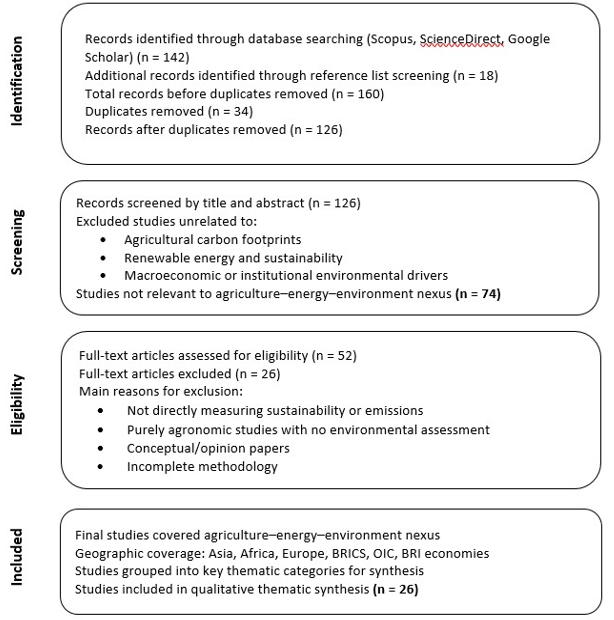
Document identification and selection process.
References
- Akther, T., M.M.I. Selim, S. Hossain, and G. Kibria. 2024. Synergistic role of agriculture production, fertilizer use, tourism, and renewable energy on CO₂ emissions in South Asia: A static and dynamic analysis. Energy Nexus., 13: 100287.
- Ali, S., Z. Yusop, S.R. Kaliappan, and L. Chin. 2021. Trade-environment nexus in OIC countries: fresh insights from environmental Kuznets curve using GHG emissions and ecological footprint. Environ. Sci. Pollut. Res., 28(4): 4531-4548.
- Ali, S., Z. Yusop, and M.S. Meo. 2022. Asymmetric openness-environment nexus in most open OIC countries: new evidence from quantile-on-quantile (QQ) estimation. Environ. Sci. Pollut. Res., 29(18): 26352-26370.
- Ali, S., Z. Yusop, and M.S. Meo. 2020. Dynamic common correlated effects of trade openness, FDI, and institutional performance on environmental quality: Evidence from OIC countries. Environ. Sci. Pollut. Res., 27(11): 11671–11682. https://doi.org/10.1007/s11356-020-07872-8[CrossRef]
- Ali, S., Z. Yusop, S.R. Kaliappan, and L. Chin. 2021. Trade-environment nexus in OIC countries: Fresh insights from environmental Kuznets curve using GHG emissions and ecological footprint. Environ. Sci. Pollut. Res., 28(4): 4531–4548. https://doi.org/10.1007/s11356-020-10819-3[CrossRef]
- Ali, S., Z. Yusop, & M.S. Meo. 2022. Asymmetric openness–environment nexus in most open OIC countries: New evidence from quantile-on-quantile (QQ) estimation. Environ. Sci. Pollut. Res., 29(18): 26352–26370. https://doi.org/10.1007/s11356-022-19378-5[CrossRef]
- Amin, N. and H. Song, 2022. The role of renewable, non-renewable energy consumption, trade, economic growth, and urbanization in achieving carbon neutrality: A comparative study for South and East Asian countries. Environ. Sci. Pollut. Res., 29(44): 66804–66819. https://doi.org/10.1007/s11356-022-10819-3[CrossRef]
- Bathaei, S. and D. Štreimikienė. 2023. Renewable energy adoption in agriculture: Systematic review. Renewable and Sustainable Energy Reviews. Advance online publication. https://doi.org/10.1016/j.rser.2023.113842[CrossRef]
- BAYSSI, O., M. Naimi, M. Sabir, M. Chikhaoui, and J. Hallam. 2024. Carbon footprint of agro-industrial chains: A meta-analysis. Moroccan J. Agric. Sci., 5(2): 97–110.
- Caglar, A.E., M.W. Zafar, F.V. Bekun, and M. Mert. 2022. Determinants of CO2 emissions in the BRICS economies: The role of partnerships investment in energy and economic complexity. Sustain. Ener. Technol. Assessm., 51: 101907. https://doi.org/10.1016/j.seta.2022.101907[CrossRef]
- Chandio, A.A., K.K. Gokmenoglu, D.P. Dash, I. Khan, F. Ahmad, and Y. Jiang, 2024. Exploring the energy–climate–agriculture nexus: A roadmap toward agricultural sustainability in Asian countries. Environ. Develop. Sustain., 26(1): 1629–1647.
- Chen, J., F. Yang, Y. Liu, and A. Usman. 2022. The asymmetric effect of technology shocks on CO2 emissions: A panel analysis of BRICS economies. Environ. Sci. Pollut. Res., 29(18): 27115–27123. https://doi.org/10.1007/s11356-022-18849-0[CrossRef]
- De Silva, A.G.S., Z.K. Al-Musawi, A. Samuel, S.M. Malwalage, T. Ramanathan, I.M. Kulmány, and Z. Molnár. 2025. Greenhouse gas emissions in agricultural crops and management practices: The impact of the integrated crop emission mitigation framework on greenhouse gas reduction. Agron., 16(1): 5. https://doi.org/10.3390/agronomy16010005[CrossRef]
- Ganie, A.U.H., A.M. Khah, and M. Ahmad, 2024. Investigating the agriculture-induced environmental Kuznets curve hypothesis in South Asian economies. J. Econ. Administrat. Sci., 40(1): 27–46.
- Gold, K.L. and F. Tregenna, 2025. Financial development, green innovation, green tax, industrialisation, and environmental performance in South Africa: The mediating role of institutions. J. Environ. Manag., 393: 126942. https://doi.org/10.1016/j.jenvman.2023.126942[CrossRef]
- Hasan, S.S., Z. Li, & F. Zhang. 2025. Exploring regional variations in agricultural greenhouse gas emissions: Insights from Bangladesh’s districts. Geograp. Sustain., 6(4): 100298. https://doi.org/10.1016/j.geosus.2025.100298[CrossRef]
- Huang, Y., S.U. Rahman, M.S. Meo, M.S.E. Ali, and S. Khan. 2024. Revisiting the environmental Kuznets curve: Assessing the impact of climate policy uncertainty in the Belt and Road Initiative. Environ. Sci. Pollut. Res., 31(7): 10579–10593. https://doi.org/10.1007/s11356-023-28795-6[CrossRef]
- Ilyas, M., Z. Mu, S. Akhtar, H. Hassan, K. Shahzad, B. Aslam, and S. Maqsood. 2024. Renewable energy, economic development, energy consumption and its impact on environmental quality: New evidence from South East Asian countries. Renew. Ener., 222: 119961.
- Jahangir, M.M.R., E. Aguilera, J. Ferdous, F. Mahjabin, A. Al Asif, M. Hossan, and M. Zaman. 2025. Carbon footprint and greenhouse gas emissions of different rice-based cropping systems using LCA. Scient. Repor., 15(1): 10214. https://doi.org/10.1038/s41598-025-10214-2[CrossRef]
- Jiang, S., G. Mentel, I. Shahzadi, M.B. Jebli, and N. Iqbal. 2022. Renewable energy, trade diversification and environmental footprints: Evidence for Asia-Pacific Economic Cooperation (APEC). Renew. Ener., 184: 1–13.
- Kaur, S., B.K. Sidana, S. Kaur, and A. Biswas. 2025. Carbon footprint reduction in Punjab agriculture: Analyzing impacts and strategies in major crop rotations. Ener. Nexus., 18:100424. https://doi.org/10.1016/j.nen.2025.100424[CrossRef]
- Khaqan, K., B. Fest, T. Harrison, and H. Sandhu. 2025. Carbon farming and agriculture: A bibliometric analysis. Discov. Agric., 3(1): 22. https://doi.org/10.1007/s43671-025-00022-1[CrossRef]
- Liao, C.S. 2025. Does Fintech improve green innovation efficiency in China? Insight from R&D activities, green finance, and government environmental awareness. Quarter. Rev. Econ. Finan., 102035. https://doi.org/10.1016/j.qref.2025.102035[CrossRef]
- Li, Q. and X. Zhang. 2024. Effects of agricultural trade on reducing carbon emissions under the “Dual Carbon” target: Evidence from China. Agric., 14(8): 1274.
- Li, Y., M. Alharthi, I. Ahmad, I. Hanif, and M. Ul Hassan. 2022. Nexus between renewable energy, natural resources and carbon emissions under the shadow of transboundary trade relationship from South East Asian economies. Ener. Strat. Rev., 41: 100856.
- Liu, H. and Y. Liu. 2025. Agricultural carbon footprints, renewable energy and sustainable development in Asia. Scient. Repor., 15(1): 34429. https://doi.org/10.1038/s41598-025-34429-7[CrossRef]
- Liu, X., S. Zhang, and J. Bae. 2017. The impact of renewable energy and agriculture on carbon dioxide emissions: Investigating the environmental Kuznets curve in four selected ASEAN countries. J. Clean. Prod., 164: 328–334.
- Luo, B., A. Rauf, F. Osei-Kusi, R. Sundas, and R. Mehmood. 2024. Exploring the impacts of agricultural emissions from natural gas on ecological footprint. Ecol. Process., 13: 83. https://doi.org/10.1186/s13717-024-01083-5[CrossRef]
- Luo, Y., X. Gu, Y. Zhang, N. Anderson, D. Zang, and Q. Shen. 2025. A study on the impact mechanism of agricultural trade on agricultural carbon emissions. Sustain., 17(11): 5060.
- Mahato, A. 2024. Greenhouse gas emission from agriculture and their mitigation strategies. Int. J. Agric. Exten. Soc. Develop., 7(7): 188–198. https://doi.org/10.33545/26180723.2024.v7.i7c.790[CrossRef]
- Mehmood, U. 2022. Determining the factors of ecological footprints in South Asian countries: Exploring the role of renewable energy and forest area. Environ. Sci. Pollut. Res., 29(15): 21876–21886.
- Mohsin, M. and F. Jamaani. 2023. Unfolding impact of natural resources, economic growth, and energy nexus on the sustainable environment: Guidelines for green finance goals in 10 Asian countries. Resour. Polic., 87: 104235.
- Moeen, M.S., J. Jupesta, and T. Hanaoka. 2025. Integrated energy planning: Review of global practices for energy security and Paris Agreement implementation in Pakistan. Ener. Nexus., 18: 100413.
- Murshed, M., R. Ahmed, C. Kumpamool, M. Bassim, and M. Elheddad. 2021. The effects of regional trade integration and renewable energy transition on environmental quality: Evidence from South Asian neighbors. Bus. Strat. Environ., 30(6): 2963–2977.
- Nyawira, S.S., M. Herold, K.A. Mulatu, R.M. Roman-Cuesta, R.A. Houghton, G. Grassi, and L. Verchot. 2024. Pantropical CO₂ emissions and removals for the AFOLU sector in the period 1990–2018. Mitigat. Adaptat. Strat. Glob. Chan., 29(2): 1–28.
- Qadri, S.U., X. Shi, S.U. Rahman, A. Anees, M.S.E. Ali, L. Brancu, & A.N. Nayel. 2023. Green finance and foreign direct investment–environmental sustainability nexuses in emerging countries: New insights from the environmental Kuznets curve. Front. Environ. Sci., 11: 1074713. https://doi.org/10.3389/fenvs.2023.1074713[CrossRef]
- Qamruzzaman, M. 2021. Nexus between environmental quality, institutional quality and trade openness through the channel of FDI: An application of common correlated effects estimation (CCEE), NARDL, and asymmetry causality. Environ. Sci. Pollut. Res., 28(37): 52475–52498. https://doi.org/10.1007/s11356-021-14547-x[CrossRef]
- Raihan, A., T. Tanchangya, J. Rahman, and M. Ridwan. 2024. The influence of agriculture, renewable energy, international trade, and economic growth on India’s environmental sustainability. J. Environ. Ener. Econ., 3(1): 1–13.
- Rauf, U.A., A. Ali, S. Ahmad, & N. Shil. 2025. Greening Agriculture: Exploring the Asymmetric Impact of Agriculture on Carbon Emissions in SCO Countries. J. Agric. Environ. Int. Develop. (JAEID)., 119(1): 43-64.
- Sajid, M., M.A.A. Ansari, A. Tanveer, M. Faheem, and A. Waseem. 2023. Evaluating the influence of green growth, institutional quality and financial inclusion on financial stability: Evidence by sustainable finance theory. Environ. Sci. Pollut. Res., 30(54): 115965–115983. https://doi.org/10.1007/s11356-023-25564-5[CrossRef]
- Sharma, G.D., M.I. Shah, R. Chopra, A. Rao, and U. Shahzad. 2024. Impact of technological advancement and greener energy on sustainable agriculture in Asia: Evidence from selected Asian countries. Sustainable Development.
- Spanos, K., N. Kladovasilakis, C. Achillas, and D. Aidonis. 2025. Mapping agricultural sustainability through life cycle assessment: A narrative review. Environ., 12(11): 436. https://doi.org/10.3390/environments12110436[CrossRef]
- Sultan, H., S.U. Rahman, F. Munir, A. Ali, S. Younas, & H. Khan. 2025. Institutional dynamics, innovation, and environmental outcomes: A panel NARDL analysis of BRICS nations. Environ., Develop. Sustain., 1–43. https://doi.org/10.1007/s10668-025-02354-1[CrossRef]
- Udeagha, M.C. and N. Ngepah. 2021. The asymmetric effect of trade openness on economic growth in South Africa: A nonlinear ARDL approach. Econ. Chan. Restructur., 54(2): 491–540. https://doi.org/10.1007/s10644-020-09287-y[CrossRef]
- Vejendla, L.C., P. Janaki, E. Parameswari, M. Suganthy, R. Krishnan, & S. Meena, 2025. Harnessing regenerative agriculture for climate change mitigation: A comprehensive review and meta-analysis. Discov. Agric., 3(1): 180. https://doi.org/10.1007/s43671-025-00180-3[CrossRef]
- Wang, L., U. Mehmood, E.B. Agyekum, S.E. Uhunamure, and K. Shale. 2022. Associating renewable energy, globalization, agriculture, and ecological footprints: Implications for sustainable environment in South Asian countries. Int. J. Environ. Res. Public Health., 19(16): 10162.
- Zhang, J., J. Cherian, A.M. Parvez, S. Samad, M.S. Sial, M.A. Ali, and M.A. Khan. 2022. Consequences of sustainable agricultural productivity, renewable energy, and environmental decay: Recent evidence from ASEAN countries. Sustain., 14(6): 3556.
Services
Article usage statistics
Loading…