
The study examines how socio-economic aspects and knowledge about industrialization influence farmers’ attitudes and further evaluates the moderating role of attitude in shaping farming practices. Using data from 360 farmers residing near the Batang Special Economic Zone (SEZ) in Indonesia, relationships among variables were analyzed through Structural Equation Modeling–Partial Least Squares (SEM-PLS). The results of the study showed that social factors (T = 2.768 > 1.960) and economic factors (T = 2.907 > 1.960) had a significant influence on farmers’ attitudes, and knowledge about the Special Economic Zone (SEZ) in Batang Regency also statistically influenced farmers’ attitudes towards the phenomenon of change (T = 8.050 > 1.960). This subsequently had a significant positive impact on their farming practices (10.307 > 1.960). Overall, the study offers valuable insight into farmers’ attitudes toward rural industrialization and supports government efforts in formulating policies that sustain agricultural participation. One such policy regulates the conversion of agricultural land.
Research Article · Volume 39, Issue 3, 13 September 2026 · Open Access
Rural Development: Farmers’ Knowledge, Socio-Economic Impact, Attitudes, and Farming Practices in Batang Regency, Indonesia
· ·
Affiliations & Notes ⌄
- 1Universitas Diponegoro, Faculty of Animal and Agricultural Sciences, Department of Agribusiness, Semarang, Indonesia. *Correspondence | Muhammad Luthfie Fadhilah, Universitas Diponegoro, Faculty of Animal and Agricultural Sciences, Department of Agribusiness, Semarang, Indonesia
- 2Email: luthfie.fadhilah@live.undip.ac.id
Article Info ⌄
- Journal:
- Pakistan Journal of Agricultural Research
- Published:
- 13 September 2026
Abstract
Introduction
The Indonesian government has recently intensified its development agenda through the establishment of Special Economic Zones (SEZs) in several regions. One of the most recent SEZs is located in Batang Regency, officially inaugurated in 2025 . The industries in the Batang Special Economic Zone are food, manufacturing, logistics, commercial, housing and tourism. Although the development in Batang has generated positive outcomes through local government initiatives that provide employment opportunities within SEZ, rural development should be accompanied by adequate support for farmers who are directly affected by changes in agricultural land. A decline in farmers’ motivation to preserve their farmland could potentially threaten the sustainability of food production in the region.
Social-economic changes play a crucial role in shaping farmers’ attitudes. Li et al. (2022) revealed that farmers’ attitudes are influenced by both social and economic dimensions. The study highlighted family and community pressures as social influences, while household income and compensation for land expropriation as economic aspects which were found in shaping behavioral responses. Industrialization creates complex socio-economic and environmental dilemmas for farmers. Economically, this phenomenon exerts pressure that narrows livelihood options, potentially encouraging unethical behavior as a means of survival . Consequently, the socio-economic gap between farmers is widening . Furthermore, from an environmental perspective, industrialization often leads to soil and water pollution, ultimately hindering the implementation of sustainable agricultural systems and exacerbating the long-term vulnerability of the agricultural sector . This will impact farmers’ attitudes and decisions regarding farming practices.
Educational interventions and knowledge dissemination tools play a crucial role in enhancing farmers’ understanding of innovative agricultural techniques ; . This improved knowledge positively shapes farmers’ attitudes, making them more receptive and confident in adopting new agricultural practices. However, while declarative knowledge effectively shapes attitudes, it does not necessarily translate into actual adoption behavior . This indicates that having knowledge alone is not sufficient to ensure behavioral change, as farmers may still need practical experience or contextual support to implement new practices effectively. Idris and Zulkifli (2024) found that farmers with higher knowledge of smart farming technologies showed greater motivation and readiness to adopt these innovations. Similarly, Bhujel and Joshi (2023) and Despotović et al. (2021) reported that environmental knowledge fosters positive attitudes toward sustainable farming practices, while Du et al. (2025) demonstrated that higher information literacy enhances positive attitudes and promotes the adoption of green production technologies.
SEZs in Batang Regency, Indonesia, was officially launched in 2025, therefore, only a few studies have been conducted in this area. Moreover, previous researches about Batang SEZs have focused on environmental impacts and local resources ; . Hence, a study analyzing farmers’ behavior toward industrial development in Batang Regency is considered novel. Several studies have used the attitude variable as a mediator to explain individual practices. However, to the best of our knowledge, studies that explore farmers’ socio-economic conditions and knowledge of SEZs awareness in rural areas, using attitude as a mediating variable influencing their farming practices are still very limited. Therefore, the purpose of this study is to examine the influence of farmers’ socio-economic conditions and knowledge in the areas surrounding the SEZs in Batang Regency on the formation of their attitudes, as well as to analyze how these attitudes affect their farming practices after the establishment of the SEZs.
Materials and Methods
This study employed quantitative research methods, selecting a sample of 360 farmers residing near the Batang SEZ, Indonesia. The sample specifically included farmers from the subdistricts of Banyuputih, Gringsing, Subah, Limpung, Bandar, and Tulis, chosen based on the proximity of their farms to the Batang SEZ. Data were collected through interviews using structured questionnaires featuring a three-point Likert scale. The collected data were analyzed using Structural Equation Modeling-Partial Least Squares (SEM-PLS) with SmartPLS software, chosen for its flexibility in handling complex structural models. The SEM-PLS analysis involved two main stages: the measurement model and the structural model . The measurement model evaluated the loading factor for each indicator and assessed convergent validity, discriminant validity, and composite reliability to ensure the robustness of the constructs . Subsequently, the structural model was used to test the research hypotheses and determine the R-square value. The independent variables in this study were social aspect, economic aspect, and knowledge; the dependent variable was farming practice, with attitude serving as the mediating variable.
Results and Discussion
Measurement model
Loading Factor Evaluation
This study evaluated loading factors to ensure that each indicator achieved a value above 0.60. In the first step, Kn7, DS3, DE6, and At1 were eliminated. After the first stage, all indicators were obtained with loading factor values that met the required criteria. Information regarding the indicators for each variable can be seen in Table 1.
Table 1: Variabel operational definition
|
Variable |
Operational Definition |
Indicator |
Reference |
|
Economy |
The impact of SEZ on the financial performance and resource allocation within agricultural operations among farmers in Batang regency |
Industry influences the selling price of agricultural products Industry influences the number of agricultural workers Industry influences agricultural labour wages Industry influences farm income Industry influences agricultural marketing costs |
Tafese at al., 2025; Wu et al., 2024; Dong and Schaefer, 2025 |
|
Social |
The extent of social interaction and collaboration between farmers and SEZ in Batang regency, reflecting their relationship quality and engagement |
Industry-farmer interaction frequency Industry-farmer collaboration Industry-farmer conflict occurrence Farmer group meeting frequency Farmers’ social participation |
Rustinsyah, 2019; Milliet, et al., 2024; Inggrida et al., 2023; Chen at al., 2023; Pratiwi and Suzuki, 2017; Dalmiyatun et al., 2025 |
|
Knowledge |
Farmers' awareness and understanding of the industries in the Batang SEZ surrounding their farmland and their impacts on farming activities |
Farmer know the number of industries around the farmland Farmer know the names of companies around the farmland Farmer know the products produced by industries around the farmland Farmer know that Batang SEZ is an integrated area developed by the government Farmer know that industries have impacts on the farming activities Farmer know that some agricultural land has been converted into industrial areas |
Despotovic et al., 2021; Wasono et al., 2021; Hidayat et al., 2021 |
|
Attitude |
Farmers' views and evaluations of the effects of Batang SEZ on employment, farm benefits, environmental impact, collaboration opportunities, and land-use changes around their farmland |
Farmer believe industries create job opportunities for family Farmer believe industries benefit the farm Farmer believe industries impacts the environment around the farm Farmer believe industries create opportunities for collaboration with the farm Farmer believe industries increase the possibility of land conversion |
Al Siddiq et al., 2019; Wang et al., 2024; Kule et al., 2025 |
|
Farming Practice |
Farmers’ participation and cooperation with industrial activities affecting their agricultural operations |
Farmers maintain agricultural activities in collaboration with industry Farmer have sold or plan to sell the farmland to industry Farmer or their family members plan to work in industrial Farmer participate in community meetings about industrial impacts on agriculture Industries or their workers purchase farmers’ agricultural products |
Zhang and Wu, 2023; Al Siddiq et al., 2019; Junaidi et al., 2021; Sugiarto at al., 2025; Nurjati and Wiryawan, 2023 |
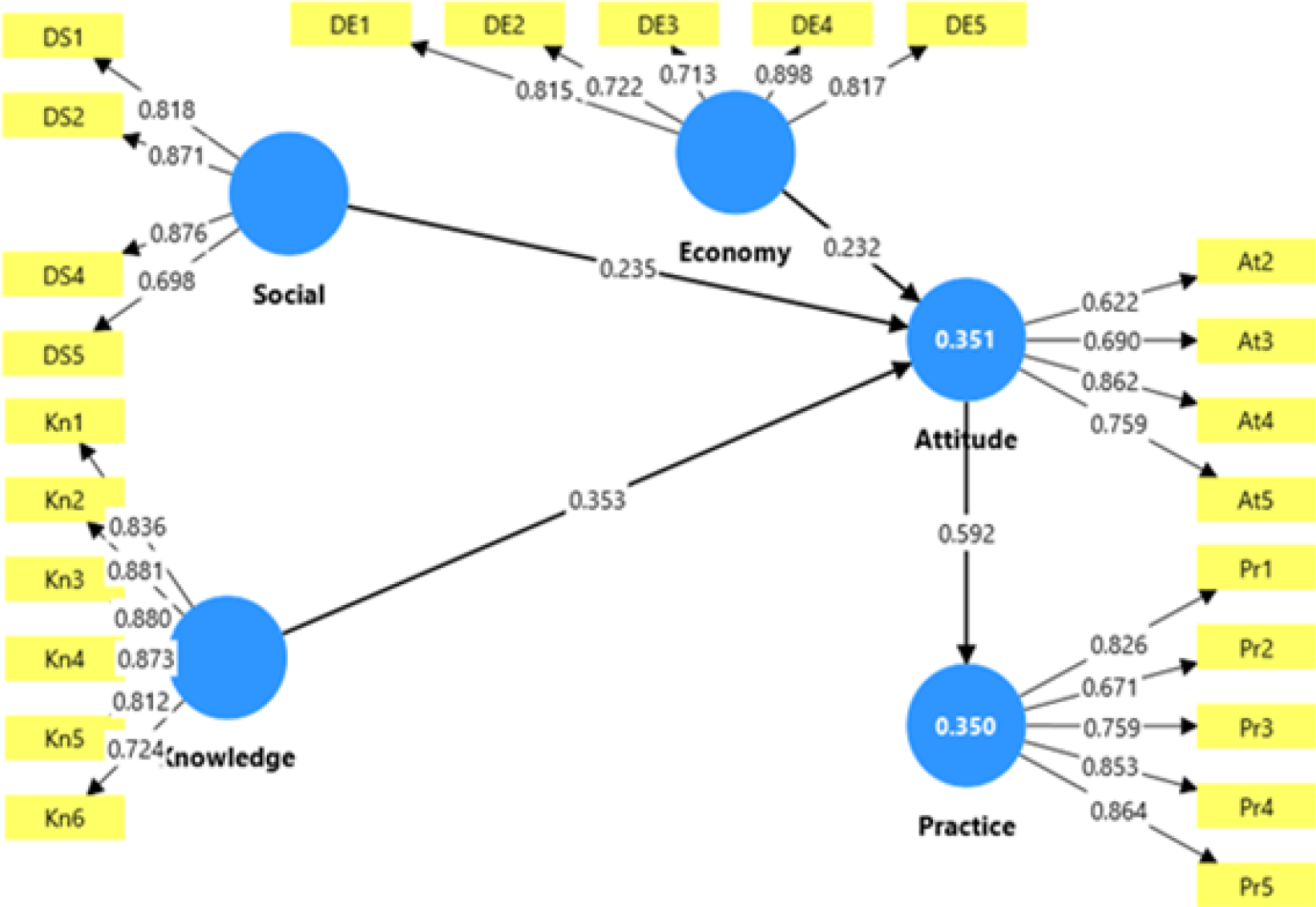
Figure 1 shows the final path diagram in which all indicators met the established criteria.
Convergent validity
All variables obtained AVE values above 0.50, it confirmed that the convergent validity criterion has been fulfilled. Table 2 reports the AVE results.
Discriminant validity
Using the Fornell-Larcker criterion, discriminant validity was confirmed for this study because the analysis indicated that the square root of each variable’s AVE value was greater than its correlations with other variables. A detailed information of these findings is reported in Table 3.
|
Variables |
Average variance extracted (AVE) |
|
Attitude |
0.546 |
|
Economy |
0.634 |
|
Knowledge |
0.699 |
|
Practice |
0.636 |
|
Social |
0.670 |
Table 3: Discriminant validity
|
Variables |
Attitude |
Economy |
Knowledge |
Practice |
Social |
|
Attitude |
0.739 |
|
|
|
|
|
Economy |
0.423 |
0.796 |
|
|
|
|
Knowledge |
0.433 |
0.169 |
0.836 |
|
|
|
Practice |
0.592 |
0.486 |
0.210 |
0.798 |
|
|
Social |
0.426 |
0.557 |
0.174 |
0.655 |
0.819 |
Table 4: Cronbach’s alpha and composite reliability
|
Variables |
Cronbach's alpha |
Composite reliability (rho_c) |
|
Attitude |
0.721 |
0.826 |
|
Economy |
0.863 |
0.896 |
|
Knowledge |
0.913 |
0.933 |
|
Practice |
0.854 |
0.897 |
|
Social |
0.833 |
0.890 |
Composite reliability
Based on Table 4, all constructs in this study achieved Cronbach’s Alpha and Composite Reliability values greater than 0.70.
Structural model
Hypothesis testing
The results show that all relationships between the independent and dependent variables are significant, as the T-Statistic values are greater than 1.960 and all P values are less than 0.05.
Table 5: Hypothesis testing
|
Path coefficients |
Original Sample |
T statistics (|O/STDEV|) |
P values |
Results |
|
Attitude -> Practice |
0.592 |
10.307 |
0.000 |
Significant |
|
Economy -> Attitude |
0.232 |
2.907 |
0.004 |
Significant |
|
Knowledge -> Attitude |
0.353 |
8.050 |
0.000 |
Significant |
|
Social -> Attitude |
0.235 |
2.768 |
0.006 |
Significant |
|
Variables |
R-square |
|
Attitude |
0.351 |
|
Practice |
0.350 |
R-square evaluation
The R-square of this study can be seen in Table 6. Social, Economic, and Knowledge variables can explain 35.1% of Attitude variable, while the remaining 64.9% is influenced by other factors not included in the model. Similarly, Attitude explains 35% of the variation in Farming Practice, with the remaining influenced by factors outside the model.
Discussions
The demographic characteristics examined in this research include gender, age, formal education, farming experience, land area, and the number of family members working in the industry (Table 7).
The demographic analysis indicates that most respondents are male (58.61%). The predominant age group is 50-59 years old, representing 29.72% of the sample. Most participants have extensive farming experience, with over 40 years reported by 25.28%. A significant portion of respondents cultivate small land areas, with 61.33% owning less than 0.5 hectares. Additionally, most families (76.67%) have no members working in the industry.
The influence of social factors on farmers’ attitude
Based on Table 5, the results demonstrate that social factors, including industry-farmer interaction frequency, industry-farmer collaboration, industry-farmer conflict occurrence, farmer group meeting frequency, and farmers’ social participation can influence farmers’ attitudes toward SEZs in Batang Regency, Indonesia, as proven by the T-statistic score (2.768 > 1.960). This finding confirms that social aspects play an important role in creating individual attitudes, as social interactions influence how individuals respond to development processes ; ; . The development of industries in rural areas has led to changes in social dynamics. Farmers residing close to SEZs have begun to engage with a more diverse group of individuals, including industrial employees. These transformations in social relations may influence farmers’ attitude toward farming practices. Increased participation in social activities provides opportunities for farmers to discuss and share information about industrial impacts . These interactions help farmers understand the changes occurring around them and may strengthen their attitudes toward the presence of industry.
Table 7: Characteristics of farmers around batang SEZ
|
Characteristic respondents |
Farmers around the industry |
|
|
Number |
Percentage (%) |
|
|
Gander: |
||
|
Male |
211 |
58.61 |
|
Famele |
149 |
41.39 |
|
Total |
360 |
100 |
|
Age (year): |
||
|
20-29 |
21 |
5.83 |
|
30-39 |
25 |
6.94 |
|
40-49 |
51 |
14.17 |
|
50-59 |
107 |
29.72 |
|
60-69 |
101 |
28.06 |
|
>70 |
55 |
15.28 |
|
Total |
360 |
100 |
|
Farming experience (year): |
||
|
< 10 |
51 |
14.17 |
|
10-19 |
53 |
14.72 |
|
20-29 |
81 |
22.50 |
|
30-39 |
84 |
23.33 |
|
> 40 |
91 |
25.28 |
|
Total |
360 |
100 |
|
Land area (ha): |
||
|
< 0,5 |
184 |
61.33 |
|
0,51-0,99 |
62 |
20.67 |
|
1-1,99 |
34 |
11.33 |
|
> 2 |
20 |
6.67 |
|
Average |
360 |
100 |
|
Families working in industry: |
||
|
0 |
276 |
76.67 |
|
1-2 |
63 |
17.50 |
|
> 3 |
21 |
5.83 |
|
Total |
360 |
100 |
The influence of economy factors on farmers’ attitude
Economic factors were also found to significantly influence based on the research findings (2.907 > 1.960). Previous studies have emphasized that economic conditions strongly influence attitudes, as individuals tend to evaluate development initiatives based on their potential economic benefits or risks ; ; . The establishment of SEZs in Batang Regency, Indonesia, has altered farmers’ economic conditions. Year-on-year economic growth in Batang in 2023, before SEZ was officially launched, was 4.73% . Meanwhile, according to the Statistics Indonesia, year-on-year economic growth in Batang, following the arrival of numerous industries in the SEZ, reached 7.49% in 2024 . SEZs create opportunities for local communities, including farmers, to initiate and expand businesses in surrounding areas ; . These changes may shape farmers’ attitudes toward industrial presence. Farmers may develop more favourable attitudes toward industrial development when they perceive economic benefits and improved livelihoods .
The influence of knowledge on farmers’ attitude
This research found that knowledge about SEZs in Batang Regency can influence farmers’ attitudes toward the phenomenon of change (8.050 > 1.960). This result confirms that knowledge influences attitude, as individuals with better understanding are more able to evaluate development impacts and respond appropriately ; . Farmers with sufficient knowledge about SEZs are more likely to understand how this phenomenon affects their activities, which in turn influences their attitudes. This awareness helps farmers make informed decisions about land use, crop selection, as well as exploit new market opportunities and adapt to changing SEZ-related regulations.
The influence of farmers’ attitude on farming practices
Farmers’ attitudes toward SEZ development were found to significantly influence their farming practices, as indicated by a high T-statistic value (10.307 > 1.960). This result supports previous studies indicating that individuals’ attitudes and behaviors can influence their willingness to adopt a program ; . This finding suggests that farmers have a positive attitude toward the presence of the Batang SEZs, as they believe it can open opportunities for collaboration with industries related to their farming practices. The development of rural areas near their farmland does not reduce their motivation to engage in farming, instead, it increases their enthusiasm, as they perceive potential partnerships with industries to enhance agricultural productivity.
Conclusions and Recommendations
This study analyzes the impact of socio-economic factors and knowledge on farmers’ attitudes toward the SEZs phenomenon, as well as the influence of those attitudes on farming practices. The findings revealed that both socio-economic factors and knowledge significantly affect farmers’ attitudes, and that attitude, in turn, has a significant influence on farming practices. This study was limited to the Batang SEZ in Indonesia, which was newly established and inaugurated in 2025. Therefore, understanding farmers’ perspectives and behaviors is essential, as the development may affect their agricultural activities. The results can help the Indonesian government formulate policies that support farmers. Future studies should explore additional factors, as industrial development in rural areas continues to expand and farmers remain among the groups most affected by such change. Moreover, further research could extend the scope to other SEZs across Indonesia to enable comparative analysis between regions and provide a more comprehensive understanding of how SEZ development influences rural farming communities.
Acknowledgements
The authors would like to express their gratitude to Institute for Research and Community Services, Universitas Diponegoro (Project No; 222-156/UN7.D2/PP/IV/2025) for financial support and facilitating the research process.
Novelty Statement
This study chose farmers in Batang regency SEZ as subjects because the industry in this region was only officially launched in 2025, so there is still limited research examining this area, especially research that analyzes the relationship between knowledge, socio-economic impacts, and farmer attitudes with farming practices.
Author Contributions
Avivah Rahmanıngtyas: Conception and design of the study, sample collection, analysis and interpretation of data, writing manuscript.
Muhammad Luthfie Fadhilah: Conception and design of the study, sample collection, visualization, writing manuscript.
Irma Fauziah: Conception and design of the study, sample collection, statistical analysis, writing manuscript.
Generative AI and AI-assisted technology statement
The authors declare that no generative AI and AI assisted technology was used in the creation of this manuscript.
Conflict of interest
There is no conflict of interest between the authors in this study.
Figures
Final stage of path model with valid indicator loadings
References
- Al Siddiq, I.H., M. Saputra, and S. Untari. 2019. May). Rural Industrialization And The Impact On Citizens (The Shifting Of Agricultural Land Using In Henri Lefebvre’s Space Perspective). In Int. Confer. Rural Stud. Asia (ICoRSIA 2018) (pp. 285-289). Atlantis Press.
- Amalia, F. and D.N. Sari. 2025. “Land surface temperature dynamics due to the development of Batang ıntegrated ındustrial estate (2014 & 2024)”. E3S Web Confer., https://doi.org/10.1051/e3sconf/202565212001.[CrossRef]
- Bell, A.R. and M. Engelbert. 2025. When does new information encourage adoption, and where can we observe it: A synthesis of 3ie’s thematic window on agricultural innovation. World Develop. Perspect., 37 (December 2024): 100647. https://doi.org/10.1016/j.wdp.2024.100647.[CrossRef]
- Bhujel, R.R. and H.G. Joshi. 2023. Understanding farmers’ intention to adopt sustainable agriculture in Sikkim: The role of environmental consciousness and attitude. Cogent Food Agric., 9(1). https://doi.org/10.1080/23311932.2023.2261212.[CrossRef]
- Chen, F., Y. Yi, and Y. Zhao. 2023. The effect of social capital at the community and individual levels on farmers’ participation in the rural public goods provision. Agric., 13(6): 1247.
- Dai, D.D., L.T. Ngan, and N.T. Dien. 2013. Difficulties in transition among livelihoods under agricultural land conversion for industrialization: Perspective of human development. Mediterranean J. Soc. Sci., 4(10): 259–267. https://doi.org/10.5901/mjss.2013.v4n10p259.[CrossRef]
- Dalmiyatun, T., Y. Permatasari, and J. Mariyono. 2025. Linking farmers’ organizational functions to productivity performance: The role of learning, cooperation, and collective production. Soc. Sci. Human. J., 9(11): 9351–9357
- Despotović, J., V. Rodić, and F. Caracciolo. 2021. Farmers’ environmental awareness: Construct development, measurement, and use. J. Clean. Prod., 295. https://doi.org/10.1016/j.jclepro.2021.126378.[CrossRef]
- Dong, Z. and K.A. Schaefer. 2025. Urbanization and the industrialization of agriculture. Europ. Rev. Agric. Econ., 52(5): 1023-1040.
- Du, Y., H. Feng, Q. Zhang, and S. Zheng. 2025. Influence of ınformation literacy on farmers’ green production technology adoption behavior: The moderating role of risk attitude. Chinese J. Eco-Agric., 33(3): 590–604. https://doi.org/10.12357/cjea.20240318.[CrossRef]
- Ghozali, I. and H. Latan. 2020. Partial least squares: Konsep, teknik, dan aplikasi menggunakan program SmartPLS 3.0 (2nd ed.). Badan Penerbit UNDIP.
- Hendrickson, M.K. and H.S. James Jr. 2005. The ethics of constrained choice: How the industrialization of agriculture impacts farming and farmer behavior. J. Agric. Environ. Eth., 18(3), 269–291. https://doi.org/10.1007/s10806-005-0631-5.[CrossRef]
- Hidayat, A.R.T., A.W. Hasyim, G. Prayitno, & J.D. Harisandy. 2021. Farm owners’ perception toward farmland conversion: an empirical study from Indonesian municipality. Environ. Res. Engineer. Manag., 77(1): 109-124.
- Idris, N.A.M. and Z. Zulkifli. 2024. Knowledge, attitude and practices of smart farming technology for small scale farmers in paddy production: A case study in Melaka. IOP Confer. Ser: Earth Environ. Sci., 1397(1). https://doi.org/10.1088/1755-1315/1397/1/012032.[CrossRef]
- Inggrida, J.A., F. Mulyadi, and S.M. Purnama. 2023. Rural social capital in organic farmer institutions in rice organic farming. Habit., 34(2): 190-202.
- Jumadi. 2025. Ekonomi Batang tumbuh lebih dari 7%, angka kemiskinan turun. Layanan Desa Mandiri Kabupaten Batang. (Web-page: https://desa.batangkab.go.id/page/berita_ detail/cUNoM2ZoWEhSMGE5S jJCN29UUEpGZz09). (Date accesed: 2026, February 2025).
- Junaidi, Y., Y. Yulius, E. Rosana, and O.F. Manullang. 2021. Farmer institutional dynamics in vegetable agribusiness development efforts in kelurahan talang keramat, Banyuasin District. J. Lahan Subopt: J. Subopt. Land., 10(2): 178-186.
- Khaled, R. and L. Hammas. 2019. “Technological ınnovation and the agricultural sustainability: what compatibility for the mechanization?”. Environmental and Agricultural Informatics: Concepts, Methodologies, Tools, and Applications: Volumes 1-3 (Vol. 1, pp. 1–16). IGI Global. https://doi.org/10.4018/978-1-5225-9621-9.ch001.[CrossRef]
- Khan, T.U., G. Nabi, A. Iqbal, K. Ullah, and H. Hu. 2025. Fields of conflict: public attitudes and economic ımpacts of human–wildlife conflict on rural livelihood in district Lakki Marwat, Pakistan. Divers., 17(3): 1–19. https://doi.org/10.3390/d17030180.[CrossRef]
- Kule, E.K., A. Obia, D. Agole, D.M. Okello, and W. Odongo. 2025. Farmer perceptions and their implications for adoption of sustainable agricultural intensification practices. Discov. Sustain., 6(1): 210.
- Li, D. and X. Wang. 2021. Land-Use change and efficiency in Laos’ Special Economic Zones. Land., 10(10): 1012. https://doi.org/10.3390/land10101012[CrossRef]
- Li, Z., Q. Yang, X. Yang, Z. Ouyang, X. Cai, and J. Qi. 2022. Assessing farmers’ attitudes towards rural land circulation policy changes in the Pearl River Delta, China. Sustain., (Switzerland)., 14(7): 1–16. https://doi.org/10.3390/su14074297.[CrossRef]
- Mdiya, L., M. Aliber, L. Mdoda, J. Van Niekerk, J. Swanepoel, & S. Ngarava. 2024. Empowering resilience: the ımpact of farmer field schools on smallholder livestock farmers’ climate change perceptions in Raymond local municipality. Sustain. (Switzerland)., 16(20): 1–16. https://doi.org/10.3390/su16208784.[CrossRef]
- Milliet, E., C. Plancherel, A. Roulin, and F. Butera. 2024. The effect of collaboration on farmers’ pro-environmental behaviors–A systematic review. J. Environ. Psychol., 93: 102223.
- Mulya, S.P., D. Hudalah, and N. Prilandita. 2025. Farmers’ attitudes toward urbanization pressure for agriculture sustainability. Agraris., 11(1): 19–39. https://doi.org/10.18196/agraris.v11i1.513.[CrossRef]
- Musyarofah, S.A. and A.E. Tontowi. 2024. Pemetaan sumber daya lokal kota pekalongan untuk mendukung kebutuhan kawasan ındustrı terpadu batang. J. Lıtbang Kota Pekalong., 22(2): 88–100. https://doi.org/10.54911/litbang.v22i2.1016.[CrossRef]
- Nguyen, T.P.L., G. Seddaiu, and P.P. Roggero. 2019. Declarative or procedural knowledge? Knowledge for enhancing farmers’ mitigation and adaptation behaviour to climate change. J. R. Stud., 67(January): 46–56. https://doi.org/10.1016/j.jrurstud.2019.02.005.[CrossRef]
- Nurjati, E. and F.S. Wiryawan. 2023. The sustainability of contract farming model: A case study of an agribusiness company. J. Ekon. Pembangunan: Kajian Masal. Ekon. dan Pembang., 52-76.
- Pratiwi, A. and A. Suzuki. 2017. Effects of farmers’ social networks on knowledge acquisition: lessons from agricultural training in rural Indonesia. J. Econ. Struc., 6(1): 8.
- Rustinsyah, R. 2019. The significance of social relations in rural development: A case study of a beef-cattle farmer group in Indonesia. J. Co-Operat. Organiz. Manag., 7(2): 100088.
- Statistics Indonesia. 2024. Pertumbuhan ekonomi Jawa Tengah triwulan IV-2023. (Web-page: https://batangkab.bps.go.id/id/pressrelease /2024/02/05/204/ pertumbuhan-ekonomi -jawa -tengah- triwulan-iv- 2023.html). (Date accesed: 2026, February 25)
- Sugiarto, A.A., D. Dinaloni, N. Sudarwati, and F. Amri. 2025. The Role of Agricultural Cooperatives in Prospering Farming Communities. J. Ilmiah Inovasi., 25(2): 99-106.
- Tafese, T., J. Lay, and V. Tran. 2025. From fields to factories: Special economic zones, foreign direct investment, and labour markets in Vietnam. J. Develop. Econ., 174: 103467.
- Ukwuaba, I.C., C.J. Arene, and C.B. Okpukpara. 2024. Smallholder commercialization: What drives the household welfare of smallholder rice farmers? J. Agric. Facul. Ege Uni., 61(4): 413–424. https://doi.org/10.20289/zfdergi.1435516.[CrossRef]
- Wang, J., L. Peng, J. Chen, and X. Deng. 2024. Impact of rural industrial integration on farmers’ income: Evidence from agricultural counties in China. J. Asian Econ., 93: 101761.
- Wasono, D.M., A.W. Muhaimin, and R. Isaskar. 2024. The effect of farmer knowledge, farmer attitudes, and farmer skills on farmer decisions in Bakalan village, East Java Province, Indonesia. Agro Bali: Agric. J., 7(3): 972-980.
- Wu, J., M. Zhang, X. Yang, & B. Wu. 2024. Effects of land and labor costs growth on agricultural product prices and farmers’ income. Land., 13(11): 1754.
- Xinhua. 2025. Indonesia inaugurates largest state-owned SEZ in Batang. (Web-page: https://english.news.cn/20250321/a6a336b1839e4cfca5f52494a3b74b17/c.html). (Date accessed: August 2025).
- Zeng, D.Z. 2021. The past, present, and future of special economic zones and their impact. J. Int. Econ. Law., 24(2): 259-275. https://doi.org/10.1093/jiel/jgab014.[CrossRef]
- Zhang, H. and D. Wu. 2023. The impact of rural industrial integration on agricultural green productivity based on the contract choice perspective of farmers. Agric., 13(9): 1851.
Services
Article usage statistics
Loading…