
Phosphatidylinositol-3-kinase (PI3K) mediated or Ras/PI3K/PTEN/Akt/mTOR is one of the major effector pathways in the pathogenesis of Non-Hodgkin Lymphoma (NHL). Binding of growth factors/ mitogen/cytokine or interleukin to EGFR leads to Ras induced RAF-MAPK cascade activation. PTEN protein is involved in the negative regulation of PI3K pathway. Mutations in upstream kinases, growth factor receptors or intrinsic members of cascades can lead to induce or promote cancers. Number of somatic mutations in several genes, majority of which are involved in chromatin modification and transcriptional regulation, have been reported in NHL. G468R and G468A mutations in BRAF gene have been reported in NHL, BRAF is a member of RAS mediated MAPK pathway. In current study, hot spots of Kras gene were analysed in a 40 years old male patient, presented with NHL located in ascending colon with worst prognosis of disease. Through mutagenic PCR, codon 12 was analysed by creating a single nucleotide mismatch at the 3′-end of primers to produce a BstNI recognition sequence at codon 12 while codon 13 was analysed by introducing HaeIII recognition sequence. By using RFLP and sequencing, point mutation substituting the glycine (GGC) to aspartic acid (GAC) was observed at codon 13. The p.G13D or cDNA.230G>A/ g.5590G>A is previously recognized as rs112445441 and being reported for the first time in NHL. By in silico analysis, it is anticipated to be a diseases causing or pathogenic alteration by Mutation taster and SIFT analysis. Spotting the rs112445441 in NHL is supporting the idea of cross talk between RAS-ERK-MAPK and PI13K and this could be one of the factors behind the development of resistance to the current therapy and relapse in NHL. K ras mutant isoforms, being the negative predictors for prognosis, are vital to analyse before the start of adjuvant therapy. Further studies needed to confirm the functional aspects of rs112445441 and other variants involved in NHL pathogenesis.
Research Article · Volume 52, Issue 2, 27 January 2020 · Open Access
Spotting rs112445441 in Non-Hodgkin Lymphoma: Another Clue for the Context-Dependent Crosstalk between RAS-MAPK and PI3K Mediated Pathways
· · · ·
Affiliations & Notes ⌄
- 1Department of Zoology, Kinnaird College for Women University, Lahore 54000 2Services Institute of Medical Sciences, Lahore 54000 3Department of Biochemistry, Faculty of Science, King Abdulaziz University, Jeddah 21589, Saudi Arabia 4Department of Biochemistry, Faculty of Life Sciences, University of Central Punjab, Johar Town, Lahore , * Corresponding author: arshaksbs@yahoo.com
- 2dr.arshakoori@ucp.edu.pk
Article Info ⌄
- Journal:
- Pakistan Journal of Zoology
- Published:
- 27 January 2020

From the article
- Codon 13 was observed to have alteration (Fig. 2A), which was subsequently confirmed by sequencing and alignment (Fig. 2B and 2C), a G to A transition at second base of the codon (p.G13D), substituting glycine (GGC) to aspartic acid (GAC).
- G13D or cDNA.230G>A/ g.5590G>A/rs112445441 is an already a recognized mutant variant.
- The role of PI3K pathway is well understood in NHL pathogenesis.
- This cross talk between RAS-ERK-MAPK and PI13K is a context-dependent.
Selected from the article's own text.
Abstract
INTRODUCTION
Non-Hodgkin lymphoma (NHL) makes up about 90% of all malignant lymphoma has become seventh most frequently occurring cancer ; . The reported prevalence in Southeast Asian and Central/South American countries were 5.2 and 3%, respectively, as compared with just 0.3% in North American and European countries . In Pakistan, the reported age standardised incidence rate recorded in 1995, was 5.3/100,000 and 4.1/100,000 in males and females, respectively, which increased to 8.4/100,000 in males and 6.5/100,000 in females when recorded in 2002. People from the North western regions of the country, especially with low socio-economic condition and children were found to have greater risk of developing the disease . It was ranked at 4th top most malignancy (both genders) in all age groups and mostly falls into intermediate to high grade category (CRCDM, 2011; . Accounting 80-85% of total NHL incidences, B-NHL is the most common type of NHL, followed by T-NHL. Use of hair dye, diets rich in fats, higher BMI, exposure to few chemicals and certain gene-environment interactions are responsible for such mutations . Modification of histones (post-transcriptional) is crucial in germinal centre B cells. Genetic alterations in related genes can deregulate these modification leading to the enhanced methylation and reduced acetylation which are the key steps involved in the development of NHL (Morin et al., 2012). Based on the expression pattern of LMO2 and TNFRSF9 (tumor biomarker and tumor microenvironment marker respectively), a two-gene model was proposed in B-NHL . Although, several types of therapies have been developed yet the molecular genetics of NHL is not very clear for all subtypes ; . Besides the CD20 and members of PI3K pathway, other major genes observed to be altered in NHL are MLL2, BCL2, CARD11, CD79B, EZH2, IRF4, MEF2B, TP53, BTG1, BTG2, CREBBP, GNA13, SGK1, B2M, ETS1, FAT2, IRF4, FOXO1, STAT3, RAPGEF1, ABCA7, RNF213, MUC16, PIM1, COL4A2, EP300, SAMD9, PRKDC, HDAC7, FAS, CIITA, TMEM30A, KLHL6, MYD88, CD70, CD58, CD79B and CCND3. With truncating mutations, MLL2 was found to be frequently mutated tumor suppressor gene in NHL (Morin et al., 2012). Contribution of proto oncogene like BCL-1, BCL-2, BCL-6 and c-MYC have also been relevant for clinicians when treating NHL . A novel variant TNFRSF13C has been identified in the gene encoding human B cell-activating factor receptor in NHL . Mutations in BRAF gene in NHL tumors have been reported by Lee et al. (2003). KRAS is a GTP- and GDP-binding protein, plays an important role in signal transduction. In the inactive state it is bound to GDP, in the active to GTP. Guanine nucleotide exchange factor (GEF) acts as a positive regulator by promoting dissociation of GDP, while GTPase activating protein (GAPS) acts as a negative regulator by promoting hydrolysis of GTP. Pi, inorganic phosphate . Usually release of GDP is regulated by the intracellular concentration of GTP. Mutations in K ras gene have been reported in various cancer types, i. e pancreatic, colorectal, lung adenocarcinomas and thyroid lymphoma which develops in autoimmune thyroiditis . Codon 12, 13 and 61 have been found to be widely studied hotspots of the gene, found to be mutated in a wide range of cancers. Point mutations reported in other codons are in codon 11 , 12 , 13 ; , 15, 18 , 19 and 20 ; , 22 , 27, 30 , 31 , 61 (Enomoto et al., 1992), 117, 146 and 154 ; ; ; . With advanced clinical stages of CRC, codon 13 mutations have been associated with lymph node metastasis ; .
Patients having metastatic CRC with K ras p.G13D mutation have found to have better prognosis when treated with cetuximab as compared to codon 12 mutant variant. The underlying mechanism is the similar behaviour of c.38G.A K ras as wild type K ras ; . In a preclinical trial, codon 13 mutation showed sensitivity towards cetuximab in an in vitro LoVo cell line model . CRC cells harboring p.G13D observed to be more sensitive to anti-EGFR treatment . Codon12 mutations in K ras represents an aggressive phenotype of tumour as compared to codon 13 mutations by altering the threshold level for apoptosis induction in CRC . Modelling of G13D onto the wild type K ras structure demonstrated that the side chain atoms of Asp13 face the opposite side of the P-loop, its 4 Å from Tyr32 (Fig. 1).
MATERIALS AND METHODS
Patients and samples
A 42 year old male patient presented for the surgical resection of a growth located in ascending colon was the case for study. After the informed consent, a small piece of tumour tissue, its adjacent normal tissue (12 cm away from the tumour location), whole blood (5 ml) was taken. The tissue samples were immediately transferred to liquid nitrogen, and then stored at -800C until further processed. Genomic DNA from tissue samples was extracted using Puregene DNA extraction kit (Qiagen) and from blood the protocol established by Helms (1990) as followed.
Analysis of K ras hotspots
Through mutagenic PCR, codon 12 was analysed by creating a single nucleotide mismatch at the 3′-end of primers to produce a BstNI (Thermo Fischer Scientific Cat. No. 0551) recognition sequence at codon 12. Following primers were used:
Forward: 5’ actgaatataaacttgtggtagttggacct 3’
Reverse: 5’ tcaaagaatggtcctgcacc 3’.
Forward primer carried a mismatched nucleotide (underlined). The cleavage site would be absent in the case of mutated codon 12. In PCR, 50 ng of gDNA with 0.25 units of Taq and 20 pmoles of each primer was amplified at 60°C annealing temperature. Approximately, 250 ng DNA was restricted with 20 units of BstN1 by overnight incubation at 37°C . Codon 13 was analysed by following the protocol established by Hatzaki et al. (2001). An HaeIII recognition sequence was introduced in the PCR-amplified wild-type alleles through a mutagenic PCR. Forward primer with nucleotide sequence 5′ gtactggtggagtatttgatagtgtattaa 3’ and reverse with 5′ gtatcgtcaagg’cactcttgcctagg 3′ were used. For reaction, 50 ng of gDNA with 0.25 units of Taq and 20 picomoles of each primer was amplified at 50 °C annealing temperature. Approximately 250 ng DNA was restricted with 20 units of HaeIII (Thermo Fischer ER# 0151) by an overnight incubation at 37°C.
Protocol established by Sills et al. (1999) was followed to analyse the codon 61. The forward primer with nucleotide sequence 5’ gacatcttagacacagcagtt ‘3 and reverse with 5’ tagccataggtggctcacct ‘3 were used for the PCR. For the reaction, 50 ng of gDNA with 0.1 unit of Taq and 20 picomoles of each primer was amplified at 59°C annealing temperature. The normal sequence of codon 61 is CAA and there are restriction sites for XbaI (Thermo Fischer #ER0681), MSEI (Fermentas Life Sciences, ER# 09825), and TaqI (Fermentas Life Sciences, ER# 0671) enzyme were created by the presence of A to T, C to A or A to G, mutation respectively, in the first or second base of codon 61. The presence of mutations was finally confirmed by DNA sequencing by using capillary electrophoresis-based sequencing services (Applied Biosystems (ABI) 3730xl DNA Analyser). Presence of mutations was analysed by SeqMan sequence assembly software. For analysing the mutations bioinformatics tools like Blast alignment, Sorting Intolerant from Tolerant (SIFT) Mutation Taster and ProMod3 were used.
RESULTS
The patient under study was going through the routine surgical resection for NHL confirmed by histopathological examination of biopsy. Tumour was negative for any p53 mutations. K ras hotspots i.e codon 12, 13 and 61 were analysed. For codon 12, in case of wild type allele, BstNI digestion of codon 12 should result in 2 bands of 29 and 128 bp, whereas mutant should remain uncut product of 157 bp. After HaeIII restriction, wild-type codon 13 should result in 3 bands (additional fragment due to an internal HaeIII recognition site) of 85, 48, and 26 bp, but mutant allele would be digested into 2 bands of 85 and 74 bp. For codon 61, CTA, AAA and CGA mutations were analysed by XbaI, MSEI and TaqI digestion, respectively. Wild type codon 61 should not be cut by these enzymes. Herein, no mutation was found at codon 12 and 61. Codon 13 was observed to have alteration (Fig. 2A), which was subsequently confirmed by sequencing and alignment (Fig. 2B and 2C), a G to A transition at second base of the codon (p.G13D), substituting glycine (GGC) to aspartic acid (GAC). p. G13D or cDNA.230G>A/ g.5590G>A/rs112445441 is an already a recognized mutant variant. According to our knowledge based on published reports, this variant has never been reported in NHL before. K RAS wild type, K RAS p.G13 Models were constructed using ProMod3 based on template–target alignment. p. G13D scored 94 and predicted to be a disease causing or pathogenic alteration by Mutation taster. Based on Bayes classification, Mutation Taster counts the score (0.0 to 215) from an amino acid substitution matrix that depends on the difference between the physicochemical properties of amino acids involved. According to SIFT analysis p. G13D is DAMAGING with the median conservation 3.37. SIFT is based on the changes in sequence homology by substitutions and low confidence predictions with Median conservation above 3.25 will be declared as damaging.
DISCUSSION
The role of PI3K pathway is well understood in NHL pathogenesis. To reduce the overexpression of the pathway, number of inhibitors including RAD001 targeting mTOR, idelalisib or CAL-101 (GS-1101) targeting p110δ, IPI-145 targeting p110γ/δ, NVP-BKM120, GDC-0941 and BAY80-6946 targeting PI3K have been developed (Fang et al. 2014). Rituximab, a monoclonal antibody targeting CD20, in combination with other agents like vincristine, doxorubicin, cyclophosphamide and prednisone has proven to be a therapy of choice for NHL but the development of resistance against the hyper activated pathways is also evident. Some of new agents are in trials and showing promise. Axicabtagene ciloleucel or Yescarta is also another option approved by FDA (FDA, 2018). Despite the presence of variety of these therapeutic agents, poor prognosis is still a challenge especially in relapsed cases and with salvage regimens ; . The possible involvement of RAS–RAF-MAP kinase pathway cannot be ignored. In a combined therapy for treating KRAS mutant CRC, it has been observed that BKM120, an inhibitor of PI3K enhances the efficacy of cetuximab. Both pathways can activate or
inhibit each other . This cross talk between RAS-ERK-MAPK and PI13K is a context-dependent. Erk-dependent phosphorylation leads to post translational inactivation and disability of TSC2 to inhibit oncogenic progressions and mTOR signalling (Fig. 3). Activation of p38-kinase pathway and ERK are evident in lymphomas ; ; . Protein kinase C and RasGRP1/3 has been linked to apoptosis in B-NHL cells . In silico models as well as clinical trials have depicted that mutational status of K ras gene can affect the responsiveness to the currently available therapeutic agents for the anticancer treatment. By calculating the B-factors for each residue at P loop, switch I and II regions, Chen et al. (2013) observed that c.35G.A (p.G12D) has significant atomic fluctuations at the switch II and P-loop regions when compared with c.38G.A (p.G13D) and normal (Fig. 4).
Mutant Ras results in cellular instability and tumorigenesis through different mechansims . Understanding the mutational status and molecular genetics by using modern techniques like exome sequencing, before the start of any anticancer therapy is vital and rational combinations of therapeutic agents can be tried out.
ETHICAL APPROVAL
The study was approved by the Ethical Committee of School of Biological Sciences, Lahore and Advanced Board of Studies and Research, University of the Punjab, Lahore, Pakistan.
Conflict of Interest
All authors state that there is no conflict of interest.
Figures
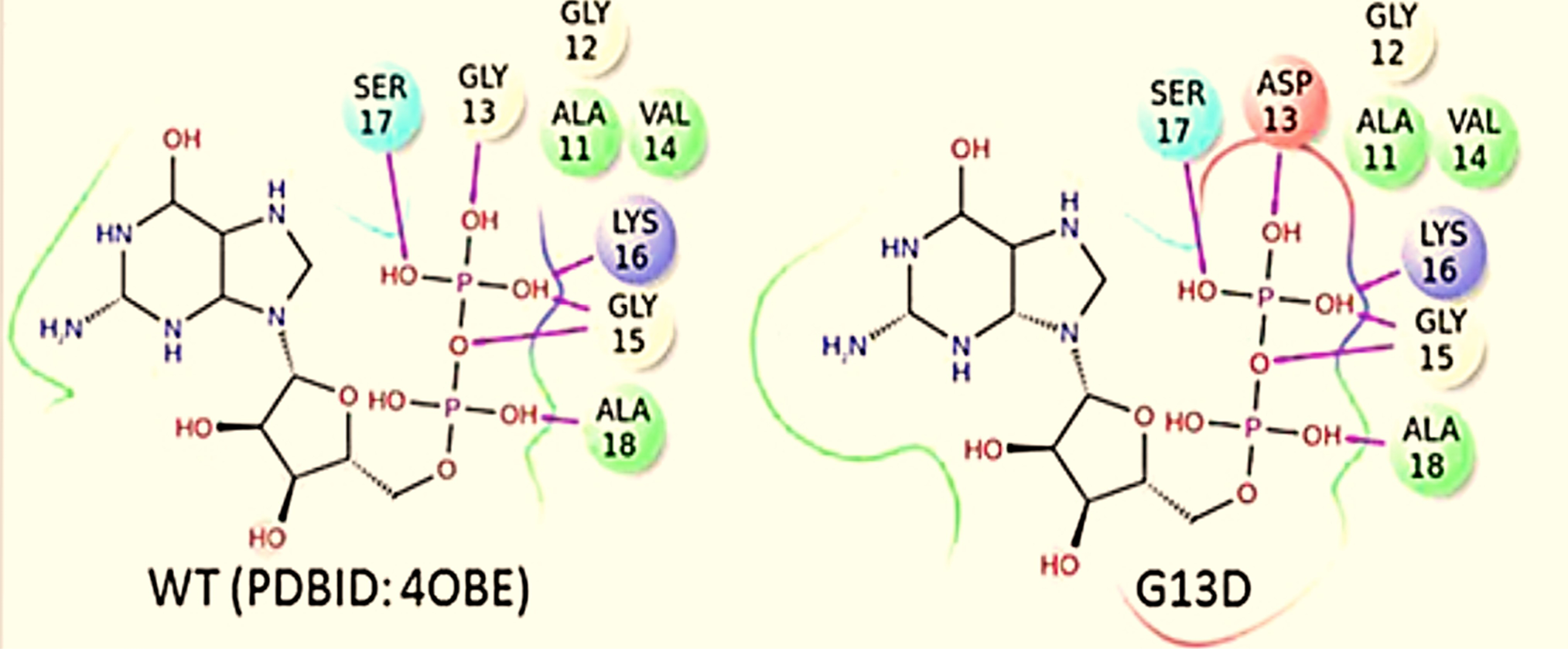
Scheme of Hydrogen bonding between β-phosphate of GDP and backbone of P-loop (residues 13–17) in WT (left) and G13D (right) (Figure adapted from Lu et al., 2015). RAS family is direct or indirect regulator of complex signalling mechanism like, RAS-ERK-MAPK, PI13K, ral guanine nucleotide dissociation stimulator (RALGDS) and protein kinase C (PKC) etc. (Khan et al., 2018), hence involved in plethora of molecular activities associated with normal cellular functions.
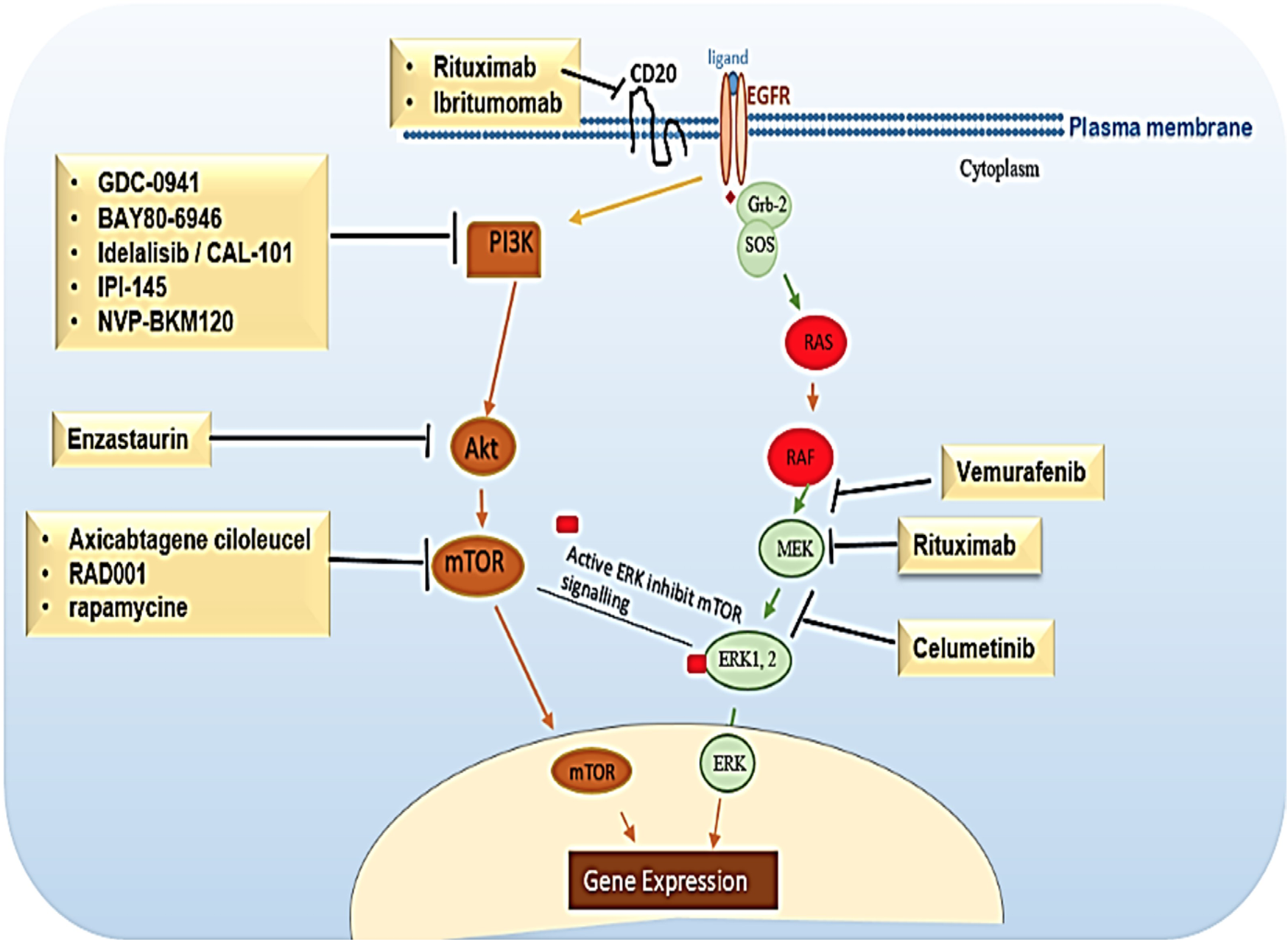
A, Sequence alignment by BLAST; B, 12 % Acrylamide: bisacrylamide electrophoresis photograph showing DNA fragment containing codon 13 after restriction. Sample lanes 1-7 and 9, wild type; lane 8, NHL (heterozygous mutant); and lane M is 50 bp DNA marker (Fermentas); C, Sequencing shwoing GGC (glycine) to GAC (aspartic acid).
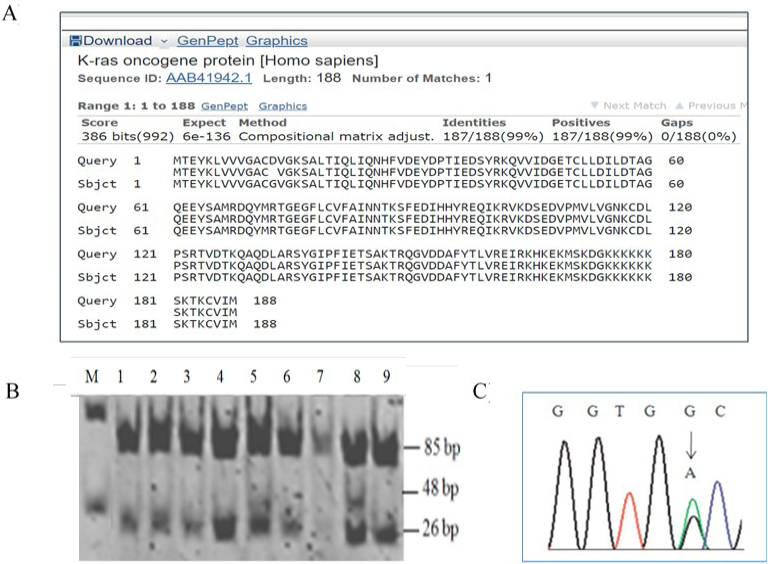
Context-dependent crosstalk between RAS-MAPK and PI3K mediated pathways. (Figure adapted).
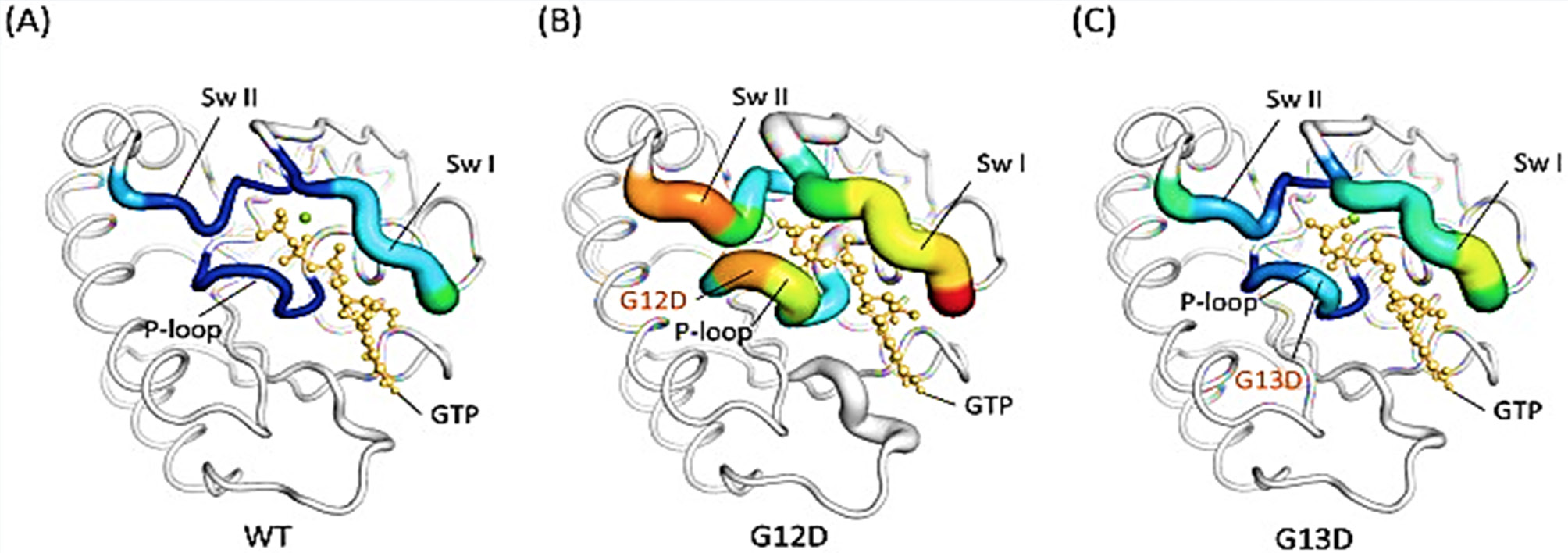
The structures of (A) WT, (B) G12D and, (C) G13D KRAS proteins are drawn in cartoon putty representations at the P-loop, switch I and II regions; blue represents the lowest and red the highest B-factor value. In addition, the size of the tube reflects the value of the B-factor, in that the larger the B-factor, the thicker the tube. The structures in the other regions are coloured in white and displayed in cartoon tube representation, where the size of the tube is independent of the B-factors (Figure adapted from Chen et al., 2013).
References
- Akagi, K., Uchibori, R., Yamaguchi, K., Kurosawa, K., Tanaka, Y. and Kozu, T., 2007. Characterization of a novel oncogenic K-ras mutation in colon cancer. Biochem. biophys. Res. Commun., 352: 728-732. https://doi.org/10.1016/j.bbrc.2006.11.091[CrossRef]
- Aksamitiene, E., Kiyatkin, A., Kholodenko, B.N., 2012. Cross-talk between mitogenic Ras/MAPK and survival PI3K/Akt pathways: A fine balance. Biochem. Soc. Trans., 40: 139-146. https://doi.org/10.1042/BST20110609[CrossRef]
- Alizadeh, A.A., Eisen, M.B., Davis, R.E., Ma, C., Lossos, I.S., Rosenwald, A., Boldrick, J.C., Sabet, H., Tran, T., Yu, X. and Powell, J.I., 2000. Distinct types of diffuse large B-cell lymphoma identified by gene expression profiling. Nature, 403: 503.
- Barbacid, M., 1990. Ras oncogenes: Their role in neoplasia. Eur. J. clin. Invest. 20: 225–235. https://doi.org/10.1111/j.1365-2362.1990.tb01848.x[CrossRef]
- Bassig, B.A., Lan, Q., Rothman, N., Zhang, Y. and Zheng, T., 2012. Current understanding of lifestyle and environmental factors and risk of Non-Hodgkin lymphoma: An epidemiological update. J. Cancer Epidemiol., 2012: 978930. https://dx.doi.org/10.1155/2012/978930[CrossRef]
- Bazan, V., Migliavacca, M., Zanna, I., Tubiolo, C., Grassi, N., Latteri, M.A., Farina, M., Albanese, L., Dardanoni, G., Salerno, S., Tomasino, R.M., Labianca, R., Gebbia, N. and Russo, A., 2002. Specific codon 13 K-ras mutations are predictive of clinical outcome in colorectal cancer patients, whereas codon 12 K-ras mutations are associated with mucinous histotype. Annls Oncol., 19: 1438-1446. https://doi.org/10.1093/annonc/mdf226[CrossRef]
- Bhurgri, Y., Pervez, S., Bhurgri, A., Faridi, N., Usman, A., Kazi, L.A.G., Ahmed, R., Kayani, N. and Hasan, S.H., 2005. Increasing incidence of Non-Hodgkin’s lymphoma in Karachi. Asian Pacific J. Cancer Preven. 6: 364-369.
- Cancer Registry and Clinical Data Management (CRCDM), 2011. Shaukat Khanum Memorial Cancer Hospital and Research Center (SKMCH & RC) Report based on cancer cases registered at SKMCH & RC from Dec. 1994-Dec. 2010 and in 2010. Released June, 2011.
- Chen, C.C., Er, T.K., Liu, Y.Y., Hwang, J.K., Barrio, M.J., Rodrigo, M., Garcia-Toro, E. and Herreros-Villanueva, M., 2013. Computational analysis of KRAS mutations: Implications for different effects on the KRAS p.G12D and p.G13D mutations. PLoS One, 8: e55793. https://doi.org/10.1371/journal.pone.0055793[CrossRef]
- Chao, M.P., 2013. Treatment challenges in the management of relapsed or refractory non-Hodgkin’s lymphoma–novel and emerging therapies. Cancer Manage. Res., 5: 251-269. https://doi.org/10.2147/CMAR.S34273[CrossRef]
- Cheson, B.D., 2014. CLL and NHL: the end of chemotherapy? Blood, 123: 3368-3370. https://doi.org/10.1182/blood-2014-04-563890[CrossRef]
- Coiffier, B., Thieblemont, C., Van Den Neste, E., Lepeu, G., Plantier, I., Castaigne, S., Lefort, S., Marit, G., Macro, M., Sebban, C. and Belhadj, K., 2010. Long-term outcome of patients in the LNH-98.5 trial, the first randomized study comparing rituximab-CHOP to standard CHOP chemotherapy in DLBCL patients: a study by the Groupe d’Etudes des Lymphomes de l’Adulte. Blood, 116: 2040-2045. https://doi.org/10.1182/blood-2010-03-276246[CrossRef]
- Dogan, S., Shen, R., Ang, D.C., Johnson, M.L., D’Angelo, S.P., Paik, P.K., Brzostowski, E.B., Riely, G.J., Kris, M.G., Zakowski, M.F. and Ladanyi, M., 2012. Molecular epidemiology of EGFR and KRAS mutations in 3,026 lung adenocarcinomas: higher susceptibility of women to smoking-related KRAS-mutant cancers. Clin. Cancer Res., 18: 6169-6177. https://doi.org/10.1158/1078-0432.CCR-11-3265[CrossRef]
- Edkins, S., O’Meara, S., Parker, A., Stevens, C., Reis, M., Jones, S., Greenman, C., Davies, H., Dalgliesh, G., Forbes, S. and Hunter, C., 2006. Recurrent KRAS codon 146 mutations in human colorectal cancer. Cancer Biol. Ther., 5: 928-932. https://doi.org/10.4161/cbt.5.8.3251[CrossRef]
- Ekstrom-Smedby, K., 2006. Epidemiology and etiology of non-Hodgkin lymphoma–a review. Acta Oncol., 45: 258–271. https://doi.org/10.1080/02841860500531682[CrossRef]
- Enomoto, T., Weghorst, C.M., Inoue, M., Tanizawa, O. and Rice, J.M., 1991. K-ras activation occurs frequently in mucinous adenocarcinomas and rarely in other common epithelial tumors of the human ovary. Am. J. Pathol., 139: 777-785.
- Fang, X., Zhou, X. and Wang, X., 2013. Clinical development of phosphatidylinositol 3-kinase inhibitors for non-Hodgkin lymphoma. Biomark. Res., 1: 30. https://doi.org/10.1186/2050-7771-1-30[CrossRef]
- FDA News Release: FDA approves CAR-T cell therapy to treat adults with certain types of large B-cell lymphoma. Yescarta is the second gene therapy product approved in the U.S. https://www.fda.gov/NewsEvents/Newsroom/PressAnnouncements/ucm581216.htm
- Gaidano, G., Pastore, C., Volpe, G., 1995. Molecular pathogenesis of non-Hodgkin lymphoma: A clinical perspective. Haematologica, 80: 454-472.
- Guex, N., Peitsch, M.C. and Schwede, T., 2009. Automated comparative protein structure modeling with SWISS-MODEL and Swiss-PdbViewer: A historical perspective. Electrophoresis, 30: 162-S173. https://doi.org/10.1002/elps.200900140[CrossRef]
- Guerrero, S., Casanova, I., Farre, L., Mazo, A., Capella, G. and Mangues, R., 2000. K-ras codon 12 mutation induces higher level of resistance to apoptosis and predisposition to anchorage-independent growth than codon 13 mutation or proto-oncogene overexpression. Cancer Res., 60: 6750–6756.
- Guo, J.L., Narasimhan, S., Changolkur, L., He, Z., Stieber, A., Zhang, B., Gathagan, R.J., Iba, M., McBride, J.D., Trojanowski, J.Q. and Lee, V.M., 2016. Unique pathological tau conformers from Alzheimer’s brains transmit tau pathology in non-transgenic mice. J. exp. Med., 213: 2635-2654. https://doi.org/10.1084/jem.20160833[CrossRef]
- Hatzaki, A., Razi, E., Anagnostopoulou, K., Iliadis, K., Kodaxis, A., Papaioannou, D., Labropoulos, S., Vasilaki, M., Kosmidis, P., Saetta, A. and Mihalatos, M., 2001. A modified mutagenic PCR-RFLP method for K-ras codon 12 and 13 mutations detection in NSCLC patients. Mol. Cell. Prob., 15: 243-247. https://doi.org/10.1006/mcpr.2001.0367[CrossRef]
- Helms, C., 1990. Salting out procedure for human DNA extraction. The Donis-Keller Lab - Lab Manual Homepage: (http://hdklab.wustl.edu/lab_manual/dna/dna2.html).
- Hongyo, T., Buzard, G.S., Palli, D., Weghorst, C.M., Amorosi, A., Galli, M., Caporaso, N.E., Fraumeni, J.F. and Rice, J.M., 1995. Mutations of the K-Ras and p53 genes in gastric adenocarcinomas from a high incidence region around Florence, Italy. Cancer Res., 55: 2665-2672.
- Jazirehi, A.R., Vega, M.I., Chatterjee, D., Goodglick, L. and Bonavida, B., 2004. Inhibition of the Raf–MEK1/2–ERK1/2 signaling pathway, Bcl-xL down-regulation and chemosensitization of non-Hodgkin’s lymphoma B cells by rituximab. Cancer Res., 64: 7117-7126. https://doi.org/10.1158/0008-5472.CAN-03-3500[CrossRef]
- Jinesh, G.G., Sambandam, V., Vijayaraghavan, S., Balaji, K. and Mukherjee, S., 2018. Molecular genetics and cellular events of K-Ras-driven tumorigenesis. Oncogene, 37: 839-846. https://doi.org/10.1038/onc.2017.377[CrossRef]
- Khan, A.Q., Kuttikrishnan, S., Siveen, K.S., Prabhu, K.S., Shanmugakonar, M., Al-Naemi, H., Haris, M., Dermime, S. and Uddin, S., 2018. RAS-mediated oncogenic signaling pathways in human malignancies. Sem. Cancer Biol., https://doi.org/10.1016/j.semcancer.2018.03.001[CrossRef]
- Kumar, S.S., Price, T.J., Mohyieldin, O., Borg, M., Townsend, A. and Hardingham, J.E., 2014. KRAS G13D Mutation and Sensitivity to Cetuximab or Panitumumab in a Colorectal Cancer Cell Line Model. Gastroint. Cancer Res., 7: 23–26.
- Kurland, J.F., Voehringer, D.W. and Meyn, R.E., 2003. The MEK/ERK pathway acts upstream of NFκB1 (p50) homodimer activity and Bcl-2 expression in a murine B-Cell lymphoma cell line MEK inhibition restores radiation-induced apoptosis. J. biol. Chem., 278: 32465-32470. https://doi.org/10.1074/jbc.M212919200[CrossRef]
- Lee, J.W., Yoo, N.J., Soung, Y.H., Kim, H.S., Park, W.S., Kim, S.Y., Lee, J.H., Park, J.Y., Cho, Y.G., Kim, C.J. and Ko, Y.H., 2003. BRAF mutations in non-Hodgkin’s lymphoma. Br. J. Cancer, 89: 1958-19860. https://doi.org/10.1038/sj.bjc.6601371[CrossRef]
- Lu, J., Hunter, J., Manandhar, A., Gurbani, D. and Westover, K.D., 2015. Structural dataset for the fast-exchanging KRAS G13D. Data Brief, 5: 572-578. https://doi.org/10.1016/j.dib.2015.10.001[CrossRef]
- Ma, L. and Chen, Z., Erdjument-Bromage, H., Tempst, P., Pandolfi, P.P., 2005. Phosphorylation and functional inactivation of TSC2 by Erk: Implications for tuberous sclerosisand cancer pathogenesis. Cell, 121: 179-193. https://doi.org/10.1016/j.cell.2005.02.031[CrossRef]
- Messner, I., Cadeddu, G., Huckenbeck, W., Knowles, H.J., Gabbert, H.E., Baldus, S.E. and Schaefer, K.L., 2012. KRAS p.G13D mutations are associated with sensitivity to anti-EGFR antibody treatment in colorectal cancer cell lines. J. Cancer Res. clin. Oncol., 139: 201-209. https://doi.org/10.1007/s00432-012-1319-7[CrossRef]
- Miyakura,Y., Sugano, K., Fukayama, N., Konishi, F. and Nagai, H., 2002. Concurrent mutations of K-ras oncogene at codons 12 and 22 in colon cancer. Jap. J. clin. Oncol., 32: 219-221. https://doi.org/10.1093/jjco/hyf043[CrossRef]
- Moerkerk, P., Arends, J.W., van-Driel, M., de-Bruine, A., de-Goeij, A. and Kate, J., 1994. Type and number of Ki-ras point mutations relate to stage of human colorectal cancer. Cancer Res., 13: 3376-3378.
- Morin, R.D., Mendez-Lago, M., Mungall, A.J., Goya, R., Mungall, K.L., Corbett, R.D., Johnson, N.A., Severson, T.M., Chiu, R., Field, M., Jackman, S., Krzywinski, M., Scott, D.W., Trinh, D.L., Tamura-Wells, J., LI, S., Firme, M.R., Rogic, S., Griffith, M., Chan, S., Yakovenko, O., Meyer, I.M., Zhao, E.Y., Smailus. D., Moksa, M., Chittaranjan. S., Rimsza, L., Brooks-Wilson, A., Spinelli, J.J., Ben-Neriah, S., Meissner, B., Woolcock, B., Boyle, M., McDonald, H., Tam, A., Zhao, Y., Delaney, A., Zeng, T., Tse, K., Butterfield, Y., Birol, I., Holt, R., Schein, J., Horseman, D.E., Moore, R., Jones, S.J., Connors, J.M., Hirst, M., Gascoyne, R.D. and Marra, Mi.A., 2011. Frequent mutation of histone-modifying genes in non-Hodgkin lymphoma. Nature, 476: 298-303.fied by gene expression profiling. Nature, 403: 503. https://doi.org/10.1038/nature10351[CrossRef]
- Murtaza, B.N., Bibi, A., Nadeem, M.S., Chaudri, M.S. and Shakoori, A.R., 2012. Identification of novel mutation in codon 31 of Kirstein rat sarcoma viral oncogene homologue in colon cancer: Another evidence of non-canonical mutational pathway. Pakistan J. Zool., 44: 1671-1676.
- Murtaza, B.N., Bibi, A., Rashid, M.U., Khan, Y.I., Chaudri, M.S. and Shakoori, A.R., 2014. Specrtrum of K ras mutations in Pakistani colorectal cancer patients. Brazil. J. med. biol. Res., 47: 35-41. https://doi.org/10.1590/1414-431X20133046[CrossRef]
- Naguib, A., Wilson, C.H., Adams, D.J. and Arends, M.J., 2011. Activation of K-RAS by co-mutation of codons 19 and 20 is transforming. J. mol. Signal., 3: 2-6. https://doi.org/10.1186/1750-2187-6-2[CrossRef]
- Ng, P.C., Henikoff S, 2003. SIFT: Predicting amino acid changes that affect protein function. Nucl. Acids Res., 31: 3812-3814. https://doi.org/10.1093/nar/gkg509[CrossRef]
- Neumann, J., Zeindl-Eberhart, E., Kirchner, T. and Jung, A., 2009. Frequency and type of KRAS mutations in routine diagnostic analysis of metastatic colorectal cancer. Pathol. Res. Pract., 205: 858-862. https://doi.org/10.1016/j.prp.2009.07.010[CrossRef]
- Perry, A.M, Diebold, J., Nathwani, B.N., MacLennan, K.A., Muller-Hermelink, H.K., Bast, M., Boilesen, E., Armitage, J.O. and Weisenburger, D.D., 2016. Non-Hodgkin lymphoma in the developing world: Review of 4539 cases from the International Non-Hodgkin Lymphoma Classification Project. Haematologica, 101:1244–1250. https://doi.org/10.3324/haematol.2016.148809[CrossRef]
- Pervez, S., 2012. Non-Hodgkin Lymphoma (NHL) in Pakistan. Int. J. mo1. cell. Med. 1:62-63.
- Prall, F. and Ostwald, C., 2007. High-degree tumor budding and podia-formation in sporadic colorectal carcinomas with K-ras gene mutations. Human Pathol., 38: 1696-1702. https://www.sciencedirect.com/science/article/abs/pii/S0046817707001906
- Qiao, Z., Zhe, Y., Zhuqing, J., Cuiling, L., Chen, G., Huafei, L., Chen, P., Ma, K., Wang, W. and Zhou, C., 2014. ISL-1 is overexpressed in non-Hodgkin lymphoma and promotes lymphoma cell proliferation by forming a p-STAT3/p-c-Jun/ISL-1 complex. Mol. Cancer, 13: 181. https://doi.org/10.1186/1476-4598-13-181. https://doi.org/10.1186/1476-4598-13-181[CrossRef]
- Rodig, S.J., Shahsafaei, A., Li, B., Mackay, C.R. and Dorfman, D.M., 2005. BAFF-R, the major B cell–activating factor receptor, is expressed on most mature B cells and B-cell lymphoproliferative disorders. Human Pathol., 36:1113-1119. https://doi.org/10.1016/j.humpath.2005.08.005[CrossRef]
- Sills, R.C., Hong, H..L,, Melnick, R.L., Boorman, G.A. and Devereux, T.R., 1999. High frequency of codon 61 K-ras A→ T transversions in lung and Harderian gland neoplasms of B6C3F1 mice exposed to chloroprene (2-chloro-1, 3-butadiene) for 2 years, and comparisons with the structurally related chemicals isoprene and 1, 3-butadiene. Carcinogenesis, 20: 657-662. https://doi.org/10.1093/carcin/20.4.657[CrossRef]
- Singer, G., Oldt, R., Cohen, Y., Wang, B.G., Sidransky, D., Kurman, R.J. and Shih, I.M., 2003. Mutations in BRAF and KRAS characterize the development of low-grade ovarian serous carcinoma. J. natl. Cancer Inst. 95: 484-486. https://doi.org/10.1093/jnci/95.6.484[CrossRef]
- Stang, S.L., Lopez-Campistrous, A., Song, X., Dower, N.A., Blumberg, P.M., Wender, P.A. and Stone, J.C., 2009. A proapoptotic signaling pathway involving RasGRP, Erk, and Bim in B cells. Exp. Hematol., 37: 122-134. https://doi.org/10.1016/j.exphem.2008.09.008[CrossRef]
- Takakuwa, T., Hongyo, T., Syaifudin, M., Kanno, H., Matsuzuka, F., Narabayashi, I., Nomura, T. and Aozasa, K., 2000. Microsatellite instability and k-ras, p53 mutations in thyroid lymphoma. Jpn. J. Cancer Res., 91: 280–286. https://doi.org/10.1111/j.1349-7006.2000.tb00942.x[CrossRef]
- Teneriello, M.G., Ebina, M., Linnoila, R.I., Henry, M., Nash, J.D., Park, R.C. and Birrer, M.J,, 1993. p53 and Ki-ras gene mutations in epithelial ovarian neoplasms. Cancer Res., 53: 3103-3108.Prall, F. and Ostwald, C., 2007. High-degree tumor budding and podia-formation in sporadic colorectal carcinomas with K Ras gene mutations. Hum. Pathol., 38: 1696–1702. https://doi.org/10.1016/j.humpath.2007.04.002[CrossRef]
- Wang, H.Y., Cheng, Z. and Malbon, C.C., 2003. Overexpression of mitogen-activated protein kinase phosphatases MKP1, MKP2 in human breast cancer. Cancer Lett., 191: 229-237. https://doi.org/10.1016/S0304-3835(02)00612-2[CrossRef]
- Watzinger, F, and Lion, T., 1999. RAS family. Atlas Genet. Cytogenet. Oncol. Haematol. http://www.infobiogen.fr/services/chromcancer/Deep/Ras.html.
Services
Article usage statistics
Loading…