
The purpose of this study is to describe the clinical and genetic characteristics of a Chinese patient with hyperekplexia. We described the clinical feature of a 31-year-old male patient with hyperekplexia. Gene mutation was screened by whole exome sequencing. Furthermore, the plasmid containing wild type or mutant was transiently transfected into HEK293T cells. Realtime PCR and Western blotting were performed to evaluate the expression of GLRB. The distribution of GLRB was observed by immunofluorescence. One novel p.M99K mutation in the extracellular ligand binding domain of glycine receptor beta subunit was identified in our patient. Through the comparison of different species, it was found that the mutation site and its nearby sequences were highly conserved. Pathogenicity prediction (Polyphen 2 and Mutation Taster) indicated this mutation may be pathogenic. The expression and distribution of GLRB were not significant between the mutant and wild types. Our results suggest that the novel GLRB mutation may cause hyperekplexia. In addition, we also tried to explore the possible pathogenic mechanism of this mutation. It is essential to conduct more genetic and functional research to improve the understanding of this disease.
Research Article · 22 March 2025 · Open Access
A Novel Missense Mutation in the GLRB Gene Causes Hyperekplexia
· · · ·
Affiliations & Notes ⌄
- 1Health Management Center, Renji Hospital, School of Medical, Shanghai Jiaotong University, Shanghai 200127, China 2Department of Cardiology, Renji Hospital, School of Medicine, Shanghai Jiaotong University, Shanghai 201100, China 3Cerebrovascular Disease Center, Renji Hospital, School of Medicine, Shanghai Jiaotong University, Shanghai 201100, China 4Department of Clinical Laboratory, Shanghai East Hospital, Tongji University School of Medicine, Shanghai 200120, China Jia-lue Hua and Peng-fei Wa
Article Info ⌄
- Journal:
- Pakistan Journal of Zoology
- Published:
- 22 March 2025

From the article
- We found a homozygous recessive GLRB mutation (c.T296A/p.M99K) in our patient.
- And this novel mutation did not alter GLRB expression and distribution in HEK293T cells.
- To date, it is unclear how the mutation detected in our patient altered the function of glycine receptors to cause hyperekplexia.
- The exact mechanism of GLRB mutation needs to be explored in the future.
Selected from the article's own text.
Abstract
Introduction
Hyperekplexia is a rare disease. Hyperekplexia is characterized by increased muscle tone (hypertonia) and an exaggerated reaction to abrupt unexpected stimuli . It affects newborn children and gradually fades during the first year of life. Nonetheless, older patients with hyperekplexia may still startle easily and exhibit stiffiness, which may lead to falls ; .
Hyperekplexia results from the dysfunction of the glycinergic neurotransmission system, which is involved in inhibitory neurotransmission. Five genes have been identified as causing the disease . Mutations of GLRA1 gene, which encodes the glycine receptor alpha-1 subunit, are the most common . However, the glycine transporter-2 (SLC6A5), gephyrin (GPHN), and collybistin, a RhoGEF for the receptor clustering protein, have yet to be identified as contributing to disease ; ; .
The detection of these genes is crucial in making a diagnosis for this disease. We here report a case of hyperekplexia resulting from a novel missense GLRB mutation that results in the substitution of methionine at position 99 with lysine (M99K).
Materials and Methods
The patient was a 31 years old male from Shanghai. He suffered from recurrent falls for 20 years ago, which could be induced by sudden sound and other stimuli. He could not maintain his balance and was easy to fall, resulting in multiple abrasions and sprains. He walked with a wide-based gait for fear of falling. He was conscious at the time of the attacks, and his symptoms disappeared during sleep. He is the only child in his family. His parents were not close relatives, and none of them had similar symptoms. He was born of spontaneous vaginal delivery with a normal birth process and weight (3.2 kg). His intellectual development was normal, but his physical performances were relatively poor during school days.
The physical examination showed the patient had mild hypertension. He presented with a wide-based gait. Tapping his nose tip could induce facial muscle contraction with head back and body stiffness. The tendon reflex of limbs was active. No obvious abnormalities were found in other neurological examinations. The serum creatine kinase level was 412 IU/L (normal range 55-170 IU/L). MRI of the brain with contrast-enhancement revealed an arachnoid cyst in the left temporal area. Ambulatory electroencephalography (AEEG), electromyography (EMG) and other laboratory tests were all normal. Considering the possibility of hyperekplexia, the stiffness and startle symptoms of patients were significantly relieved after treatment with clonazepam.
Mutation analysis
We collected peripheral blood samples from the proband and his parents. We used the Qiagen kit (QIAGEN, Hilden, Germany) to extract DNA from 3mL blood samples and conduct sample quality inspections. We then used next generation sequencing (NGS) to capture and sequence the exons of 3204 genes related to genetic diseases. The variant was analyzed and classified according to ACMG (the American College of Medical Genetics and Genomics) guidelines . Moreover, we investigated allele frequency (1000 g, dbSNP, and ExAC) and pathogenicity prediction [Polyphen2 and Mutation Taster (http://www.mutationtaster.org)]. Sanger sequencing was used to confirm the results of second-generation sequencing.
Culture and transfection of cells
In a humidified incubator with 95% air and 5% CO2, HEK293T cells (ATCC) were maintained in Dulbecco’s modified Eagle medium (DMEM) with 10% FBS and 100 U/mL penicillin/streptomycin. Lipofectamine 3000 (Invitrogen) was used for transfection.
Plasmid construction
The GLRB wild type and mutant plasmids were obtained from Genechem Company (Shanghai, China). To create site-specific mutants within the CV061 vector, PCR-based site-directed mutagenesis was used. Synthesized and annealed sequences are as follows:
Sense: 5’-ACGGGCCCTCTAGACTCGAGCGCCACCATGAAGTTTTTATTG-3’,
Antisense: 5’-AGTCACTTAAGCTTGGTACCGATAAATATATAGACCAATATATAAC-3’
Real-time PCR
RNA was extracted from cells with TRIZOL reagent (Invitrogen). PrimeScript 1st Strand cDNA Synthesis Kit (Takara) was used to synthesize the cDNA. SYBR Green Real-time PCR Master Mix (TOYOBO) was used to measure the GLRB level. GLRB mRNA amplification primers were 5′-AGTGCCCCTGGGTATCTTCT-3′ and 5′-CTTTTGGGGTTGTTCAGCAT-3′. GLRB mRNA level was compared to glyceraldehyde 3-phosphate dehydrogenase (GAPDH).
Western blotting
GLRB protein expression was determined by Western blotting by using GLRB antibody (1: 1000 dilution, Santa Cruz, sc-365819). GLRB expression was normalized to that of GAPDH (1: 1000 dilution, Cell Signaling Technology, #5174).
Immunofluorescence
After seeding on poly-L-lysine-coated coverslips, HEK293T cells were processed for immunofluorescence. Cells were fixed, eluted with GLRB antibody overnight, and incubated with goat anti mouse fluorescent antibody (P-phycoerythrin, PE) for 30 min. Images were photographed under a fluorescence microscope (Leica).
Swiss-model and UniProt
SWISS-MODEL (https://swissmodel.expasy.org) was an automated server for the modeling of homo- and hetero- protein complexes. UniProt (https://www.uniprot.org) is a free resource for elucidating the amino acid sequence and function of various protein.
Results
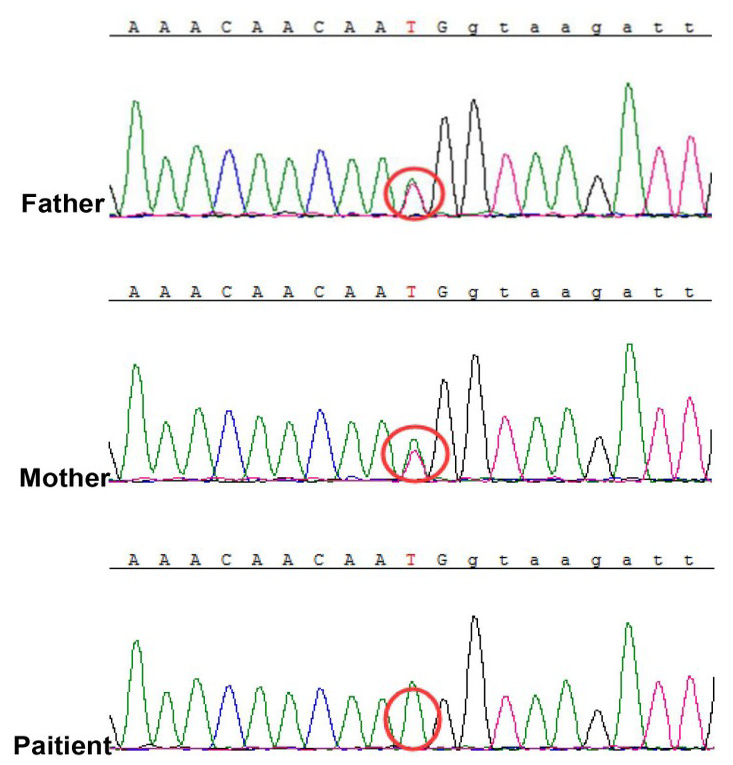
One homozygous variant of the GLRB gene, c.T296A (p.M99K), was found in this patient. His parents were both heterozygous carriers of the same variant (Fig. 1). Neither dbSNP (http://www.ncbi.nlm.nih/gov/snp) nor 100 genome project (http://browser.100genomes.org) or Exome Aggregation Consortium (ExAC) contained this variant. By MutationTaster, c.T296A was predicted to cause disease (0.99 probability, range: 0-1.0). With a score of 0.9667, Polyphen-2 also predicted that the mutation is probably damaging (sensitivity: 0.77; specificity: 0.95).
Mutant GLRB’s mRNA level was not affected by real-time PCR (Fig. 2A). There was no difference in WT and mutant GLRB protein expression (Fig. 2B). Furthermore, immunofluorescence indicated that the distribution of mutant protein did not differ significantly from the control (Fig. 2C). Mutation taster showed strong conservation of amino acid sequence near the mutation site between different species (Fig. 3A). We further used SWISS-MODEL software and UniProt to show the mutation site (Fig. 3B).
Discussion
Hyperekplexia is a relatively rare hereditary nervous system disease, which is related to the dysfunction of the glycinergic neurotransmission system . As a result of the lack of understanding of this disease, it is often misdiagnosed as epilepsy or other disorders. So far, a total of 12 patients have been reported in China ; ; ; ; ; ; ; . A typical clinical manifestation of hyperekplexia is an excessive startle response after birth. Its inducing factors are often sudden unexpected sound, visual or tactile stimuli, and sometimes even when touching daily operations such as feeding or changing diapers . Patients can also have the following abnormal manifestations, such as limb movement during sleep and myoclonus before falling asleep, umbilical hernia or esophageal hiatal hernia, epilepsy, intellectual or motor developmental delay, congenital hip dislocation, and spastic paraplegia . Some patients can be complicated with anxiety and depression . The diagnosis of hyperekplexia is mainly based on clinical manifestations. Detailed history and physical examination are helpful, especially the patient’s neonatal and childhood history. The nose-tapping test can be used as a characteristic diagnostic examination . In patients with hyperekplexia, laboratory tests, MRI and EEG are often normal. The diagnosis should exclude the possibility of other diseases. Previous studies suggested that gene mutation detection rates for hyperekplexia were approximately 60% . Thus, it is necessary to perform genetic analysis for the precise diagnosis. Clonazepam is usually used in treatment, which can compensate for the defects of the GABAergic pathway in the brain stem and enhance the protective response of patients during startle reflex . The prognosis of this disease is generally favorable.
At present, at least five genes have been identified to be related to hyperekplexia. GLRA1 is the most frequent mutation gene, encoding glycine transporter subunit α1. GLRB is also a major gene of effect , which encodes glycine transporter subunit β. GLRA1 binds to GLRB to form postsynaptic hetero pentameric glycine (GlyR) receptor with 2α1:3β subunit . The presynaptic glycine transporter-2 (SLC6A5) as well as two of the GlyR synaptic clustering proteins (GPHN and ARHGEF9) have also been identified as having mutations. To date, more than 20 GLRB mutations have been identified as hyperekplexia (Fig. 4) ; . Genes encoding GLRB are mutated in many ways, including in-frame deletions, two-hit duplications, large repeats-mediated deletions, and splice site mutations that result in exon skipping and missense mutations . Inheritance of hyperekplexia can be autosomal dominant or autosomal recessive . GLRB mediated hyperekplexia is mainly in the mode of homozygous recessive or a compound heterozygote inheritance .
GLRB encodes the glycine receptor β subunit which contains an extracellular domain (ECD), a transmembrane domain (TMD) with four α-helices (TM1-TM4), and a cytoplasmic domain as well as glycine receptor α1 subunit. Interestingly, most GLRB mutations are located on the ECD of the protein, not like GLRA1 mutations which were mostly located on the TMDs . UniProt showed position 99 of GLRB was also at the extracellular region (https://www.uniprot.org). Recent functional studies indicated some GLRB mutations either reduced the expression of the glycine receptor on the cell surface or reduced the sensitivity to glycine . However, our results showed GLRB expression and distribution were not affected obviously. A previous study showed a common mutation M177R that was also located on the ECD did not affect GLRB expression, which was consistent with our results . We further used the prediction tool to find the potential pathogenicity of the mutation. Interestingly, the mutation site was highly conserved across species (Fig. 3A), suggesting this mutation may have an important effect. Furthermore, bioinformatics software was performed to illustrate this mutation may be harmful. Since GLRB expression and distribution were unchanged, we hypothesized this mutation may disturb the glycine sensitivity.
Conclusions
In our case, the patient had symptoms of exaggerated startle responses and slightly delayed motor development. Our case suggests that for unexplained abnormal gait and frequent falls in adults, it is also necessary to evaluate the possibility of potential undiagnosed hyperekplexia. We found a homozygous recessive GLRB mutation (c.T296A/p.M99K) in our patient. And this novel mutation did not alter GLRB expression and distribution in HEK293T cells. However, bioinformatics revealed this mutation to be probably deleterious. To date, it is unclear how the mutation detected in our patient altered the function of glycine receptors to cause hyperekplexia. The exact mechanism of GLRB mutation needs to be explored in the future.
Declarations
Acknowledgement
We are very grateful to the patient and his parents for cooperating with this study.
Funding
The research was supported by the National Natural Science Foundation of China (Grant no. 81801616, 81971535) and Renji Hospital National Natural Science Foundation Youth Cultivation Advancement Project (RJTJ24-QN-060).
Ethical approval
This study was approved by the Ethics Committee of Renji Hospital, Shanghai Jiao Tong University School of Medicine. Consent was obtained from all participants. The patient and both of his parents were examined in the study.
Statement of conflicts of interest
The authors have declared no conflict of interest.
Figures
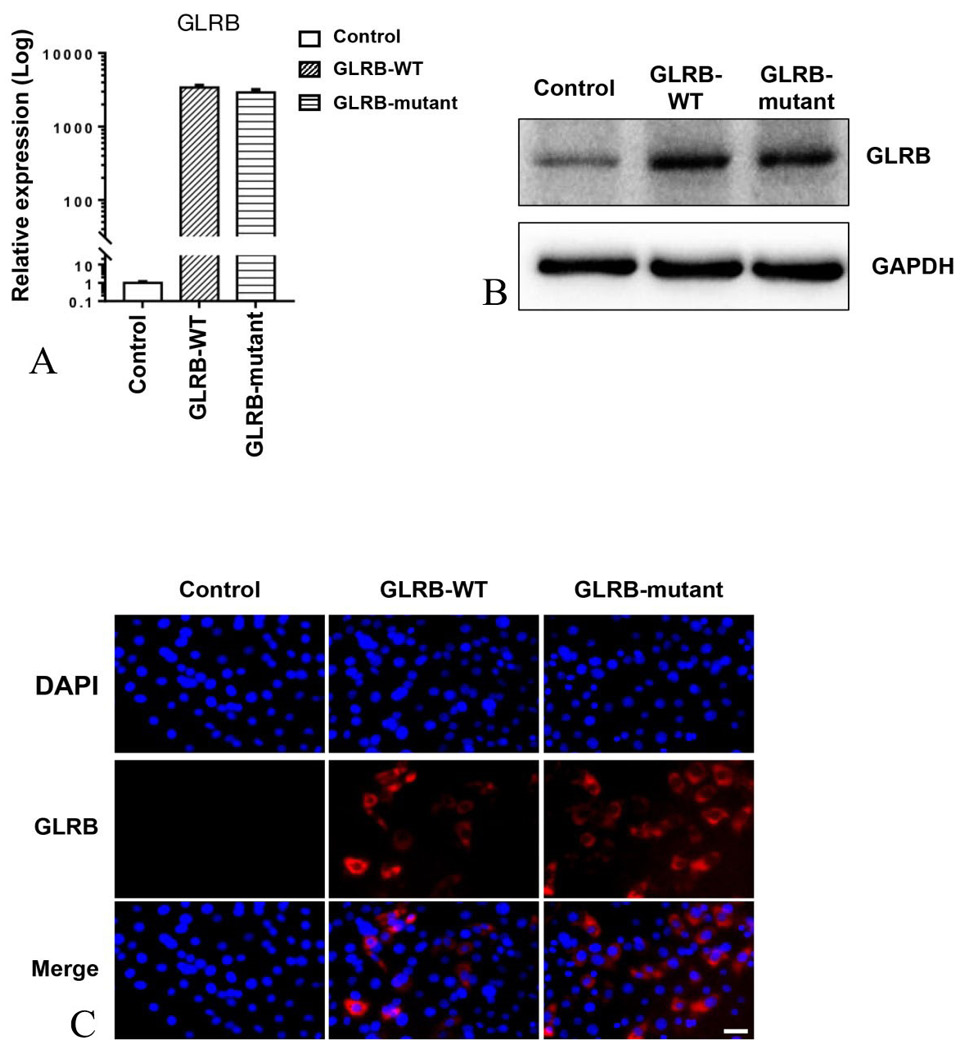
The mutant GLRB does not affect the expression and distribution of GLRB. The expression of wild type and mutant GLRB were examined by (a) Real-time PCR (b) Western blotting (c) Immunofluorescence analysis. Scale bar = 50μm.
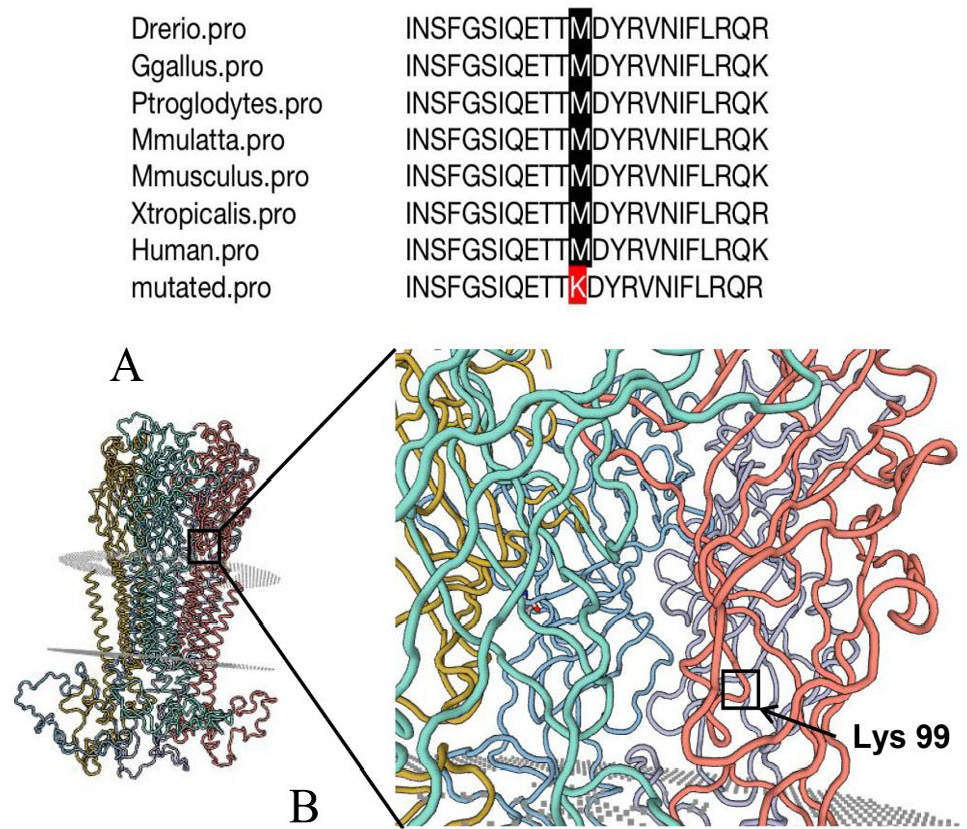
Modeling of the novel GLRB mutant. A. Sequence alignment of the conserved GLRB sequence among different species. The mutation site is labeled in red. B. The p.M99K mutation and surrounding region are shown on the hypothetical 3-D structure of the GLRB (Swiss-model).
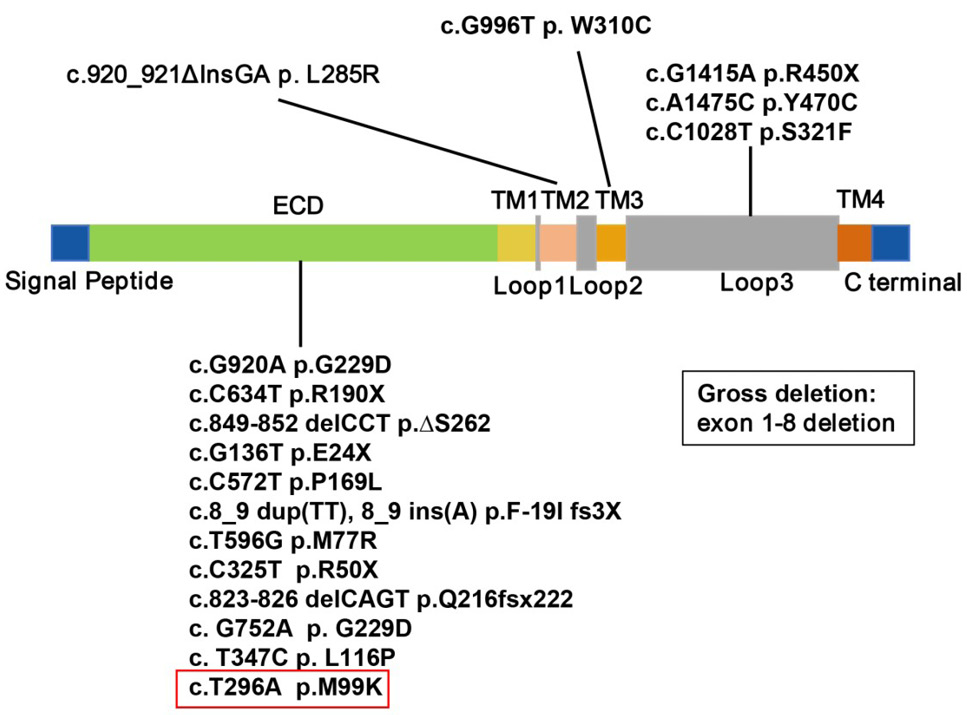
Summary of GLRB mutations. Diagram of all GLRB mutations (NM_000824). Mutations in black: recessive or compound heterozygous mutations. The mutation detected in this paper is marked in red. ECD, extracellular domain, TM, transmembrane domain.
References
- Alfadhel, M., Nashabat, M., Qahtani, H.A., Alfares, A., Mutairi, F.A., Shaalan, H.A., Douglas, G.V., Wierenga, K., Juusola, J., Alrifai, M.T., Arold, S.T., Alkuraya, F. and Ali, Q.A., 2016. Mutation in SLC6A9 encoding a glycine transporter causes a novel form of non-ketotic hyperglycinemia in humans. Hum. Genet., 135: 1263-1268. https://doi.org/10.1007/s00439-016-1719-x[CrossRef]
- Bakker, M.J., van Dijk, J.G., van den Maagdenberg, A.M. and Tijssen, M.A., 2006. Startle syndromes. Lancet Neurol., 5: 513-524. https://doi.org/10.1016/S1474-4422(06)70470-7[CrossRef]
- Chan, K.K., Cherk, S.W., Lee, H.H., Poon, W.T. and Chan, A.Y., 2014. Hyperekplexia: A Chinese adolescent with 2 novel mutations of the GLRA1 gene. J. Child Neurol., 29: 111-113. https://doi.org/10.1177/0883073812465338[CrossRef]
- Chung, S.K., Bode, A., Cushion, T.D., Thomas, R.H., Hunt, C., Wood, S.E., Pickrell, W.O., Drew, C.J., Yamashita, S., Shiang, R., Leiz, S., Longardt, A.C., Raile, V., Weschke, B., Puri, R.D., Verma, I.C., Harvey, R.J., Ratnasinghe, D.D., Parker, M., Rittey, C., Masri, A., Lingappa, L., Howell, O.W., Vanbellinghen, J.F., Mullins, J.G., Lynch, J.W. and Rees, M.I., 2013. GLRB is the third major gene of effect in hyperekplexia. Hum. Mol. Genet., 22: 927-940. https://doi.org/10.1093/hmg/dds498[CrossRef]
- Dafsari, H.S., Kawalia, A., Sprute, R., Karakaya, M., Malenica, A., Herkenrath, P., Nürnberg, P., Motameny, S., Thiele, H. and Cirak, S., 2019. Novel mutations in SLC6A5 with benign course in hyperekplexia. Cold Spring Harb. Mol. Case Stud., 5. https://doi.org/10.1101/mcs.a004465[CrossRef]
- Davies, J.S., Chung, S.K., Thomas, R.H., Robinson, A., Hammond, C.L., Mullins, J.G., Carta, E., Pearce, B.R., Harvey, K., Harvey, R.J. and Rees, M.I., 2010. The glycinergic system in human startle disease: a genetic screening approach. Front. Mol. Neurosci., 3: 8. https://doi.org/10.3389/fnmol.2010.00008[CrossRef]
- Harvey, K., Duguid, I.C., Alldred, M.J., Beatty, S.E., Ward, H., Keep, N.H., Lingenfelter, S.E., Pearce, B.R., Lundgren, J., Owen, M.J., Smart, T.G., Lüscher, B., Rees, M.I. and Harvey, R.J., 2004. The GDP-GTP exchange factor collybistin: An essential determinant of neuronal gephyrin clustering. J. Neurosci., 24: 5816-5826. https://doi.org/10.1523/JNEUROSCI.1184-04.2004[CrossRef]
- Harvey, R.J., Topf, M., Harvey, K. and Rees, M.I., 2008. The genetics of hyperekplexia: More than startle! Trends Genet., 24: 439-447. https://doi.org/10.1016/j.tig.2008.06.005[CrossRef]
- Huang, Z., Lian, Y., Xu, H. and Zhang, H., 2018. Weird Laughing in Hyperekplexia: A new phenotype associated with a novel mutation in the GLRA1 gene? Seizure, 58: 6-8. https://doi.org/10.1016/j.seizure.2018.03.017[CrossRef]
- James, V.M., Bode, A., Chung, S.K., Gill, J.L., Nielsen, M., Cowan, F.M., Vujic, M., Thomas, R.H., Rees, M.I., Harvey, K., Keramidas, A., Topf, M., Ginjaar, I., Lynch, J.W. and Harvey, R.J., 2013. Novel missense mutations in the glycine receptor β subunit gene (GLRB) in startle disease. Neurobiol. Dis., 52: 137-149. https://doi.org/10.1016/j.nbd.2012.12.001[CrossRef]
- Koning-Tijssen, M.A. and Brouwer, O.F., 2000. Hyperekplexia in the first year of life. Mov. Disord, 15: 1293-1296. https://doi.org/10.1002/1531-8257(200011)15:6<1293::AID-MDS1047>3.0.CO;2-K[CrossRef]
- Li, H., Yang, Z.X., Xue, J., Qian, P. and Liu, X.Y., 2017. Clinical and genetic analysis of hyperekplexia in a Chinese child and literature review. Zhonghua Er Ke Za Zhi, 55: 120-124.
- Mine, J., Taketani, T., Yoshida, K., Yokochi, F., Kobayashi, J., Maruyama, K., Nanishi, E., Ono, M., Yokoyama, A., Arai, H., Tamaura, S., Suzuki, Y., Otsubo, S., Hayashi, T., Kimura, M., Kishi, K. and Yamaguchi, S., 2015. Clinical and genetic investigation of 17 Japanese patients with hyperekplexia. Dev. Med. Child Neurol., 57: 372-377. https://doi.org/10.1111/dmcn.12617[CrossRef]
- Poon, W.T., Au, K.M., Chan, Y.W., Chan, K.Y., Chow, C.B., Tong, S.F. and Lam, C.W., 2006. Novel missense mutation (Y279S) in the GLRB1 gene causing hyperekplexia. Clin. Chim. Acta, 364: 361-362. https://doi.org/10.1016/j.cca.2005.09.018[CrossRef]
- Praveen, V., Patole, S.K. and Whitehall, J.S., 2001. Hyperekplexia in neonates. Postgrad. med. J., 77: 570-572. https://doi.org/10.1136/pmj.77.911.570[CrossRef]
- Rees, M.I., Harvey, K., Pearce, B.R., Chung, S.K., Duguid, I.C., Thomas, P., Beatty, S., Graham, G.E., Armstrong, L., Shiang, R., Abbott, K.J., Zuberi, S.M., Stephenson, J.B., Owen, M.J., Tijssen, M.A., van den Maagdenberg, A.M., Smart, T.G., Supplisson, S. and Harvey, R.J., 2006. Mutations in the gene encoding GlyT2 (SLC6A5) define a presynaptic component of human startle disease. Nat. Genet., 38: 801-806. https://doi.org/10.1038/ng1814[CrossRef]
- Richards, S., Aziz, N., Bale, S., Bick, D., Das, S., Gastier-Foster, J., Grody, W.W., Hegde, M., Lyon, E., Spector, E., Voelkerding, K. and Rehm, H.L., 2015. Standards and guidelines for the interpretation of sequence variants: A joint consensus recommendation of the American College of Medical Genetics and Genomics and the Association for Molecular Pathology. Genet. Med., 17: 405-424. https://doi.org/10.1038/gim.2015.30[CrossRef]
- Russo, S.P., Fossati, B., Toffetti, M., Lanzone, J., Cardani, R. and Meola, G., 2017. Clinical Reasoning: A 35-year-old woman with hyperstartling, stiffness, and accidental falls: A startling diagnosis. Neurology, 88: e38-e41. https://doi.org/10.1212/WNL.0000000000003567[CrossRef]
- Shahar, E., Brand, N., Uziel, Y. and Barak, Y., 1991. Nose tapping test inducing a generalized flexor spasm: A hallmark of hyperexplexia. Acta Paediatr. Scand., 80: 1073-1077. https://doi.org/10.1111/j.1651-2227.1991.tb11785.x[CrossRef]
- Tijssen, M.A., Voorkamp, L.M., Padberg, G.W. and van Dijk, J.G., 1997. Startle responses in hereditary hyperekplexia. Arch. Neurol., 54: 388-393. https://doi.org/10.1001/archneur.1997.00550160034012[CrossRef]
- Tsai, C.H., Chang, F.C., Su, Y.C., Tsai, F.J., Lu, M.K., Lee, C.C., Kuo, C.C., Yang, Y.W. and Lu, C.S., 2004. Two novel mutations of the glycine receptor gene in a Taiwanese hyperekplexia family. Neurology, 63: 893-896. https://doi.org/10.1212/01.WNL.0000138566.65519.67[CrossRef]
- Yang, Z., Sun, G., Yao, F., Tao, D. and Zhu, B., 2017. A novel compound mutation in GLRA1 cause hyperekplexia in a Chinese boy- a case report and review of the literature. BMC Med. Genet., 18: 110. https://doi.org/10.1186/s12881-017-0476-6[CrossRef]
- Yang, Z., Taran, E., Webb, T.I. and Lynch, J.W., 2012. Stoichiometry and subunit arrangement of α1β glycine receptors as determined by atomic force microscopy. Biochemistry, 51: 5229-5231. https://doi.org/10.1021/bi300063m[CrossRef]
- Zhan, F., Zhang, C., Wang, S., Zhu, Z., Chen, G., Zhao, M. and Cao, L., 2020. Excessive startle with novel GLRA1 mutations in 4 Chinese patients and a literature review of GLRA1-related hyperekplexia. J. clin. Neurol., 16: 230-236. https://doi.org/10.3988/jcn.2020.16.2.230[CrossRef]
- Zhan, F.X., Wang, S.G. and Cao, L., 2021. Advances in hyperekplexia and other startle syndromes. Neurol. Sci., 42: 4095-4107. https://doi.org/10.1007/s10072-021-05493-8[CrossRef]
- Zhang, Y., Wu, L.L., Zheng, X.L. and Lin, C.M., 2020. C.292G>A, a novel glycine receptor alpha 1 subunit gene (GLRA1) mutation found in a Chinese patient with hyperekplexia: A case report. Medicine (Baltimore), 99: e19968. https://doi.org/10.1097/MD.0000000000019968[CrossRef]
- Zhou, L., Chillag, K.L. and Nigro, M.A., 2002. Hyperekplexia: A treatable neurogenetic disease. Brain Dev., 24: 669-674. https://doi.org/10.1016/S0387-7604(02)00095-5[CrossRef]
Services
Article usage statistics
Loading…