
Recently, BoHV-1 is detected with a 69% seroprevalence in the cattle sampled from Lahore and Rawalpindi districts of the Punjab Province of Pakistan. The objectives of the present study included evaluating the seroprevalence of BoHV-1 in goats accompanied by cattle in the areas where seropositive cattle have been previously identified. A total of 126 blood samples were collected from goats located in areas of Lahore District where previously cattle were seropositive for BoHV-1. Competitive ELISA was performed to detect antibodies for glycoprotein E of BoHV-1. Of 126 sampled goats 13 (10.3%) were seropositive for BoHV-1. The odds ratio analyses indicated that both the history of abortion and respiratory disease as well as being a male goat and accompanying cattle were significant risk factors for BoHV-1 infection in goats, however, age (> 2 years), was not a significant risk factor. To our knowledge this is first study in Pakistan investigating the role of goats in the chain of transmission of BoHV-1.
Short Communication · Volume 54, Issue 6, 23 September 2022 · Open Access
Serological Evidence of Bovine Herpes Virus-1 in Goats in Lahore, Pakistan
· · ·
Affiliations & Notes ⌄
- 1Institute of Microbiology, Faculty of Veterinary Science, University of Veterinary and Animal Sciences, Lahore 54000, Pakistan 2Department of Epidemiology and Public Health, Faculty of Veterinary Science, University of Veterinary and Animal Sciences, Lahore 54000, Pakistan * Corresponding author: sazeem@uvas.edu.pk
Article Info ⌄
- Journal:
- Pakistan Journal of Zoology
- Published:
- 23 September 2022

From the article
- The present study’s odds ratio (OR) analysis suggested that BoHV-1 is a significant factor for abortion in goats (OR=13.35; CI=1.99, 89.68).
- Published data are not available for age as risk factor for BoHV-1 in goats.
- There are some important questions to be answered such as, what is the exact seroprevalence of BoHV-1 in goats in Pakistan.
- Based on this study conducted in Lahore it could be concluded that BoHV-1 is circulating in the goats of Lahore.
Selected from the article's own text.
Abstract
Materials and methods
A total of 126 blood samples were collected from goats accompanied by cattle located in areas where BoHV-1 seropositive cattle have previously been identified . The blood samples from goats were collected using a sterile syringe and transferred to vacutainers .
In order to detect antibodies against BoHV-1, serum was separated from the blood samples. All serum samples were tested using a commercially available ID Screen® Iinfectious Bovine Rhinotracheitis glycoprotein E (gE) competitive ELISA kit (ID Vet, Grables, France) according to the manufacturer’s instructions. This kit is designed to detect antibodies to gE of BoHV-1. After performing the ELISA optical density (OD) of each well was calculated at 450 nm using an ELISA reader (Bio-Rad, Hercules, California, USA).
The descriptive statistics of various risk factors was calculated as percentage. The risk factors were evaluated by calculating odds ratio (OR) using an online tool Open Epi (openepi.com). The OR and corresponding 95% confidence interval (CI) were reported.
Results and discussion
Out of a total of 126 serum samples, 13 (10.3%) were positive for BoHV-1. Different countries have reported varying percentages of seropositive goats for BoHV-1. A study conducted in Iran has reported a seroprevalence of 28.4% in sheep . A study done in Egypt has reported relatively high percentage of seropositivity for BoHV-1 in goats: 27.6% compared to sheep: 23.8% . The percentage of seropositive goats for BoHV-1 in the present study is consistent with previous studies ; that have reported variable seropositivity of goats to BoHV-1. Seropositivity for BoHV-1 can vary from region-to-region depending on the frequency of antibodies in goats at the time of testing. The presence of seropositive goats tested in the present study clearly indicates that BoHV-1 in circulating in the goats located in Lahore, Pakistan. This is the first documented report of serologic presence of BoHV-1 in goats in Pakistan. High percentage of the seropositive goats (10.3%) in Lahore suggests that this area should be targeted for future surveillance of BoHV-1 in goats.
The descriptive statistics of various risk factors is presented as Figure 1. BoHV-1 causes abortion in cattle and is likely a risk factor for abortion in sheep . There is no published data available for abortion being a potential risk factor for BoHV-1 in goats. The present study’s odds ratio (OR) analysis suggested that BoHV-1 is a significant factor for abortion in goats (OR=13.35; CI=1.99, 89.68). The present study suggests that in comparison to goats with no history of abortion, the odds of BoHV-1 infection in goats with the history of abortion were 13.4 times greater, therefore, such goats should be tested for the presence of BoHV-1 before introducing to a flock or herd and considered a potential reservoir of the virus for other ruminants.
Respiratory disease is a hallmark of BoHV-1 infection in cattle . Respiratory signs in cattle include rhinitis and tracheitis . The present study’s odds ratio analysis did strongly suggest that the history of respiratory disease is a significant factor for BoHV-1 (OR=5.43; CI=1.41, 20.82) consistent with Wafula et al. (1985) who have reported that goats develop mild respiratory disease after intranasal exposure of BoHV-1 and shed the virus in nasal secretions . Therefore, goats with the history of respiratory disease should be kept separated from susceptible large and small ruminants. Such goats should be tested for the presence of BoHV-1 before introducing to a flock or herd as they could be a source of infection for other ruminants.
The present study’s odds ratio analysis suggested that male goats have higher odds of infection with BoHV-1 (OR= 1.48; CI=0.37, 5.91). Published data are not available for gender as a risk factor for BoHV-1 infection in goats. However, a study in sheep has also reported higher odds of BoHV-1 infection in male sheep (1.13) consistent with our findings (Borujeni at al. 2020).
BoHV-1 largely infects cattle and has been detected in areas of district Lahore, Pakistan with the seroprevalence of 69% . In the present study BoHV-1 infection in goats was detected using ELISA from the same areas of district Lahore, Pakistan where seropositive cattle were previously identified . The results of odds ratio analysis to ascertain that accompanying cattle was a risk factor for goats suggested that accompanying cattle is a significant risk factor (OR=1.76; CI= 0.46, 6.76) as odds of infection were 1.76 times greater in goats that accompanied cattle, compared to the goats that did not accompany cattle. The presence of BoHV-1 in both cattle and goats in the same area suggest inter-specie transmission of BoHV-1 at the cattle-goat interface .
The present study’s odds ratio analysis suggested that age > 2 years is a not a significant factor for being seropositive for BoHV-1 (OR= 0.85; CI =0.23, 3.17). Published data are not available for age as risk factor for BoHV-1 in goats. Borujeni at al. (2020) have reported a similar trend in sheep (Borujeni at al., 2020). These authors compared sheep in three age groups: ≤1 year, 2-3 years and ≥4 for BoHV-1 infection and found no significant difference in the odds of infection (Borujeni at al., 2020).
The limitations of this study include limited number of goats sampled in designated areas of Lahore. The virus may have been circulating in goats in other areas of Lahore not covered in the present study. Additionally, further studies involving molecular identification of BoHV-1 circulating in both cattle and goats and at the cattle-goat interface along with phylogenetic analyses are warranted. Large-scale studies are needed to further elucidate the role of various risk factors for BoHV-1 infection in goats identified in the present study. There are some important questions to be answered such as, what is the exact seroprevalence of BoHV-1 in goats in Pakistan. Large-scale studies involving various geographic regions of Pakistan will likely answer this question as BoHV-1 infection in goats may vary with the region (Borujeni at al., 2020).
Based on this study conducted in Lahore it could be concluded that BoHV-1 is circulating in the goats of Lahore. Therefore, goats should be considered while designing a BoHV-1 control program. A comprehensive study should be conducted throughout Pakistan to evaluate the prevalence and phylogenetic diversity of BoHV-1 circulating in goats.
Acknowledgments
This research was funded by the Higher Education Commission, Pakistan’s National Research Program for Universities project #7198/Punjab/NRPU/R&D/HEC/2017. The Principal Investigator of the project, Prof. Dr. Masood Rabbani, is acknowledged for his support. The laboratory members at the Institute of Microbiology of UVAS, Lahore, Pakistan: Hammad Ur Rehman and Iqra Nazir are acknowledged for their support. The authors also thank Dr. Farhat Nazir Awan, Livestock and Dairy Development Department, Government of Punjab for her help in sample collection.
Statement of conflict of interest
The authors have declared no conflict of interest.
Figures
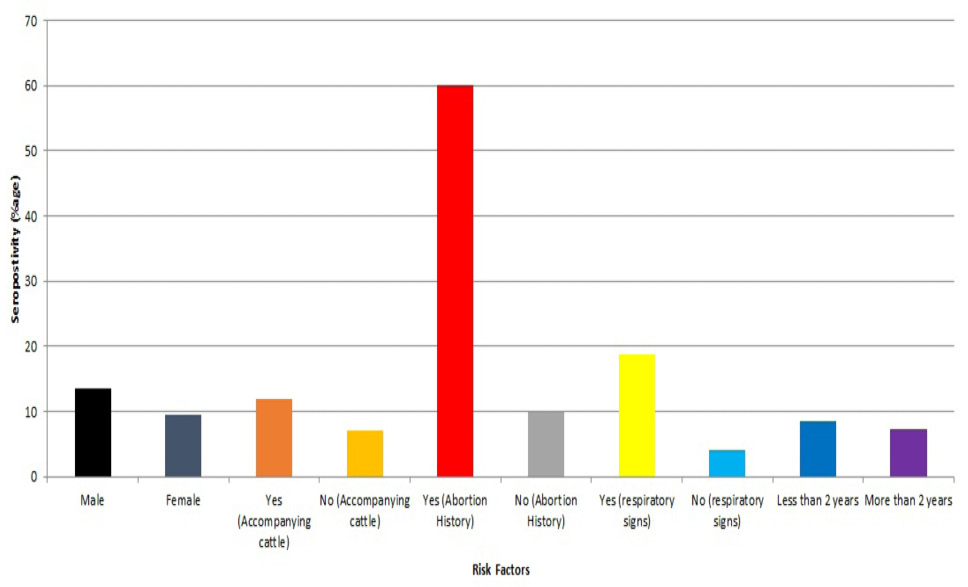
Percentage risk factors associated with BoHV-1 seropositivity in goats.
References
- Borujeni, M.P., Hajikolaei, M.R.H., Shapouri, M.R.S.A., and Roshani, F., 2020. Prev. Vet. Med., 174: 104818. https://doi.org/10.1016/j.prevetmed.2019.104818[CrossRef]
- Can, M.F., Ataseven, V.S., and Yalçin, C., 2016. Vet. Arhiv., 86: 499-513.
- De Vries, A., 2006. J. Dairy Sci., 89: 3876–3885. https://doi.org/10.3168/jds.S0022-0302(06)72430-4[CrossRef]
- Graham, D.A., 2013. Irish Vet. J., 66: 15. https://doi.org/10.1186/2046-0481-66-15[CrossRef]
- Gür, S., Erol, N., Yapıcı, O., Kale, M., Tan, M.T., Turan, T., Çakmak, M.A., Tosun, C., Yılmaz, S., Acar, A., Özenli, I., and Gür, C., 2019. Trop. Anim. Hlth. Prod., 51: 753-758. https://doi.org/10.1007/s11250-018-1746-9[CrossRef]
- Mahmoud, M., and Ahmed, S., 2009. Glob. Vet., 3: 472-479.
- Rehman, H.U., Rabbani, M., Ghafoor, A., Riaz, A., Awan, F.N., and Raza, S., 2020. Pak. Vet. J., 41: 163-165.
- Ring, S.C., Graham, D.A., Sayers, R., Byrne, N., Kelleher, M.M., Doherty, M.L., and Berry, D., 2018. J. Dairy Sci., 101: 6190-6204. https://doi.org/10.3168/jds.2018-14481[CrossRef]
- Sayers, R.G., 2017. J. Dairy Sci., 100: 1340-1352. https://doi.org/10.3168/jds.2016-11113[CrossRef]
- Thompson, J., Greiner, T., and Evans, L., 1965. Iowa State Univ. Vet., 27: 4.
- Wafula, J.S., Mushi, E.Z., and Wamwayi, H., 1985. Res. Vet. Sci., 39: 84-86. https://doi.org/10.1016/S0034-5288(18)31777-6[CrossRef]
Services
Article usage statistics
Loading…