
Bovine herpesvirus 1 (BoHV-1) is an emerging disease responsible for high production losses in the dairy animals. A cross-sectional study was conducted to determine the seroprevalence of BoHV-1 in and associated risk factors with disease prevalence in various agro-ecological zones of Pakistan focusing on the Punjab Province. A total of 400 samples were randomly collected from cattle and buffalo of wheat rice Punjab, mixed Punjab, cotton/wheat Punjab, Low intensity Punjab and Rain-fed Punjab zones. The study revealed individual seroprevalence of BoHV-1 49.5% in cattle and 51.5% in buffalo. Over all prevalence in five zones of Punjab was observed as 25% in mixed Punjab to 71.25% in Rain-fed Punjab. The BoHV-1 seropositivity ranged from 30 - 60% in cattle and 20-75% in buffaloes. Age, breeds of animals and milking status were not found to be potential risk factors for the disease. Logistic regression demonstrated that herd size (>thirty), parity (>2) and abortion history are potential risk factors associated with seroconversion of BoHV-1.
Short Communication · Volume 55, Issue 1, 14 November 2022 · Open Access
Serologic Evidence of Bovine Herpes Virus-1 in Cattle and Buffalo Population of Punjab, Pakistan
· · · · ·
Affiliations & Notes ⌄
- 1Institute of Microbiology, University of Veterinary and Animal Sciences, Lahore 2Provincial Diagnostic Laboratory, Livestock and Dairy Development, Punjab, Lahore 3Institute of Biochemistry and Biotechnology, University of Veterinary and Animal Sciences, Lahore * Corresponding author: mrabbani@uvas.edu.pk
Article Info ⌄
- Journal:
- Pakistan Journal of Zoology
- Published:
- 14 November 2022

From the article
- The highest overall prevalence with reference to zones was seen in rain fed Punjab zone (Rawalpindi) and lowest in mixed Punjab zone (Faisalabad) (Fig. 1).
- In case of cattle, the highest prevalence of BoHV-1 was seen in district Bahawalnagar of cotton/wheat zone and the lowest in Faisalabad district of mixed Punjab zone.
- Between the specie statistical comparison suggested non-significant differences as P>0.05 in the seroprevalence of BoHV-1 infections in cattle and buffaloes (Fig. 1).
- The present study revealed that BoVH-1 is prevalent in agro-ecological zones of Punjab and 49.5% (99/200) cattle were found positive, while in case of buffalo, 51.5% seropositive samples were found (103/200).
Selected from the article's own text.
Abstract
Materials and methods
The Punjab Province is divided into five agro-ecological zones. On the basis of dense population data provided by the Livestock and Dairy Development census, one district was selected from each zone. Wheat rice Punjab (Kasur), mixed Punjab (Faisalabad), cotton/wheat Punjab (Bahawalnagar), low intensity Punjab (Muzaffargarh) and rain-fed Punjab (Rawalpindi) . The aim of the study design was to get a representative data from each zone of animals for seroprevalence of BoHV-1.
A 3-5 ml blood was aseptically collected in vacutainers from jugular vein of the randomly selected animals considering breed, age, and physiological condition of animal. Blood was allowed to clot by incubating at ambient temperature for ~ 30 min and then centrifuged at 2500xg for 5 min for separating the serum for further processing by ELISA for detection of antibodies against bovine herpesvirus 1. All serum samples were tested using a commercially available ID Screen® IBR gE competition ELISA kit (ID.Vet, Grables, France) as per the manufacturer’s instructions.
All data were analyzed using SPSS 20.0 software (IBM, Armonk, NY, USA) through Chi-square. In case of qualitative variables, relationship between independent and dependent variables was determined by chi-square and logistic regression where values were presented in the form of EXP(B) having confidence interval 95% (CI) and significant values p<0.05.
Results
In cattle, a total of 400 samples were tested for BoHV-1 antibodies. In this study overall, 49.5% (99/200) seropositivity was observed in cattle, while in buffalo, 51.5% seropositive samples were found (103/200). The highest overall prevalence with reference to zones was seen in rain fed Punjab zone (Rawalpindi) and lowest in mixed Punjab zone (Faisalabad) (Fig. 1). Overall seroprevalence in the five studied zones follows: wheat rice Punjab (51.25%), mixed Punjab zone (25%), low intensity Punjab (51.25%), rain fed Punjab zone (71.25%), cotton/wheat zone (56%). In case of cattle, the highest prevalence of BoHV-1 was seen in district Bahawalnagar of cotton/wheat zone and the lowest in Faisalabad district of mixed Punjab zone. Between the specie statistical comparison suggested non-significant differences as P>0.05 in the seroprevalence of BoHV-1 infections in cattle and buffaloes (Fig. 1).
Table I shows the factors including age, herd size, breeds of animals, parity, milking status and history of abortion as risk factors for BoHV-1 infection. Herd size greater than thirty was a potential risk factor for seropositivity of BoHV-1 infections (P=0.0281). Animals having parity more than two times were more prone to infections (P=0.0011). Moreover, higher prevalence of BoHV-1 was observed in animals with history of abortion P<0.001) (Table I). No statistically significant difference (OR=0.69, P=0.527) in the BoHV-1 prevalence was found in various breeds of cattle. Likewise, BoHV-1 seroconversion was not statistically significant in milking animals (P=0.773). Age factor did not statistically contribute in virus infections (P=0.681)
Table I. Risk factors associated with BoHV-1 infection in five districts of Punjab, Pakistan.
| Variables | n | ELISA result | p value | Exp (b) | 95% CI for xp(b) |
| Age <4 years >4 years | 167 223 | 79 123 | 0.68 | 0.058 | 0.005-0.65 |
| Herd size < 30 >30 | 194 206 | 67 135 | 0.028 | 2.9 | 2.62-3.26 |
| Breed of cattle Sahiwal Crossbred | 106 94 | 51 48 | 0.53 | 0.69 | 0.14-4.73 |
| Breed of buffalo Niliravi | 200 | 103 | 0.599 | ||
| Parity < 2 >2 | 191 209 | 69 133 | 0.001* | 7.32 | 6.59-8.32 |
| Milking status Yes No | 212 188 | 112 90 | 0.77 | 0.92 | 0.26-3.53 |
| Abortion Yes | 200 | 148 | 0.001* | 78.24 | 9.41-650.92 |
*Significant difference (at p<0.05).
Discussion
In the present study overall seropositivity of BoHV-1 was found to be 50.5% in targeted areas of sampling and individually 49.5% in cattle and 51.5% in buffaloes. Seroprevalence of BoHV-1 in the buffaloes of study area is found to be very close to the study in Colombia . Seroprevalence of virus is compatible with the already present study on BoHV-1 in Punjab province . Results have shown variability with results of seroprevalence in terms of associated risk factors where greater herd size was not found a potential risk factor . One such study conducted in Rawalpindi detected BoHV-1 antibodies reported 28.65% and 21.64% with immune-fluorescent antibody detection prevalence which was low in past. Abortion as positively associated risk factor as found in study of a herd with history of abortion storm in cattle . Variable data tends to be found with reference to location of areas as observed by different districts in India (16.00-40%). Age-wise seroprevalence increases, however, is in line with the previous study in various agro-climatic zones of India . Variability of prevalence found in various agro-climatic zones in Punjab is consistent with results of study in Eastern and Western zones of India .
The overall prevalence data generated by the present study is consistent with a study done in India that reported an overall seroprevalence of 60.84%, and a prevalence of 60.46% in cattle and 62.39% in buffaloes . In the present study the highest prevalence of BoHV-1 in cattle was noticed in Cotton/ wheat Punjab and lowest in Mixed Punjab. District-wide seropositivity of cattle was found as Kasur in wheat rice Punjab (50%), Faisalabad in mixed Punjab zones (30%), Bahawalnagar in cotton/wheat Punjab (65%), Muzaffargarh in low intensity Punjab (42.5%) and Rawalpindi in rain-fed Punjab (60%). Variability noted in the prevalence of BoHV-1 in the present study is not surprising and also reported by workers in China where prevalence ranged from 12.1% to 77.8% . Variability of climatic conditions and different raising systems among districts may contribute to these differences in BoHV-1 prevalence .
In case of buffalo highest prevalence was found in Rawalpindi (77.5%) and lowest in Faisalabad (20%). This individual seroprevalence 77.5% shows that BoHV-1 is highly prevalent in buffaloes raised in Rawalpindi district . Similarly, high prevalence of BoHV-1 was also reported from a study done in Mexico where 59% of buffaloes were positive in target population . However, these findings are not in agreement with Kathiriya et al. (2018) who reported relatively low prevalence (33.99%) of BoHV-1 in Indian buffaloes compared to cattle (36.31%) .
Regarding the parity, cattle and buffaloes with more than 2 calving had higher seroprevalence of BoHV-1 compare to animals with less than 2 calving.
History of abortion was found to be a potential risk factor in this this study. Data analysis suggested higher seroprevalence (p<0.05) of BoHV-1 infection in cattle and buffalo with the history of abortion. Dairy herds with modest prevalence for BoHV-1, maintain a low level of infection for some time that leads to endemic abortions and active virus spread . Poor management practices may also play part in the spread of BoHV-1 and subsequent abortions.
Increased age has been considered a risk factor for higher prevalence as a result of greater chances of virus exposure to susceptible animals with age. For example, one study noted that BoHV-1 is more prevalent in animals greater than 4 years . However, in the present study age was not found a statistically significant risk for BoHV-1. Herd size is also a potential risk factor for BoHV-1 seropositivity. Lower number of animals in smaller herds means less chance to maintain and spread the infection. Risk of viral transmission within infected herds is also higher in large herds .
BoHV-1 has a major impact on the production and economics of many herds owing to ability to establish latency and persist inside the infected animals throughout the life. The infected animals keep shedding the virus under any stressful conditions. If a single animal becomes positive with the BoHV-1, the whole herd becomes infected direct contact with the secretions of the infected animal. Strict biosecurity measure, proper vaccination, culling of positive animals, and the regular screening of whole herd at different times may be helpful in prevention and control of the BoHV-1 infections. The present study only provided a limited yet representative data in the selected districts of Punjab Province only. Similar and large-scale studies involving more districts in the Punjab Province and other provinces of Pakistan can shed more light on the status of BoHV-1 in Pakistan. Moreover, molecular characterization of the BoHV-1 circulating in Pakistan could further help in studying epidemiology of this emerging virus. Good management practices including implementing high biosecurity standards coupled with timely and strategic vaccination could prevent the spread of BoHV-1 in Pakistan.
Conclusion
The present study revealed that BoVH-1 is prevalent in agro-ecological zones of Punjab and 49.5% (99/200) cattle were found positive, while in case of buffalo, 51.5% seropositive samples were found (103/200). Greater herd size, parity more than two times, abortion history are positively associated with seroconversion of BoHV-1. Study also suggested that BoHV-1 is present in Pakistan and it is an emerging disease of livestock. Further studies should investigate the circulating serotypes of BVDV in order to develop the vaccines to control the disease.
Acknowledgment
This research was being funded by Higher Education Commission, Pakistan under the National Research Program for Universities (NRPU) project#7198/Punjab/NRPU/R&D/HEC/2017. The Project is under principal investigator Prof. Dr. Masood Rabbani.
Statement of conflict of interest
The authors have declared no conflict of interest.
Figures
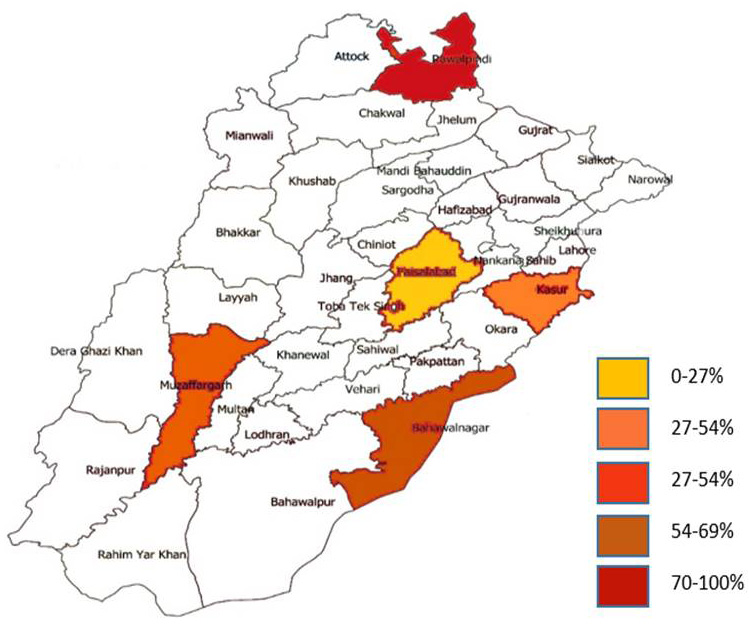
Distribution of cattle and buffaloes seropositive for bovine herpes virus-1 in the five districts of Punjab, Pakistan
References
- Ahmad, T.I., 2013. The role of rural women in livestock management: Socio-economic evidences from diverse geographical locations of Punjab (Pakistan). (Doctoral dissertation, Université Toulouse le Mirail-Toulouse II).
- Ahmed, I., Hameed, A., Memon, M. and Naeem, K., 1999. Pak. Vet. J., 19: 61-63.
- Boelaert, F., Speybroeck, N., de Kruif, A., Aerts, M., Burzykowski, T., Molenberghs, G. and Berkvens, D., 2005. Pre. Vet. Med., 69: 285-295. https://doi.org/10.1016/j.prevetmed.2005.02.010[CrossRef]
- Crook, T., Benavides, J., Russell, G., Gilray, J., Maley, M. and Willoughby, K., 2012. J. Vet. Diag. Invest., 24: 662-670. https://doi.org/10.1177/1040638712448187[CrossRef]
- Derrar, S., Aggad, H., Hammoudi, A., Saim, M.S., Ayad, M.A., Benzineb, F.Z., Abdali, M. and Abdelli, A., 2019. Veterinary, 68.
- Farooq, S., Kumar, A., Chaudhary, S., Patil, C., Banger, Y., Khasa, V., Dahiya, S. and Maan, S., 2021. Indian J. Anim. Res., 55: 582-587.
- Graham, D.A., 2013. Irish Vet. J., 66: 1-12. https://doi.org/10.1186/2046-0481-66-15[CrossRef]
- Hemadri, D. and Patil, S., 2010. Sero-status of bovine herpesvirus 1 (BoHV-1) infections in Bihar, India.
- Jones, C. and Chowdhury, S., 2010. Vet. Clin. Fd. Anim. Prac., 26: 303-321. https://doi.org/10.1016/j.cvfa.2010.04.007[CrossRef]
- Kaddour, A., Bouyoucef, A., Fernandez, G., Prieto, A., Geda, F. and Moula, N., 2019. J. Adv. Vet. Anim. Res., 6: 60.
- Kathiriya, J., Sindhi, S., Mathapati, B. and Bhedi, K., 2018. Int. J. Cur. Microbiol. appl. Sci., 7: 1371-1376. https://doi.org/10.20546/ijcmas.2018.703.164[CrossRef]
- Pastrana, M.E.O., Carrascal-Triana, E., Ramos, M.D. and Ortega, D.O., 2022. Ciência Rural, 52. https://doi.org/10.1590/0103-8478cr20210215[CrossRef]
- Raaperi, K., Aleksejev, A., Orro, T. and Viltrop, A., 2012. Vet. Rec., 171: 99-99. https://doi.org/10.1136/vr.100253[CrossRef]
- Raaperi, K., Orro, T. and Viltrop, A., 2014. Vet. J., 201: 249-256. https://doi.org/10.1016/j.tvjl.2014.05.040[CrossRef]
- Raza, S., Shahin, F., Zhai, W., Li, H., Alvisi, G., Yang, K., Chen, X., Chen, Y., Chen, J. and Hu, C., 2020. Microorganisms, 8: 409. https://doi.org/10.3390/microorganisms8030409[CrossRef]
- Rehman, H.U., Rabbani, M., Ghafoor, A., Riaz, A., Awan, F.N. and Raza, S., 2020. Pak. Vet J., 41: 163-165.
- Romero-Salas, D., Cruz-Romero, A., Aguilar-Domínguez, M., Ibarra-Priego, N., Barradas-Piña, F., Nogueira, D.L., Castro-Arellano, I, Lohmeyer, K. and Pérez, L.A., 2018. Trop. Biomed., 35: 541-552.
- Rudra, J., Sahana, M., Samanta, I., Sarkar, U., Baidya, S. and Ghosh, J., 2017. Prevalence of antibodies against persistent production-limiting infections in ruminants in India. Appl. Biol. Res., 19: 226-231. https://doi.org/10.5958/0974-4517.2017.00032.5[CrossRef]
- Sambamurti, K., Refolo, L.M., Shioi, J., Pappolla, M.A. and Robakis, N.K., 1992. Annu. N. Y. Acad. Sci., 674:118-128. https://doi.org/10.1111/j.1749-6632.1992.tb27481.x[CrossRef]
- Shabbir, M.Z., Khalid, R.K., Freitas, D.M., Javed, M.T., Rabbani, M., Yaqub, T., Ahmad, A., Shabbir, M.A.B. and Abbas, M., 2013. Pak. Vet. J., 33: 19-22.
- Trangadia, B., Rana, S.K., Mukherjee, F. and Srinivasan, V.A., 2010. Trop. Anim. Hlth. Prod., 42: 203-207. https://doi.org/10.1007/s11250-009-9407-7[CrossRef]
- Yan, B., Chao, Y., Chen, Z., Tian, K., Wang, C., Lin, X., Chen, H. and Guo, A., 2008. Vet. Microbiol.., 127: 136-141. https://doi.org/10.1016/j.vetmic.2007.08.025[CrossRef]
Services
Article usage statistics
Loading…