
This study aimed to investigate the activity patterns of the Asian badger (Meles leucurus.). Camera trapping method was employed to document the variations in Asian badger captures from April 2022 to September 2023 in a temperate forest within Mt. Songnisan National Park, Boeun, Chungbuk province, South Korea. The monthly observed frequencies of the Asian badger recorded using camera traps were analyzed. Additionally, the daily activity patterns of the Asian badger were examined for each season using kernel density estimations. From late of November to early March, the species was not observed in the study area, suggesting a potential period of winter hibernation. Moreover, higher observed frequencies were recorded in September and June. The seasonal activities of the mammal consistently displayed nocturnal behavior, with high activity levels observed during nighttime. This study also found significant overlap coefficients for the daily activity patterns between seasons. Further studies on critical aspects such as habitat use and diet are necessary to promote the conservation of the species and its habitat.
Short Communication · Volume 57, Issue 5, 29 August 2025 · Open Access
Exploring Activity Patterns of the Asian Badger Using Camera Traps in a South Korean Temperate Forest
· · · ·
Affiliations & Notes ⌄
- 1School of Bioresource and Bioscience, Chung-Ang University, 4726 Seodong-Daero, Ansung 17546, South Korea * Corresponding author: sjrhim@cau.ac.kr
Article Info ⌄
- Journal:
- Pakistan Journal of Zoology
- Published:
- 29 August 2025

From the article
- In the present study, the seasonal activities of the Asian badgers consistently appeared nocturnal (Fig. 2).
- In this study, higher overlap coefficients for daily activity patterns between seasons were observed.
- Despite the similar seasonal activity patterns observed, some variations were noted in each season.
- Although this study monitored certain fluctuations in the seasonal activity patterns of Asian badgers, there remains a lack of detailed studies on the ecological characteristics of this species.
Selected from the article's own text.
Abstract
Materials and methods
This study was conducted in a temperate forest (36°33′9.3′′–36°33′50.4′′ N, 127°49′16.0′′–127°50′58.1′′ E) located on Mt. Songnisan National Park, Boeun, Chungbuk province, South Korea. Mt. Songnisan National Park spans an area of 274 km2 and comprises coniferous, deciduous, and mixed forests, with Korean red pine (Pinus densiflora) and oak (Quercus species) being the dominant species. The altitudinal gradient ranges from 128 to 1,039 m above the sea level (Korea National Park Research Institute, 2019). The annual average precipitation and mean temperature during the study period are recorded as 1,456.9 mm and 12.1 °C, respectively (Korea Meteorological Administration, 2023).
The camera trapping method was employed to observe variations in Asian badger capture. A camera-trap survey was conducted from April 2022 to September 2023. For the survey, a study plot measuring 2,250 m × 2,250 m (arranged in a 6 × 6 grid with 450-m intervals) was set up within a mixed forest. A total of 25 cameras (Spec Ops Elite HP4, Browning Co., USA) were affixed to trees at heights ranging from 50 to 80 cm above the ground . Each camera was programmed to record a 5-second video upon activation. For video analysis, consecutive events occurring within 30 min of the previous events were excluded to ensure the use of independent records . The study period was divided into spring (March-May), summer (June-August), and autumn (September-November).
The monthly observed total frequency of Asian badgers captured using camera traps was analyzed throughout study period. Additionally, the daily activity patterns of Asian badgers were examined for each season, with kernel density estimated along with 95% confidence intervals. Overlaps in daily activities were estimated between the seasons, employing the overlap coefficient ⊿4 for comparing daily activity patterns between seasons. The coefficient is defined as the overlapping area under the curves of the kernel density estimates from two seasons, with values ranging from 0 to 1 .
Results and discussion
We used independent camera trap records, excluding instances of prolonged records of the same individuals. A total of 460 records of Asian badgers were analyzed over a sampling effort spanning 13,500 camera days. Notably, from late of November to early March, the study species was not observed in the study area (Fig. 1), suggesting a potential period of winter hibernation. Moreover, observed frequencies were higher in September and June. The winter dormancy of mammals represents an adaptative response to seasonal variations in environmental conditions . Asian badgers may have developed effective adaptations to cope with pronounced seasonal fluctuations in temperature and food availability on the Korean peninsula.
Many species synchronize their activity patterns with the day-night cycle, and most mustelids typically commence their activities around sunset . In the present study, the seasonal activities of the Asian badgers consistently appeared nocturnal (Fig. 2). Similar to the behavior observed in European badger Meles meles (Do Linh San et al., 2010), high levels of nighttime activity were observed for Asian badgers in this study. The nocturnal behavior of the Asian badger may be attributed to its circadian rhythm, suggesting that it is consistent characteristics of the species .
In this study, higher overlap coefficients for daily activity patterns between seasons were observed. The overlap coefficient between spring and summer exhibited the highest value (overlap coefficient ⊿ 4 = 0.91, CI 95% = 0.82-0.97), while the value was lower between spring and autumn (⊿ 4 = 0.77, CI 95% = 0.65-0.83) (Table I).
Table I. Overlap coefficient for daily activity patterns of the Asian badger (Meles leucurus) using camera traps between seasons from April 2022 to September 2023 in a South Korean temperate forest.
| Season | Overlap coefficient (⊿ 4) | Overlap value |
| Spring-summer | 0.91 (CI 95%: 0.82-0.97) | High |
| Spring-autumn | 0.77 (CI 95%: 0.65-0.83) | High |
| Summer-autumn | 0.81 (CI 95%: 0.76-0.92) | High |
Despite the similar seasonal activity patterns observed, some variations were noted in each season. Asian badger was frequently active during spring and summer, likely due to females needing additional foraging time and caring for their cubs (Tanaka et al., 2002). Conversely, in autumn, there was a notable increase in nocturnal activity patterns as the mammals no longer needed to care for their offspring/s . Furthermore, the daily activity pattern was prolonged in autumn, presumably to build up reserves for wintering .
Although this study monitored certain fluctuations in the seasonal activity patterns of Asian badgers, there remains a lack of detailed studies on the ecological characteristics of this species. Further research, such as investigations into habitat use and diet, is essential for the conserving the species and its habitat.
DECLARATIONS
Funding
This study received no funding from external sources.
Statement of conflict of interest
The authors declare that there is no conflict of interests regarding the publication of this article.
Figures
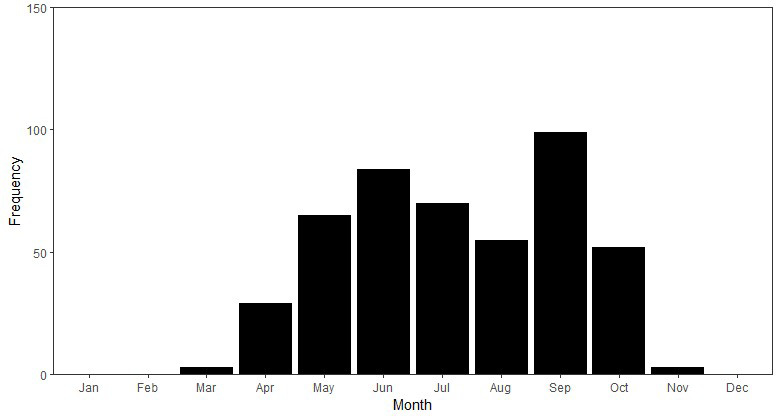
Monthly observed frequency of the Asian badger (Meles leucurus) using camera traps from April 2022 to September 2023 in a South Korean temperate forest.
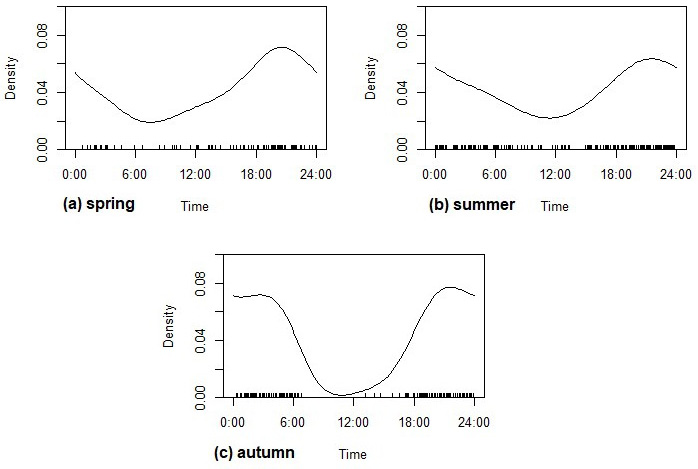
Seasonal daily activity patterns of the Asian badger (Meles leucurus) using camera traps from April 2022 to September 2023 in a South Korean temperate forest. Kernel density estimates are represented on the y-axis with 95% confidence intervals.
References
- Bae, H.K., Lee, J.K., Eom, T.K., Lee, D.H., Ko, H., Kim, J.H., Ahn, S.H. and Rhim, S.J., 2024. Pakistan J. Zool., htps://dx.doi.org/ 10.17582/journal.pjz/20230412120425.
- Baryshnikov, G.F., Puzachenko, A.Y. and Abramov, A.V., 2002. Russ. J. Theriol., 1: 133-149.
- Bennie, J.J., Duffy, J.P., Inger, R. and Gaston, K.J., 2014. Proc. natl. Acad. Sci. USA, 111: 13727-13732. https://doi.org/10.15298/rusjtheriol.01.2.07[CrossRef]
- Creswell, W.J. and Harris, S., 1988. J. Zool., 216: 187-194. https://doi.org/10.1073/pnas.1216063110[CrossRef]
- Do Linh San, E., Ferrari, N. and Weber, J.M., 2010. Rev. Suiss Zool., 117: 111-119. https://doi.org/10.1111/j.1469-7998.1988.tb02424.x[CrossRef]
- Eom, T.K., Lee, J.K., Lee, D.H., Bae, H.K., Ko, H., Kim, K.J., Jung, S.C., Lim, S.H. and Rhim, S.J., 2023a. Pakistan J. Zool., 55: 1003-1008. https://doi.org/10.5962/bhl.part.117593[CrossRef]
- Eom, T.K., Lee, J.K., Lee, D.H., Ko, H. and Rhim, S.J., 2023b. Wildl. Biol., 2023: e01138. https://doi.org/10.17582/journal.pjz/20220103200132[Full text][CrossRef]
- Halle, S. and Stenseth, N.C., 2000. Activity patterns in small mammals. Springer, Berlin, Germany. https://doi.org/10.1002/wlb3.01138[CrossRef]
- Ko, H., 2024. Seasonal differences in ecological characteristics of Asian badger (Meles leucurus). MSc thesis. Chung-Ang University, Seoul, Korea. https://doi.org/10.1007/978-3-642-18264-8[CrossRef]
- Korea Meteorological Administration, 2023. Open MET data portal. https://data.kma.go.kr.
- Korea National Park Research Institute, 2019. Report on resources survey in Songnisan National Park. Korea National Park Research Institute, Wonju, Korea.
- Kowalczyk, R., Jędrzejewska, B. and Zalewski, A., 2003. J. Biogeog., 30: 463-472.
- Law, C.J., Slater, G.J. and Mehta, R.S., 2018. Syst. Biol., 67: 127-144. https://doi.org/10.1046/j.1365-2699.2003.00804.x[CrossRef]
- Lodé, T., 1995. Ethology, 100: 295-308. https://doi.org/10.1093/sysbio/syx047[CrossRef]
- Marcelli, M., Fusillo, R. and Boitani, L., 2003. J. Zool., 261: 249-255. https://doi.org/10.1111/j.1439-0310.1995.tb00334.x[CrossRef]
- Neal, E.G. and Cheeseman, C.L., 1996. Badgers. T & AD Poyser Natural History, London, UK. https://doi.org/10.1017/S0952836903004151[CrossRef]
- Oleynikov, A.Y., Sedash, G.A., Salkina, G.P. and Maslov, M.V., 2023. Mammalia, 87: 564-576.
- Prigioni, C. and Deflorian, M.C., 2005. Ital. J. Zool., 72: 43–48. https://doi.org/10.1515/mammalia-2023-0016[CrossRef]
- Tanaka, H., 2005. Mammal. Stud., 30: 11-17. https://doi.org/10.1080/11250000509356651[CrossRef]
- Tanaka, H., Yamanaka, A. and Endo, K., 2002. Mammal. Stud., 27: 15-22. https://doi.org/10.3106/1348-6160(2005)30[11:SADAPO]2.0.CO;2[CrossRef]
- Wilson, D.E. and Reeder, D.M., 2005. Mammals species of the world: A taxonomic and geographic reference. 3rd ed. Johns Hopkins University Press, Baltimore, USA. https://doi.org/10.3106/mammalstudy.27.15[CrossRef]
Services
Article usage statistics
Loading…