
Estimating habitat use patterns within specific environments provides valuable insights into species-specific behavioral characteristics in particular areas. Understanding these ecological and ethological aspects enhances the effectiveness of management and conservation efforts. The Eurasian otter Lutra lutra, one of the most endangered species in South Korea, inhabits freshwater environments, coastal areas, and islands. Despite the diverse habitats utilized by Eurasian otters, information on their habitat use patterns on islands remains limited compared to studies conducted in terrestrial areas. Therefore, this study aimed to assess the relationship between habitat characteristics and the occurrence of Eurasian otters on uninhabited islands in South Korea. Data on the detection or non-detection of Eurasian otter field signs on uninhabited islands were collected through ecological surveys conducted annually from May to October between 2019 and 2023. Habitat variables measured for each island included area; proportions of forest, grassland, barren, and intertidal zone coverage; elevation; slope; distance from the mainland; and the density of Eurasian otter field signs on the mainland. The top logistic regression model, selected from a series of candidate models, identified island area, elevation and slope at the island edges, and distance from the mainland as significant predictors influencing the occurrence of Eurasian otters. Moreover, elevation at the island edge was positively associated with the occurrence of Eurasian otter field signs. Conversely, slope at the island edge, distance from the mainland, and island area were negatively associated with the occurrence of Eurasian otter field signs. Elevation and slope at island edges may influence exposure to seawater and locomotion costs, respectively. Therefore, the relationship between habitat variables on uninhabited islands and the occurrence of Eurasian otter field signs may reflect energy efficiency strategies that promote the establishment of stable resting sites. Furthermore, our findings suggest that Eurasian otters primarily use uninhabited islands as shelters or corridors based on their distance from the mainland. Consequently, conservation strategies for Eurasian otters on uninhabited islands should differ from those implemented on the mainland.
Research Article · Volume 58, Issue 6, 2 October 2026 · Open Access
Relationship Between Habitat Characteristics and the Occurrence of Eurasian Otter Lutra lutra Field Signs on Uninhabited Islands, South Korea
· · · · ·
Affiliations & Notes ⌄
- 1Protected Area Research Team, National Institute of Ecology, 1210, Geumgang-ro, Seocheon 33657, South Korea. 2Department of Geography, Seoul National University, 1, Gwanak-ro, Gwanak-gu, Seoul 08826, South Korea. * Corresponding author: hhs1124@gmail.com
Article Info ⌄
- Journal:
- Pakistan Journal of Zoology
- Published:
- 2 October 2026

From the article
- Habitat factors between islands with Eurasian otter field signs and those without did not differ significantly, except for the distance from the mainland (Table II).
- Our results indicate that elevation levels at the edge areas of uninhabited islands are positively correlated with the occurrence of Eurasian otter field signs.
- Moreover, our findings indicate a negative relationship between both island area and distance from the mainland and the occurrence of Eurasian otters.
- Notably, uninhabited islands with Eurasian otter field signs were located approximately 8 km from the mainland, suggesting that Eurasian otters may use nearby islands connected to mainland habitats.
Selected from the article's own text.
Abstract
Introduction
Estimating habitat use patterns provides valuable insights about into species-specific behavioral characteristics within particular environmental contexts ; . Even within the same species, variations in environmental conditions or differences in life cycle stages can alter habitat use patterns. Specifically, differences in habitat factors such as soil composition, elevation, and atmospheric conditions, can lead to changes in the flora and fauna communities . These changes affect the availability of food resources, shelter, and the presence of competitors for the species . The availability of food resources and vertical habitat structure are strongly related to species’ habitat preferences. Moreover, the composition of intra- and interspecific competition within a habitat influences fluctuations in energy expenditure for foraging, breeding, and resting . Additionally, life cycle stages influence habitat use patterns based on varying needs. For example, during the mating season, mammals typically require larger territories to protect themselves and their young from starvation, competitors, and predators ; . During migration, habitat preferences are influenced by the perception and memory of food resources . Furthermore, habitat use patterns at spatial scales differ between breeding and wintering seasons due to temporal variations in habitat requirements . Therefore, estimating species habitat use patterns at a local scale provides valuable information about species-specific interactions among habitat factors.
Uninhabited islands with unique characteristics such as low human activity, isolation from the mainland, and exposure to salt spray have influenced the habitat use patterns of various species . Several bird species, including the black-tailed gull Larus crassirostris, Chinese egret Egretta eulophotes, and black-faced spoonbill Platalea minor, select uninhabited islands as breeding sites and leave these islands after breeding . Additionally, the water deer Hydropotes inermis exhibits different habitat use patterns, including preferences for food resources and daily activity, between forested areas and islands . Furthermore, as the distance from the mainland increases, species richness on islands decreases due to dispersal limitations and isolation . The simpler species composition on islands compared to the mainland can influence habitat use patterns based on constraints imposed by biotic and abiotic resources . Therefore, habitat use patterns of the same species may differ between the mainland and islands.
The Eurasian otter Lutra lutra, a semi-aquatic carnivore occupying the highest trophic niche in aquatic habitats of the Korean Peninsula, has been found in freshwater systems, coastal area, and islands . Due to decreasing population size and shrinking ecological niche in aquatic habitats, the Eurasian otter has been designated as a Grade I endangered species and a natural monument in South Korea . On terrestrial areas, the habitat preference of the Eurasian otter is negatively affected by human activity and water pollution, and positively influenced by the availability of food, especially fish . The relationship between habitat characteristics and habitat use patterns of the Eurasian otter has been primarily studied in mainland and freshwater environments ; . For example, in urban areas, the occurrence and intensity of habitat use by Eurasian otters are strongly influenced by human disturbance, habitat structure, and habitat productivity ; . Moreover, in rural areas, habitat preference is strongly affected by the availability of food resources ; . However, information on the habitat use patterns of Eurasian otters on islands remains limited, with most studies focusing on distribution , genetic diversity , and food resources . Additionally, these surveys have been conducted mainly on large, inhabited islands. Therefore, we investigated the relationship between habitat characteristics and the occurrence of Eurasian otters on uninhabited islands in South Korea to provide valuable information for conservation and management efforts.
Materials and Methods
Study area
This study was conducted on 94 uninhabited islands (34°06’58’’ N to 35°04’28’’ N, 125°05’39’’ E to 129°05’34’’ E) in the southern part of South Korea from May 2019 to October 2023 (Fig. 1). These islands are protected as specified island by the Ministry of Climate, Energy and Environment. The islands range in size from 913 m2 to 281,693 m2 and support diverse terrestrial flora and fauna, including vascular plants, mammals, birds, amphibians, reptiles, and insects, with species counts on each island ranging from 26 to 327. Notably, the study recorded mammals belonging to 4 orders, 8 families, and 9 species: Lutra lutra, Nyctereutes procyonoides, Sus scrofa, Hydropotes inermis argyropus, Capra aegagrus hircus, Hypsugo alaschanicus, Sciurus vulgaris, Rattus norvegicus, and Mus musculus.
Data collection and analysis
To estimate the relationship between habitat factors and the occurrence of Eurasian otter field signs on uninhabited islands, we used data from ecological surveys conducted annually from May to October between 2019 and 2023 on specific islands. The occurrence of Eurasian otter field signs was surveyed by the same observer across spatial and temporal scales to minimize observer bias and temporal variation. From these data, we selected only the detection or non-detection of Eurasian otters based on coupled field signs including footprints, spraints, and camera trap on each island . If field signs or camera traps indicated the presence of Eurasian otters, the island was classified as “detected”; otherwise, it was classified as “non-detected.. We calculated 9 habitat variables for each island, including area; proportions of forest, grassland, barren, and intertidal zone coverage; elevation; slope; distance from the mainland; and density of Eurasian otter field signs on the mainland (Table I). Specifically, uninhabited islands in our study area
Table I. Variables of habitat factors on the study.
|
Variables |
Description |
Source |
|
Area |
Total size of each uninhabited island |
Digital topographic map |
|
Elevation |
Mean elevation levels on edge part (the area of buffer zone 10 m from the island border) of each uninhabited island |
|
|
Slope |
Mean slope levels on edge part (the area of buffer zone 10 m from the island border) of each uninhabited island |
|
|
Forest |
Proportion of forest area on each uninhabited island |
Land Cover Map |
|
Grassland |
Proportion of grass area on each uninhabited island |
|
|
Barren |
Proportion of barren area on each uninhabited island |
|
|
Intertidal Zone |
Proportion of intertidal zone area on each uninhabited island |
|
|
Distance from mainland |
Shortest length between mainland to uninhabited island |
|
|
Density of otter |
Eurasian otter field sign per km2 on the mainland |
The 5th National Ecosystem Survey |
experience a tidal range exceeding 5 m and up to a maximum of 10 m . Therefore, to calculate the area of each island, we used a digital topographic map (National Geographic Information Institute, 2020), considering only land above 5 m above sea level to focus on terrestrial habitats. The proportion of land cover for each island was determined based on a land cover map (Ministry of Environment, 2020). The intertidal zone was calculated as the water area contained within the island boundary, since island borders were defined at elevations above 5 m above sea level. Elevation and slope were derived from a digital elevation model (DEM) generated from the digital topographic map. Subsequently, the mean values of elevation and slope were estimated for the edge area, defined as a 10 m buffer zone from the island’s boundary . The distance from the mainland was measured as the shortest distance between the island and the mainland shoreline. The connection between the island and the mainland could potentially alter the island’s community if connected artificially . Therefore, based on the land cover map, we defined the mainland boundary as including islands connected to the mainland by roads, bridges, or other structures facilitating human activity. Additionally, we assessed the density of Eurasian otter field signs on the mainland by estimating their density using data from the 5th National Ecosystem Survey, conducted between 2019 and 2023, using kernel density estimation (field signs per km2) (Fig. 2). All processes for calculating habitat characteristics were conducted using ArcGIS Pro (Esri, USA).
Statistical analysis
To evaluate the relationship between habitat factors and the occurrence of the Eurasian otter field signs, we conducted a statistical analysis using R (ver. 4.4.1). We performed the Mann-Whitney U test to assess differences in habitat factors including area, proportion of coverage by forest, grassland, barren, intertidal zones, elevation, slope, distance from the mainland, and density of Eurasian otter field signs on the mainland between islands with and without Eurasian otter field signs. Additionally, to identify the relationship between habitat factors and Eurasian otter occurrence, we ran a logistic regression model. The results of the logistic regression were used to select the best model based on Akaike’s Information Criterion (AIC). To minimize multicollinearity issues, we calculated the variance inflation factor (VIF) for each factor; all VIF values were below 4, indicating no significant multicollinearity in the analysis.
Results
Habitat factors between islands with Eurasian otter field signs and those without did not differ significantly, except for the distance from the mainland (Table II). Specifically, islands with Eurasian otter field signs were closer to the mainland than those without (Z = -3.89, p < 0.001).
The top model explaining the relationship between habitat factors and the occurrence of the Eurasian otter, based on AIC, identified area, elevation, slope on the edge area, and distance from the mainland of each island as significant predictors influencing occurrence of Eurasian otter field signs (Table III). Slope on the edge of each island (log-odds = -1.38, p = 0.01), island area (log-odds = -1.21, p = 0.02), and distance from the mainland (log-odds = -0.89, p = 0.01) were negatively influential variables on occurrence of Eurasian otter field signs, respectively. In contrast, elevation on the edge area of each island (log-odds = 2.26, p = 0.01) had a positive effect on occurrence of Eurasian otter. Moreover, elevation on the edge area of each island (odds ratio = 9.55, 95% CI: 1.80–70.90) showed the strongest positive association with the occurrence of Eurasian otter field signs (Table IV).
Table II. Differences of habitat factors (mean±S.E.) between uninhabited island with and without Eurasian otter Lutra lutra field sign, South Korea.
|
Variables |
Island with otter |
Island without otter |
Z |
p |
|
Area (km2) |
0.04±0.01 |
0.05±0.01 |
-0.68 |
0.49 |
|
Elevation (m) |
8.93±0.41 |
9.79±1.11 |
-0.89 |
0.37 |
|
Slope (º) |
34.05±1.57 |
37.63±3.21 |
-1.08 |
0.28 |
|
Forest (%) |
11.08±3.38 |
4.58±3.97 |
-1.02 |
0.31 |
|
Grassland (%) |
0.55±0.31 |
3.79±2.73 |
-1.96 |
> 0.05 |
|
Barren (%) |
2.98±1.50 |
5.07±3.15 |
-0.65 |
0.52 |
|
Intertidal Zone (%) |
0.06±0.04 |
0.04±0.03 |
-0.21 |
0.83 |
|
Distance from mainland (km) |
7.81±0.88 |
23.53±6.30 |
-3.89 |
< 0.001 |
|
Density of otter (field sign/ km2) |
0.07±0.02 |
0.03±0.01 |
-1.20 |
0.23 |
Discussion
Species-specific habitat use and preference were strongly associated with habitat composition, including land cover, geomorphological characteristics, and species assemblages ; . Generally, the Eurasian otter’s use of terrestrial areas is influenced by factors such as food resource availability, water pollution, human activity, the spatial extent of rivers, and the coverage of riparian grasslands ; . Furthermore, vegetation coverage around waterbodies is the most important factor influencing shelter selection in riparian systems . This vegetation provides visual protection from predators and thermal insulation for otters . Our results indicate that elevation levels at the edge areas of uninhabited islands are positively correlated with the occurrence of Eurasian otter field signs. Elevation is strongly related to temperature; as elevation increases, temperature decreases, leading to changes in atmospheric conditions and species composition . However, the study area is characterized by low elevation, reaching a maximum of 150 m. Elevation and slope were estimated within a 10 m buffer zone from the island shoreline for each uninhabited island. Beyond atmospheric effects associated with elevation,
Table III. Models based on the correlation Akaike Information Criterion (AICc) developed to explain the occurrence probability of Eurasian otter Lutra lutra in each ecological factors on study area by the ΔAICc value resulted by the logistic regression model.
|
Model |
AICc |
ΔAICc |
ω |
|
94.66 |
0.00 |
0.59 |
|
|
+ Area + Grassland + Elevation + Slope + Distance from mainland |
96.24 |
1.57 |
0.27 |
|
+ Area + Grassland + Elevation + Slope + Distance from mainland + Density of otter |
98.35 |
3.68 |
0.09 |
|
+ Area + Grass + Barren + Elevation + Slope + Distance from mainland + Density of otter |
102.98 |
8.32 |
0.01 |
|
+ Area + Grass + Barren + Intertidal Zone + Elevation + Slope + Distance from mainland + Density of otter |
105.50 |
10.84 |
0.00 |
|
+ Area+Forest+ Grass+ Barren+ Intertidal Zone+ Elevation+ Slope+ Distance from mainland+ Density of otter |
108.11 |
13.45 |
0.00 |
Table IV. Top model explaining the occurrence probability of Eurasian otter Lutra lutra in uninhabited islands, South Korea.
|
Variables |
Log-odds |
S.E. |
z |
Odds ratio |
95% CI |
p |
|
|
Lower |
Upper |
||||||
|
Intercept |
1.37 |
0.30 |
4.57 |
- |
0.82 |
2.01 |
< 0.001 |
|
Area |
-1.21 |
0.51 |
-2.37 |
0.30 |
0.10 |
0.78 |
0.02 |
|
Elevation |
2.26 |
0.93 |
2.44 |
9.55 |
1.80 |
70.90 |
0.01 |
|
Slope |
-1.38 |
0.54 |
-2.58 |
0.25 |
0.08 |
0.69 |
0.01 |
|
Distance from mainland |
-0.89 |
0.34 |
-2.61 |
0.41 |
0.17 |
0.71 |
0.01 |
higher elevation at island edges may provide a more stable environment for Eurasian otters by offering protection from ocean waves and seawater intrusion . Furthermore, slope gradient at the edge areas of uninhabited islands are negatively correlated with the occurrence of Eurasian otter field signs. Slope also affects habitat conditions by influencing soil composition, flora distribution, energy expenditure for climbing, and the risk of falling . Moreover, slope near the shoreline is positively related to the energy required for climbing onto the island (Birn-Jeffery and Higham, 2014). Therefore, higher elevations and gentler slopes near shorelines may provide relatively stable resting sites protected from wave action and seawater intrusion. These habitat characteristics may reduce locomotion costs and contribute to suitable resting environments.
Increasing habitat size is generally associated with enhanced biodiversity, as larger areas encompass a variety of habitat types including grasslands, forests, water bodies, wetlands, and barren regions thereby providing sufficient spatial extent . However, our study identified a negative relationship between the presence of the Eurasian otter and the size of uninhabited islands. Unlike many species that establish polygonal home ranges and territories, the Eurasian otter exhibits a linear home range aligned with river systems . In riparian zones, Eurasian otters preferentially utilize narrow riparian strips for resting, with field signs predominantly observed on rocks ; . Additionally, some studies have indicated that Eurasian otters use islands as ecological corridors ; . Moreover, our findings indicate a negative relationship between both island area and distance from the mainland and the occurrence of Eurasian otters. Within riparian habitats, Eurasian otters exhibit home ranges varying widely from 1 km to 30 km, with home range size influenced by individual body size and social rank ; Ruiz-Olmo et al., 2005; . Furthermore, Eurasian otters have home ranges of up to 40 km and can travel 20 km in a single day . Notably, uninhabited islands with Eurasian otter field signs were located approximately 8 km from the mainland, suggesting that Eurasian otters may use nearby islands connected to mainland habitats.
Although the habitat use patterns of the Eurasian otter were linear, the species did not primarily inhabit uninhabited islands characterized by simple habitat coverage and limited spatial extent. Our findings suggest that Eurasian otters utilize uninhabited islands mainly as shelter or corridors. Therefore, conservation efforts for Eurasian otters on uninhabited islands require a different approach than those on the mainland. For example, managing grass coverage along the edges of islands could increase the availability of suitable habitat by reduce erosion, which in turn maintain the elevation and slope gradients . Notably, feral goats Capra aegagrus hircus were present on 12 islands in our study, where their grazing has reduced the flora population . Management of feral goat populations may help maintain vegetation structure and habitat stability on some islands. Our study was conducted only from spring to fall and did not incorporate data on the movement and prey availability of Eurasian otters. Therefore, additional research on habitat use patterns across diverse spatial and temporal scales including uninhabited islands and coastal areas as well as ethological information such as movement and feeding behavior, is essential to inform effective conservation planning for the Eurasian otter.
Declarations
Acknowledgments
We appreciate Dr. Lee Sang-Gi and Dr. Yi Jin-Hee for supporting the field survey.
Funding
This work was supported by a National Institute of Ecology [Ecological survey of specific islands (NIE-C-2026-01) and Ecological survey of Baekdudaegan Protected Area (NIE-C-2026-06)].
Ethical statement
No live specimens were used in our study.
Generative AI and AI-assisted technology statement
The authors declare that no generative AI and AI assisted technology was used in the creation of this manuscript.
Statement of conflict of interest
The authors have declared no conflict of interest.
Figures
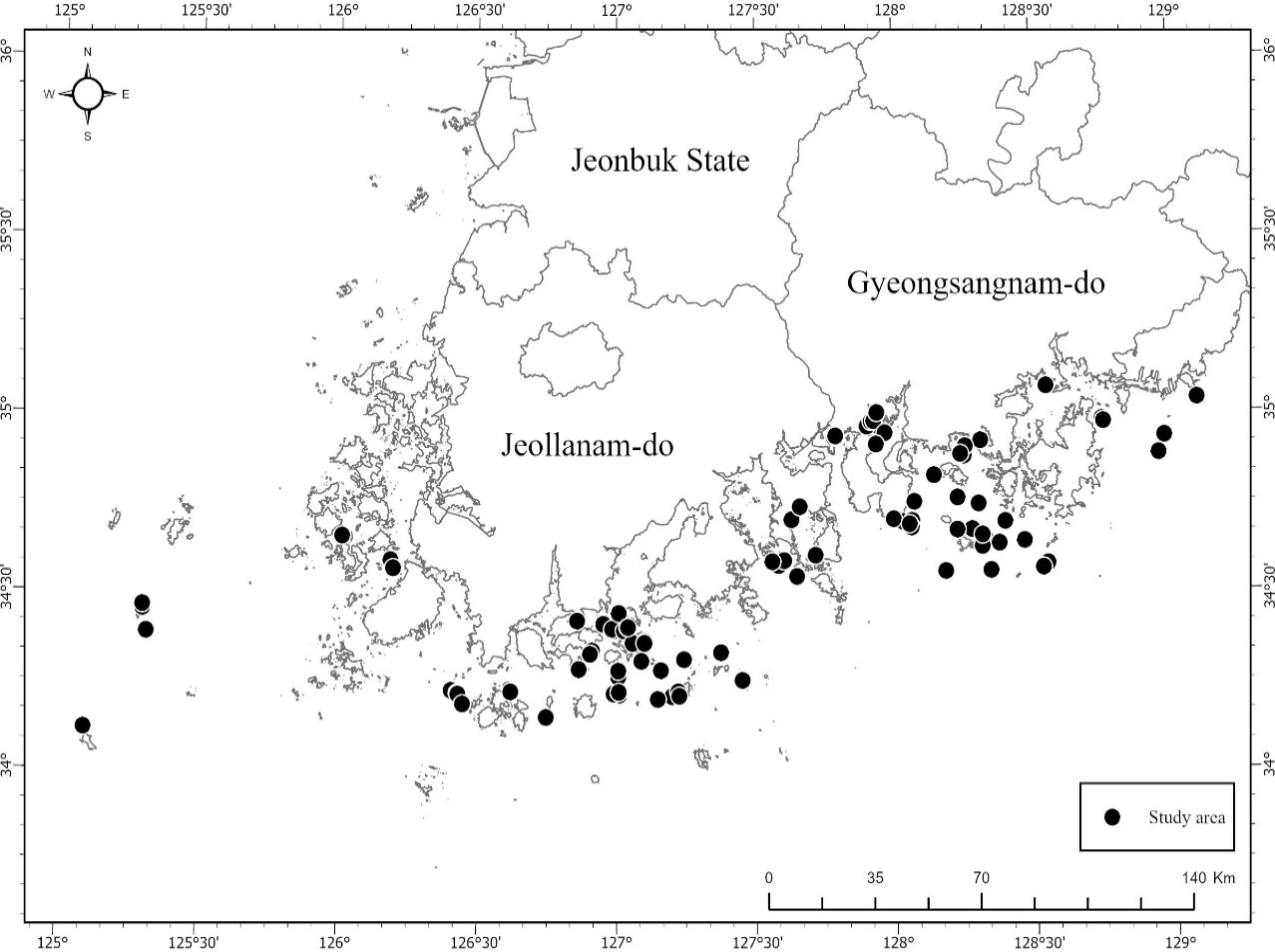
Location of the ecological survey of specific island from 2019 to 2023, South Korea.
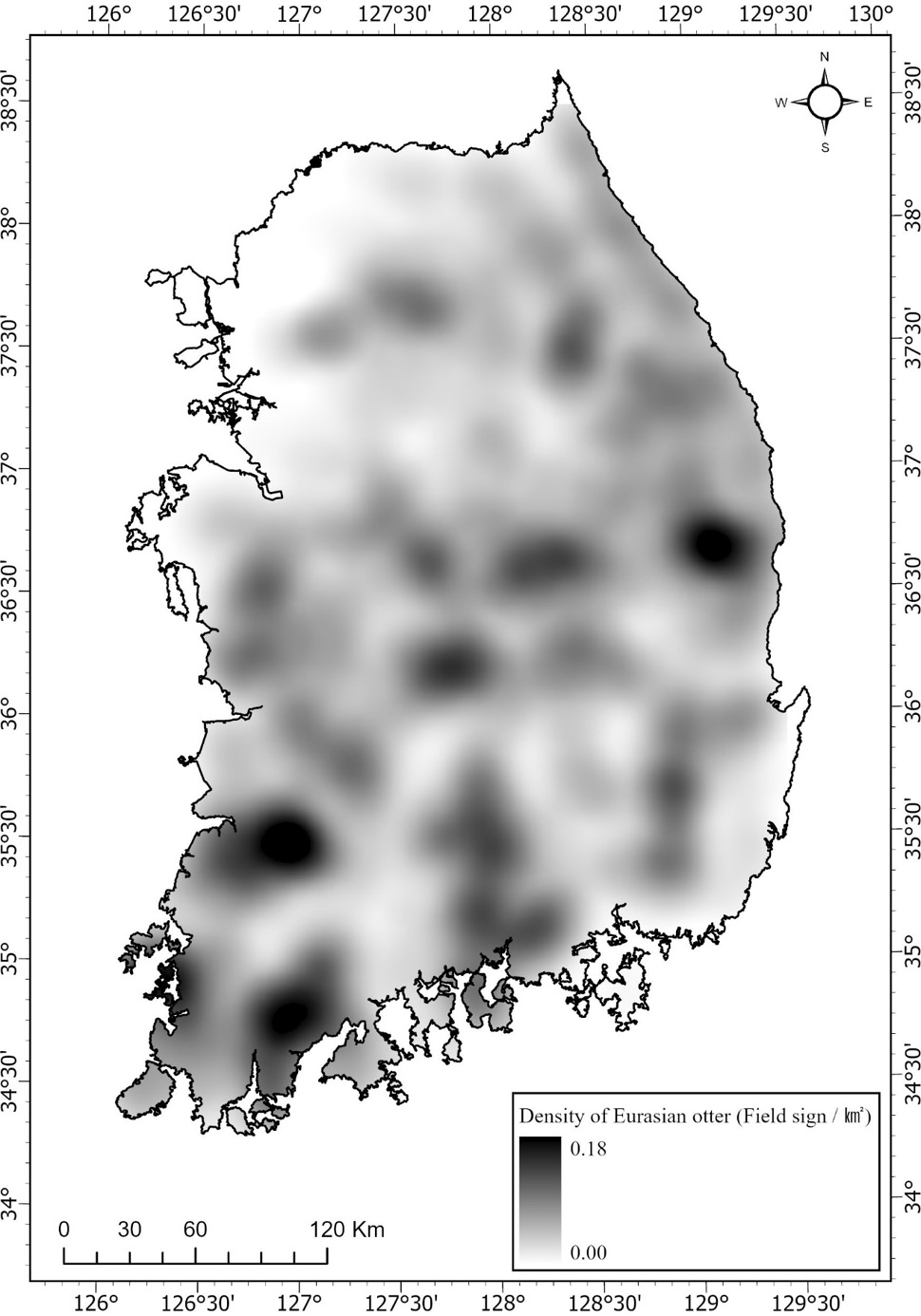
Estimated field sign density of Eurasian otter Lutra lutra based on the 5th National Ecosystem Survey from 2019 to 2023, South Korea.
References
- Albeke, S.E., Nibbelink, N.P., Mu, L. and Ellsworth, D.J., 2010. Measuring boundary convexity at multiple spatial scales using a linear “moving window” analysis: An application to coastal river otter habitat selection. Landsc. Ecol., 25: 1575-1587. https://doi.org/10.1007/s10980-010-9528-4[CrossRef]
- Baghil, A. and Verhagen, R., 2005. Activity patterns and use of resting sites by polecats in an endangered population. Mammalia, 69: 211-222. https://doi.org/10.1515/mamm.2005.018[CrossRef]
- Bedford, S.J., 2009. The effects of riparian habitat quality and biological water quality on the European otter (Lutra lutra) in Devon. Biosci. Horiz., 2: 125-133. https://doi.org/10.1093/biohorizons/hzp015[CrossRef]
- Beyer, H.L., Haydon, D.T., Morales, J.M., Frair, J.L., Hebblewhite, M., Mitchell, M. and Matthiopoulos, J., 2010. The interpretation of habitat preference metrics under use–availability designs. Philos. Trans. R. Soc. B: Biol. Sci., 365: 2245-2254. https://doi.org/10.1098/rstb.2010.0083[CrossRef]
- Bracis, C. and Mueller, T., 2017. Memory, not just perception plays an important role in terrestrial mammalian migration. Proc. R. Soc. B: Biol. Sci., 284: 20170499. https://doi.org/10.1098/rspb.2017.0449[CrossRef]
- Brin-Jeffery, A.V. and Higham, T.E., 2014. The scaling of uphill and downhill locomotion in legged animals. Integr. Comp. Biol., 54: 1159-1172. https://doi.org/10.1093/icb/icu015[CrossRef]
- Byun, D.S., Hart, D.E. and Jeong, W.J., 2013. Tidal current energy resources off the South and West of Korea: Preliminary observation-derived estimates. Energies, 6: 566-578. https://doi.org/10.3390/en6020566[CrossRef]
- Carvalho-Junior, O., Fillipini, A. and Salvador, C., 2012. Distribution of neotropical otter, Lontra longicaudis (Olfers, 1818) (Mustelidae) in coastal islands of Santa Catarina, Southern Brazil. IUCN Otter Spec. Group Bull., 29: 95-108.
- Cha, H.G., Kim, H. and Hwang, H.S., 2025. Habitat factors influencing the brown rat Rattus norvegicus abundance on uninhabited island, South Korea. J. Ecol. Environ., 49: 226-232. https://doi.org/10.5141/jee.25.032[CrossRef]
- Cosson, J.F., Ringuet, S., Claessens, O., de Massary, J.C., Dalecky, A., Villiers, J.K., Granjon, L. and Pons, J.M., 1999. Ecological changes in recent land-bridge islands in French Guiana, with emphasis on vertebrate communities. Biol. Conserv., 91: 213-222. https://doi.org/10.1016/S0006-3207(99)00091-9[CrossRef]
- Dettori, E.E., Balestrieri, A., Zapata-Perez, V.M., Bruno, D., Rubio-Saura, N. and Robledano-Aymerich, F., 2021. Distribution and diet of recovering Eurasian otter (Lutra lutra) along the natural-to-urban habitat gradient (river Segura, SE Spain). Urban Ecosyst., 24: 1221-1230. https://doi.org/10.1007/s11252-021-01109-3[CrossRef]
- Dhimal, M., Ahrens, B. and Kuch, U., 2014. Species composition, seasonal occurrence, habitat preference and altitudinal distribution of malaria and other disease vectors in eastern Nepal. Parasit. Vectors, 7: 540. https://doi.org/10.1186/s13071-014-0540-4[CrossRef]
- Eggermann, J., Da Costa, G.F., Guerra, A.M., Kirchner, W.H. and Petrucci-Fonseca, F., 2011. Presence of Iberian wolf (Canis lupus signatus) in relation to land cover, livestock and human influence in Portugal. Mammal. Biol., 76: 217-221. https://doi.org/10.1016/j.mambio.2010.10.010[CrossRef]
- Erlinge, S., 1967. Home range of the otter Lutra lutra L. in Southern Sweden. Oikos, pp. 186-209. https://doi.org/10.2307/3565098[CrossRef]
- Gaillard, J.M., Hebblewhite, M., Loison, A., Fuller, M., Powell, R., Basille, M. and Moorter, B.V., 2010. Habitat–performance relationships: Finding the right metric at a given spatial scale. Phil. Trans. R. Soc. B: Biol. Sci., 365: 2255-2265. https://doi.org/10.1098/rstb.2010.0085[CrossRef]
- Galanaki, A., Kominos, T., Zogaris, S., Gasteratos, I. and Lymberakis, P., 2019. Presence of the Eurasian otter Lutra lutra on the islands of Greece: A review. Folia Zool., 68: 246-252. https://doi.org/10.25225/fozo.073.2019[CrossRef]
- Gao, X., Gong, Y., Chen, X. and Li, Y., 2022. Dietary shifts and niche partitioning throughout ontogeny reduce intraspecific competition in a pelagic generalist predator. Mar. Ecol. Progr. Ser., 692: 81-97. https://doi.org/10.3354/meps14079[CrossRef]
- Gizicki, Z.S., Tamez, V., Galanopoulou, A.P., Avramidis, P. and Foifopoilos, J., 2018. Long-term effects of feral goats (Capra hircus) on Mediterranean island communities: Results from whole island manipulations. Biol. Invasions, 20: 1537-1552. https://doi.org/10.1007/s10530-017-1645-4[CrossRef]
- Gray, T.N.E. and Phan, C., 2011. Habitat preference and activity patterns of the larger mammal community in Phnom Prich Wildlif Sanctuary, Cambodia. Raffles Bull. Zool., 59: 311-318.
- Gutowski, J.M., Sućko, K., Zub, K. and Bohdan, A., 2014. Habitat preferences of Boros schneideri (Coleoptera: Boridae) in the natural tree stands of the Białowieża forest. J. Insect Sci., 14: 276. https://doi.org/10.1093/jisesa/ieu138[CrossRef]
- Hong, S., Do, Y., Kim, J.Y., Cowan, P. and Joo, G.J., 2017. Conservation activities for the Eurasian otter (Lutra lutra) in South Korea traced from newspapers during 1962–2010. Biol. Conserv., 210: 157-162. https://doi.org/10.1016/j.biocon.2017.03.010[CrossRef]
- Jang-Liaw, N.H., Tan, Y.C., Chang, C.J., Juan, C.H., Hou, H.Y., Chung, L.W., Cao, H.S., Waku, D., Chang, S.W. and Lee, L.L., 2023. Genetic diversity and structure of Eurasian otters on Kinmen Island. Conserv. Genet., 24: 589-606. https://doi.org/10.1007/s10592-023-01525-2[CrossRef]
- Jo, Y.S. and Won, C., 2019. The sprainting behavior and habitat preference of the Eurasian otter Lutra lutra along a montane stream in South Korea. Mammal. Study, 45: 3-11. https://doi.org/10.3106/ms2018-0071[CrossRef]
- Jo, Y.S., Won, C.M., Fritts, S.R., Wallace, M.C. and Baccus, J.T., 2017. Distribution and habitat models of Eurasian otter, Lutra lutra, in South Korea. J. Mammal., 98: 1105-1117. https://doi.org/10.1093/jmammal/gyx037[CrossRef]
- Kanwal, S., Mahmood, T., Mehmood, T., Akrim, F. and Azoz, R., 2026. Camera trapping coupled with field sign survey revel the mammalian diversity and abundance at Murree-Kotli Sattian-Kahuta National Park, Pakistan. J. Anim. Pl. Sci., 36: 152-169.
- Karamanlidis, A.A., Hornigold, K., Krambokoukis, L., Papakostas, G., Stefanidis, K. and Quaglietta, L., 2014. Occurrence, food habits, and activity patterns of Eurasian otters Lutra lutra in northwestern Greece: implications for research and conservation. Mammalia, 78: 239-243. https://doi.org/10.1515/mammalia-2013-0096[CrossRef]
- Kelly, B.P., Badajos, O.H., Kunnasranta, M., Moran, J.R., Martinez-Bakker, M., Wartzok, D. and Boveng, P., 2010. Seasonal home ranges and fidelity to breeding sites among ringed seals. Polar Biol., 33: 1095-1109. https://doi.org/10.1007/s00300-010-0796-x[CrossRef]
- Krauss, K.W., Cahoon, D.R., Allen, J.A., Ewel, K.C., Lynch, J.C. and Cormier, N., 2010. Surface elevation change and susceptibility of different mangrove zones to sea-level rise on Pacific high islands of Micronesia. Ecosystems, 13: 129-143. https://doi.org/10.1007/s10021-009-9307-8[CrossRef]
- Lawrence, A., O’Connor, K., Haroutounian, V. and Swei, A., 2018. Patterns of diversity along a habitat size gradient in a biodiversity hotspot. Ecosphere, 9: e02183. https://doi.org/10.1002/ecs2.2183[CrossRef]
- Lee, C. and Luan, X., 2025. A review on Eurasian otters in urban areas: Principles for enhancement of biodiversity. Diversity, 17: 356. https://doi.org/10.3390/d17050356[CrossRef]
- Lerone, L., Mengoni, C., Di Febbraro, M., Krupa, H. and Loy, A., 2022. A noninvasive genetic insight into the spatial and social organization of an endangered population of the Eurasian otter (Lutra lutra, Mustelidae, Carnivora). Sustainability, 14: 1943. https://doi.org/10.3390/su14041943[CrossRef]
- Loy, A., Carranza, M.L., Cianfrani, C., D’alessandro, E., Bonesi, L., Marzio, P.D., Minotti, M. and Reggiani, G., 2009. Otter Lutra lutra population expansion: Assessing habitat suitability and connectivity in southern Italy. Folia Zool., 58: 309-326.
- Lyons, A.J., Turner, W.C. and Getz, W.M., 2013. Home range plus: A space-time characterization of movement over real landscapes. Movement Ecol., 1: 2. https://doi.org/10.1186/2051-3933-1-2[CrossRef]
- Ministry of Environmen., 2020. Land use map: Partners Available at https://egis.me.go.kr/map/map.do (accessed 1 Feb 2021)]
- National Geographic Information Institute, 2020. Digital Topographic Map: https://map.ngii.go.kr/ms/map/NlipMap.do (accessed 1 Feb 2021)]
- Nations, J.A., Heaney, L.R., Demos, T.C., Achmadi, A.S., Rowe, K.C. and Esselstyn, J.A., 2019. A simple skeletal measurement effectively predicts climbing behaviour in a diverse clade of small mammals. Biol. J. Linn. Soc., 128: 323-336. https://doi.org/10.1093/biolinnean/blz085[CrossRef]
- Natsukawa H., H. Yuasa, M. Fujisaki, T. Kobayashi, H. Maruyama, K. Masukawa, H. Saito, G. Sato, L. J. Sutton, M. Takahashi, T. Toba, S. Washizawa, M. Yanagawa, K. Yoshida, and F. Sergio. 2024. Importance of the interplay between land cover and topography in modeling habitat selection. Ecol. Indicat., 169: 112896. https://doi.org/10.1016/j.ecolind.2024.112896[CrossRef]
- Penteriani, V., González-Bernardo, E., Díaz, D., Benjumea, R., González, M.A.G., Iglesias, A.P., Zarzo-Arias, A., García-Sánchez, P., Torres-Romero, E.J., Russo, L.F. and del Mar Delgado, M., 2025. Diel activity patterns of a semiaquatic carnivore in human-modified landscapes: Insights from Eurasian otter behaviour. Anim. Behav., 228: 123312. https://doi.org/10.1016/j.anbehav.2025.123312[CrossRef]
- Quaglietta, L., Hájková, P., Mira, A. and Boitani, L., 2015. Eurasian otter (Lutra lutra) density estimate based on radio tracking and other data sources. Mamm. Res., 60: 127-137. https://doi.org/10.1007/s13364-015-0216-2[CrossRef]
- Raha, A. and Hussain, S.A., 2016. Factors affecting habitat selection by three sympatric otter species in the southern Western Ghats, India. Acta Ecol. Sin., 36: 45-49. https://doi.org/10.1016/j.chnaes.2015.12.002[CrossRef]
- Rahman, D.A. and Mardiastuti, A., 2021. Factors influencing the activity patterns of two deer species and their response to predators in two protected areas in Indonesia. Therya, 12: 149-161. https://doi.org/10.12933/therya-21-1087[CrossRef]
- Rho, P., 2010. Species richness related to landscape characteristics of uninhabited islands in Korea. J. Ecol. Environ., 33: 105-114. https://doi.org/10.5141/JEFB.2010.33.2.105[CrossRef]
- Romanowski, J., Brzeziński, M. and Żmihorski, M., 2013. Habitat correlates of the Eurasian otter Lutra lutra recolonizing Central Poland. Acta Theriol., 58: 149-155. https://doi.org/10.1007/s13364-012-0107-8[CrossRef]
- Rüdisser, J., Tasser, E. and Tappeiner, U., 2012. Distance to nature: A new biodiversity relevant environmental indicator set at the landscape level. Ecol. Indicat., 15: 208-216. https://doi.org/10.1016/j.ecolind.2011.09.027[CrossRef]
- Ruiz‐Olmo, J., Margalida, A. and Batet, A., 2005. Use of small rich patches by Eurasian otter (Lutra lutra L.) females and cubs during the pre-dispersal period. J. Zool., 265: 339-346. https://doi.org/10.1017/S0952836905006424[CrossRef]
- Saavedra, D., 2004. Reintroduce of Eurasian otter (Lutra lutra) in Muga and Fluvia basins (northeastern Spain): Viability, development, monitoring and trends of the new population. PhD Thesis. Univesitat de Girona, Girona.
- Tolrà, A., Ruiz-Olmo, J. and Riera, J.L., 2024. Human disturbance and habitat structure drive Eurasian otter habitat selection in heavily anthropized river basins. Biodiv. Conserv., 33: 1683-1710. https://doi.org/10.1007/s10531-024-02826-9[CrossRef]
- Tranquillo, C., Wauters, L.A., Santicchia, F., Preatoni, D. and Martinoli, A., 2023. Living on the edge: Morphological and behavioral adaptations to a marginal high-elevation habitat in an arboreal mammal. Integr. Zool., 18: 746-761. https://doi.org/10.1111/1749-4877.12679[CrossRef]
- Wang, Q.Y., Zheng, K.D., Han, X.S., He, F., Zhao, X., Fan, P.F. and Zhang, L., 2021. Site-specific and seasonal variation in habitat use of Eurasian otters (Lutra lutra) in western China: Implications for conservation. Zool. Res., 42: 825. https://doi.org/10.24272/j.issn.2095-8137.2021.238[CrossRef]
- Weinberger, I.C., Muff, S., Kranz, A. and Bontadina, F., 2019. Riparian vegetation provides crucial shelter for resting otters in a human-dominated landscape. Mammal. Biol., 98: 179-187. https://doi.org/10.1016/j.mambio.2019.09.001[CrossRef]
- Xing, S., Leahy, L., Ashton, L.A., Kitching, R.L., Bonebrake, T.C. and Scheffers, B.R., 2023. Ecological patterns and processes in the vertical dimension of terrestrial ecosystems. J. Anim. Ecol., 92: 538-551. https://doi.org/10.1111/1365-2656.13881[CrossRef]
- You, Q., Kang, S., Pepin, N., Flügel, W.A., Yan, Y., Behrawan, H. and Huang, J., 2010. Relationship between temperature trend magnitude, elevation and mean temperature in the Tibetan Plateau from homogenized surface stations and reanalysis data. Glob. Planet. Change, 71: 24-133. https://doi.org/10.1016/j.gloplacha.2010.01.020[CrossRef]
Services
Article usage statistics
Loading…