
This study was conducted to clarify the latrine site selection preference of the Asian badger Meles leucurus in a temperate forest, Pyeongchang, South Korea. Logistic regression models were used to determine which habitat variables affect latrine site selection. The relationship between elevation and latrine location was examined using the Mann-Whitney U test, and we used Jacob’s index to examine the relationship between latrine site selection and forest type. Badger field signs were negatively affected by human presence. Dense overstory vegetation and the percent ground cover of rock, grass, and bare land were positively correlated with latrine site selection by the logistic regression models that displayed good predictive performance (a ROC-AUC value ≥ 0.65). The latrines were found at higher elevations, rather than lower to aviod higher temperatures, and we found that Asian badgers tend to make their latrines in deciduous forest. For the conservation of the species and their habitat, these habitat variables should be considered and addressed by forest managers.
Short Communication · Volume 56, Issue 6, 9 November 2024 · Open Access
Latrine Site Selection by the Asian Badger (Meles leucurus) in a Temperate Forest of South Korea
· · · · · · ·
Affiliations & Notes ⌄
- 1School of Bioresource and Bioscience, Chung-Ang University, Ansung, South Korea * Corresponding author: sjrhim@cau.ac.kr
Article Info ⌄
- Journal:
- Pakistan Journal of Zoology
- Published:
- 9 November 2024

From the article
- Dense overstory vegetation and the coverage of rock, grass, and bare land were positively correlated with latrine site selection.
- Jacob’s index indicated that forest type affected latrine site selection by Asian badgers.
- In this study, deciduous forests were highly selected as latrine sites by the Asian badgers.
- The latrine selection by the Asian badger was strongly related to overstory vegetation cover, ground characteristics, the proximity of shrubs, elevation, and forest type.
Selected from the article's own text.
Abstract
Materials and methods
The study area is located in a temperate forest, Mt. Gariwang (37° 27′–37° 29′ N, 128° 32′–128° 34′ E), Pyeongchang, South Korea. The annual precipitation is 1305 mm, and the annual mean temperature is 11℃ (range –17.8 to 36.0℃). The altitudinal range of the study area is 423 to 1546 m a.s.l. Natural deciduous forest is dominant, but some areas are planted with conifers. The dominant tree species are oak Quercus spp., Korean pine Pinus densiflora, and Japanese larch Larix kaempferi .
The field survey was carried out from September to October 2019 and April to September 2020. We searched for field signs of badgers foot-prints, hair, scats, and setts to identify activity of the species and recorded latrine points using GPS (GPSMAP64s, Garmin) .
Habitat variables were surveyed at all latrine points in September 2020, and randomly selected points were surveyed for a control group. Habitat data related to foliage layer coverage, ground type coverage, and distance from the nearest structure were collected within a 5.56 m radius . The foliage layer was categorized as ground, understory, mid-understory, sub-overstory, and overstory vegetation. Foliage layer coverage: v0, ground vegetation (0–1 m) coverage; v1; understory vegetation (1–2 m) coverage; v2, Mid-story vegetation (2–8 m) coverage; v8; sub-overstory vegetation (8–20 m) coverage; v20; overstory vegetation (20–30 m) coverage. The ground types were classified as grass, rock, and bare land. Coverage of each foliage layer and ground type was estimated and placed into four categories: 0 (percentage coverage = 0%), 1 (1–33%), 2 (34–66%), and 3 (67–100%), ground type coverage: GC, grass area coverage; RC, rock area coverage; BC, bare land coverage. Distance from the nearest structure: DS, distance from the nearest shrub < 2 m: 0, > 2 m: 1; DR, distance from the nearest boulder < 2 m: 0, > 2 m: 1 *boulder volume > 2 m³. Additionally, the distance from the nearest shrub and boulder were recorded. We also recorded each point’s elevation above sea level, and each point’s forest type was categorized as coniferous, deciduous, mixed, or non-forest .
Logistic regression models were used to determine which habitat variables affected latrine site selection. The Akaike information criterion (AIC) was used to select the best models from a set of models. The Akaike weights of each model were calculated and compared among predictive models with ΔAICc < 2. Receiver operating characteristic-area under the curve (ROC-AUC) statistics were calculated to assess the accuracy of the models. Moreover, the total Akaike weight of the factors in each model was analyzed.
The relationship between elevation and latrine site selection was examined by comparing the elevation of latrine and control points using the Mann-Whitney U test. We used Jacob’s index to examine the relationship between latrine site selection and forest type. The formula of Jacob’s index is D = (r – p)/(r + p – 2rp) where r is the proportion of habitat used and p is the proportion of the habitat type in the total survey area . Jacob’s index ranges from –1 (total avoidance) to 1 (maximun preference). All statistical analyses were conducted with the R (ver. 4.0) and IBM SPSS statistics (ver. 27) software platforms.
Results and discussion
The six logistic regression models of the habitat variables affecting latrine site selection by Asian badgers with ΔAICc < 2 are shown in Table I. These models together included five habitat variables: Overstory vegetation coverage (v20), rock area coverage (RC), grass area coverage (GC), bare land coverage (BC), and distance from the nearest shrub (DS). The variable v20 was present in four of the models, and three factors RC, GC, and BC were present in three models. Dense overstory vegetation and the coverage of rock, grass, and bare land were positively correlated with latrine site selection. These models displayed good predictive performance, having high ROC-AUC values (≥ 0.65).
Table I. Statistics and habitat variables of the models predicting latrine site selection by the Asian badger Meles leucurus.
| Model | Habitat variables | AICc | ΔAICc | Weight | ROC-AUC |
| 1 | RC + v20 | 106.45 | 0.00 | 0.20 | 0.67 |
| 2 | BC + GC + v20 | 106.67 | 0.22 | 0.18 | 0.70 |
| 3 | RC + DS + v20 | 106.82 | 0.37 | 0.17 | 0.70 |
| 4 | BC+GC+DS+v20 | 106.94 | 0.49 | 0.16 | 0.73 |
| 5 | BC + GC | 107.08 | 0.63 | 0.15 | 0.68 |
| 6 | RC | 107.10 | 0.65 | 0.15 | 0.65 |
RC, rock area coverage; v20, overstory vegetation (20–30 m) coverage; BC, bare land coverage; DS, distance from the nearest shrubs < 2 m: 0, > 2 m: 1; GC, grass area coverage; AICc, Akaike information criterion, -->; ΔAICc, changes in corrected Akaike information criterion; ROC-AUC, receiver operating characteristics-area under curve.
There was a significant difference in elevation between the latrine and control points (Mann-Whitney U test, Z = 522.50, P = 0.01). We found that the mean elevation of latrine points (1069 m) was higher than that of control points (931 m). Most latrines were recorded at elevations higher than 1000 m a.s.l. in this study (Fig. 1).
Jacob’s index indicated that forest type affected latrine site selection by Asian badgers. Only the deciduous forest showed a positive association with latrine presence (Jacob’s index > 0). For other forest types, the association was negative (Jacob’s index < 0; Fig. 2).
Badgers are known to occur in various habitats, such as mountains, arid areas, and farms . In this study, we found that setts and latrines were not recorded around villages and human settlements. Badger field signs have previously been found to be negatively affected by human presence .
We carried out a logistic regression using Asian badger latrine presence/absence as the response variable in a temperate forest. Overstory vegetation, rock area, grass area, bare land area, and distance from the nearest shrub influenced the location of latrines. Trees and large rocks can serve as thermal cover and shelter for mammals. Latrines may be effective methods for badgers to communicate estrous status ; , and the presence of latrines can be easily identified in grass areas and on bare land. Moreover, dense ground vegetation is favorable for food and cover ; .
Latrines were found at higher elevations rather than lower. Temperature is an important environmental variable for badger species . In this study, Asian badgers selected higher elevation areas to avoid higher temperatures because temperature decreases with increasing elevation, as does solar radiation exposure .
Asian badger latrine site location can be influenced by forest type. Deciduous forests are also known as important habitats for the European badger . In this study, deciduous forests were highly selected as latrine sites by the Asian badgers. The litter of deciduous forests can increase the availability of earthworms , and the increased food resources ensure this habitat’s appeal.
The latrine selection by the Asian badger was strongly related to overstory vegetation cover, ground characteristics, the proximity of shrubs, elevation, and forest type. For the conservation of the species and their habitat, these habitat variables should be considered and addressed by forest managers.
Funding
There was no external funding source for this study.
Ethics statement
Not applicable.
Statement of conflict of interest
The authors have declared no conflict of interest.
Figures
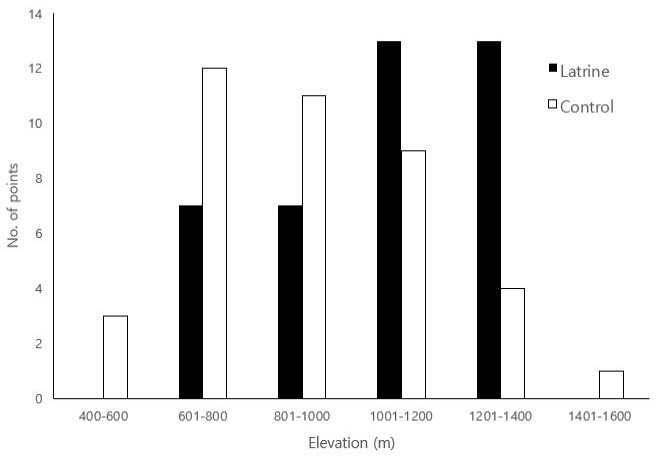
The relationship between elevation and the Asian badger Meles leucurus latrine occurrence with randomly located plot points as the control.
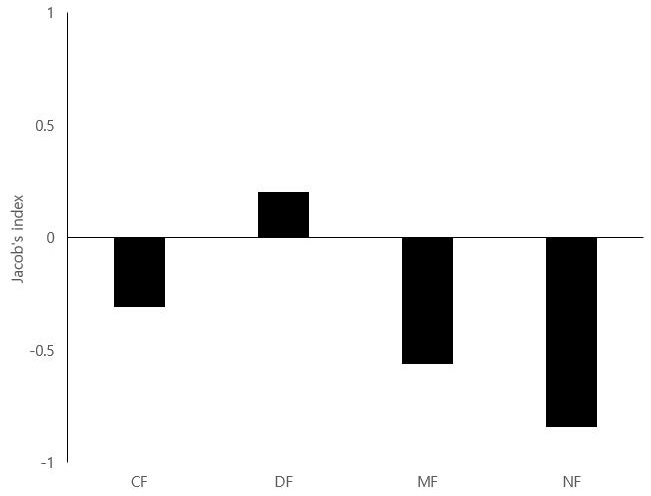
Jacob’s index values for forest type in relation to latrine site selection by the Asian badger Meles leucurus. CF, coniferous forest; DF, deciduous forest; MF, mixed forest; NF, non-forest.
References
- Bae, H.K., 2021. Characteristics of field signs and habitat variables of Asian badger Meles leucurus. MSc thesis, Chung-Ang University, Korea.
- Bae, H.K., Lee, J.K., Eom, T.K., Lee, D.H. and Rhim, S.J., 2021. Wildl. Biol., 2021: wlb.00910. https://doi.org/10.2981/wlb.00910[CrossRef]
- Browne, C., Stafford, K. and Fordham, R., 2006. Irish Vet. J., 59: 97–104.
- Buesching, C.D. and Macdonald, D.W., 2004. Acta Theriol., 49: 235–246. https://doi.org/10.1007/BF03192523[CrossRef]
- Buesching, C.D., Newman, C., Service, K., Macdonald, D.W. and Riordan, P., 2016. Ecosphere, 7: e01328. https://doi.org/10.1002/ecs2.1328[CrossRef]
- Buesching, C.D., Stopka, P. and Macdonald, D.W., 2003. Behaviour, 140: 965–980. https://doi.org/10.1163/156853903322589597[CrossRef]
- Byrne, A.W., Sleeman, D.P., O’Keeffe, J. and Davenport, J., 2012. Biol. Environ. Proc. R. Irish Acad., 112B: 105–132. https://doi.org/10.1353/bae.2012.0038[CrossRef]
- Delahay, R.J., Ward, A.I., Walker, N., Long, B. and Cheeseman, C.L., 2007. J. Zool., 272: 311–320. https://doi.org/10.1111/j.1469-7998.2006.00271.x[CrossRef]
- Hutchings, M.R., Service, K.M. and Harris, S., 2001. Acta Theriol., 46: 87–96. https://doi.org/10.4098/AT.arch.01-10[CrossRef]
- Johnson, D.D., Macdonald, D.W., Newman, C. and Morecroft, M.D., 2001. Oikos, 95: 265–274. https://doi.org/10.1034/j.1600-0706.2001.950208.x[CrossRef]
- Kaneko, Y., Maruyama, N. and Macdonald, D.W., 2006. J. Zool., 270: 78–89. https://doi.org/10.1111/j.1469-7998.2006.00063.x[CrossRef]
- Kaneko, Y., Suzuki, T. and Atoda, O., 2009. Mamm. Stud., 34: 179–186. https://doi.org/10.3106/041.034.0401[CrossRef]
- Kauhala, K. and Salonen, L., 2012. Mammal. Biol., 7: 264–270. https://doi.org/10.1016/j.mambio.2012.02.007[CrossRef]
- Kilshaw, K., Newman, C., Buesching, C., Bunyan, J. and Macdonald, D., 2009. J. Mammal., 90: 1188–1198. https://doi.org/10.1644/08-MAMM-A-200.1[CrossRef]
- Krebs, C.J., 2002. Wildl. Res., 29: 1–10. https://doi.org/10.1071/WR01074[CrossRef]
- Lara-Romero, C., Virgós, E., Escribano-Ávila, G., Mangas, J.G., Barja, I. and Pardavila, X., 2012. J. Arid Environ., 76: 43–48. https://doi.org/10.1016/j.jaridenv.2011.08.004[CrossRef]
- Prigioni, C. and Deflorian, M.C., 2005. Ital. J. Zool., 72: 43–48. https://doi.org/10.1080/11250000509356651[CrossRef]
- Roca, C.P., La Haye, M.J. and Jongejans, E., 2014. Lutra, 57: 87–109.
- Roper, T.J., Conradt, L., Butler, J., Christian, S.E., Ostler, J. and Schmid, T.K., 1993. Behaviour, 127: 289–307. https://doi.org/10.1163/156853993X00074[CrossRef]
- Service, K.M., Brereton, R.G. and Harris, S., 2001. Analyst, 126: 615–623. https://doi.org/10.1039/b100755f[CrossRef]
- Silva, M., Rosalino, L.M., Alcobia, S. and Santos-Reis, M., 2021. Animals, 11: 2663. https://doi.org/10.3390/ani11092663[CrossRef]
- Stewart, P.D., Macdonard, D.W., Newman, C. and Cheeseman, C.L., 2001. J. Zool., 255: 191–198. https://doi.org/10.1017/S0952836901001261[CrossRef]
- Tsukada, H., Kawaguchi, Y., Hijikata, K., Masuda, M., Minami, M. and Suyama, T., 2020. Mammal. Res., 65: 517–522. https://doi.org/10.1007/s13364-020-00500-3[CrossRef]
- Virgós, E. and Casanovas, J.G., 1999. Acta Theriol., 44: 173–182. https://doi.org/10.4098/AT.arch.99-15[CrossRef]
- Wang, J., Ji, S., Wu, J., Shrestha, T.K., Bu, X., Zhu, Y., Xiang, R., Sheng, Y. and Meng, X., 2021. Biologia, 76: 1737–1746. https://doi.org/10.2478/s11756-020-00673-x[CrossRef]
- Yao, Z., Liu, Z., Teng, L. and Yang, H., 2013. Mammalia, 77: 157–162. https://doi.org/10.1515/mammalia-2011-0116[CrossRef]
- Yoon, M.H., 1992. Wildlife. Daewonsa Publishing Company, Korea.
Services
Article usage statistics
Loading…