
Coastal dunes possess considerable geomorphological and ecological significance, serving as natural barriers against storms and saline aerosols from the ocean, while also providing diverse habitats for wildlife. Despite their ecological and geomorphological value, coastal dunes are subject to substantial developmental pressures arising from various economic activities. The protection and management of species occupying the highest trophic levels, through the conservation and management of their habitats, constitute an effective strategy for habitat preservation. This study examines the relationship between ecological factors and bird diversity, with an emphasis on top trophic levels within coastal dune ecosystems, to inform their effective management. Data on vegetation structure, biotic variables including the diversity of plants, invertebrates, and birds and land cover were collected from 44 coastal dunes surveyed during the national ecological survey of coastal dunes conducted between 2019 and 2024. To examine the relationship between ecological factors and bird diversity on coastal dunes in South Korea, we employed generalized linear models (GLMs). The optimal model, selected from a series of generalized linear models, revealed that insect diversity, ground vegetation coverage, and the proportion of agricultural land surrounding each dune were strongly associated with bird diversity. In contrast, tree units categorized into coniferous and deciduous shrubs, as well as vegetation coverage within the shrub, understory, and canopy layers, exhibited weaker associations with bird diversity. The relationship between bird diversity and ecological factors on coastal dunes is strongly influenced by the quantity and quality of food resources. Managing and conserving the plant community on coastal dunes not only prevents erosion by trapping sand particles but also provides valuable habitat for birds. Therefore, when managing and conserving dunes, it is necessary to consider the vegetation present on both the foredune and hind dune.
Research Article · Volume 58, Issue 6, 2 October 2026 · Open Access
The Influence of Ecological Factors on Bird Diversity During Breeding Season in Coastal Dunes, South Korea
· · ·
Affiliations & Notes ⌄
- 1Department of Geography, Seoul National University, 1 Gwanak-ro, Gwanak-gu, Seoul 08826, South Korea. 2Protected Area Research Team, National Institute of Ecology, 1210, Geumgang-ro, Seocheon 33657, South Korea. 3Department of Social Studies Education, Ewha Womans University, 52, Ewhayeodae-gil, Seodaemun-gu, Seoul 03760, South Korea. * Corresponding author: hhs1124@gmail.com
Article Info ⌄
- Journal:
- Pakistan Journal of Zoology
- Published:
- 2 October 2026

From the article
- The order Passeriformes included 12,550 individuals spanning 97 species, constituting the greatest species diversity observed on coastal dunes.
- Vegetation structure varied significantly among the regions with respect to tree coverage (F = 0.41, p < 0.01), shrub coverage (F = 3.76, p < 0.01), grass coverage (F = 4.61, p = 0.03), and dominant shrub species (F = 7.05, p < 0.01).
- Furthermore, biotic composition across the regions did not differ significantly in terms of total plant species (F = 0.21, p = 0.65), insect biodiversity index (F = 1.44, p = 0.24), or bird biodiversity index (F = 0.44, p = 0.51) (Table IV).
- Additionally, land cover including vegetation coverage (F = 0.11, p = 0.75), agricultural area (F = 0.11, p = 0.75), and total size of coastal dunes (F = 0.02, p = 0.90) exhibited no significant differences among the regions (Table V).
Selected from the article's own text.
Abstract
Introduction
Coastal dunes, which are geomorphological sedimentary formations, demonstrate considerable dynamism in response to windstorms, precipitation, and wave action . These dunes comprise multiple habitats, including the beach, foredune, and hind dune, each characterized by distinct ecological attributes ; . For instance, the beach is typified by elevated mineral concentrations and arid conditions, being largely exposed to marine influences and dominated by sand. Conversely, the hind dune resembles a terrestrial environment with dense vegetation, shielded by the foredune, which functions as a buffer against sea breezes . Coastal dunes exhibit unique properties such as high mineral content, dryness, and elevated water permeability, making them favorable habitats for certain species ; . Consequently, despite their limited spatial extent, coastal dunes hold substantial ecological value and represent important habitats for conservation.
Coastal dunes experience significant developmental pressures despite their considerable ecological importance ; . Factors such as increasing urbanization, intensified agricultural activities, recreational use, and sand mining have markedly impacted the functionality and volume of these dune systems . These pressures stem from diverse economic activities, including resting, trampling, vehicular traffic, horse riding, camping, and recreational sports ; Hanley et al., 2013). The depletion of sand within coastal dunes, driven by climate change, anthropogenic influences, and rising sea levels, has accelerated the reduction of both their physical extent and ecological functions, a phenomenon commonly termed coastal squeeze . Furthermore, coastal dunes constitute highly dynamic geomorphological systems composed of sediments naturally eroded by windstorms, ocean currents, and precipitation . Anthropogenic developments near coastal dunes further exacerbate their degradation through mechanisms such as localized alterations of ocean currents and the introduction of invasive species .
Habitat conservation and management necessitate a wide range of information and economic resources . Therefore, the protection of target species such as keystone species , umbrella species , flagship species , or other focal taxa ; Redoath et al., 2017) represents the most ecologically and economically efficient approach. Accordingly, the selection of target species for protection is a critical consideration. The conservation and management of species or taxa at the apex of trophic hierarchies represent an effective approach to habitat preservation ; . Generally, Mammalia and Aves encompass multiple trophic levels, ranging from primary consumers to apex predators on the mainland. Especially, carnivores in the order Carnivora, as mammalian apex predators on the mainland, require extensive forest or grassland habitats that support the species they prefer to prey upon . However, coastal dune ecosystems, characterized by fewer forest patches, tend to exhibit low mammalian biodiversity. In contrast, avian species, which consume fish from the ocean and invertebrates from mudflats and the mainland, display high biodiversity in coastal areas . Consequently, birds occupy the apex trophic level within coastal dune ecosystems . Moreover, because of being highly sensitive to environmental changes, birds are considered good indicators of various ecosystems . Therefore, the protection and management of bird populations at the apex of trophic hierarchies on coastal dunes, which serve as indicators of habitat quality, based on the conservation and management of their habitats, may be beneficial for the preservation and management of coastal dune ecosystems. Therefore, this study assessed the influence of habitat composition on avian diversity in coastal dunes during the spring season to provide ecological insights that can inform management strategies for these ecosystems.
Materials and Methods
Study area
This study was conducted from April 2020 to August 2024 on coastal dunes situated in the Incheon, Gangwon, Gyeongsang, Jeolla, and Jeju regions of South Korea. The spatial extent of these coastal dunes varied from 7,334 m² to 1,004,555 m². Given the considerable distances between sites, the dunes were categorized according to their respective regions. Accordingly, between 7 and 11 coastal dunes were surveyed annually (Fig. 1).
Data collection and analysis
Data from the ecological survey of national coastal sand dunes, conducted annually from April to October between 2020 and 2024, were utilized in this study. The survey encompassed 45 coastal dunes: 7 dunes in Jeju, 11 in Incheon, 10 in Gyeongsang, 8 in Gangwon, and 9 in Jeolla (Fig. 1). The minimum distance between the edges of coastal dunes was approximately 900 m to avoid possible double counting. Our analysis focused on the breeding season, from April to June, to evaluate the influence of ecological factors on bird diversity within coastal dune habitats, thereby minimizing disturbance from extreme atmospheric conditions. The habitat preferences of avian populations are influenced by multiple factors, including landscape composition, vertical vegetation structure, and the availability of food resources within specific habitats. Accordingly, this study examined ecological variables within the study area, categorizing them into three groups: vegetational structure, biotic factors, and land cover. Vegetation structure and biotic factors were surveyed from April to June each year between 2020 and 2024. Each factor, including vegetation structure, birds, and insects, was surveyed by the same observer for each taxon across spatial and temporal scales to minimize observer bias and temporal variation. Vegetation structure data were collected at 30 randomly selected points per coastal dune, encompassing coverage of vertical strata and characteristics of dominant plant species. Vertical structure was classified into four height categories: tree (over 15 m, TRC), arborescent (between 2 m to 15 m, ARC), shrub (between 1 m to 2 m, SHC), and grass (under 1 m, GRC). Vegetation coverage was categorized into six classes following Westhoff and Van der Maarel (1978): 0 (<1%), 1 (1–5%), 2 (6–25%), 3 (26–50%), 4 (51–75%), and 5 (75–100%). For vegetation exceeding one m in height: tree (over 15m, TRS), arborescent (between 2m to 15m, ARS), shrub (between 1m to 2m, SHS), dominant plant species were further classified as deciduous or coniferous. Bird survey was conducted for diurnal bird species from April to June between 2020 and 2024. Each coastal dune was surveyed on a single day within the same year due to the large spatial extent of the study area, and birds were counted within a 100 m-radius from the site. Moreover, insect survey was conducted for diurnal and nocturnal species by sweeping and setting a pitfall trap per 0.15 km2 from April to July between 2020 and 2024. Each coastal dune was surveyed for two days in the same year. Land cover was estimated based on the proportional coverage of vegetation (Vegetation), agricultural areas (Agriculture), and total dune area (Size), using land use maps of coastal dunes provided by the Ministry of Environment (2020). Spatial analyses were performed using ArcGIS Pro (Esri, USA). The composition of flora and fauna on each dune was assessed. Floral diversity was quantified by enumerating the total number of plant species, encompassing grasses, shrubs, and trees (Plant). Faunal diversity was evaluated using the Shannon-Weaver index for bird (Bird) and insect (Insect) populations using the maximum number of individuals observed during field survey on each coastal dune (Table I).
Table I. Variables of ecological factors on the study.
|
Variables |
Description |
|
Vegetational structure |
|
|
TRC |
Coverage (%) of over 15m vegetation |
|
TRS |
Dominant species of tree type (1: deciduous or 2: coniferous) |
|
ARC |
Coverage (%) of between 2m to 15m vegetation |
|
ARS |
Dominant species of arborescent type (1: deciduous or 2: coniferous) |
|
SHC |
Coverage (%) of between 1m to 2m vegetation |
|
SHS |
Dominant species of shrub type (1: deciduous or 2: coniferous) |
|
GRC |
Coverage (%) of under 1m vegetation |
|
Biotic factor |
|
|
Plant |
Species richness on each coastal dune for vascular plant |
|
Insect |
Biodiversity calculated by Shannon-Weaver Index on each coastal dune |
|
Bird |
|
|
Land cover |
|
|
Vegetation |
Proportion of vegetation coverage excluding the agricultural area on each coastal dune |
|
Size |
Total area of each coastal dune |
|
Agriculture |
Proportion of agricultural area on each coastal dune |
Statistical analysis
To assess the impact of ecological factors on avian diversity, we conducted statistical analyses using R (ver. 4.4.1). The Kruskal-Wallis test was employed to evaluate differences in vegetational structure, biotic factors, and land cover across the surveyed regions. When the Kruskal-Wallis test indicated statistically significant differences, post-hoc comparisons were performed using a Bonferroni-type adjustment. Moreover, to guarantee the independence of bird populations across coastal dunes and to account for spatial autocorrelation within the data, we utilized Moran’s I correlogram to assess the spatial autocorrelation patterns in bird diversity. The analysis revealed no significant spatial autocorrelation of bird diversity within individual coastal dunes (Moran’s I = -0.04, Expected I = -0.02, p = 0.69). Subsequently, Generalized Linear Models (GLMs) with an identity link were applied to investigate the relationship between bird diversity, measured by the Shannon-Weaver Index (H’), as the response variable, and vegetation structure along with biotic factors. Model selection was based on the Akaike Information Criterion (AIC), with models exhibiting ΔAIC values less than 2 considered competitive. Regression coefficients were subsequently estimated, and the relative importance of predictor variables was assessed using the MuMIn R package . To address potential multicollinearity, variance inflation factors (VIF) were calculated for each predictor variable; all VIF values were below 2, indicating an absence of significant multicollinearity in the analyses.
Results
Within the study area, a total of 17 orders, 52 families, 190 species, and 32,722 individual birds were documented. The order Passeriformes included 12,550 individuals spanning 97 species, constituting the greatest species diversity observed on coastal dunes. Conversely, Charadriiformes comprised 13,934 individuals across 32 species, representing the highest abundance of individuals recorded in this habitat (Table II).
Vegetation structure varied significantly among the regions with respect to tree coverage (F = 0.41, p < 0.01), shrub coverage (F = 3.76, p < 0.01), grass coverage (F = 4.61, p = 0.03), and dominant shrub species (F = 7.05, p < 0.01). In contrast, no significant differences were observed in arborescent coverage (F = 3.83, p > 0.05), dominant tree species (F = 0.95, p = 0.33), or dominant arborescent species (F = 0.49, p = 0.49) (Table III). Furthermore, biotic composition across the regions did not differ significantly in terms of total plant species (F = 0.21, p = 0.65), insect biodiversity index (F = 1.44, p = 0.24), or bird biodiversity index (F = 0.44, p = 0.51) (Table IV). Additionally, land cover including vegetation coverage (F = 0.11, p = 0.75), agricultural area (F = 0.11, p = 0.75), and total size of coastal dunes (F = 0.02, p = 0.90) exhibited no significant differences among the regions (Table V).
Table II. Composition of birds on coastal dunes during breeding season, South Korea.
|
Order |
No. of family |
No. of species |
No. of individual |
|
Passeriformes |
27 |
97 |
12,550 |
|
Falconiformes |
2 |
14 |
149 |
|
Columbiformes |
1 |
2 |
812 |
|
Galliformes |
1 |
1 |
86 |
|
Pelecaniformes |
1 |
2 |
234 |
|
Ciconiiformes |
3 |
10 |
955 |
|
Anseriformes |
1 |
10 |
3,128 |
|
Charadriiformes |
5 |
32 |
13,934 |
|
Cuculiformes |
1 |
4 |
42 |
|
Strigiformes |
1 |
2 |
3 |
|
Coraciiformes |
3 |
3 |
66 |
|
Podicipediformes |
1 |
3 |
30 |
|
Piciformes |
1 |
4 |
123 |
|
Apodiformes |
1 |
2 |
51 |
|
Gruiformes |
1 |
2 |
8 |
|
Gaviiformes |
1 |
1 |
1 |
|
Procellariiformes |
1 |
1 |
550 |
Three generalized linear models (GLMs) were selected based on a ΔAIC value of less than 2 to investigate the relationship between habitat factors and bird diversity on coastal dunes. These models incorporated similar variables associated with bird diversity. The first model was specified as follows: 0.23 × Insect + 0.00 × Plant + 0.00 × SHC - 0.09 × SHS - 0.00 × ARC + 0.00 × TRC + 0.03 × GRC + 0.03 ×
Table III. Differences of vegetational structures (mean±S.E.) among the study regions.
|
Variables |
IC* |
GW |
GS |
JL |
JJ |
F |
p |
|
TRC |
22.57±2.90a |
20.47±2.79a |
12.56±2.23b |
18.56±2.64b |
5.25±1.74c |
4.01 |
<0.01 |
|
TRS |
1.21±0.06 |
1.02±0.02 |
1.00±0.00 |
1.28±0.07 |
0.00±0.00 |
0.95 |
0.33 |
|
ARC |
5.61±1.56 |
1.51±0.65 |
8.86±1.94 |
7.56±1.61 |
7.52±2.15 |
3.83 |
0.05 |
|
ARS |
1.92±0.08 |
2.00±0.00 |
1.95±0.05 |
1.96±0.04 |
2.00±0.00 |
0.49 |
0.49 |
|
SHC |
40.43±3.04a |
26.21±2.88b |
22.34±2.89b |
45.73±3.13a |
55.54±3.77a |
3.76 |
<0.01 |
|
SHS |
1.85±0.03a |
1.73±0.05b |
1.92±0.03a |
1.94±0.02a |
1.90±0.03a |
7.05 |
<0.01 |
|
GRC |
66.69±4.43a |
54.34±2.42b |
49.04±2.78b |
66.07±2.28a |
53.38±3.08b |
4.61 |
0.03 |
* IC, Incheon region; GW, Gangwon region; GS, Gyeongsang region; JL, Jeolla region; JJ, Jeju region; a>b>c
SeeTable I for details of variables.
Table IV. Differences of compositions on the flora (No. of species) and fauna (H’) factors (mean±S.E.) among the study regions.
|
Taxon |
IC* |
GW |
GS |
JL |
JJ |
F |
p |
|
Plant |
186.73±14.76 |
167.50±14.55 |
154.40±16.53 |
209.33±13.12 |
152.00±16.23 |
0.21 |
0.65 |
|
Insect |
2.18±0.21 |
1.61±0.33 |
1.62±0.17 |
2.57±0.12 |
2.26±0.27 |
1.44 |
0.24 |
|
Bird |
2.36±0.19 |
2.76±0.30 |
2.50±0.11 |
3.37±0.22 |
2.13±0.16 |
0.44 |
0.51 |
* IC, Incheon region; GW, Gangwon region; GS, Gyeongsang region; JL, Jeolla region; JJ, Jeju region.
Table V. Differences of abiotic factors (mean±S.E.), vegetation coverage and agricultural area on the coastal dune (%), and total area of coastal dune (km2) among the study regions.
|
Taxon |
IC* |
GW |
GS |
JL |
JJ |
F |
p |
|
Vegetation |
11.18±5.12 |
12.09±7.44 |
11.67±8.78 |
34.52±13.37 |
0.87±0.67 |
0.11 |
0.75 |
|
Size |
0.17±0.07 |
0.49±0.13 |
0.21±0.06 |
0.33±0.10 |
0.23±0.08 |
0.02 |
0.90 |
|
Agriculture |
46.97±6.21 |
51.84±8.08 |
53.91±8.74 |
37.64±11.97 |
73.05±6.57 |
0.11 |
0.75 |
* IC: Incheon region, GW: Gangwon region, GS: Gyeongsang region, JL: Jeolla region, JJ: Jeju region
Table VI. Models based on the correlated Akaike Information Criterion (AICc) developed to explain the relative abundance index (RAI) of bird diversity index (H’) in each ecological factors on study area by the ΔAICc value resulted by the generalized linear model.
|
Model |
AICc |
ΔAICc |
ω |
|
801.18 |
0.00 |
0.40 |
|
|
+ Insect + Plant + SHC + SHS+ ARC+ ARS+ TRC+ GRC + Agriculture |
801.21 |
0.34 |
0.34 |
|
+ Insect + Plant + SHC + SHS + ARC + ARS + TRC +TRS + GRC + Agriculture |
801.37 |
1.89 |
0.16 |
Table VII. Coefficients and relative variable importance, including the best model that explains the variability in the relative abundance index of ecological factors on study area for each species.
|
Coefficient |
S.E. |
t |
P |
Relative variable importance |
|
|
Intercept |
0.77 |
0.07 |
10.77 |
<0.001 |
|
|
Insect |
0.23 |
0.01 |
15.84 |
<0.001 |
0.86 |
|
Plant |
0.00 |
0.00 |
1.45 |
0.15 |
0.00 |
|
SHC |
0.00 |
0.00 |
1.89 |
0.06 |
0.00 |
|
SHS |
-0.09 |
0.02 |
-4.58 |
<0.001 |
0.00 |
|
ARC |
-0.00 |
0.00 |
-2.58 |
0.01 |
0.00 |
|
TRC |
0.00 |
0.00 |
7.10 |
<0.001 |
0.01 |
|
GRC |
0.03 |
0.00 |
33.34 |
<0.001 |
1.00 |
|
Agriculture |
0.03 |
0.00 |
37.46 |
<0.001 |
0.83 |
Agriculture. The second model was specified as: 0.24 × Insect + 0.01 × Plant + 0.01 × SHC - 0.12 × SHS - 0.02 × ARC + 0.05 × ARS + 0.00 × TRC + 0.02 × GRC + 0.03 × Agriculture. The third model was specified as: 0.24 × Insect + 0.01 × Plant + 0.01 × SHC - 0.12 × SHS - 0.02 × ARC + 0.05 × ARS + 0.00 × TRC - 0.09 × TRS + 0.02 × GRC + 0.03 × Agriculture (Table VI). Based on the ΔAIC and model weight (ω) values, the first model provided the best explanation of the relationship between habitat variables and bird diversity on coastal dunes in South Korea. Furthermore, relative variable importance analysis identified the proportion of vegetation coverage, insect biodiversity, and proportion of agricultural area as the most influential factors affecting bird biodiversity in this ecosystem (Table VII).
Discussion
Habitat preference in species is determined by multiple factors, including seasonal home range , the quantity and availability of food resources , protection from predators , and competition for resources within the habitat . Accordingly, when evaluating habitat preferences for a given species, it is essential to define habitat based on patterns of use. Most seabirds preferentially select uninhabited islands as breeding sites to establish colonies that afford protection from predators . Additionally, birds breeding in mountainous habitats tend to select areas with dense vegetation cover, which serves to conceal nests and chicks and provides food resources such as caterpillars and insects . In the present study, Passeriformes emerged as the dominant avian order, primarily consuming invertebrates and typically nesting within forest interiors or edges. Ground-level vegetation coverage exhibited a stronger correlation with Passeriformes density during the breeding season than other vertical vegetation strata . Dense ground vegetation is closely associated with invertebrate abundance. Certain Passeriformes and Galliformes species demonstrate ground-feeding behaviors that are strongly linked to ground vegetation coverage ; . Although our study of each coastal dune was conducted over a short term, limiting the observed probability of detecting a more diverse fauna population or rare species, our findings indicate that vegetation coverage at the ground, shrub, understory, and canopy levels, as well as insect biodiversity, are significant habitat variables on coastal dunes. The functional roles of vascular plants in these environments extend beyond erosion control through sand particle retention ; ; they also offer critical habitats for bird species. Consequently, management should prioritize maintaining native ground vegetation complex on both foredunes and hind dunes to support invertebrate prey, and establish buffer zones to mitigate the negative edge effect of surrounding agriculture.
Declaration
Acknowledgements
We appreciate Dr. Kyu-Song Lee, Dr. Young-Bok Cho, and Dr. Heui-Young Kang for supporting the field survey.
Funding
This work was supported by a national institute of ecology (Ecological survey of national coastal sand dunes NIE-C-2025-01).
Availability of data and materials
The datasets used and/or analyzed in current study are available from the corresponding author on reasonable request.
Generative AI and AI assisted technology statement
The authors declare that no generative AI and AI assisted technology was used in the creation of this manuscript.
Statement of conflict of interest
The authors have declared no conflict of interest.
Figures
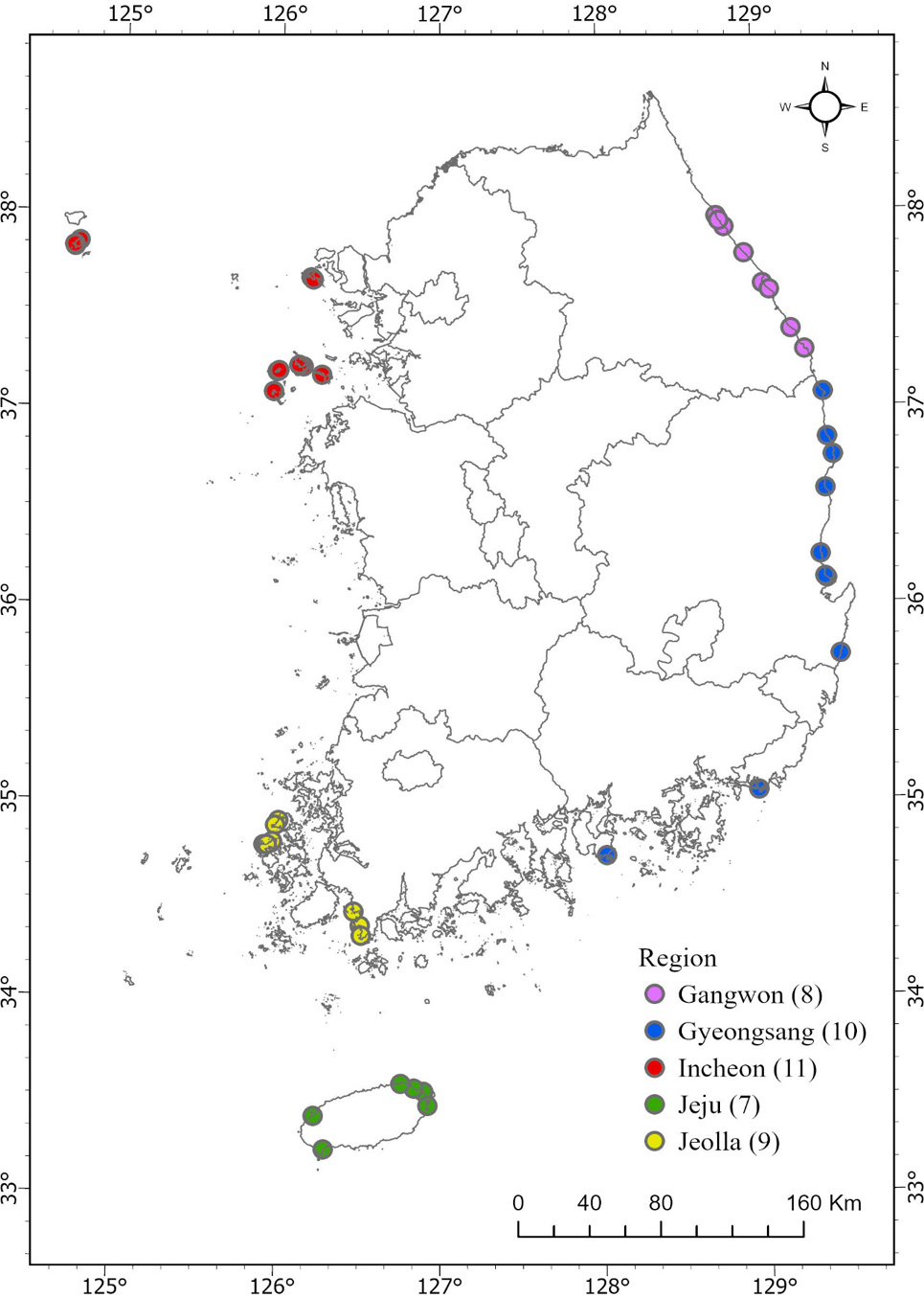
Location of the ecological survey of national coastal dunes conducted by regions involved Gangwon (8), Gyeongsang (10), Incheon (11), Jeju (7), Jeolla (9) from April 2020 to August 2024.
References
- Alves, T., Lima, M.R. and dos Anjos, L., 2023. Forest cover positively affects the occurrence of understory insectivorous Passeriformes in bird communities of Atlantic Forest. Commun. Ecol., 24(1): 87-98. https://doi.org/10.1007/s42974-023-00137-7[CrossRef]
- Bakker, M.A., van Heteren, S., Vonhögen, L.M., van der Spek, A.J. and van der Valk, B., 2012. Recent coastal dune development: Effects of sand nourishments. J. Coast. Res., 28: 587-601. https://doi.org/10.2112/JCOASTRES-D-11-00097.1[CrossRef]
- Bartoń, K., 2016. MuMIn: Multi-model inference. R Package, Version 1.15.6. https://CRAN.R-project.org/package=MuMIn
- Branton, M. and Richardson, J.S., 2011. Assessing the value of the umbrella-species concept for conservation planning with meta-analysis. Conserv. Biol., 25: 9-20. https://doi.org/10.1111/j.1523-1739.2010.01606.x[CrossRef]
- Chadwick, A., Weston, M.A., Burns, T., Randall, G., Radvan, M., and Rendall, A.R., 2022. Natural and anthropogenic processes influence the occurrence of vertebrate fauna in coastal dunes. Estuarine, Coastal Shelf Sci., 276: 108025. https://doi.org/10.1016/j.ecss.2022.108025[CrossRef]
- Chang, M.H., Song, J.Y. and Koo, K.S., 2021. Effect of coastal dune restoration on the population of endangered Mongolian racerunner (Ertmias argus) in the Republic of Korea. J. Coast. Conserv., 25: 29. https://doi.org/10.1007/s11852-021-00820-9[CrossRef]
- Chatterjee, S. and Basu, P., 2018. Food preference determine habitat selection at multiple scales: implication for bird conservation in tropical forests. Anim. Conserv., 21: 332-342. https://doi.org/10.1111/acv.12397[CrossRef]
- Chen, L., Shu, Z., Yao, W., Ma, Y., Xio, W. and Huang, X., 2019. Combined effects of habitat and interspecific interaction define cooccurrence patterns of sympatric Galliformes. Avian Res., 10: 29. https://doi.org/10.1186/s40657-019-0169-2[CrossRef]
- Codron, D., Hull, J., Brink, J.S., Codron, J., Ward, D. and Clauss, M., 2011. Effect of competition on niche dynamics of syntopic grazing ungulates: Contrasting the predictions of habitat selection models using stable isopote analysis. Evol. Ecol. Res., 13(3): 217-235.
- D’Alessandro, F., Tomasicchio, G.R., Francone, A., Leone, E., Frega, F., Chiaia, G., Saponieri, A. and Damiani, L., 2020. Coastal sand dune restoration with an eco-friendly technique. Aquat. Ecosyst. Hlth. Manage., 23: 417-426. https://doi.org/10.1080/14634988.2020.1811531[CrossRef]
- Delibes-Mateos, M., Smith, A.T., Slobodchikoff, C.N. and Swenson, J.E., 2011. The paradox of keystone species persecuted as pests: A call for the conservation of abundant small mammals in their native range. Biol. Conserv., 144: 1335-1346. https://doi.org/10.1016/j.biocon.2011.02.012[CrossRef]
- Finke, D.L. and Snyder, W.E., 2010. Conserving the benefits of predator biodiversity. Biol. Conserv., 143: 2260-2269. https://doi.org/10.1016/j.biocon.2010.03.022[CrossRef]
- Gao, J., Kennedy, D.M. and Konlechner, T.M., 2020. Coastal dune mobility over the past century: A global review. Prog. Phys. Geogr. Earth Environ., 44: 814-836. https://doi.org/10.1177/0309133320919612[CrossRef]
- Golubev, S., 2022. Analysis of the attempts to breed seabirds in uninhabited territories of the Haswell archipelago and Adams Island (East Antarctica). Czech Polar Rep., 12: 44-59. https://doi.org/10.5817/CPR2022-1-4[CrossRef]
- Gregory, R.D., Vořišek, P., Noble, D.G., Van Strien, A., Klvaňová, A., Eaton, M., Meyling, A.W.G., Joys, A., Foppen, R.P.B. and Burfield, I.J., 2008. The generation and use of bird population indicators in Europe. Bird Conserv. Int., 18: 223-244. https://doi.org/10.1017/S0959270908000312[CrossRef]
- Hanley, M.E., Hoggart, S.P.G., Simmonds, D.J., Bichot, A., Colangelo, M.A., Bozzeda, F., Heurtefeux, H., Ondiviela, B., Ostowski, R., Recio, M., Trude, R., Zawadzka-Kahlau, E. and Thompson, R.C., 2014. Shifting sands? Coastal protection by sand banks, beaches and dunes. Coast. Eng., 87: 136-146. https://doi.org/10.1016/j.coastaleng.2013.10.020[CrossRef]
- Horn, S., de la Vega, C., Asmus, R., Schwemmer, P., Enners, L., Garthe, S., Binder, K. and Asmus, H., 2017. Interaction between birds and macrofauna within food webs of six intertidal habitats of the Wadden Sea. PLoS One, 12: e0176381. https://doi.org/10.1371/journal.pone.0176381[CrossRef]
- Huang, Y., Zhao, Y., Li, S. and von Gadow, K., 2015. The effect of habitat area, vegetation structure and insect richness on breeding bird populations in Beijing urban parks. Urban For. Urban Green., 14: 1027-1039. https://doi.org/10.1016/j.ufug.2015.09.010[CrossRef]
- Iwasato, M. and Nagamatsu, D., 2017. Plant species diversity and habitat conditions in a protected large coastal dune area of western Japan. Landsc. Ecol. Eng., 14: 99-113. https://doi.org/10.1007/s11355-017-0334-x[CrossRef]
- Kammann, S., Schiefelbein, U., Dolnik, C., Mikhaiyuk, T., Demchenko, E., Karsten, U. and Glaser, K., 2023. Successional development of the phototrophic community in biological soil crusts on coastal and inland dunes. Biology, 12: 58. https://doi.org/10.3390/biology12010058[CrossRef]
- Kim, D. and Yu, K.B., 2008. A conceptual model of coastal dune ecology synthesizing spatial gradients of vegetation, soil, and geomorphology. Plant Ecol., 202: 135-148. https://doi.org/10.1007/s11258-008-9456-4[CrossRef]
- Kindermann, G. and Gormally, M.J., 2010. Vehicle damage caused by recreational use of coastal dune systems in a Special Area of Conservation (SAC) on the west coast of Ireland. J. Coast. Conserv., 14: 173-188. https://doi.org/10.1007/s11852-010-0102-7[CrossRef]
- Lantschner, M.V., Rusch, V. and Hayes, J.P., 2012. Habitat use by carnivores at different spatial scales in a plantation forest landscape in Patagonia, Argentina. For. Ecol. Manage., 269: 271-278. https://doi.org/10.1016/j.foreco.2011.12.045[CrossRef]
- Luna-Jorquera, G., Fernández, C.E. and Rivadeneira, M.M., 2012. Determinants of the diversity of plants, birds and mammals of coastal islands of the Humbolt current systems: Implications for conservation. Biodiv. Conserv., 21: 13-32. https://doi.org/10.1007/s10531-011-0157-2[CrossRef]
- Marczak, L.B., Thompson, R.M. and Richardson, J.S., 2007. Meta-analysis: Trophic level, habitat, and productivity shape the food web effects of resource subsides. Ecology, 88: 140-148. https://doi.org/10.1890/0012-9658(2007)88[140:MTLHAP]2.0.CO;2[CrossRef]
- Ministry of Environment, 2020. Land use map: Partners Available at https://egis.me.go.kr/map/map.do (accessed 1 Feb 2021).
- Mohamed, I.N.L. and Verstraeten, G., 2012. Analyzing dune dynamics at the dune-field scale based on multi-temporal analysis of Landsat-TM images. Remote Sens. Environ., 119: 105-117. https://doi.org/10.1016/j.rse.2011.12.010[CrossRef]
- Pessoa, M.F. and Lidon, F.C., 2013. Impact of human activities on coastal vegetation-A review. Emirat. J. Fd. Agric., 25: 16730. https://doi.org/10.9755/ejfa.v25i12.16730[CrossRef]
- Pontee, N., 2013. Defining coastal squeeze: A discussion. Ocean Coast. Manage., 84: 204-207. https://doi.org/10.1016/j.ocecoaman.2013.07.010[CrossRef]
- Qian, J., Zhuang, H., Yang, W., Chen, Y., Chen, S., Qu, Y., Zhang, Y., Yang, Y. and Wang, Y., 2020. Selecting flagship species to solve a biodiversity conservation conundrum. Pl. Diversity, 42: 448-491. https://doi.org/10.1016/j.pld.2021.01.004[CrossRef]
- Raymond, C.M. and Brown, G., 2011. Assessing conservation opportunity on private land: Socio-economic, behavioral and spatial dimensions. J. Environ. Manage., 92: 2513-2523. https://doi.org/10.1016/j.jenvman.2011.05.015[CrossRef]
- Rechetelo, J., Grice, A., Reside, A.E., Hardesty, B.D. and Moloney, J., 2016. Movement patterns, home range size and habitat selection of an endangered resource tracking species, the black-throated finch (Poephilia cincta cincta). PLoS One, 11: e0167254. https://doi.org/10.1371/journal.pone.0167254[CrossRef]
- Redpath, S.M., Linnel, J.D.C., Festa-Bianchet, M., Boitani, L., Bunnefeld, N., Dickman, A., Gutiérrez, R.J., Irvine, R.J., Johansson, M., Majić, A., McMahon, B.J., Pooley, S., Sandström, C., Sjölander-Lindqvist, A., Skogen, K., Swenson, J.E., Trouwborst, A., Young, J. and Milner-Gulland, E.J., 2017. Don’t forget to look down–collaborative approaches to predator conservation. Biol. Rev., 92: 2157-2163. https://doi.org/10.1111/brv.12326[CrossRef]
- Šálek, M., Kreisinger, J., Sedláček Sedláček, F. and Albrecht, T., 2010. Do prey densities determine preferences of mammalian predators for habitat edges in an agricultural landscape? Landsc. Urban Plann., 98: 86-91. https://doi.org/10.1016/j.landurbplan.2010.07.013[CrossRef]
- Santamaria-Rivero, W., Leyequien, E., Hernandez-Stefanoni, J.L. and Wood, P., 2016. Influence of landscape structure and forest age on the richness and abundance of different bird feeding guilds and forest-dependent birds in a seasonal dry tropical forest of Yucatan, Mexico. Trop. Ecol., 57: 313-332.
- Sigren, J., Figlus, J. and Armitage, A., 2014. Coastal sand dunes and dune vegetation: Restoration, erosion, and storm protection. Shore Beach, 82: 5-12.
- Wagner, P. and Wilms, T.M., 2010. A crowned devil: New species of Cerastes Laurenti, 1768 (Ophidia, Viperidae) from Tunisia, with two nomenclatural comments. Bonn Zool. Bull., 57: 297-306.
- Westhoff, V. and Van Der Maarel, E., 1978. The braun-blanquet approach. In: Classification of plant communities. Springer Netherlands, Dordrecht. pp. 287-399. https://doi.org/10.1007/978-94-009-9183-5_9[CrossRef]
Services
Article usage statistics
Loading…