
Microplastics (MPs) are an emerging class of ubiquitous pollutants that pose a threat to aquatic biota. It has been established that Sewage treatment plant (STP) effluents are a potential source of MPs into the aquatic compartment of the environment. The present study elucidates the apoptotic effect of these contaminants in the effluent on the liver of effluent exposed freshwater fish (Oreochromis niloticus) and the remedial effect of UV mediated photocatalytic degradation of zinc oxide nanoparticles (ZnONPs).The fish were exposed to 50% and 75% of the effluent without treatment and with treatment with ZnO NPs. Exposure to potential MPs in the effluent induced the reactive oxygen species (ROS) generation, subsequently affecting the oxidative mechanism leading to apoptosis. The mRNA expression profile of pro-apoptotic gene Bax and tumour suppressor gene, p53 was upregulated significantly in the group exposed to 75 % effluent. Treatment with the ZnONPs, significantly retreated the alterations in the mRNA expression of both Bax and p53. In conclusion, the findings of this work suggest that the MPs and the compounds in the organic matrix of the STP effluent induced a concentration-dependent ROS mediated apoptotic response in tilapia. Furthermore, zinc oxide exhibits immense potential towards absorption and degradation of organic pollutants from wastewater in the field of heterogeneous photo catalysis and can be further encouraged as a sustainable strategy in water remediation.
Research Article · Volume 57, Issue 4, 8 June 2025 · Open Access
Putative Remedial Effect of Zinc Oxide Nanoparticles on the Apoptotic Response in Nile Tilapia Exposed to Potential Micro Plastics in Sewage Effluent
· · · ·
Affiliations & Notes ⌄
- 1Department of Zoology, College of Sciences, King Saud University, P.O. Box 22452, Riyadh, 11459, Saudi Arabia. 2King Abdullah Institute for Nanotechnology, King Saud University, Riyadh, 11451, Saudi Arabia. 3Department of Chemical Engineering, King Saud University, Riyadh, 11421, Saudi Arabia. * Corresponding author: bvirk@ksu.edu.sa
Article Info ⌄
- Journal:
- Pakistan Journal of Zoology
- Published:
- 8 June 2025

From the article
- The findings of the present study demonstrated the photo-degradative ability of the ZnO NPs as a nano-photo catalyst that alleviated the oxidative stress and apoptosis induced by the potential MPs in the effluent.
- The biomarker response demonstrated a marked increase in the mRNA expression of the apoptosis-related regulator gene Bax (Fig. 1A) in a concentration-dependent manner, being significantly (p ≤ 0.05) high in fish exposed to 75% sewage effluent (SE75).
- There was no significant change observed in the mRNA expression of Bax in the control (C) and the groups exposed to only ZnO NPs (ZnO) and the 50% sewage effluent (SE50).
- Groups exposed to the effluent showed a dose-dependent response; the mRNA expression of hepatic p53 was significantly elevated (16.283±0.410) in comparison to the control (0.447±0.035) and the group exposed to 50% of (SE50) (1.20±0.554).
Selected from the article's own text.
Abstract
Introduction
Even though plastics primarily originate on land, their ubiquitous existence in the aquatic compartments of the environment is notable. The microplastics (MPs) and nano plastics as a result of plastic degradation in marine environments has garnered significant attention in the past few years and research on MPs in freshwater resources has been rising in the recent times. Microplastics are considered as contaminants of emerging concern (CECs) in the aquatic environment adversely affecting aquatic life as well as posing potential public health risks globally . Due to their accumulation in organisms, MPs inevitably result in chronic toxicity manifested as oxidative stress and apoptosis . Prior to entering natural aquatic systems, wastewater treatment plants (WWTPs) or sewage treatment plants (STPs) are thought to be the major recipients of terrestrial MPs where primary MPs are transformed into secondary MPs. Thus, WWTPs are often considered as a major source of MPs in the aquatic environment . Substantial amounts of MPs have been reported to be removed by WWTPs. However, the continual discharge of the escaped MPs in the effluents adds up enormously to the MP mass in the receiving waterbodies.
Extensive research conducted in both lab and field settings has shown that emerging contaminants such as MPs negatively impact various fish organs. Fish growth may be severely inhibited by MPs, resulting in severe mortality thereby threatening aquatic biodiversity . Additionally, a number of studies have shown that freshwater fish kept in cages in rivers that receive wastewater exhibited increased levels of oxidative stress indicators and biotransformation enzymes . DNA damage, lipid peroxidation (LPO), enzymatic inactivation, and eventually cell death are all possible outcomes of oxidative stress ; van der Oost et al., 2003). Thus, oxidative stress is so far most widely reported in the pathogenesis of MP exposure in fish, animals and humans . This is possibly the common denominator in the toxicological MPs and is associated to physiological responses such as metabolism, apoptosis and immunity. The generation of ROS (reactive oxygen species) elicited by oxidative stress is associated to apoptotic cell death via the mitochondrial apoptosis pathway. It has been previously documented how exposure to MPs in fish triggers the p53 apoptotic cascade through ROS. Additionally, cell cycle, senescence, cell survival, and apoptosis include the biological responses that are regulated by the p53 signaling system .
Considering the environmental impact of the emerging contaminants including MPs in the wastewater, it is imperative to efficaciously treat effluent to and remove these particles before being discharged into water bodies. One of the major global challenges today is sustainable environmental remediation and restoration. For a long time, heterogeneous photo catalysis has been seen as a promising and sustainable strategy. Harmful organic contaminants are effectively degraded or removed from wastewater by using photocatalytic semiconductor materials like metal oxides. Although a variety of metal oxides exhibit photocatalytic activity, ZnO has garnered most attention due to its ability to completely degrade pollutants and break them down into simpler molecules .
On the other hand, nanoparticles of ZnO have been widely used in wastewater remediation. In addition, application of illuminated (solar/ultraviolet) semiconductors nanoparticles has been successfully employed for the decomposition of variety of organic contaminants in water. In fact, the present study is an extension of our previous work that reported an exhaustive analysis of wastewater to identify potential MPs and the heterogeneous photocatalytic degradation by ZnO nanoparticles (ZnONPs).
Materials and Methods
The present study reports additional findings on bioassays that illustrate the toxicological effect of exposure to potential MPs in the wastewater along with other organic contaminants. The study was conducted at the Animal House Facility at King Saud University, Riyadh, Saudi Arabia. The Institutional Research Ethics Committee, Deanship of Scientific Research, King Saud University, Riyadh, Saudi Arabia, approved the exposure study (Approval number: KSU-SE-21-73). The study included the exposure of the freshwater fish, Oreochromis niloticus (Nile tilapia) to high and low concentrations (75%, 50%) of treated effluent from a local WWTP in Riyadh City, Saudi Arabia. In addition, the remedial effect of the ZnO NPs was elucidated through the oxidative photo degradation of the MPs which were primarily identified as fibres and fragments (PE, PP, PVC and PET). After the exposure period, fish from every tank were rinsed with methanol, and anesthetized with buffered MS-222 and euthanized by cervical transection. After this, liver samples were removed and preserved at -80°C for later analysis. The bioassays showed marked induction of oxidative stress markers; lipid peroxidation, DNA damage and modulation of 7-ethoxyresorufin-O-deethylase (EROD) activity which was attenuated by the ZnONPs induced photo degradation of contaminants in the wastewater .
The current study focussed on the assessment of the oxidative stress driven apoptosis in the liver of the fish exposed to the wastewater and the remedial effect of the ZnO NP mediated and UV illuminated photo degradation.
Quantification of mRNA of Bax and p53
Quantitating changes in the mRNA expression levels of target pro-apoptotic gene (Bax) and anti-tumor suppressor gene (p53) were assessed by quantitative real-time PCR (q RT-PCR), a two-step process employed for mRNA quantification using gapdh as the house keeping gene. For cDNA synthesis, the Pure Link RNA mini kit Quick Reference was used (Qiagen, Limburg, Netherlands). The amplifications were done in duplicates with a real-time PCR instrument (7500, Applied Biosystems, Grand Island, USA). The ΔCT value was calculated by the subtraction of the gapdh CT from each target gene CT. This was followed by the calculation of the ΔΔCT value by subtraction of the control ΔCT from each Bax and p53 ΔCT. The expression relative to control was finally calculated using the equation 2−ΔΔCT. The amplifications were performed in duplicates with a real-time PCR (7500, Applied Biosystems, Grand Island, USA). The gene-specific primers are listed in Table I.
Table I. Primer sequences for both target and housekeeping genes used for q RT-PCR .
| Gene | Sequence (5`→3`) | Tm ( c ) |
| gapdh | F= 5-GTGTAGGCGTGGACTGTGGT-3 R= 5-GGGAGTCAACCAGGACAAATA-3 | F→64.5 R→61.3 |
| p53 | F=5-GCATGTGGCTGATGTTGTTC-3 R= 5-GCAGGATGGTGGTCATCTCT-3 | F→58.6 R→62.2 |
| Bax (Bcl2 associated x, apoptosis regulator) Primer | F=5-AAGATGGCAATAAAGCAGTGAC-3 R= 5-TGCAAAGTAGAACAGGGCAAC-3 | F→58.9 R→62.2 |
Statistical analysis
The statistical analysis of the data was conducted with SPSS software (version 22; SPSS Inc., Chicago, IL, USA). To examine group differences, the Tukey’s post hoc test was employed. At a value of p ≤ 0.05, the limit of significance for all analyses was deemed significant.
Results
The findings of the present study demonstrated the photo-degradative ability of the ZnO NPs as a nano-photo catalyst that alleviated the oxidative stress and apoptosis induced by the potential MPs in the effluent. The biomarker response demonstrated a marked increase in the mRNA expression of the apoptosis-related regulator gene Bax (Fig. 1A) in a concentration-dependent manner, being significantly (p ≤ 0.05) high in fish exposed to 75% sewage effluent (SE75). The fold change observed was 13.66±0.055 in comparison to the control (0.213±0.025).
There was no significant change observed in the mRNA expression of Bax in the control (C) and the groups exposed to only ZnO NPs (ZnO) and the 50% sewage effluent (SE50). Among the groups exposed to the effluent treated with ZnO NPs, a significant (p ≤ 0.05) decrease in the expression of Bax was observed in the group exposed to 75% of the effluent (TSE75). A similar pattern was observed for the mRNA expression of the tumor suppressor protein p53 as shown in Figure 1B. The control and the group exposed to ZnO NPs did not elicit a statistically significant change. Groups exposed to the effluent showed a dose-dependent response; the mRNA expression of hepatic p53 was significantly elevated (16.283±0.410) in comparison to the control (0.447±0.035) and the group exposed to 50% of (SE50) (1.20±0.554). Groups exposed to the effluent treated with the nano-photocatalyst (TSE50 and TSE75) demonstrated a reduction in the fold change of P53 mRNA expression being significant (p ≤ 0.05) in the TSE75 group (2.137±0.305).
Discussion
In recent times, oxidative stress has emerged as a significant denominator in aquatic toxicology, with an increasing amount of focus on the mechanism underlying oxidative damage and the cellular response in biological systems . In oxygen-consuming organisms, reactive oxygen species (ROS)are constantly created and the cells maintain a stringent equilibrium and control over the ROS levels. Exposure to hazardous chemical pollutants may produce an imbalance between these endogenous and external ROS, which may then lower an organism’s antioxidant defences or result in oxidative damage, what is also known as oxidative stress . Thus, oxidative stress plays a significant role in the toxicity of chemical pollutants. Mitochondrial malfunction subsequent to oxidative damage is one of the initial stages of apoptotic cell death as the pro-apoptotic component cytochrome C (Cyt C) is released into the cytoplasm. The pro-apoptogenic protein Bax promotes the release of Cyt C from the mitochondria, but the anti-apoptotic protein Bcl-2 can inhibit Cyt C its release .
In line with this, the present study showed a marked a dose-dependent upregulation of the pro-apoptogenic gene, Bax in tilapia on exposure to the sewage effluent. The expression was statistically significant to the control in the group exposed to 75% of the effluent. Furthermore, a similar pattern was observed in the hepatic expression of p53, the tumour suppressor gene that regulates cell division. The expression of p53 was also significantly higher in the group exposed to a higher concentration of the effluent. According to reports, this is consistent with the role of ROS in the signalling pathways leading to p53’s mitochondrial migration, which in turn initiates ROS-dependent cell death . Higher levels of p53 upregulate the expression of the proto-oncogene MDM2 ; . Furthermore, by upregulating the expression of Bax and downregulating the expression of Bcl-2, p53 can induce apoptosis ; . The results of the current study are in consensus with a previous study by Ganesan et al. (2021) that assessed the impact of tannery wastewater on Oreochromis mossambicus fingerlings, a species of freshwater fish. The fish on exposure to 10% tannery effluent concentration showed significantly modulated activity for caspase 3 and 9 (pro-apoptotic proteins) with a concomitant marked DNA damage assessed by Comet assay.
Since STP effluents are a major source of both legacy and emerging pollutants, including metals, pesticides, detergents, plastic by-products, micro plastics, pharmaceuticals, and personal care products (PPCPs), they are frequently a source of stress in the urban areas. Several of these chemicals are ineffectively or entirely eliminated via standard wastewater treatment procedures because STPs are not built to break down such contaminants . The biological disruption observed in wild fish collected downstream from STP outfalls ranges from molecular to whole-organism responses. There have been several studies that have reported biological responses that include altered gene expression, gonadal intersex and external male feminization, poor fertilization success, increased metabolism, impaired stress responsiveness ; .
Untreated MPs have been reported to often exit STPs, find their way into water bodies, and eventually build up in the environment . Our previous study provided a comprehensive account on the presence of potential MPs in the organic matrix of the domestic sewage effluent and its subsequent biological response in Nile tilapia. The exposure study reported an induction of oxidative stress and DNA damage in fish exposed to two different concentrations of the effluent (50% and 75%). The results of the present study are an extension of this study and mirror the biological responses described previously. Numerous papers on micro plastic toxicology have documented oxidative stress, which is intimately linked to physiological responses like metabolism, apoptosis, and immunology and may be the primary toxicity of micro plastics . The intermediate processes of these responses, which are mediated by oxidative stress in micro plastic toxicity studies, are, nevertheless, little understood. In a thorough investigation, Umamaheswari et al. (2021) demonstrated that ROS-mediated changes to p53 signaling were the source of zebrafish apoptosis during MPs stress . Furthermore, the findings of the current study show that the treated STP effluent with ZnO NPs under UV irradiation reversed the apoptosis induced by the potential MPs and other organic contaminants in the effluent. The photo degradative effect of the ZNO NPs on the MPs has been reported previously ; Tofa et al., 2019a, b).
There has been a plethora of studies which have focused on photo catalysis that plays an important role in the water remediation process using nanomaterials ; .
Conclusion
In conclusion, the results of the current study reveal the photo degradative competency of zinc oxide nanoparticles for disinfecting water under UV light irradiation. The sewage effluent on treatment with the ZnONPs effectively transposed the modulatory effect on the expression of the apoptotic genes. Thus, wastewater/effluent can be treated with ZnO nanoparticles in the remedial process to eliminate MPs and other organic compounds and microbes. ZnO nanoparticles are harmless with enhanced photocatalytic activity, low cost, antimicrobial in action making their commercial application a sustainable strategy in near future to. Nonetheless, further studies are still imperative to use ZnO-based nanocomposites and doped ZnO NPs under solar irradiation.
Declarations
Acknowledgement/ Funding
The authors acknowledge the Research Institute /Centre supporting program (RICSP-25-1), King Saud University, Riyadh, Saudi Arabia.
Ethics statement
The Institutional Research Ethics Committee,Deanship of Scientific Research, King Saud University, Riyadh, Saudi Arabia, approved the exposure study (Approval number: KSU-SE-21-73).
Data availability statement
Data will be available on request.
Statement of conflict of interest
The authors have declared no conflict of interest.
Figures
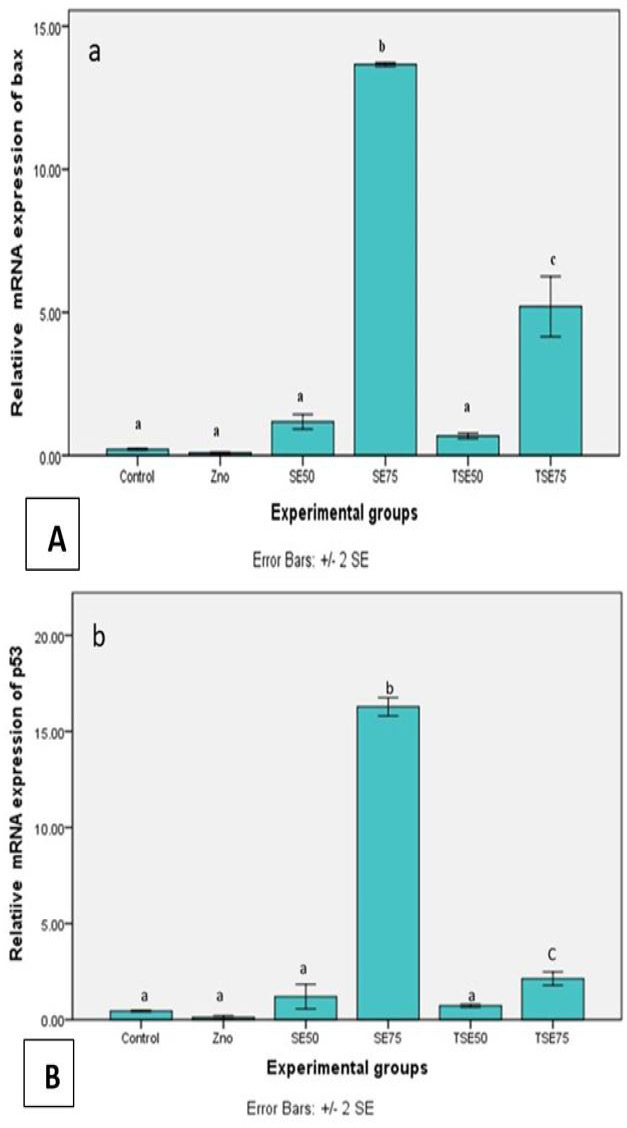
Effect of ZnO nanoparticles (TSE50 and TSE75) on hepatic mRNA expression of Bax gene (A) and p53 gene (B) in Nile tilapia exposed to 50% (SE50) and 75% (SE75) of sewage effluent. The values are Mean (±SE) fold change in hepatic mRNA expression. Variables with the same letter show no statistical difference between the means.
References
- Aftab, S., Shabir, T., Shah, A., Nisar, J., Shah, I. and Muhammad, H., 2022. Highly efficient visible light active doped ZnO photocatalysts for the treatment of wastewater contaminated with dyes and pathogens of emerging concern. Nanomater, 12: 486. https://doi.org/10.3390/nano12030486[CrossRef]
- Alanazi, M.Q., Virk, P., Alterary, S.S., Awad, M., Ahmad, Z., Albadri, A.M., Albadri, A.M., Ortashi, K.M., Ahmed, M.M.A., Yousef, M.I.A., Elobeid, M. and Al-Qahtani, E.A., 2023. Effect of potential microplastics in sewage effluent on Nile Tilapia and photocatalytic remediation with zinc oxide nanoparticles. Environ. Pollut., 332: 121946. https://doi.org/10.1016/j.envpol.2023.121946[CrossRef]
- Blanco, M., Rizzi, J., Fernandes, D., Colin, N., Maceda-Veiga, A. and Porte, C., 2019. Assessing the impact of waste water effluents on native fish species from a semi-arid region, NE Spain. Sci. Total Environ., 654: 218–225. https://doi.org/10.1016/j.scitotenv.2018.11.115[CrossRef]
- de Rozieres, S., Maya, R., Oren, M. and Lozano, G., 2000. The loss of mdm2 induces p53-mediated apoptosis. Oncogene, 19: 1691–1697. https://doi.org/10.1038/sj.onc.1203468[CrossRef]
- Galluzzi, L. and Kroemer, G., 2007. Mitochondrial apoptosis without VDAC. Nat. Cell Biol., 9: 487-489. https://doi.org/10.1038/ncb0507-487[CrossRef]
- Ganesan, N., Samyappan, K. and Saravanan, R., 2021. Assessment of DNA damage and apoptosis in the brain of freshwater fish Oreochromis mossambicus exposed to tannery effluent wastewater. Appl. Ecol. environ. Res., 9: 575-579. https://doi.org/10.12691/aees-9-5-8[CrossRef]
- Kim, J.H., Yu, Y.B. and Choi, J.H., 2021. Toxic effects on bioaccumulation, hematological parameters, oxidative stress, immune responses and neurotoxicity in fish exposed tomicroplastics: A review. J. Hazard. Mater., 413: 125423. https://doi.org/10.1016/j.jhazmat.2021.125423[CrossRef]
- Lee, J., Kang, J. and Kim, J., 2023. Toxic effects of microplastic (Polyethylene) on fish: Accumulation, hematological parameters and antioxidant responses in Korean Bullhead, Pseudobagrus fulvidraco. Sci. Total Environ., 877: 162874. https://doi.org/10.1016/j.scitotenv.2023.162874[CrossRef]
- Li, J.Y., Liu, H.H. and Paul, C.J.P., 2018. Microplastics in freshwater systems: A review on occurrence, environmental effects, and methods for microplastics detection. Water Res., 137: 362–374. https://doi.org/10.1016/j.watres.2017.12.056[CrossRef]
- Liu, W., Zhang, J., Liu, H., Guo, X., Zhang, X., Yao, X., Cao, Z. and Zhang, T., 2021. A review of the removal of microplastics in global wastewater treatment plants: Characteristics and mechanisms. Environ. Int., 46: 106277. https://doi.org/10.1016/j.envint.2020.106277[CrossRef]
- McCallum, E.S., Nikel, K.E., Mehdi, H., Du, S.N.N., Bowman, J.E., Midwood, J.D., Kidd, K.A., Scott,G.R. and Balshine, S., 2019. Municipal wastewater effluent affects fish communities: A multi-year study involving two wastewater treatment plants. Environ. Pollut., 252: 1730-1741. https://doi.org/10.1016/j.envpol.2019.06.075[CrossRef]
- Michael, D. and Oren, M., 2002. The p53 and Mdm2 families in cancer. Curr. Opin. Genet. Dev., 12: 53–59. https://doi.org/10.1016/S0959-437X(01)00264-7[CrossRef]
- Pérez, M.R., Rossi, A.S., Bacchetta, C., Elorriaga, Y., Carriquiriborde, P., Cazenave, J., 2018. In situ evaluation of the toxicological impact of a wastewater effluent on the fish Prochilodus lineatus: Biochemical and histological assessment. Ecol. Indic., 84: 345-353. https://doi.org/10.1016/j.ecolind.2017.09.004[CrossRef]
- Perveen, S., Pablos, C., Reynolds, K., Stanley, S. and Marugán,J., 2022. Microplastics in fresh- and wastewater are potential contributors to antibiotic resistance. A mini review. J. Hazard. Mater., 6: 100071. https://doi.org/10.1016/j.hazadv.2022.100071[CrossRef]
- Puri,N. and Gupta, A., 2023. Water remediation using titanium and zinc oxide nanomaterials through disinfection and photo catalysis process: A review. Environ. Res., 227: 115786. https://doi.org/10.1016/j.envres.2023.115786[CrossRef]
- Selvakumaran, M., Lin, H.K., Miyashita, T., Wang, H.G., Krajewski, S., Reed, J.C., Hoffman, B. andLiebermann, D., 1994. Immediate early up-regulation of bax expression by p53 but not TGF beta 1: A paradigm for distinct apoptotic pathways. Oncogene, 9: 1791–1798.
- Sun, J., Dai, X.H., Wang, Q.L., van Loosdrecht, M.C.M. and Ni, B.J., 2019. Microplastics in wastewater treatment plants: Detection, occurrence and removal. Water Res., 152: 21–37. https://doi.org/10.1016/j.watres.2018.12.050[CrossRef]
- Tang, N., Liu, X. and Xing, W., 2020. Microplastics in wastewater treatment plants of Wuhan, central China: Abundance, removal, and potential source in household wastewater. Sci. Total Environ., 745: 141026. https://doi.org/10.1016/j.scitotenv.2020.141026[CrossRef]
- Tofa, T.S., Kunjali, K.L., Paul, S. and Dutta, J., 2019a. Visible light photocatalytic degradation of microplastic residues with zinc oxide nanorods. Environ. Chem. Lett., 7: 1341–1346. https://doi.org/10.1007/s10311-019-00859-z[CrossRef]
- Tofa, T.S., Ye, F., Kunjali, K.L. and Dutta, J., 2019b. Enhanced visible light photodegradation of microplastic fragments with plasmonic platinum/zinc oxide Nanorod photocatalysts. Catalysts, 10: 819. https://doi.org/10.3390/catal9100819[CrossRef]
- Umamaheswari, S., Priyadarshinee, S., Kadirvelu, K. and Ramesh, M., 2021. Polystyrene microplastics induce apoptosis via ROS-mediated p53 signaling pathway in zebrafish. Chem. Biol. Interact., 345: 109550. https://doi.org/10.1016/j.cbi.2021.109550[CrossRef]
- van der Oost, R., Beyer, J. and Vermeulen, N.P., 2003. Fish bioaccumulation and biomarkers in environmental risk assessment: A review. Environ. Toxicol. Pharmacol., 13: 57–149. https://doi.org/10.1016/S1382-6689(02)00126-6[CrossRef]
- Wang, F., Zheng, F. and Liu, F., 2020a. Effects of triclosan on antioxidant-and apoptosis-related genes expression in the gill and ovary of zebrafish. Exp. Anim., 69: 199-206. https://doi.org/10.1538/expanim.19-0115[CrossRef]
- Wang, R., Liu, K., Zhang, Y., Chen, X. and Wang, X., 2020b. Evaluation of the developmental toxicity induced by E804 in zebrafish embryos. Front. Pharmacol., 11: 32. https://doi.org/10.3389/fphar.2020.00032[CrossRef]
- Xu, T., Cui, J., Xu, R., Cao, J. and Guo, M., 2023. Microplastics induced inflammation and apoptosis via ferroptosis and the NF-κB pathway in carp. Aquat. Toxicol., 262: 106659. https://doi.org/10.1016/j.aquatox.2023.106659[CrossRef]
Services
Article usage statistics
Loading…