
Zucchini yellow mosaic virus (ZYMV) presents a major threat to the global cucurbit crop production, highlighting the urgent need for safe and effective vaccine strategies. This study aimed to employ a comprehensive in silico approach to identify immunogenic epitopes from the ZYMV capsid protein, targeting B-cell, cytotoxic T lymphocyte (CTL), and helper T lymphocyte (HTL) responses. B-cell epitope prediction using ABCpred and SVMTrip revealed high-scoring, overlapping sequences, particularly in the 38–57 region, with strong antigenicity and favorable safety profiles (i.e., non-allergenic and non-toxic). For CTL epitope identification, NetMHCpan analysis highlighted the potent MHC Class I binders, including ASHQQFSSW, LEYKPDQIEL, and GSHGKIVPR. Notably, GSHGKIVPR overlapped with the predicted B-cell regions, supporting its potential for inclusion in a multi-epitope vaccine. HTL epitopes predicted via NetMHCIIpan included immunodominant peptides such as PDQIELYNTRASHQQ (86–100), capable of eliciting robust CD4⺠T-cell responses. The final vaccine construct incorporated the most promising epitopes, linked appropriately, and combined with an adjuvant. Physicochemical characterization indicated a stable, soluble, and immunogenic protein (instability index: 24.35; GRAVY: –0.722; pI: 9.11), with favorable predicted half-lives across the multiple expression systems. Structural modeling confirmed correct folding and surface accessibility of epitopes. Validation through Ramachandran plot and Z-score analysis further supported the structural integrity of the construct. Overall, these findings point to a promising multi-epitope vaccine candidate against ZYMV, meriting experimental validation and further development.
Research Article · Volume 9, Issue 5, 17 September 2025 · Open Access
Proteomic Analysis and Immunogenic Characterization of Multi-Epitopes Predicted from the Zucchini yellow mosaic virus Coat Protein for Immunization and Diagnostic Tool Development
· · · ·
Affiliations & Notes ⌄
- 1Department of Agricultural Microbiology, Laboratory of Virology, Faculty of Agriculture, Ain Shams University, P.O. Box 68, Hadayek Shobra, Cairo, Egypt
- 2Agricultural Genetic Engineering Research Institute, Agricultural Research Center, 9 Gamaa St., P.O. Box, 12619, Giza, Egypt. *Correspondence | Atef Shoukry Sadik, Department of Agricultural Microbiology, Laboratory of Virology, Faculty of Agriculture, Ain Shams University, P.O. Box 68, Hadayek Shobra, Cairo, Egypt
- 3Email: atef_sadik@yahoo.com
Article Info ⌄
- Journal:
- Novel Research in Microbiology Journal
- Published:
- 17 September 2025

From the article
- Notably, several MHC II peptides overlapped with the epitopes predicted for MHC I and B-cell responses, indicating promising multi-epitope vaccine targets capable of inducing broad immune activation.
- The physicochemical analysis of the multi-epitope vaccine indicated that the construct was well-optimized for expression and delivery.
- In summary, this study successfully developed a promising multi-epitope vaccine candidate targeting ZYMV through an extensive in silico methodology.
- By combining the B-cell, cytotoxic T lymphocyte (CTL), and helper T lymphocyte (HTL) epitopes characterized by high antigenicity, safety, and structural soundness, the construct demonstrated a strong potential to elicit effective and specific immune responses.
Selected from the article's own text.
Abstract
Introduction
Plant viruses represent a major threat to global agriculture, infecting a wide range of host species and causing significant crop losses ; ; . Among them, Zucchini yellow mosaic virus (ZYMV)-a member of the Potyviridae family poses a serious risk to cucurbit production worldwide, with notable economic impact ; ; . Central to ZYMV’s infectivity and host interactions is its coat protein (CP), which plays a critical role in viral assembly, transmission, and immune recognition ; .
The ZYMV CP is a 31-kDa protein that assembles into flexuous and filamentous virions approximately 680–730 nm long and 11–13 nm wide. These virions consist of about 2,000 CP subunits encapsidating a ~9.6 kb RNA genome (Gal-On, 2007; Abdel-Razek et al., 2025). Processed from the C-terminal end of the viral polyprotein, the CP is highly immunogenic and capable of triggering robust immune responses in host plants . Several studies have mapped specific antigenic regions within the CP using monoclonal antibodies (MAbs), aiding in the development of diagnostic tools and cross-protection strategies .
Synthetic peptides and site-directed mutagenesis were applied to full-length ZYMV cDNA clones to precisely identify the CP epitopes recognized by monoclonal antibodies (MAbs) CC11 and DD2. These antibodies demonstrated the ability to successfully distinguish between wild-type and mutant virus strains during mixed infections in muskmelon plants. This specificity underscores their valuable role in strain differentiation and highlights their potential application in plant virology diagnostics and disease management ; . Genetic variations in the CP among different ZYMV isolates also influence the aphid transmissibility and pathogenicity. For instance, specific mutations have been shown to restore vector transmission capability without compromising viral replication, emphasizing the CP’s multifaceted roles in virus-host-vector dynamics ; .
Proteomics has emerged as a powerful tool for studying viral proteins and their interactions with host factors. Several advanced techniques such as two-dimensional gel electrophoresis (2-DE) and differential in-gel electrophoresis (DIGE) have been applied to investigate host responses in virus-resistant transgenic plants, revealing changes in protein expression profiles associated with infection . Additionally, proteomic analyses have helped to distinguish between compatible and incompatible plant-virus interactions, providing insights into the molecular basis of plant defense mechanisms ; ; .
The objective of this study was to conduct a comprehensive proteomic and immune-informatic analyses of ZYMV CP from diverse isolates, with the goal of identifying immunogenic epitopes relevant for vaccine design and serological diagnostics. By integrating molecular, immunological, and bioinformatics approaches, the current study intended to advance the understanding of the CP-mediated immune recognition and support the development of effective tools for early detection and management of ZYMV infections in cucurbit crops.
Materials and Methods
Identification of immunogenic epitopes
The coat protein sequence of the ZYMV Egy-23 isolate (accession number BFF82037.1) was obtained from GenBank (https://www.ncbi.nlm.nih.gov/protein/). To identify potential immunogenic regions, epitope prediction was conducted using immune-informatics tools available through the Immune Epitope Database (IEDB), specifically the Bepipred Linear Epitope Prediction 2.0 algorithm .
B cell epitope prediction
B-cell epitope prediction is a crucial step in identifying the antigenic regions that can effectively stimulate antibody production, potentially replacing the whole antigens. For linear B-cell epitope prediction, the SVMTriP , ABCpred , and Bepipred 2.0 tools available at the Immune Epitope Database and Analysis Resource (IEDB) were utilized. These tools, which relied on sequence properties, amino acid scales, and hidden Markov models (HMMs), are recognized for their high accuracy and strong performance based on area under the curve (AUC) scores .
Prediction of linear B-cell epitopes
Identifying linear B-cell epitopes is essential for pinpointing the antigenic regions capable of inducing specific antibody responses, potentially serving as alternatives to whole-antigen vaccines. In this study, 3 established tools-SVMTriP , ABCpred , and Bepipred 2.0 were employed through the Immune Epitope Database (IEDB) platform. These algorithms leveraged sequence-based features, including amino acid physicochemical properties and machine learning models such as hidden Markov models (HMMs) and supported vector machines, were known for their robust predictive performance as demonstrated by their high AUC values .
Prediction of T-cell epitopes
T-cell epitope identification is essential for understanding the antigen presentation and eliciting the targeted cellular immune responses. Epitopes bound by MHC Class I molecules were typically 8–12 amino acids in length and recognized by CD8⁺ T cells, which differentiated them into cytotoxic T lymphocytes (CTLs). In contrast, MHC Class II molecules, particularly those associated with the HLA-DR complex, presented longer peptides (9–22 amino acids) to CD4⁺ T cells, initiated their differentiation into T helper lymphocytes (THLs). For the prediction of both MHC-I and MHC-II binding peptides, the NetMHCpan and NetMHCIIpan servers were used ; offering reliable binding affinity estimates based on neural networks and peptide-HLA interaction data.
Evaluation of antigenicity, allergenicity, and toxicity
To ensure the safety and immunogenic potential of the selected epitopes, a series of predictive tools was employed. VaxiJen v2.0 was used to assess the antigenicity based on the physicochemical properties, and independent of sequence alignment. AllerTOP v2.1 was utilized to evaluate the likelihood of allergenic responses, while ToxinPred predicted the potential toxicity. This integrative analysis helped to prioritize epitopes with strong immunogenic profiles and low risks of allergenicity or toxicity.
Design and validation of the chimeric vaccine construct
A multi-epitope chimeric vaccine was designed by integrating immunodominant B-cell, CTL, and HTL epitopes into a single construct. To enhance immunogenicity, the PADRE peptide (AKFVAAWTLKAAA) was incorporated at the N-terminal as an adjuvant. Structural flexibility and domain separation were optimized using four commonly employed linkers: EAAAK, AAY, GPGPG, and KK, following established design strategies ; ; ; Yazdani et al., 2023; . To achieve a compact and effective construct, overlapping epitopes were merged, maintaining high immunogenic potential while minimizing redundancy. The final vaccine sequence was organized as follows:
Adjuvant → EAAAK linker → CTL epitopes → AAY linker → HTL epitopes → GPGPG linker → B-cell epitopes → KK linker → 6×His tag. Post-construction, the vaccine candidate underwent evaluation for antigenicity, allergenicity, and toxicity using VaxiJen v2.0, AllerTOP v1.0, and ToxinPred, respectively. Additionally, physicochemical properties such as stability, molecular weight, isoelectric point, and hydropathicity were analyzed using Expasy’s ProtParam tool , confirming the construct’s suitability for further experimental validation.
Three-dimensional structure modeling of the vaccine construct
Protein structure prediction is a critical component of computational biology, employing several methods such as homology modeling, fold recognition, and ab initio prediction. Several state-of-the-art platforms developed to support these approaches. Among them, I-TASSER stands out for its high accuracy, utilizing iterative fragment assembly simulations and ranked among the top performers in CASP7–CASP14 experiments. SWISS-MODEL offered an automated pipeline for homology modeling, leveraging a large database of experimentally resolved structures. Other notable tools include Phyre2 , which employed fold recognition techniques for modeling remote homologs, and GalaxyWEB that refined protein structures via energy minimization and loop modeling. The Robetta server provided integrated structure prediction capabilities, combining both homology-based and ab initio methods. Additionally, AlphaFold developed by DeepMind, represented a major advancement in the field by accurately predicting protein structures directly from amino acid sequences, as demonstrated in CASP13. These tools collectively enabled accurate modeling of the chimeric vaccine’s tertiary structure, essential for downstream validation and docking analyses.
Refinement of predicted protein models
Refining protein structures is essential to improve the accuracy of initial models by correcting the local distortions and enhancing the atomic-level details. Web-based platforms such as DeepRefiner , GalaxyRefine , ModRefiner , and 3Drefine employed multiple techniques like energy minimization and molecular dynamics simulations, to enhance both global conformation and local structural features. These tools optimized the key structural aspects, such as hydrogen bonding networks, and applied composite physics-based and knowledge-based force fields to reduce steric clashes and improve overall model quality . The refined structures served as more reliable inputs for subsequent analyses, including docking, epitope accessibility evaluation, and molecular interaction studies.
Structural model evaluation
Comprehensive quality assessment (QA) is crucial for validating predicted protein models. A range of structural validation tools and metrics were used to evaluate model accuracy in terms of fold geometry, atomic interactions, and stereochemical properties. Key evaluation scores included GDT-TS and GDT-HA , TM-score , RMSD , MolProbity (MP) score and clash score , Z-score and QMEAN , and Ramachandran plot statistics . These metrics collectively assessed model topology, interatomic contacts, and backbone conformation.
For this study, model evaluation was performed using a suite of established web servers, including GalaxyRefine , ModRefiner , ProQ , ProSA-web , and the Ramachandran Plot Server . Additional assessments were conducted via the QMEAN Server and TM-align ; for structural alignment and similarity scoring. Model quality was further validated using the SAVES v6.0 suite , which integrated multiple programs including ERRAT , VERIFY 3D (Lüthy et al., 1992), PROVE , PROCHECK , and WHATCHECK . Together, these tools provided a robust framework for ensuring the structural reliability of the refined vaccine model.
Secondary structure prediction
The secondary structure of the designed vaccine was predicted using the PredictProtein server , a comprehensive meta-platform that integrates multiple tools to forecast structural and functional protein features. These include α helices, β strands, coils, solvent accessibility, trans-membrane helices, coiled-coil regions, disulfide bonds, and intrinsically disordered regions. The platform utilized a range of neural network architectures and sequence-based features, offering varying levels of prediction accuracy based on protein size and input quality. Additional methods such as RaptorX, known for its high-performance contact prediction in CASP12 and CASP13, as well as PSIPRED, SOPMA, Porter, YASPIN, and PROTEUS, were also considered. These tools employed diverse machine learning algorithms to classify the secondary structure elements, further supporting reliable structural modeling of the vaccine candidate.
Tertiary structure modeling and refinement of the chimeric vaccine
The 3D structure of the chimeric vaccine was predicted using AlphaFold 3 (Abramson et al., 2024), a state-of-the-art deep learning tool known for its high accuracy in protein structure prediction, as demonstrated in the CASP13 competition. The initial model was subsequently refined using the GalaxyRefine server to improve both global topology and local structural features. Refinement involved energy minimization and molecular dynamics simulations, optimizing hydrogen bonding networks and applying composite physics- and knowledge-based force fields for atomic-level adjustments . These refinements enhanced the model stability and accuracy, making the structure suitable for downstream applications such as docking and interaction studies. Structural validation was performed using ERRAT and the SAVES v6.0 meta-server , confirming the quality and reliability of the refined 3D model.
Results
Comparative analysis of predicted B-cell epitopes from ZYMV capsid protein
Table 1 presents a comparative overview of B-cell epitope predictions derived from the ZYMV capsid protein using two computational tools: ABCpred and SVMTrip. The identified epitopes exhibited high antigenicity scores, indicating a strong likelihood of eliciting an immune response. Of particular interest is the region spanning amino acids 38 to 57, where both tools predicted overlapping sequences with notably high scores “AVTKDKDVNAGSHGKI” (39–54) from ABCpred and “AAVTKDKDVNAGSHGKIVPR” (38–57) from SVMTrip, scoring 1.0776 and 1.2196, respectively. This overlap suggested a conserved and highly immunogenic region that may be suitable for vaccine or diagnostic applications. Furthermore, all predicted peptides were classified as non-allergenic and non-toxic, supporting their safety profile and potential for further experimental development. The convergence of results from both prediction tools enhanced confidence in the immunological relevance of this epitope-rich segment.
MHC class I binding predictions for ZYMV capsid peptides
The results of MHC Class I binding predictions for peptides derived from the ZYMV capsid protein as analyzed using the NetMHCpan server are presented in Table 2. Peptides with binding scores closer to 1.0 were indicative of strong affinity towards MHC Class I molecules, and were thus more likely to be recognized by the cytotoxic T lymphocytes (CTLs). Among the top-ranking candidates were ASHQQFSSW (score: 0.9878), LEYKPDQIEL (0.9269), and GSHGKIVPR (0.9182), highlighting their potential for inclusion in CTL-targeted vaccine formulations. In addition to binding affinity, several peptides, most notably LEYKPDQIEL and GSHGKIVPR-demonstrated high antigenicity scores (1.5081 and 1.3423, respectively), indicating a strong capacity to stimulate immune responses. All listed peptides were classified as non-allergenic and non-toxic, reinforcing their suitability for therapeutic applications. Importantly, GSHGKIVPR overlapped with a region identified in the B-cell epitope analysis (Table 1), suggesting its potential as a multi-epitope candidate capable of activating both humoral and cellular immune responses.
Table 1: B-cell epitope prediction of the Zucchini yellow mosaic virus capsid protein using ABCpred and SVMTrip servers.
| Epitope type | Location | Antigenicity | Allergenicity | Toxicity |
| Using ABCpred server | ||||
| GEKTVAAVTKDKDVNA | 33-48 | 0.8273 | Non-Allergen | Non-Toxic |
| SDAAEAYIEMRNAEAP | 175-191 | 0.7786 | Non-Allergen | Non-Toxic |
| SGTQPTAADAGATKKD | 1-15 | 0.8727 | Non-Allergen | Non-Toxic |
| ILDIDHLLEYKPDQIE | 75-90 | 0.7736 | Non-Allergen | Non-Toxic |
| DVNAGSHGKIVPRLSK | 45-60 | 0.9049 | Non-Allergen | Non-Toxic |
| AVTKDKDVNAGSHGKI | 39-54 | 1.0776 | Non-Allergen | Non-Toxic |
| AREAVAQMKAAALSNV | 224-239 | 0.5823 | Non-Allergen | Non-Toxic |
| Using SVMTrip server | ||||
| AAVTKDKDVNAGSHGKIVPR | 38-57 | 1.2196 | Non-Allergen | Non-Toxic |
Table 2: MHC class I epitope prediction of the Zucchini yellow mosaic virus capsid protein using NetMHCpan server.
| Sequence type | Position | Score | Antigenicity | Allergenicity | Toxicity |
| ASHQQFSSW | 96-104 | 0.987838 | 0.5134 | Non-allergen | Non-Toxic |
| LEYKPDQIEL | 82-91 | 0.926936 | 1.5081 | Non-allergen | Non-Toxic |
| GSHGKIVPR | 49-57 | 0.918162 | 1.3423 | Non-allergen | Non-Toxic |
| TEYDLNEQQM | 110-119 | 0.813299 | 0.8343 | Non-allergen | Non-Toxic |
| TVAAVTKDK | 36-44 | 0.795015 | 1.1065 | Non-allergen | Non-Toxic |
| RAREAVAQMK | 223-232 | 0.781470 | 0.5504 | Non-allergen | Non-Toxic |
| NEQQMGVVM | 115-123 | 0.777604 | 0.9947 | Non-allergen | Non-Toxic |
| VAQMKAAAL | 228-236 | 0.758701 | 0.8594 | Non-allergen | Non-Toxic |
| NAKPTLRQI | 162-170 | 0.750842 | 0.8938 | Non-allergen | Non-Toxic |
| ATTSEETER | 251-259 | 0.574930 | 0.7251 | Non-allergen | Non-Toxic |
| TARDVNRNM | 261-269 | 0.154824 | 0.5258 | Non-allergen | Non-Toxic |
Table 3: MHC class II epitope prediction of the Zucchini yellow mosaic virus capsid protein using NetMHCIIpan-4.3 server.
| Sequence type | Position | Score | Antigenicity | Allergenicity | Toxicity |
| RKTTVLRKNVTEVDY | 138-152 | 0.1974 | 0.5075 | Non-allergen | Non-Toxic |
| PDQIELYNTRASHQQ | 86-100 | 0.9577 | 0.8238 | Non-allergen | Non-Toxic |
| REAVAQMKAAALSNV | 225-239 | 0.5691 | 0.6045 | Non-allergen | Non-Toxic |
| AAEAYIEMRNAEAPY | 177-191 | 0.2956 | 0.9594 | Non-allergen | Non-Toxic |
| ARDVNRNMHTLLGVN | 262-276 | 0.0778 | 0.6031 | Non-allergen | Non-Toxic |
| TQPTAADAGATKKDK | 3-17 | 0.1098 | 1.0748 | Non-allergen | Non-Toxic |
| AYIEMRNAEAPYMPR | 180-194 | 0.1440 | 1.0876 | Non-allergen | Non-Toxic |
| QVRTEYDLNEQQMGV | 107-121 | 0.0912 | 0.9435 | Non-allergen | Non-Toxic |
MHC class II binding predictions and antigenicity for ZYMV capsid peptides
As analyzed using NetMHCIIpan-4.3, the MHC Class II binding predictions for peptides derived from the ZYMV capsid protein are summarized in Table 3. Each peptide was evaluated based on its predicted binding affinity to MHC II molecules, as well as its antigenicity, allergenicity, and toxicity, to assess its capacity to trigger CD4⁺ T-helper cell responses. The peptide PDQIELYNTRASHQQ (residues 86–100) exhibited the highest binding score (0.9577), expressing it as a particularly promising candidate for MHC II presentation. While binding affinities varied across the peptides, several stood out for their strong antigenic potential, including AYIEMRNAEAPYMPR (1.0876), TQPTAADAGATKKDK (1.0748), and QVRTEYDLNEQQMGV (0.9435). These values displayed the peptides capacity to elicit a robust immune activation. Notably, all predicted peptides were found to be non-allergenic and non-toxic, supporting their suitability for safe therapeutic application. In addition, some peptides overlapped with epitopes previously identified in the MHC Class I and the B-cell predictions, particularly those spanning residues 86–100 and 177–194, highlighting potential multi-epitope regions capable of stimulating both humoral and cellular immune responses.
Overlapping B-cell, CTL and THL epitopes from zymv capsid protein for multi-epitope vaccine design
Table 4 presents a curated selection of overlapping B-cell, cytotoxic T lymphocyte (CTL), and helper T lymphocyte (THL) epitopes identified from the ZYMV capsid protein using a comprehensive in silico pipeline. incorporating ABCpred, NetMHCpan (MHC I), and NetMHCIIpan (MHC II). These overlapping sequences were of particular interest due to their potential to activate multiple arms of the immune system. A notable example is the peptide AAVTKDKDVNAGSHGKIVPR (residues 38–57), which appeared in both B-cell and CTL predictions, overlapping with CTL epitopes TVAAVTKDK and GSHGKIVPR, indicated its potential to induce both humoral and cellular immune responses. Similarly, the sequences AREAVAQMKAAALSNV (224–239) and REAVAQMKAAALSNV (225–239) were identified as shared B-cell and THL epitopes, emphasizing the immunogenic relevance of the C-terminal region of the protein. Regions such as 1–17
Table 4: Final overlapping B-cell and T-cell Epitopes of the Zucchini yellow mosaic virus capsid protein predicted using ABCpred, NetMHCpan, and NetMHCIIpan servers.
| Epitope type | Position | Sequence |
| B-Cell-01 | 1-15 | SGTQPTAADAGATKKD |
| B-Cell-02 | 38-57 | AAVTKDKDVNAGSHGKIVPR |
| B-Cell-03 | 75-90 | ILDIDHLLEYKPDQIE |
| B-Cell-04 | 175-191 | SDAAEAYIEMRNAEAP |
| B-Cell-05 | 224-239 | AREAVAQMKAAALSNV |
| CTL-01 | 36-44 | TVAAVTKDK |
| CTL-02 | 49-57 | GSHGKIVPR |
| CTL-03 | 82-91 | LEYKPDQIEL |
| CTL-04 | 96-104 | ASHQQFSSW |
| CTL-05 | 110-119 | TEYDLNEQQM |
| CTL-06 | 162-170 | NAKPTLRQI |
| CTL-07 | 223-232 | RAREAVAQMK |
| CTL-08 | 251-259 | ATTSEETER |
| CTL-09 | 261-269 | TARDVNRNM |
| THL-01 | 3-17 | TQPTAADAGATKKDK |
| THL-02 | 68-100 | PDQIELYNTRASHQQ |
| THL-03 | 107-121 | QVRTEYDLNEQQMGV |
| THL-04 | 180-194 | AYIEMRNAEAPYMPR |
| THL-05 | 225-239 | REAVAQMKAAALSNV |
| THL-06 | 262-276 | ARDVNRNMHTLLGVN |
(e.g., SGTQPTAADAGATKKD and TQPTAADAGATKKDK) and 68–100 (e.g., PDQIELYNTRASHQQ) were also represented across multiple immune pathways, suggesting they may function as immunodominant hotspots with strong potential for eliciting a comprehensive immune protection. Altogether, the selected epitopes spanned diverse regions of the capsid protein, offering broad epitope coverage that could help reduce the risk of immune escape. These multi-functional sequences were well-suited for the development of multi-epitope vaccines, synthetic peptide formulations, and/or serological diagnostic tools, aimed to generate targeted, robust, and safe immune responses.
Physicochemical properties and stability analysis of the ZYMV multi-epitope vaccine construct
A detailed overview of the physicochemical characteristics of the engineered multi-epitope vaccine construct targeting the ZYMV capsid protein is provided in Table 5. Comprising 343 amino acids and with a molecular weight of 36.78 kDa, the construct fell within the optimal size range for expression and delivery in the heterologous systems. The predicted isoelectric point (pI) of 9.11 indicated a basic protein, suggesting it carried a net positive charge at the physiological pH. This was further supported by the composition of 44 positively charged residues (Arg + Lys) versus 38 negatively charged residues (Asp + Glu), which may influence solubility and interaction with the host components. The chemical formula (C₁₆₀₀H₂₅₂₇N₄₇₉O₄₉₉S₁₀) (PubChem) reflected a compact structure with sulfur-containing residues, which could support disulfide bond formation, contributing to structural integrity. An instability index of 24.35 (below the threshold of 40) suggested the protein was stable and unlikely to be degraded rapidly under the prevailing physiological conditions. Predicted half-lives were favorable across expression platforms: 4.4 hours in mammalian cells (in vitro), over 20 hours in yeasts (in vivo), and more than 10 hours in E. coli. These results supported its suitability for both laboratory research and large-scale production. The aliphatic index of 60.61 suggested moderate thermostability, enhancing its shelf life and storage potential. Additionally, a Grand Average of Hydropathicity score of –0.722 indicated that the protein was hydrophilic, which supported solubility and proper folding-essential features for efficient expression and immune accessibility.
Table 5: Physicochemical properties of the constructed multi-epitope vaccine candidate against Zucchini yellow mosaic virus.
| Aspect | ZYMV vaccine |
| Number of amino acids | 343 |
| Molecular weight | 36,778.18Da |
| Theoretical pI | 9.11 |
| Total number of negatively charged residues (Asp + Glu) | 38 |
| Total number of positively charged residues (Arg + Lys) | 44 |
| Formula | C1600H2527N479O499S10 |
| The estimated half-life | 4.4 hours (mammalian reticulocytes, in vitro) |
| >20 hours (yeast, in vivo) | |
| >10 hours (Escherichia coli, in vivo) | |
| Instability index | 24.35 |
| Aliphatic index | 60.61 |
| Grand average of hydropathicity | -0.722 |
Secondary structure prediction and structural insights of the ZYMV multi-epitope vaccine
The secondary structure of the ZYMV vaccine construct was predicted using the Predict Protein server, providing a comprehensive overview of its structural composition. Results indicated the predominance of α helices, comprising 58.60% of the structure, alongside 4.04% β sheets, and 37.19% random coils, reflecting a folding pattern typical of stable proteins. Surface accessibility analysis further showed that approximately 46.36 % of the amino acid residues were likely exposed on the protein surface, identifying potential sites for immune system recognition. The remaining 53.64% of the residues were buried within the core, contributing to the overall structural stability. This combination of exposed and buried regions suggested a well-balanced conformation that favored proper folding, stability, and efficient immune interaction, supporting the construct’s potential for further experimental validation and vaccine development.
Tertiary structure prediction, refinement and structural validation of the ZYMV multi-epitope vaccine
The structural design and validation of the multi-epitope vaccine candidate strongly supported its stability, feasibility, and immunogenic potential (Figure 1a). The epitopes were strategically organized, beginning with the PADRE adjuvant, followed by CTL, HTL, and B-cell epitopes, separated by EAAAK linkers.
This arrangement promoted functional compartmentalization, enhancing the immunological role of each segment while maintaining structural integrity and minimizing interference among the epitopes. The predicted tertiary structure (Figure 1b) revealed a compact and well-organized fold essential for effective antigen presentation and molecular stability. Computational modeling confirmed that key epitopes were surface-exposed and accessible to the immune cells, critical for vaccine efficacy. The Ramachandran plot (Figure 1c) provided a stereochemical assessment of the protein backbone, showing a high proportion of residues in the favored and allowed regions, indicating an energetically favorable conformation with minimal steric clashes. Finally, the Z-score (Figure 1d) assessed the overall model quality by comparing it to the known experimental structures. Its position within the expected range for native proteins confirmed the vaccine construct’s stable, native-like fold, supporting its suitability for in vitro expression and subsequent preclinical studies.
Discussion
The findings of this study offer a thorough characterization of the multi-epitope vaccine candidate targeting the ZYMV capsid protein. By integrating in silico epitope prediction, structural modeling, and physicochemical evaluation, the obtained results highlight the vaccine’s potential for effective immunization and diagnostic development. Key insights from each analysis component are discussed below. B-cell epitope prediction using ABCpred and SVMTrip identified several highly antigenic peptides, including AVTKDKDVNAGSHGKI (ABCpred) and AAVTKDKDVNAGSHGKIVPR (SVMTrip), both showing strong immunogenic potential. Previous literatures support the correlation between elevated antigenicity scores and enhanced immune responses, particularly for viral capsid proteins ; . The consistent overlap of epitopes predicted by both tools, especially within the 38–57 amino acid regions, adds confidence to these results. Additionally, the classification of all the predicted epitopes as Non-Allergen and Non-Toxic improves their safety prospects, a critical factor for therapeutic use . This convergence also points towards the feasibility of designing multi-epitope vaccines capable of eliciting both humoral and cellular immunity, potentially providing broad-spectrum protection against ZYMV .
The MHC Class I binding analysis identified several peptides with strong affinity to the MHC Class I molecules, a key factor in activating cytotoxic T lymphocytes (CTLs). Peptides such as ASHQQFSSW, LEYKPDQIEL, and GSHGKIVPR showed particularly high binding scores, highlighting their potential for CTL-targeted immunotherapies. These results are consistent with the previous findings reported by Hoof et al. (2009), who emphasized the critical role of high MHC I binding affinity in effective CTL responses. Additionally, peptides like LEYKPDQIEL and GSHGKIVPR exhibited elevated antigenicity, suggesting a strong capacity to stimulate immune activation . The classification of all peptides as Non-Allergen and Non-Toxic further supports their safety profile, an essential consideration in vaccine design and diagnostic applications. This underscores the importance of early allergenicity and toxicity screening, as reported by Lee et al. (2018), in ensuring candidate suitability for therapeutic use.
MHC Class II binding plays a pivotal role in activating helper T lymphocytes (THLs), which are essential for orchestrating the adaptive immune responses. Among the peptides analyzed, PDQIELYNTRASHQQ exhibited the highest binding affinity, marking it as a strong candidate for THL-focused vaccine development. This aligns with prior study highlighting the importance of MHC II peptide presentation in eliciting effective helper T-cell responses during vaccination . Additional peptides such as AYIEMRNAEAPYMPR, TQPTAADAGATKKDK, and QVRTEYDLNEQQMGV demonstrated elevated antigenicity, reinforcing their potential to activate THLs . Notably, several MHC II peptides overlapped with the epitopes predicted for MHC I and B-cell responses, indicating promising multi-epitope vaccine targets capable of inducing broad immune activation. The synergistic incorporation of both MHC I and II epitopes has been shown to enhance immune responses and provide more comprehensive protection, as demonstrated in a recent study conducted by Zhao et al., (2025).
The curated list of overlapping B-cell, CTL, and THL epitopes underscores the immunogenic promise of shared sequences that engage multiple arms of the immune system. For example, the peptide AAVTKDKDVNAGSHGKIVPR (38–57) overlapped between B-cell and CTL epitopes, indicating its potential to stimulate both antibody-mediated and cellular immune responses. This finding is consistent with a previous study demonstrating that multi-epitope vaccines targeting diverse immune pathways can generate stronger and more comprehensive immunity . Similarly, epitopes such as AREAVAQMKAAALSNV and REAVAQMKAAALSNV from the capsid’s C-terminal region appeared in both B-cell and THL predictions, highlighting this region’s capacity to provoke a broad immune activation. Identifying these multi-epitope regions is especially valuable in minimizing the risk of immune evasion caused by viral mutations, a key consideration for ensuring durable vaccine efficacy . Collectively, these overlapping epitopes provided a robust basis for a multi-epitope vaccine strategy aimed at eliciting synergistic immune responses across the different components of the immune system, in accordance with Feng et al. (2019).
The physicochemical analysis of the multi-epitope vaccine indicated that the construct was well-optimized for expression and delivery. With a molecular weight of 36.78 kDa, the vaccine construct falls within the optimal range for efficient protein expression in heterologous systems. Its theoretical isoelectric point (pI) of 9.11 suggests a basic nature, potentially enhancing solubility and facilitating interactions with host biomolecules (Pramanik et al., 2018). An instability index of 24.35 further implied that the vaccine was structurally stable and likely to resist rapid degradation in physiological environments, corroborating findings revealed by Freyer et al. (2012) that link low instability indices to improved protein longevity in the biological systems.
Secondary structure prediction using the Predict Protein server showed that α helices dominated the vaccine’s architecture (58.60 %), accompanied by smaller fractions of β sheets (4.04 %) and random coils (37.19 %). The abundance of α helices was characteristic of the stable proteins and played a critical role in protein-protein interactions and antigen presentation . Such helical structures have been implicated in enhancing epitope stability and functionality in various viral vaccines . Meanwhile, the notable presence of random coils likely provides flexibility to the construct, facilitating dynamic interactions with antigen-presenting cells and immune receptors . This structural flexibility may prove beneficial in exposing epitopes effectively, supporting a broad and potent immune response.
Moreover, surface accessibility analysis indicated that 46.36 % of the residues were exposed, aligning with a previous study that highlight the importance of surface-exposed regions for effective immune recognition . The remaining 53.64 % of residues were buried, contributing to the structural integrity and compactness of the vaccine construct. This balance between exposed and buried residues was crucial for maintaining stability under physiological conditions, consistent with previous observations from other multi-epitope vaccine designs ; .
The tertiary structure prediction of the ZYMV multi-epitope vaccine demonstrated a compact and well-organized conformation critical for efficient antigen presentation and molecular stability. The epitopes were methodically arranged, starting with the PADRE adjuvant at the N-terminus, followed by CTL, HTL, and B-cell epitopes, each separated by EAAAK linkers. This configuration was intentionally designed to optimize the individual function of each epitope while preserving the overall structural integrity. Using linkers to separate distinct functional domains is a common strategy in multi-epitope vaccine design, ensuring correct spatial orientation for enhanced immune activation . Notably, incorporating the PADRE adjuvant boosted the immune responses by facilitating the activation of both T-helper cells and B-cells, thereby increasing the vaccine immunogenicity, as supported by prior studies ; . The EAAAK linker played a vital role in maintaining sufficient separation among the epitopes, preventing steric clashes, and minimizing potential interference, ultimately enhancing the vaccine construct’s effectiveness .
The Ramachandran plot offered a detailed stereochemical assessment of the vaccine’s protein backbone. The large proportion of residues located within the favored and allowed regions suggested that the construct adopted a stable and energetically favorable conformation, crucial for correct folding and overall stability . This observation is consistent with a prior research linking favorable Ramachandran plot distributions to enhanced protein stability and a lower risk of mis-folding . Proper tertiary structure organization is vital for effective antigen presentation, as it ensures epitopes are optimally displayed to the immune system . Consequently, the strong stereochemical properties of the vaccine construct bode well for its successful expression in vitro and its immunogenicity in vivo.
The Z-score, a measure of overall protein model quality, confirmed that the ZYMV vaccine construct adopted a stable and native-like fold, falling within the expected range for experimentally determined protein structures. Z-scores serve as a benchmark for assessing the accuracy of computational models, with values closer to zero indicating a more realistic and reliable conformation . This validation reinforces the likelihood that the vaccine construct will maintain a stable and functional 3D structure under the experimental conditions. Structural integrity is essential to ensure that epitopes remain surface-exposed and accessible to the immune system. A previous study highlighted that proper protein folding and stability significantly impacted the vaccine effectiveness via enhancing the immune recognition and response . Therefore, the favorable Z-score supports the suitability of the ZYMV vaccine candidate for preclinical studies and further experimental evaluation.
Conclusions and Recommendations
In summary, this study successfully developed a promising multi-epitope vaccine candidate targeting ZYMV through an extensive in silico methodology. By combining the B-cell, cytotoxic T lymphocyte (CTL), and helper T lymphocyte (HTL) epitopes characterized by high antigenicity, safety, and structural soundness, the construct demonstrated a strong potential to elicit effective and specific immune responses. The structural validation and physicochemical profiling further confirmed the vaccine’s stability, solubility, and immunogenic properties, supporting its candidacy for further development. Given these encouraging computational findings, it is recommended that the vaccine undergoes thorough experimental validation, including both laboratory-based (in vitro) and animal model (in vivo) studies, to verify its immunogenicity and protective capability against ZYMV. Future investigations should also assess the expression efficiency of the construct in appropriate plant or microbial systems. Moreover, field trials is are highly recommended to determine the vaccine’s real-world effectiveness in safeguarding cucurbit crops from natural viral infection. Comprehensive safety evaluations of the vaccine must also be performed to exclude any allergenic or toxic risks, facilitating its potential application within integrated strategies for managing plant viral diseases.
Acknowledgments
We sincerely acknowledge Miss El-Shymaa Tarek Abdel-Aziz for her significant contribution to the molecular docking analysis.
Novelty Statement
This study represents the first effort to develop a rationally designed multi-epitope vaccine aimed specifically at Zucchini yellow mosaic virus (ZYMV) through an extensive immune-informatics approach. By combining the B-cell, CTL, and HTL epitopes into a unified construct that exhibited strong antigenicity, safety, and structural robustness, this study offers a novel and innovative framework for plant virus vaccine development, advancing the prospects for sustainable and precise immunization strategies in cucurbits cultivation.
Author’s Contribution
FSA: Methodology. SI: Methodology, validation. SSAE: Methodology, interpretation. KAE: Validation, review. ASS: Conceptualization, supervision, review. All authors approved the final manuscript.
Ethical approval
Ethical approval was not applicable to this study, as it exclusively involved plant and microbial samples, which typically do not require review by human or animal ethics committees.
Funding source
No external financial support was provided for this study.
Generative AI or AI-assisted technology statement
The authors declare that no Generative AI was used in the creation of this manuscript.
Conflict of interests
The authors have declared no conflicts of interest.
Figures
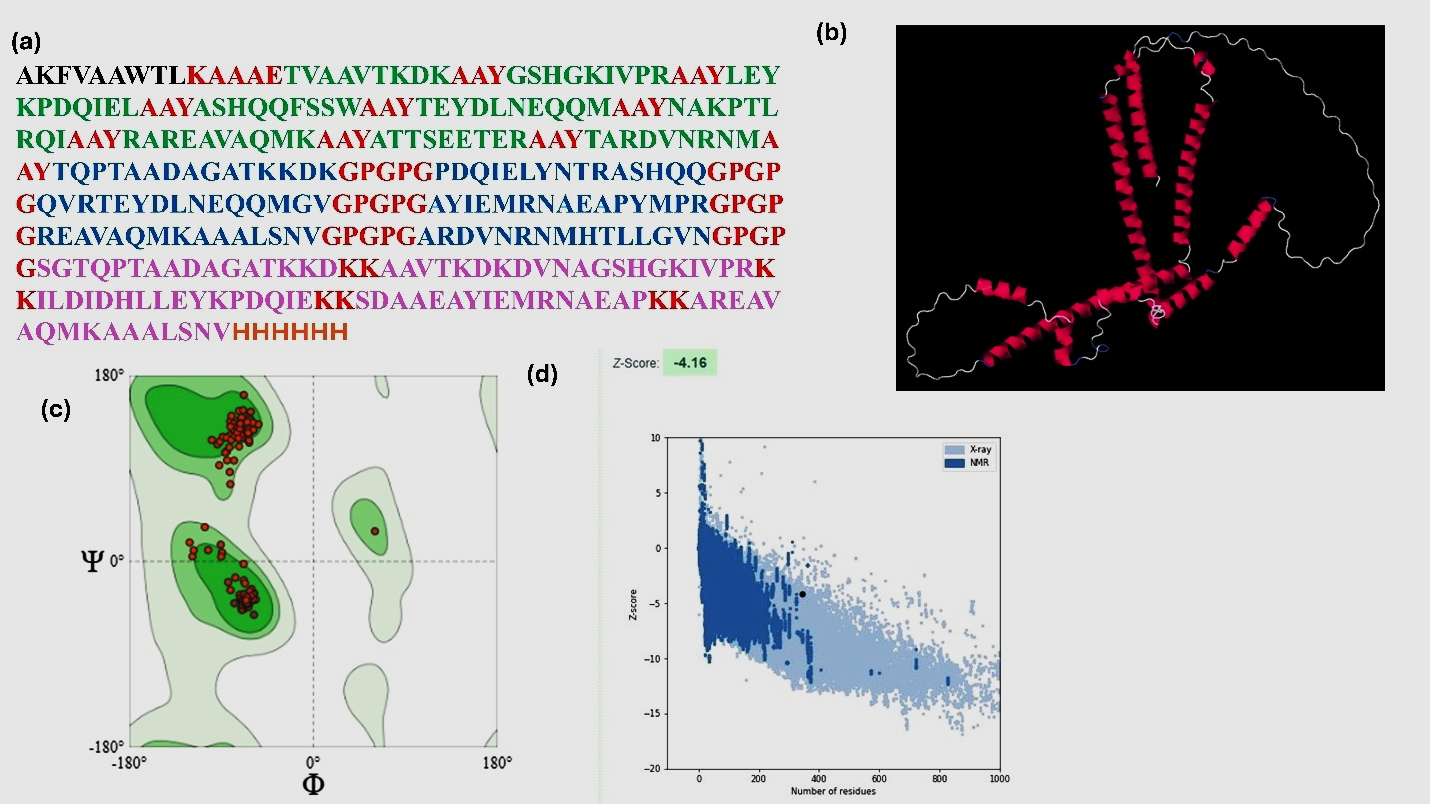
Illustration of the designed vaccine construct targeting the ZYMV coat protein. The engineered vaccine sequence was organized to enhance the immunogenicity and structural stability. It began with the PADRE adjuvant (depicted in black) at the N-terminal, linked via a five-residue EAAAK linker (shown in red) to ensure structural separation and functional independence of the domains. The construct included CTL epitopes (green), HTL epitopes (blue), and B-cell epitopes (purple), each connected by red-colored EAAAK linkers to maintain flexibility and spacing (a). The 3D cartoon model (b) visually demonstrates the predicted tertiary structure of the vaccine, while the Ramachandran plot (c) provides a stereochemical assessment via analyzing the backbone dihedral angles, verifying the model’s conformational reliability. Finally, the Z-score analysis (d) evaluated the overall model quality and thermodynamic stability, supporting its potential for downstream experimental validation and vaccine development.
References
- Abdel Razek, F.S.A., Mahdy, A., El-Masry, S.S., Ibrahim, S., Farg, S.E. and Sadik, A., 2025. Nucleotide sequence and bioinformatics analysis of the complete genome of an Egyptian isolate of zucchini yellow mosaic virus. Novel Res. Microbiol. J., 9(2): 92-115. https://doi.org/10.17582/journal.NRMJ/2025/9.2.92.115[Full text][CrossRef]
- Abramson, J., Adler, J., Dunger, J., Evans, R., Green, T., Pritzel, A., Ronneberger, O., Willmore, L., Ballard, A.J., Bambrick, J., Bodenstein, S.W., Evans, D.A., Hung, C.C., O’Neill, M., Reiman, D.,Tunyasuvunakool, K., Wu, Z., Žemgulytė, A., Arvaniti, E., Beattie, C., Bertolli, O., Bridgland, A., Cherepanov, A., Congreve, M. and Jumper, J.M., 2024. Accurate structure prediction of biomolecular interactions with AlphaFold 3. Nature, 630(8016): 493-500. https://doi.org/10.1038/s41586-024-07487-w[CrossRef]
- Ahsan, M., Ashfaq, M., Amer, M.A., Shakeel, M.T., Mehmood, M.A., Umar, M. and Al-Saleh, M.A., 2023. Zucchini yellow mosaic virus (ZYMV) as a serious biotic stress to cucurbits: Prevalence, diversity, and its implications for crop sustainability. Plants, 12(19): 3503. https://doi.org/10.3390/plants12193503[CrossRef]
- Alexander, J., del Guercio, M.F., Frame, B., Maewal, A., Sette, A., Nahm, M.H. and Newman, M.J., 2004. Development of experimental carbohydrate-conjugate vaccines composed of Streptococcus pneumoniae capsular polysaccharides and the universal helper T-lymphocyte epitope (PADRE®). Vaccine, 22(19): 2362-2367. https://doi.org/10.1016/j.vaccine.2003.11.061[CrossRef]
- Bai, Y., Zhou, M., Wang, N., Yang, Y. and Wang, D., 2024. Designing a candidate multi-epitope vaccine against transmissible gastroenteritis virus based on immunoinformatic and molecular dynamics. Int. J. Mol. Sci., 25(16): 8828. https://doi.org/10.3390/ijms25168828[CrossRef]
- Benkert, P., Biasini, M. and Schwede, T., 2011. Toward the estimation of the absolute quality of individual protein structure models. Bioinformatics, 27(3): 343-350. https://doi.org/10.1093/bioinformatics/btq662[CrossRef]
- Bhattacharya, D., Nowotny, J., Cao, R. and Cheng, J., 2016. 3Drefine: An interactive web server for efficient protein structure refinement. Nucl. Acids Res., 44(W1): W406-W409. https://doi.org/10.1093/nar/gkw336[CrossRef]
- Bibiano, L.B., Carvalho, C.P., Giória, R., Rezende, J.A. and Camargo, L.E., 2025. Multicomponent Resistance Responses of Melon to Zucchini Yellow Mosaic Virus. Phytopathology, 115(2): 162-171. https://doi.org/10.1094/PHYTO-05-24-0166-R[CrossRef]
- Bukhari, S.N.H., Jain, A., Haq, E., Mehbodniya, A. and Webber, J., 2022. Machine learning techniques for the prediction of B-cell and T-cell epitopes as potential vaccine targets with a specific focus on SARS-CoV-2 pathogen: A review. Pathogens, 11(2): 146. https://doi.org/10.3390/pathogens11020146[CrossRef]
- Chen, H., Zhang, X., Zhang, S., Duan, X., Xiang, T., Zhou, X., Zhang, W., Zhang, X., Feng, Q., Kang, Y. and Li, J., 2021. T cell epitope screening of Epstein-Barr virus fusion protein gB. J. Virol., 95(10): 10-1128. https://doi.org/10.1128/JVI.00081-21[CrossRef]
- Chen, V.B., Arendall, W.B., Headd, J. J., Keedy, D.A., Immormino, R.M., Kapral, G.J. and Richardson, D.C. 2010. MolProbity: All-atom structure validation for macromolecular crystallography. Biol. Crystallogr., 66(1): 12-21. https://doi.org/10.1107/S0907444909042073[CrossRef]
- Chinnadurai, C., 2024. Cucurbitaceous vegetables-I. In Viral Diseases of Field and Horticultural Crops (pp. 411-417). Academic Press. https://doi.org/10.1016/B978-0-323-90899-3.00030-6[CrossRef]
- Colovos, C. and Yeates, T.O., 1993. Verification of protein structures: patterns of nonbonded atomic interactions. Protein Sci., 2(9): 1511-1519. https://doi.org/10.1002/pro.5560020916[CrossRef]
- De Vincenzo, R., Conte, C., Ricci, C., Scambia, G. and Capelli, G., 2014. Long-term efficacy and safety of human papillomavirus vaccination. Int. J. Women’s Health, 6: 999–1010. https://doi.org/10.2147/IJWH.S50365[CrossRef]
- Di Carli, M., Villani, M.E., Bianco, L., Lombardi, R., Perrotta, G., Benvenuto, E. and Donini, M., 2010. Proteomic analysis of the plant− virus interaction in cucumber mosaic virus (CMV) resistant transgenic tomato. J. Proteome Res., 9(11): 5684-5697. https://doi.org/10.1021/pr100487x[CrossRef]
- Di Carli, M., Benvenuto, E. and Donini, M., 2012. Recent insights into plant–virus interactions through proteomic analysis. J. Proteome Res., 11(10): 4765-4780. https://doi.org/10.1021/pr300494e[CrossRef]
- Di Pasquale, A., Bonanni, P., Garçon, N., Stanberry, L.R., El-Hodhod, M. and Da Silva, F.T., 2016. Vaccine safety evaluation: Practical aspects in assessing benefits and risks. Vaccine, 34(52): 6672-6680. https://doi.org/10.1016/j.vaccine.2016.10.039[CrossRef]
- Dimitrov, I., Bangov, I., Flower, D.R. and Doytchinova, I., 2014. AllerTOP v. 2-a server for in silico prediction of allergens. J. Mol. Model., 20: 1-6. https://doi.org/10.1007/s00894-014-2278-5[CrossRef]
- Doytchinova, I.A. and Flower, D.R., 2007. VaxiJen: A server for prediction of protective antigens, tumour antigens and subunit vaccines. BMC Bioinf., 8: 1-7. https://doi.org/10.1186/1471-2105-8-4[CrossRef]
- Duan, N., Gao, Z., Hu, B., Ge, D., Li, W., Ye, T., Geng, X. and Li, X., 2020. Computational insights into the binding pattern of mitochondrial calcium uniporter inhibitor through homology modeling, molecular dynamics simulation, binding free energy prediction and density functional theory calculation. J. Biomol. Struct. Dyn., 38(17): 5095-5107. https://doi.org/10.1080/07391102.2019.1695674[CrossRef]
- Elrashedy, A., Nayel, M., Salama, A., Salama, M.M. and Hasan, M.E., 2024. Bioinformatics approach for structure modeling, vaccine design and molecular docking of Brucella candidate proteins BvrR, OMP25 and OMP31. Sci. Rep., 14(1): 11951. https://doi.org/10.1038/s41598-024-61991-7[CrossRef]
- Eramian, D., Shen, M.Y., Devos, D., Melo, F., Sali, A. and Marti‐Renom, M.A. 2006. A composite score for predicting errors in protein structure models. Protein Sci., 15(7): 1653-1666. https://doi.org/10.1110/ps.062095806[CrossRef]
- Evans, R., O’Neill, M., Pritzel, A., Antropova, N., Senior, A., Green, T., Žídek, A., Bates, U., Blackwell, S., Yim, J., Ronneberger, O., Bodenstein, S., Zielinski, M., Bridgland, A., Potapenko, A., Cowie, A., Tunyasuvunakool, K., Jain, R., Clancy, E., Kohli, P., Jumper, J. and Hassabis, D., 2021. Protein complex prediction with AlphaFold-Multimer. biorxiv, 2021-10. https://doi.org/10.1101/2021.10.04.463034[CrossRef]
- Farag, S.E.E., Ibrahim, S., Abdel-Gaffar, M.H. and Sadik, A., 2025. Global genetic diversity of ZYMV coat protein isolates in cucurbits: comparative sequence analysis and phylogenetic insights for diagnostic applications. Novel Res. Microbiol. J., 9(3): 178-197. https://doi.org/10.17582/journal.NRMJ/2025/9.3.178.197[Full text][CrossRef]
- Feig, M. and Mirjalili, V., 2016. Protein structure refinement via molecular-dynamics simulations: What works and what does not? Proteins, 84: 282-292. https://doi.org/10.1002/prot.24871[CrossRef]
- Feng, X., Xu, W., Li, Z., Song, W., Ding, J. and Chen, X., 2019. Immunomodulatory nanosystems. Adv. Sci., 6(17): 1900101. https://doi.org/10.1002/advs.201900101[CrossRef]
- Freyer, F., Roberts, J.A., Ritter, P. and Breakspear, M., 2012. A canonical model of multistability and scale-invariance in biological systems. pp. e1002634. https://doi.org/10.1371/journal.pcbi.1002634[CrossRef]
- Gal‐On, A.M.I.T., 2007. Zucchini yellow mosaic virus: Insect transmission and pathogenicity the tails of two proteins. Mol. Plant Pathol., 8(2): 139-150. https://doi.org/10.1111/j.1364-3703.2007.00381.x[CrossRef]
- Gasteiger, E., Hoogland, C., Gattiker, A., Duvaud, S.E., Wilkins, M.R., Appel, R.D. and Bairoch, A., 2005. Protein identification and analysis tools on the ExPASy server. Proteomics Protocols Handbook, pp. 571-607. https://doi.org/10.1385/1-59259-890-0:571[CrossRef]
- Graham, B.S., Gilman, M.S. and McLellan, J.S., 2019. Structure-based vaccine antigen design. Ann. Rev. Med., 70(1): 91-104. https://doi.org/10.1146/annurev-med-121217-094234[CrossRef]
- Güller, A. and Usta, M., 2019. Occurrence and characterization of coat protein gene of Zucchini yellow mosaic potyvirus (ZYMV) isolate infecting pumpkin (Cucurbita pepo L.) in Bingol Province (Turkey). Türk Tarım ve Doğa Bilimleri Dergisi, 6(4): 798-807. https://doi.org/10.30910/turkjans.633604[CrossRef]
- Gupta, S., Kapoor, P., Chaudhary, K., Gautam, A., Kumar, R. and Raghava, G.P., 2013. In silico approach for predicting toxicity of peptides and proteins. PLoS One, 8(9): e73957. https://doi.org/10.1371/journal.pone.0073957[CrossRef]
- Heo, L., Park, H. and Seok, C., 2013. GalaxyRefine: Protein structure refinement driven by side-chain repacking. Nucl. Acids Res., 41(W1): W384-W388. https://doi.org/10.1093/nar/gkt458[CrossRef]
- Hoof, I., Peters, B., Sidney, J., Pedersen, L.E., Sette, A., Lund, O., Buus, S. and Nielsen, M., 2009. NetMHCpan, a method for MHC class I binding prediction beyond humans. Immunogenetics, 61: 1-13. https://doi.org/10.1007/s00251-008-0341-z[CrossRef]
- Hooft, E.E., Schouten, H. and Detrick, R.S., 1996. Constraining crustal emplacement processes from the variation in seismic layer 2A thickness at the East Pacific Rise. Earth Planet. Sci. Lett., 142(3-4): 289-309. https://doi.org/10.1016/0012-821X(96)00101-X[CrossRef]
- Hua, Z. and Hou, B., 2020. The role of B cell antigen presentation in the initiation of CD4+ T cell response. Immunol. Rev., 296(1): 24-35. https://doi.org/10.1111/imr.12859[CrossRef]
- Jaenicke, R., 2007. Protein stability and protein folding. In: Ciba foundation symposium 161‐protein conformation: Protein conformation: Ciba foundation symposium 161 (pp. 206-221). Chichester, UK: John Wiley and Sons, Ltd. https://doi.org/10.1002/9780470514146.ch13[CrossRef]
- Jespersen, M.C., Peters, B., Nielsen, M. and Marcatili, P., 2017. BepiPred-2.0: Improving sequence-based B-cell epitope prediction using conformational epitopes. Nucl. Acids Res., 45(W1): W24-W29. https://doi.org/10.1093/nar/gkx346[CrossRef]
- Kelley, L.A., Mezulis, S., Yates, C.M., Wass, M.N. and Sternberg, M.J., 2015. The Phyre2 web portal for protein modeling, prediction and analysis. Nat. Protoc., 10(6): 845-858. https://doi.org/10.1038/nprot.2015.053[CrossRef]
- Kim, D.E., Chivian, D. and Baker, D., 2004. Protein structure prediction and analysis using the Robetta server. Nucl. Acids Res., 32(2): W526-W531. https://doi.org/10.1093/nar/gkh468[CrossRef]
- Kimman, T.G., Vandebriel, R.J. and Hoebee, B., 2007. Genetic variation in the response to vaccination. Publ. Health Genom., 10(4): 201-217. https://doi.org/10.1159/000106559[CrossRef]
- Kleywegt, G.J. and Jones, T.A., 1996. Efficient rebuilding of protein structures. Biol. Crystallogr., 52(4): 829-832. https://doi.org/10.1107/S0907444996001783[CrossRef]
- Ko, J., Park, H., Heo, L. and Seok, C., 2012. GalaxyWEB server for protein structure prediction and refinement. Nucl. Acids Res., 40(W1): W294-W297. https://doi.org/10.1093/nar/gks493[CrossRef]
- Kundu, S., Chakraborty, D., Kundu, A. and Pal, A., 2013. Proteomics approach combined with biochemical attributes to elucidate compatible and incompatible plant-virus interactions between Vigna mungo and Mungbean Yellow Mosaic India Virus. Proteome Sci., 11: 1-14. https://doi.org/10.1186/1477-5956-11-15[CrossRef]
- Kyte, J. and Doolittle, R.F., 1982. A simple method for displaying the hydropathic character of a protein. J. Mol. Biol., 157(1): 105-132. https://doi.org/10.1016/0022-2836(82)90515-0[CrossRef]
- Laskowski, R.A., MacArthur, M.W., Moss, D.S. and Thornton, J.M., 1993. PROCHECK: A program to check the stereochemical quality of protein structures. Appl. Crystallogr., 26(2): 283-291. https://doi.org/10.1107/S0021889892009944[CrossRef]
- Lee, L.Y.Y., Izzard, L. and Hurt, A.C., 2018. A review of DNA vaccines against influenza. Front. Immunol., 9: 1568. https://doi.org/10.3389/fimmu.2018.01568[CrossRef]
- Liu, B., Bai, M., Zheng, F., Yan, M., Huang, E., Wen, J., Li, Y. and Wang, J., 2025. The identification of dual T-cell and B-cell epitopes within viral proteins utilizing a comprehensive peptide array approach. Vaccines, 13(3): 239. https://doi.org/10.3390/vaccines13030239[CrossRef]
- Liu, H.L., Liu, Y.W., Shen, T.L., Hsu, C.H. and Chang, Y.C., 2016. Characterization and application of a common epitope recognized by a broad-spectrum C4 monoclonal antibody against capsid proteins of plant potyviruses. Appl. Microbiol. Biotechnol., 100(4): 1853-1869. https://doi.org/10.1007/s00253-015-7116-x[CrossRef]
- Lum, K.K. and Cristea, I.M., 2016. Proteomic approaches to uncovering virus–host protein interactions during the progression of viral infection. Exp. Rev. Proteom., 13(3): 325-340. https://doi.org/10.1586/14789450.2016.1147353[CrossRef]
- Lüthy, R., Bowie, J.U. and Eisenberg, D., 1992. Assessment of protein models with three-dimensional profiles. Nature, 356(6364): 83-85. https://doi.org/10.1038/356083a0[CrossRef]
- Mortazavi, B., Molaei, A. and Fard, N.A., 2024. Multi-epitope vaccines, from design to expression; an in silico approach. Hum. Immunol., pp. 110804. https://doi.org/10.1016/j.humimm.2024.110804[CrossRef]
- Moult, J., Fidelis, K., Kryshtafovych, A., Schwede, T. and Tramontano, A., 2014. Critical assessment of methods of protein structure prediction (CASP) round x. Proteins Struct. Funct. Bioinf., 82: 1-6. https://doi.org/10.1002/prot.24452[CrossRef]
- Naveed, M., Tehreem, S., Arshad, S., Bukhari, S.A., Shabbir, M.A., Essa, R. and Khan, I., 2021. Design of a novel multiple epitope-based vaccine: An immunoinformatics approach to combat SARS-CoV-2 strains. J. Infect. Publ. Health, 14(7): 938-946. https://doi.org/10.1016/j.jiph.2021.04.010[CrossRef]
- Negahdaripour, M., Nezafat, N., Eslami, M., Ghoshoon, M.B., Shoolian, E., Najafipour, S., Morowvat, M.H., Dehshahri, A., Erfani, N. and Ghasemi, Y., 2018. Structural vaccinology considerations for in silico designing of a multi-epitope vaccine. Infect. Genet. Evol., 58: 96-109. https://doi.org/10.1016/j.meegid.2017.12.008[CrossRef]
- Parvizpour, S., Pourseif, M.M., Razmara, J., Rafi, M.A. and Omidi, Y., 2020. Epitope-based vaccine design: A comprehensive overview of bioinformatics approaches. Drug Discov. Today, 25(6): 1034-1042. https://doi.org/10.1016/j.drudis.2020.03.006[CrossRef]
- Pontius, J., Richelle, J. and Wodak, S.J., 1996. Deviations from standard atomic volumes as a quality measure for protein crystal structures. J. Mol. Biol., 264(1): 121-136. https://doi.org/10.1006/jmbi.1996.0628[CrossRef]
- Pramanik, S.K., Mahmud, S., Paul, G.K., Jabin, T., Naher, K., Uddin, M.S., Zaman, S. and Saleh, M.A., 2021. Fermentation optimization of cellulase production from sugarcane bagasse by Bacillus pseudomycoides and molecular modeling study of cellulase. Curr. Res. Microb. Sci., 2: 100013. https://doi.org/10.1016/j.crmicr.2020.100013[CrossRef]
- Rahman, N., Ali, F., Basharat, Z., Shehroz, M., Khan, M.K., Jeandet, P., Nepovimova, E., Kuca, K. and Khan, H., 2020. Vaccine design from the ensemble of surface glycoprotein epitopes of SARS-CoV-2: An immunoinformatics approach. Vaccines, 8(3): 423. https://doi.org/10.3390/vaccines8030423[CrossRef]
- Ras-Carmona, A., Pelaez-Prestel, H.F., Lafuente, E.M. and Reche, P.A., 2021. BCEPS: A web server to predict linear B cell epitopes with enhanced immunogenicity and cross-reactivity. Cells, 10(10): 2744. https://doi.org/10.3390/cells10102744[CrossRef]
- Reynisson, B., Alvarez, B., Paul, S., Peters, B. and Nielsen, M., 2020. NetMHCpan-4.1 and NetMHCIIpan-4.0: Improved predictions of MHC antigen presentation by concurrent motif deconvolution and integration of MS MHC eluted ligand data. Nucl. Acids Res., 48(W1): W449-W454. https://doi.org/10.1093/nar/gkaa379[CrossRef]
- Saha, S. and Raghava, G.P.S., 2006. Prediction of continuous B‐cell epitopes in an antigen using recurrent neural network. Proteins Struct. Funct. Bioinf., 65(1): 40-48. https://doi.org/10.1002/prot.21078[CrossRef]
- Seder, R., Darrah, P. and Roederer, M., 2008. T-cell quality in memory and protection: Implications for vaccine design. Nat. Rev. Immunol., 8: 247–258. https://doi.org/10.1038/nri2274[CrossRef]
- Sette, A. and Fikes, J., 2003. Epitope-based vaccines: An update on epitope identification, vaccine design and delivery. Curr. Opin. Immunol., 15(4): 461-470. https://doi.org/10.1016/S0952-7915(03)00083-9[CrossRef]
- Shi, D., Chen, Y., Chen, M., Zhou, T., Xu, F., Zhang, C. and Li, Z., 2023. Bioinformatics analysis of Omp19 and Omp25 proteins for designing multi-epitope vaccines against Brucella. Medicine, 102(11): e33182. https://doi.org/10.1097/MD.0000000000033182[CrossRef]
- Shuvo, M.H., Gulfam, M. and Bhattacharya, D., 2021. DeepRefiner: High-accuracy protein structure refinement by deep network calibration. Nucl. Acids Res., 49(W1): W147-W152. https://doi.org/10.1093/nar/gkab361[CrossRef]
- Simmons, H.E., Dunham, J.P., Zinn, K.E., Munkvold, G.P., Holmes, E.C. and Stephenson, A.G., 2013. Zucchini yellow mosaic virus (ZYMV, Potyvirus): Vertical transmission, seed infection and cryptic infections. Virus Res., 176(1-2): 259-264. https://doi.org/10.1016/j.virusres.2013.06.016[CrossRef]
- Smith, T.R., Patel, A., Ramos, S., Elwood, D., Zhu, X., Yan, J., Gary, E.N., Walker, S.N., Schultheis, K., Purwar, M. and Broderick, K.E., 2020. Immunogenicity of a DNA vaccine candidate for COVID-19. Nat. Commun., 11(1): 2601. https://doi.org/10.1038/s41467-020-16505-0[CrossRef]
- Studer, G., Rempfer, C., Waterhouse, A.M., Gumienny, R., Haas, J. and Schwede, T., 2020. QMEANDisCo-distance constraints applied on model quality estimation. Bioinformatics, 36(6): 1765-1771. https://doi.org/10.1093/bioinformatics/btz828[CrossRef]
- Takahashi, H., 2003. Antigen presentation in vaccine development. Compar. Immunol. Microbiol. Infect. Dis., 26(5-6): 309-328. https://doi.org/10.1016/S0147-9571(03)00017-1[CrossRef]
- Tan, C., Zhu, F., Pan, P., Wu, A. and Li, C., 2023. Development of multi-epitope vaccines against the monkeypox virus based on envelope proteins using immunoinformatics approaches. Front. Immunol., 14: 1112816. https://doi.org/10.3389/fimmu.2023.1112816[CrossRef]
- Tarrahimofrad, H., Zamani, J., Hamblin, M.R., Darvish, M. and Mirzaei, H., 2022. A designed peptide-based vaccine to combat Brucella melitensis, B. suis and B. abortus: Harnessing an epitope mapping and immunoinformatics approach. Biomed. Pharmacother., 155: 113557. https://doi.org/10.1016/j.biopha.2022.113557[CrossRef]
- Tian, Y.P., Hepojoki, J., Ranki, H., Lankinen, H. and Valkonen, J.P., 2014. Analysis of potato virus Y coat protein epitopes recognized by three commercial monoclonal antibodies. PLoS One, 9(12): e115766. https://doi.org/10.1371/journal.pone.0115766[CrossRef]
- Ullah, Z., Chai, B., Hammar, S., Raccah, B., Gal-On, A. and Grumet, R., 2003. Effect of substitution of the amino termini of coat proteins of distinct potyvirus species on viral infectivity and host specificity. Physiol. Mol. Plant Pathol., 63(3): 129-139. https://doi.org/10.1016/j.pmpp.2003.11.001[CrossRef]
- Viswanathan, K. and Früh, K., 2007. Viral proteomics: global evaluation of viruses and their interaction with the host. Expert. Rev. Proteom., 4(6): 815-829. https://doi.org/10.1586/14789450.4.6.815[CrossRef]
- Wang, L., Gao, J., Lan, X., Zhao, H., Shang, X., Tian, F., Wen, H., Ding, J., Luo, L. and Ma, X., 2019. Identification of combined T-cell and B-cell reactive Echinococcus granulosus 95 antigens for the potential development of a multi-epitope vaccine. Ann. Trans. Med., 7(22): 652. https://doi.org/10.21037/atm.2019.10.87[CrossRef]
- Waterhouse, A., Bertoni, M., Bienert, S., Studer, G., Tauriello, G., Gumienny, R., Heer, F., de Beer, T.A.P., Rempfer, C., Bordoli, L. Lepore, R. and Schwede, T., 2018. Swiss-Model: Homology modelling of protein structures and complexes. Nucl. Acids Res., 46(W1): W296-W303. https://doi.org/10.1093/nar/gky427[CrossRef]
- Wiederstein, M. and Sippl, M.J., 2007. ProSA-web: Interactive web service for the recognition of errors in three-dimensional structures of proteins. Nucl. Acids Res., 35(2): W407-W410. https://doi.org/10.1093/nar/gkm290[CrossRef]
- Xie, S., Xie, X., Zhao, X., Liu, F., Wang, Y., Ping, J. and Ji, Z., 2023. HNSPPI: A hybrid computational model combing network and sequence information for predicting protein–protein interaction. Brief. Bioinf., 24(5): bbad261. https://doi.org/10.1093/bib/bbad261[CrossRef]
- Xu, D. and Zhang, Y., 2011. Improving the physical realism and structural accuracy of protein models by a two-step atomic-level energy minimization. Biophys. J., 101(10): 2525-2534. https://doi.org/10.1016/j.bpj.2011.10.024[CrossRef]
- Yao, B., Zhang, L., Liang, S. and Zhang, C., 2012. SVMTriP: A method to predict antigenic epitopes using support vector machine to integrate tri-peptide similarity and propensity. PLoS One, 7: e45152. https://doi.org/10.1371/journal.pone.0045152[CrossRef]
- Yazdani, Z., Rafiei, A., Ghoreyshi, M. and Abediankenari, S., 2024. In silico analysis of a candidate multi-epitope peptide vaccine against human brucellosis. Mol. Biotechnol., 66(4): 769-783. https://doi.org/10.1007/s12033-023-00698-y[CrossRef]
- Zhang, Y. and Skolnick, J., 2004. Scoring function for automated assessment of protein structure template quality. Proteins Struct. Funct. Bioinf., 57(4): 702-710. https://doi.org/10.1002/prot.20264[CrossRef]
- Zhang, Y. and Skolnick, J., 2005. TM-align: A protein structure alignment algorithm based on the TM-score. Nucl. Acids Res., 33(7): 2302-2309. https://doi.org/10.1093/nar/gki524[CrossRef]
- Zhao, S., Luo, J., Guo, W., Li, L., Pu, S., Dong, L., Zhu, W. and Gao, R., 2025. The development of a novel broad-spectrum influenza polypeptide vaccine based on multi-epitope tandem sequences. Vaccines, 13(1): 81. https://doi.org/10.3390/vaccines13010081[CrossRef]
- Zhou, X., Zheng, W., Li, Y., Pearce, R., Zhang, C., Bell, E.W., Bell, E.W. and Zhang, Y., 2022. I-TASSER-MTD: A deep-learning-based platform for multi-domain protein structure and function prediction. Nat. Protoc., 17(10): 2326-2353. https://doi.org/10.1038/s41596-022-00728-0[CrossRef]
Services
Article usage statistics
Loading…